

Results are estimates for comparison, not financial advice. Your lender's or card issuer's own disclosure shows the exact cost.
Runs in your browser. Nothing you type is sent or saved.
A payday loan rollover calculator shows something the loan offer leaves out. On a $300 loan at $15 per $100, your fees pass what you borrowed at the sixth renewal, and you still owe the full $300. The calculator above applies your state’s fee cap and rollover limit. It returns the fee per loan, the APR, the total fees, the total to repay and how many weeks you stay in debt, as long as you have your state, the amount you need, the days until the loan is due and the number of renewals you expect.
Your money, in brief
- Paying only the fee to renew does not reduce your principal. You owe the same amount every cycle.
- At $15 per $100, a 14-day loan works out to a 391% APR, and your fees pass your principal at the sixth renewal.
- Ten states in this calculator that allow payday loans ban paid rollovers outright, and 14 states plus DC do not allow payday loans at all.
- A federal credit union Payday Alternative Loan is capped at 28% interest plus an application fee of up to $20.
- Not repaying a payday loan is not a crime. A lender can sue you, but it cannot have you jailed for the debt.
How to use it
- Pick your State. The calculator then loads that state’s fee rule and rollover limit from our state law guides.
- Enter Amount you need ($). This is the cash you will actually receive. In California, Kentucky and Tennessee the fee is set on the check, so the check you write is larger than this amount. Don’t type the check amount here.
- Set Loan term (days). Count the days from today to your next payday on your pay stub, or copy the due date from the loan offer or agreement.
- Enter Times you roll it over or renew. Look at your bank statement and count every fee-only payment the lender has already debited. Then add the renewals you expect to need.
- Compare the result with the Truth in Lending disclosure on your loan agreement. The finance charge and APR boxes should match the calculator, or come close.
On this page: what each field means · how the formula works · payday loan fees by state · when fees pass what you borrowed · paying down principal · how common rollovers are · rollover limits by state · federal rules in 2026 · cheaper options · car loan rollovers · FAQ
Fact-checked
We checked these key facts against the sources named, on November 27, 2026:
- The same formula gives about 261% at $10 per $100, 521% at $20, 652% at $25 and 782% at $30 (source: consumerfinance.gov)
- Its 2026 regulatory agenda, released July 6, 2026, plans a proposed rule to reconsider them (source: consumerfinancialserviceslawmonitor.com)
- For example, $18,000 owed − $15,000 trade-in = $3,000, and that $3,000 gets added to the new loan (source: consumerfinance.gov)
- At $15 per $100, renewing a $300 loan adds $45 every two weeks: $90 in total after one renewal and $315 after six (source: consumerfinance.gov)
- On a $300 loan at $15 per $100, your fees pass what you borrowed at the sixth renewal, and you still owe the full $300 (source: consumerfinance.gov)
What each field means, and the input mistakes that skew results
The calculator has four fields, and most wrong results come from two of them: the amount and the renewal count. Each field is explained below, followed by the errors that change the answer.
State
The State field defaults to California and has 51 choices. Your choice decides which of five rule types the calculator applies:
| Rule type | States | What the calculator does |
|---|---|---|
| Fee set by formula | Alabama, Alaska, Florida, Indiana, Kansas, Michigan, North Dakota, Oklahoma, South Carolina, Washington | Works out the fee from the statute |
| Fee set on the check | California, Kentucky, Mississippi, Tennessee | Converts the check-based cap into a fee on the cash you receive |
| No per-loan fee cap | Delaware, Idaho, Missouri, Nevada, Texas, Utah, Wisconsin | Asks for the lender’s fee per $100 from your loan offer |
| Annual rate cap | Colorado, Illinois, Minnesota, Montana, Nebraska, New Hampshire, Ohio, Oregon, South Dakota, Virginia | Shows the most a loan can cost over your term |
| Payday loans not legal | Arizona, Arkansas, Connecticut, Georgia, Hawaii, Maryland, Massachusetts, New Jersey, New Mexico, New York, North Carolina, Pennsylvania, Vermont, West Virginia, plus the District of Columbia | Shows no payday fee, because none can be lawfully charged |
If an online lender offers you a payday loan while you live in a state on the last row, treat that as a warning sign. Our Arkansas payday loan laws and Maryland payday loan laws guides explain what is legal there instead. Hawaii’s two-week deferred deposit product was replaced by small-dollar installment loans starting January 1, 2022.
Choose the state where you live and take out the loan. Don’t choose the state named on the lender’s website.
Amount you need ($)
The default is $255. That figure is deliberate. California caps the check at $300, and the fee can be up to 15% of the check, so the largest cash advance a $300 check can produce is $300 × 85% = $255.
The most common mistake is entering the check amount instead of the cash. In California, $300 is the check and $255 is the loan. If you type $300, the calculator treats $300 as the cash you receive, which overstates both the fee and the total.
Loan term (days)
The default is 14 days, the classic two-week payday cycle. Use the real number of days to your due date. The same $45 fee on $255 is a 460% APR over 14 days but about 215% over 30 days, because the fee is spread over more time. The cost in dollars doesn’t change. Only the yearly rate does.
Times you roll it over or renew
The default is 0. Enter the number of extra fee-bearing periods you expect to pay for. The calculator caps this at your state’s limit. California law allows no rollovers, so entering 3 still produces 0 counted renewals.
That cap doesn’t stop you paying more fees in real life. In many states that ban rollovers, a borrower can repay the loan and take out a new one soon after. The CFPB counts that pattern as one continuing loan sequence (see the data below). If that’s your situation, the renewal-by-renewal table further down shows what back-to-back loans cost.
Before you renew
Every renewal costs the full fee again, and none of it comes off what you borrowed. Check whether your state requires a no-fee extended payment plan, and ask the lender for one before the due date, ideally before you pay another fee.
How the payday loan rollover calculator works: the formula, step by step
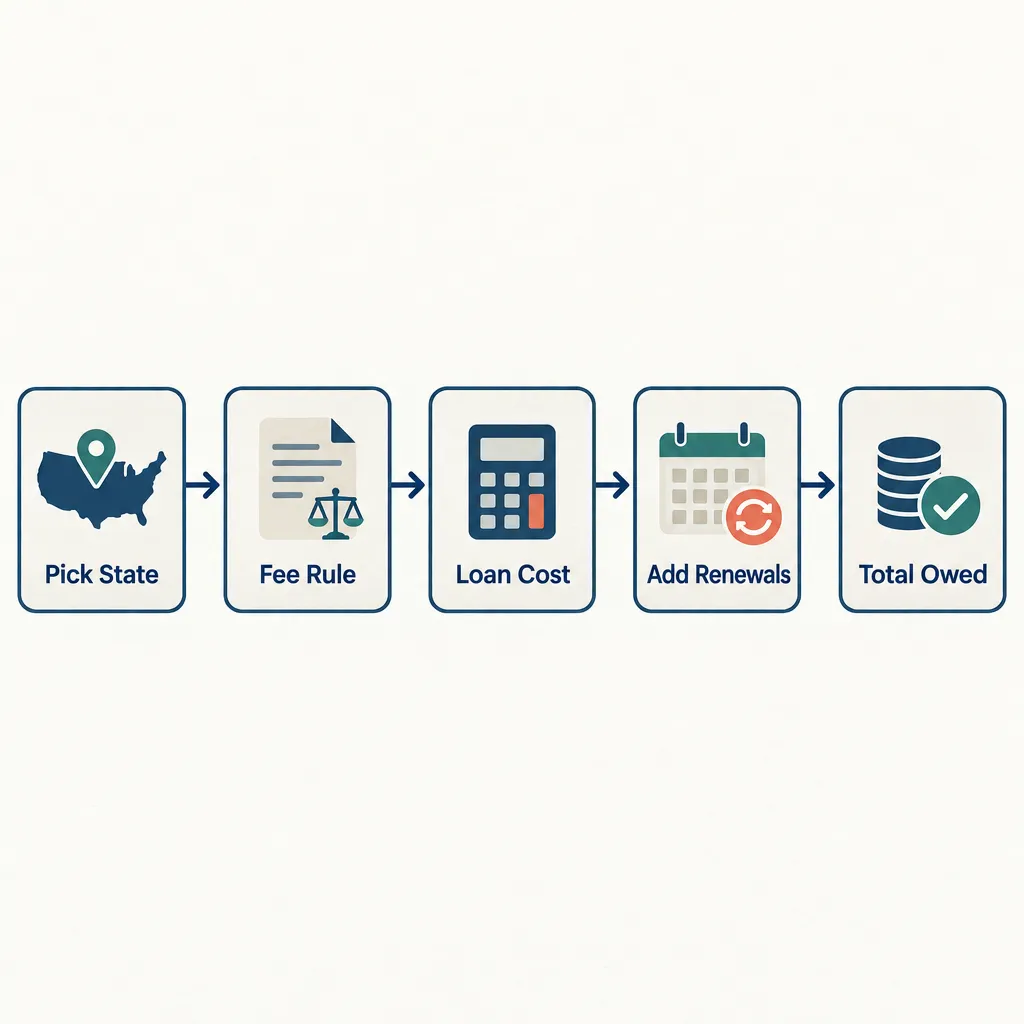
The calculator works out one fee from your state’s rule and multiplies it by the number of fee-bearing periods. It then turns the single-loan fee into an APR: fee ÷ amount × 365 ÷ days × 100. The rules and limits below are as of November 2026.
Fee for one loan, by state rule
| Rule type | States | How the fee is calculated |
|---|---|---|
| Percentage of the amount | Alabama 17.5%; Kansas 15%; South Carolina 15% | Amount × rate |
| Percentage of the amount plus a fee | Alaska: $15 per $100 plus a $5 origination fee; Florida: 10% plus a $5 verification fee | Amount × rate + fee |
| Percentage of the amount plus database fee | North Dakota: 20% | Amount × 20%, before the database fee |
| Percentage of the check | California, Kentucky, Tennessee (15% of the check; California checks $300 at most) | Amount × 15 ÷ 85 |
| Per $100 advanced, tiered by check size | Mississippi: $20 per $100 on checks up to $250; $21.95 per $100 on checks from $251 to $500 | Amount ÷ 100 × tier rate |
| Tiered | Oklahoma: $15 per $100 up to $300, $10 per $100 above, to $500 | Each slice × its rate |
| Tiered | Washington: 15% of the first $500, 10% above | Each slice × its rate |
| Tiered | Indiana: 15% up to $250, 13% to $400, 10% to $825 | Each slice × its rate |
| Tiered by $100 | Michigan: 15%, 14%, 13%, 12%, then 11% for the fifth and sixth $100 | Each $100 × its rate |
| Lender’s fee | Delaware, Idaho, Missouri, Nevada, Texas, Utah, Wisconsin | Amount ÷ 100 × fee you enter |
Mississippi’s caps come from its Check Cashers Act and the Department of Banking and Consumer Finance’s rules. The department’s consumer pamphlet also says a check can’t be written for more than $500 and that a lender can’t charge late or collection fees on a delayed deposit.
Total fees and the rollover cap
Total fees = fee for one loan × (1 + rollovers). The rollover count is capped at your state’s limit:
- No paid rollovers: California, Florida, Indiana, Kentucky, Michigan, Mississippi, Oklahoma, South Carolina, Tennessee, Washington
- One: Alabama, North Dakota, Wisconsin
- Three: Idaho
- Four: Delaware
- Six: Missouri. Each renewal must also pay down at least 5% of the original principal, and total interest and fees stop at 75% of the original loan.
- Utah: no interest after 10 weeks, so a 14-day loan can carry at most five fee periods
Total to repay = amount + total fees. Weeks in debt = days × (1 + rollovers) ÷ 7.
Turning a two-week fee into an APR
The APR answers one question: what would this fee be as a yearly rate? Divide the fee by the amount to get the cost per period. Multiply by 365 ÷ days to scale it to a year, then multiply by 100 to get a percentage.
At $15 per $100 over 14 days: 15 ÷ 100 = 0.15, then 0.15 × 365 ÷ 14 = 3.91, which is about 391%. The same formula gives about 261% at $10 per $100, 521% at $20, 652% at $25 and 782% at $30. The CFPB says payday fees range from $10 to $30 per $100 depending on state law, and $15 is common.
Worked example 1: the default inputs (California, $255, 14 days, 0 renewals)
These are the numbers the calculator shows when you first open the page.
- State rule: fee up to 15% of a check of $300 at most; no rollovers.
- Fee for one loan: $255 × 15 ÷ 85 = $45.00. As a check: $255 + $45 = $300, and 15% of $300 is $45.
- APR of one loan: $45 ÷ $255 = 0.1765. Then 0.1765 × 365 ÷ 14 = 4.60, so the APR is 460%.
- Rollovers the law allows: 0. Under California’s Deferred Deposit Transaction Law, the lender cannot renew the loan for a new fee.
- Total fees with 0 rollovers: $45.00 × (1 + 0) = $45.00.
- Total to repay: $255 + $45 = $300.00.
- Weeks in debt: 14 × 1 ÷ 7 = 2.0.
California’s 460% APR is higher than a $15-per-$100 state’s 391% because the 15% is charged on the check, not on the cash you get. In effect you pay $17.65 per $100 received. The California Department of Financial Protection and Innovation’s annual report on 2024 lending puts the average payday APR at 364% that year, below the maximum, because many loans run longer than 14 days.
Worked example 2: Alabama, $400, 14 days, you plan 2 renewals
- Fee for one loan: $400 × 17.5% = $70.00.
- APR: $70 ÷ $400 = 0.175. Then 0.175 × 365 ÷ 14 = 4.5625, so the APR is about 456%.
- Rollovers counted: you entered 2, but Alabama allows one, so the calculator uses 1.
- Total fees: $70 × (1 + 1) = $140.00.
- Total to repay: $400 + $140 = $540.00.
- Weeks in debt: 14 × 2 ÷ 7 = 4.0.
Worked example 3: Missouri, where the 75% ceiling kicks in
Say you enter Amount you need ($) 400, a lender fee of $15 per $100, 14 days and 6 renewals. Section 408.500 of the Missouri Revised Statutes allows up to six renewals. Each one must reduce the principal by at least 5% of the original loan, which is $20 here, and total interest and fees can’t pass 75% of the original amount.
| Period | Balance during period | Fee at $15 per $100 | Fees so far (capped) | Principal paid at renewal |
|---|---|---|---|---|
| 1 | $400 | $60.00 | $60.00 | $20 |
| 2 | $380 | $57.00 | $117.00 | $20 |
| 3 | $360 | $54.00 | $171.00 | $20 |
| 4 | $340 | $51.00 | $222.00 | $20 |
| 5 | $320 | $48.00 | $270.00 | $20 |
| 6 | $300 | $30.00 (capped from $45) | $300.00 | $20 |
| 7 | $280 | $0.00 (ceiling reached) | $300.00 | $280 to close |
- Fee for the first loan: $400 ÷ 100 × $15 = $60.00. The APR is 391%.
- Uncapped total, if the fee stayed at $60: $60 × 7 = $420.
- Missouri ceiling: 75% × $400 = $300. Total fees stop at $300.00, even when each fee is charged on the shrinking balance.
- Total to repay: $400 principal + $300 fees = $700.00 over 98 days, or 14.0 weeks. Of the principal, $120 goes out in $20 renewal payments and $280 at the end.
The calculator’s simpler formula (fee × periods, capped at 75%) lands on the same $300 here. Even with the ceiling, you pay $300 for the use of $400 for about three months.
Payday loan fees by state: quick-reference table
This table applies each state’s rule to a $300 loan over 14 days. California uses $255, the largest advance a $300 check allows. For states where you enter the lender’s fee, the table assumes $15 per $100. Figures are as of November 2026 and leave out late, NSF, bank and state database fees.
| State | Fee for one loan | APR (14 days) | Rollovers allowed | Total fees at the rollover limit |
|---|---|---|---|---|
| Alabama | $52.50 | 456% | 1 | $105.00 |
| Alaska | $50.00 | 435% | See below | $50.00 for one loan |
| California ($255) | $45.00 | 460% | 0 | $45.00 |
| Florida | $35.00 | 304% | 0 | $35.00 |
| Indiana | $44.00 | 382% | 0 | $44.00 |
| Kansas | $45.00 | 391% | See below | $45.00 for one loan |
| Kentucky | $52.94 | 460% | 0 | $52.94 |
| Michigan | $42.00 | 365% | 0 | $42.00 |
| Mississippi | $65.85 | 572% | 0 | $65.85 |
| North Dakota | $60.00 | 521% | 1 | $120.00 |
| Oklahoma | $45.00 | 391% | 0 | $45.00 |
| South Carolina | $45.00 | 391% | 0 | $45.00 |
| Tennessee | $52.94 | 460% | 0 | $52.94 |
| Washington | $45.00 | 391% | 0 | $45.00 |
| Delaware ($15 entered) | $45.00 | 391% | 4 | $225.00 |
| Idaho ($15 entered) | $45.00 | 391% | 3 | $180.00 |
| Missouri ($15 entered) | $45.00 | 391% | 6, with 5% paydowns | $225.00 (75% ceiling) |
| Nevada ($15 entered) | $45.00 | 391% | Set by the loan terms | $45.00 per period |
| Texas ($15 entered) | $45.00 | 391% | Set by city rules and CAB contract | $45.00 per period |
| Utah ($15 entered) | $45.00 | 391% | Fees stop at 10 weeks | $225.00 (5 periods) |
| Wisconsin ($15 entered) | $45.00 | 391% | 1 | $90.00 |
Here is how the less obvious rows were worked out:
- Alaska: $300 ÷ 100 × $15 = $45, plus the $5 origination fee, for $50.00.
- Indiana: 15% of $250 = $37.50, plus 13% of the next $50 = $6.50, for $44.00 in total.
- Kentucky and Tennessee: $300 × 15 ÷ 85 = $52.94, because the 15% is taken on the check.
- Michigan: $15 + $14 + $13 = $42.00.
- Mississippi: a $300 advance needs a check of more than $251, so the $21.95 tier applies: $300 ÷ 100 × $21.95 = $65.85.
- Missouri: with the 5% paydown, the fees run $45.00, $42.75, $40.50, $38.25 and $36.00, which is $202.50 after five periods. The sixth period hits the $225 ceiling.
Three more payday states use rules the $300 table can’t capture well. Louisiana caps the fee at 16.75% of the check’s face amount plus a $10 documentation fee, on checks of $350 at most. Wyoming allows the greater of $30 or 20% a month of the principal. Iowa sets a tiered fee on the check’s face amount ($15 for the first $100, $10 for each further $100), with a $500 check limit. Our Idaho payday loan laws, Indiana payday loan laws and Michigan payday loan laws guides cover each statute in detail.
Nevada in one line
Nevada’s payday law (NRS chapter 604A) sets no fee cap and limits a loan to 25% of your expected gross monthly income. Enter the lender’s quoted fee, and read the Nevada guide before you rely on any renewal count there.
Texas: why you enter a CAB fee
Most Texas payday loans are arranged by a credit access business (CAB) under chapter 393 of the Texas Finance Code. A third-party lender makes the loan at a low interest rate, and the CAB charges a separate fee for arranging and guaranteeing it. State law doesn’t cap that CAB fee, which is why the calculator asks for the fee per $100 from your contract. The Texas Office of Consumer Credit Commissioner (OCCC) collects quarterly CAB reports that track fees per $100 for single-payment loans.
Here’s an example with an illustrative CAB fee of $25 per $100 on a $300, 14-day loan:
| Step | Math | Result |
|---|---|---|
| Fee for one loan | $300 ÷ 100 × $25 | $75.00 |
| APR | 0.25 × 365 ÷ 14 × 100 | About 652% |
| One refinance at the same fee | $75 × 2 | $150.00 |
| Total to repay after one refinance | $300 + $150 | $450.00 |
Many Texas cities, including Dallas, Houston, Austin and San Antonio, have adopted local payday ordinances. These generally limit single-payment loans to three refinances and require each refinance to pay down part of the principal. Check whether your city has one before you count renewals.
Rate-cap states: the most a loan can cost
Ten states cap the annual rate instead of setting a fee per $100, and that keeps a two-week loan’s cost in single digits. For these states the calculator shows the most a loan can cost over your term:
- Colorado, Illinois, Montana, Nebraska, New Hampshire or South Dakota (36%): $300 × 36% × 14 ÷ 365 = $4.14 for 14 days.
- Minnesota (50%): $300 × 50% × 14 ÷ 365 = $5.75.
- Oregon (36% plus $10 per $100, up to $30): on a 31-day term, interest is $300 × 36% × 31 ÷ 365 = $9.17. Add the $30 fee and the most it can cost is $39.17.
- Ohio and Virginia: the 28% and 36% rates come with capped monthly fees, so the total depends on how many months the loan runs.
When do payday rollover fees exceed what you borrowed?
At $15 per $100, your fees pass your principal at the sixth renewal. That’s the seventh period you pay a fee for, about 14 weeks in. The break-even point depends only on the fee level, not on the loan size, so it’s the same for $200 as for $500.
| Fee per $100 | APR on a 14-day loan | Renewal at which fees exceed principal | Days in debt by then |
|---|---|---|---|
| $10 | 261% | 10th | 154 |
| $15 | 391% | 6th | 98 |
| $20 | 521% | 5th | 84 |
| $25 | 652% | 4th | 70 |
| $30 | 782% | 3rd | 56 |
At $20 and $25, the renewal before the one shown leaves fees exactly equal to the principal ($300 on $300). The next one pushes them over.
Cost of a $300 loan at $15 per $100, renewal by renewal
| Renewals | Days in debt | Fee-bearing periods | Total fees | Principal still owed | Total paid to close | Fees as % of principal |
|---|---|---|---|---|---|---|
| 0 | 14 | 1 | $45 | $300 | $345 | 15% |
| 1 | 28 | 2 | $90 | $300 | $390 | 30% |
| 2 | 42 | 3 | $135 | $300 | $435 | 45% |
| 3 | 56 | 4 | $180 | $300 | $480 | 60% |
| 4 | 70 | 5 | $225 | $300 | $525 | 75% |
| 5 | 84 | 6 | $270 | $300 | $570 | 90% |
| 6 | 98 | 7 | $315 | $300 | $615 | 105% |
| 7 | 112 | 8 | $360 | $300 | $660 | 120% |
| 8 | 126 | 9 | $405 | $300 | $705 | 135% |
The CFPB uses the first two rows as its own example: renewing a $300 loan once raises the cost from $45 to $90, and paying only fees leaves the principal untouched.
The same numbers as a bar chart
Each block below stands for one $45 fee. The $300 principal is about 6.7 blocks, so the bar passes it at the seventh block (the sixth renewal).
| Renewals | Fees paid so far | Fees vs. the $300 principal |
|---|---|---|
| 0 | $45 | █ |
| 1 | $90 | ██ |
| 2 | $135 | ███ |
| 3 | $180 | ████ |
| 4 | $225 | █████ |
| 5 | $270 | ██████ (just under $300) |
| 6 | $315 | ███████ (fees now exceed principal) |
| 7 | $360 | ████████ |
| 8 | $405 | █████████ |
Total cost vs. what you still owe today
Total to repay counts every fee from the first day, including fees you’ve already paid. What you owe today is smaller: the principal plus the fee for the current period.
Take someone at renewal four on the $300 loan. They’ve already paid $180 in fees, and they owe $345 today. The $180 is gone whatever happens next. The decision in front of them is only about the $345 and any future fees.
Is paying down principal cheaper than fee-only renewals?
Yes. If your state allows renewals and you can’t pay in full, paying $50 of principal each period cuts total fees on a $300 loan from $270 to $157.50, because each later fee is charged on a smaller balance.
The calculator above models fee-only renewals. The table below shows the same $300 loan at $15 per $100 handled three ways.
| Strategy | Periods to pay off | Total fees | Total paid |
|---|---|---|---|
| Fee only for 5 renewals, then $300 in full | 6 | $270.00 | $570.00 |
| Fee plus $50 of principal each period | 6 | $157.50 | $457.50 |
| Fee plus $100 of principal each period | 3 | $90.00 | $390.00 |
Here is the $50 path step by step:
- Fee of $45 on $300, which leaves $250.
- Fee of $37.50, which leaves $200.
- Fee of $30, which leaves $150.
- Fee of $22.50, which leaves $100.
- Fee of $15, which leaves $50.
- Fee of $7.50, and the loan is paid off.
Over the same six periods, that path saves $112.50 compared with fee-only renewals. The table assumes the lender applies each payment to the current fee first and the rest to principal. Contracts differ on this, so ask the lender in writing whether a partial payment lowers the next fee before you rely on these figures. In Missouri, a principal paydown of at least 5% of the original loan is required on every renewal anyway.
How common rollovers are: the data
Rollovers are how payday loans are normally used. The largest national studies, by the CFPB in 2014 and the Pew Charitable Trusts in 2013 and 2016, found that most borrowing comes in repeat sequences. State regulators’ reports for 2023 and 2024 show the costs are still high.
| Study and year | Finding |
|---|---|
| CFPB Data Point, March 2014 | More than 80% of payday loans were rolled over or followed by another loan within 14 days, across about 12 million storefront loans over 12 months. |
| Pew survey, 2013 | The average borrower is in debt five months of the year and pays $520 in fees to repeatedly borrow $375. Only 14% of borrowers can afford an average payday loan out of their monthly budget. |
| Pew fact sheet, 2016 | 12 million Americans take out payday loans each year and spend $9 billion on loan fees. |
| California DFPI annual report, 2024 lending | The average payday APR was 364%, and 32% of customers had average annual incomes of $30,000 or less. |
| Washington DFI payday report, 2023 lending | 18,245 small loans, or 6.1%, were converted to an installment plan. |
| Washington DFI payday report, 2024 lending | The average payday loan was $471. |
The CFPB’s 2014 measure is still the most recent national figure for the 14-day renewal rate. The CFPB counts a new loan taken within 14 days of repaying the last one as part of the same “loan sequence”. For the borrower, a “rollover”, a “renewal” and a “repay and re-borrow” cost the same: another full fee with no progress on the principal.
Did you know?
According to the CFPB’s 2014 payday lending report, the share of loans renewed within 14 days was nearly the same in states with mandatory cooling-off periods as in states without them. The waiting periods mainly cut same-day renewals.
How many times can you roll over a payday loan in your state?
It depends on where you live: from zero in ten payday states to six in Missouri, and payday loans aren’t available at all in 14 states and DC. States limit rollovers in four main ways:
- Outright bans, as in California, Florida, Mississippi, Oklahoma and Washington.
- Renewal caps, from one in Alabama, North Dakota and Wisconsin to six in Missouri.
- Cooling-off periods. For example, under Florida Statutes §560.404 a lender cannot make a new loan to you within 24 hours after your last loan ends.
- Required extended payment plans, which let you repay in installments with no extra fee.
States that require a lender to offer a payment plan
The CFPB’s April 2022 market snapshot found that 16 states have laws addressing payday extended payment plans, and 13 of them say the lender “shall offer” one. The common terms are:
- the plan is disclosed when you sign the loan,
- you repay in several installments,
- there are no additional fees.
Washington’s payday rules in chapter 31.45 RCW are one example of a state that requires lenders to offer an installment plan.
Why so few borrowers use them
Even where the law requires a plan, few borrowers use one. The CFPB found usage ranged from under 1% in Florida to 13.4% in Washington. In Wisconsin, 16.4% of loans were rolled over while only 2% went into a payment plan. Lenders earn nothing on a no-fee plan, so many won’t bring it up. Ask before the due date. In some states, the plan has to be requested before the loan goes into default.
Ask in these words
Call or write to the lender before your due date and ask: “Is an extended payment plan available on my loan, what does it cost, and how do I request it?” Write down the date, the time and the name of the person you spoke to.
How to check your state’s current rule
- Open the US Financer guide for your state. Each one cites the statute.
- Search your state financial regulator’s license lookup or the NMLS Consumer Access database. This confirms the lender is licensed where you live.
- If the lender’s terms don’t match the statute, contact your state regulator or attorney general.
Federal rules in 2026
There is no federal cap on payday fees. The federal rules that apply cover disclosures, bank withdrawals and loans to military families.
The two-failed-withdrawals limit
The CFPB’s Payday, Vehicle Title, and Certain High-Cost Installment Loans Rule (12 CFR part 1041) lost its ability-to-pay underwriting provisions in 2020. What remains are the payment provisions, with a compliance date of March 30, 2025. After two withdrawal attempts in a row fail for insufficient funds, the lender can’t try a third time unless you give new authorization. The lender must also send notices before withdrawals.
On March 28, 2025, the CFPB said it would not prioritize enforcement or supervision of these provisions. That isn’t a repeal. Its 2026 regulatory agenda, released July 6, 2026, plans a proposed rule to reconsider them. As of the latest public reporting in October 2026, no proposal had been published and the regulation text was unchanged.
Military Lending Act
The Military Lending Act caps the Military Annual Percentage Rate on covered credit at 36%. This covers active-duty servicemembers and their dependents. The MAPR includes fees that the regular APR leaves out. The rule at 32 CFR 232.8 also generally stops a lender from rolling over or refinancing your loan with new credit from the same lender, unless the new terms are better for you. Covered borrowers can get free help from the Office of Financial Readiness (FINRED) and their installation legal assistance office.
Reading your result, and the cheaper options to look at first
Read the result as the price of a short delay. If Total fees is close to the amount you borrowed, renewing is the most expensive way to buy time.
Compare three numbers:
- the Fee for one loan, against the cost of the alternatives below,
- the APR, against the 28% PAL cap and the 36% Military Lending Act limit,
- the Weeks in debt, against when your budget can realistically cover the full balance.
For any loan with a fixed payment schedule, a general loan calculator, personal loan calculator or APR calculator gives a fairer comparison than the payday tool. Our state law guides and a PAL-versus-payday comparison help you check the other side of the decision.
Cheaper options first
Ask the payday lender for a no-fee extended payment plan if your state requires one. Ask a credit union whether it offers a Payday Alternative Loan. Ask the bill you are short on for a hardship plan, or ask your employer for a no-fee pay advance.
Ways out compared for a $300 shortfall
| Option | Cost rules | Term | Who offers it | Source |
|---|---|---|---|---|
| Renew the payday loan once | About $45 more at $15 per $100; principal unchanged | 14 more days | Payday lenders, where the state allows renewals | CFPB |
| Extended payment plan | No additional fees in most states that require one | Several installments | Payday lenders in states with plan laws | CFPB 2022 snapshot |
| PAL I or PAL II | 28% maximum rate, application fee up to $20 | 1 to 6 months (PAL I); 1 to 12 months (PAL II) | Federal credit unions | NCUA rule, 12 CFR 701.21 |
| Hardship plan on the bill | Often no added interest; ask about fees | Set by the biller | Utilities, landlords, medical providers | Biller’s own terms |
| Nonprofit credit counseling | Ask what it costs before you start | Varies | Nonprofit counseling agencies | Agency’s disclosures |
| A second payday loan to repay the first | A second full fee, and two loans to repay | 14 days or so | Payday lenders | Avoid |
Here is how a PAL compares. Repay $300 over three months at 28%: the monthly rate is 28% ÷ 12 = 2.33%, which gives a payment of about $104.71. Total interest comes to about $14.13. Add the $20 maximum application fee and the total cost is about $34.13. That’s less than one more $45 renewal, and the loan is fully paid off at the end.
| PAL example | Amount | Rate and fee | Term | Total repaid |
|---|---|---|---|---|
| PAL at the maximums | $300 | 28% plus $20 application fee | 3 months | About $334.13 |
| Payday loan, renewed twice | $300 | $15 per $100 per period | 6 weeks | $435.00 |
PAL I loans run from $200 to $1,000 and usually require one month of credit union membership. PAL II loans can go up to $2,000 with no minimum, and there’s no membership waiting period.
Borrowing at a regular bank or credit union rate to pay off a payday loan usually costs less, as long as the new loan’s total cost is lower and its payments fit your budget.
Did you know?
Under the NCUA’s 2019 final rule, a federal credit union’s Payday Alternative Loan cannot carry an interest rate above 28%, and its application fee is capped at $20. Both PAL types must be repaid in full through installments.
“I keep paying the fee but the balance never goes down”
The balance stays the same because fee-only payments cover only the cost of the delay. To break the cycle, you have to change the payment itself. You can ask for an extended payment plan, pay down principal each period, or replace the loan with a lower-cost installment loan.
Paying on the same loan for months is exhausting. A nonprofit credit counselor can help you build a plan for your whole budget.
How to revoke ACH authorization
The Electronic Fund Transfer Act gives you the right to stop automatic debits, even ones you once authorized. The CFPB recommends these steps:
- Write to the lender and say you are revoking authorization for electronic withdrawals.
- Tell your bank or credit union that you have revoked authorization.
- To stop the next debit, give the bank a stop-payment order at least three business days before the debit is due. Banks often charge a fee for this.
- If your bank asks for written confirmation of a phone request, send it within 14 days.
Stopping the debit doesn’t cancel the loan. You still owe the balance, and a lender may charge whatever fees your contract and state law allow. Closing your bank account doesn’t erase the debt either. Revoking authorization does the narrower job of stopping the debits.
If you can’t pay at all
If you can’t pay, a lender can send the debt to collections, report it, or sue. A court judgment can lead to wage garnishment. Defaulting on a payday loan is not a crime, and a lender cannot legally threaten you with jail. Under the Fair Debt Collection Practices Act, a debt collector cannot falsely claim that not paying will get you arrested.
If you are sued, respond to the court papers by the deadline. A missed deadline usually means the lender wins by default.
The official rules that apply
The rules below govern what the calculator models and what lenders must disclose:
- Truth in Lending Act and Regulation Z (12 CFR 1026): require the finance charge and APR to be disclosed before you sign.
- Electronic Fund Transfer Act: your right to stop preauthorized debits.
- Payday, Vehicle Title, and Certain High-Cost Installment Loans Rule (12 CFR part 1041): the two-failed-withdrawals limit and the payment notices.
- Military Lending Act (32 CFR part 232): the 36% MAPR cap and the rollover limits for covered borrowers.
- Fair Debt Collection Practices Act: limits on what third-party collectors can say and do.
- NCUA Payday Alternative Loans rule (12 CFR 701.21): the PAL I and PAL II terms.
- State laws such as the California Deferred Deposit Transaction Law, Florida Statutes §560.404, chapter 31.45 RCW in Washington, section 408.500 of the Missouri Revised Statutes, the Mississippi Check Cashers Act and chapter 393 of the Texas Finance Code: fee caps, rollover limits and payment plans.
You can complain to the CFPB complaint portal, your state financial regulator or your state attorney general. Report scams to FTC ReportFraud.
Looking for a car loan rollover calculator?
If you searched “rollover” because of a car loan, you need different math. Negative equity = what you owe on your current car − its trade-in value. For example, $18,000 owed − $15,000 trade-in = $3,000, and that $3,000 gets added to the new loan.
Rolling it over costs more than the $3,000 itself. At an example 9% APR over 60 months, the monthly rate is 9% ÷ 12 = 0.75%. That puts the extra payment at about $62.27 a month, or about $3,736 over the term, so the rolled-over balance alone adds about $736 in interest. A dedicated car loan or negative-equity calculator handles the full trade-in math. The payday tool above doesn’t.
How we calculated this
Every figure on this page follows the calculator’s rule as of November 2026. Each state’s fee and rollover limit comes from our state law guides, and each guide cites the statute or the state regulator’s own rules.
We assume:
- flat fees per period, except in Missouri, where each renewal includes the required 5% paydown,
- a 365-day year,
- no late fees, NSF charges, bank stop-payment fees or state database fees,
- in the paydown tables, payments applied to the fee first and then to principal.
Data was last checked November 27, 2026.
FAQ
How much does it cost to roll over a payday loan?
Each rollover costs the full fee again. At $15 per $100, renewing a $300 loan adds $45 every two weeks: $90 in total after one renewal and $315 after six. The amount you owe stays at $300 the whole time.
Does rolling over a payday loan reduce what I owe?
No. The CFPB says a fee-only renewal pushes back the due date without reducing your principal. Only payments on top of the fee lower the balance. Missouri is an exception that requires a principal paydown of at least 5% of the original loan on each renewal.
How many times can you roll over a payday loan?
It depends on the state. California, Florida, Indiana, Kentucky, Michigan, Mississippi, Oklahoma, South Carolina, Tennessee and Washington allow no paid rollovers. Alabama, North Dakota and Wisconsin allow one, Idaho three, Delaware four and Missouri six. Utah stops interest after 10 weeks.
How is payday loan APR calculated?
Divide the fee by the amount you borrowed, multiply by 365 ÷ the term in days, then multiply by 100. A $45 fee on $255 over 14 days works out to 460%. Entering your own numbers in the calculator above gives the same result.
What is $15 per $100 as an APR?
About 391% on a 14-day loan: 0.15 × 365 ÷ 14 = 3.91. On a 30-day loan, the same fee is about 183%.
Which states ban payday loans or payday loan rollovers?
Payday loans aren’t legal in Arizona, Arkansas, Connecticut, Georgia, Hawaii, Maryland, Massachusetts, New Jersey, New Mexico, New York, North Carolina, Pennsylvania, Vermont and West Virginia, or in the District of Columbia. Colorado, Illinois, Montana, Nebraska, New Hampshire and South Dakota cap rates at 36%, which rules out typical payday fees. Among states that allow payday loans, ten ban paid rollovers: California, Florida, Indiana, Kentucky, Michigan, Mississippi, Oklahoma, South Carolina, Tennessee and Washington.
How do Texas payday loan fees work?
Most Texas payday loans come through a credit access business, which charges a fee that state law doesn’t cap on top of a third-party lender’s interest. Copy the total fee per $100 from your contract into the calculator. At an example fee of $25 per $100, a $300 two-week loan costs $75, an APR of about 652%.
Can I get a payment plan instead of a rollover?
Often, yes. According to the CFPB, 13 states require lenders to offer an extended payment plan, usually with no added fees. Ask before the due date. In states without that rule, the lender can say no, but asking costs nothing.
Can a payday lender keep withdrawing from my bank account?
Under the CFPB payday rule’s payment provisions, after two failed attempts in a row the lender needs your new authorization to try again. You can also revoke authorization in writing and give your bank a stop-payment order at least three business days before the debit.
What happens if I can’t pay my payday loan and don’t roll it over?
The lender may try to debit your account, send the debt to collections or sue you. Contact the lender before the due date to ask about a plan, and look into a credit union PAL.
Can you go to jail for not paying a payday loan?
No. Not paying is a civil matter, not a crime, and threatening you with jail is illegal. A lender can take you to court, and if it wins a judgment, it may be able to garnish your wages.
Guides that use this calculator
- New Hampshire Loan Laws: Payday, Title and Installment Rules
- Oregon Loan Laws: Payday, Title and Installment Rules
- Kentucky Loan Laws: Payday, Title and Installment Rules
- Indiana Loan Laws: Payday, Title and Installment Rules
- Idaho Loan Laws: Payday, Title and Installment Rules
- Nevada Loan Laws: Payday, Title and Installment Rules
Laws and regulations referenced
- Truth in Lending Act, 15 U.S.C. 1601
- Regulation Z, 12 CFR Part 1026
- Fair Debt Collection Practices Act, 15 U.S.C. 1692
- Electronic Fund Transfer Act, 15 U.S.C. 1693
- Military Lending Act, 10 U.S.C. 987
- Military Lending Act rule, 32 CFR Part 232
- CFPB payday lending rule, 12 CFR Part 1041
Links go to the official text on government sites.
Check, verify or complain
Sources
- CFPB finds four out of five payday loans are rolled over or renewed consumerfinance.gov · official source
- What does it mean to renew or roll over a payday loan? (CFPB) consumerfinance.gov · official source
- CFPB market snapshot: payday loan extended payment plans (April 2022) files.consumerfinance.gov · official source
- CFPB finds payday borrowers continue to pay significant rollover fees consumerfinance.gov · official source
- NCUA Payday Alternative Loans final rule (2019) govinfo.gov · official source
- 32 CFR 232.8 Limitations (Military Lending Act) ecfr.gov · official source
- FDIC Consumer Compliance Examination Manual: Military Lending Act fdic.gov · official source
- Florida Statutes 560.404 Deferred presentment transactions m.flsenate.gov · official source
- How can I stop a payday lender from electronically taking money out of my account? (CFPB) consumerfinance.gov · official source
- CFPB Data Point: Payday Lending (March 2014) webarchive.library.unt.edu
- Pew survey: payday loans fail to work as advertised pewtrusts.org
- Payday Loan Facts and the CFPB's Impact (Pew) pewtrusts.org
- CFPB's 2026 Regulatory Agenda Tees Up NPRM to Reconsider Payday Lending Rule natlawreview.com
- CFPB's 2026 Regulatory Agenda Tees Up Long-Awaited NPRM (Legal 500) legal500.com
- CFPB announces March 30, 2025 compliance date for payday lending rule consumerfinancemonitor.com
- Rule on Bounced Payday and High-Cost Loan Payments Now in Effect (NCLC) library.nclc.org
- What happens if you can't pay back a payday loan (Experian) experian.com
- 'This Cycle Is Destroying My Mental Health' — Payday Loan Sinks Borrower Into 'Deep Financial Trouble' aol.com

Marcus covers credit scores, credit reports and getting out of debt: consolidation, nonprofit counseling, settlement and what debt collectors may and may not do. He works from the federal laws that apply, CFPB guidance and the credit bureaus' published rules.
Ruth is US Financer's standards editor. Every article goes through her checks before and after it is published: each rate, fee, cap, deadline and rule is matched against its primary source, every law named is linked to its official text, and anything that cannot be…
What changed
- Nov 27, 2026 First published.
Comments are closed