
A Ponzi scheme is an investment fraud that pays earlier investors with money collected from newer ones, while the operator claims the “returns” come from a real business. Nothing is actually being invested, so the scheme survives only as long as new deposits outpace withdrawals. Crypto has become the fastest-growing home for this fraud because it combines big return expectations with assets that are hard to verify.
Before you put money in
If an investment promises steady or guaranteed returns, especially in crypto, treat that as the single strongest sign of a Ponzi scheme. Crypto can lose all its value and is not FDIC or SIPC insured, and money handed to a Ponzi operator is usually gone for good.
Where the word “Ponzi” comes from
The scheme is named after Charles Ponzi, an Italian immigrant who ran his fraud out of Boston in 1920. He told investors he could profit by buying international postal reply coupons cheaply abroad and redeeming them in the United States at a higher value. He promised a 50% return in 45 days, or 100% in 90 days.
The coupon trade was real but tiny. Ponzi never bought coupons in any meaningful volume. He simply paid the first investors with deposits from the next wave, and word of mouth did the rest. When the Boston Post started digging in late July 1920 and the arithmetic fell apart that August, investors lost roughly $20 million, a fortune at the time. Ponzi went to federal prison, and his name became the label for every “rob Peter to pay Paul” fraud since.
He was not the first. Sarah Howe’s Ladies’ Deposit in the 1880s and William “520 Percent” Miller in 1899 ran the same play. Ponzi was simply the one who got famous enough to lend his name to it.
How a Ponzi scheme works
Every Ponzi scheme has the same four moving parts, regardless of whether the pitch involves postal coupons, hedge fund trading or a crypto “arbitrage bot”.
- A promoter offers returns that are high, consistent or both, backed by a strategy that is vague or “proprietary”.
- Early investors receive the promised payments on time. Those payments come from later deposits, not profits.
- Satisfied early investors recruit friends and family, giving the promoter free marketing and social proof.
- The operator skims money for personal use while encouraging everyone to “reinvest” rather than withdraw.
The math guarantees collapse. Here is a simplified example of a scheme promising 10% per month, with each investor putting in $10,000 and everyone collecting their returns in cash.
| Month | New investors | Cash in | Owed to all investors | Cumulative shortfall |
|---|---|---|---|---|
| 1 | 10 | $100,000 | $10,000 | $0 |
| 2 | 20 | $200,000 | $30,000 | $0 |
| 3 | 40 | $400,000 | $70,000 | $0 |
| 6 | 320 | $3.2 million | $630,000 | $0 |
| 12 | 20,480 | $204.8 million | $40.9 million | $0 |
The scheme looks healthy only because recruitment doubles every month. The moment growth slows, or a wave of investors asks for principal back, the cash runs out. In Madoff’s case the trigger was the 2008 financial crisis, when clients requested about $7 billion in redemptions that did not exist. Prosecutors found that Madoff’s firm had not executed a single trade for clients in years, despite account statements showing $64.8 billion in balances. Investors’ actual lost principal came to about $17.5 billion according to the court-appointed trustee, and Madoff received a 150-year sentence in 2009.
Ponzi scheme vs pyramid scheme vs real investing
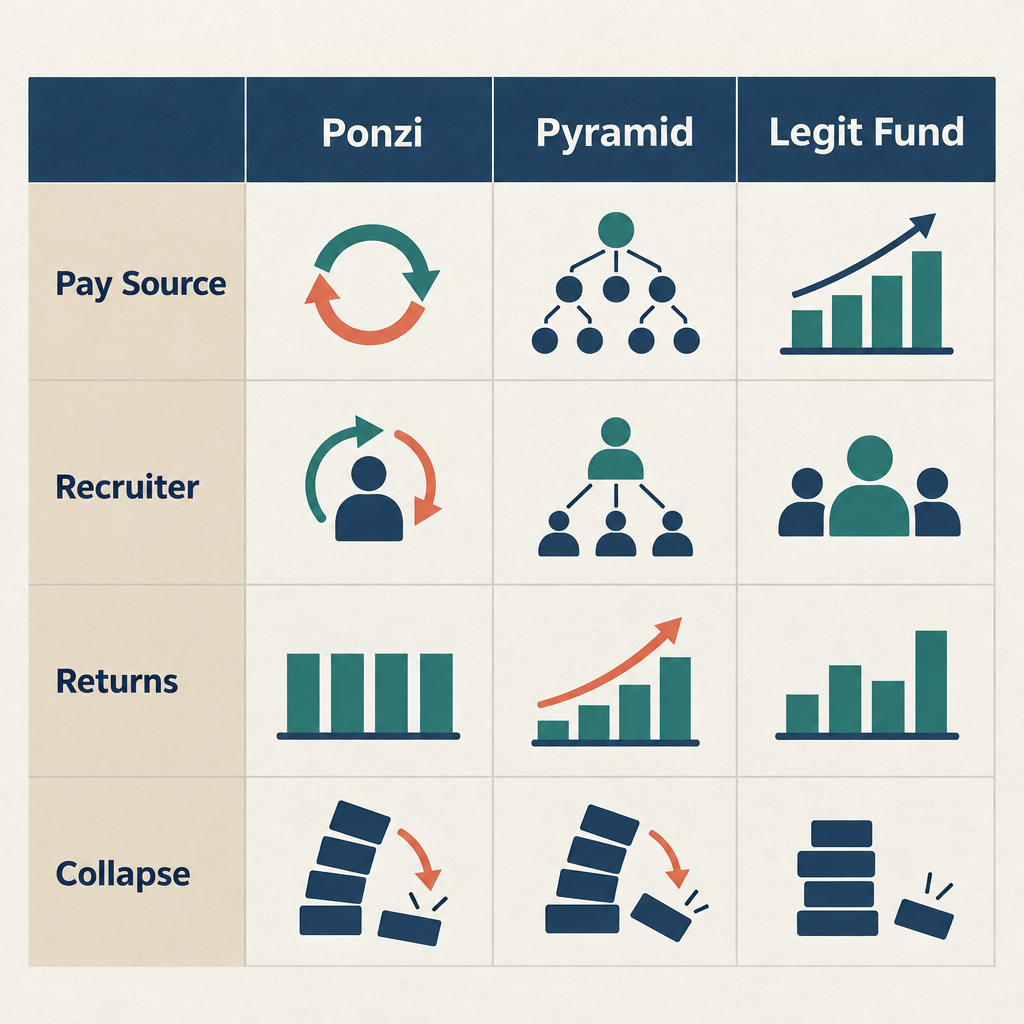
People use “Ponzi” and “pyramid” interchangeably, but regulators separate them.
| Feature | Ponzi scheme | Pyramid scheme | Legitimate fund |
|---|---|---|---|
| Who recruits | The operator | Each participant | No recruiting needed |
| What investors think they own | Shares in a trading strategy | A product distributorship | Audited assets |
| Source of payouts | New deposits | Recruitment fees | Actual returns |
| Returns | Steady, often guaranteed | Depends on your downline | Variable, can be negative |
| Ends when | New money dries up | Recruitment stalls | Never required to |
Many crypto frauds blend both models: a central “platform” fakes returns like a Ponzi while paying multi-level referral bonuses like a pyramid. The Securities and Exchange Commission treats both as securities fraud when an investment of money is involved.
How crypto Ponzi schemes work
Crypto gives a Ponzi operator three advantages that Charles Ponzi never had.
First, verification is hard. A fund manager who claims to hold Treasury bonds can be checked against a custodian statement. A platform that claims to run a “trading bot” or to stake tokens across chains can show you a dashboard that is nothing more than a web page. The balance you see is a number in a database, not a wallet you control.
Second, the token itself can be the bait. Operators create a coin, control most of the supply, and tell investors the price can only rise. Paying “returns” in that token costs the operator nothing until people try to sell.
Third, payments are fast, global and often irreversible, which makes recovery harder once the scheme ends.
The biggest cases follow the same script:
- BitConnect promised daily returns from a “volatility software trading bot” and paid referral commissions through a multi-level structure. The platform shut its lending program in January 2018, and the SEC later charged founder Satish Kumbhani, alleging the scheme defrauded retail investors worldwide of about $2 billion, while a separate federal grand jury indictment put the figure at $2.4 billion. Lead US promoter Glenn Arcaro pleaded guilty to conspiracy.
- OneCoin sold “packages” of a coin that was never even on a blockchain. Co-founder Ruja Ignatova, the self-styled “Cryptoqueen”, disappeared in 2017 and sits on the FBI’s Ten Most Wanted list. Co-founder Karl Sebastian Greenwood was sentenced to 20 years in US federal prison in 2023, with investors losing an estimated $4 billion.
- PlusToken drew in mostly Chinese and Korean investors in 2018 and 2019 with promises of monthly wallet “dividends” before operators vanished with billions in crypto, which later moved through exchanges and depressed prices when it was sold.
- Forsage was a smart-contract “matrix” that the SEC charged in August 2022 as a pyramid and Ponzi scheme, alleging it raised more than $300 million. The code paid earlier participants from new ones automatically, which prosecutors argued made the fraud transparent rather than legitimate.
The scale keeps growing. The FBI’s Internet Crime Complaint Center reported $3.94 billion in losses from crypto investment fraud in 2023, the largest share of the $4.57 billion in investment fraud losses that topped its annual report, and investment fraud losses rose to $5.8 billion in its 2024 report. Many of those complaints involve “pig butchering” schemes that use fake trading platforms to show fictitious gains, which is a Ponzi structure run by a scam compound rather than a single promoter.
Red flags the SEC tells investors to watch for
The SEC’s investor education site lists the warning signs below. If you see two or more, stop and verify before sending anything.
- Returns that are high with little or no stated risk. Every real investment that can gain can also lose.
- Returns that are suspiciously consistent regardless of market conditions. Madoff reported gains in months when the market dropped.
- Investments not registered with the SEC or state regulators, and sellers who are not licensed.
- Strategies described as secret, too complex to explain, or “proprietary AI”.
- Paperwork errors, missing statements, or a refusal to show audited financials.
- Difficulty withdrawing money, or pressure to “roll over” rather than cash out.
- Referral bonuses for bringing in new investors.
How to check an investment before you commit
- Search the person and firm on FINRA BrokerCheck and the SEC’s Investment Adviser Public Disclosure database.
- Look up the offering on SEC EDGAR; most legitimate funds and token offerings file something.
- Check your state securities regulator’s licensing database through the North American Securities Administrators Association.
- For a crypto exchange, confirm it is registered as a money services business in FinCEN’s MSB registrant search.
- Ask for audited financial statements naming the auditor, then call the auditor directly.
What US law says and what you can get back
A Ponzi scheme violates federal securities law when the investment meets the Howey test from the 1946 Supreme Court case SEC v. W.J. Howey Co.: an investment of money in a common enterprise with an expectation of profit from the efforts of others. That covers nearly every crypto yield platform. Operators face civil action from the SEC, and criminal charges from the Department of Justice under the securities fraud statutes and the federal wire fraud statute (18 U.S.C. 1343). The Commodity Futures Trading Commission can also bring charges under the Commodity Exchange Act when the scheme involves spot crypto or derivatives.
Recovery runs through a court-appointed receiver or bankruptcy trustee. Two facts surprise most victims. First, recoveries are partial and slow: the Madoff trustee has returned over $14 billion of the $17.5 billion in lost principal, which is unusually high, and it took more than a decade. Most crypto cases return cents on the dollar. Second, “net winners” who withdrew more than they deposited can be sued by the trustee to give the excess back under fraudulent transfer law. Profiting from a Ponzi scheme early does not protect you.
How the IRS treats Ponzi losses
The IRS treats crypto as property under Notice 2014-21, so an ordinary drop in a coin’s price is a capital loss. A Ponzi loss is different. Under Revenue Ruling 2009-9 and Revenue Procedure 2009-20, money stolen in a Ponzi scheme is a theft loss from a transaction entered into for profit, which stays deductible under Internal Revenue Code Section 165(c)(2) even though the 2017 tax law suspended most personal theft losses through 2025.
The safe harbor lets you deduct 95% of your qualified investment in the year the lead figure is charged, or 75% if you are pursuing recovery from third parties, without waiting years to learn the final recovery amount. “Qualified investment” means cash you put in plus any phantom income you reported and paid tax on, minus withdrawals. Keep every statement, since exchanges now report crypto sales on Form 1099-DA and you will need to reconcile what was real against what was fiction.
Where to report a suspected Ponzi scheme
- SEC: submit a tip or complaint through the SEC’s Tips, Complaints and Referrals system.
- CFTC: file a tip for commodity or crypto derivatives fraud.
- FBI: file at the Internet Crime Complaint Center, IC3, especially for crypto cases with wallet addresses and transaction hashes.
- FTC: ReportFraud.ftc.gov for consumer-facing schemes.
- Your state securities regulator, which often moves faster on local promoters.
Report even if your loss is small. Regulators build cases from patterns, and your complaint can be the one that connects a dozen others.
FAQ
What is a Ponzi scheme in simple terms?
A Ponzi scheme is a fake investment where the operator uses money from new investors to pay returns to earlier ones, instead of earning profits. It collapses when new money stops coming in.
Why is it called a Ponzi scheme?
The name comes from Charles Ponzi, who ran a postal reply coupon fraud in Boston in 1920 that collapsed with around $20 million in losses. Similar schemes existed before him, but his became the household name.
Is Bitcoin itself a Ponzi scheme?
No. Bitcoin has no operator promising returns and no mechanism that pays old holders from new deposits. It is a volatile asset that can fall sharply or lose all its value, which is a different risk from fraud. Ponzi schemes are built on top of crypto by people who promise yields.
How is a crypto Ponzi scheme different from a traditional one?
The structure is identical. Crypto versions are harder to verify because “returns” can be displayed on a dashboard or paid in a token the operator controls, and funds move across borders in minutes. That makes recovery less likely.
Can I get my money back from a Ponzi scheme?
Sometimes, partially. Court-appointed receivers and trustees distribute recovered assets, but most crypto cases return a small fraction. You can also claim a theft loss on your federal taxes under the IRS safe harbor in Revenue Procedure 2009-20.
Can I be sued if I made money in a Ponzi scheme?
Yes. Trustees routinely sue “net winners” to claw back withdrawals above their original deposits, since that money came from other victims.