Fast money is possible, but the honest version looks like selling things, working shifts that pay quickly, and claiming cash you already own. This list ranks 17 ways to make money fast by how soon the money hits your account, how much you can realistically clear, and what each one costs you. We also show what borrowing instead would cost, so you can compare before you decide.
Before you chase fast cash
Any offer that asks you to pay first, deposit a check and send part of it back, or buy gift cards to “unlock” earnings is a scam. Real work never costs you money up front, and real payouts never need a fee to release them.
How we ranked these
We scored every method on four things. Speed to first dollar matters most for someone who needs rent money by Friday. Then we looked at the realistic amount a first-timer can clear in a week, the fees and taxes that eat into it, and the risk of wasting your time or getting scammed.
Everything here is legal in all 50 states unless we say otherwise. Nothing requires a credit check, and nothing on this list is a loan except one pawn option that we flag clearly.
Our top pick is selling things you already own, locally, for cash. It beats every app on speed, has no fees, and does not create a tax bill in most cases. The rest of the list fills in once your closet and garage are empty.
Quick comparison
| # | Method | First payout | Realistic first-week range | The catch |
|---|---|---|---|---|
| 1 | Sell items locally for cash | Same day | $50 to $500+ | Buyers haggle and flake |
| 2 | Donate plasma | Same day (prepaid card) | $100 to $400 as a new donor | Health screening, twice-a-week limit |
| 3 | Same-day shift apps | 1 to 3 days | $100 to $400 | Shifts go fast, need photo ID |
| 4 | Food and grocery delivery | Same day with instant pay | $100 to $500 | Gas, car wear, small cash-out fee |
| 5 | Sell gold, silver, jewelry | Same day | Depends on weight | Buyers pay below melt value |
| 6 | Pawn an item (a loan) | Same day | $20 to $300 typical | High interest, you can lose the item |
| 7 | Drive for Uber or Lyft | 3 to 10 days | $200 to $600 | Approval takes days, car costs |
| 8 | Odd jobs and TaskRabbit | 1 to 7 days | $100 to $400 | Physical work, builds slowly |
| 9 | Dog walking and pet sitting | 2 to 7 days | $50 to $300 | Rover keeps 20% |
| 10 | Babysitting | Same day if local | $60 to $300 | Trust takes time to build |
| 11 | Extra shifts or overtime | Next paycheck | Varies | Only if your employer allows it |
| 12 | Tutoring | 1 to 7 days | $50 to $300 | Need a subject you can teach |
| 13 | Online freelance work | 5 to 14 days | $0 to $500 | Platform holds and fees |
| 14 | Paid studies and opinions | Same day to 2 weeks | $20 to $150 | Low hourly rate, screen-outs |
| 15 | Resell online (eBay, Poshmark, Etsy) | 3 to 14 days | $50 to $400 | Fees, shipping, slower |
| 16 | Bank account bonuses | 2 to 12 weeks | $100 to $300 | Direct deposit rules, taxable |
| 17 | Claim money you are owed | 2 to 12 weeks | $0 to thousands | Paperwork, waiting |
Ways that can pay today
1. Sell things you already own, locally, for cash
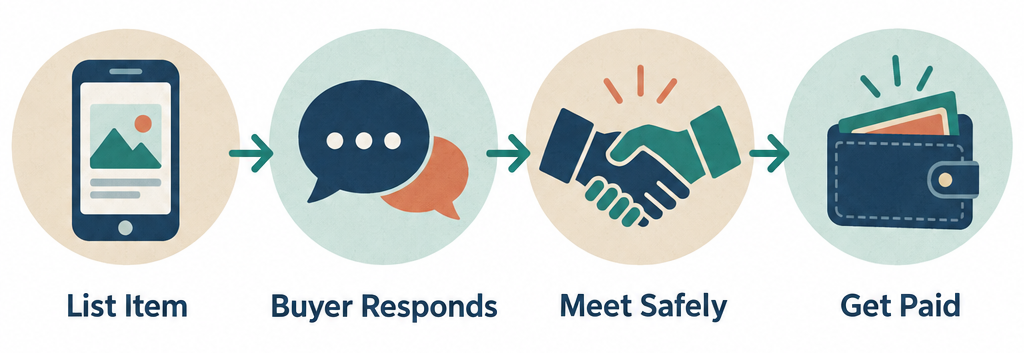
This is the top pick because nothing else is this fast or this free. Facebook Marketplace, Craigslist, and OfferUp charge no fee for local pickup sales. You list in the morning, meet in a public place in the afternoon, and walk away with cash or an instant transfer.
What sells the same day: working phones and laptops, game consoles, power tools, bikes, furniture, baby gear, and name-brand sneakers. Price 10% to 20% under the other listings in your area and say “pickup today” in the title. Buyers in a hurry search for that.
Three safety rules. Meet at a police station lot or a busy store entrance. Take cash or a transfer you can see land in your own banking app before you hand over the item. Never accept a check or an overpayment request.
Taxes are usually not an issue here. The IRS does not tax a loss, and most used household goods sell for less than you paid. If you sell a collectible or an item for more than you paid, that gain is reportable.
2. Donate plasma
Plasma centers pay on the day of your visit, typically to a prepaid debit card. Pay varies by city and company, but $30 to $100 per visit is the common range, and most centers run new-donor promotions that stack several hundred dollars across your first month.
Under FDA rules in 21 CFR 630.15, you can donate plasma no more than twice in a seven-day period. You need a valid government photo ID, proof of address, and a Social Security number. First visits include a physical and a health questionnaire, so plan on two to three hours. Repeat visits take about an hour.
Plasma pay is taxable income even though centers rarely send a tax form. Keep a simple record of what you received during the year.
3. Same-day shift apps
Apps like Instawork, Wonolo, and GigSmart list warehouse, event, catering, and cleaning shifts that start within hours. Many pay the day after the shift, some pay sooner, and the rates usually sit a few dollars above your state minimum wage.
You will need a photo ID, a smartphone, and reliable transportation. Shifts fill fast, so turn on notifications and claim early. Some shifts classify you as a W-2 employee of the staffing company and some as an independent contractor. Check which one before you accept, because contractors owe self-employment tax and get no overtime.
Local day-labor halls and temp agencies are the no-app version. Walk in early, bring ID, and ask about daily pay.
4. Deliver food or groceries with instant cash-out
DoorDash, Uber Eats, Instacart, and Amazon Flex all let you move earnings to a debit card the same day. DoorDash’s Fast Pay and Uber’s Instant Pay charge a small flat fee per transfer, usually under $2, while standard weekly deposits are free. Approval takes a few hours to a few days depending on how quickly the background check clears.
Delivery pays best on Friday and Saturday evenings and during bad weather. Gross earnings of $15 to $25 an hour are common in busy metros. Subtract gas and wear on your car and the net is lower. The IRS standard mileage rate exists for exactly this, so track every mile from your first delivery to your last.
Amazon Flex works a bit differently. You reserve delivery blocks, typically two to four hours, and pay goes out twice a week. It is slower to start but the pay per block is posted before you accept.
5. Sell gold, silver, or jewelry
Gold moves at the spot price, and buyers pay a percentage of melt value based on weight and purity. A reputable buyer tests the metal in front of you and quotes a price per gram. Get two or three quotes, because the spread between a local jeweler, a coin shop, and a mail-in buyer can be wide.
Mail-in gold services pay slower and you lose leverage once the package is gone. Local coin shops usually pay the same day in cash or check. Never sell at a hotel “gold party” event.
Sterling silver flatware, old class rings, broken chains, and single earrings all count. Gemstones usually add little unless they are certified.
6. Pawn an item (this one is a loan)
A pawn shop hands you cash the same day against an item you leave as collateral. No credit check, no income check. If you repay the loan plus interest within the term, usually 30 to 90 days, you get the item back. If you do not, the shop keeps it and the debt ends there. Nothing goes to your credit report either way.
Pawn interest is set by state law and the range is huge, from a few percent a month in some states to much higher in others. Under the Truth in Lending Act and Regulation Z, the shop must give you a written disclosure of the finance charge and APR. Read it before you sign.
Pawning is better than a payday loan only because the downside is capped at losing the item. Selling the item outright usually pays more than pawning it.
Ways that can pay this week
7. Drive for Uber or Lyft
Rideshare pays more per hour than delivery in most cities, but it starts slower. You need a car that passes the company’s age and inspection rules, a clean driving record, and a background check that can take several days to clear. After that, instant cash-out works the same way it does for delivery.
Airport runs, early mornings, and surge pricing after concerts and games move the needle. Full-time drivers in large metros report gross earnings in the $20 to $30 per hour range before expenses. Your real number depends on your city and how much you drive during slow hours.
Rideshare background checks are consumer reports under the Fair Credit Reporting Act. If you are rejected based on the report, the company must send you a copy and a chance to dispute errors.
8. Odd jobs through TaskRabbit, Nextdoor, and neighbors
Moving help, furniture assembly, yard cleanup, snow shoveling, gutter cleaning, and junk hauling all pay the same day in cash or Venmo when you book directly with a neighbor. Post in your local Nextdoor or Facebook group with a short list of what you do and your rate.
TaskRabbit adds structure and a steady flow of clients, but it takes a few days to get approved and the site collects payment and releases it after the task is complete. Taskers set their own hourly rates, and furniture assembly and moving help are the categories with the most demand.
Bring your own tools, show up on time, and ask for a review. Three good reviews in your first week turn this into a reliable side income line.
9. Walk dogs and pet-sit
Rover connects you with owners who need dog walking, drop-in visits, and overnight boarding. The company keeps 20% of each booking and pays you two days after a service completes. Walks commonly run $15 to $30 and overnight boarding $30 to $75 a night, with you setting the price.
Getting your first booking takes a few days because owners read profiles and want to meet you. Skip the app and ask neighbors directly if you need money sooner. Cat drop-ins while people travel are the easiest entry point.
Boarding dogs in your home may violate a lease or a local ordinance, so check first.
10. Babysit or do evening childcare
Families pay in cash or by app the same night, and rates of $15 to $25 an hour are normal in most of the country, higher in big cities. Care.com and Sittercity list jobs, but the fastest route is telling every parent you know that you are available this weekend.
Date-night sitting, school pickup, and overnight care for parents who work hospital shifts fill up first. A CPR certification from the Red Cross or American Heart Association takes a few hours and lets you charge more.
11. Pick up extra shifts, overtime, or an employer advance
The quickest raise is more hours at the job you already have. Under the Fair Labor Standards Act, nonexempt employees earn at least one and a half times their regular rate for every hour over 40 in a workweek. Ask your manager for open shifts, holiday coverage, or a temporary second role.
Also ask payroll about earned wage access. Some employers let you draw part of your earned pay before payday at no cost. That is the cheapest advance in existence. If the option goes through a third-party app that charges express fees or asks for tips, treat it like the cash advance apps in our cost table below.
12. Tutor a subject you know well
Parents pay $25 to $50 an hour for in-person help with math, reading, SAT prep, and languages, and they pay by app or cash after each session. Wyzant, Varsity Tutors, and local Facebook parent groups generate leads. College students, teachers, and anyone with a technical background can start this week.
Online tutoring platforms pay less per hour and hold payment for a week or more. Direct clients pay faster and you keep the whole rate.
13. Freelance work online
Upwork, Fiverr, and Freelancer.com let you sell writing, design, data entry, bookkeeping, video editing, and admin work from anywhere. The catch is speed. Upwork holds payment for days after a client approves a milestone, and both big platforms take a percentage of what you earn. Your first client can take a week to land and your first dollar two weeks.
This is a stronger medium-term answer than a this-week answer. Price competitively on your first three jobs to collect reviews, then raise rates.
Two scam red flags: a “client” who wants to move the conversation off the platform right away, and any job that sends you a check to buy equipment.
14. Paid research studies, user tests, and opinions
UserTesting pays about $10 for a recorded 20-minute website test, and live interviews pay more. Respondent and User Interviews list paid research sessions that often pay $50 to $150 for an hour, though you have to qualify through a screener. University psychology departments and medical schools run paid studies you can find through ClinicalTrials.gov and campus job boards.
Survey sites that pay for your opinions are the weakest option here. Points add up slowly, cash-out minimums delay payment, and the effective hourly rate often lands below minimum wage. Use them while waiting for something better, not instead of it.
Ways that pay in two to six weeks
15. Resell online through eBay, Poshmark, or Etsy
Online resale reaches more buyers than a local post, but money moves slower and fees take a slice. Poshmark keeps a flat $2.95 on sales under $15 and 20% on sales of $15 or more. Etsy charges a $0.20 listing fee plus a 6.5% transaction fee, then payment processing on top. eBay’s final value fee runs in the low to mid teens as a percentage in most categories, and payouts land in your bank a few days after the sale.
Shipping, packaging, and returns add cost and time. Clothing, collectibles, electronics, and handmade goods do best. If you need money this week, sell locally first and move the leftovers online.
16. Bank account bonuses
Banks pay $100 to $300 to open a checking account and meet a direct deposit requirement within 60 to 90 days. Credit unions and regional banks often match the big names. Read the fine print for monthly fees, minimum balances, and how long you must keep the account open to avoid a clawback.
The bonus is interest income and the bank sends you a Form 1099-INT if the total reaches $10. Bonuses are slow money, but they are nearly risk-free compared with everything else on this list.
17. Claim money you are already owed
Every state treasurer runs an unclaimed property database. Old utility deposits, forgotten bank accounts, uncashed paychecks, and insurance refunds sit there until someone claims them. Search your name at your state’s official site and at MissingMoney.com, which several states feed. Claims take weeks, but they are free.
Check these too: a federal or state tax refund you never filed for, class action settlements at the official settlement site, a security deposit a landlord still owes you, and pay stubs for unpaid overtime. If you lost work, file for unemployment insurance the same week. Benefits are taxable but they are yours.
How to vet any fast-cash offer in five minutes
- Search the company name plus “scam” and “FTC”.
- Confirm you never pay anything up front, including training or equipment.
- Refuse any job that sends you a check and asks you to forward money.
- Check how and when you get paid, in writing, before you start.
- Verify a lender on NMLS Consumer Access and your state regulator’s license lookup.
If earning is not enough: what borrowing really costs
Sometimes the number you need is bigger than what one week of hustle can cover. Compare the real cost of each quick borrowing option before you reach for one. The APR figures below use the standard formula: fee divided by the amount, divided by the days, times 365.
| Option | Amount | Fee or APR | Term | Total repaid |
|---|---|---|---|---|
| Credit union payday alternative loan | $300 | 28% APR plus $20 application fee | 3 months | About $334 |
| Credit card cash advance | $300 | 5% fee plus about 30% APR | 30 days | About $322 |
| Cash advance app | $100 | $5 express fee plus $2 tip | 10 days | $107, about 256% APR |
| Payday loan | $300 | $15 per $100 borrowed | 14 days | $345, about 391% APR |
The payday math in plain words: $45 on $300 is 15%. A 14-day term fits into a year about 26 times. Fifteen percent times 26 is roughly 391%. The CFPB uses this same example to explain why a payday loan is the most expensive line on the table, and its research found that most payday borrowers roll over or re-borrow within two weeks.
Cash advance apps look cheap at $7 on $100 until you annualize it. The CFPB’s 2024 analysis of earned wage access products found an average APR above 100% once express fees and tips were counted, and heavy users took more than two dozen advances a year.
Credit card cash advances have no grace period. Interest starts the day you take the cash, and most issuers charge a higher APR for advances than for purchases.
The credit union loan wins on cost. The National Credit Union Administration caps payday alternative loans at 28% APR, with an application fee of no more than $20, amounts from $200 to $1,000, and terms of one to six months. You need to be a member, and some credit unions require a month of membership first.
Cheaper options first
Ask your employer about a no-fee pay advance before any app.
Call utilities, landlords, and lenders for a hardship plan; many have one.
Dial 211 for local rent, food, and utility assistance, and check LIHEAP and SNAP.
A nonprofit credit counselor can set up a plan at little or no cost.
Leave retirement money alone if you can. Pulling from a 401(k) or IRA before age 59½ triggers income tax plus a 10% additional tax under Internal Revenue Code Section 72(t) in most cases. A 401(k) loan, if your plan offers one, avoids the penalty but puts your retirement savings at risk if you leave the job and cannot repay quickly.
State rules that change the picture
Payday lending is not available everywhere. New York, Pennsylvania, New Jersey, Massachusetts, and a growing group of other states cap small-loan rates at or near 36% APR, which keeps storefront payday lenders out. Those caps come from state usury laws, and the ceiling is different in every state, so a lender that is legal in Texas can be a felony operation in New York.
Plasma donation is legal in every state, but centers set their own age minimums, usually 18, and a few states require 19. Pawn interest rates and redemption periods are set state by state. Gig driving rules on minimum pay, insurance, and worker classification differ too, with California, Washington, and New York City each having their own regimes. Check your state before you count on a specific rate.
Members of the military and their dependents get extra protection. The Military Lending Act caps most consumer loans at a 36% military APR, including payday loans and some cash advance products.
Taxes on fast money
The IRS taxes income from gig work, freelancing, plasma, tutoring, and resale profits, with or without a tax form. If your net self-employment earnings reach $400 for the year, you file Schedule SE and pay self-employment tax of 15.3% on top of income tax. If you expect to owe $1,000 or more, the IRS wants quarterly estimated payments.
Tax forms are less common than people think. Under the tax law signed in July 2025, the Form 1099-K threshold for payment apps and marketplaces returned to $20,000 and more than 200 transactions. The same law raises the Form 1099-NEC threshold from $600 to $2,000 for payments made in 2026. Not getting a form does not make the income tax-free. It just means you have to track it yourself.
Keep mileage, phone, and supply records. Those deductions are the difference between a gig that nets $18 an hour and one that nets $12.
Your rights while earning fast
Employees, including temp and shift-app workers paid on a W-2, are covered by the Fair Labor Standards Act. That means at least the federal minimum wage of $7.25 or your higher state minimum, overtime past 40 hours, and pay on the regular schedule your state requires. Unpaid wages can be reported to the Department of Labor’s Wage and Hour Division or your state labor agency.
Independent contractors on gig apps have fewer protections, but a few still apply. Background checks run by Checkr or similar companies fall under the Fair Credit Reporting Act, so you get a copy of the report and a chance to dispute mistakes before you are deactivated. Deposits to a debit card are electronic fund transfers, and the Electronic Fund Transfer Act gives you the right to dispute errors with your bank within 60 days of the statement.
If you borrow instead, the Truth in Lending Act requires a written disclosure of the APR and total finance charge before you sign. The Equal Credit Opportunity Act bars lenders from treating you differently because of race, sex, age, marital status, or because your income comes from public assistance.
Report scams to the FTC at ReportFraud.ftc.gov and to the FBI’s Internet Crime Complaint Center. Complaints about lenders, cash advance apps, and debt collectors go to the CFPB’s complaint portal. The FTC’s 2024 fraud data showed reported losses topping $12.5 billion, with job and business opportunity scams among the fastest growing. Any “investment” that promises daily returns from a stranger online is almost always a ponzi scheme and should be treated as one.
FAQ
How to make $1,000 dollars ASAP?
Stack the fastest items on this list. Sell electronics, tools, and furniture locally for $300 to $500 in a day, donate plasma twice in a week for roughly $100 to $150 at standard rates, more if a new-donor bonus applies, and run delivery or same-day shifts for the rest. One week is realistic for most people with a car and a closet full of things they do not use. Without a car, pair selling with shift apps and odd jobs for neighbors.
How do I make money right now ASAP?
Same-day cash comes from three places: selling something locally, a plasma center, and a pawn shop. Delivery apps pay the same day too once you are approved, which can take hours to days. Everything else on this list takes at least a day or two.
How can I make $100 a day?
Four to six hours of delivery during peak meal times clears $100 gross in most cities, before gas. Two dog walks and a drop-in visit on Rover get there. A single same-day warehouse or event shift at a few dollars above minimum wage usually lands close. Combining two of these is the most reliable path on days when one is slow.
How to make $1,000 a day fast?
No legitimate method on this list produces $1,000 in a day from a standing start. Selling a car, a high-end bike, or a watch can, but that is converting an asset, not earning. Anyone promising $1,000 a day from a phone, a course, or a crypto “opportunity” is selling the promise, not the income. Treat the claim as a red flag and report it if money is requested up front.