Form 1099-DA, titled “Digital Asset Proceeds From Broker Transactions,” is the IRS form that US crypto exchanges and other custodial brokers use to report your sales of cryptocurrency, stablecoins and NFTs. It debuted for sales made on or after January 1, 2025, and the first copies reached customers in early 2026. If you sold crypto through a US platform, the IRS now has a record of your proceeds, and your return needs to match it.
What Form 1099-DA is
The IRS treats crypto as property, a position it first laid out in IRS Notice 2014-21. Every time you sell, swap or spend a digital asset, you realize a gain or loss, and that has been true since long before this form existed. What changed is who tells the IRS about it.
For stocks, brokers have reported sales to the IRS on Form 1099-B for decades. Crypto had no equivalent until Congress rewrote Section 6045 of the Internal Revenue Code in the Infrastructure Investment and Jobs Act of 2021. That law widened the definition of “broker” to cover businesses that handle digital asset sales for customers. The Treasury Department finalized the rules in Treasury Decision 10000, published in the Federal Register on July 9, 2024, and Form 1099-DA is the paperwork those regulations created.
Think of it as a 1099-B rebuilt for crypto. It lists what you sold, how many units, when you sold it and how much money or value you got back. Over time it will also show what you paid, which is the number that actually determines your tax.
Who sends it and who gets one
The form comes from “digital asset brokers,” a term the regulations define more narrowly than the crypto community feared in 2021. As the rules stand now, the businesses required to file include:
- Centralized exchanges that hold customer assets, such as Coinbase, Kraken and Gemini
- Hosted wallet providers that take custody of your coins
- Crypto ATMs and kiosks
- Certain payment processors that settle crypto payments to merchants, which the regulations call PDAPs
You should receive a 1099-DA if you are a US customer of one of these businesses and you sold, swapped or spent a digital asset through it during the year. The broker sends you a copy and files a matching copy with the IRS.
Several categories were left out. Miners and validators are not brokers just because they confirm transactions. Self-custody wallet software that never touches your keys does not report. Decentralized finance front ends were going to be covered by a separate rule, Treasury Decision 10021 from December 2024, but Congress repealed that rule under the Congressional Review Act in April 2025. So a swap you make from your own wallet through a decentralized protocol does not generate a 1099-DA. It is still taxable, and you still have to report it yourself.
Two de minimis rules also matter. Under the final regulations, a broker can skip reporting sales of qualifying stablecoins if your total stablecoin sales through that broker stay under $10,000 for the year, and it can report larger stablecoin volumes as a single annual total rather than trade by trade. Specified NFT sales have a similar aggregate option with a $600 floor. Payment processors only report once a customer’s crypto payments pass $600 in a year.
How the form works, year by year
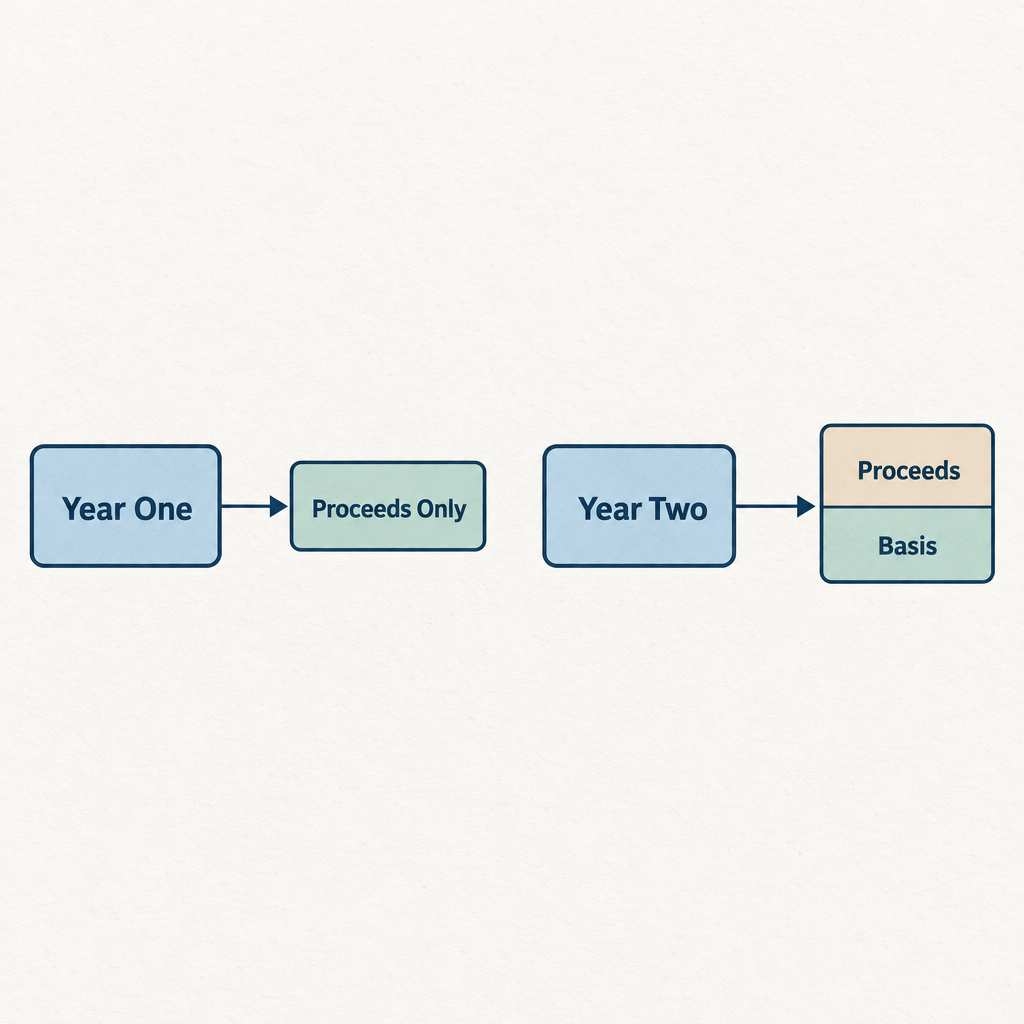
The IRS phased the reporting in over two tax years, and the phase-in is the source of most of the confusion.
| Tax year | What the broker reports | When you receive it |
|---|---|---|
| 2025 sales | Gross proceeds only; basis box generally blank | February 17, 2026 |
| 2026 sales | Proceeds, plus cost basis for assets bought on or after January 1, 2026 in that same account | mid-February 2027 |
| 2027 and later | Same as 2026, with more assets qualifying as “covered” over time | mid-February each year |
The phrase “covered digital asset” does the heavy lifting here. A covered asset is one you bought through the broker on or after January 1, 2026 and kept in that same account until you sold it. For those, the broker knows your purchase price and must report it. Anything bought before 2026, or transferred in from another wallet or exchange, is “noncovered.” The broker reports the proceeds but leaves basis to you, and it ticks a box on the form telling the IRS that basis was not reported.
For 2025 sales, nearly everything was noncovered by definition. That means your first 1099-DA almost certainly showed a proceeds figure with no basis next to it.
The IRS also carved out transaction types it was not ready to handle. Notice 2024-57 told brokers they do not have to report wrapping and unwrapping tokens, liquidity pool deposits and withdrawals, staking, crypto lending, short sales and notional principal contracts until the IRS says otherwise. Those activities can still create taxable income for you. They just will not appear on this form yet.
What the form actually shows
Each 1099-DA covers a single sale or disposition, though most brokers deliver them as one consolidated statement that runs through every transaction. The key fields are:
- An identifier and name for the digital asset
- The number of units disposed of
- The date you acquired the asset, if the broker knows it
- The date you sold or disposed of it
- Gross proceeds, usually the dollar value you received after any fees the broker netted out
- Cost or other basis, when the asset is covered
- A checkbox showing whether basis was reported to the IRS
- Whether the holding period was short-term or long-term, when the broker can determine it
- Any federal income tax withheld
Early drafts of the form in 2024 asked for wallet addresses, transaction hashes and the exact time of day of each sale. After public comments, the IRS dropped those fields from the version brokers now use.
One more detail worth knowing: the proceeds figure can reflect value you received in other crypto, not only cash. If you traded ETH for SOL on an exchange, the broker reports the fair market value of the SOL you received as your proceeds from selling ETH. Swaps count as sales for tax purposes and always have.
Why a proceeds-only form can cost you money
Here is the problem with a form that reports what you sold for but not what you paid. The IRS runs an automated matching program that compares the 1099s it receives against the income on your return. When a 1099-DA arrives showing $45,000 in proceeds and your return shows nothing, the system does not assume you broke even. It can treat the entire $45,000 as gain and send you a CP2000 notice proposing extra tax, interest and an accuracy penalty.
A worked example shows the gap:
| Item | Your real numbers | What a bare 1099-DA shows |
|---|---|---|
| Sold | 0.5 BTC on a US exchange | 0.5 BTC |
| Proceeds | $45,000 | $45,000 |
| Cost basis | $38,000 (bought in 2024) | blank, noncovered |
| Actual gain | $7,000 | unknown to IRS |
| Tax at a 15% long-term rate | $1,050 | could be assessed on $45,000 if you fail to report |
The fix is entirely in your hands. You report the sale on Form 8949 with your own basis figure, carry the total to Schedule D, and the proceeds you report match what the broker filed. The matching program is satisfied, and you pay tax on the $7,000 you actually made.
Ignoring the notice is the expensive route. Unpaid balances accrue interest daily, and the IRS can file liens, levy bank accounts and, for older inactive accounts, assign the debt to a private debt collector under its private collection program. None of that happens if you reconcile the form the first time.
Tracking basis under the new rules
Because the broker will not know your basis for most older coins, the IRS has issued a cluster of guidance on how you prove it.
Wallet-by-wallet accounting. Revenue Procedure 2024-28 ended the informal “universal” method many investors used, where all their coins across every exchange were treated as one big pool. As of January 1, 2025, basis must be tracked account by account and wallet by wallet. The revenue procedure gave a safe harbor for allocating your existing unused basis to specific wallets as of that date. If you never made that allocation, you need to do it now using records you already had.
Default method is FIFO. If you do not specifically identify which units you are selling, the regulations treat you as selling the earliest units acquired in that account first. For coins bought cheaply years ago, FIFO can produce the largest possible gain.
Specific identification. You can choose which lots to sell, which often lowers your gain, but under the regulations the identification has to be made no later than the time of the sale and the broker needs to be able to record it. Because most exchanges did not have that capability ready, Notice 2025-7 gave taxpayers relief for 2025: you could rely on your own books and records to identify the units sold, as long as you kept them. Check whether your exchange now supports lot selection before you assume that relief continues.
Transfers. When you move coins from one exchange to another, the receiving exchange has no idea what you paid. The final regulations did not require brokers to pass basis information between each other, so the burden of carrying that number across platforms is yours. Keep the original purchase confirmation, the transfer record and the dates.
How to reconcile your 1099-DA
- Download every 1099-DA and the broker’s full transaction history for the year.
- Confirm the proceeds on the form match the sum of your sales in the history export.
- Pull your own basis for each sale from purchase records, prior-year forms or your tracking software.
- Enter each sale on Form 8949, using the box for basis not reported to the IRS where the form marks the asset noncovered.
- Carry the totals to Schedule D, and answer “Yes” to the digital asset question on Form 1040.
- Keep the records for at least three years after filing, and longer if the IRS questions a return.
Risks the form does not change
A 1099-DA reports taxes, it does not protect you from losses. Crypto can lose all of its value, and holding it on an exchange adds custody risk on top of market risk. Your coins on an exchange are not FDIC insured the way bank deposits are, and they are not covered by SIPC the way securities in a brokerage account are. When FTX collapsed in 2022, customers got tax paperwork from other platforms as usual but spent years in bankruptcy court trying to recover their assets.
Losses have their own tax rules. Capital losses offset capital gains, and up to $3,000 of net capital loss per year can offset ordinary income, with the remainder carried forward. A 1099-DA that shows a sale below your basis is useful evidence of that loss. Coins that simply became worthless while you still hold them are harder; there is no sale, so there is usually no deductible loss until you dispose of them.
Backup withholding is the other risk worth flagging. Normally a broker must withhold 24 percent of proceeds when a customer has not supplied a valid taxpayer identification number. Notice 2024-56 gave brokers transitional relief from backup withholding and related penalties on digital asset sales during 2025 so their systems could come online, and Notice 2026-20 later extended identification relief into 2026. If your exchange account has an outdated or missing Social Security number, fix it, because once the relief expires 24 percent of each sale can go straight to the Treasury.
What a 1099-DA is not
The form only covers sales and dispositions. Several other kinds of crypto income show up elsewhere or nowhere at all:
- Staking and mining rewards are ordinary income when you gain control of them, per Revenue Ruling 2023-14. An exchange may report larger amounts on Form 1099-MISC, but the income is taxable at any amount.
- Airdrops and hard forks are ordinary income at fair market value when received.
- Payments received for goods or services in crypto may arrive on a Form 1099-K from a payment app or a 1099-NEC from a client, not a 1099-DA.
- Real estate bought with crypto is reported by the closing agent on Form 1099-S for closings on or after January 1, 2026, with the digital asset’s fair market value shown.
Receiving no form at all also changes nothing. Self-custody trades, foreign exchanges and DeFi activity all remain reportable. The 1099-DA tells the IRS part of the story; your return has to tell the whole thing.
Before you file
The biggest mistake is reporting nothing because the basis box is blank. The IRS has the proceeds figure either way, and a return that omits the sale invites a notice taxing the full amount.
Free help first
IRS Free File supports Form 8949 for most filers under its income limit.
VITA and Tax Counseling for the Elderly sites prepare returns free for eligible taxpayers.
The IRS Taxpayer Advocate Service can step in if a notice is causing hardship and the normal channels have stalled.
FAQ
What is Form 1099-DA in plain terms?
It is the tax form a US crypto exchange or other custodial broker files to report your sales of digital assets to the IRS, with a copy to you. It lists the asset, the units, the dates and your gross proceeds, and for assets bought on the platform from 2026 onward it also lists your cost basis.
When did Form 1099-DA start?
Brokers began tracking sales on January 1, 2025. The first forms, covering 2025 activity, were due to customers by February 17, 2026. Cost basis reporting starts with assets acquired on or after January 1, 2026 and appears on forms issued in early 2027.
Do I owe tax on the proceeds number?
No. You owe tax on your gain, which is proceeds minus basis. The form may show only proceeds. You supply the basis on Form 8949, and the difference, if positive, is your taxable gain.
I did not get a 1099-DA. Do I still report my crypto sales?
Yes. The reporting requirement applies to you regardless of what paperwork arrives. Sales from a self-custody wallet, a decentralized exchange or a foreign platform are taxable even though no broker reports them.
What if the form is wrong?
Contact the broker and ask for a corrected form. If the broker will not fix it, report the correct figures on Form 8949 and attach an explanation of the difference. Keep the records that support your numbers, because the IRS will see the broker’s version too.
Does Form 1099-DA report swaps between two cryptocurrencies?
Yes. Trading one digital asset for another is a disposition of the asset you gave up, and the broker reports the fair market value of what you received as your proceeds.
Will the IRS see my wallet addresses on the form?
No. The IRS removed wallet addresses, transaction hashes and time-of-day fields from the final version of the form after public comments on the 2024 drafts.