Author: Nadia Cole

  • What a Ponzi scheme is and how crypto Ponzi schemes work

    What a Ponzi scheme is and how crypto Ponzi schemes work

    A Ponzi scheme is an investment fraud that pays earlier investors with money collected from newer ones, while the operator claims the “returns” come from a real business. Nothing is actually being invested, so the scheme survives only as long as new deposits outpace withdrawals. Crypto has become the fastest-growing home for this fraud because it combines big return expectations with assets that are hard to verify.

    Named afterCharles Ponzi, Boston, 1920
    Core tricknew money pays old investors
    Largest everMadoff, $64.8 billion on paper
    Crypto examplesBitConnect, OneCoin, PlusToken, Forsage
    US regulatorsSEC, CFTC, DOJ, state securities agencies
    As ofOctober 2026

    Before you put money in

    If an investment promises steady or guaranteed returns, especially in crypto, treat that as the single strongest sign of a Ponzi scheme. Crypto can lose all its value and is not FDIC or SIPC insured, and money handed to a Ponzi operator is usually gone for good.

    Where the word “Ponzi” comes from

    The scheme is named after Charles Ponzi, an Italian immigrant who ran his fraud out of Boston in 1920. He told investors he could profit by buying international postal reply coupons cheaply abroad and redeeming them in the United States at a higher value. He promised a 50% return in 45 days, or 100% in 90 days.

    The coupon trade was real but tiny. Ponzi never bought coupons in any meaningful volume. He simply paid the first investors with deposits from the next wave, and word of mouth did the rest. When the Boston Post started digging in late July 1920 and the arithmetic fell apart that August, investors lost roughly $20 million, a fortune at the time. Ponzi went to federal prison, and his name became the label for every “rob Peter to pay Paul” fraud since.

    He was not the first. Sarah Howe’s Ladies’ Deposit in the 1880s and William “520 Percent” Miller in 1899 ran the same play. Ponzi was simply the one who got famous enough to lend his name to it.

    How a Ponzi scheme works

    Every Ponzi scheme has the same four moving parts, regardless of whether the pitch involves postal coupons, hedge fund trading or a crypto “arbitrage bot”.

    1. A promoter offers returns that are high, consistent or both, backed by a strategy that is vague or “proprietary”.
    2. Early investors receive the promised payments on time. Those payments come from later deposits, not profits.
    3. Satisfied early investors recruit friends and family, giving the promoter free marketing and social proof.
    4. The operator skims money for personal use while encouraging everyone to “reinvest” rather than withdraw.

    The math guarantees collapse. Here is a simplified example of a scheme promising 10% per month, with each investor putting in $10,000 and everyone collecting their returns in cash.

    Month New investors Cash in Owed to all investors Cumulative shortfall
    1 10 $100,000 $10,000 $0
    2 20 $200,000 $30,000 $0
    3 40 $400,000 $70,000 $0
    6 320 $3.2 million $630,000 $0
    12 20,480 $204.8 million $40.9 million $0

    The scheme looks healthy only because recruitment doubles every month. The moment growth slows, or a wave of investors asks for principal back, the cash runs out. In Madoff’s case the trigger was the 2008 financial crisis, when clients requested about $7 billion in redemptions that did not exist. Prosecutors found that Madoff’s firm had not executed a single trade for clients in years, despite account statements showing $64.8 billion in balances. Investors’ actual lost principal came to about $17.5 billion according to the court-appointed trustee, and Madoff received a 150-year sentence in 2009.

    Ponzi scheme vs pyramid scheme vs real investing
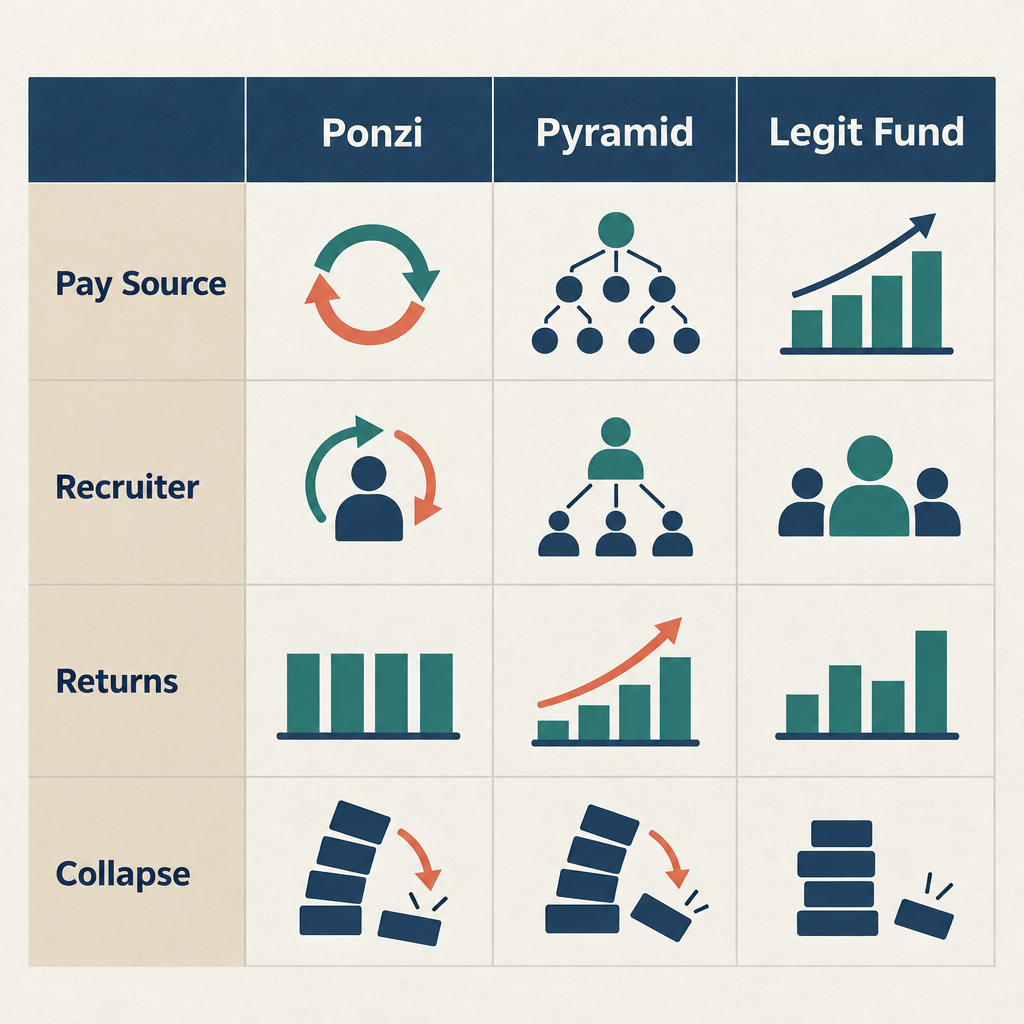
    Three-column flow diagram comparing a Ponzi scheme, a pyramid scheme, and a legitimate fund across four labeled rows: source of pay, who recruits, investor return, and collapse trigger

    People use “Ponzi” and “pyramid” interchangeably, but regulators separate them.

    Feature Ponzi scheme Pyramid scheme Legitimate fund
    Who recruits The operator Each participant No recruiting needed
    What investors think they own Shares in a trading strategy A product distributorship Audited assets
    Source of payouts New deposits Recruitment fees Actual returns
    Returns Steady, often guaranteed Depends on your downline Variable, can be negative
    Ends when New money dries up Recruitment stalls Never required to

    Many crypto frauds blend both models: a central “platform” fakes returns like a Ponzi while paying multi-level referral bonuses like a pyramid. The Securities and Exchange Commission treats both as securities fraud when an investment of money is involved.

    How crypto Ponzi schemes work

    Crypto gives a Ponzi operator three advantages that Charles Ponzi never had.

    First, verification is hard. A fund manager who claims to hold Treasury bonds can be checked against a custodian statement. A platform that claims to run a “trading bot” or to stake tokens across chains can show you a dashboard that is nothing more than a web page. The balance you see is a number in a database, not a wallet you control.

    Second, the token itself can be the bait. Operators create a coin, control most of the supply, and tell investors the price can only rise. Paying “returns” in that token costs the operator nothing until people try to sell.

    Third, payments are fast, global and often irreversible, which makes recovery harder once the scheme ends.

    The biggest cases follow the same script:

    • BitConnect promised daily returns from a “volatility software trading bot” and paid referral commissions through a multi-level structure. The platform shut its lending program in January 2018, and the SEC later charged founder Satish Kumbhani, alleging the scheme defrauded retail investors worldwide of about $2 billion, while a separate federal grand jury indictment put the figure at $2.4 billion. Lead US promoter Glenn Arcaro pleaded guilty to conspiracy.
    • OneCoin sold “packages” of a coin that was never even on a blockchain. Co-founder Ruja Ignatova, the self-styled “Cryptoqueen”, disappeared in 2017 and sits on the FBI’s Ten Most Wanted list. Co-founder Karl Sebastian Greenwood was sentenced to 20 years in US federal prison in 2023, with investors losing an estimated $4 billion.
    • PlusToken drew in mostly Chinese and Korean investors in 2018 and 2019 with promises of monthly wallet “dividends” before operators vanished with billions in crypto, which later moved through exchanges and depressed prices when it was sold.
    • Forsage was a smart-contract “matrix” that the SEC charged in August 2022 as a pyramid and Ponzi scheme, alleging it raised more than $300 million. The code paid earlier participants from new ones automatically, which prosecutors argued made the fraud transparent rather than legitimate.

    The scale keeps growing. The FBI’s Internet Crime Complaint Center reported $3.94 billion in losses from crypto investment fraud in 2023, the largest share of the $4.57 billion in investment fraud losses that topped its annual report, and investment fraud losses rose to $5.8 billion in its 2024 report. Many of those complaints involve “pig butchering” schemes that use fake trading platforms to show fictitious gains, which is a Ponzi structure run by a scam compound rather than a single promoter.

    Red flags the SEC tells investors to watch for

    The SEC’s investor education site lists the warning signs below. If you see two or more, stop and verify before sending anything.

    • Returns that are high with little or no stated risk. Every real investment that can gain can also lose.
    • Returns that are suspiciously consistent regardless of market conditions. Madoff reported gains in months when the market dropped.
    • Investments not registered with the SEC or state regulators, and sellers who are not licensed.
    • Strategies described as secret, too complex to explain, or “proprietary AI”.
    • Paperwork errors, missing statements, or a refusal to show audited financials.
    • Difficulty withdrawing money, or pressure to “roll over” rather than cash out.
    • Referral bonuses for bringing in new investors.

    How to check an investment before you commit

    1. Search the person and firm on FINRA BrokerCheck and the SEC’s Investment Adviser Public Disclosure database.
    2. Look up the offering on SEC EDGAR; most legitimate funds and token offerings file something.
    3. Check your state securities regulator’s licensing database through the North American Securities Administrators Association.
    4. For a crypto exchange, confirm it is registered as a money services business in FinCEN’s MSB registrant search.
    5. Ask for audited financial statements naming the auditor, then call the auditor directly.

    What US law says and what you can get back

    A Ponzi scheme violates federal securities law when the investment meets the Howey test from the 1946 Supreme Court case SEC v. W.J. Howey Co.: an investment of money in a common enterprise with an expectation of profit from the efforts of others. That covers nearly every crypto yield platform. Operators face civil action from the SEC, and criminal charges from the Department of Justice under the securities fraud statutes and the federal wire fraud statute (18 U.S.C. 1343). The Commodity Futures Trading Commission can also bring charges under the Commodity Exchange Act when the scheme involves spot crypto or derivatives.

    Recovery runs through a court-appointed receiver or bankruptcy trustee. Two facts surprise most victims. First, recoveries are partial and slow: the Madoff trustee has returned over $14 billion of the $17.5 billion in lost principal, which is unusually high, and it took more than a decade. Most crypto cases return cents on the dollar. Second, “net winners” who withdrew more than they deposited can be sued by the trustee to give the excess back under fraudulent transfer law. Profiting from a Ponzi scheme early does not protect you.

    How the IRS treats Ponzi losses

    The IRS treats crypto as property under Notice 2014-21, so an ordinary drop in a coin’s price is a capital loss. A Ponzi loss is different. Under Revenue Ruling 2009-9 and Revenue Procedure 2009-20, money stolen in a Ponzi scheme is a theft loss from a transaction entered into for profit, which stays deductible under Internal Revenue Code Section 165(c)(2) even though the 2017 tax law suspended most personal theft losses through 2025.

    The safe harbor lets you deduct 95% of your qualified investment in the year the lead figure is charged, or 75% if you are pursuing recovery from third parties, without waiting years to learn the final recovery amount. “Qualified investment” means cash you put in plus any phantom income you reported and paid tax on, minus withdrawals. Keep every statement, since exchanges now report crypto sales on Form 1099-DA and you will need to reconcile what was real against what was fiction.

    Where to report a suspected Ponzi scheme

    • SEC: submit a tip or complaint through the SEC’s Tips, Complaints and Referrals system.
    • CFTC: file a tip for commodity or crypto derivatives fraud.
    • FBI: file at the Internet Crime Complaint Center, IC3, especially for crypto cases with wallet addresses and transaction hashes.
    • FTC: ReportFraud.ftc.gov for consumer-facing schemes.
    • Your state securities regulator, which often moves faster on local promoters.

    Report even if your loss is small. Regulators build cases from patterns, and your complaint can be the one that connects a dozen others.

    FAQ

    What is a Ponzi scheme in simple terms?

    A Ponzi scheme is a fake investment where the operator uses money from new investors to pay returns to earlier ones, instead of earning profits. It collapses when new money stops coming in.

    Why is it called a Ponzi scheme?

    The name comes from Charles Ponzi, who ran a postal reply coupon fraud in Boston in 1920 that collapsed with around $20 million in losses. Similar schemes existed before him, but his became the household name.

    Is Bitcoin itself a Ponzi scheme?

    No. Bitcoin has no operator promising returns and no mechanism that pays old holders from new deposits. It is a volatile asset that can fall sharply or lose all its value, which is a different risk from fraud. Ponzi schemes are built on top of crypto by people who promise yields.

    How is a crypto Ponzi scheme different from a traditional one?

    The structure is identical. Crypto versions are harder to verify because “returns” can be displayed on a dashboard or paid in a token the operator controls, and funds move across borders in minutes. That makes recovery less likely.

    Can I get my money back from a Ponzi scheme?

    Sometimes, partially. Court-appointed receivers and trustees distribute recovered assets, but most crypto cases return a small fraction. You can also claim a theft loss on your federal taxes under the IRS safe harbor in Revenue Procedure 2009-20.

    Can I be sued if I made money in a Ponzi scheme?

    Yes. Trustees routinely sue “net winners” to claw back withdrawals above their original deposits, since that money came from other victims.


  • Capitulation: what it means in crypto and stock markets

    Capitulation: what it means in crypto and stock markets

    Capitulation is the moment investors give up. The capitulation definition in markets is a wave of panic selling in which holders dump an asset at almost any price because they cannot stand the losses any longer, or because a lender forces them out. The word comes from the military idea of surrender, and in crypto and stock markets it describes the same thing: the fight is over, and the sellers walk off the field.

    Plain meaningsurrender, giving up
    Market meaningpanic selling at any price
    Word formscapitulation, capitulate, capitulating
    Typical signshuge volume, sharp price drop
    Crypto insurancenone, not FDIC or SIPC
    Tax treatmentIRS treats crypto as property

    Capitulation definition: the plain-English meaning

    Open any dictionary and the entry is short. Capitulation is a noun meaning the act of surrendering, especially on agreed terms. Merriam-Webster and Cambridge both lead with the military sense: an army capitulates when it stops fighting and accepts defeat. The second, older meaning is the document that lists those surrender terms.

    The word traces back to the Latin capitulum, a “little head” or chapter, which gave rise to capitulare, to draw up an agreement under headings. A surrender was literally a list of conditions written out point by point. That is why “capitulation” and “chapter” share a root.

    The verb is capitulate. The present participle is capitulating, the adjective is capitulatory, and the plural is capitulations. A few example sentences show the range:

    • The garrison’s capitulation came after a nine-day siege.
    • She refused to capitulate to pressure from the board.
    • The team spent the fourth quarter capitulating on every drive.
    • Analysts described Friday’s crash as a classic capitulation.

    That last sentence is the one this article is about. Finance borrowed the word because it captures something ordinary price language misses. A “drop” or a “sell-off” is a number. Capitulation is a feeling, the point where holding on hurts more than letting go.

    What does capitulation mean in a market?

    In trading, capitulation means that the people who were still holding a losing position finally sell, all at once, and usually at the worst possible prices. Three groups tend to sell during a capitulation:

    1. Exhausted holders. They bought high, watched the asset fall for weeks or months, and told themselves it would recover. One more bad day breaks that story.
    2. Forced sellers. Anyone who borrowed to buy gets a margin call or an automatic liquidation. They do not choose to sell; the lender or the exchange sells for them.
    3. Funds hit by redemptions. When clients pull money, a fund has to raise cash and sells whatever it can, including good assets.

    Those three groups feed each other. Forced selling pushes the price down, which triggers more margin calls, which pushes it lower still. Volume explodes because almost everyone is on the sell side. Then, often within hours, the selling stops, because the people who were going to sell already have.

    Market commentators like to say that capitulation “washes out the weak hands.” We think that phrase is unkind, but the mechanics behind it are real. After a capitulation, the remaining holders are the ones who did not need to sell. With fewer sellers left, prices can stabilize, at least for a while.

    Signs analysts look for

    There is no official measure. Nobody rings a bell. Analysts piece together a judgment from a few signals:

    • Volume far above normal, often several times the recent daily average.
    • A sharp price gap down, meaning the asset opens well below the prior close.
    • Fear gauges at extremes. For stocks, the Cboe Volatility Index (VIX) is the usual reference. In crypto, many people watch the Crypto Fear and Greed Index published by Alternative.me, where readings from 0 to 24 count as “extreme fear.”
    • Forced-selling evidence. In crypto, that means a spike in liquidations of leveraged positions. In stocks, it shows up as margin debt falling sharply in FINRA’s monthly data.
    • A reversal the same day or soon after. The price bounces because sellers are exhausted, not because any news improved.

    The honest caveat is that all of this is a label assigned in hindsight. During the event, a capitulation looks exactly like the middle of a crash.

    Capitulation in the stock market: two examples

    The US stock market has clear circuit breakers under rules that took their current form in 2013. If the S&P 500 falls 7% from the prior close before 3:25 p.m. Eastern, trading halts for 15 minutes. A 13% drop triggers a second halt. A 20% drop ends trading for the day. Those rules exist to slow capitulation down, and twice in modern history they got a serious workout.

    Episode Peak to trough What capitulation looked like Fear reading
    2008 financial crisis S&P 500 from 1,565 (Oct 2007) to 677 (Mar 2009), about 57% Massive volume in October 2008 after Lehman Brothers failed; the final low came five months later VIX hit a record intraday high of 89.53 on Oct 24, 2008
    COVID crash, 2020 S&P 500 from 3,386 (Feb 19) to 2,237 (Mar 23), about 34% Level 1 circuit breakers tripped on March 9, 12, 16 and 18 VIX closed at a record 82.69 on Mar 16, 2020

    The 2008 example is worth a closer look because it shows how capitulation and “the bottom” are not the same thing. October 10, 2008 is still cited as one of the heaviest selling days in the history of the New York Stock Exchange. Many commentators called it capitulation. The S&P 500 then fell another 20% before bottoming on March 9, 2009. The panic in October was real. It just was not the last panic.

    March 2020 went the other way. The capitulation on March 16 and the low on March 23 were a week apart, and the market recovered its losses within about five months. Same word, two completely different follow-throughs.

    Capitulation in crypto: 2018, 2020 and 2022

    Crypto has no circuit breakers, trades 24 hours a day and lets people borrow far more against their positions than any US stock broker would allow. That makes crypto capitulations faster and deeper.

    Episode Price move (bitcoin) What forced the selling
    2018 bear market From roughly $19,800 (Dec 2017) to about $3,200 (Dec 2018), around 84% Slow grind lower all year, then a November 2018 break below $6,000 that liquidated leveraged longs
    “Black Thursday,” Mar 12, 2020 Roughly 40% lower in about 24 hours Global margin calls across every asset class; DeFi lending protocols liquidated collateral at fire-sale prices
    2022 bear market From about $69,000 (Nov 2021) to about $15,500 (Nov 2022), around 77% TerraUSD lost its dollar peg in May; Celsius froze withdrawals on June 12; Three Arrows Capital was ordered into liquidation in June; FTX filed for bankruptcy on November 11

    The 2022 cycle produced at least three separate capitulations, and that is the lesson. In May, the collapse of the Terra ecosystem wiped out a token that had ranked among the ten largest by market value within days. In June, Celsius halted customer withdrawals with bitcoin trading in the low $20,000s, and within days the price fell below $20,000 for the first time since 2020, briefly touching the $17,000s. Plenty of analysts called that the capitulation. Five months later, FTX failed, and the price fell another 15% to its cycle low.

    Each of those events cleared out leveraged positions. None of them was the final one until the last.

    Why crypto capitulations hit harder

    Four structural differences make the crypto version of capitulation more violent than the stock version.

    Leverage. Under Regulation T, a US stock broker can lend at most 50% of a purchase, and FINRA Rule 4210 requires 25% maintenance equity. Offshore crypto derivatives exchanges have advertised leverage of 50x or 100x. At 100x, a 1% move against you wipes out your entire margin. A cascade of those liquidations is what turns a 5% dip into a 20% crash.

    No trading halts. A stock capitulation pauses at 7%, 13% and 20%. A crypto capitulation at 3 a.m. on a Sunday just keeps going.

    Thin order books. Beyond bitcoin and ether, most tokens have very little real buying interest below the current price. When forced sellers hit the market, there is nobody there to catch them.

    Counterparty failure. In stocks, capitulation hurts your portfolio. In crypto, it can take down the company holding your coins. Celsius, Voyager, BlockFi and FTX customers did not just see lower prices; they lost access to their assets and became unsecured creditors in bankruptcy court, waiting years for partial recoveries.

    The risks of acting on capitulation

    Before you act on a "capitulation" call

    Nobody can identify a market bottom in real time, and in crypto an asset can capitulate all the way to zero. Crypto held on any exchange or in any wallet is not FDIC insured and is not covered by SIPC, so losses from price moves and from platform failures fall entirely on you.

    The appeal of the word is obvious. If capitulation marks the point where sellers run out, buying there sounds like a bargain. Here is what that framing leaves out.

    Capitulation is not a floor. October 2008 and June 2022 both show capitulation followed by further declines of 15% to 20%. A bounce after panic selling can be a “dead cat bounce” that fades within days.

    Some assets never come back. LUNA fell from more than $60 to fractions of a cent in May 2022 and did not recover. Thousands of smaller tokens from the 2017 and 2021 cycles are effectively worthless. In stocks, a capitulation in a single company can end in bankruptcy, where common shareholders typically get nothing.

    Forced sellers are forced for a reason. If you are the one being liquidated, “buying the capitulation” is not an option. Borrowed money removes your choice about when to sell.

    Emotion cuts both ways. The same panic that makes others sell at the low can make us freeze, average down into a dead asset, or borrow to “make it back.” Research on investor behavior, including work summarized by the SEC’s Office of Investor Education, consistently finds that individuals who trade around fear and greed underperform those who do not.

    Platform risk peaks during capitulation. Exchanges and lenders are most likely to fail exactly when prices crash, because that is when their own leveraged bets go wrong. FTX halted withdrawals on November 8, 2022 and filed for bankruptcy three days later.

    Safer ground during a panic

    Keep crypto you want to hold through a crash in self-custody or at a platform that publishes audited reserves and is registered where it operates.
    Never fund crypto with borrowed money, and never with money you need for rent, food or minimum debt payments.
    If a loss has left you behind on bills, a nonprofit credit counselor (NFCC member agencies) can set up a hardship plan at no or low cost.

    Capitulation and borrowed money

    A capitulation is when leverage does the most damage, and we want to be direct about one pattern that shows up in CFPB complaint data every cycle: people borrowing at high cost to cover crypto losses or to buy a dip.

    A payday loan carries fees that work out to annual percentage rates of 300% to 600% in the states that allow them, and it is due in full in about two weeks. Using one to buy an asset that just fell 40% means betting that the asset recovers faster than the loan compounds. If it does not, the borrower is now dealing with a crash and a debt collector at the same time. Under the Fair Debt Collection Practices Act, collectors cannot harass or lie to you, but the debt itself does not go away because the coins did.

    Margin in a brokerage account is cheaper but carries the same core problem. The broker can sell your positions without asking during a capitulation, and under FINRA rules it does not have to wait for you to meet the call first.

    What capitulation means for your taxes

    Selling at a loss during capitulation has one concrete consequence we can state with confidence: it is a taxable event, and the loss can be useful.

    Under IRS Notice 2014-21, the IRS treats cryptocurrency as property. Every sale, swap or spend is a disposal that produces a capital gain or loss, reported on Form 8949 and Schedule D. Stocks work the same way.

    The rules that matter after a loss:

    • Netting. Capital losses offset capital gains dollar for dollar, short-term against short-term first, then across categories.
    • The $3,000 limit. If losses exceed gains, you can deduct up to $3,000 of the excess against ordinary income per year under Internal Revenue Code Section 1211(b), or $1,500 if married filing separately. The rest carries forward indefinitely.
    • Wash sales. The wash sale rule in Section 1091 disallows a loss on “stock or securities” if you buy the same asset within 30 days before or after the sale. As of the 2025 tax year, no federal law has extended that rule to crypto, though Congress has proposed doing so more than once. For stocks, it absolutely applies.
    • Reporting. Starting with 2025 transactions, US crypto brokers must send Form 1099-DA showing gross proceeds, with cost basis added for assets bought in 2026 or later. The first of those forms reached taxpayers in early 2026. If you sold during a crash, expect the IRS to have a copy.

    Capitulation losses on a platform that went bankrupt are messier. Until the bankruptcy resolves and you know what you will recover, the IRS generally does not consider the loss realized. People with funds stuck at FTX or Celsius found this out the hard way, and a tax professional is worth the fee in that situation.

    Capitulation versus a crash, a correction and a bear market

    These terms get mixed together, so here is how we separate them.

    Term What it describes Typical scale
    Correction A decline from a recent high 10% to 20%
    Bear market A sustained decline 20% or more
    Crash A sudden, steep drop Often 10%+ in days
    Capitulation The panic-selling climax inside a crash or bear market A moment, not a period

    A bear market can last a year. A crash can last a week. Capitulation is the hour, day or handful of days when the selling becomes indiscriminate. You can have a crash without a clear capitulation, and a bear market can contain several.

    The opposite of capitulation is euphoria, sometimes called a blow-off top: buying at any price because everyone is afraid of missing out. November 2021 in crypto and early 2000 in dot-com stocks are the standard examples. Both words describe a crowd abandoning judgment, just in opposite directions.

    How to check a platform before a panic, not during one

    Capitulation is when platforms fail, and the time to verify one is before you need to withdraw. This is the process we use.

    How to verify a crypto platform's US registration

    1. Search the company name in FinCEN’s MSB Registrant Search to confirm it is registered as a money services business.
    2. Check your state regulator’s license lookup; New York requires a BitLicense, and most states require a money transmitter license.
    3. If the platform offers anything it calls a security or a brokerage account, look it up on FINRA BrokerCheck and the SEC’s EDGAR system.
    4. Read the terms of service for the words “custody,” “lend” and “rehypothecate” to see what the platform can do with your coins.
    5. Report anything that does not match at the CFPB complaint portal, FTC ReportFraud or the FBI’s IC3.

    FAQ

    What does capitulation mean in simple terms?

    It means giving up. In a market, capitulation is the point where investors who were holding onto losses finally sell in a panic, often all at the same time, pushing prices down sharply on very heavy volume.

    Is capitulation the same as a market crash?

    No. A crash is a fast, steep price decline. Capitulation is the emotional and mechanical climax inside a crash or bear market, when selling becomes indiscriminate. A crash can happen without a clear capitulation, and a long bear market can include more than one.

    Does capitulation mean the bottom is in?

    Not reliably. October 2008 and June 2022 were both widely called capitulations, and prices fell another 15% to 20% afterward. The label is assigned in hindsight. In crypto, some assets capitulate all the way to zero and never recover.

    How do analysts identify capitulation?

    They look for a combination of signals: volume several times the normal daily average, a sharp gap down in price, extreme readings on fear gauges such as the VIX or the Crypto Fear and Greed Index, a spike in forced liquidations, and a reversal soon after. None of these is official, and they only confirm a capitulation after it is over.

    Can I deduct losses from selling during a capitulation?

    Yes, within limits. The IRS treats crypto as property, so a sale at a loss is a realized capital loss reported on Form 8949. Losses offset gains first, then up to $3,000 of ordinary income per year, with the remainder carried forward. The wash sale rule currently applies to stocks and securities but not to crypto under federal law as of the 2025 tax year.

    What is the opposite of capitulation?

    Euphoria, or a blow-off top. That is when buyers pay any price out of fear of missing out, the mirror image of sellers accepting any price out of fear of further losses.

  • Form 1099-DA explained for crypto investors

    Form 1099-DA explained for crypto investors

    Form 1099-DA, titled “Digital Asset Proceeds From Broker Transactions,” is the IRS form that US crypto exchanges and other custodial brokers use to report your sales of cryptocurrency, stablecoins and NFTs. It debuted for sales made on or after January 1, 2025, and the first copies reached customers in early 2026. If you sold crypto through a US platform, the IRS now has a record of your proceeds, and your return needs to match it.

    Form name1099-DA, Digital Asset Proceeds
    First tax year covered2025 sales
    Furnished to youby mid-February each year
    Shows gross proceedsyes, starting with 2025
    Shows cost basis2026 purchases onward
    Legal authorityIRC Section 6045, TD 10000

    What Form 1099-DA is

    The IRS treats crypto as property, a position it first laid out in IRS Notice 2014-21. Every time you sell, swap or spend a digital asset, you realize a gain or loss, and that has been true since long before this form existed. What changed is who tells the IRS about it.

    For stocks, brokers have reported sales to the IRS on Form 1099-B for decades. Crypto had no equivalent until Congress rewrote Section 6045 of the Internal Revenue Code in the Infrastructure Investment and Jobs Act of 2021. That law widened the definition of “broker” to cover businesses that handle digital asset sales for customers. The Treasury Department finalized the rules in Treasury Decision 10000, published in the Federal Register on July 9, 2024, and Form 1099-DA is the paperwork those regulations created.

    Think of it as a 1099-B rebuilt for crypto. It lists what you sold, how many units, when you sold it and how much money or value you got back. Over time it will also show what you paid, which is the number that actually determines your tax.

    Who sends it and who gets one

    The form comes from “digital asset brokers,” a term the regulations define more narrowly than the crypto community feared in 2021. As the rules stand now, the businesses required to file include:

    • Centralized exchanges that hold customer assets, such as Coinbase, Kraken and Gemini
    • Hosted wallet providers that take custody of your coins
    • Crypto ATMs and kiosks
    • Certain payment processors that settle crypto payments to merchants, which the regulations call PDAPs

    You should receive a 1099-DA if you are a US customer of one of these businesses and you sold, swapped or spent a digital asset through it during the year. The broker sends you a copy and files a matching copy with the IRS.

    Several categories were left out. Miners and validators are not brokers just because they confirm transactions. Self-custody wallet software that never touches your keys does not report. Decentralized finance front ends were going to be covered by a separate rule, Treasury Decision 10021 from December 2024, but Congress repealed that rule under the Congressional Review Act in April 2025. So a swap you make from your own wallet through a decentralized protocol does not generate a 1099-DA. It is still taxable, and you still have to report it yourself.

    Two de minimis rules also matter. Under the final regulations, a broker can skip reporting sales of qualifying stablecoins if your total stablecoin sales through that broker stay under $10,000 for the year, and it can report larger stablecoin volumes as a single annual total rather than trade by trade. Specified NFT sales have a similar aggregate option with a $600 floor. Payment processors only report once a customer’s crypto payments pass $600 in a year.

    How the form works, year by year

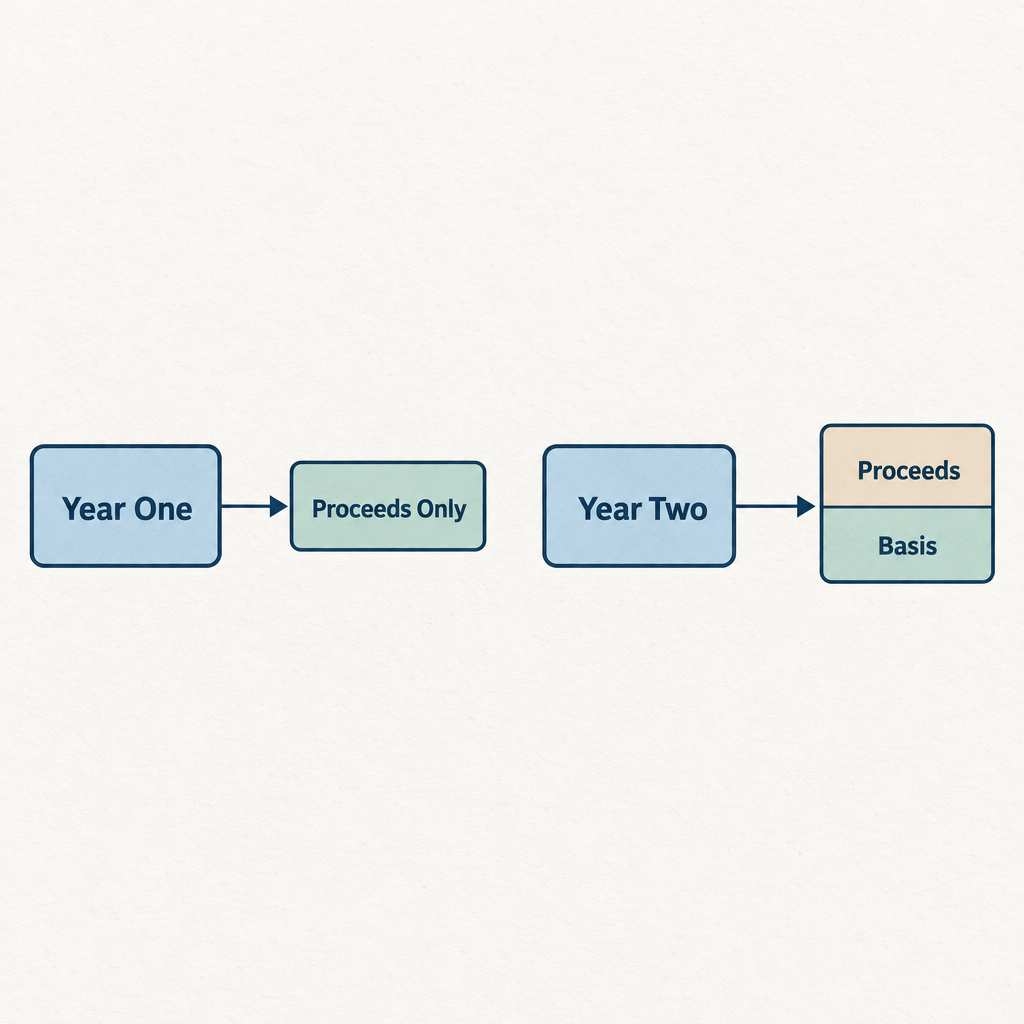
    Flow diagram showing two phases of 1099-DA reporting: first year proceeds only, second year proceeds plus basis

    The IRS phased the reporting in over two tax years, and the phase-in is the source of most of the confusion.

    Tax year What the broker reports When you receive it
    2025 sales Gross proceeds only; basis box generally blank February 17, 2026
    2026 sales Proceeds, plus cost basis for assets bought on or after January 1, 2026 in that same account mid-February 2027
    2027 and later Same as 2026, with more assets qualifying as “covered” over time mid-February each year

    The phrase “covered digital asset” does the heavy lifting here. A covered asset is one you bought through the broker on or after January 1, 2026 and kept in that same account until you sold it. For those, the broker knows your purchase price and must report it. Anything bought before 2026, or transferred in from another wallet or exchange, is “noncovered.” The broker reports the proceeds but leaves basis to you, and it ticks a box on the form telling the IRS that basis was not reported.

    For 2025 sales, nearly everything was noncovered by definition. That means your first 1099-DA almost certainly showed a proceeds figure with no basis next to it.

    The IRS also carved out transaction types it was not ready to handle. Notice 2024-57 told brokers they do not have to report wrapping and unwrapping tokens, liquidity pool deposits and withdrawals, staking, crypto lending, short sales and notional principal contracts until the IRS says otherwise. Those activities can still create taxable income for you. They just will not appear on this form yet.

    What the form actually shows

    Each 1099-DA covers a single sale or disposition, though most brokers deliver them as one consolidated statement that runs through every transaction. The key fields are:

    • An identifier and name for the digital asset
    • The number of units disposed of
    • The date you acquired the asset, if the broker knows it
    • The date you sold or disposed of it
    • Gross proceeds, usually the dollar value you received after any fees the broker netted out
    • Cost or other basis, when the asset is covered
    • A checkbox showing whether basis was reported to the IRS
    • Whether the holding period was short-term or long-term, when the broker can determine it
    • Any federal income tax withheld

    Early drafts of the form in 2024 asked for wallet addresses, transaction hashes and the exact time of day of each sale. After public comments, the IRS dropped those fields from the version brokers now use.

    One more detail worth knowing: the proceeds figure can reflect value you received in other crypto, not only cash. If you traded ETH for SOL on an exchange, the broker reports the fair market value of the SOL you received as your proceeds from selling ETH. Swaps count as sales for tax purposes and always have.

    Why a proceeds-only form can cost you money

    Here is the problem with a form that reports what you sold for but not what you paid. The IRS runs an automated matching program that compares the 1099s it receives against the income on your return. When a 1099-DA arrives showing $45,000 in proceeds and your return shows nothing, the system does not assume you broke even. It can treat the entire $45,000 as gain and send you a CP2000 notice proposing extra tax, interest and an accuracy penalty.

    A worked example shows the gap:

    Item Your real numbers What a bare 1099-DA shows
    Sold 0.5 BTC on a US exchange 0.5 BTC
    Proceeds $45,000 $45,000
    Cost basis $38,000 (bought in 2024) blank, noncovered
    Actual gain $7,000 unknown to IRS
    Tax at a 15% long-term rate $1,050 could be assessed on $45,000 if you fail to report

    The fix is entirely in your hands. You report the sale on Form 8949 with your own basis figure, carry the total to Schedule D, and the proceeds you report match what the broker filed. The matching program is satisfied, and you pay tax on the $7,000 you actually made.

    Ignoring the notice is the expensive route. Unpaid balances accrue interest daily, and the IRS can file liens, levy bank accounts and, for older inactive accounts, assign the debt to a private debt collector under its private collection program. None of that happens if you reconcile the form the first time.

    Tracking basis under the new rules

    Because the broker will not know your basis for most older coins, the IRS has issued a cluster of guidance on how you prove it.

    Wallet-by-wallet accounting. Revenue Procedure 2024-28 ended the informal “universal” method many investors used, where all their coins across every exchange were treated as one big pool. As of January 1, 2025, basis must be tracked account by account and wallet by wallet. The revenue procedure gave a safe harbor for allocating your existing unused basis to specific wallets as of that date. If you never made that allocation, you need to do it now using records you already had.

    Default method is FIFO. If you do not specifically identify which units you are selling, the regulations treat you as selling the earliest units acquired in that account first. For coins bought cheaply years ago, FIFO can produce the largest possible gain.

    Specific identification. You can choose which lots to sell, which often lowers your gain, but under the regulations the identification has to be made no later than the time of the sale and the broker needs to be able to record it. Because most exchanges did not have that capability ready, Notice 2025-7 gave taxpayers relief for 2025: you could rely on your own books and records to identify the units sold, as long as you kept them. Check whether your exchange now supports lot selection before you assume that relief continues.

    Transfers. When you move coins from one exchange to another, the receiving exchange has no idea what you paid. The final regulations did not require brokers to pass basis information between each other, so the burden of carrying that number across platforms is yours. Keep the original purchase confirmation, the transfer record and the dates.

    How to reconcile your 1099-DA

    1. Download every 1099-DA and the broker’s full transaction history for the year.
    2. Confirm the proceeds on the form match the sum of your sales in the history export.
    3. Pull your own basis for each sale from purchase records, prior-year forms or your tracking software.
    4. Enter each sale on Form 8949, using the box for basis not reported to the IRS where the form marks the asset noncovered.
    5. Carry the totals to Schedule D, and answer “Yes” to the digital asset question on Form 1040.
    6. Keep the records for at least three years after filing, and longer if the IRS questions a return.

    Risks the form does not change

    A 1099-DA reports taxes, it does not protect you from losses. Crypto can lose all of its value, and holding it on an exchange adds custody risk on top of market risk. Your coins on an exchange are not FDIC insured the way bank deposits are, and they are not covered by SIPC the way securities in a brokerage account are. When FTX collapsed in 2022, customers got tax paperwork from other platforms as usual but spent years in bankruptcy court trying to recover their assets.

    Losses have their own tax rules. Capital losses offset capital gains, and up to $3,000 of net capital loss per year can offset ordinary income, with the remainder carried forward. A 1099-DA that shows a sale below your basis is useful evidence of that loss. Coins that simply became worthless while you still hold them are harder; there is no sale, so there is usually no deductible loss until you dispose of them.

    Backup withholding is the other risk worth flagging. Normally a broker must withhold 24 percent of proceeds when a customer has not supplied a valid taxpayer identification number. Notice 2024-56 gave brokers transitional relief from backup withholding and related penalties on digital asset sales during 2025 so their systems could come online, and Notice 2026-20 later extended identification relief into 2026. If your exchange account has an outdated or missing Social Security number, fix it, because once the relief expires 24 percent of each sale can go straight to the Treasury.

    What a 1099-DA is not

    The form only covers sales and dispositions. Several other kinds of crypto income show up elsewhere or nowhere at all:

    • Staking and mining rewards are ordinary income when you gain control of them, per Revenue Ruling 2023-14. An exchange may report larger amounts on Form 1099-MISC, but the income is taxable at any amount.
    • Airdrops and hard forks are ordinary income at fair market value when received.
    • Payments received for goods or services in crypto may arrive on a Form 1099-K from a payment app or a 1099-NEC from a client, not a 1099-DA.
    • Real estate bought with crypto is reported by the closing agent on Form 1099-S for closings on or after January 1, 2026, with the digital asset’s fair market value shown.

    Receiving no form at all also changes nothing. Self-custody trades, foreign exchanges and DeFi activity all remain reportable. The 1099-DA tells the IRS part of the story; your return has to tell the whole thing.

    Before you file

    The biggest mistake is reporting nothing because the basis box is blank. The IRS has the proceeds figure either way, and a return that omits the sale invites a notice taxing the full amount.

    Free help first

    IRS Free File supports Form 8949 for most filers under its income limit.
    VITA and Tax Counseling for the Elderly sites prepare returns free for eligible taxpayers.
    The IRS Taxpayer Advocate Service can step in if a notice is causing hardship and the normal channels have stalled.

    FAQ

    What is Form 1099-DA in plain terms?

    It is the tax form a US crypto exchange or other custodial broker files to report your sales of digital assets to the IRS, with a copy to you. It lists the asset, the units, the dates and your gross proceeds, and for assets bought on the platform from 2026 onward it also lists your cost basis.

    When did Form 1099-DA start?

    Brokers began tracking sales on January 1, 2025. The first forms, covering 2025 activity, were due to customers by February 17, 2026. Cost basis reporting starts with assets acquired on or after January 1, 2026 and appears on forms issued in early 2027.

    Do I owe tax on the proceeds number?

    No. You owe tax on your gain, which is proceeds minus basis. The form may show only proceeds. You supply the basis on Form 8949, and the difference, if positive, is your taxable gain.

    I did not get a 1099-DA. Do I still report my crypto sales?

    Yes. The reporting requirement applies to you regardless of what paperwork arrives. Sales from a self-custody wallet, a decentralized exchange or a foreign platform are taxable even though no broker reports them.

    What if the form is wrong?

    Contact the broker and ask for a corrected form. If the broker will not fix it, report the correct figures on Form 8949 and attach an explanation of the difference. Keep the records that support your numbers, because the IRS will see the broker’s version too.

    Does Form 1099-DA report swaps between two cryptocurrencies?

    Yes. Trading one digital asset for another is a disposition of the asset you gave up, and the broker reports the fair market value of what you received as your proceeds.

    Will the IRS see my wallet addresses on the form?

    No. The IRS removed wallet addresses, transaction hashes and time-of-day fields from the final version of the form after public comments on the 2024 drafts.