WARNINGConsumer alert, published October 17, 2026
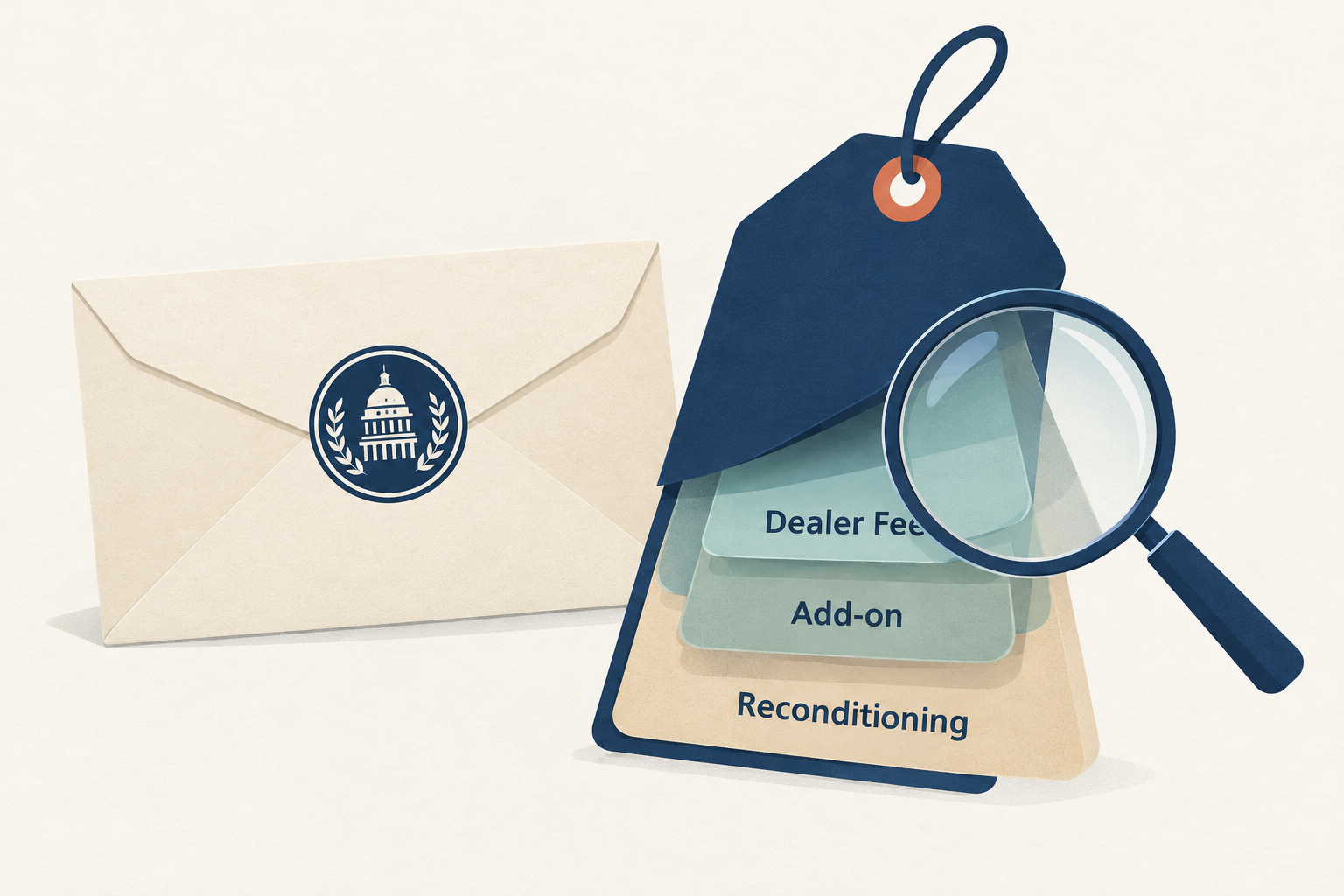
The Federal Trade Commission said on March 13, 2026 that it is sending warning letters to 97 auto dealership groups across the country. The letters, each dated March 11, 2026 in the FTC’s warning-letter database, tell dealers that an advertised price must be the total price a buyer will actually have to pay, including every mandatory fee. On October 8, 2026, the FTC followed up with a proposed settlement against one dealer group it accused of advertising prices thousands of dollars below what it charged.
What is happening
According to the FTC’s March 2026 press release, the letters ask each dealer group to review its advertising and pricing practices and make sure the prices it advertises match the prices it actually charges. The FTC said it will keep monitoring the market and take further action as warranted under the FTC Act and the other rules it enforces.
The FTC says the auto letters are part of a broader push on price transparency that also covers rental housing, ticketing, hotels, grocery and delivery services.
The letters are not a finding that any dealer broke the law. Law-firm summaries from Hudson Cook and AFS Law describe them as warnings, not determinations of a violation, and the FTC’s own release frames them as a request that dealers review their practices.
The FTC did not name the recipients at first. Crowell & Moring, a law firm, reports the names were made public on May 28, 2026. The FTC’s warning-letter database now lists the letters under the press release title and shows 98 entries. Recipients include Sonic Automotive, Page Toyota and Ourisman Automotive Group. An industry analysis cited by Carscoops put the reach at about 203 dealership locations.
Crowell & Moring also notes the letters came after the Fifth Circuit vacated the FTC’s CARS Rule, so the agency is relying on its general authority against deception under Section 5 of the FTC Act.
What the warning covers
The FTC’s March 2026 release lists several practices it considers red flags:
- Advertising a price that does not include all required fees.
- Advertising a price that reflects rebates or discounts not available to every buyer.
- Advertising a price that leaves out an additional required down payment.
The October 8, 2026 case shows what the FTC says happens when a dealer ignores the warning. The FTC said its Bureau of Consumer Protection sent Greenway Auto Group a letter in March 2026 about misleading advertising. According to the FTC’s complaint, Greenway responded by adding false assurances of price transparency to its websites. The FTC alleged the group advertised prices thousands of dollars below what it actually charged and sent false prize mailers.
Greenway agreed to a proposed order to settle the lawsuit. Under that order, the FTC said, Greenway’s price ads must prominently include the actual price a consumer must pay, leaving out only government-required charges. The order also bars deceptive prize mailers and bars misrepresenting whether any charge, fee, tax, product or service is optional or required, or whether a specific type or source of financing is required. The order was filed in federal court in Florida. It is a proposed settlement, not a verdict, and the FTC page did not show an effective date.
How to spot it
- The price in the ad is lower than the price on the buyer’s order once “dealer fees,” “reconditioning” or “protection packages” appear.
- The ad price assumes a rebate you do not qualify for, such as a military, loyalty or recent-graduate discount.
- A “low monthly payment” ad is built on a large down payment that is not mentioned up front.
- The dealer says an add-on is required when the ad never mentioned it.
- You are told you must finance through the dealer to get the advertised price.
- A mailer says you have won a prize and need to visit the dealership to claim it.
Never sign for a price you have not seen in full
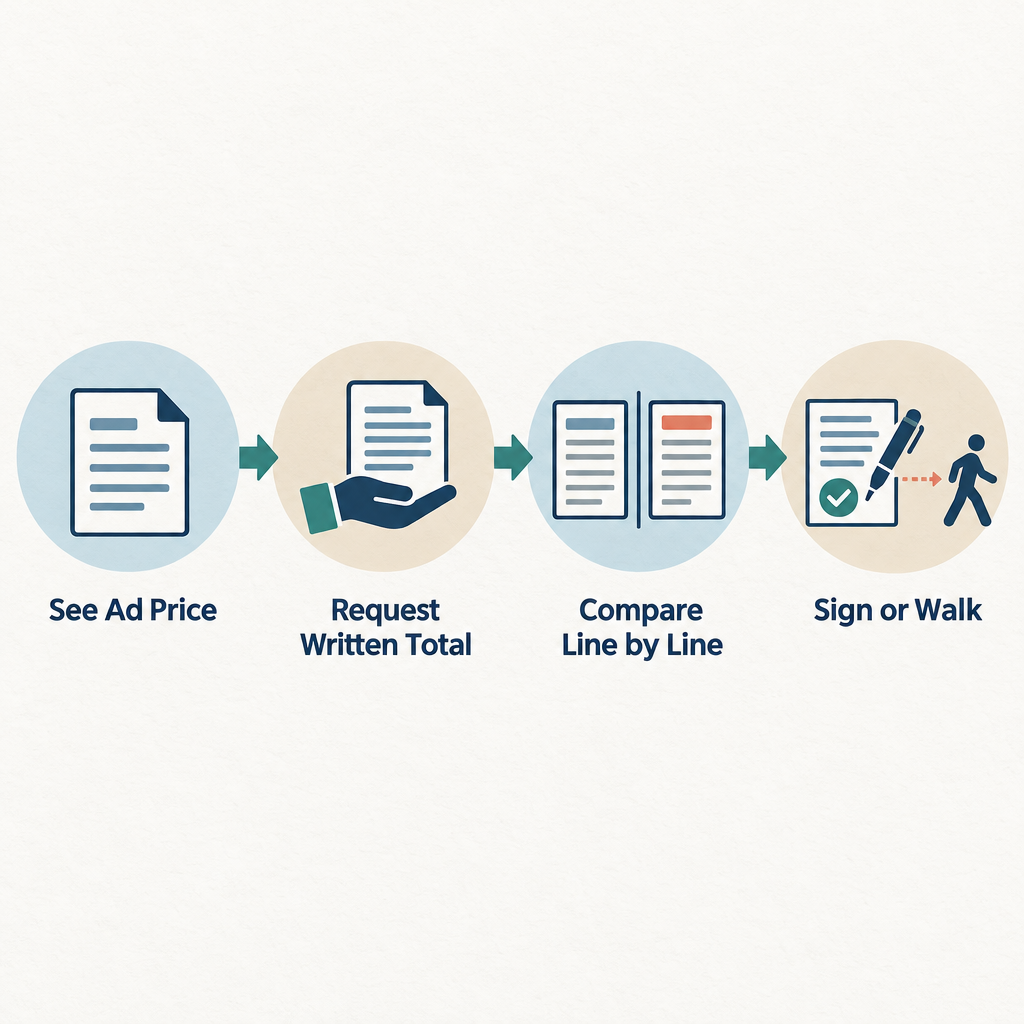
Ask for one written number: the total you will pay, with every fee, add-on and tax listed. If the dealer will not put that in writing before you sign, walk out. Once you sign a purchase contract or financing agreement, it is much harder to undo.
If you were targeted
- Save the ad. Take screenshots of the online listing or keep the mailer, with the date.
- Compare the ad price line by line to your buyer’s order or contract and note every added charge.
- Ask the dealer, in writing, to explain each fee and whether it was required.
- If you put down a deposit on a card and the dealer will not honor the advertised price, call the number on the back of your card and ask about disputing the charge.
- If you already financed the car and the numbers do not add up, talk to a lawyer or a nonprofit credit counselor before making any changes to the loan.
- Report the ad to the FTC and your state attorney general, with your screenshots attached.
How to report it
File a report with the FTC at ReportFraud.ftc.gov. Include the dealer’s name, the ad, the date and the price you were actually charged. The FTC said its March 2026 letters are one step and that it will act further as warranted, so reports help it see which dealers have not changed their practices.
Report deceptive car ads to your state attorney general’s consumer protection office as well. Many states have their own rules on dealer advertising and can act on complaints locally.
If a dealer-arranged loan has problems, you can also file a complaint with the CFPB at consumerfinance.gov/complaint.
Check, verify or complain
Sources
- FTC press release 'FTC Warns 97 Auto Dealership Groups About Deceptive Pricing' (ftc.gov) ftc.gov · primary source
- FTC Legal Library, Warning Letters by Press Release (ftc.gov) ftc.gov · primary source
- FTC press release, Oct 8, 2026 (ftc.gov) ftc.gov · primary source
- FTC (ftc.gov) boilerplate, older release ftc.gov · primary source

Leah writes US Financer's Consumer Alerts: scam warnings and money rule changes issued by federal agencies, state attorneys general, regulators and courts. Each alert starts from the official notice, says what is confirmed and what is not known yet, and lists the agency's own page…

Ruth is US Financer's standards editor. Every article goes through her checks before and after it is published: each rate, fee, cap, deadline and rule is matched against its primary source, every law named is linked to its official text, and anything that cannot be…
Comments are closed