A cash advance app lets you pull a few hundred dollars forward from your next paycheck, usually for a subscription, an express fee or a “tip” rather than stated interest. We ranked the apps that publish their terms, worked out what each one actually costs on a typical two-week advance, and set the whole category next to the cheaper options a credit union or your employer may already offer.
Key takeaways
- No app on this list charges stated interest, but almost all of them earn money from express fees, monthly subscriptions or default tip prompts. A $3.99 fee on a $100 advance repaid in 14 days works out to an APR above 100%.
- The cheapest advances come from the bank you already use. Chime MyPay and Varo Advance only serve their own account holders, and that is exactly why they can afford to charge so little.
- Advances are small. The headline “up to $500” or “up to $750” figure is a ceiling that new users rarely reach. The FTC has sued or settled with Brigit, Cleo, FloatMe and Dave over the gap between advertised and actual amounts.
- Nothing here builds credit. Apps do not report to Equifax, Experian or TransUnion, so paying on time gains you nothing, and most apps also do not run a hard credit check.
- Repayment is automatic. The app debits your linked account on payday, and the biggest hidden cost is the overdraft that debit can trigger at your bank.
How we ranked these cash advance apps
We compared apps on six criteria: total cost of a typical advance, whether a free delivery option exists, how clearly the fee is disclosed before you accept, the realistic advance limit for a new user, delivery speed, and the company’s record with regulators. We only included apps that publish fee schedules and that operate under a licensed bank partner or a state registration. Each app got a real weakness in its write-up, because every one of them has at least one.
Figures below come from each app’s published fee disclosure and terms at the time of writing. Apps change pricing often and quietly, so read the exact fee on the confirmation screen before you tap accept.
Best cash advance apps compared at a glance
| Rank | App | Max advance | Mandatory cost | Free delivery? | Instant delivery fee | Needs its own bank account? |
|---|---|---|---|---|---|---|
| 1 | EarnIn (Cash Out) | $150/day, $750/pay period | $0 | Yes, 1 to 3 business days | $2.99 to $5.99 | No |
| 2 | Chime (MyPay) | $500 | $0 | Yes, by next day | $2 to $5 (3% of amount) | Yes, Chime checking with direct deposit |
| 3 | Varo (Advance) | $500 | $0 to $40 flat, by amount | Instant is standard | Included in flat fee | Yes, Varo Bank account with direct deposit |
| 4 | Cash App (Borrow) | $200 | 5% flat | No separate tiers | Included | Yes, active Cash App account |
| 5 | MoneyLion (Instacash) | $500, higher with RoarMoney | $0 | Yes, 1 to 5 business days | $0.49 to $8.99 | No |
| 6 | Dave (ExtraCash) | $500 | $1/month plus 5% (min $5, max $15) | No under current pricing | Included in 5% fee | No |
| 7 | Current (Paycheck Advance) | Scaled to deposit history | $0 | Yes, standard delivery | Varies by amount | Yes, Current account with direct deposit |
| 8 | Brigit (Instant Cash) | $250 | $9.99 or $14.99/month | Yes, 1 to 3 business days | $0.99 to $3.99 | No |
| 9 | Empower (Cash Advance) | $400 | $8/month | Yes, 1 to 2 business days | $1 to $8 | No |
Klover, Albert and Cleo also offer advances. They did not make the ranked list because their published limits for new users are low, their subscription plus express pricing lands near the top of the cost range, and in Cleo’s case the FTC reached a $17 million settlement with the company in 2025 over advertised advance amounts and cancellation practices.
Before you borrow
The real risk with a cash advance app is not the fee on the first advance. It is the loop: the app debits your full balance on payday, your check is short, and you take another advance the same day. CFPB research found the average user takes more than two dozen advances a year.
What a cash advance app really costs
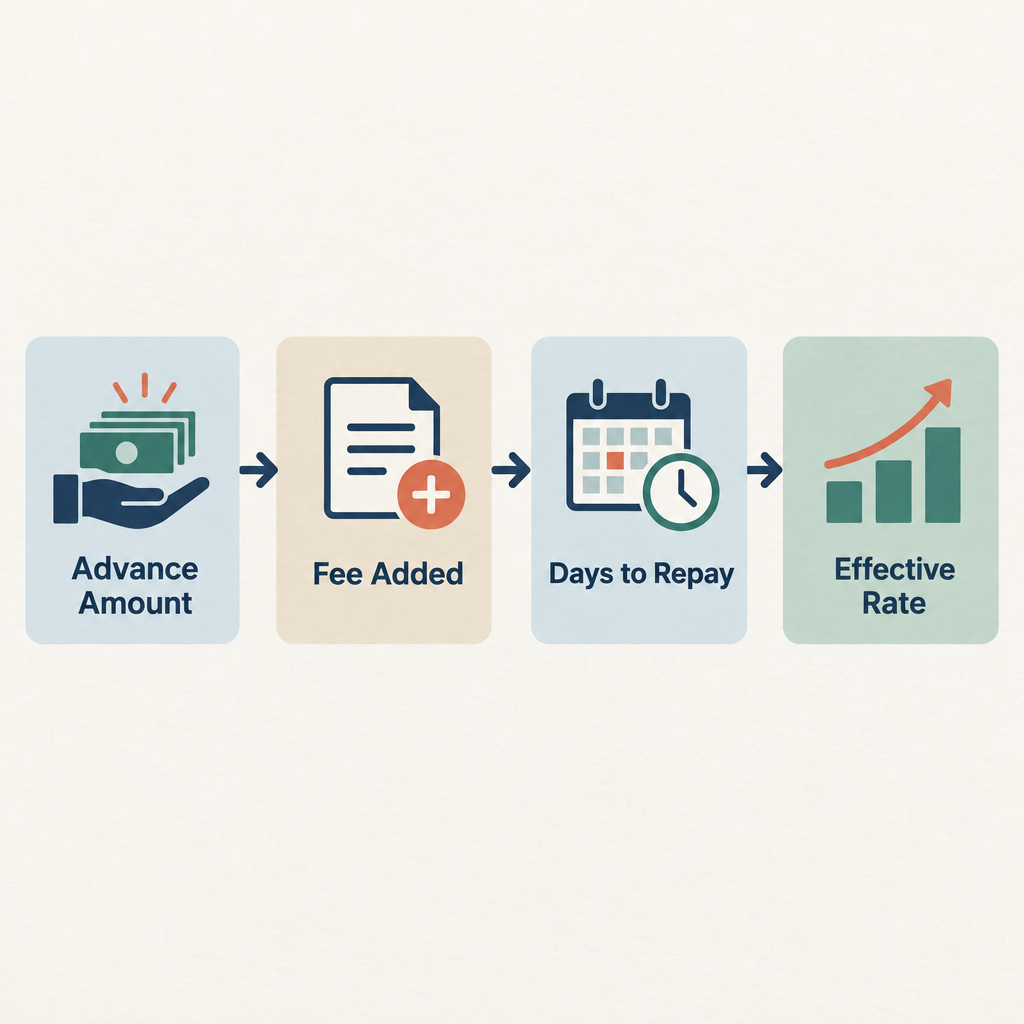
Apps do not quote an APR, so you have to compute it yourself. The math is simple: divide the fee by the amount, then multiply by 365 divided by the number of days until repayment. A $3.99 fee on $100 for 14 days is 3.99 divided by 100, times 26.07, which comes to about 104%.
That is the number to compare against a credit union loan or a credit card cash advance, because it puts a 14-day product and a 12-month product on the same scale. The CFPB’s July 2024 data spotlight on paycheck advance products found the typical advance was a little over $100 and that the average effective APR, for users who paid a fee or tip, was above 100%.
| App and scenario | Amount | Fees you pay | Days to repay | Total repaid | Effective APR |
|---|---|---|---|---|---|
| EarnIn, standard delivery, no tip | $100 | $0 | 14 | $100.00 | 0% |
| EarnIn, Lightning Speed at $3.99, no tip | $100 | $3.99 | 14 | $103.99 | 104% |
| EarnIn, Lightning Speed plus $5 tip | $100 | $8.99 | 14 | $108.99 | 234% |
| Chime MyPay, instant | $500 | $5.00 | 14 | $505.00 | 26% |
| Varo Advance, top tier | $500 | $40.00 | 30 | $540.00 | 97% |
| Cash App Borrow | $200 | $10.00 | 28 | $210.00 | 65% |
| MoneyLion Instacash, Turbo at $8.99 | $500 | $8.99 | 14 | $508.99 | 47% |
| Dave ExtraCash, 5% fee plus $1 membership | $200 | $11.00 | 14 | $211.00 | 143% |
| Dave ExtraCash at the $15 fee cap plus $1 | $500 | $16.00 | 14 | $516.00 | 83% |
| Brigit Plus, standard delivery | $250 | $9.99 | 14 | $259.99 | 104% |
| Empower, subscription plus $8 instant fee | $300 | $16.00 | 14 | $316.00 | 139% |
| Credit union PAL, 28% APR plus $20 application fee | $500 | about $44 | 90 | about $544 | 28% stated |
| Storefront payday loan at $15 per $100 | $500 | $75.00 | 14 | $575.00 | 391% |
Two things stand out. First, the gap between apps is large: Chime’s $5 instant fee on $500 is a third of Dave’s capped fee on the same amount, and one fifteenth of what a payday loan charges. Second, every app that charges a percentage or a subscription gets more expensive as the advance gets smaller, which is backwards from how most credit works. A $9.99 monthly plan to borrow $50 is an APR near 520%.
The tip line matters more than it looks. EarnIn and MoneyLion present a tip slider on the confirmation screen, and the CFPB’s 2024 analysis treated tips as part of the cost because so few users set them to zero. You can. Nothing in either app’s terms penalizes a $0 tip.
The 9 cash advance apps, ranked
1. EarnIn Cash Out: top pick for borrowing against hours you already worked
EarnIn is our top pick because it is the only app with no subscription, no mandatory fee and no requirement to move your bank account. You connect a checking account that receives direct deposit, add your employer and either a work address or a timesheet, and EarnIn tracks earnings as you go. Cash Out lets you pull up to $150 a day and $750 per pay period, repaid by a debit on payday.
Standard delivery takes one to three business days and costs nothing. Lightning Speed delivers in minutes for $2.99 to $5.99 depending on the amount. The tip prompt defaults to a dollar figure, so set it to zero every time if you want the free product. The app also has a Balance Shield feature that auto-advances when your balance drops below a threshold you set, which is convenient and also the fastest route into the repeat loop described above.
Weaknesses: new users start well below the $750 ceiling and limits rise slowly. Earnings verification can fail for tipped, gig or irregular-hours workers. EarnIn paused or limited service in Connecticut after that state brought earned wage access under its small loan law in 2023, so the app is not available everywhere.
2. Chime MyPay: cheapest option if your paycheck already lands at Chime
MyPay is a feature of Chime’s checking account, not a standalone app. Members with a qualifying direct deposit can access up to $500 of pay before payday. Delivery by the next day costs nothing. Instant delivery costs 3% of the amount, with a $2 minimum and a $5 cap, which still makes it one of the cheapest instant advances in the market. Chime repays itself from the direct deposit when it arrives.
Chime is a financial technology company, not a bank. Deposits are held at The Bancorp Bank, N.A. or Stride Bank, N.A., both FDIC members, and that is who you are actually banking with.
Weaknesses: you have to move your direct deposit to Chime to use it, and switching banks to get a cheap advance is a big step for a small benefit. Your limit is set by Chime’s read of your deposit history, and new members typically see far less than $500. If your employer’s pay date slips, the repayment and the deposit can land out of order.
3. Varo Advance: flat fees with no subscription and no tips
Varo Bank, N.A. is a chartered bank, which makes it unusual on this list. Varo Advance lets qualifying account holders with direct deposit borrow $20 to $500 and repay within 30 days. The fee is a flat amount tied to the advance size, shown in the app before you accept. There is no monthly plan, no express surcharge and no tip screen.
That flat fee schedule is the honest part. The fee on a large advance is not cheap, but it is printed in the app before you accept and it never changes based on how fast you want the money.
Weaknesses: you need a Varo account with recent qualifying direct deposits. Small advances are a bargain and large ones are not, so the product rewards borrowing $20 and punishes borrowing $500. The 30-day term is longer than most apps’, which helps cash flow but makes it easy to forget the debit.
4. Cash App Borrow: the “money app cash advance” most people are searching for
When readers search for a money app cash advance they usually mean Cash App. Borrow is Cash App’s small loan feature: up to $200 for eligible users, a flat 5% fee, and four weeks to repay. A $200 loan costs $10, a 65% APR, with no tip prompt and no subscription. Repayment can be weekly or in a single payment at the end.
Borrow is a loan, not an earned wage product, so it is disclosed as one. Late balances accrue a 1.25% weekly finance charge after a short grace period, which is the one way the price can climb.
Weaknesses: Borrow is invitation-only. Cash App enables it based on your account activity and location, and there is no way to apply. Limits start low. The late charge compounds weekly, so a $200 balance left alone for three months costs noticeably more than the headline 5%.
5. MoneyLion Instacash: biggest advances without switching banks
Instacash advances run up to $500 for users who link an outside checking account, and MoneyLion advertises higher limits for people who move their direct deposit to its RoarMoney account. No subscription is required for Instacash itself. Standard delivery is free and takes one to five business days to an external bank. Turbo delivery costs $0.49 to $8.99 depending on the amount and where it is going, and there is an optional tip.
The published Turbo fee for a $500 advance is lower than Dave’s capped fee, which is why MoneyLion ranks above Dave despite similar limits.
Weaknesses: the five-day standard window to an outside bank is the slowest free option on the list, so most users end up paying for Turbo. The app aggressively cross-sells its paid membership, credit builder loan and investing products. The CFPB sued MoneyLion in 2022, alleging its membership fees pushed loans to servicemembers over the Military Lending Act’s 36% cap; the company contested the case.
6. Dave ExtraCash: a bigger limit at a higher price
Dave advertises ExtraCash advances up to $500 and charges a $1 monthly membership. Under the pricing Dave has published most recently, each advance carries two mandatory charges: the monthly membership fee plus a 5% service fee on the amount, with a $5 minimum and a $15 cap. Dave dropped tips in early 2025. A $100 advance costs $5 plus the membership dollar. A $500 advance costs the capped $15.
That structure is simpler than the old mix of express fees and tips, and the $15 cap makes Dave reasonable on large advances. It also means there is no longer a free slow option; check the current terms, because this is the fee structure that changed most recently.
Weaknesses: on small advances the $5 minimum is steep, a 130% APR on $100 over two weeks. In November 2024 the FTC, later joined by the Department of Justice, sued Dave over its “up to $500” advertising and the way it disclosed express fees and tips. Dave disputed the claims. Whatever the outcome, the complaint lays out the gap between advertised and typical advance amounts in detail.
7. Current Paycheck Advance: best for existing Current members with steady deposits
Current is another fintech checking account, with deposits held at partner banks. Paycheck Advance lets members who direct deposit their pay access a portion of it early, with the limit set by the size and consistency of their deposit history. Standard delivery is free; instant delivery carries a fee that scales with the amount. Repayment comes out of the next deposit.
Weaknesses: like Chime and Varo, this only works if your pay already goes to Current. Limits for new members are modest, and Current publishes the instant fee inside the app rather than on a public schedule, so you cannot price it before you open an account.
8. Brigit Instant Cash: budgeting alerts bundled with a small advance
Brigit’s advance is only available on a paid plan: Plus at $9.99 a month or Premium at $14.99 a month. Advances run from $50 up to $250 (Brigit advertises higher amounts for some longer-tenured members). Standard delivery is free in one to three business days, and instant delivery costs $0.99 to $3.99. The plan also includes overdraft prediction alerts, credit monitoring and a credit builder product.
Weaknesses: the subscription is the whole problem. Paying $9.99 to borrow $100 once in a month is a 260% APR before any express fee. In November 2023 Brigit paid $18 million to settle FTC allegations that it advertised “up to $250” to users who could not get that amount and made the subscription hard to cancel, which the FTC pursued under the FTC Act and the Restore Online Shoppers’ Confidence Act.
9. Empower Cash Advance: easy approval, expensive bundle
Empower advances up to $400 for $8 a month, with free delivery in one to two business days or instant delivery for $1 to $8. Approval leans on bank account cash flow rather than a credit score, and the app does a decent job showing the fee before you accept.
Weaknesses: the subscription stacks with the express fee, so a $300 instant advance can cost $16 for two weeks, a 139% APR. Empower also pushes its Thrive line of credit, which is a separate product with its own cost, in the same screens where you manage advances.
Apps that did not make the cut
Klover offers advances up to about $200 and makes money partly by asking you to share shopping and transaction data for points, with express fees that vary widely by amount and bank. Albert bundles advances into a paid subscription and has changed its limits and plan pricing repeatedly. Cleo charges a monthly plan and settled with the FTC in March 2025 for $17 million over deceptive advance amounts. FloatMe paid $3 million to the FTC in early 2024 over similar claims. Beem, Grant, VANSi and similar names that appear in app store search results publish thin or shifting fee information, which is enough on its own to leave them off a ranked list.
Cheaper options first
Ask your employer about an earned wage program; many pay the provider’s fee so your advance is free.
Check a credit union’s payday alternative loan: $200 to $1,000 at a 28% APR ceiling under NCUA rules.
Big banks now offer small-dollar loans with flat fees: Bank of America Balance Assist charges $5, U.S. Bank Simple Loan charges $6 per $100.
Cheaper ways to get the same money
Everything in the ranked list is a last-mile product. Before you connect a bank account to any of them, price these.
| Option | Amount | Cost | Term | Who qualifies |
|---|---|---|---|---|
| Employer earned wage access (DailyPay, Payactiv, etc.) | Portion of hours worked | $0 if your employer pays the fee; otherwise a few dollars | Next payday | Employees of participating companies |
| Credit union payday alternative loan (PAL) | $200 to $1,000 | Max 28% APR, application fee up to $20 | 1 to 6 months | Members of a participating federal credit union |
| Bank of America Balance Assist | $100 to $500 | $5 flat | 3 monthly installments | Existing checking customers |
| U.S. Bank Simple Loan | $100 to $1,000 | $6 per $100 | 3 monthly installments | Existing checking customers with direct deposit |
| Wells Fargo Flex Loan | $250 or $500 | $12 or $20 flat | 4 monthly payments | Existing customers invited in the app |
| Huntington Standby Cash | $100 to $1,000 | 0% with autopay, otherwise 1% a month | 3 monthly payments | Existing checking customers |
| Nonprofit credit counseling hardship plan | Varies | Free or low cost | Varies | Anyone; look for NFCC member agencies |
| Utility and rent hardship programs, 211 referrals | Bill-specific | $0 | Varies | Income-based |
The NCUA’s payday alternative loan rule, 12 CFR 701.21(c)(7)(iii), sets the PAL terms above: $200 to $1,000, one to six months, a 28% APR ceiling, an application fee of no more than $20, and one month of membership before borrowing. PAL II loans under the same regulation go up to $2,000 for up to 12 months with no membership waiting period. A $500 PAL at 28% for three months costs about $24 in interest plus the application fee, which is less than a single month of Brigit Premium plus two express fees.
An employer-based program is different from a consumer app in one key way: the employer or payroll provider verifies the hours, so there is no bank-account scraping and often no fee to you at all. If your workplace offers one, it beats every consumer app in this article on cost. For readers comparing a paycheck loan from a lender against this kind of employer program, the difference in price is usually several hundred percentage points of APR.
How a cash advance app decides what you get
None of these apps run a hard credit inquiry, which is why they can claim “no credit check.” What they do instead is read your bank account. You grant access through Plaid or a similar aggregator, and the app looks at how often direct deposits land, how large they are, how low your balance dips between paydays, and whether you have bounced payments. EarnIn goes further and ties the advance to verified hours worked.
That is why limits start small. The app has no credit report to lean on, so it tests you with $25 or $50 and raises the ceiling as it watches you repay. Advertised maximums describe long-tenured users with large, steady deposits. The FTC’s complaints against Brigit, Cleo and Dave all turned on this point: most users never saw the headline amount.
Gig workers, tipped employees and anyone paid by paper check or irregular transfers tend to get the lowest limits or get declined, because the model cannot find a predictable paycheck to borrow against.
Where cash advance apps are regulated
There is no single federal rule for this category, and the picture has shifted twice in two years.
At the federal level, the CFPB issued an advisory opinion in 2020 saying a narrow kind of employer-integrated, no-fee earned wage product was not “credit” under the Truth in Lending Act. In July 2024 the Bureau proposed an interpretive rule going the other way, stating that paycheck advance products are credit under Regulation Z (12 CFR 1026) and that expedite fees and tips count as finance charges that must be disclosed with an APR. In May 2025 the CFPB withdrew that proposed rule along with dozens of other guidance documents. As a result, federal treatment is unsettled, and no app currently shows you an APR because none is required to.
States have filled the gap, and they disagree with each other.
| State | What the law does | Effect on apps |
|---|---|---|
| Nevada | 2023 law (SB 290) created the first earned wage access license; providers must offer a free option, cannot require tips and cannot pursue collections or report to credit bureaus | Apps operate under license; not treated as loans |
| Missouri | 2023 registration law modeled on Nevada’s | Similar to Nevada |
| Wisconsin, Kansas, South Carolina | 2024 licensing laws with free-option and no-mandatory-tip rules | Similar to Nevada |
| Connecticut | 2023 law counts app fees and tips as interest under the small loan act | Several apps, including EarnIn, limited or paused service |
| California | DFPI rules effective February 2025 require providers to register and report advances as loans, with fees and tips tracked as charges | Apps must register with DFPI; no fee cap yet |
| Maryland | 2025 law adds licensing and fee limits for earned wage access | New rules; check the Commissioner of Financial Regulation |
Several more states, including Indiana and Arkansas, passed licensing laws in 2025, and the list keeps growing. The practical takeaway: an app available to a friend in Nevada may not serve you in Connecticut, and an app’s fee in California is reported to a regulator while the same fee in Texas is not. Check your state regulator’s license lookup before assuming a product is available or overseen where you live.
Your rights when you use a cash advance app
Even without a settled federal rule, several laws already apply to the mechanics.
Electronic Fund Transfer Act and Regulation E (12 CFR 1005). The app repays itself by debiting your account. You have the right to revoke that authorization, and your bank must honor a stop payment on a preauthorized debit if you give notice at least three business days before the scheduled transfer. If the app debits more than you authorized, Regulation E’s error resolution rules require your bank to investigate. Blocking a debit does not cancel the debt, but it can stop an overdraft cascade.
Military Lending Act (10 U.S.C. 987, 32 CFR 232). Active-duty servicemembers and dependents are “covered borrowers,” and credit extended to them carries a 36% cap on the Military APR, which includes fees and subscription charges connected to the credit. The CFPB’s case against MoneyLion is built on this rule.
Truth in Lending Act and Regulation Z. Because most apps structure advances as non-recourse (they say they will not sue or send a debt collector if you do not repay), they argue no finance charge exists. If a product does charge a fee that is mandatory for the credit, TILA disclosures may be required, and Cash App Borrow, which is structured as a loan, does disclose on those terms.
Federal Trade Commission Act, Section 5. Deceptive advertising of advance limits and dark-pattern cancellation flows are what drove the Brigit, Cleo, FloatMe and Dave actions. The Restore Online Shoppers’ Confidence Act covers the subscription side.
Fair Credit Reporting Act. Apps generally do not furnish payment data to the credit bureaus, so an advance does not help or hurt your score. Apps that bundle a “credit builder” product are furnishing data on that product, not the advance.
Fair Debt Collection Practices Act. Most apps state they will not refer unpaid advances to collections. If one does, the collector is bound by the FDCPA’s limits on calls, threats and disclosures to third parties.
State small loan and usury laws. In states like Connecticut, and increasingly California, tips and express fees are counted as charges on a loan. That means state rate caps and licensing can apply.
Where to complain: the CFPB complaint portal for problems with debits, fees or disclosures; the FTC’s ReportFraud site for deceptive advertising and cancellation traps; your state financial regulator for licensing questions.
How to check a cash advance app before you connect your bank
- Find the fee page on the app’s website and write down the subscription, express fee and tip default.
- Compute the APR: fee divided by amount, times 365, divided by days to payday.
- Search the company name on the CFPB complaint database and read the most recent 20 complaints.
- Check your state regulator’s license or registration lookup, and NMLS Consumer Access if the product is a loan.
- Confirm there is a free delivery option and that the tip can be set to $0.
- Read the repayment section: which account is debited, on what date, and how to revoke authorization.
How to choose the right cash advance app for you
Start with where your paycheck already goes. If it lands at Chime, Varo or Current, their in-house advances are cheaper than anything that requires linking an outside bank. Switching banks just to get a cheaper advance is rarely worth it; the savings on a $200 advance are a few dollars, and the hassle of moving direct deposit and autopays is real.
If you want to keep your current bank, EarnIn is the lowest-cost outside app provided you accept the one-to-three-day wait and set the tip to zero. MoneyLion is the next cheapest for instant delivery on larger amounts. Dave makes sense only when you need $400 or more quickly, because the $15 cap makes large advances cheaper than its small ones.
Avoid any subscription-based app unless you will use the other features every month. Paying $9.99 or $14.99 for budgeting alerts you could get free from your bank is the most common way these apps quietly cost more than a payday advance from a storefront on a per-dollar basis.
Think about repayment before speed. A next-day free delivery with a payday that falls on a Friday is fine. An instant delivery that triggers a debit the day before rent is a problem. Line the advance date, the debit date and your other automatic payments up on a calendar before you accept.
Things to consider before using a cash advance app
Overdrafts at your own bank. The app debits the full advance on payday whether or not your balance covers it. If the deposit is late or smaller than expected, your bank’s overdraft fee, often $35, lands on top of the app fee. Several apps claim to check your balance first and delay the debit if it would overdraw you, but that is a courtesy in the terms, not a right.
The repeat cycle. CFPB data shows the typical user does not take one advance. They take two dozen or more a year, and each one shortens the next paycheck by the amount advanced plus fees. The arithmetic only ends when you skip a cycle, which means living on a short check once. Budgeting for that skipped cycle is the real exit plan.
Data access. Connecting the app means granting continuous read access to your bank transactions. Some apps, Klover most openly, monetize that data. Read the privacy policy for the words “sell,” “share” and “affiliates,” and revoke the connection in your bank’s or Plaid’s settings when you stop using the app.
Subscription cancellation. Cancel inside the app, not just by deleting it. The FTC’s cases against Brigit and Cleo centered on users who thought they had canceled and kept getting charged.
Non-recourse is not free money. Most apps say they will not sue or send a debt collector. They will, however, close your account, keep retrying the debit for weeks, and block future advances. Unpaid balances do not affect your credit score, but they do affect your relationship with the one app that was helping.
What it is not. A cash advance app is not a payday loan, which carries stated interest, a signed loan agreement and, in states that allow it, APRs around 400%. It is also not a loan you can build credit with. Treat it as a bridge for a single short gap, priced in the triple digits for anything beyond the free tier, and look at the cheaper options table before you reach for it twice.
FAQ
What are the best cash advance apps right now?
By total cost, Chime MyPay and Varo Advance are cheapest for people who already bank there, and EarnIn is cheapest for anyone who wants to keep their existing bank and can wait one to three business days. MoneyLion and Dave offer the largest limits for outside-bank users at a higher price. Subscription apps like Brigit and Empower cost the most per dollar borrowed.
Which cash advance app gives you the most money?
EarnIn’s published ceiling is $750 per pay period, and MoneyLion advertises up to $1,000 for users who move direct deposit to RoarMoney. In practice new users on every app start between $25 and $100, and the ceiling only applies after months of consistent deposits and on-time repayment.
Do cash advance apps check your credit?
Not with a hard inquiry. They read your linked bank account for deposit patterns and balance behavior instead. Because they do not check credit, they also do not report to the credit bureaus, so repaying on time will not raise your score.
Are cash advance apps cheaper than a payday loan?
Usually, but not always. A payday loan at $15 per $100 over two weeks is about a 391% APR. A free, slow-delivery advance from EarnIn or Chime is 0%. A subscription app used once a month for a small advance can top 500%, which is worse than the storefront product it is marketed against.
What happens if I cannot repay a cash advance app?
Most apps state they will not charge late fees, sue or send the debt to a collector. They will keep attempting the debit, which can overdraw your bank account, and they will suspend your access. Cash App Borrow is the exception on this list: it is a loan and adds a 1.25% weekly finance charge on late balances.
Can I stop a cash advance app from debiting my account?
Yes. Under Regulation E you can revoke a preauthorized debit by notifying your bank at least three business days before the scheduled transfer, and you can revoke the app’s authorization in its settings. Stopping the debit does not erase what you owe, but it can prevent an overdraft fee while you sort out the timing.
Is a cash advance app available in every state?
No. Connecticut brought these products under its small loan law in 2023 and several apps limited service there. Nevada, Missouri, Wisconsin, Kansas, South Carolina, California and Maryland each require licensing or registration under different rules, and more states added laws in 2025. Check the app’s availability page and your state regulator before assuming you qualify.