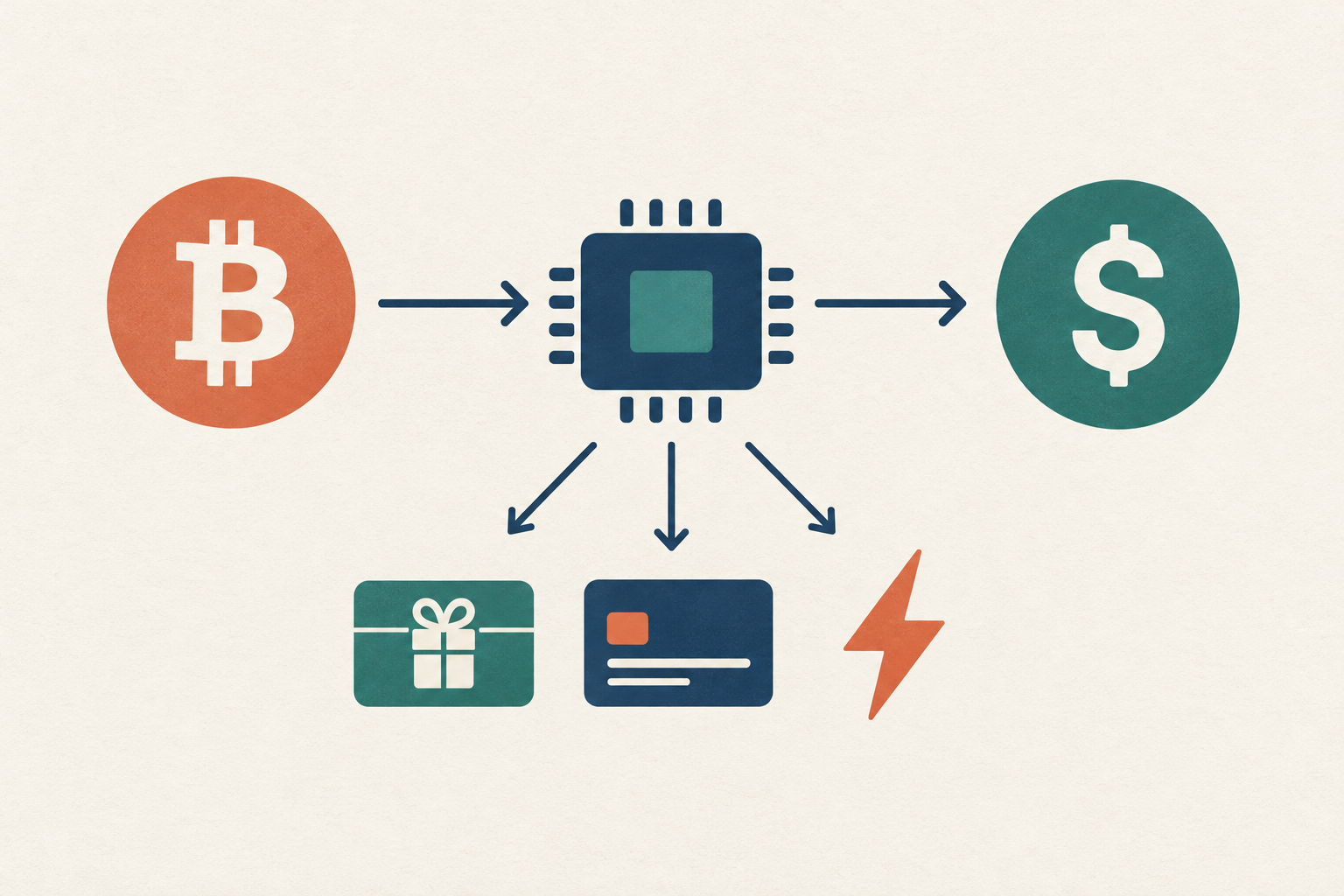
You can spend bitcoin on electronics, gift cards, hotel stays, bills, charity gifts and burgers, but almost never by handing bitcoin straight to the store. Most US purchases run through a payment processor, a crypto debit card or a gift card, and the merchant gets dollars. Each route has its own fees, and every purchase is a taxable sale in the eyes of the IRS.
How spending bitcoin actually works
Bitcoin is a network for sending value without a bank. Nothing in US law stops a business from taking it. Nothing requires a business to take it either. The US dollar is legal tender under 31 U.S.C. 5103, and a store can refuse any other form of payment.
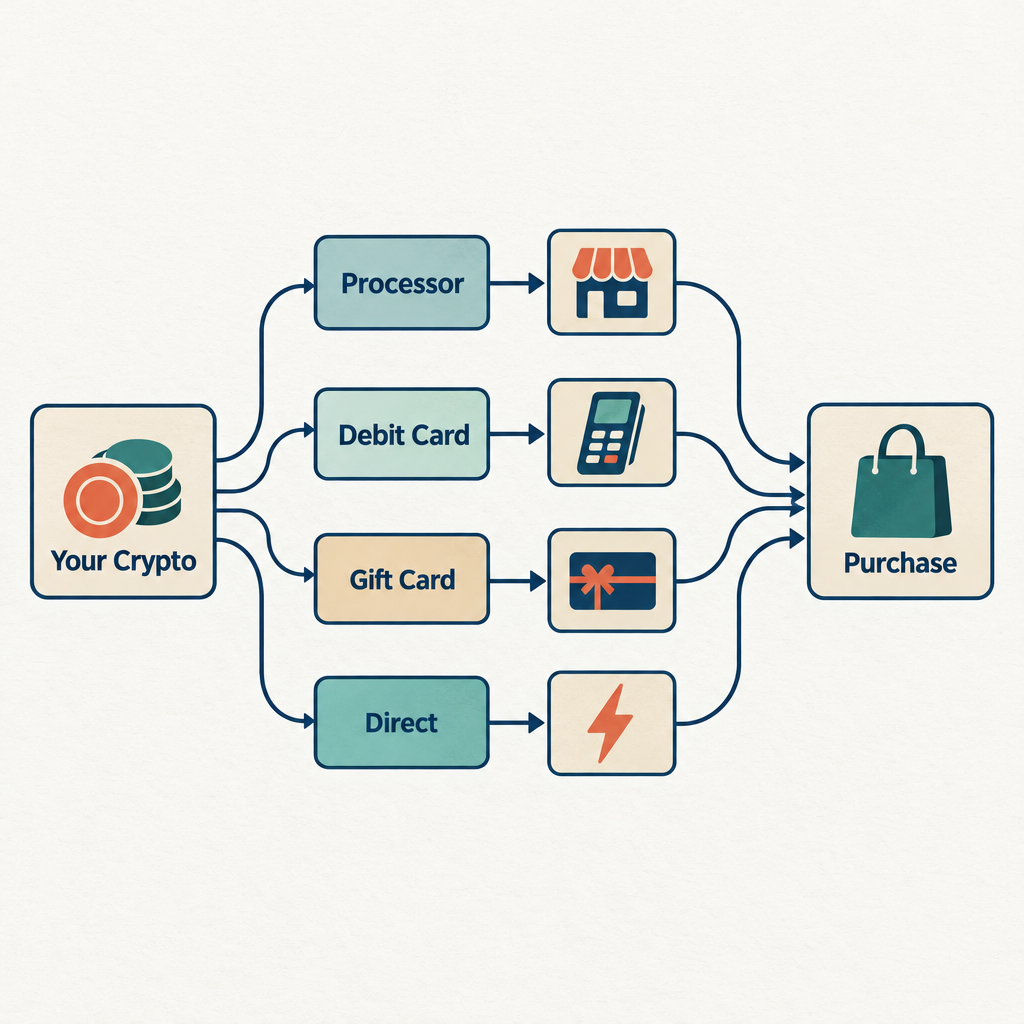
So when you see “we accept bitcoin,” read the fine print. In nearly every case one of four things is happening behind the counter.
A processor converts it. Companies like BitPay, Coinbase Commerce and Crypto.com Pay sit between you and the store. You send crypto to the processor at a locked exchange rate. The merchant receives dollars, usually minus a processing fee around 1 percent, which the merchant pays. BitPay locks its quoted rate for a short window, roughly 15 minutes, so you are not exposed to a price swing while you confirm.
A card converts it. Crypto debit cards from Coinbase, Crypto.com and BitPay sell your crypto at the moment you tap, then push dollars through the Visa or Mastercard network. The merchant never knows crypto was involved.
A gift card converts it. Services like Bitrefill and BitPay’s gift card marketplace sell retailer gift cards for crypto. You then spend the gift card like anyone else.
The merchant keeps it. A small number of businesses, mostly independent shops, hold the bitcoin they receive. Many of these use the Lightning Network, a second layer on top of bitcoin built for small, fast payments with fees that are typically a fraction of a cent.
Understanding which route a store uses matters, because it decides what fees you pay and what happens if something goes wrong.
Before you spend
On-chain bitcoin payments are final. There is no chargeback, no issuer dispute and no “undo” if you send to the wrong address or get scammed. Crypto itself can lose all of its value, and nothing you hold in a wallet or exchange is FDIC or SIPC insured.
1. Online retailers that take crypto through a processor
This is where the biggest brand names sit. The list changes often, so treat any directory as a starting point and confirm on the checkout page before you load a wallet.
Retailers that have run crypto checkout through BitPay for years include Newegg for electronics and the Dallas Mavericks for tickets and merchandise. AMC Theatres added bitcoin, ether and several other coins at its online checkout in late 2021. Namecheap has taken bitcoin for domains and hosting since 2013. Privacy-focused services such as ExpressVPN, NordVPN and Mullvad accept crypto, and Mullvad accepts it without even asking for an email.
Shopify stores can turn on crypto payments with a few clicks through Coinbase Commerce, BitPay or Crypto.com Pay. That means thousands of small online shops accept bitcoin without advertising it loudly. Look for the crypto option on the payment page rather than the homepage.
Big names drop out too. Tesla paused bitcoin payments in May 2021 after a few months. Expedia stopped in 2018. Microsoft has turned bitcoin top-ups on and off for its store over the years. Always check the current state of the checkout, not a blog post from three years ago.
2. Gift cards, the workaround for everything else
Amazon, Walmart, Target, Uber, DoorDash, Starbucks and most major US chains do not accept crypto directly. Gift cards are how people spend bitcoin at them anyway.
Bitrefill lists gift cards and phone top-ups for hundreds of US brands and accepts bitcoin, Lightning, ether, USDC and others. BitPay’s wallet app and browser extension sell gift cards from a similar range of retailers. Coinsbee is another option with a large catalog.
The trade-offs are real. Gift cards are non-refundable once delivered. Some brands cap the card value or limit how many you can buy per day. Prices track the dollar face value, so you are not getting a discount unless the service runs a promotion. And a gift card is only as safe as the retailer behind it: if the chain goes bankrupt, the card may become worthless.
3. Crypto debit cards for everyday spending
A crypto debit card is the closest thing to “spending bitcoin anywhere.” The Coinbase Card (Visa), Crypto.com Visa Card and BitPay Card (Mastercard) all let you fund purchases from a crypto balance. Tap at a gas station, grocery store or restaurant, and the card issuer sells enough crypto to cover the dollar amount.
Three things to know before relying on one:
- Every swipe is a sale. Buy a $4 coffee and you have a taxable disposition of a tiny slice of bitcoin. More on the tax rules below.
- You pay a spread. Card issuers convert at their own rate, which includes a margin over the market price. Read the fee schedule on the issuer’s site, since terms change and vary by card.
- Availability varies by state. The BitPay Card, for example, is issued to US residents in states where its banking partner operates, and some cards exclude New York or other states. Check the issuer’s eligibility page.
Do not confuse these with crypto rewards credit cards such as the Gemini Credit Card. Those bill you in dollars and pay rewards in crypto. You are not spending bitcoin with them.
4. Bills, rent and credit card balances
BitPay’s Bill Pay feature lets US users pay credit card statements, car loans, mortgages and some utilities from a crypto balance. Spritz Finance offers a similar bill-pay service. In both cases the biller receives dollars; you are simply funding the payment with crypto.
This can be useful if most of your savings sit in crypto and a bill is due. It is a poor idea if you are selling at a loss under pressure or paying a fee on top of a balance that is already costing you interest. If you are behind on debts and a debt collector is calling, you have rights under the Fair Debt Collection Practices Act regardless of how you pay, and a nonprofit credit counselor costs nothing to consult.
5. Travel, cars and real estate
Travala.com books hotels and flights for bitcoin and dozens of other coins. CheapAir has accepted bitcoin for flights since 2013. Several private jet and cruise brokers accept crypto as well, usually through BitPay.
For cars, a few dealers accept crypto, almost always by converting it through a processor at signing. Real estate deals in crypto do happen, but the title company or escrow agent typically converts to dollars and the transaction must still be reported like any other sale. Expect extra paperwork and a counterparty who wants to know where the coins came from, since money transmitters and escrow firms carry anti-money-laundering obligations under the Bank Secrecy Act.
6. Restaurants and local shops
Steak ‘n Shake launched bitcoin payments through the Lightning Network at all of its US restaurants on May 16, 2025. That is the largest US food chain to do so at the counter rather than through a gift card.
Beyond that, local acceptance is a patchwork. BTC Map, a community-maintained directory, shows independent merchants that take bitcoin and Lightning, with a heavy concentration in cities like Austin, Miami and Nashville. Coinmap is an older directory with similar coverage. Both are community data, so a pin on the map can be stale. Call ahead.
The Lightning route is where bitcoin feels like cash. Scan a QR code, confirm in your wallet, done in seconds for a fee under a penny. Wallets like Cash App, Strike, Phoenix and Wallet of Satoshi support it, though Wallet of Satoshi and some other custodial Lightning wallets have restricted US users in the past. Check the app’s current terms.
7. Donations and causes
Charities were early adopters because of a tax quirk explained below. Save the Children, the American Cancer Society, United Way and many others accept crypto through The Giving Block. Donor-advised funds such as Fidelity Charitable accept bitcoin donations. The Wikimedia Foundation, by contrast, stopped taking crypto in 2022 after a community vote.
Open-source projects, including some bitcoin developers, run on donations too. Verify the address on the project’s official site, since fake donation pages are a common scam.
What each route costs
Fees depend on the route, not just the coin. Here is how a hypothetical $100 purchase compares.
| Route | Who converts | Typical fee you pay | Reversible? |
|---|---|---|---|
| On-chain payment to processor | Processor | Network fee (varies with congestion, can exceed $5 when busy) | No |
| Lightning payment | Processor or merchant | Usually under $0.01 | No |
| Crypto debit card | Card issuer | Conversion spread set by issuer, plus any card fees | Card purchase yes, crypto sale no |
| Gift card bought with crypto | Gift card seller | Network fee, sometimes a small markup | No |
| Bill pay service | Service | Service fee plus network fee | No |
Bitcoin’s base-layer fee is the wild card. It depends on how crowded the network is that hour, not on the amount you send. Paying $20 for a $15 purchase has happened during busy periods. For anything small, Lightning or a card beats an on-chain transfer.
Taxes: every purchase is a sale
Under IRS Notice 2014-21, the IRS treats cryptocurrency as property, not currency. Spending it is a disposition, the same as selling it for dollars. You owe capital gains tax on the difference between what you paid for the coins and their fair market value when you spent them.
| Step | Amount |
|---|---|
| Bought 0.005 BTC | $300 (your cost basis) |
| Spent it on a monitor when 0.005 BTC was worth | $450 |
| Capital gain | $150 |
| Held more than one year | Long-term rate (0%, 15% or 20% by income) |
| Held one year or less | Taxed as ordinary income |
Losses work the other way. Spend coins worth less than you paid and you have a capital loss you can use against gains, and up to $3,000 a year against other income.
You report each disposition on Form 8949 and Schedule D. Starting with 2025 transactions, exchanges and other brokers send you a 1099-DA showing gross proceeds, and cost basis reporting on that form phases in for later years. The IRS also requires you to track basis wallet by wallet under Revenue Procedure 2024-28, so a card that sells slivers of bitcoin a dozen times a week creates a dozen taxable lots. Most card issuers and exchanges export a transaction history; keep it.
There is no de minimis exemption in current law. Bills have been introduced in Congress to exempt small purchases, a 2025 Senate proposal set the line at $300, but as of this writing none has passed. Until one does, the coffee counts.
Sales tax still applies based on the dollar value of what you bought. Paying in bitcoin does not change what the state collects.
Donations are the exception that makes charities popular. Give appreciated crypto you have held more than a year directly to a qualified charity and you deduct the fair market value without paying capital gains on the appreciation. Gifts over $5,000 require a qualified appraisal on Form 8283, and the IRS confirmed in Chief Counsel Advice 202302012 that an exchange price printout does not count as one.
Your rights, and where they stop
A bitcoin payment is not an electronic fund transfer from a bank account, so the error-resolution and unauthorized-transfer protections of the Electronic Fund Transfer Act and Regulation E generally do not reach it. If you use a crypto debit card, the dollar purchase at the merchant runs on the card network and the issuing bank’s dispute rules apply to that leg. The crypto sale that funded it is still final.
The consumer-protection laws that do apply are the general ones. Processors like BitPay are licensed money transmitters, and you can confirm a license on NMLS Consumer Access or your state regulator’s lookup. A merchant that takes your bitcoin and never ships is still liable for the goods under state consumer law, and you can report it to the FTC at ReportFraud and to the FBI’s IC3.
Lower-cost ways to pay
Use Lightning or a card for small purchases; on-chain fees can swamp a $20 order.
Buy only the gift card you need today, since cards are non-refundable.
If a bill is the reason you are spending, call the biller about a hardship plan before selling crypto at a loss.
Before you pay a merchant in crypto
- Confirm the crypto option exists on today’s checkout page, not in an old announcement.
- Note which processor handles it and check its license on NMLS Consumer Access.
- Compare the locked exchange rate to the current market price.
- Match the network: send bitcoin to a bitcoin address, Lightning to a Lightning invoice. Mixing them loses the money.
- Save the receipt with the dollar value and date for your tax records.
Scams that target people trying to spend crypto
A real merchant never asks you to pay bitcoin to a personal wallet address in a text message. Fake “crypto stores” with prices far below market, fake charity pages and “pay with bitcoin for a discount” offers on marketplaces are classic theft patterns, because the payment cannot be reversed. Anyone promising guaranteed returns if you “spend” crypto on an investment product is describing a ponzi scheme. Verify the business, verify the address on its official site, and walk away if the only accepted payment is crypto.
FAQ
Where can I buy things with bitcoins in the US?
Directly at merchants that use processors like BitPay or Coinbase Commerce, such as Newegg, AMC Theatres and Namecheap; indirectly almost anywhere through gift cards from Bitrefill or BitPay, or with a crypto debit card.
How do you spend bitcoins at a store that does not accept them?
Buy a gift card for that retailer with crypto, or use a crypto debit card that sells your bitcoin and pays the store in dollars.
Does spending bitcoin trigger taxes?
Yes. The IRS treats crypto as property, so each purchase is a sale with a capital gain or loss. There is currently no exemption for small purchases.
Are crypto purchases protected like credit card purchases?
No. On-chain payments are final with no chargeback. A crypto debit card gives you the card network’s dispute process for the merchant charge, but not for the crypto sale that funded it.
Why do merchants stop accepting bitcoin?
Price volatility, low customer demand and compliance costs. Tesla, Expedia and Wikimedia all dropped it, which is why you should check a checkout page rather than a list.