NPoS stands for nominated proof of stake, the consensus system Polkadot and Kusama use to choose which computers validate transactions. Token holders called nominators back validators with their coins, an election algorithm picks the validator set, and both sides share the rewards and the penalties. This guide explains how that flow works, what you can lose, and how US tax rules treat the rewards.
The short definition
In plain words, nominated proof of stake means you vote with your coins for the validators you trust, and you put those coins at risk if your picks misbehave.
That second half is what separates NPoS from most “delegated” systems. On Polkadot, a nominator is not a passive voter. Your stake is bonded, it earns a share of the validator’s reward, and it can be slashed alongside the validator’s own stake.
The design comes from Web3 Foundation research. Its stated goals are to spread stake evenly across as many independent validators as possible, to keep hardware costs low enough that ordinary operators can run a node, and to make it expensive for any one group to capture the network.
How NPoS works, step by step
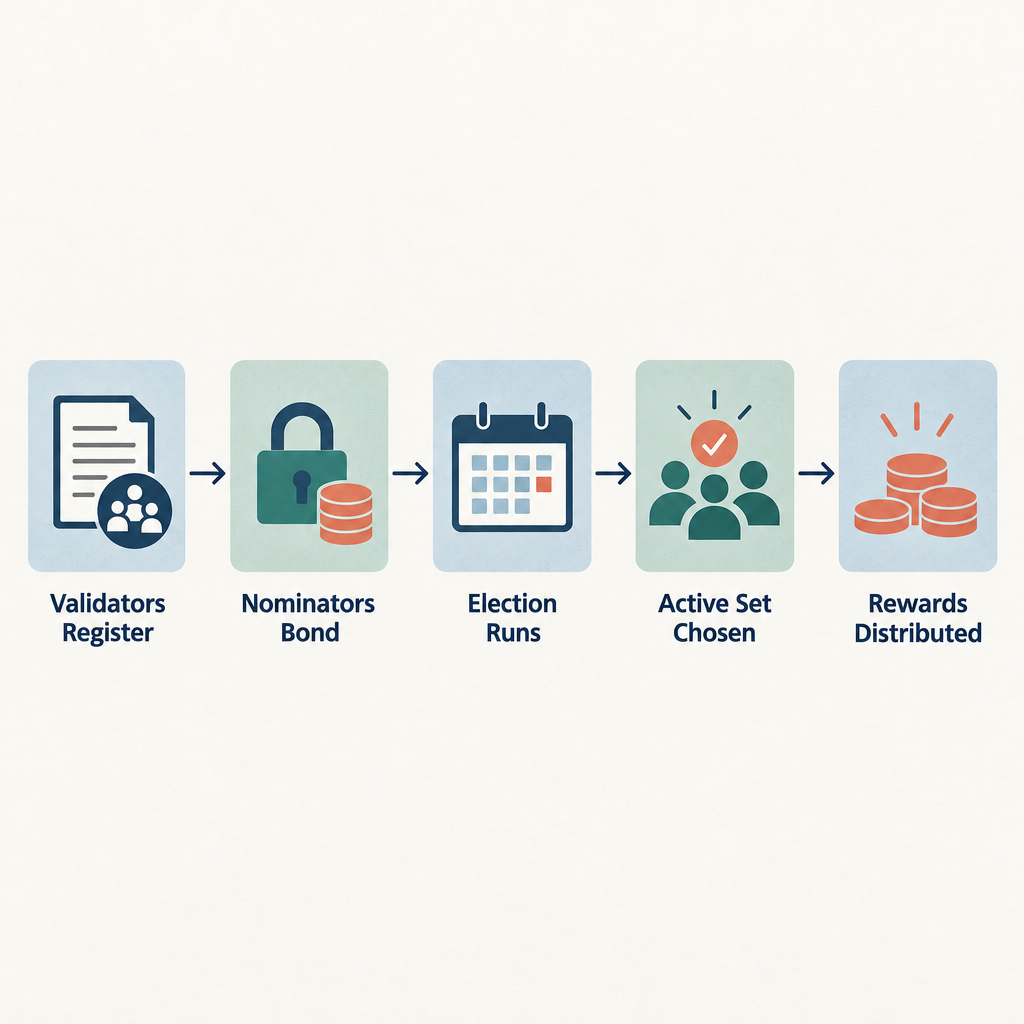
Polkadot runs staking in rounds called eras. An era lasts 24 hours on Polkadot and 6 hours on Kusama. At the boundary of each era, the chain reruns the validator election.
What happens in one Polkadot era
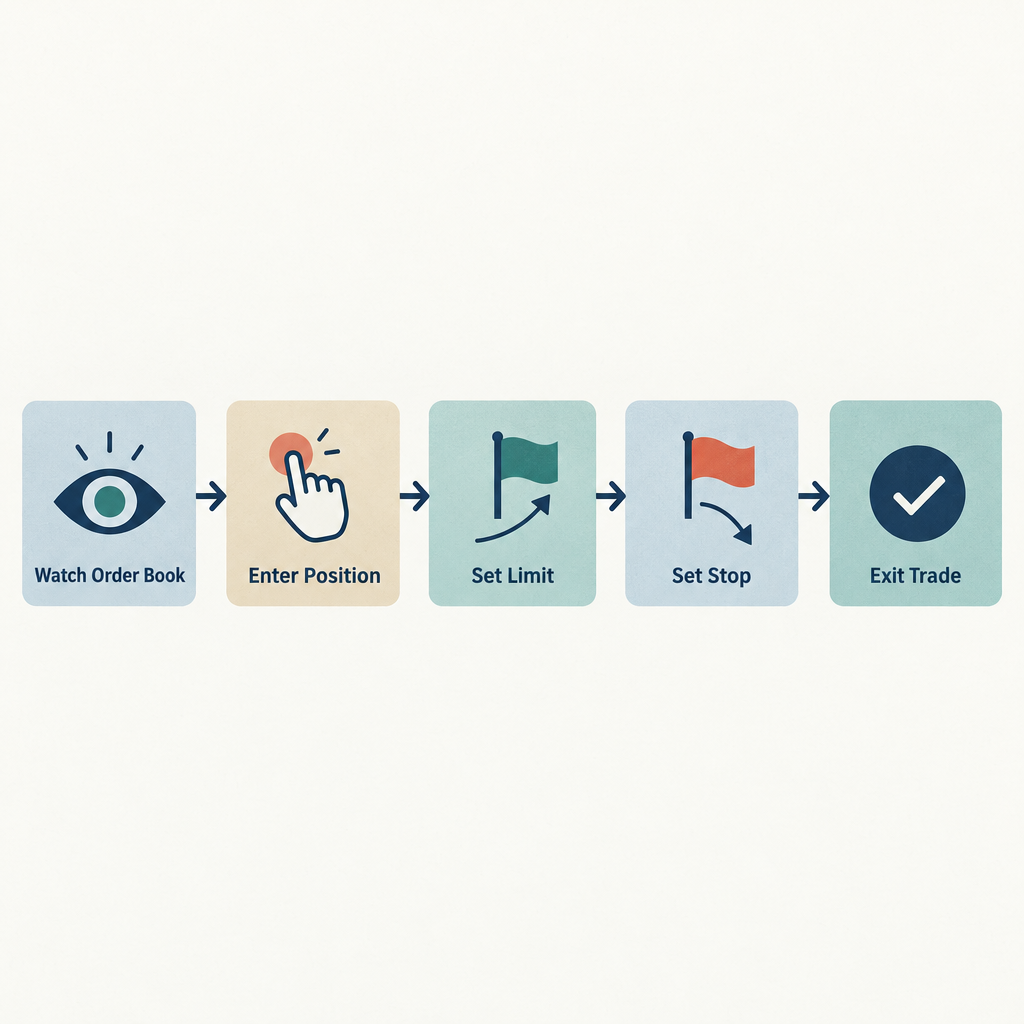
- Validators advertise themselves, set a commission rate and post their own bonded stake.
- Nominators bond DOT and name up to 16 validators they are willing to back.
- The election algorithm selects the active set and splits each nominator’s stake across their winning picks.
- Active validators produce blocks, check parachain data and vote on finality, earning era points.
- At the era’s end, rewards are calculated per validator and shared with nominators after commission.
- Any misbehavior recorded during the era is flagged for slashing, which applies after a delay.
Validators
Validators run the software that produces blocks and finalizes them. They also verify the data coming from Polkadot’s parachains, which is the heavier job. Each validator sets a commission, a percentage of the total reward it keeps before splitting the rest with nominators. Commission ranges from 0% to 100%, and a validator at 100% keeps everything.
The number of active validators is a governance parameter. Polkadot has run a few hundred active validators since launch and has raised the count through referendums more than once. Kusama, the faster-moving test network, runs roughly a thousand.
Nominators
Nominators are the backers. You lock DOT, choose up to 16 validators, and let the algorithm decide how your stake is distributed among the ones that win. You can change your list at any time, but the change only takes effect at the next election.
Your reward depends on which of your picks actually get elected, how much total stake they carry, and their commission. If none of your 16 picks are elected, you earn nothing that era.
The election algorithm
This is the part that makes NPoS distinct. Polkadot uses a sequential version of the Phragmén method, a proportional voting system worked out by the Swedish mathematician Edvard Phragmén in the 1890s. The research team later published a refinement called Phragmms.
The algorithm has two aims:
- Elect a set that reflects nominator preferences proportionally, so a group holding 20% of the stake can secure about 20% of the seats and not more.
- Maximize the minimum backing of any elected validator, so there is no weakly staked validator that an attacker could cheaply knock out.
Because of that second goal, the chain does not simply hand seats to the richest validators. It actively moves nominator stake toward less-backed candidates. You see the result when you check your account: your stake usually ends up concentrated on one or two of your 16 picks rather than spread evenly.
How rewards are split
Rewards in NPoS are not proportional to a validator’s total stake. Each active validator earns era points for the work it performs, and validators that do similar work earn similar points. A validator backed by 2 million DOT and one backed by 1.8 million DOT earn close to the same payout.
That reward is then split in this order:
- The validator takes its commission off the top.
- The remainder is divided among everyone backing that validator, including the validator’s own bond, in proportion to stake.
The arithmetic means nominators on a lightly backed validator earn a higher percentage return than those on a heavily backed one. Say two validators each earn 100 DOT in an era, both charge 5% commission, and one has 1 million DOT behind it while the other has 2 million. Backers of the first share 95 DOT across 1 million, or 0.0095% for the era. Backers of the second get half that rate. This is deliberate. It pushes stake toward smaller operators and keeps the set decentralized.
Overall yield depends on how much DOT is being issued and what share of all DOT is staked. Polkadot’s inflation schedule is set by on-chain governance and has been changed by referendum, so you should treat any single APY figure you see online as a snapshot rather than a promise.
Slashing: what you can actually lose
Slashing is the enforcement mechanism. When a validator is caught misbehaving, a percentage of its bonded stake is destroyed, and the same percentage is taken from every nominator backing it.
Two offenses matter in practice:
- Unresponsiveness. A validator that goes offline for most of a session is flagged. A single offline validator is not slashed. The penalty only kicks in when more than 10% of the set is offline at once, because that pattern looks like a coordinated failure rather than one operator’s bad night.
- Equivocation. Signing two conflicting blocks or two conflicting finality votes. This is the serious one. Penalties start small for an isolated incident and scale toward 100% when many validators equivocate together, since that is what an attack on the chain looks like.
Slashes on Polkadot do not apply instantly. They sit in a queue for about 27 days, and Polkadot’s governance can cancel a slash during that window if it was caused by a software bug rather than bad intent. That has happened. The delay protects honest operators, but it also means a pending slash can hit you after you have already decided to leave.
Nominators have one more exposure to understand. Your reward share and your slash share come from the same proportion of stake. If you are a large part of a validator’s backing, you take a large part of any penalty.
Bonding, unbonding and the 28-day lockup
Once you bond DOT, it stays locked while it is staking. If you decide to stop, you unbond, and then you wait 28 days on Polkadot (7 days on Kusama) before the coins become transferable. You earn no rewards during that wait.
The length of that lockup is the biggest practical difference between staking and simply holding. If the price falls 40% in week two of your unbonding period, you watch it happen with no way to sell. Any plan to stake should assume you cannot touch the coins for a month after you change your mind.
Polkadot added a fast-unstake option for accounts that have been bonded but never actually exposed to a validator. If your picks were never elected, you may be able to withdraw without the full wait. Accounts that were actively backing elected validators still serve the 28 days.
Nomination pools for small holders
Direct nomination on Polkadot has a practical floor. The chain limits how many nominators can be counted in an era, and only the largest bonds above a dynamic threshold earn rewards. That minimum active bond has often sat in the low hundreds of DOT, which prices out small accounts.
Nomination pools, launched on Polkadot in late 2022, solve that. A pool combines many small bonds into one nominating account run by a pool operator. The minimum to join is 1 DOT. You keep the same slashing exposure and the same unbonding period, and the pool operator picks the validators on your behalf. You are trusting that operator’s judgment on validator selection, so you should find out who runs it and how long it has been active.
NPoS compared with other staking designs
The names sound similar, so it helps to see the differences side by side.
| Feature | NPoS (Polkadot) | Delegated PoS (EOS, Tron) | Plain PoS (Ethereum) |
|---|---|---|---|
| Who validates | Elected set, a few hundred | Small elected set, often 21 to 27 | Anyone with 32 ETH |
| How stake is assigned | Algorithm spreads it proportionally | Votes go to top-ranked producers | Each validator stakes its own |
| Do backers get slashed | Yes, same rate as validator | Usually no | No backers in the base protocol |
| Payout per validator | Roughly equal regardless of stake | Varies by rank | Per validator, scales with count |
| Exit wait | 28 days | Varies, often days | Queue-based, varies |
The key difference from delegated proof of stake is accountability. In most DPoS chains, you vote for block producers but face no direct penalty if they cheat. In NPoS you do. Polkadot’s designers argue that shared risk makes nominators pick carefully, which keeps bad operators out of the set.
Consensus design also does not, on its own, determine throughput. How many “transactions per second” a chain handles depends far more on block size, block time and the parachain or sharding layout than on how validators are chosen.
The risks in plain terms
Before you stake DOT or any NPoS token
Staking locks your coins for 28 days after you decide to leave, and a validator’s mistake can destroy part of your stake. The coins themselves can lose all of their value, and nothing about staking is insured by the FDIC or SIPC.
Beyond price risk and slashing, watch for these:
- Commission changes. A validator can raise commission at any time. Some set 0% to attract nominators, then move to 100% and pocket the entire reward. The chain now flags sharp commission jumps in many wallet interfaces, but the responsibility to check is yours.
- Validator churn. Your 16 picks may stop being elected. Rewards drop to zero until you choose new ones.
- Custodial staking. If you stake through an exchange rather than on-chain, you hold an IOU from that company. If it fails, you are an unsecured creditor. Customers of FTX, Celsius and Voyager learned this in 2022.
- Phishing. Fake “Polkadot staking” sites ask you to enter your seed phrase. No legitimate staking process ever requires it on a website.
US rules and taxes on staking rewards
The IRS treats crypto as property under IRS Notice 2014-21. Staking rewards are addressed directly in Revenue Ruling 2023-14, issued July 31, 2023. It says rewards are ordinary income in the year you gain dominion and control over them, valued at fair market value on that day. On Polkadot, control usually arrives when the payout lands in your account, not when it is calculated.
That income becomes your cost basis. When you later sell the rewarded DOT, the difference between the sale price and that basis is a capital gain or loss. Record the date and dollar value of every payout. With daily eras, that can mean 365 small income events per year.
If you stake through a US exchange, the exchange may send you a Form 1099-MISC for rewards above $600. Separately, brokers must report crypto sales on Form “1099-DA” for transactions from January 1, 2025 onward, with cost basis reporting phasing in for 2026 sales. Those forms cover sales, not the staking income itself, so you still need your own records.
On securities law, the picture has shifted. In February 2023, Kraken paid $30 million to settle SEC charges over its staking-as-a-service program and shut that program for US customers. In May 2025, the SEC’s Division of Corporation Finance published a staff statement saying that certain protocol staking activities, including self-staking and some custodial arrangements, do not involve securities offerings. That statement is staff guidance, not a rule or a court ruling, and it can change. Web3 Foundation has said publicly that it believes DOT is not a security, which is the foundation’s position rather than an SEC finding.
If you want to verify a US company offering staking, check FinCEN’s MSB registrant search and your state’s money transmitter license lookup. Report suspected fraud at FTC ReportFraud or the FBI’s IC3 portal.
Other things “npos” can mean
The search term is shared by a few unrelated fields, so here is a quick sort in case you landed in the wrong place.
- string::npos in C++ is a constant that means “no position.” Functions like find() return it when they cannot locate a substring. Its value is the largest possible size_t, which is why comparing a position against it works as a not-found check.
- NPO in medicine is Latin for nil per os, meaning nothing by mouth. It is a fasting instruction before surgery or certain tests, and the length of time varies by procedure.
- NPO as an organization type means nonprofit organization.
None of those relate to crypto staking, and nothing in this article applies to them.
FAQ
Is NPoS the same as delegated proof of stake?
No. Both let token holders back validators, but NPoS slashes nominators alongside validators and uses a proportional election algorithm to spread stake. Most DPoS chains do neither.
How much DOT do I need to nominate?
Direct nomination only earns rewards above a dynamic minimum that has often been in the low hundreds of DOT. Nomination pools accept as little as 1 DOT. Both carry the same slashing risk and 28-day unbonding wait.
Can I lose my whole stake as a nominator?
In theory yes. Equivocation slashes scale toward 100% when a large share of validators misbehave together. In practice, slashes on Polkadot have been rare and small, and governance has reversed some caused by bugs. Rare is not never.
Are staking rewards taxed if I never sell them?
Yes. Under Revenue Ruling 2023-14, rewards are income when you gain control of them, at that day’s dollar value, regardless of whether you sell.
Why does my stake only show on one or two validators when I picked 16?
The Phragmén election assigns your stake where it best balances the network, not evenly. Your 16 picks are a list of validators you are willing to back, not a split you control.
Is staked DOT insured?
No. Crypto is not covered by FDIC or SIPC insurance, and a staking position can fall to zero in value.