

Crypto can lose all of its value and is not protected by FDIC or SIPC insurance. This is education, not investment advice.
In 2025, the FBI logged more than 13,400 complaints involving crypto kiosks, with reported losses above $388 million. A crypto ATM swaps your cash for bitcoin or another cryptocurrency, and some machines also buy crypto back for cash. They are fast and you don’t need a bank account to use one, but they are among the most expensive ways to buy crypto, and federal agencies track them as a major payment channel for scams.
SCAM ALERTRelated consumer alert, Nov 14, 2026
FBI disrupts North Korean FaceStealer scheme that stole over $400 million in cryptoKey takeaways
- Most kiosk fees sit inside the exchange rate, so compare the screen price with the market price before you insert cash.
- A 15% charge means your crypto has to rise 17.6% just to get back to what you paid.
- IC3 kiosk losses rose 58% from 2024 to 2025, and people over 50 accounted for more than $302 million of them.
- Rules depend on the state: California caps fees and daily amounts, and Minnesota has banned kiosks outright.
- Anyone who tells you to feed cash into a crypto ATM is running a scam.
What is a crypto ATM?
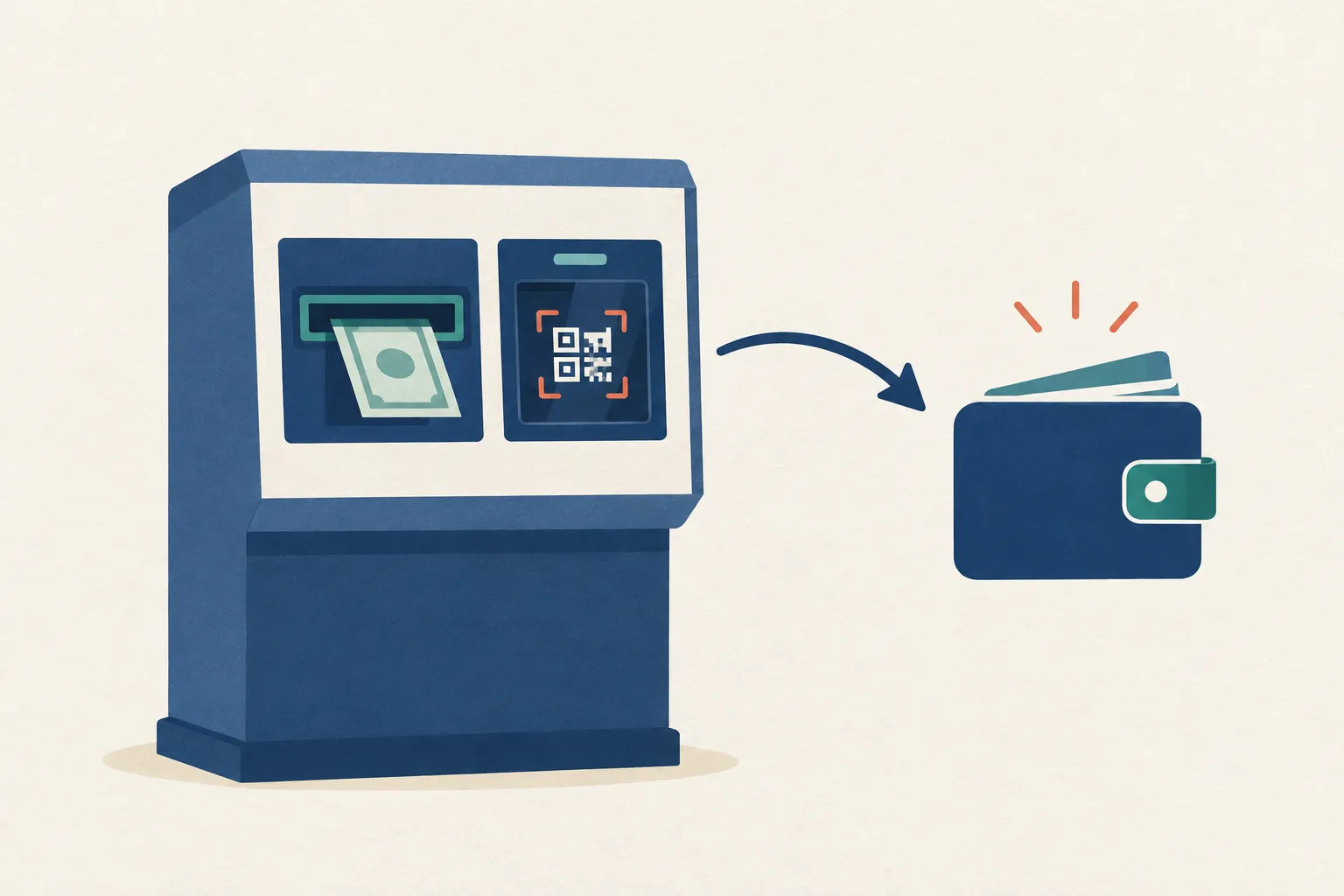
A crypto ATM is a privately owned kiosk, not a bank ATM. It doesn’t connect to your checking account and no bank stands behind it. The company that owns the machine sets the price and moves your money, and in legal terms that company is a money transmitter.
The machines go by many names: bitcoin ATM, bitcoins machine, crypto machine, crypto kiosk, cryptocurrency ATM and cryptomat. “Crypto Dispensers” is also the brand name of one US kiosk operator, which has its own app. Most crypto ATM machines sit in gas stations, convenience stores, grocery stores and malls. The United States has the large majority of the world’s machines, and trackers such as Coin ATM Radar map where they are.
There are two types:
- One-way kiosks only let you buy crypto with cash. Most US machines work this way.
- Two-way kiosks also let you sell crypto and take cash out.
How a crypto ATM works
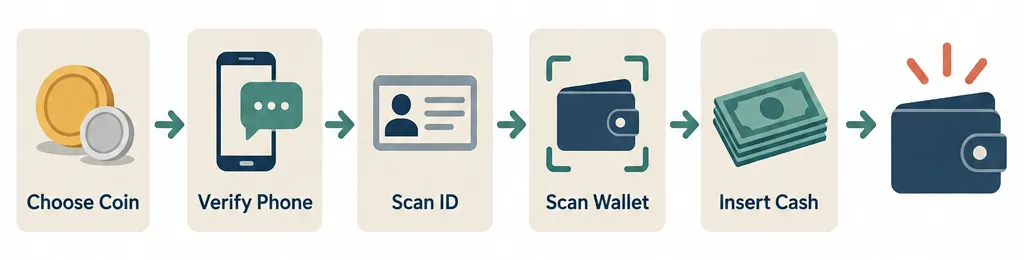
You pick a coin, verify your phone or ID, scan a wallet QR code and insert cash. The crypto goes to whichever wallet you scanned. That wallet step decides who ends up owning the money.
Buying crypto with cash
A typical crypto ATM purchase
- Choose the coin you want, usually bitcoin.
- Enter your phone number and type in the code the machine texts you.
- Scan your ID if the amount is above the operator’s lower tier.
- Scan the QR code of the wallet that will receive the crypto.
- Insert your cash and review the price and fees on screen.
- Confirm and keep the paper or emailed receipt.
The machine sends the crypto to the address you scanned. It usually shows up in your wallet within minutes, though full confirmation on the bitcoin network can take longer.
Whoever controls that wallet controls the money. If someone else gave you the QR code, the crypto goes to them.
Selling crypto for cash
On a two-way machine, you pick “sell” and enter the amount. The kiosk shows a wallet address that belongs to the operator. You send crypto there from your phone and wait for the network to confirm it, and then the machine pays out cash. Some operators give you a redemption code so you can come back later to collect.
ID checks and limits
Kiosk operators must register with FinCEN as money services businesses under the Bank Secrecy Act. That means they have to verify customers, watch for suspicious activity and file a Currency Transaction Report for more than $10,000 in cash in a day.
In practice, a small purchase may only need a phone number. Larger amounts trigger an ID scan, a selfie or extra questions. Each operator sets its own tiers, and a growing number of states set hard daily caps on top of them (see the state table below).
What crypto ATMs really cost
Most of the cost is hidden in the exchange rate. The machine quotes a bitcoin price above the market price, so your cash buys fewer coins. Some kiosks also add a flat fee or pass on a network (miner) fee.
To see the real cost, compare the price on the screen with the market price on a public price page before you insert any money.
Worked example: $500 in cash
In the first three rows below, the charge is a share of the cash you put in. These are example markups, not any operator’s actual rates. The last row shows the most a kiosk could legally charge on $500 in California, where the 15% cap applies to the value of the crypto you receive, not to your cash.
| Cash inserted | Total charge | Charge in dollars | Crypto value you receive | Rise needed to break even |
|---|---|---|---|---|
| $500 | 8% of cash | $40.00 | $460.00 | 8.7% |
| $500 | 15% of cash | $75.00 | $425.00 | 17.6% |
| $500 | 20% of cash | $100.00 | $400.00 | 25.0% |
| $500 | California maximum (15% of crypto value) | $65.22 | $434.78 | 15.0% |
Here is the math. At a 15% markup on cash, $75 of your $500 goes to the operator ($500 × 0.15 = $75), so you hold $425 of crypto. To get back to $500, that crypto has to gain $75 on $425: $75 ÷ $425 = 17.6%.
California’s version works differently. Under Financial Code section 3904, the charge can’t be more than 15% of the crypto’s dollar value at market price. If the charge is C, then C has to be no more than 0.15 × ($500 − C). Solving gives C = $75 ÷ 1.15 = $65.22, which leaves $434.78 of crypto ($500 − $65.22). You can get the same answer another way: $500 ÷ 1.15 = $434.78 of crypto. As a check, 15% of $434.78 is $65.22. The California DFPI has said several operators got this wrong by applying the 15% to the cash instead.
None of these figures include network fees or the cost of selling later. A two-way machine usually takes a second spread, this time below market, when you sell, so a full round trip at kiosks can eat a quarter of your money or more.
Online exchanges and brokerage apps usually charge anywhere from under 1% to a few percent per trade. The tradeoff is that they need a bank account or debit card and take longer to set up.
Cheaper options first
With a bank account or debit card, a regulated exchange or brokerage app almost always costs less than a kiosk.
If you need cash rather than crypto, skip the kiosk and talk to a credit union or a nonprofit credit counselor first.
The biggest risk: scams
Most of the harm tied to crypto ATMs comes from scams, not from fees. Once your cash becomes crypto at a scammer’s address, the money is effectively gone.
Before you use a crypto ATM
Crypto ATM transactions are effectively irreversible. If a caller claiming to be your bank, a government agency, tech support or a romance partner tells you to bring cash to a crypto ATM, it is a scam.
What the federal data shows
FBI and FTC data both show losses climbing fast, and older adults bear most of them. These are the latest official figures:
| Source and period | Complaints or reports | Reported losses | Who is hit hardest |
|---|---|---|---|
| FBI IC3, 2025 (kiosk supplement published May 2026) | More than 13,400 | More than $388 million | People over 50: more than half of complaints, over $302 million |
| FBI IC3, 2024 Annual Report | 10,956 | About $246.7 million | Older adults |
| FTC Consumer Sentinel, 2023 (published September 2024) | Not stated | Over $110 million, nearly 10 times the 2020 level | People 60+: more than 3 times as likely to report a loss |
| FTC Consumer Sentinel, first half of 2024 | Not stated | Over $65 million | People 60+: $46 million, about 71% of losses |
From 2024 to 2025, IC3 reported a 23% rise in kiosk complaints and a 58% rise in losses. According to the FBI’s state table, Texas had the highest losses in 2025 (about $56.8 million from 1,179 complaints), Florida had the most complaints (1,213, about $32.8 million), and California had 978 complaints and about $24.0 million. The FBI cautions that these losses can’t be blamed on kiosks alone, because some complaints also involve other ways of paying.
Both agencies say the true numbers are higher, since most fraud is never reported. In August 2025, FinCEN issued a notice warning financial institutions about kiosks being used to move scam payments.
Did you know?
The FTC found that about 86% of people who reported losing money through a bitcoin ATM in the first half of 2024 described a government impersonation, business impersonation or tech support scam.
How the scam usually works
Scammers favor these machines because cash goes in, crypto comes out and nobody can claw it back. The script rarely changes:
- You get a call, text or pop-up saying your bank account was hacked, you owe taxes, or a relative has been arrested.
- The caller tells you to withdraw cash and not tell bank staff why.
- They send a QR code and stay on the phone while you feed cash into the machine.
Red flags
- Someone sends you a QR code to scan at a kiosk.
- A “government agency” wants payment in crypto. The IRS, the Social Security Administration and the police don’t take payment this way.
- You’re told to stay on the phone, or to lie to a bank teller or store clerk.
- An investment “advisor” promises steady high returns paid in crypto. That pattern often turns out to be a Ponzi scheme.
- There’s pressure to act now: a deadline in hours, a threat of arrest, a frozen account.
Other risks
Fees and scams aren’t the only dangers. The crypto itself, how it’s stored and how the machine behaves all carry risk.
Price risk. Crypto can lose all of its value, and prices can move by double digits in a day. Cash put into a crypto ATM is not FDIC insured, and crypto in a wallet is not SIPC protected.
Custody risk. If you use a wallet app on your phone, losing the phone and the recovery phrase can mean losing the coins. If you scan an address at an exchange, that company holds your crypto, so its security and solvency matter.
Address errors. Crypto sent to the wrong address is generally gone for good.
Operator problems. A machine can take your cash and fail to send the crypto. Keep the receipt and contact the operator right away.
US rules for crypto kiosks
Federal law treats kiosk operators as money services businesses, and the states add licensing, daily caps, fee caps and, in some places, outright bans. A national kiosk law has been proposed but not enacted.
Federal law
Operators must register with FinCEN, run anti-money-laundering programs and report large cash transactions and suspicious activity under the Bank Secrecy Act. No federal law sets kiosk fees or daily amount limits.
State rules
Most states require kiosk operators to hold a money transmitter license, and many have kiosk-specific laws on top of that. Key rules as of November 2026:
| State | Daily limit | Fee cap | Status |
|---|---|---|---|
| California | $1,000 per customer | Greater of $5 or 15% of the crypto’s market value | Daily limit since 2024, fee cap since January 1, 2025; operators had to apply for a DFAL license by July 1, 2026 |
| Illinois | $2,500 new customers, $10,500 existing | Greater of $5 or 18% | In force |
| Alabama | $1,000 per day and $10,000 per month for new customers; $10,500 per day existing | Set by statute | Took effect October 1, 2026 |
| Wisconsin | $1,000 per customer | Not set in the 2026 law | Signed April 9, 2026 |
| Minnesota | Kiosks banned | Not applicable after ban | SF 3868 signed May 5, 2026; ban effective August 1, 2026; machines must be removed by December 31, 2026 |
| Indiana | Kiosks banned | Not applicable after ban | House Enrolled Act 1116 signed March 9, 2026 |
California’s DFPI enforces its rules actively. For example, it fined Coinme $300,000 over kiosk violations and secured $51,700 in restitution for victims. Minnesota’s Department of Commerce found 120 kiosk complaints from 2023 through 2025, with close to $1 million in losses. The ban doesn’t stop Minnesotans from buying or holding crypto through lawful online services.
Connecticut, Iowa, Arizona and Vermont are among the other states with their own kiosk limits, fee caps or fraud-warning rules. The details differ from state to state, so check your state financial regulator’s website before you rely on any number.
Local bans
Some cities have gone further than their states. Spokane, Washington, voted in 2025 to ban crypto kiosks within city limits.
What is only proposed
Several bills would add new limits, but none of them is law yet:
- Federal. The Crypto ATM Fraud Prevention Act (S. 710), introduced by Senator Dick Durbin on February 25, 2025, would require scam warnings and limit new customers to $2,000 a day and $10,000 over their first 14 days. It would also give full refunds for fraudulent transactions reported within 30 days. As of November 2026 it has not been enacted and has no legal force.
- States. North Carolina’s House passed a kiosk bill in June 2026 with a proposed 3% fee cap, and Nevada lawmakers have proposed a ban. Until a bill is signed and takes effect, its limits don’t apply.
How to check an operator
Verify a crypto ATM operator
- Find the company name on the machine’s screen or sticker.
- Search for it in FinCEN’s MSB registration search.
- Look up its money transmitter license in NMLS Consumer Access or your state regulator’s license search.
- Check the CFPB complaint database and your state attorney general’s site for actions against it.
How the IRS taxes crypto ATM transactions
Under IRS Notice 2014-21, the IRS treats crypto as property, not currency. Buying at a kiosk isn’t taxable. Selling is.
- Buying with cash is not a taxable event. Your cost basis is what you paid, including the fees.
- Selling for cash is a sale of property. You owe tax on any gain over your basis, or you can claim a loss.
- Holding period decides the rate. A gain on crypto held for more than one year is long-term; one year or less is short-term and taxed as ordinary income.
Brokers began issuing Form 1099-DA for digital asset sales made in 2025, and a kiosk operator that buys crypto from you may report the sale on that form. Keep every receipt anyway. A kiosk receipt is often your only record of the price you paid and the date you bought, and the IRS can ask you to back up your basis.
Where to report a problem
Report fast, because the first hours give the best chance of an operator flagging a transaction before the funds move on.
- Call the kiosk operator’s support line printed on the machine and ask them to freeze or flag the transaction.
- Report to the FBI at IC3, including the transaction ID, wallet address and receipt.
- File with the FTC at ReportFraud.
- Submit a complaint to the CFPB complaint portal and your state financial regulator. California residents can file with the DFPI.
- Contact local police and keep a copy of the report.
FAQ
What is a crypto ATM used for?
Mostly for buying bitcoin and a few other coins with cash, without a bank account. Two-way machines also let you sell crypto for cash.
How much does a crypto ATM charge?
It depends on the operator and the state. Total markups commonly run about 10% or more above market price. California caps charges at the greater of $5 or 15% of the crypto’s value, and Illinois caps them at the greater of $5 or 18%. Compare the screen price with the market price before you pay.
Do I need ID to use a crypto ATM?
For small amounts, a phone number may be enough. Larger purchases need a government ID. Operators set the thresholds within federal rules and any state daily limits.
Can I get my money back from a crypto ATM?
Usually not, once the crypto has been sent. Report fraud to the operator, IC3 and the FTC right away. State regulators such as California’s DFPI have won restitution for some kiosk fraud victims through enforcement actions.
Is a crypto ATM a good way to get emergency cash?
No. Selling at a kiosk loses a large spread and can create a tax bill. If you need money quickly, look at payday alternative loans, hardship plans with your lenders and the other routes in our guide to emergency loans first.
Are crypto kiosks legal everywhere in the US?
No. Minnesota and Indiana have banned them, and Spokane, Washington, has banned them within city limits. In most other places they’re legal, but operators need state licenses and many states cap daily amounts and fees.
Do the FBI’s kiosk loss figures cover every case?
No. They only count complaints people filed with IC3, and the FBI says some of those losses also involved other payment types. Both the FBI and the FTC say most fraud goes unreported, so actual losses are higher.
If a kiosk is the only way you can think of to buy crypto, the price gap alone is a good reason to stop and compare. If someone is telling you to use one, hang up and call your bank on the number printed on your card.
Laws and regulations referenced
- IRS Notice 2014-21 (virtual currency is property)
- IRS Form 1099-DA, Digital Asset Proceeds From Broker Transactions
- Bank Secrecy Act, 31 U.S.C. 5311
- FDIC deposit insurance
Links go to the official text on government sites.
Check, verify or complain
Sources
- fincen.gov › system › files › 2025 08 › FinCEN Notice CVCKIOSK.pdf fincen.gov · official source
- fbalance.substack.com › p › california vs crypto navigating the fbalance.substack.com
- spokesman.com › stories › 2025 › jun › 17 › concerns over scams lead to ban of crypto kiosks i spokesman.com
- theblock.co › post › 343319 › sen dick durbin introduces legislation to combat crypto a… theblock.co
- cryptoslate.com › crypto laws › california dfal crypto kiosk provisions cryptoslate.com
- aoshearman.com › en › insights › california enacts two new virtual currency laws what mark… aoshearman.com
- accountants.intuit.com › taxprocenter › tax law and news › irs cryptocurrency reporting requiremen… accountants.intuit.com

Owen explains how crypto works for US readers: coins and tokens, buying and selling, wallets and self-custody, staking and DeFi. He sticks to how things work and what they cost, never price calls, and checks platform fees and licensing against the companies' own disclosures.
Ruth is US Financer's standards editor. Every article goes through her checks before and after it is published: each rate, fee, cap, deadline and rule is matched against its primary source, every law named is linked to its official text, and anything that cannot be…
What changed
- Nov 12, 2026 Facts re-checked against official sources and updated; sources and links refreshed.
- Oct 19, 2026 First published.
Comments are closed