

General information, not legal advice. Laws change, so confirm with the official statute, your state regulator or a licensed attorney before you act.
As of November 2026, a licensed Indiana payday lender can charge you $37.50 to borrow $250 for two weeks. That works out to an annual percentage rate (APR) of about 391%. Payday lending is legal in Indiana only under the state’s small loan rules, which moved from Indiana Code 24-4.5-7 into the new IC Title 37 on July 1, 2026. Title loans at triple-digit rates are not legal, and installment loans are capped at 36% a year on the smallest balances.
Run the numbers
Key takeaways
- Since January 1, 2025, an Indiana small loan can be no larger than $825 or 20% of your gross monthly income, whichever is lower.
- The fee caps of 15%, 13% and 10% produce APRs of roughly 314% to 391% on a 14-day loan.
- Indiana has no title loan license. Rates above 72% APR outside the small loan rules can count as criminal loansharking.
- On July 1, 2026 the consumer credit code was renumbered from IC 24-4.5 into the new Title 37. No 36% payday cap has been enacted.
- A credit union Payday Alternative Loan costs far less: 28% APR at most, with an application fee of up to $20.
How Indiana regulates borrowing
Indiana’s lending rules come from its Uniform Consumer Credit Code (UCCC). The UCCC decides who needs a license, sets the rate ceilings and limits how lenders collect. The Indiana Department of Financial Institutions (DFI) enforces it through its Consumer Credit Division. Contact DFI if a lender breaks the rules.
There are three layers to understand:
- Small loans (payday loans). One chapter covers short-term loans made against a check or a bank debit. Before July 2026 it was IC 24-4.5-7. It allows fees that would be illegal on any other consumer loan.
- Consumer and supervised loans (installment and personal loans). These fell under IC 24-4.5-3. The cap is much lower and tops out at 36% a year on the smallest balances (IC 24-4.5-3-508).
- The criminal loansharking law. IC 35-45-7-2 makes it a crime to lend at more than twice the 36% rate in the UCCC, so the line is 72% APR. Licensed small loan lenders that follow the small loan rules are exempt. That exemption is the only reason triple-digit payday loans are legal in Indiana.
The July 2026 recodification
Effective July 1, 2026, P.L.115-2026 (Senate Bill 169) repealed IC 24-4.5 and moved the consumer credit code into Indiana Code Title 37, the new “Consumer Lending” title. Each new section carries a “pre-2026 revision citation” pointing back to its old number. For example, the minimum credit service charge rule that was IC 24-4.5-2-201(10) is now IC 37-2-3-4(j).
DFI’s 2025 borrower brochure, most loan contracts signed before July 2026 and most court filings still use the old numbers. For that reason this guide cites each rule by its pre-2026 section. You can find the current wording in Title 37 on the Indiana General Assembly’s code site. The small loan structure carried over in the move: DFI’s 2026 rulemaking applies the same fee tiers and loan caps under the new citations.
Dollar limits that change every two years
Many dollar figures in the UCCC adjust with inflation. DFI publishes the adjusted figures in its rule at 750 IAC 1-1-1. The current amounts took effect January 1, 2025. On a small loan, the statute’s $550 base is now $825. DFI has proposed an interim rule that would raise that figure to $880 starting January 1, 2027. Until the final figures appear in the Indiana Register, the $825 cap applies.
Did you know?
DFI’s rule at 750 IAC 1-1-1 has raised Indiana’s payday loan cap in steps. The statute says $550, but the enforced cap has been $825 since January 1, 2025, and DFI has proposed $880 for January 1, 2027.
Payday and short-term loans in Indiana
In Indiana law, a payday loan is called a “small loan.” Before the small loan chapter took effect in 2002, many of these lenders worked through partnerships with out-of-state banks. The chapter turned them into state-licensed businesses with fee caps, loan limits and a statewide database. Indiana’s rules are stricter than the near-absence of limits described in our guide to Texas payday loan laws. They are looser than in states that cap all consumer loans at 36%. For background on how the product works anywhere, see our general payday loan guide.
Maximum loan amount
A small loan in Indiana can’t be larger than the lower of two figures (IC 24-4.5-7-104 and IC 24-4.5-7-402):
- $825, the inflation-adjusted cap in effect since January 1, 2025. The statute’s base is $550.
- 20% of your gross monthly income. If you earn $2,000 a month, your limit is $400 ($2,000 × 0.20). If you earn $5,000 a month, 20% is $1,000, so the $825 cap applies.
The smallest small loan allowed is $50. A lender that lends above either limit is breaking the law, and you can report it to DFI.
What lenders can charge
The finance charge is a percentage of the amount you borrow, charged in tiers (IC 24-4.5-7-201). DFI’s January 2025 brochure lists the current bands:
| Portion of the loan | Maximum finance charge |
|---|---|
| First $250 | 15% |
| Over $250, up to $400 | 13% of that portion |
| Over $400, up to $825 | 10% of that portion |
If your payment bounces, the lender can charge one returned-payment (NSF) fee of $25 (IC 24-4.5-7-202). Your bank will probably add its own overdraft or NSF fee. Indiana law does not limit what your bank charges.
What a payday loan really costs in Indiana
Indiana caps the fee in dollars but sets no APR limit, so the APR on a legal payday loan runs into the hundreds. To work it out, divide the fee by the amount borrowed to get the cost for the loan term. Then multiply by the number of terms in a year, which is 365 divided by the number of days.
| Amount borrowed | Finance charge | Term | Total repaid | APR |
|---|---|---|---|---|
| $250 | $37.50 | 14 days | $287.50 | about 391% |
| $400 | $57.00 | 14 days | $457.00 | about 372% |
| $550 | $72.00 | 14 days | $622.00 | about 341% |
| $825 | $99.50 | 14 days | $924.50 | about 314% |
Here is the math for the $825 loan:
- 15% of the first $250 is $37.50.
- 13% of the next $150 is $19.50.
- 10% of the remaining $425 is $42.50.
- The total fee is $37.50 + $19.50 + $42.50 = $99.50.
$99.50 divided by $825 is 12.06% for 14 days. A year holds 26.07 fourteen-day periods (365 ÷ 14). 12.06% × 26.07 comes to about 314%.
The $250 loan follows the same steps: 15% × 26.07 = about 391%. Our payday loan calculator runs the same math for other amounts and terms.
The Truth in Lending Act and Regulation Z (12 CFR 1026) require the lender to show you the APR and the finance charge in dollars before you sign. If the contract does not show both clearly, report the lender.
Loan term
A small loan has to run at least 14 days (IC 24-4.5-7-401). A lender can’t write you a seven-day loan to collect fees more often. If you are paid weekly, the loan still has to last at least two weeks. A lender also can’t renew, refinance or consolidate your small loan using the money from another small loan.
Consecutive loans, the extended payment plan and the cooling-off period
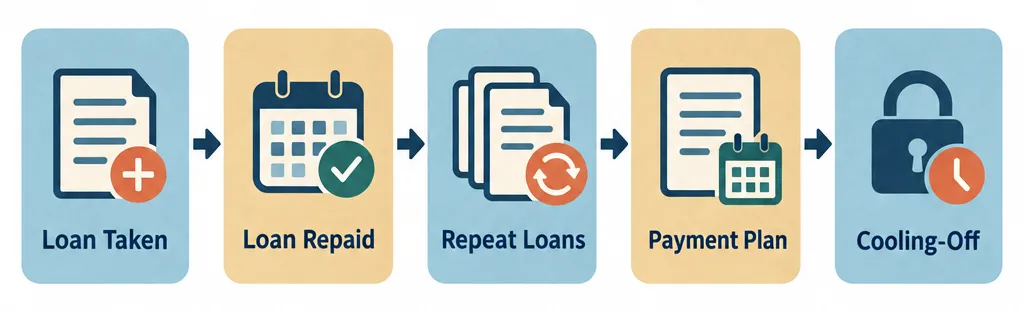
The biggest risk with a payday loan is the cycle. You repay on payday, come up short and borrow again. Indiana doesn’t ban repeat borrowing, but IC 24-4.5-7-401 slows it down in three ways.
- What counts as consecutive. A new small loan from the same lender within seven calendar days after you pay off the last one is a “consecutive” loan (IC 24-4.5-7-108).
- Extended payment plan (EPP). When you enter a third, fourth or fifth consecutive loan, the lender must offer you an EPP, according to DFI’s brochure. You can ask for one at any time during a third or later consecutive loan, as long as you are not in default and the rescission period has ended. The plan splits the balance into at least four equal payments over at least 60 days. The lender can’t charge a fee for it, and you can’t take another small loan while you are on the plan.
- Cooling-off period. After your first loan plus five consecutive loans, six in a row in total, you must wait seven days after paying off the last one before you can borrow again.
These limits help, but the fees still pile up. Take six back-to-back $400 loans at the maximum fee. You pay $57 six times, or $342, and you still owe the full $400 on the last loan.
| Consecutive $400 loans | Fees paid so far | Principal still owed |
|---|---|---|
| 1 | $57 | $400 |
| 3 | $171 | $400 |
| 6 | $342 | $400 |
The state database
Before making a small loan, a licensed lender must check a statewide database (IC 24-4.5-7-404, now recodified in Title 37). The database tracks your open loans, your run of consecutive loans and the combined amount you owe. That combined amount is capped at $825 as of November 2026. A storefront or website that says it doesn’t need to check the database is either unlicensed or ignoring the law.
Collection limits on small loans
A small loan lender can’t use a bounced check to threaten you with criminal charges. A postdated check or debit authorization given for a payday loan is not check fraud when the lender knew you didn’t have the money at the time. If a payday lender or its collector threatens arrest or jail, write down the date, the person’s name and what was said. Then report it to DFI and the CFPB.
Reform efforts and where they stand
Groups including the Indiana Institute for Working Families and Prosperity Indiana have pushed for years to cap small loans at 36% APR. That is the same limit federal law already applies to loans to active-duty service members. Recent bills:
- HB 1171 (2024): Rep. Carey Hamilton’s bill to cap payday loans at 36%.
- HB 1582 (2025): would have replaced the fee tiers with a maximum annual rate.
- HB 1174 (2025): went the other way. It would have raised the rate allowed on supervised loans of $5,000 to $25,000 to 36%, with added conditions, and it drew opposition from consumer advocates. It passed the House 51-46 and died in the Senate.
As of November 2026, Indiana has not enacted a 36% payday cap, and the 2026 recodification kept the tiered fees in place. Be wary of any claim that “payday loans are now banned in Indiana” unless you can see a signed bill. You can follow bills on the Indiana General Assembly’s official site.
Indiana’s neighbors have taken different paths. Illinois capped most consumer loans, payday loans included, at 36% APR in 2021, as our guide to Illinois payday loan laws explains. Missouri still allows some of the most expensive payday loans in the region, as covered in our Missouri payday loan laws page.
Car title loans in Indiana
The title loans advertised in Tennessee, Missouri or Texas are not legal in Indiana. Those loans typically charge about 25% a month against your car title, or roughly 300% APR, and Indiana has no license that allows that pricing.
Here is why:
- The small loan rules are the only route to triple-digit pricing, and they cover short-term loans repaid from your bank account. They don’t authorize loans secured by a vehicle title.
- A loan secured by your car falls under the general consumer loan rules, where the supervised lender cap is 36% on the smallest balances.
- Pricing above 72% APR is criminal loansharking under IC 35-45-7-2 unless an exemption applies.
So a $1,000 title loan due in 30 days with a $250 fee does not comply with Indiana law. Three situations come up often:
- Online title lenders. Some say they are licensed in another state or covered only by tribal law. Indiana’s code applies to loans made to Indiana residents when the lender solicits business in the state (the territorial rule, IC 24-4.5-1-201). Check the license before you hand over a title.
- Crossing the state line. If you sign a title loan in person in another state, that state’s law generally governs it. If you default, your car can still be repossessed from your Indiana driveway. Our guide to Tennessee payday loan laws explains how title pledge loans work there.
- Car-secured installment loans at legal rates. Credit unions and licensed consumer finance companies can make loans secured by your car within the UCCC caps. These cost far less than a title loan.
Pawning is a different product. Indiana pawnbrokers are licensed by DFI. If you pawn something and don’t repay, you lose the item, but your credit report isn’t affected. Indiana pawn law does not let you pawn a car and keep driving it.
Installment and personal loans in Indiana
Borrowers who need more than the $825 small loan cap usually end up with an installment loan, governed by the consumer loan rules (IC 24-4.5-3). A company that regularly makes these loans at rates above the basic consumer loan rate needs a supervised lender license from DFI (IC 24-4.5-3-502). Our installment loan guide explains how these loans work in general.
Rate caps for supervised loans
A licensed supervised lender can price a loan in one of two ways (IC 24-4.5-3-508):
| Pricing method | Maximum annual rate |
|---|---|
| Tiered: lowest band of the unpaid balance | 36% |
| Tiered: next band | 21% |
| Tiered: balance above that | 15% |
| Alternative: flat rate on the whole unpaid balance | 25% |
The dollar boundaries between the bands change every two years under DFI’s adjusted-amount rule. What stays fixed is the pattern: the smaller the balance, the higher the legal rate. On a loan of a few thousand dollars, the blended rate usually falls between the low 20s and 36%. Some loans can also carry a limited nonrefundable prepaid finance charge, similar to an origination fee. That charge counts toward the APR the lender must disclose under Regulation Z.
Here is a worked example at the top of the range:
| Loan | APR | Term | Monthly payment | Total repaid | Interest |
|---|---|---|---|---|---|
| $1,500 | 36% | 12 months | $150.69 | $1,808.28 | $308.28 |
The math: 36% a year is 3% a month. At that rate, 12 equal payments on $1,500 come to $150.69 each. Twelve payments add up to $1,808.28 ($150.69 × 12). Subtract the $1,500 you borrowed and the interest is $308.28.
Compare that with payday pricing. Six back-to-back $400 payday loans cost $342 in fees, more than this $1,500 loan costs over a full year.
Bad credit offers and what the ads really mean
Search for Indiana loans for bad credit and you will see ads promising “guaranteed approval” and loans with no credit check. Neither phrase gives you any legal right.
- The credit-check claim usually means the lender skips a hard pull at the three major credit bureaus. It still checks something else: a specialty consumer reporting agency for payday borrowers, your bank account history or your income. Those reports are covered by the Fair Credit Reporting Act, so you can request them and dispute errors.
- “Guaranteed approval” is a marketing line. No licensed lender approves everyone. On a legal Indiana payday loan, the 20%-of-income limit and the database check make guaranteed approval impossible.
- Higher prices for higher risk are the real trade-off. Lenders that approve low credit scores charge close to the legal ceiling. A company charging an Indiana borrower more than Indiana’s caps is either unlicensed or relying on an exemption that may not hold up.
The Equal Credit Opportunity Act bars lenders from turning you down because of race, sex, marital status, age, national origin or religion, or because your income comes from public assistance. If you are denied, the lender must give you the reasons or tell you how to get them.
Online and tribal lenders: does Indiana law apply?
Yes. Indiana’s rules apply to loans made to Indiana residents, including loans made online. Under the territorial provision (IC 24-4.5-1-201), a lender that solicits and lends to Indiana consumers has to follow Indiana’s caps and licensing rules, even if its offices are in another state. An online payday lender making Indiana loans needs an Indiana small loan license, has to stay within the fee tiers and must check the state database.
Three business models try to get around this:
- Tribal lenders. Some online lenders say a Native American tribe owns them and only tribal law applies. They then charge 400% to 700% APR or more. Courts and federal regulators have rejected these claims, especially when the tribe is a front for a non-tribal operator. Suing one of these lenders is still hard in practice, so the best protection is to avoid them.
- Offshore lenders. These websites are based abroad and hold no license anywhere. Most fake-loan scams operate this way.
- Lead generators. Many “Indiana payday loans” websites are not lenders at all. They collect your Social Security number and bank details and sell them to the highest bidder, which can include unlicensed lenders.
Warning signs that a lender is unlicensed or fake:
- It asks for an upfront “insurance” or “processing” fee before releasing the loan, or wants payment by gift card, wire transfer or crypto.
- It offers a short-term loan above $825.
- It won’t say which state licensed it, or the name on the license doesn’t match the website.
- The contract sends all disputes to a tribal or foreign forum.
- It promises approval before seeing any of your information.
If you already have a loan from an unlicensed online lender, you can cancel your authorization for electronic debits. Under the Electronic Fund Transfer Act and Regulation E, tell your bank at least three business days before the scheduled debit to stop future preauthorized transfers. Then file complaints with DFI and the CFPB. Don’t ignore a real debt from a licensed lender. If you think a loan is illegal, get advice before you keep paying it. Indiana Legal Services can help.
Debt collection and wage garnishment in Indiana
Who can collect, and how
Third-party collectors must follow the federal Fair Debt Collection Practices Act and the CFPB’s Regulation F (12 CFR 1006). Indiana also requires collection agencies to be licensed under its Collection Agency Act (IC 25-11), which the Indiana Secretary of State administers. A collector without that license is a red flag. Our debt collector guide covers your rights in more detail.
Under the FDCPA and Regulation F, a collector:
- Must send you a validation notice listing the amount owed, the creditor’s name and your dispute rights.
- Must stop collecting until it sends verification, if you dispute in writing within the validation period. That period runs about 30 days from when you receive the notice.
- Is presumed to be harassing you if it calls more than seven times in seven days about one debt, or within seven days after a phone conversation about it.
- Can’t threaten arrest, misstate the amount, call before 8 a.m. or after 9 p.m. your time, or discuss your debt with your employer or neighbors.
How long a creditor has to sue
A creditor generally has six years to sue on a promissory note or other written contract to pay money (IC 34-11-2-9). Most loan and credit card debts fall under this rule. After that, the debt is “time-barred.” Under Regulation F, a collector that sues or threatens to sue on a time-barred debt breaks the law. Making a payment on an old debt can complicate your position, so get advice before paying on one.
Wage garnishment limits
A creditor can garnish your wages only after it sues you and wins a court judgment. Indiana’s limit (IC 24-4.5-5-105) follows the federal Consumer Credit Protection Act. Each week, garnishment can take no more than the lower of:
- 25% of your disposable earnings, or
- the amount by which your disposable earnings exceed 30 times the federal minimum wage. At $7.25 an hour, that protected amount is $217.50 a week.
Disposable earnings are what is left after legally required deductions such as taxes.
| Weekly disposable earnings | 25% test | Amount above $217.50 | Maximum garnishment |
|---|---|---|---|
| $217.50 or less | $54.38 or less | $0 | $0 |
| $250 | $62.50 | $32.50 | $32.50 |
| $300 | $75.00 | $82.50 | $75.00 |
| $600 | $150.00 | $382.50 | $150.00 |
Child support, federal student loans and tax debts follow different, higher limits. Your bank account has protections too. Federal rules at 31 CFR Part 212 require your bank to automatically protect two months of directly deposited federal benefits, such as Social Security and VA payments, from garnishment. Indiana also has personal property exemptions (IC 34-55-10-2) that you can claim in court.
Debt relief in Indiana
Debt relief comes in three forms, and they work very differently:
- Nonprofit credit counseling and debt management plans. A counselor reviews your budget and may set up a plan where you make one monthly payment and creditors agree to lower your interest rates. Debt management companies must be licensed by DFI (IC 28-1-29). Look for one that holds an Indiana license and is accredited by a national body such as the National Foundation for Credit Counseling.
- Debt settlement. The company tells you to stop paying creditors and save money in an account, then tries to negotiate lump-sum payoffs. This can badly damage your credit, and creditors can sue you while you wait. Under the FTC’s Telemarketing Sales Rule (16 CFR 310.4), companies that sell debt relief by phone can’t charge fees until they settle at least one of your debts.
- Bankruptcy. Filing Chapter 7 or Chapter 13 triggers the automatic stay, which stops garnishment and collection. Federal law requires individual filers to complete a credit counseling session with an approved agency before filing.
Help that costs less than a payday loan
Cheaper options first
A credit union Payday Alternative Loan is capped at 28% APR, and any application fee must reasonably reflect processing costs, up to $20. Your township trustee can help with rent, utilities and other basic needs in an emergency. Before you borrow to pay a bill, ask that utility, landlord or lender for a hardship plan.
Credit union Payday Alternative Loans
Federal credit unions can offer Payday Alternative Loans (PALs) under NCUA rules at 12 CFR 701.21(c)(7). There are two versions:
| Feature | PAL I | PAL II |
|---|---|---|
| Loan amount | $200 to $1,000 | Up to $2,000 |
| Term | 1 to 6 months | 1 to 12 months |
| Maximum APR | 28% | 28% |
| Application fee | Up to $20 | Up to $20 |
| Membership wait | At least 1 month | None required |
Here is how the costs compare:
| Option | Amount | Fee or APR | Term | Total repaid |
|---|---|---|---|---|
| PAL I | $1,000 | 28% APR + $20 fee | 6 months | $1,103.24 |
| Indiana payday loan | $825 | $99.50 fee (about 314% APR) | 14 days | $924.50 |
The PAL math: 28% a year is about 2.333% a month. At that rate, six equal payments on $1,000 come to $180.54 each, or $1,083.24 in total. That is $83.24 in interest. Add the $20 fee and the total cost is $103.24, and you have six months to repay. The payday loan costs $99.50 on $175 less money, and you must repay all $924.50 in 14 days.
Not every credit union offers PALs. State-chartered credit unions may have their own small-dollar loans on different terms, so call and ask.
Indiana assistance programs
- Township trustee assistance. Under Indiana’s township assistance law (IC 12-20), every township trustee must provide emergency help with basic needs such as rent, utilities and food for residents who qualify. The trustee’s office is often the fastest local help with a shutoff notice or an eviction filing. Each township sets its own standards, and the trustee must give you a written decision.
- Energy Assistance Program (EAP). This is Indiana’s version of the federal LIHEAP program. The Indiana Housing and Community Development Authority (IHCDA) runs it through local community action agencies. It helps with heating and cooling bills, and applications open seasonally.
- SNAP and TANF. The Family and Social Services Administration’s Division of Family Resources handles food and cash assistance.
- Indiana 211. Dial 211 for referrals to local rent, utility, food and medical help.
- Indiana Legal Services. Free civil legal help for eligible low-income residents, including help with collection lawsuits, garnishment and unlicensed lenders.
Outside Indiana, most states have 211 and a LIHEAP program. Searches for financial assistance in NJ or financial assistance in PA lead to those states’ own agencies and 211 lines. Neither state has anything like Indiana’s township trustee system.
Ask before you borrow
Before taking a payday loan to pay a bill, call the company you owe. Utilities often offer budget billing or payment arrangements. Medical providers often have charity care or interest-free payment plans. Credit card issuers and other lenders often have hardship programs. Some employers offer free pay advances through payroll. Any of these costs less than a 391% APR loan.
Federal rules that apply in Indiana and everywhere
- Truth in Lending Act / Regulation Z (12 CFR 1026). Lenders must disclose the APR, finance charge, amount financed and total of payments before you sign.
- Military Lending Act (10 U.S.C. 987, 32 CFR Part 232). Active-duty service members and their dependents can’t be charged more than a 36% Military Annual Percentage Rate on most consumer credit, including payday, title and installment loans. Fees and add-on products count toward that rate. That makes a standard Indiana payday loan to a covered borrower illegal.
- Servicemembers Civil Relief Act. Interest on debts taken on before active duty can be capped at 6% during service.
- Fair Debt Collection Practices Act. Gives you validation rights, limits on harassment and the right to sue collectors who break the law.
- Electronic Fund Transfer Act / Regulation E. Lets you stop preauthorized debits from your bank account.
Payday rules in other states you may be searching
The table below covers the states most often searched alongside Indiana. Rules change, so confirm with each state’s regulator.
| State | Storefront payday loans | Notes |
|---|---|---|
| Indiana | Allowed with limits | Tiered fees, $825 cap as of November 2026 |
| Tennessee | Allowed | Also permits title pledge loans |
| Illinois | Capped at 36% APR | Predatory Loan Prevention Act, 2021 |
| Massachusetts | Not available at payday rates | Small loan rate limits apply |
| New Hampshire | Capped at 36% APR | Covers payday and title loans |
| New Jersey | Not available | Criminal usury law blocks payday pricing |
| Pennsylvania | Not available | No payday license category |
People searching for loans for bad credit in TN will find payday and title lenders operating legally. Searches for loans for bad credit in MA or NH mostly turn up installment lenders and credit unions, because those states don’t allow triple-digit short-term loans. A lender charging payday-style prices in a state that bans them is breaking that state’s law, just as it would be in Indiana.
How to check a lender’s license and file a complaint
How to check an Indiana lender
- Get the lender’s full legal name and license number from its website or contract.
- Search for that exact name in DFI’s licensee lookup and in NMLS Consumer Access.
- Make sure the license type matches the product: small loan for payday, supervised lender for installment loans.
- For a debt collector, check the Indiana Secretary of State’s collection agency licenses.
- If you can’t find a matching license, don’t give the company your bank or Social Security details.
Where to complain:
- Indiana Department of Financial Institutions, Consumer Credit Division. Handles licensed payday lenders, installment lenders, pawnbrokers and debt management companies. DFI can investigate, order refunds and act against licenses.
- Indiana Attorney General, Consumer Protection Division. Handles deceptive practices, scams and unlicensed businesses.
- Indiana Secretary of State. Handles licensing problems with collection agencies.
- Consumer Financial Protection Bureau. The CFPB’s complaint portal sends your complaint to the company and tracks its response. It covers payday lenders, debt collectors, banks and credit reporting.
- FTC ReportFraud and the FBI’s IC3. Handle advance-fee loan scams, fake lenders and identity theft.
Keep copies of everything: the contract, payment records, screenshots of the website and notes on calls with dates and names. Our guide to financial dispute resolution explains what happens after you file. A short written complaint with documents attached gets better results than a phone call.
Before you borrow
A legal Indiana payday loan of $250 costs $37.50 for two weeks, about 391% APR. The real danger is rolling it into back-to-back loans that cost more in fees than you borrowed.
FAQ
Are payday loans legal in Indiana?
Yes. Lenders with a DFI small loan license can make them. The fee is capped at 15% of the first $250, 13% of the amount from $250 to $400 and 10% of the amount from $400 to $825. As of November 2026 the loan can’t exceed $825 or 20% of your gross monthly income, whichever is lower, and the term must be at least 14 days.
How many payday loans can I have in Indiana?
Lenders must check a statewide database that tracks your open loans, your combined balance and your run of consecutive loans. As of November 2026, your outstanding small loans can’t total more than $825. After your first loan and five consecutive loans, you have to wait seven days. When you take a third consecutive loan, the lender must offer a no-fee extended payment plan.
Did Indiana’s payday loan law change in 2026?
The law was renumbered, but the rules stayed the same. On July 1, 2026 the consumer credit code moved from IC 24-4.5 into the new IC Title 37, and the small loan fee tiers carried over. The dollar cap last rose to $825 on January 1, 2025. DFI has proposed $880 starting January 1, 2027.
Can I get a car title loan in Indiana?
Not at the triple-digit rates title lenders charge in other states. Indiana has no title loan license. A loan secured by your car falls under the general consumer loan caps, which top out at 36% a year on small balances. Pricing above 72% APR can be criminal loansharking under IC 35-45-7-2.
Can a payday lender have me arrested in Indiana?
No. An unpaid payday loan is a civil debt, not a crime. Indiana’s small loan rules bar lenders from using bounced checks to pursue criminal charges, and the FDCPA bars collectors from threatening arrest. A lender can sue you. If it wins a judgment, it can garnish part of your wages within the limits of IC 24-4.5-5-105.
Do Indiana payday loan laws apply to online lenders?
Yes, for lenders that market to and lend to Indiana residents. They need an Indiana license and must follow the same fee and loan limits. Lenders claiming tribal or offshore status often charge far more, so check DFI’s license lookup before you share any banking information.
Where can I get emergency money help in Indiana without a loan?
Start with your township trustee, who must provide emergency help to eligible residents under IC 12-20. You can also apply for the Energy Assistance Program through your local community action agency and for SNAP through the Division of Family Resources, or dial 211 for local referrals. Indiana Legal Services offers free help with collection lawsuits and garnishment.
Laws and regulations referenced
- Truth in Lending Act, 15 U.S.C. 1601
- Regulation Z, 12 CFR Part 1026
- Fair Debt Collection Practices Act, 15 U.S.C. 1692
- Regulation F (debt collection), 12 CFR Part 1006
- Fair Credit Reporting Act, 15 U.S.C. 1681
- Equal Credit Opportunity Act, 15 U.S.C. 1691
- Electronic Fund Transfer Act, 15 U.S.C. 1693
- Regulation E (electronic transfers), 12 CFR Part 1005
- Military Lending Act, 10 U.S.C. 987
- Military Lending Act rule, 32 CFR Part 232
- Servicemembers Civil Relief Act, 50 U.S.C. 3901
Links go to the official text on government sites.
Check, verify or complain
Sources
- ncua.gov › support services › access ncua.gov · official source
- ecfr.gov › current › title 32 › subtitle A › chapter I › subchapter M › part 232 ecfr.gov · official source
- usfinancer.com › loans › personal loans › installment loan usfinancer.com
- lendingtree.com › personal › payday alternative loan lendingtree.com
- cashcompasspro.com › loan laws › indiana cashcompasspro.com
- finanso.com › us › loans › payday › indiana finanso.com
- debthammer.org › indiana payday loan laws debthammer.org
- finder.com › short term loans › short term loans illinois finder.com

Elena writes about getting through a money emergency, assistance programs, budgeting on a tight income, banking basics and borrower rights. Her guides list the cheaper options first and link the agency or program that can actually help.
Ruth is US Financer's standards editor. Every article goes through her checks before and after it is published: each rate, fee, cap, deadline and rule is matched against its primary source, every law named is linked to its official text, and anything that cannot be…
What changed
- Nov 13, 2026 Facts re-checked against official sources and updated; sources and links refreshed.
- Oct 19, 2026 First published.
Comments are closed