

General information, not legal advice. Laws change, so confirm with the official statute, your state regulator or a licensed attorney before you act.
Missouri has no cap on payday loan interest rates. Its main limit is on total cost: a payday loan can be no more than $500, and interest plus fees over the life of the loan, renewals included, cannot exceed 75 percent of the original principal. Car title loans and consumer installment loans are also legal and have no rate cap. The Missouri Division of Finance licenses all three.
Run the numbers
Key takeaways
- Payday loans run 14 to 31 days, can be renewed up to six times, and total fees stop at 75% of the amount borrowed.
- Title loans and consumer installment loans from licensed lenders have no rate cap in Missouri.
- No cooling-off period or statewide database stops you from taking loans from several lenders at once.
- A federal credit union payday alternative loan is capped at 28% APR. That makes it the cheapest regulated substitute.
- Check any lender’s license with the Division of Finance before you share bank details.
Payday and short-term loans in Missouri
Missouri regulates payday loans under Sections 408.500 to 408.506, RSMo. The statute calls them “unsecured loans of five hundred dollars or less.” Each lender location needs its own license from the Division of Finance, and the Division reports on the industry to the General Assembly every two years. The latest report, dated February 2025, covers October 2023 through September 2024. For that period it put the average payday APR at about 406 percent, which works out to an average fee of roughly $15.58 per $100 borrowed.
The core rules
These are the rules that matter to a borrower:
- Loan size: no more than $500 in principal.
- Term: 14 to 31 days under Section 408.500.
- Rate: whatever the contract says. Section 408.100 lets the parties agree in writing to any rate.
- Total cost: under Section 408.505, all interest and fees on one loan and all its renewals together cannot exceed 75 percent of the initial loan amount.
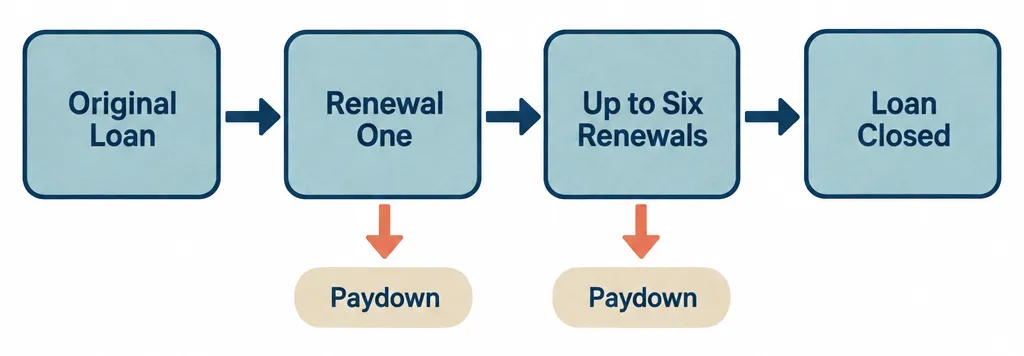
- Renewals: up to six. At each renewal the borrower must pay the principal down by at least 5 percent of the original loan amount. The Division of Finance’s rule at 20 CSR 1140-11 enforces the paydown.
Missouri is looser than stricter states on what happens between loans. It has no cooling-off period, no statewide database tracking how many loans a person has open, and no rule against borrowing from a second lender the same day. Renewals are also where costs build up. Use the payday loan calculator to test your own numbers before you sign.
What a $500 payday loan costs
The fee rates in the first two rows are illustrations, not quotes from any lender. The third row shows the legal maximum.
| Scenario | Principal | Fees | Term | APR | Total repaid |
|---|---|---|---|---|---|
| 14-day loan at $17.50 per $100 | $500 | $87.50 | 14 days | 456% | $587.50 |
| 14-day loan at $15 per $100 | $500 | $75.00 | 14 days | 391% | $575.00 |
| Maximum fees under Section 408.505 | $500 | $375.00 | Up to 7 periods (98 days) | Varies | $875.00 |
How the APR works: divide the fee by the principal, multiply by 365, then divide by the number of days in the term.
- First row: $87.50 ÷ $500 = 17.5 percent for two weeks. 17.5 × 365 ÷ 14 = 456.25 percent a year.
- Second row: $75 ÷ $500 = 15 percent. 15 × 365 ÷ 14 = 391.07 percent.
How the 75 percent cap works: suppose you renew the $15-per-$100 loan six times and pay $25 (5 percent of $500) off the principal each time. The balances over the seven periods are:
- $500, $475, $450, $425, $400, $375 and $350.
At 15 percent per period, the fees would be:
- $75 + $71.25 + $67.50 + $63.75 + $60 + $56.25 + $52.50 = $446.25.
The cap stops the lender at $375. After five periods you have paid $337.50 in fees, so the lender can charge only $37.50 more in the sixth period and nothing in the seventh. Your total comes to $500 of principal plus $375 in fees, or $875, for a loan that lasted 98 days.
Most Missouri payday loans are single-payment loans repaid by a post-dated check or an electronic debit authorization. Compared with a no-fee payday advance from an employer or an app, the payday loan usually costs hundreds of dollars more.
Car title loans in Missouri
Title loans fall under Missouri’s Title Loan Law, Sections 367.500 to 367.533, RSMo. The lender needs a Division of Finance license and holds your vehicle title as security while you keep driving the car. Under Section 367.512, the term is 30 days and renewals are allowed. From the third renewal on, you must pay the principal down by 10 percent of the original loan amount each time until the loan is paid off.
Missouri title loans have no interest rate cap. The same freedom-of-contract rule in Section 408.100 applies, so the rate is whatever you sign. The Truth in Lending Act still requires the lender to show you the APR before you sign. Section 367.527 covers repossession and sale after default, including notice to you.
Watch the license type. Some Missouri lenders take car titles as security under a consumer installment lender license (Section 408.510) or a small loan license instead of the Title Loan Law. The St. Louis Post-Dispatch reported on this practice in 2010. Those loans escape the 30-day term and the 10 percent paydown rule. Before you sign, ask which statute the loan is made under, and check which license type appears on the contract.
| Feature | Payday loan (408.500) | Title loan (367.500) | Consumer installment loan (408.510) |
|---|---|---|---|
| Max principal | $500 | No statutory cap | No statutory cap |
| Rate cap | None; fees capped at 75% of principal | None | None |
| Term | 14 to 31 days | 30 days, renewable | At least 4 equal installments over 120 days or more |
| Renewals | Up to 6, each paying 5% of original principal | Allowed; 10% paydown from third renewal | Not applicable |
| Collateral | None (post-dated check or debit) | Vehicle title | Varies |
| Licensing | Division of Finance | Division of Finance | Division of Finance |
Installment and personal loans in Missouri
Installment loans are made under Section 408.510, which creates the consumer installment lender license. The loan must be repayable in at least four substantially equal payments over at least 120 days. Beyond that, the statute leaves pricing to the contract. Missouri’s general usury ceiling in Section 408.030 does not reach these loans, because Section 408.100 allows any agreed rate on consumer loans from licensed or exempt lenders. In practice, licensed lenders in Missouri face no working interest cap.
Section 408.140 lists the extra charges a lender may add on top of interest, including an origination fee and a late charge on past-due payments. The legislature adjusts the dollar limits from time to time. Check the current wording of the statute and the Division of Finance’s guidance rather than an older article.
An installment loan from a licensed Missouri lender can cost anywhere from under 36 percent APR to several hundred percent. Banks and credit unions sit at the low end. Lenders advertising “online installment loans no credit check Missouri” sit at the high end, and that phrase is marketing. Most of them run a soft inquiry or look at other data, such as your bank transaction history, and then set the price high enough to absorb defaults. The real difference from a payday loan is amortization: each payment covers interest plus some principal, so the balance actually goes down.
Online and tribal lenders
Missouri law applies to any lender making payday or consumer installment loans to Missouri residents, wherever the company is based. An online lender needs the same Division of Finance license as a storefront. A lender with only an out-of-state license, or no license at all, is operating illegally in Missouri.
Tribal lenders are the hard case. Companies owned by federally recognized tribes argue that sovereign immunity shields them from state licensing and state limits. The CFPB has sued several tribal lending operations under federal law, and borrowers have won individual cases, but getting money back is slow and uncertain. Our position is simple: an unlicensed lender gives you no Missouri protections and no state complaint process, and nothing makes it respect the 75 percent cap. Verify the license before you hand over a bank login.
Missourians near the state line sometimes borrow across it, and the rules change sharply. Texas payday loan laws allow similarly loose pricing. California payday loan laws set a much lower loan cap and fee limit. Arkansas, directly south, effectively ended payday lending in 2010 with a constitutional amendment that caps consumer loan rates at 17 percent.
Debt collection and wage garnishment limits in Missouri
Missouri does not license collection agencies. Complaints about a debt collector go to the Attorney General’s Consumer Protection Division under the Missouri Merchandising Practices Act (Chapter 407, RSMo), and to the CFPB under the Fair Debt Collection Practices Act. The FDCPA bans calls before 8 a.m. or after 9 p.m. and false threats of arrest. It also bars a collector from contacting your employer about the debt except to locate you. An unpaid payday loan is a civil debt, so a collector who threatens jail is breaking federal law.
How much of your paycheck can be taken
A lender or debt buyer has to sue and win a judgment before it can garnish your wages. Section 525.030 then sets the limits:
- For most people, the lesser of 25 percent of disposable earnings or the amount by which weekly disposable earnings exceed 30 times the federal minimum wage.
- For a Missouri resident who is the head of a family, the lesser of 10 percent of disposable earnings or that same excess amount.
- The 30-times-minimum-wage floor comes from 15 U.S.C. 1673. With the federal minimum still $7.25 as of November 2026, it is $217.50 a week.
A Missouri appeals court has held that the 10 percent limit does not require written proof of head-of-family status. Support orders follow separate, higher federal limits.
| Weekly disposable earnings | Standard limit (25%) | Head of family (10%) | Amount above $217.50 | Maximum garnishment |
|---|---|---|---|---|
| $300 | $75 | $30 | $82.50 | $75 (or $30 head of family) |
| $600 | $150 | $60 | $382.50 | $150 (or $60 head of family) |
| $1,000 | $250 | $100 | $782.50 | $250 (or $100 head of family) |
Reading the table: the maximum is the lowest limit that applies. At $300 a week, 25 percent is $75, which is less than the $82.50 above the floor, so $75 is the most a creditor can take.
Claim your exemptions in writing
Bank account garnishments are subject to Missouri’s exemptions in Sections 513.430 and 513.440. These protect a set amount of property plus an extra head-of-family allowance. Courts do not apply them automatically, so file your claim with the court promptly.
Time limits on lawsuits
Missouri gives creditors 10 years to sue on a written promise to pay money (Section 516.110) and five years for other contract claims (Section 516.120). Which one applies depends on the loan paperwork. If a collector sues on a debt that is past its deadline, you can raise that as a defense in court.
Help that costs less
Cheaper options first
A federal credit union payday alternative loan runs $200 to $2,000 at no more than 28% APR.
Missouri 211 and your local Community Action Agency can connect you with utility, rent and food help.
Many utilities, hospitals and landlords offer hardship plans if you ask before you fall behind.
Federal credit unions can offer payday alternative loans under 12 CFR 701.21(c)(7):
- PALs I: $200 to $1,000, with terms of one to six months.
- PALs II: up to $2,000, with terms of up to 12 months.
- Price limits: the APR cap is 28 percent and the application fee cannot exceed $20.
What a $500 PAL costs: at 28 percent APR over six months, the monthly rate is 28 ÷ 12 = 2.33 percent. That gives a payment of about $90.27 a month. Six payments total about $541.62, so the interest is about $41.62, with the final payment adjusted by a few cents for rounding. A single two-week payday loan at $17.50 per $100 costs $87.50 in fees, more than twice the PAL’s interest for six months.
Did you know?
In February 2026, the NCUA Board extended the federal credit union loan rate ceiling through 2027, according to reporting by CU Times. That decision also keeps the 28 percent payday alternative loan program running.
Missouri also offers real financial help:
- Energy bills: the Low Income Home Energy Assistance Program and the Energy Crisis Intervention Program, both run by the Department of Social Services’ Family Support Division.
- Food and cash: SNAP, plus Temporary Assistance cash benefits for families with children.
- Local help: Community Action Agencies process energy assistance applications and often have weatherization and emergency funds. Catholic Charities, the Salvation Army and United Way 211 help with rent and prescriptions.
Nonprofit credit counseling agencies approved by the U.S. Trustee Program can set up a debt management plan that lowers credit card interest without a new loan. Earned wage access through your employer costs nothing if it carries no fee.
How to check a lender’s license and file a complaint
How to check a Missouri lender
- Open the Division of Finance licensee search at finance.mo.gov.
- Search the exact legal name on the loan contract, not the brand name on the website.
- Confirm the license type matches the loan: payday (408.500), title (367.500) or consumer installment (408.510).
- Cross-check online lenders on NMLS Consumer Access.
- Save the contract and all payment records before you complain.
The Missouri Division of Finance is part of the Department of Commerce and Insurance in Jefferson City. It licenses and examines every payday, title and consumer installment lender in the state and takes consumer complaints. The CFPB complaint portal sends your complaint to the company and tracks its response, and its public database shows a lender’s complaint record before you borrow. Complaints about collectors and unlicensed lenders go to the Missouri Attorney General’s Consumer Protection Division. Report outright fraud to the FTC at ReportFraud.ftc.gov. For the written-dispute process step by step, see our guide to financial dispute resolution.
Federal rules that apply everywhere
Several federal laws protect Missouri borrowers on top of state law:
- Truth in Lending Act and Regulation Z (12 CFR 1026): every lender must disclose the APR, finance charge and total of payments before you sign.
- Military Lending Act and 32 CFR 232: for active-duty service members and their dependents, the Military Annual Percentage Rate is capped at 36 percent. Lenders also generally cannot take a vehicle title, a check or other access to a bank account as security.
- Electronic Fund Transfer Act: a lender cannot condition the loan on repayment by preauthorized electronic fund transfers.
- CFPB payday rule (12 CFR 1041): the payment provisions took effect March 30, 2025. After two failed withdrawal attempts in a row, a lender cannot try a third without your new authorization.
The CFPB said on March 28, 2025 that it would not prioritize enforcement of those payment provisions. Its 2026 regulatory agenda lists a planned proposal to reconsider them. As of November 2026, the rule remains in the Code of Federal Regulations.
Before you borrow
Missouri lets a payday lender collect up to $375 in fees on a $500 loan across six renewals. It has no rate cap, no cooling-off period and no database stopping a second loan elsewhere, so a short loan can easily cost far more than planned.
FAQ
How many payday loans can I have at once in Missouri?
Each loan is capped at $500, but Missouri doesn’t limit how many lenders you can borrow from, and it has no database to enforce a limit. Taking two loans in the same week is legal. It is also how fees stack up beyond what you can repay.
Can a Missouri payday lender have me arrested for not paying?
No. An unpaid payday loan is a civil debt. The lender’s remedy is to sue for a judgment, then garnish within the limits of Section 525.030. A collector who threatens arrest is breaking the FDCPA. Report it to the CFPB, the Division of Finance and the Attorney General.
Is there an interest rate cap on title loans in Missouri?
No. The Title Loan Law sets a 30-day term and a 10 percent principal paydown from the third renewal on, but the rate is whatever the contract says. Missouri’s usury laws in Section 408.030 do not reach licensed lenders, because Section 408.100 allows any agreed rate.
Has Missouri tried to cap payday loan rates at 36 percent?
Yes, many times, and none of the attempts has become law:
- 2012: a ballot initiative for a 36 percent cap never reached voters after court fights and an aggressive industry campaign against the petition.
- 2014: the legislature passed SB 694, which would have ended renewals. Governor Jay Nixon vetoed it, calling it too weak.
- 2025: House Bill 217 would have set a 36 percent APR cap. It died when the session ended in May 2025. Similar bills have been filed in session after session.
As of November 2026, Sections 408.500 to 408.506 still contain no rate cap.
Can my wages be garnished for a payday loan in Missouri?
Only after the lender sues and wins a judgment. Section 525.030 then limits garnishment to 25 percent of disposable earnings, or 10 percent for a Missouri head of family. The federal floor of 30 times the minimum wage also applies. Federal benefits such as Social Security are generally protected from garnishment.
Do Missouri laws apply to online lenders based in another state?
Yes, if they lend to Missouri residents. They need a Division of Finance license, which you can check at finance.mo.gov. In practice, tribal lenders claiming sovereign immunity are the exception, so we treat any unlicensed online lender as one to avoid.
Laws and regulations referenced
- Missouri Revised Statutes, Sections 408.500 to 408.506 (Payday Loans: Unsecured Loans of $500 or Less), Division of Finance copy
- Truth in Lending Act, 15 U.S.C. 1601
- Regulation Z, 12 CFR Part 1026
- Fair Debt Collection Practices Act, 15 U.S.C. 1692
- Electronic Fund Transfer Act, 15 U.S.C. 1693
- Military Lending Act, 10 U.S.C. 987
- Military Lending Act rule, 32 CFR Part 232
- CFPB payday lending rule, 12 CFR Part 1041
Links go to the official text on government sites.
Check, verify or complain
Sources
- finance.mo.gov › consumer credit licensing › payday lenders finance.mo.gov · official source
- ncua.gov › newsroom › press release › 2019 › payday alternative loan rule will create … ncua.gov · official source
- ustatesloans.org › law › mo ustatesloans.org
- moconsumers.org › personal finance › missouri lenders find ways to avoid title loan regul… moconsumers.org

Elena writes about getting through a money emergency, assistance programs, budgeting on a tight income, banking basics and borrower rights. Her guides list the cheaper options first and link the agency or program that can actually help.
Ruth is US Financer's standards editor. Every article goes through her checks before and after it is published: each rate, fee, cap, deadline and rule is matched against its primary source, every law named is linked to its official text, and anything that cannot be…
What changed
- Nov 13, 2026 Facts re-checked against official sources and updated; sources and links refreshed.
- Oct 16, 2026 First published.
Comments are closed