
Payday lending is legal in California, but only on tight terms: the check you write cannot exceed $300, the fee cannot exceed 15% of that amount, and the loan cannot run longer than 31 days. Those limits come from the California Deferred Deposit Transaction Law, Financial Code §§ 23000 to 23106, and they apply to storefronts and online lenders alike when the borrower lives in California. Larger loans fall under a different statute, the California Financing Law, which caps most consumer loans under $10,000 at 36% plus the federal funds rate.
Run the numbers
Payday and short-term loans in California
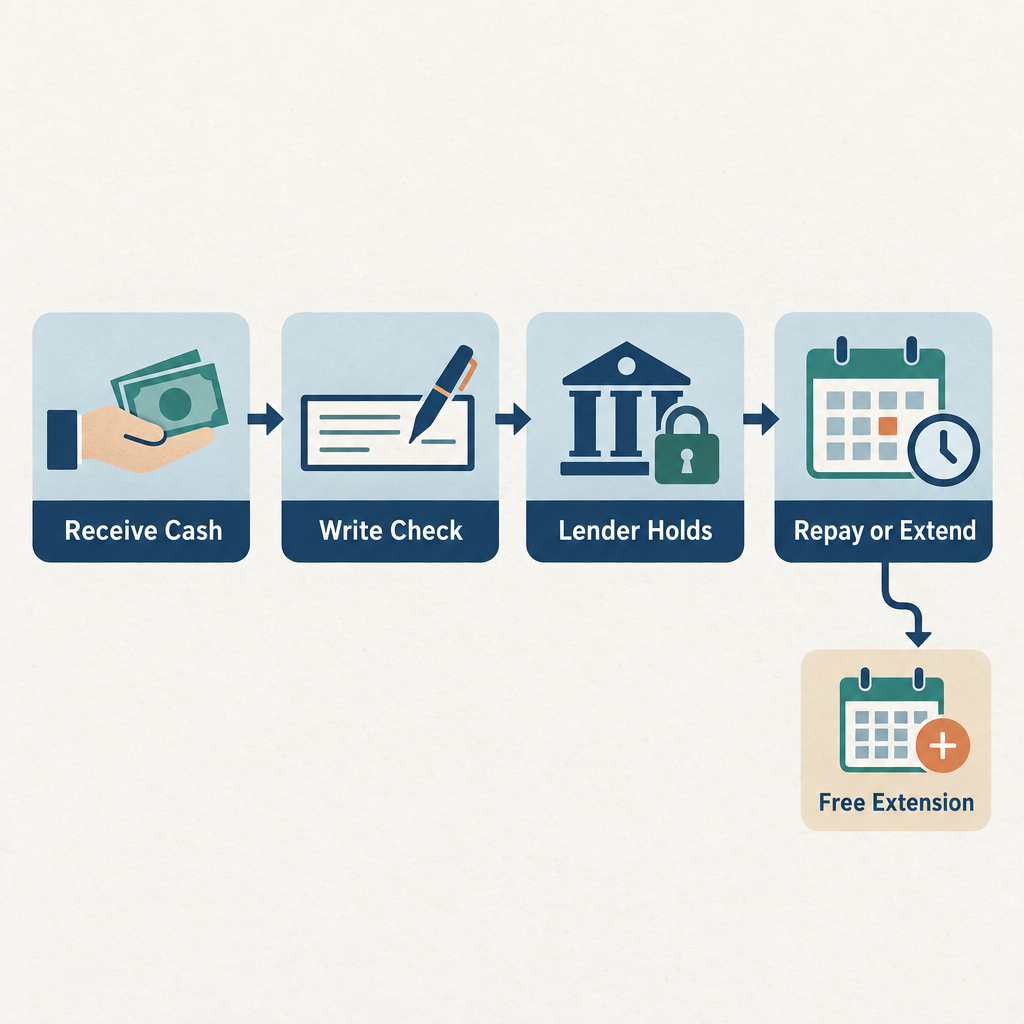
California calls a payday loan a “deferred deposit transaction.” You write a personal check (or sign an electronic debit authorization) and the lender holds it until your next payday. The rules below come straight from the Financial Code and have not moved in more than two decades, so a lender quoting anything different is either unlicensed or describing a different product.
The core limits
Financial Code § 23035(a) sets the ceiling: the face amount of your check cannot be more than $300, and the lender cannot defer deposit for more than 31 days. Section 23036(a) caps the fee at 15% of the check’s face amount. Because the fee comes out of the check, the most cash you can walk away with is $255. The lender keeps the other $45.
That $255 figure is why so many California storefronts advertise “$255 loans.” It is not a special deal. It is the legal maximum after the maximum fee.
| Rule | California limit | Statute |
|---|---|---|
| Maximum check amount | $300 (including fee) | Fin. Code § 23035(a) |
| Maximum fee | 15% of face amount ($45 on $300) | Fin. Code § 23036(a) |
| Cash you receive | $255 at most | Derived from above |
| Maximum term | 31 days | Fin. Code § 23035(a) |
| Rollovers or refinancing | Not allowed | Fin. Code § 23037(a) |
| Loans outstanding with one lender | One at a time | Fin. Code § 23037(a) |
| Returned check fee | $15 maximum, charged once | Fin. Code § 23036 |
| Fee to extend or set up a payment plan | None allowed | Fin. Code § 23036 |
| Collateral | Cannot be required | Fin. Code § 23037 |
| Threats of criminal prosecution | Prohibited | Fin. Code §§ 23035, 23037 |
What the fee costs as an APR
A $45 charge on $255 sounds like 17.6%. That is the fee as a share of cash received, not an annual rate. Under the Truth in Lending Act and Regulation Z (12 CFR 1026), the lender must also disclose the cost as an APR, and the DFPI’s own consumer page uses the same example we do: a two-week loan at the legal maximum works out to roughly 460% APR.
| Cash received | Fee | Term | Total repaid | APR (approx.) |
|---|---|---|---|---|
| $255 | $45 | 14 days | $300 | 460% |
| $255 | $45 | 31 days | $300 | 208% |
| $100 | $17.65 | 14 days | $117.65 | 460% |
The APR math in plain words: divide the fee by the cash you got ($45 ÷ $255 = 0.176). Multiply by the number of 14-day periods in a year (365 ÷ 14 = 26.07). The result is 4.6, or 460%. Stretching the same $45 fee over the full 31 days cuts the APR to about 208%, which is why a longer term at the same flat fee is always cheaper for you. California lenders are not required to give you the full 31 days, but nothing stops you from asking.
No rollovers, and what happens instead
Financial Code § 23037(a) bars a licensee from making a new deferred deposit loan to pay off an existing one with the same customer, and from having more than one loan outstanding with you at a time. California does not run a statewide borrower database the way Florida or Illinois do, so a lender cannot see whether you have a loan open with a competitor. The practical effect is that the “one loan at a time” rule is enforced per lender, and the DFPI’s annual reports on the industry consistently show a large share of loans going to repeat borrowers who take a new loan soon after repaying the old one.
What the law does give you is a free extension. Under § 23036, a lender may give you more time or set up a payment plan but may not charge for it. A lender who quotes a “rollover fee” or “extension fee” is breaking the law.
When the check bounces
If your check is returned, the lender may charge one dishonored-check fee of up to $15 under § 23036. Your bank will likely charge its own overdraft or NSF fee on top of that, which is usually the bigger hit. The lender cannot threaten you with criminal charges for a bounced payday check; the statute requires the loan agreement to tell you that in writing. Civil collection is allowed, and the lender can sue you in small claims court for the $300 plus the returned-check fee, but not for additional interest.
Who is covered
The CDDTL applies to anyone who makes deferred deposit loans to California residents, whether from a storefront in Fresno or a server in another state. Every payday lender needs a DFPI license under § 23005, and the license must be displayed. Pawnbrokers, banks and credit unions are regulated under other laws. Earned wage access apps were a gray area until the DFPI finalized regulations under the California Consumer Financial Protection Law requiring income-based advance providers to register with the department, effective February 15, 2025. Those rules treat a paycheck advance as subject to state oversight even when the app calls its charge a “tip” or “expedite fee.”
Car title loans in California
California has no standalone title loan statute. A title lender is a consumer lender under the California Financing Law (Financial Code § 22000 and following), and its rates depend on how much you borrow. That single fact explains most of what you see in the title loan market here.
Why title loans used to start at $2,500
Before 2020, the CFL capped interest only on loans under $2,500. Lenders who wanted to charge 100% or more simply lent $2,500 or $2,501, and title loans at that size with triple-digit APRs were common. Assembly Bill 539, the Fair Access to Credit Act, closed that gap. Since January 1, 2020, Financial Code § 22304.5 caps the annual rate on consumer loans of at least $2,500 and less than $10,000 at 36% plus the federal funds rate.
The cap floats. If the federal funds rate is 4%, the ceiling is 40%; if the Fed cuts to 3%, the ceiling drops to 39%. The lender must use the rate in effect when the loan is made. AB 539 also set a minimum term of 12 months for loans in that bracket, a maximum term of 60 months and 15 days for loans of $3,000 to under $10,000, and barred prepayment penalties on covered consumer loans. Licensed lenders in that bracket must also offer a free credit education program and report your payments to at least one national credit bureau.
What is still uncapped
Loans of $10,000 or more carry no state rate cap when made by a CFL licensee. After AB 539, some title lenders moved their minimum loan up to $10,000 or left the California market. If you own a car outright and a lender offers to “lend you up to $15,000 against it,” the rate on that loan is whatever the contract says, and California’s constitutional usury cap does not help you because licensed lenders are exempt from it.
Repossession rules
A title loan is secured by your vehicle, so default means the lender can repossess it. California does not require a court order for a self-help repossession, but the repossession agency must be licensed by the Bureau of Security and Investigative Services, cannot breach the peace, and cannot enter a locked garage without permission. After repossession the lender must send you notice before selling the car under Commercial Code § 9611, and you have the right to redeem the vehicle by paying the full balance plus reasonable costs before the sale. If the sale brings less than you owe, the lender can sue for the difference. The Rees-Levering Act, which limits deficiency judgments on car purchase financing, does not apply to a title loan you took out on a car you already owned.
| Title loan size | Rate cap | Minimum term | Statute |
|---|---|---|---|
| Under $2,500 | Tiered monthly caps (see next section) | None | Fin. Code § 22303 |
| $2,500 to $9,999 | 36% plus federal funds rate | 12 months | Fin. Code § 22304.5 |
| $10,000 and up | No cap | None | CFL exemption |
Installment and personal loans in California
A California installment loan is any closed-end consumer loan you repay in scheduled payments over months or years. Credit unions and banks are mostly outside the CFL, but every nonbank lender, including online lenders, needs a California Financing Law license from the DFPI. Licensing runs through the Nationwide Multistate Licensing System, so a legitimate lender will have an NMLS number you can check.
The rate tiers
For loans under $2,500, Financial Code § 22303 sets monthly caps that step down as the balance rises: 2.5% per month on the part of the unpaid balance up to $225, 2% on the part from $225 to $900, 1.5% from $900 to $1,650, and 1% above $1,650. On a $1,000 balance that works out to about $20.63 in a month, or roughly 25% a year. Lenders can also take an administrative fee under § 22305, capped at 5% of the principal with a dollar ceiling set in the statute. Those caps are why licensed California lenders make very few small installment loans; a payday lender earns more on a $255 loan in two weeks than a CFL lender earns on $1,000 in a month.
For $2,500 to under $10,000, the 36%-plus-federal-funds-rate cap from AB 539 applies. For $10,000 and up, there is no cap. The table below shows what a loan at the top of the capped tier costs if we assume the cap lands at 40% for illustration.
| Loan | APR | Term | Monthly payment | Total repaid | Total interest |
|---|---|---|---|---|---|
| $2,500 | 40% (illustrative cap) | 12 months | about $256 | about $3,075 | about $575 |
| $2,500 | 40% (illustrative cap) | 24 months | about $153 | about $3,670 | about $1,170 |
| $5,000 | 40% (illustrative cap) | 36 months | about $235 | about $8,480 | about $3,480 |
The longer the term, the lower the payment and the higher the total cost. A loan calculator will show you the same trade-off for the exact rate a lender quotes, and you should run the numbers before signing because the APR on the disclosure is the only figure that lets you compare one offer to another.
“No credit check” and “bad credit” installment loans
Nothing in California law requires a hard credit pull before a consumer loan, so a lender can truthfully say “no credit check.” That usually means a soft inquiry, a bank-account data review, or a decision based on income alone. It does not mean the loan can escape the rate caps. A licensed lender making a $3,000 “bad credit” loan to a California resident is bound by § 22304.5 no matter how it underwrites. If you see a California installment loan between $2,500 and $10,000 quoted at 60%, 99% or 160% APR, the lender is either unlicensed or claiming the loan was really made by an out-of-state bank. We cover that second case next.
A legal experiment for small loans
California also runs a Pilot Program for Increased Access to Responsible Small Dollar Loans, Financial Code § 22365 and following, which lets DFPI-approved lenders charge somewhat more than the standard sub-$2,500 caps on loans of $300 and up in exchange for added protections such as credit bureau reporting and underwriting standards. Pilot loans are still far cheaper than payday loans, and the DFPI publishes a list of participating lenders. If a lender tells you it charges more than § 22303 allows because it is “in the pilot,” you can check that claim on the department’s site.
Online and tribal lenders
Where the lender sits does not change which law applies. The CDDTL and the CFL both reach any loan made to a California resident, and the DFPI treats an unlicensed website lending to Californians the same way it treats an unlicensed storefront. Under Financial Code § 22750, a loan made in willful violation of the CFL is void, and the lender has no right to collect principal, interest or fees. That is a strong remedy, but you have to know the lender is unlicensed to use it.
Tribal lenders
Some online lenders are owned by or affiliated with federally recognized tribes and argue that tribal sovereign immunity exempts them from state caps. The California Supreme Court addressed this in People ex rel. Owen v. Miami Nation Enterprises (2016), holding that a lending business must prove it is a genuine “arm of the tribe,” looking at factors such as who controls it and who gets the profits, before it can claim immunity from state enforcement. The practical takeaway: a tribal label on a website is not proof of anything, and loans at 300% to 700% APR from these lenders are not enforceable against you on California’s terms if the lender turns out to be an ordinary company using a tribe as a front. Those cases take years, though, and the lender will keep collecting in the meantime.
“Rent-a-bank” loans
The other workaround pairs a fintech with an out-of-state bank. Banks can export the rate of their home state under federal law, so a loan “made by” a Utah bank can legally carry a rate Utah allows. The DFPI has challenged this structure: in 2022 it took the position in litigation with Opportunity Financial (OppFi) that OppFi, not its partner bank, was the “true lender” on loans to Californians at APRs around 160%, and that the CFL caps applied. That dispute was still working through the courts as of our last check, and the outcome will shape how much of this lending survives in the state. Until then, a California loan from a fintech above 36% plus the federal funds rate is legally contested, not clearly legal.
What to do before borrowing online
Look for the DFPI license number on the website, usually in the footer or on a “licenses” page. Search that number on the DFPI’s license lookup and the NMLS Consumer Access site. If the company is not there and claims a tribal or bank exemption, assume you will be paying an uncapped rate and that getting out of the loan later will require a complaint or a lawsuit. If you are comparing states, our piece on “texas payday loan laws” shows how differently a state with no fee cap looks, and the difference is almost entirely about licensing.
Debt collection and wage garnishment in California
California gives borrowers more protection from collectors than federal law alone, and the garnishment limits changed in 2023 in your favor.
Who collectors answer to
The federal Fair Debt Collection Practices Act (15 U.S.C. § 1692) covers third-party collectors. California’s Rosenthal Fair Debt Collection Practices Act, Civil Code § 1788 and following, goes further and also covers original creditors collecting their own debts, including payday and title lenders. Since January 1, 2022, the Debt Collection Licensing Act (Financial Code § 100000 and following) has required debt collectors and debt buyers operating in California to hold a DFPI license. Debt buyers must also comply with the Fair Debt Buying Practices Act, Civil Code § 1788.50 and following, which requires them to have documentation of the debt before they contact you or sue.
Under those laws a collector in California cannot:
- Call you at work after you say your employer does not allow it, or call before 8 a.m. or after 9 p.m.
- Threaten arrest, criminal prosecution or actions it does not intend to take.
- Contact your family, friends or coworkers about the debt except to locate you.
- Sue or threaten to sue on a debt past the statute of limitations, which is four years for written contracts under Code of Civil Procedure § 337 and two years for oral agreements under § 339. Civil Code § 1788.14(d) requires a written disclosure when a collector contacts you about a time-barred debt.
- Collect any amount not authorized by the contract or by law. For a payday loan, that means nothing beyond the $300 check and one $15 returned-check fee.
Wage garnishment limits
A creditor needs a court judgment before it can garnish your wages for a payday, title or installment loan. Once it has one, California law limits the amount. Senate Bill 1477, effective September 1, 2023, amended Code of Civil Procedure § 706.050 so that the maximum weekly garnishment is the lesser of 20% of your disposable earnings or 40% of the amount by which your disposable earnings exceed 48 times the state minimum hourly wage (or the local minimum wage where it is higher).
| Rule | Before Sept. 1, 2023 | Since Sept. 1, 2023 |
|---|---|---|
| Percentage cap | 25% of disposable earnings | 20% of disposable earnings |
| Protected floor | 40 × state minimum wage per week | 48 × state minimum wage per week |
| Share above the floor that can be taken | 50% | 40% |
| Federal limit (15 U.S.C. § 1673) | 25% or 30 × federal minimum wage | Same; California is stricter |
At the 2025 statewide minimum wage of $16.50 an hour, 48 times that is $792 a week. If your disposable earnings were $900 a week, 40% of the $108 above the floor is $43.20, which is less than 20% of $900 ($180), so $43.20 is the most that could be garnished. The minimum wage adjusts each January, so the protected floor rises with it; check the Department of Industrial Relations for the current figure. You can also file a Claim of Exemption with the levying officer under § 706.051 if even the capped amount leaves you unable to support your family.
Bank levies have their own protection. Code of Civil Procedure § 704.220 automatically exempts an amount in your deposit account equal to the state’s minimum basic standard of adequate care for a family of four, a figure the Department of Social Services updates each year, and a creditor must leave that amount in place without you filing anything.
Can a payday lender garnish wages without a judgment?
No. Payday lenders sometimes have you sign an electronic debit authorization, and under Regulation E (12 CFR 1005.10(e)) a lender cannot make repayment by preauthorized electronic transfer a condition of getting the loan. Since March 30, 2025, the CFPB’s payday lending rule (12 CFR Part 1041) also prohibits a lender from making more than two consecutive failed withdrawal attempts from your account without getting a fresh authorization from you. Revoking an ACH authorization with your bank is your right; the debt still exists, but the lender then has to collect it the slow way.
Help that costs less
A $45 fee for two weeks is the most expensive legal credit in California. Everything below costs less, and several options cost nothing.
Cheaper options first
Federal credit unions offer payday alternative loans at 28% APR or less, up to $2,000.
Ask your utility, landlord or hospital for a payment plan before borrowing to pay them.
Dial 211 for county emergency assistance, and apply for CalFresh, CalWORKs and LIHEAP if you qualify.
Credit union payday alternative loans
Federal credit unions can make Payday Alternative Loans under NCUA rules at 12 CFR 701.21(c)(7). A PAL I is $200 to $1,000 for one to six months; a PAL II is up to $2,000 for up to 12 months. Both carry a maximum 28% APR and an application fee of no more than $20, and you need to have been a member for at least a month for a PAL I (no waiting period for a PAL II). On $500 for three months at 28%, total interest is around $24, versus a $45 fee for two weeks at a payday store. State-chartered California credit unions are not bound by the NCUA PAL rule but many offer similar small loans; the DFPI supervises them.
Programs that exist in California
These are real programs with real eligibility rules, administered by the state or counties:
- CalFresh, the state’s name for SNAP, provides monthly food benefits and is run through county social services offices.
- CalWORKs provides cash assistance and services to low-income families with children, including a Homeless Assistance program that can pay a security deposit or temporary shelter.
- General Assistance or General Relief is county-run cash aid for adults without children who do not qualify for other programs. Amounts and rules vary by county.
- LIHEAP, administered by the California Department of Community Services and Development, helps with heating and cooling bills and crisis utility shutoffs.
- CalEITC and the Young Child Tax Credit are refundable state tax credits claimed on your California return, paid as a refund even if you owe no tax.
- California LifeLine discounts phone service for qualifying households.
- 211 connects you to local rent, utility and food assistance in most counties.
None of these are loans. If you are considering a payday loan to cover a utility bill or groceries, the programs above are the first calls to make.
Nonprofit credit counseling and “California debt relief”
Searches for “California debt relief” mostly surface for-profit debt settlement companies that charge a percentage of your enrolled debt to negotiate lump-sum settlements while you stop paying creditors. The FTC’s Telemarketing Sales Rule (16 CFR 310.4(a)(5)) bans these companies from charging a fee before they settle a debt when they sell by phone. Under DFPI regulations that took effect February 15, 2025, debt settlement providers serving Californians must also register with the department. Settlement can work for some people with large unsecured balances, but it damages your credit, settled amounts can be taxable as forgiven debt, and creditors can sue while you wait.
A nonprofit credit counseling agency, such as a member of the National Foundation for Credit Counseling, offers a different path: a debt management plan that pays creditors in full at reduced interest, usually for a small monthly fee. For-profit companies that collect your money and distribute it to creditors need a prorater license under the Check Sellers, Bill Payers and Proraters Law, Financial Code § 12000 and following. Nonprofits are exempt from that licensing but still answer to the DFPI under the CCFPL.
How to check a lender’s license and file a complaint
The Department of Financial Protection and Innovation, formerly the Department of Business Oversight, licenses every payday lender, consumer finance lender, debt collector and (since 2025) income-based advance provider in California. Its website is dfpi.ca.gov. Checking a license takes a few minutes and is the single most useful thing you can do before borrowing.
How to check a California lender
- Find the license number on the lender’s website, storefront or loan agreement.
- Open the DFPI license search and look up the company by name and number.
- Confirm the license type matches the product: CDDTL for payday loans, CFL for installment and title loans.
- Cross-check the NMLS number on NMLS Consumer Access.
- Search the CFPB complaint database for the company’s name and read recent complaints.
If a lender overcharged you, refused a free extension, threatened arrest, or kept debiting your account after you revoked authorization, file with the DFPI first; the department investigates licensees and can order refunds. File a second complaint with the Consumer Financial Protection Bureau, whose complaint portal forwards your submission to the company and requires a response within 15 days. For suspected fraud or an unlicensed online lender, add reports to the FTC at ReportFraud and to the FBI’s Internet Crime Complaint Center. For a dispute the lender will not resolve, our guide to financial dispute resolution walks through small claims court and arbitration, both of which are available for payday loan disputes in California.
Federal rules that apply in every state
A few federal laws sit on top of California’s rules. The Truth in Lending Act and Regulation Z require every lender to disclose the APR and the finance charge in writing before you sign; a payday lender that shows you only “$15 per $100” without an APR is violating federal law. The Military Lending Act (10 U.S.C. § 987 and 32 CFR Part 232) caps the Military Annual Percentage Rate at 36% for active-duty service members and their dependents on payday, title and most other consumer loans, which effectively bars them from California payday loans at the state maximum. The Fair Debt Collection Practices Act governs third-party collectors nationwide, and the Fair Credit Reporting Act gives you the right to dispute inaccurate loan information on your credit reports. The Electronic Fund Transfer Act, discussed above, protects your bank account from being used as a condition of credit.
Why California capped rates, and who objects
The debate behind AB 539 is worth understanding because it still shapes what you can borrow. Before 2020, the DFPI’s predecessor reported that a majority of CFL loans in the $2,500 to $5,000 range carried APRs above 100%, and title loans in that bracket were a large part of the total. Supporters of the cap, including the National Consumer Law Center and the Center for Responsible Lending, argued that triple-digit installment loans trapped borrowers the same way payday loans do, just over a longer period. The Legislature agreed and passed the bill with bipartisan votes.
Critics made the argument that always follows a rate cap: lenders cannot profit on small, risky loans at 36%, so they will stop making them, and people with poor credit will lose access and turn to unlicensed or tribal lenders instead. DFPI licensing data since 2020 shows that some high-rate lenders did leave or raise their minimum loan to $10,000, and lending volume in the capped bracket fell. Whether that is a loss depends on what you think a 150% loan was worth to the people who took it. California’s position, written into § 22304.5, is that a loan at that price is not credit the state wants to protect. The $300 payday cap reflects the same judgment from 1996: allow the product, but keep it small enough that one loan cannot become a $2,000 problem.
If you want to see the effect on your own budget, a personal loan calculator with the capped rate and a 12-month term will show you what a licensed lender can legally charge, and anything above it is a reason to walk away.
Before you borrow
A $255 payday loan costs $45 every time you take one, and the DFPI’s own data shows most borrowers take several a year. Four loans is $180 in fees to borrow the same $255, with no credit built and no path to a smaller balance.
FAQ
How many payday loans can I have at once in California?
One per lender. Financial Code § 23037(a) prohibits a licensee from opening a new deferred deposit loan while you still have one outstanding with that lender, and from lending you money to pay off the old loan. California has no central database, so the law does not stop you from holding loans at two different companies, but every one of them carries the same $45 fee on $255.
Can a payday lender in California charge more than $45?
Not on a $300 check. The 15% cap in § 23036(a) is the entire charge; a lender cannot add origination fees, insurance, or interest if you pay late. The only extra charge the law allows is one $15 fee if your check is returned. A lender quoting anything else is either unlicensed or selling a different product, such as a CFL installment loan, which has its own caps.
Are online payday loans legal in California?
Yes, if the lender holds a DFPI license under the CDDTL and follows the same $300 and 15% limits as a storefront. An online lender without a California license is operating illegally, and loans made in willful violation of state licensing law are void under the Financial Code. Verify the license number on the DFPI’s site before giving any lender your bank login or account number.
What is the maximum interest rate on a personal loan in California?
It depends on the loan size. Under $2,500, Financial Code § 22303 sets tiered monthly caps ranging from 1% per month (12% a year) on the part of the balance above $1,650 up to 2.5% per month (30% a year) on the first $225, so the annual rate falls somewhere between roughly 12% and 30% depending on the balance. From $2,500 to under $10,000, § 22304.5 caps the rate at 36% plus the federal funds rate. At $10,000 and above, licensed lenders face no cap. The 10% limit in the state constitution’s usury provision applies only to lenders without an exemption, which in practice means private individuals.
Can I go to jail for not paying a payday loan in California?
No. Failing to repay a payday loan is a civil matter, and Financial Code §§ 23035 and 23037 bar lenders from threatening criminal prosecution over a bounced payday check. The lender can sue you in civil court and, after a judgment, garnish up to 20% of your disposable wages under Code of Civil Procedure § 706.050. Report any collector who mentions arrest to the DFPI and the CFPB.
Does California have a payday loan cooling-off period?
Not in the way some states do. California does not require a waiting period between loans or limit the number of loans per year. What it does instead is cap the amount at $300, ban rollovers, and require lenders to let you extend or set up a payment plan without charge. The absence of a cooling-off rule is one reason consumer groups continue to push for further limits; as of our last review, no bill changing the CDDTL caps had been enacted.
Laws and regulations referenced
- Truth in Lending Act, 15 U.S.C. 1601
- Regulation Z, 12 CFR Part 1026
- Fair Debt Collection Practices Act, 15 U.S.C. 1692
- Fair Credit Reporting Act, 15 U.S.C. 1681
- Electronic Fund Transfer Act, 15 U.S.C. 1693
- Regulation E (electronic transfers), 12 CFR Part 1005
- Military Lending Act, 10 U.S.C. 987
- Military Lending Act rule, 32 CFR Part 232
- CFPB payday lending rule, 12 CFR Part 1041
Links go to the official text on government sites.
Check, verify or complain
Sources
- berkeleyca.gov › sites › default › files › documents › 2019 05 14%20Item%2029%20Support%20AB%2… berkeleyca.gov · primary source
- dfpi.ca.gov › regulated industries › important notices › new requirements for licensees… dfpi.ca.gov · primary source
- codes.findlaw.com › ca › financial code › fin sect 22304 5 codes.findlaw.com
- consumerfinancemonitor.com › 2019 › 09 › 16 › california financing law rate cap advances to governor new… consumerfinancemonitor.com
- infobytes.orrick.com › 2019 10 16 › california caps rate installment loans infobytes.orrick.com

Elena writes about getting through a money emergency, assistance programs, budgeting on a tight income, banking basics and borrower rights. Her guides list the cheaper options first and link the agency or program that can actually help.

Ruth is US Financer's standards editor. Every article goes through her checks before and after it is published: each rate, fee, cap, deadline and rule is matched against its primary source, every law named is linked to its official text, and anything that cannot be…
Comments are closed