Runs in your browser. Nothing you type is sent or saved.
This personal loan calculator shows your monthly payment, the origination fee taken out of your loan, the cash that actually lands in your account, your total interest, and the APR once that fee is counted. To use it, you need five numbers from a loan offer: the amount borrowed, the interest rate, the term, whether the term is in years or months, and the origination fee percentage. Below, we explain the math behind every result and how to tell a fair offer from an expensive one.
How to use the calculator
- Type the loan amount from your offer or prequalification into Amount you borrow ($). This is the figure the lender will charge interest on, not the cash you expect to receive.
- Enter the interest rate from the offer letter into Interest rate (%). If the lender only shows an APR, use that for a conservative estimate and set the fee to 0.
- Put the repayment length into Loan term and pick Years or Months in Term in. A 3 year loan is 36 months; the result is the same either way.
- Find the origination fee on the offer or the Truth in Lending disclosure and enter it as a percentage in Origination fee (%). If the lender quotes a dollar figure, divide it by the loan amount.
- Compare the Monthly payment to the take-home pay on your pay stub and the Total cost of the loan to what you would pay with a credit union or a hardship plan.
What each field means and the mistakes that skew results
Amount you borrow ($) is the principal on the contract. Lenders calculate interest on this full amount even though an origination fee is subtracted before funding. If you need exactly $5,000 in hand and the fee is 5%, you have to borrow about $5,263, because 5,263 x 0.95 is roughly $5,000. Entering the amount you want to receive instead of the amount financed is the most common mistake we see.
Interest rate (%) is the annual note rate, sometimes called the nominal rate. Do not enter the APR here if the loan also has a fee, because the calculator would then count the fee twice. If your offer lists only one number and calls it APR, enter it as the rate and set the fee to zero.
Loan term and Term in work together. Many offers say “36 monthly payments” while others say “3 years.” Entering 36 with Years selected would produce a 432 month loan and a tiny, misleading payment, so check the dropdown before you read the result.
Origination fee (%) is the upfront charge most online lenders deduct from the loan proceeds. Personal loan origination fees in lender disclosures generally run from 0% to around 10%, though some reach 12% for borrowers with weaker credit. Credit unions and banks often charge none. The calculator assumes the fee is deducted, which is how nearly all personal loan lenders handle it. If your lender adds the fee to the balance instead, the money received would equal the full amount and the interest would be slightly higher than shown.
How the personal loan calculator does the math
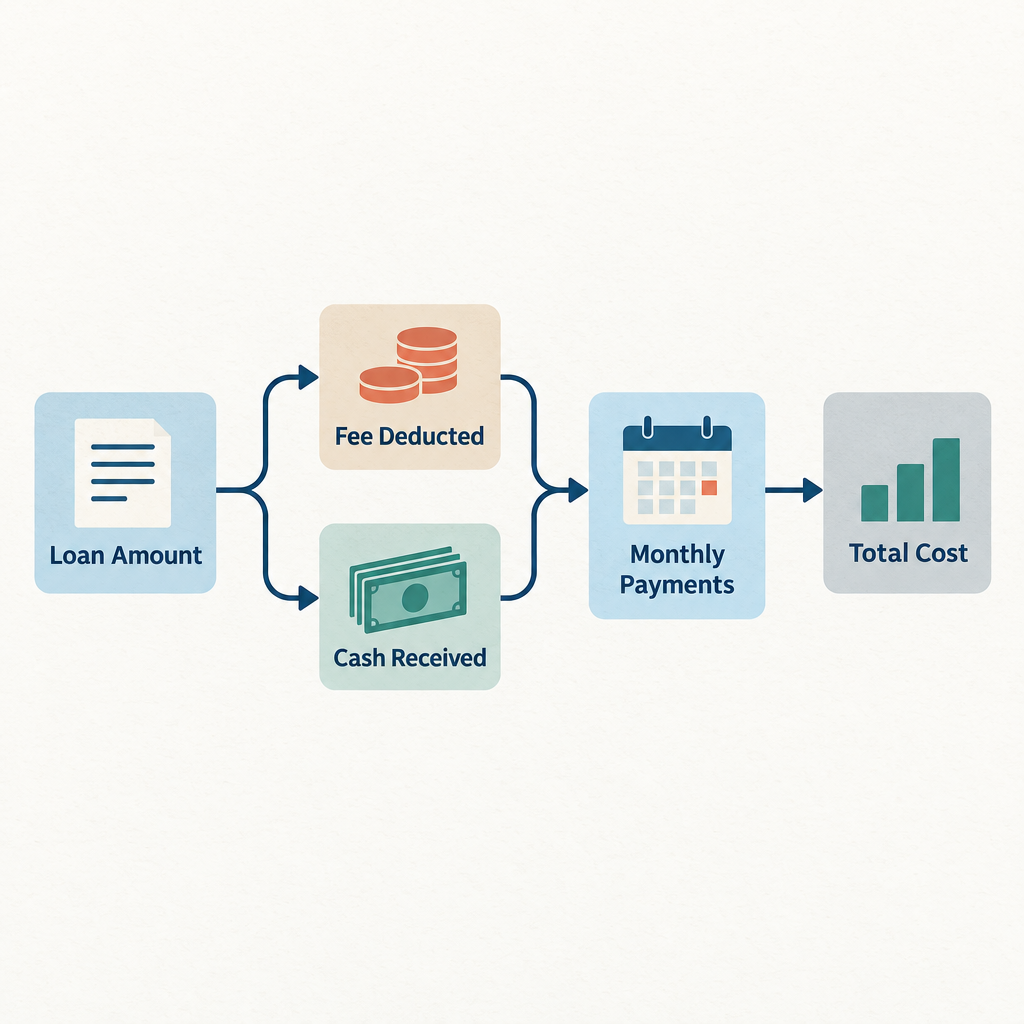
Every result on this page comes from one standard amortization formula and a bit of arithmetic around it.
Monthly payment = P x r / (1 – (1 + r)^-n)
P is the amount you borrow, r is the monthly rate (the annual rate divided by 12), and n is the number of monthly payments. The formula finds the fixed payment that pays off the balance exactly at the end of the term, with each payment covering that month’s interest plus a growing slice of principal.
Then: Origination fee = amount x fee percentage. Money you receive = amount minus fee. Total interest = all payments minus the amount borrowed. Total cost = all payments minus the money you received, so the fee is counted as a cost. APR including the fee is the annual rate at which the present value of your monthly payments equals the cash you actually received. The calculator solves that numerically, and because you repay more than you got, this APR is always higher than the interest rate whenever the fee is above zero.
The default example, step by step
With the default inputs ($5,000, 15%, 36 months, 5% fee):
- Monthly rate: 15% / 12 = 1.25%, so r = 0.0125. Number of payments: n = 36.
- Growth factor: (1.0125)^36 = 1.5639. Flip it: (1.0125)^-36 = 0.6394. Subtract from 1: 0.3606.
- Numerator: 5,000 x 0.0125 = 62.50. Divide: 62.50 / 0.3606 = $173.33 per month.
- Origination fee: 5,000 x 5% = $250.00. Money you actually receive: 5,000 – 250 = $4,750.00.
- All payments: 173.3267 x 36 = $6,239.76 (the calculator keeps the unrounded payment). Total interest: 6,239.76 – 5,000 = $1,239.76.
- Total cost of the loan: 6,239.76 – 4,750 = $1,489.76.
- APR including the fee: the rate at which 36 payments of $173.33 are worth exactly $4,750 today is 18.67%.
That last line matters. The advertised 15% rate understates your cost by more than three and a half percentage points because $250 left the loan before you saw it.
A second example: $10,000 at 12% for 48 months with a 3% fee
- r = 12% / 12 = 0.01. n = 48.
- (1.01)^48 = 1.6122, so (1.01)^-48 = 0.6203. 1 – 0.6203 = 0.3797.
- 10,000 x 0.01 = 100. 100 / 0.3797 = $263.34 per month.
- Fee: 10,000 x 3% = $300. Money received: $9,700.
- All payments: 263.338 x 48 = $12,640.24. Total interest: $2,640.24.
- Total cost: 12,640.24 – 9,700 = $2,940.24.
- APR including the fee: about 13.64%, since 48 payments of $263.34 discounted at 13.64% a year come to $9,700.
A smaller fee and a lower rate narrowed the gap between note rate and APR to about 1.6 points. Fees hurt more on shorter loans, because the same upfront charge is spread across fewer months.
Quick reference: payment and cost at different rates and terms
All three tables use exactly the formula above. The first holds everything at the defaults except the rate.
| Interest rate | Monthly payment | Total interest | Total cost incl. $250 fee | APR incl. fee |
|---|---|---|---|---|
| 8% | $156.68 | $640.55 | $890.55 | 11.52% |
| 12% | $166.07 | $978.57 | $1,228.57 | 15.60% |
| 15% | $173.33 | $1,239.76 | $1,489.76 | 18.67% |
| 20% | $185.82 | $1,689.45 | $1,939.45 | 23.78% |
| 25% | $198.80 | $2,156.81 | $2,406.81 | 28.90% |
| 30% | $212.26 | $2,641.29 | $2,891.29 | 34.02% |
Notice that a 30% note rate plus a 5% fee produces a 34.02% APR, which still sits under the 36% line many state caps and the Military Lending Act use.
The second table keeps $5,000, 15% and the 5% fee, and changes only the term.
| Term | Monthly payment | Total interest | Total cost incl. fee | APR incl. fee |
|---|---|---|---|---|
| 12 months | $451.29 | $415.52 | $665.52 | 24.93% |
| 24 months | $242.43 | $818.42 | $1,068.42 | 20.29% |
| 36 months | $173.33 | $1,239.76 | $1,489.76 | 18.67% |
| 48 months | $139.15 | $1,679.30 | $1,929.30 | 17.85% |
| 60 months | $118.95 | $2,136.94 | $2,386.94 | 17.35% |
Stretching from 36 to 60 months cuts the payment by about $54 but adds roughly $897 in interest. The fee’s effect on APR shrinks over longer terms, which is why a lender’s fee can look harmless on a five year quote and painful on a one year one.
The third table is for anyone searching a 50,000 personal loan calculator. It fixes a $50,000 loan at 10% over 60 months and varies the fee, since large loans are where fee dollars get big.
| Origination fee | Fee in dollars | Money received | Monthly payment | Total cost incl. fee | APR incl. fee |
|---|---|---|---|---|---|
| 0% | $0 | $50,000 | $1,062.35 | $13,741.12 | 10.00% |
| 3% | $1,500 | $48,500 | $1,062.35 | $15,241.12 | 11.32% |
| 5% | $2,500 | $47,500 | $1,062.35 | $16,241.12 | 12.24% |
| 8% | $4,000 | $46,000 | $1,062.35 | $17,741.12 | 13.66% |
The payment never changes, which is exactly why fees are easy to overlook. An 8% fee on $50,000 is $4,000 you never touch but repay with interest for five years.
How to read your result
Before you borrow
A personal loan converts a problem you have today into 36 to 84 fixed payments you must make no matter what happens to your income, and missed payments on an installment loan get reported to the credit bureaus just like a missed card payment.
Three numbers deserve your attention, in this order.
APR including the fee. This is the one figure that lets you compare offers with different rates and fees on equal footing. Under the Truth in Lending Act and Regulation Z, 12 CFR 1026.4, prepaid finance charges such as origination fees are part of the finance charge, so the APR a lender legally discloses should match or closely track the calculator’s APR including the fee. If a lender’s disclosed APR is far lower than what the calculator shows, you entered something wrong or the lender is adding the fee to the balance rather than deducting it.
Monthly payment against your pay stub. Lenders check debt-to-income ratios, but the useful test is simpler: after rent, utilities, food, transport, insurance and existing debt payments, is the new payment covered with room to spare? If the loan only fits because you expect overtime or a raise, it does not fit.
Total cost of the loan. This is what the loan costs you in dollars. For the default example, borrowing $4,750 in usable cash costs $1,489.76, or about 31 cents per dollar received over three years.
As rough benchmarks, an APR under about 12% to 15% with no fee is competitive for a borrower with strong credit. APRs between 20% and 36% are what subprime personal loans generally carry. Anything above 36% is in the territory where a credit union’s payday alternative loan, which federal credit unions can offer only at 28% APR or less with a capped application fee under National Credit Union Administration rules, almost always costs less. A payday loan or payday advance can carry triple-digit APRs and belongs in a different category entirely.
Cheaper options first
Ask your credit union about a payday alternative loan or a small personal loan with no origination fee.
Check employer advance programs and 0% hardship plans from your utility, landlord or medical provider before borrowing.
Nonprofit credit counseling agencies can set up debt management plans that lower card rates without a new loan.
Searches for urgent loans guaranteed approval or no credit check loans lead to the most expensive end of the market. “Guaranteed approval” is a marketing phrase; every licensed lender does some form of underwriting, often with a soft credit pull and bank account data, and prices the risk accordingly. Run those offers through the calculator with the real fee and you will usually see an APR that makes the credit union look generous.
Using it as a personal loan payoff calculator
The calculator has no extra payment field, but the same formula tells you what prepaying does.
Take the default loan and pay $200 a month instead of $173.33. The balance reaches zero after 30 full payments plus a final payment of about $32.65 in month 31. Total paid drops from $6,239.76 to about $6,032.65, saving roughly $207 in interest and ending the loan five months early. Before you do this, check your contract for a prepayment penalty; many personal loans have none, and several states restrict them, but the disclosure controls.
Check an existing loan
Enter your current balance from the latest statement as the amount, your contract rate, the months remaining, and 0 in Origination fee (%).
The result shows interest left to pay, which is the number to beat if you are thinking about refinancing.
For refinancing, compare the total interest remaining on the old loan with the total cost, including any new fee, of the replacement. A lower rate can still lose if the new lender charges a 5% fee and resets the clock to 60 months.
How much personal loan can you qualify for?
This is a cost calculator, not a personal loan eligibility calculator. No tool on a website can tell you what a specific lender will approve, because approval depends on credit score, income verification, existing debt, and each lender’s own policy.
You can work backward, though. Decide the payment you can comfortably carry, then adjust Amount you borrow ($) until the Monthly payment matches it at a realistic rate for your credit. At 15% over 36 months, every $1,000 borrowed costs about $34.67 a month. If $250 a month is your limit, that points to roughly $7,200. Lenders will also run their own debt-to-income calculation, and many state a maximum in their disclosures.
Under the Equal Credit Opportunity Act and Regulation B, a lender that denies you or offers worse terms must send an adverse action notice stating the specific reasons, generally within 30 days. If the decision used a credit report, the Fair Credit Reporting Act entitles you to a free copy of that report from the bureau named in the notice.
HELOC vs personal loan: what the calculator can and cannot compare
A home equity line of credit uses your house as collateral, usually carries a variable rate tied to the prime rate, and typically lets you draw for ten years while paying interest only. A personal loan is unsecured, fixed-rate, fully amortizing from the first month. This calculator models the second, not the first.
You can still use it for a fair comparison. Enter the HELOC’s current rate as the interest rate, the amount you expect to draw, the number of months you intend to take to repay, and the closing costs as a percentage of the draw in the fee field. That gives a fixed-rate equivalent cost. Then remember two things the math ignores: a HELOC’s rate can rise over the life of the loan, and missing HELOC payments can cost you the home. The IRS allows the interest deduction on home equity debt only when the money buys, builds or substantially improves the home that secures it, so a HELOC used to consolidate cards gets no tax break.
The US rules that apply to the numbers you see
Truth in Lending Act and Regulation Z (12 CFR 1026). Before you sign, the lender must disclose the APR, the finance charge, the amount financed and the total of payments. Compare these four to the calculator’s APR including the fee, total cost, money received, and all payments. They should line up closely.
State rate caps. Personal loan pricing is governed by state law, and the limits vary widely. Some states cap all-in APRs at 36% on consumer loans; Illinois does so under its Predatory Loan Prevention Act. Others set higher caps or none for larger loans. A lender needs a license in your state, which you can verify through NMLS Consumer Access or your state financial regulator’s lookup. Never assume an online offer is legal everywhere.
Military Lending Act (10 U.S.C. 987, 32 CFR Part 232). Active-duty servicemembers and their dependents cannot be charged a Military APR above 36% on most consumer credit, including personal loans. The MAPR counts origination fees, credit insurance and add-on products, so the calculator’s APR including the fee is a reasonable check. The Servicemembers Civil Relief Act separately caps interest at 6% on debts taken on before active duty, if you request it.
IRS treatment for crypto. Some borrowers sell cryptocurrency to pay off a loan, or borrow against it. Under IRS Notice 2014-21, crypto is property, so selling it to fund a payoff is a taxable disposal with a capital gain or loss, and a crypto-backed lender liquidating your collateral can trigger the same result. Crypto is not FDIC or SIPC insured and can lose all of its value, which is a poor foundation for a repayment plan.
Where to complain. If disclosures do not match the contract or a lender refuses to explain a fee, file with the CFPB complaint portal, the FTC at ReportFraud, and your state regulator.
FAQ
Is this a free personal loan calculator?
Yes. It runs in your browser, stores nothing, asks for no personal information and is not connected to any lender.
Why is the APR including the fee higher than the interest rate I entered?
Because the origination fee is deducted before funding, you repay interest on money you never received. The APR expresses the true yearly cost on the cash you actually got. With a 0% fee, the two numbers are identical.
Can I use this as a personal loan amortization calculator?
It gives the payment and totals from the amortization formula. To see how each payment splits, multiply the current balance by the monthly rate to get that month’s interest; the rest of the payment is principal. For the default loan, month one is $62.50 interest and $110.83 principal.
How do I run a 50,000 personal loan calculator scenario?
Enter 50000 in Amount you borrow ($), the quoted rate, the term, and the fee. At 10% over 60 months the payment is $1,062.35 regardless of fee, but total cost rises from $13,741.12 with no fee to $17,741.12 with an 8% fee.
What is a personal loan EMI calculator, and is it different?
EMI stands for equated monthly installment, a term common in India and elsewhere for the same fixed payment. The formula is identical, so this page works as a personal loan EMI calculator.
How can I use the calculator to compare personal loan offers?
Run each offer with its own rate, term and fee, then compare APR including the fee and total cost, not the monthly payment alone. A lower payment on a longer term almost always costs more in total.
Does the calculator tell me how much personal loan I can qualify for?
No. Approval depends on the lender’s underwriting. Use it in reverse: set the payment you can afford and adjust the amount until the result matches.
Should I compare a HELOC and a personal loan with this tool?
Only as a rough fixed-rate check. The calculator cannot model a variable rate, an interest-only draw period, or the risk of losing your home if you fall behind.
Comments are closed