

We do not lend money or arrange loans. Rates and rules change and differ by state, so check the lender's own disclosure before you sign.
When you submit an application for borrowing money, the lender verifies who you are, pulls your credit, checks your income against your debts, and then approves you, denies you, or makes a counteroffer. Federal law then requires a written cost disclosure before you sign. If you’re turned down, you get a notice explaining why. This guide covers each stage of applying for a personal loan, what it costs, and the rights you have along the way.
WARNINGRelated consumer alert, Oct 17
FTC warns 97 auto dealer groups to advertise the total price car buyers payRun the numbers
The short version: what happens after you click submit
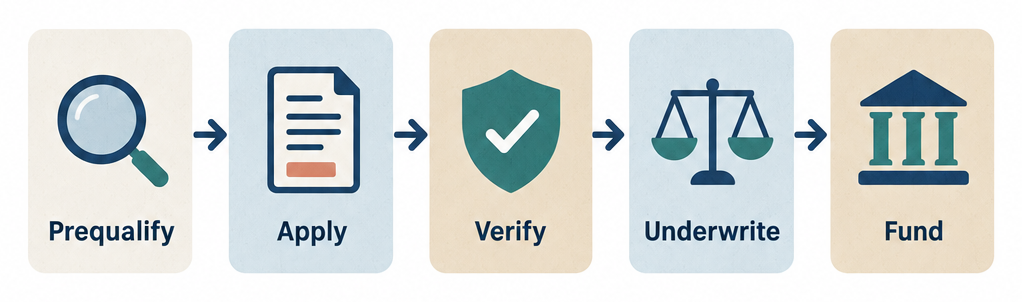
Most applications follow the same path, whether you go through a bank, a credit union or an online lender. The order can shift slightly, but these are the stages:
- Prequalification (optional). You share basic details and see estimated rates through a soft credit check.
- Full application. You give your Social Security number, income, employment, housing costs and the amount you want.
- Identity verification. The lender confirms you are who you say you are.
- Hard credit inquiry. The lender pulls your full credit report, which shows up as an inquiry other lenders can see.
- Underwriting. The lender weighs your credit history, income and existing debts to set a yes, no or counteroffer.
- Offer and disclosures. If approved, you receive the APR, finance charge, total of payments and payment schedule in writing.
- Signing and funding. You sign the agreement, and the money goes to your bank account, usually within one to five business days.
Each stage has a point where you can stop. Until you sign the final agreement, you owe nothing.
Before you apply: prequalification and the soft check
Many lenders let you check your rate before you submit a full application. You enter your name, address, income and the last four digits of your Social Security number, and the lender runs a soft inquiry. Soft inquiries appear only on your own copy of your credit report. They do not affect your credit score.
Prequalification is the closest thing to a free look at pricing. It is not a promise, though. The rate you see is an estimate based on limited information. The final rate can come in higher once the lender verifies your income and pulls your full report.
Use prequalification to compare three or four lenders before you trigger any hard inquiry. A prequalified offer at 14% from one lender and 27% from another tells you a lot. Plug both into a personal loan calculator to see the monthly payment and total interest side by side.
Check your own credit reports first, too. Equifax, Experian and TransUnion made free weekly reports permanent in 2023 through AnnualCreditReport.com. Errors such as a paid account still showing a balance can push your rate up. Under the Fair Credit Reporting Act, you can dispute inaccurate information with the credit bureau, and it generally must investigate within 30 days.
If you have a credit freeze in place, you will need to lift it temporarily before a lender can pull your report. Freezes and unfreezes are free at all three bureaus under federal law.
What the application asks for
A full application asks for more detail than prequalification. Lenders use it to verify your identity, confirm you can repay, and meet federal anti-money-laundering rules. Having these items ready speeds things up.
| What lenders ask for | Common forms of proof | Why they want it |
|---|---|---|
| Legal name, date of birth, address | Driver’s license, state ID, passport | Federal customer identification rules |
| Social Security number or ITIN | SSN entered on the form | Credit pull and identity check |
| Income | Pay stubs, W-2s, tax returns, bank statements | Ability to repay |
| Employment | Employer name and phone, offer letter | Income stability |
| Housing cost | Rent or mortgage amount, lease | Debt-to-income math |
| Existing debts | Pulled from your credit report | Debt-to-income math |
| Bank account | Routing and account number | Where funds are deposited |
| Loan amount and purpose | Entered on the form | Some lenders restrict uses |
Self-employed applicants usually need one or two years of tax returns, plus recent bank statements. Gig workers often get asked for 1099s or app earnings summaries. Income from Social Security, disability, alimony or child support counts too. Under the Equal Credit Opportunity Act, a lender cannot discount income just because it comes from public assistance. You also don’t have to disclose alimony or child support unless you want the lender to count it.
Some lenders restrict how the money can be used. Many won’t fund a personal loan for college tuition, a home down payment, gambling or investments, including crypto. If your purpose is business, a lender may steer you toward a business product instead.
Co-applicants and cosigners
You can often add a second person to the application, and the two roles work differently. A co-applicant, also called a co-borrower, shares the money and the debt equally. A cosigner usually gets none of the money but promises to repay if you don’t. Both people go through a hard credit check. Both are fully liable, and the loan appears on both credit reports.
Adding someone with stronger credit can get you approved or lower your rate. It also puts their credit at risk if you miss payments. The FTC requires most lenders to give cosigners a written notice explaining that they may have to pay the full debt.
Identity checks and the hard credit pull
Once you submit, the lender verifies your identity. Banks must run a customer identification program under federal anti-money-laundering rules. That means collecting at minimum your name, date of birth, address and an identification number. Online lenders may match your details against databases or ask you to upload a photo of your ID. Some also ask for a selfie.
Next comes the hard inquiry. Your application gives the lender a “permissible purpose” under the Fair Credit Reporting Act to pull your full credit report. Hard inquiries stay on your report for two years. FICO’s scoring counts them only for the past 12 months.
The score impact is usually small. FICO says that for most people, one additional inquiry takes less than five points off their FICO Score. Several applications in a short span hurt more, and lenders can read a cluster as a sign of money stress.
There’s a catch about rate shopping. FICO groups multiple inquiries for mortgages, auto loans and student loans within a shopping window and counts them as one. That treatment generally does not cover personal loans. This is why prequalifying with soft checks first matters.
How lenders decide: credit, income and debt
Underwriting is the stage where a person, a computer model, or both decide whether to lend and at what price. Each lender weighs factors differently. These five come up almost everywhere:
- Credit score. Many prime lenders want scores in the high 600s or above. Lenders that serve fair or poor credit exist, but they charge rates near the top of the range.
- Credit history. Late payments, collections, bankruptcies and how long you’ve had credit all matter.
- Debt-to-income ratio (DTI). This is your monthly debt payments divided by gross monthly income. Someone earning $4,000 a month and paying $1,400 toward rent, a car and cards has a DTI of 35%. Many lenders prefer applicants below roughly 35% to 40%, though limits vary.
- Income stability. Steady employment or a consistent income history makes approval easier.
- Loan amount and term. Asking for less, or picking a shorter term, can tip a borderline file to approval.
Some online lenders also look at alternative data. That can include bank account activity, education or employment history. This can help people with thin credit files, but it does not mean “no credit check.” Nearly every licensed lender still pulls a report at some point.
The outcome is one of three things. You may be approved as requested. You may be denied. Or you may get a counteroffer, such as a smaller amount, a higher rate or a request for a cosigner. You’re free to decline a counteroffer.
What borrowing actually costs: worked examples
The APR is the number that lets you compare loans fairly. Under Regulation Z (12 CFR 1026), the APR folds in interest plus most required fees and expresses the total as a yearly rate. Two loans with the same interest rate can carry very different APRs if one charges an origination fee.
Origination fees are common with online personal loans, often between 1% and 10% of the loan amount. Most lenders subtract the fee from your deposit. You repay the full loan amount but receive less cash.
Here is what different products cost on paper. Payments are rounded to the cent.
| Product | Amount | Fee or APR | Term | Payment | Total repaid |
|---|---|---|---|---|---|
| Personal loan, no fee | $5,000 | 15% APR | 36 months | $173.33/mo | $6,239.88 |
| Personal loan, 5% origination fee | $5,000 ($4,750 received) | 15% rate, about 18.7% APR | 36 months | $173.33/mo | $6,239.88 |
| Fair-credit personal loan | $2,000 | 35.99% APR | 12 months | $200.91/mo | $2,410.92 |
| Credit union PAL I | $1,000 | 28% APR + $20 fee | 6 months | $180.53/mo | $1,103.18 |
| Payday loan | $500 | $15 per $100 (about 391% APR) | 14 days | One payment | $575.00 |
How the APR math works on the fee loan. You borrow $5,000, but the lender keeps $250 as a fee, so $4,750 lands in your account. You still make 36 payments of $173.33, totaling $6,239.88. Your real cost is $1,489.88 for the use of $4,750. Spreading that cost across the loan’s life works out to about 18.7% a year. That’s the APR, even though the “rate” is 15%.
How the payday APR works. A $75 fee on $500 is 15% for two weeks. A year has about 26.07 two-week periods (365 ÷ 14), so 15% × 26.07 comes to roughly 391%. The CFPB uses the same math to show that a typical $15-per-$100 payday fee equals an APR of almost 400%. Our guide to the payday loan explains why many borrowers roll these over and pay the fee several times.
To test your own numbers, a “loan calculator” will show how the term changes the total. Stretching the $5,000 loan to 60 months lowers the payment but raises total interest well above the 36-month version.
Before you borrow
The monthly payment is the number that sinks people. Price the full term, add the payment to your budget, and walk away if it only works when nothing goes wrong.
The offer and the disclosures you must receive
If you’re approved, you get an offer to review before signing. For closed-end loans like personal and installment loan products, the Truth in Lending Act and Regulation Z require the lender to show these items clearly before you’re bound:
- Amount financed: the credit you actually receive after prepaid fees.
- Finance charge: the dollar cost of the credit, including interest and most fees.
- Annual percentage rate: the yearly cost expressed as a rate.
- Total of payments: everything you’ll pay if you follow the schedule.
- Payment schedule: the number, amount and timing of payments.
- Late fee and prepayment terms: what happens if you pay late or pay early.
Read the prepayment line. Many personal lenders charge no prepayment penalty, but don’t assume. Also check whether optional add-ons, such as credit insurance, are bundled in. Credit life or disability insurance premiums raise your cost. A lender generally can’t require them and still leave them out of the finance charge.
Most online lenders deliver disclosures and contracts electronically. Under the federal E-SIGN Act, you must consent to electronic records, and you can ask for paper copies. Save a PDF of everything you sign.
Signing and funding: how long it takes
Once you accept, you e-sign the loan agreement, and the lender schedules the deposit. Timing depends on the lender and your bank.
| Lender type | Typical decision | Typical funding after signing |
|---|---|---|
| Online lender | Minutes to one business day | Same day to 3 business days |
| Bank (existing customer) | Same day to a few days | 1 to 5 business days |
| Credit union | Same day to a week | 1 to 5 business days |
| Debt consolidation (paid to creditors directly) | Varies | Up to 1 to 2 weeks |
Funding can stall over a manual income check, a name mismatch, or a bank account that doesn’t match your identity. Respond quickly to document requests.
Personal loans don’t come with a federal cooling-off period. The three-day right to cancel under Regulation Z applies to certain loans secured by your home, not to unsecured personal loans. Some lenders voluntarily let you return the funds within a short window without interest. Check the agreement.
If you’re denied: the adverse action notice
A denial isn’t a dead end, and it comes with paperwork that helps you. Under the Equal Credit Opportunity Act and its Regulation B (12 CFR 1002), the lender must notify you of its decision within 30 days of receiving your completed application. If it denies you, the notice must give the specific reasons, or tell you that you can request them within 60 days.
“Insufficient income” or “too many recent inquiries” are acceptable reasons. Vague answers like “you didn’t meet our internal standards” are not.
If the decision relied on your credit report, the Fair Credit Reporting Act adds more rights. The notice must name the credit bureau the lender used. It must tell you that you can get a free copy of that report within 60 days and that you can dispute errors. If a credit score was used, the notice must include the score and the main factors that hurt it.
Use the reasons to decide your next step. If DTI was the issue, paying down a card balance or asking for less money can change the outcome. If there was an error on your report, dispute it before you reapply. Avoid firing off five more applications that week. Each one adds another hard inquiry.
“Easy,” “guaranteed” and “no credit check” loans
Searches for an easy loan usually lead to ads promising guaranteed approval or no credit check. Treat these as marketing claims. Here’s what usually happens behind them.
“No credit check” usually means no check with the big three bureaus. Many of these lenders still check specialty databases that track payday and subprime borrowing, or they review your bank account activity. In exchange, the price is far higher. Triple-digit APRs are common.
“Guaranteed approval” is not a real thing for a licensed lender. Every lender must verify identity, and nearly all assess ability to repay. A company that guarantees approval before seeing your information is a red flag.
Fast cash products, such as a payday advance or a car title loan, are easy to qualify for because the lender takes your next paycheck or your car title as security. That’s what makes them risky. A missed title loan payment can cost you your car. If what you really need is extra income, our piece on legit ways to make money fast covers options that don’t create debt.
How to apply for a loan online without getting scammed
Online loans are convenient, and scammers know that. The FTC warns that legitimate lenders don’t guarantee a loan before you apply. The FTC also notes it is illegal for companies doing business by phone in the US to promise you a loan and ask you to pay before you get it.
Red flags to watch for:
- An upfront fee for “insurance,” “processing” or “collateral” before funds arrive.
- Requests to pay with gift cards, wire transfers, crypto or a payment app.
- A lender with no physical address or no state license you can find.
- Pressure to decide today or “lose the offer.”
- An unsolicited text or call about a loan you never applied for.
- A “government loan” or grant for personal expenses. The federal government does not make personal loans to cover everyday bills. Real federal lending programs, such as SBA-backed loans, go through approved lenders and are for businesses, disasters or specific purposes. Nonprofit options like Kiva’s US program offer 0% interest crowdfunded loans to small businesses, not personal cash loans.
How to check a lender
- Search the company on NMLS Consumer Access to see which states license it.
- Confirm the license with your state’s financial regulator.
- Search the CFPB’s consumer complaint database for patterns.
- Make sure the website shows an APR, a physical address and a phone number.
- Never pay a fee before the loan is funded.
If you’ve been targeted, report it to the FTC at ReportFraud.ftc.gov and to the FBI’s Internet Crime Complaint Center (IC3). If a licensed lender treated you unfairly, file with the CFPB’s complaint portal and your state regulator.
Where you can borrow depends on your state
There’s no single national rulebook for small loans. States license most non-bank lenders and set their own rate caps. A product that’s legal in one state can be banned next door. Online lenders typically list the states they serve, and some can’t lend in your state at all.
| Situation | Example states | What it means for you |
|---|---|---|
| Payday loans banned or capped near 36% | New York, New Jersey, Pennsylvania, Georgia, North Carolina, Arkansas, Arizona, Massachusetts, Maryland, West Virginia, Vermont, Connecticut, plus DC | Storefront payday lenders largely absent |
| States that capped rates at 36% more recently | Montana, South Dakota, Colorado, Nebraska, Illinois, New Mexico | High-cost small loans curtailed |
| Few or no effective rate caps on short-term loans | Texas (through credit access businesses), several others | Very high costs are legal; compare carefully |
Texas is a good example of how much the rules matter. Payday and title lenders there operate as credit access businesses, and the fees they charge are not subject to the usual caps. Our guide to Texas payday loan laws covers the details.
Two federal rules apply everywhere. The Military Lending Act caps the military annual percentage rate at 36% on most consumer credit for active-duty servicemembers and their dependents. The Servicemembers Civil Relief Act caps interest at 6% on debts taken on before active duty.
Cheaper options first
Before you sign for a high-cost loan, run through options that cost less or nothing.
Cheaper options first
A federal credit union payday alternative loan caps APR at 28%.
Ask creditors about a hardship plan before borrowing to pay them.
Nonprofit credit counselors can review your budget for free or low cost.
- Payday alternative loans (PALs). Federal credit unions offer these under NCUA rules. PAL I loans run $200 to $1,000 for one to six months, with an application fee of no more than $20. You must be a member for at least one month. PAL II loans go up to $2,000 for up to 12 months, with no waiting period. Both cap APR at 28%.
- Employer or no-fee earned wage access. Some employers advance pay you’ve already earned at no cost. App-based advances vary. Optional tips and instant-transfer fees can add up, so check the real cost.
- Hardship programs. Utility companies, landlords, medical providers and credit card issuers often offer payment plans or deferrals if you ask before you fall behind.
- Nonprofit credit counseling. Agencies affiliated with the National Foundation for Credit Counseling can set up a debt management plan. They often negotiate lower card interest rates.
- Local and federal assistance. Dialing 211 connects you with local help for rent, utilities and food. LIHEAP helps with energy bills in every state.
- A smaller loan. Borrowing $1,500 instead of $3,000 lowers both the payment and the total interest.
Your rights when you apply for credit
Federal law protects you from the first click to the final payment. These are the rules that matter most during the application.
| Law | What it gives you |
|---|---|
| Equal Credit Opportunity Act (Regulation B) | No discrimination based on race, color, religion, national origin, sex, marital status, age, or receipt of public assistance. A decision within 30 days and specific reasons if denied. |
| Fair Credit Reporting Act | Lenders need a permissible purpose to pull your report. You get a notice and a free report if denied based on it, and the right to dispute errors. |
| Truth in Lending Act (Regulation Z) | Clear disclosure of APR, finance charge, amount financed and total of payments before you sign. |
| Electronic Fund Transfer Act (Regulation E) | A lender can’t require you to repay by automatic debit as a condition of getting the loan. You can revoke authorization. |
| Military Lending Act | 36% MAPR cap for covered servicemembers and dependents. No mandatory arbitration. |
| Servicemembers Civil Relief Act | 6% interest cap on debts incurred before active duty. |
One right surprises many people. Under Regulation E, lenders may offer an autopay discount but can’t make autopay mandatory to approve you. If a lender insists, you can file a complaint with the CFPB.
FAQ
Does applying for a loan hurt my credit score?
Prequalifying uses a soft inquiry and has no effect. Submitting a full application usually triggers a hard inquiry. FICO says that typically lowers scores by less than five points. The inquiry stays on your report for two years and counts in FICO scores for one year.
How can I apply for a loan with bad credit?
Start with credit unions, which often weigh your membership history, and look at PALs if you need $2,000 or less. Adding a creditworthy co-applicant or asking for a smaller amount can help. Expect higher APRs from online lenders that serve fair credit, and compare total cost, not only the monthly payment.
How long does a loan application take?
Online applications take about 10 to 15 minutes if your documents are ready. Decisions can come in minutes. Funding usually arrives within one to five business days after you sign, and some online lenders fund the same or next business day.
Can a lender deny me without telling me why?
No. Under the Equal Credit Opportunity Act, a lender must give specific reasons for a denial, or tell you how to request them within 60 days. If your credit report played a role, the Fair Credit Reporting Act also entitles you to a free copy of that report.
Is it safe to get a loan online?
It can be, if the lender is licensed in your state and discloses its APR clearly. Verify the license through NMLS Consumer Access and your state regulator. Never pay an upfront fee to “unlock” a loan, since that’s a classic advance-fee scam.
What’s the difference between prequalification and preapproval?
Prequalification is a soft-check estimate based on limited information. Preapproval usually involves more verification, sometimes a hard pull, and a firmer offer. Neither is final until underwriting confirms your income and identity and you sign the agreement.
Laws and regulations referenced
- Truth in Lending Act, 15 U.S.C. 1601
- Regulation Z, 12 CFR Part 1026
- Fair Credit Reporting Act, 15 U.S.C. 1681
- Equal Credit Opportunity Act, 15 U.S.C. 1691
- Regulation B (equal credit), 12 CFR Part 1002
- Electronic Fund Transfer Act, 15 U.S.C. 1693
- Regulation E (electronic transfers), 12 CFR Part 1005
- Military Lending Act, 10 U.S.C. 987
- Servicemembers Civil Relief Act, 50 U.S.C. 3901
Links go to the official text on government sites.
Check, verify or complain
Sources
- mycreditunion.gov › manage your money › consumer loans credit cards › payday alternative loans mycreditunion.gov · primary source
- consumerfinance.gov › ask cfpb › what is a payday loan en 1567 consumerfinance.gov · primary source
- utilitybenefits.com › electricity › assistance › liheap utilitybenefits.com
- navyfederal.org › membership › offers discounts › scra navyfederal.org
- adviceonly.com › glossary › servicemembers civil relief act adviceonly.com
- experian.com › blogs › ask experian › what is payday loan alternative experian.com

Dana writes US Financer's guides to payday loans, personal and installment loans, bad credit borrowing and cash advance apps. Every piece starts from what a loan really costs, works the numbers in a table, and checks what the lender's own disclosure and your state's rules…

Ruth is US Financer's standards editor. Every article goes through her checks before and after it is published: each rate, fee, cap, deadline and rule is matched against its primary source, every law named is linked to its official text, and anything that cannot be…
Comments are closed