

General information, not legal advice. Laws change, so confirm with the official statute, your state regulator or a licensed attorney before you act.
Payday loans are illegal in North Carolina. The law that briefly allowed them expired on August 31, 2001. Since then, most consumer loans of $25,000 or less have been capped at 16% a year unless the lender holds a state consumer finance license. Licensed lenders can charge more, but their ceiling is a tiered rate that starts at 33% a year on the first $4,000. That leaves no legal room for triple-digit car title loans.
Run the numbers
Key takeaways
- No North Carolina law authorizes payday or triple-digit car title loans, and no 2025 bill to bring them back was filed.
- Most lenders are capped at 16% a year on loans of $25,000 or less under N.C. Gen. Stat. § 24-1.1.
- Since October 1, 2023, licensed consumer finance lenders can lend up to $25,000. Their rate tops out at 33% on the first $4,000.
- An overpriced loan of $25,000 or less made to someone in North Carolina generally can’t be enforced in the state, and the borrower may recover twice the interest paid.
- In North Carolina, ordinary consumer debts generally can’t be collected by garnishing your wages.
North Carolina loan laws at a glance
North Carolina has some of the strictest small-loan rules in the country. Lawmakers never passed a separate ban for each product. Instead they let payday lending authority lapse and kept the general usury law in force. Any loan priced above that law is illegal unless a specific statute allows it. The main statute that does allow higher rates is the North Carolina Consumer Finance Act, and its caps are far below payday or title loan pricing. All the statutes below are published on the General Assembly’s official code site, ncleg.gov. The table reflects the law as of November 2026.
| Product | Legal status in NC | Main rule | Citation |
|---|---|---|---|
| Payday (deferred deposit) loans | Banned | Check cashers may not hold a check for later deposit | N.C. Gen. Stat. § 53-281 |
| General loans of $25,000 or less | Allowed, capped | 16% a year maximum for most lenders | N.C. Gen. Stat. § 24-1.1 |
| Licensed consumer finance loans | Allowed, capped | Up to $25,000; tiered caps from 33% down to 18% a year | N.C. Gen. Stat. §§ 53-166, 53-176 |
| Car title loans | Banned at typical title loan pricing | No statute authorizes them; usury and finance caps apply | N.C. Gen. Stat. §§ 24-1.1, 53-176 |
| Out-of-state and online loans to NC residents | Covered by NC caps in most cases | Overpriced loans of $25,000 or less unenforceable in NC | N.C. Gen. Stat. §§ 53-190, 24-2.1 |
| Usurious loans | Interest forfeited | Borrower can recover twice the interest paid | N.C. Gen. Stat. § 24-2 |
The last big change came in 2023. Session Law 2023-61 (Senate Bill 331) became law when the General Assembly overrode Governor Roy Cooper’s veto in June 2023, and it took effect October 1, 2023. It raised the licensed loan ceiling from $15,000 to $25,000, raised the top rate from 30% to 33%, and extended licensing to loan servicers. In 2025, the National Conference of State Legislatures’ trackers listed no North Carolina bills on payday lending or earned wage access.
Payday and short-term loans in North Carolina
How North Carolina ended payday lending
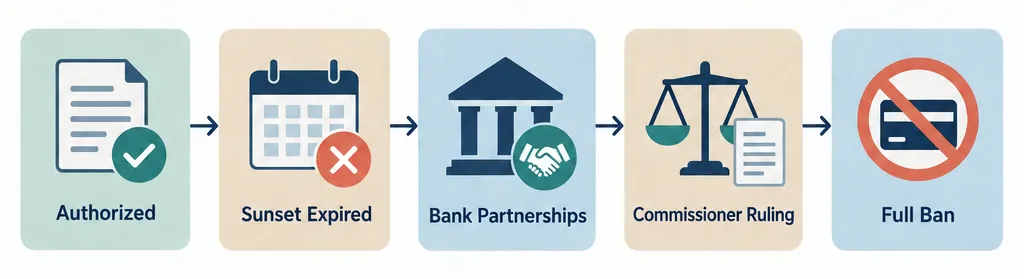
North Carolina allowed payday lending for only four years. In 1997, the General Assembly allowed “deferred deposit” transactions under the check cashing law. A store could take a postdated check and hold it until the borrower’s next payday. The law had a sunset date, lawmakers chose not to renew it, and it expired on August 31, 2001.
Several large chains kept operating by partnering with out-of-state banks. They argued that the bank was the real lender and could use its home state’s interest rate. North Carolina’s Commissioner of Banks challenged that arrangement. In late 2005, the Commissioner ruled that Advance America’s North Carolina business violated the Consumer Finance Act. By early 2006, the major storefront chains had agreed to leave the state. No legal storefront payday lender has operated in North Carolina since. That is why the state has pawnshops and check cashers but none of the payday storefronts common in neighboring Tennessee and South Carolina.
What the law says now
Two statutes do most of the work. The first is N.C. Gen. Stat. § 53-281, part of the Check Cashing Act, which bars licensed check cashers from delaying the deposit of a check. A store can cash your check for a fee. It can’t give you cash today for a check it promises to hold until payday. That arrangement is a payday loan, and it is banned.
The second is the general usury statute, N.C. Gen. Stat. § 24-1.1. It caps most loans of $25,000 or less at the greater of 16% a year or the six-month Treasury bill rate plus six points. Treasury rates are low enough that 16% is the cap that applies as of November 2026. A lender that wants to charge more on a small loan needs specific permission in a statute, which in practice means a Consumer Finance Act license. Even then, the cap is far below the roughly 400% APR of a typical payday loan.
If a lender charges more than the law allows, N.C. Gen. Stat. § 24-2 says it loses all interest on the loan. If you have already paid interest, you can recover twice that amount. That penalty is a big reason the ban has held for more than two decades.
Fees, loan size, term, rollovers and databases
North Carolina has none of the rules that states use to regulate payday loans. There is no payday fee cap, maximum payday loan amount, minimum term, rollover limit, cooling-off period or statewide borrower database. Those rules exist where payday lending is legal. North Carolina skips that layer by not allowing the product at all.
Friends in other states may mention “$15 per $100 borrowed” or “one rollover allowed.” None of that applies here. Our guides to Tennessee payday loan laws and Missouri payday loan laws show what a regulated payday market looks like, with fee schedules and database checks. In North Carolina, the numbers that matter are the 16% usury cap and the Consumer Finance Act tiers covered below.
A licensed consumer finance company can make you a short-term loan. It still has to price the loan under N.C. Gen. Stat. § 53-176, and on a two-week loan that means interest of a few dollars, not tens of dollars. That math is why payday-style products don’t pay off for lenders here, which is what lawmakers intended. You can run other scenarios through our payday loan calculator.
What a payday or title loan would cost, compared with NC’s caps
The table compares typical payday and title loans in states that allow them with the cost of the same loan under North Carolina’s 16% cap. The $15 per $100 payday fee is the typical charge the CFPB has described in its research. The 25% monthly title loan fee is the average the CFPB found in its 2016 study of single-payment vehicle title loans.
| Loan | Amount | Fee or interest | Term | Total repaid | APR |
|---|---|---|---|---|---|
| Typical payday loan (illegal in NC) | $500 | $75 fee | 14 days | $575 | About 391% |
| Same payday loan renewed 4 times (illegal in NC) | $500 | $375 in fees (5 × $75) | 10 weeks | $875 | About 391% |
| Same $500 under NC’s 16% cap | $500 | $3.07 interest | 14 days | $503.07 | 16% |
| Typical car title loan (illegal in NC) | $1,000 | $250 fee | 30 days | $1,250 | About 304% |
| Same $1,000 under NC’s 16% cap | $1,000 | $13.15 interest | 30 days | $1,013.15 | 16% |
Here is the math in plain words:
- Payday APR. A $75 fee on $500 is 15% for 14 days. A year has 365 ÷ 14 = about 26.07 two-week periods, and 15% × 26.07 = about 391%.
- Renewals. The first loan plus four renewals means five fees: 5 × $75 = $375. Add the $500 principal, which never goes down, and you repay $875.
- 16% on $500 for 14 days. $500 × 16% = $80 a year. $80 × 14 ÷ 365 = $3.07.
- Title APR. A $250 fee on $1,000 is 25% for 30 days. 25% × (365 ÷ 30) = 25% × 12.17 = about 304%.
- 16% on $1,000 for 30 days. $1,000 × 16% = $160 a year. $160 × 30 ÷ 365 = $13.15.
Did you know?
CFPB research published in 2014 found that four out of five payday loans were rolled over or renewed within 14 days. North Carolina’s ban takes that renewal cycle out of the picture entirely.
Check cashers and in-store “cash advances”
Check cashing stores are legal in North Carolina. The Commissioner of Banks licenses them under the Check Cashing Act, Article 22 of Chapter 53. The Act caps their fees, with different limits for different types of checks, and requires stores to post those fees. What they can’t do is lend. A store that offers money today in exchange for holding your personal check until Friday is offering a deferred deposit transaction, which N.C. Gen. Stat. § 53-281 bans. You can report that offer to the Commissioner of Banks.
Car title loans in North Carolina
North Carolina has no title loan statute, and that missing statute is the ban. A car title loan is a loan secured by your vehicle, so it falls under the same rules as any other loan. Most lenders are held to the 16% cap in N.C. Gen. Stat. § 24-1.1. Licensed consumer finance companies are held to the tiers in N.C. Gen. Stat. § 53-176. Under either cap, a one-month title loan priced at 25% a month can’t be offered legally. Searches for “car title loans North Carolina” often turn up online brokers and out-of-state storefronts. That doesn’t mean those lenders can legally lend to you here.
You can still get a legal loan secured by your car. A bank, credit union or licensed consumer finance company can take a lien on the vehicle as collateral for an installment loan priced within state limits and repaid over months or years. The two differ in cost and structure. A secured installment loan spreads repayment over a schedule. A title loan demands the full amount plus a large fee in 30 days.
The risks explain why the state keeps title loans out. The CFPB’s 2016 study found that about one in five single-payment title loan sequences ended with the borrower’s vehicle repossessed. More than four in five title loans were renewed on the day they came due. Outside North Carolina’s larger cities, public transit is limited, so losing the car often means losing the way to get to work.
Some residents near the state line drive into South Carolina or Tennessee to get a title loan in person. N.C. Gen. Stat. § 53-190 makes overpriced loans of $25,000 or less unenforceable in North Carolina, but it excludes loans where every step happens outside the state, from solicitation and signing to handing over the money. If you sign and take the cash at a store in another state, you may lose North Carolina’s protection, and the lender may be able to repossess under the other state’s rules. If any part of the deal reached you in North Carolina, such as a mailer, a phone call or an online application, that exception is much harder for the lender to claim.
Installment loans and personal loans in North Carolina
Consumer Finance Act rate caps
Most legal small installment loans in North Carolina come from companies licensed under the North Carolina Consumer Finance Act, N.C. Gen. Stat. §§ 53-164 through 53-191. Under N.C. Gen. Stat. § 53-166, anyone in the business of lending $25,000 or less at rates above what Chapter 24 allows needs this license from the Commissioner of Banks. Since Session Law 2023-61, the same rule also covers companies that service those loans.
The rate caps are in N.C. Gen. Stat. § 53-176(a), and N.C. Gen. Stat. § 53-173 sets how interest is calculated. Which caps apply depends on the loan’s original amount, as of November 2026:
| Loan size at origination | Slice of unpaid principal | Maximum annual rate |
|---|---|---|
| $12,000 or less | First $4,000 | 33% |
| $12,000 or less | $4,000.01 to $8,000 | 24% |
| $12,000 or less | Above $8,000 | 18% |
| Over $12,000, up to $25,000 | Entire balance | 18% |
For loans of $12,000 or less, each rate applies only to its own slice of the balance, much like tax brackets. On a $6,000 balance, the lender can charge 33% on the first $4,000, which is $4,000 × 33% ÷ 12 = $110 a month. It can charge 24% on the next $2,000, which is $2,000 × 24% ÷ 12 = $40 a month. That is $150 in the first month, and $150 × 12 ÷ $6,000 = a blended rate of 30% a year. As you pay the balance down, a larger share of it sits in the 33% slice, so the blended rate creeps up toward 33%.
A $15,000 loan is above the $12,000 line, so the whole balance is capped at 18%. The first month’s interest is $15,000 × 18% ÷ 12 = $225.
The Act also lets licensees charge a loan processing fee and limited late charges, both capped by the Act. Session Law 2023-61 raised both limits. These charges count toward the finance charge, so the APR on your Truth in Lending disclosure can be higher than the stated interest rate. When you compare offers, compare the APR and the total repaid, not the interest rate.
Here is what a small loan at the top tier costs:
| Amount | Rate | Term | Monthly payment | Total repaid | Total interest |
|---|---|---|---|---|---|
| $1,000 | 33% a year | 12 months | $98.97 | $1,187.64 | $187.64 |
The math: 33% a year is 33% ÷ 12 = 2.75% a month on whatever you still owe. In the first month, you pay $1,000 × 2.75% = $27.50 in interest. Twelve payments of $98.97 add up to $1,187.64, and $1,187.64 minus the $1,000 borrowed leaves $187.64 in interest. That is before any processing fee the lender is allowed to charge. By comparison, renewing a $500 payday loan four times in a state where that is legal costs $375 in fees.
Licensing: who needs one and who doesn’t
Some lenders that operate in North Carolina don’t need a Consumer Finance Act license. Banks and credit unions operate under their own charters. Federal law (12 U.S.C. § 85) lets national banks charge the interest rate allowed in their home state. State-chartered, FDIC-insured banks have similar authority. That is why a credit card or a personal loan from an out-of-state bank can legally carry a rate above North Carolina’s caps.
Some online lenders rely on that rule by partnering with a bank in a state without a rate cap. The bank technically makes the loan and then sells the loan or its payments to the nonbank. Whether the nonbank is the “true lender,” and so bound by North Carolina’s caps, is a disputed legal question. North Carolina’s regulator fought this battle against the storefront payday chains in 2005 and won.
Federal rules point in two directions:
- The OCC’s true lender rule. In 2020, the Office of the Comptroller of the Currency issued a rule that would have made the bank the lender in most of these deals. Congress repealed it in 2021 under the Congressional Review Act.
- The FDIC’s 2020 rule. A separate FDIC rule says a loan’s interest rate stays valid after a bank sells the loan. It remains in place.
In practice, be careful in two situations. One is a lender quoting an interest rate above 33% on a loan of $25,000 or less. The other is a lender charging any rate above 16% with no North Carolina license and no bank or credit union charter. In either case, ask who the actual lender is and check its license before you go further.
Personal loans for bad credit in North Carolina
North Carolina’s caps limit what a loan can cost. They don’t guarantee you’ll be approved. Lenders that can’t profitably lend to riskier borrowers within those limits usually turn them down rather than offer 200% APR. That is the trade-off the state chose. With a low credit score, your realistic legal options are:
- Consumer Finance Act lenders. These licensed companies focus on smaller installment loans and often accept lower scores. They usually pull your credit and verify your income. On smaller loans, expect a rate at or near the 33% tier plus allowed fees.
- Credit unions. Many look at your history with them, not only your score. Federal rules cap payday alternative loans, covered below, at 28% APR.
- Secured options. A credit union loan secured by your own savings or certificate, or a secured credit card, uses your deposit as collateral and usually carries a much lower rate.
- Online lenders. Some are licensed in North Carolina and price within the caps. Others work through bank partnerships or tribal entities and charge far more. Check the license before you share your bank account details.
Be skeptical of “guaranteed approval” and “no credit check” ads. A real lender checks something: your credit report, your bank account history or your income. Lenders that advertise no credit check often rely on other data and charge more to cover the extra risk. In North Carolina, those prices may be illegal.
Retail installment contracts and pawnshops
Two other legal kinds of credit come up often:
- Seller financing. When the seller finances furniture, appliances or a car, the North Carolina Retail Installment Sales Act (Chapter 25A) applies. It has its own finance charge limits and disclosure rules.
- Pawnshops. Pawnshops are legal under the Pawnbrokers and Cash Converters Modernization Act (Chapter 91A). It requires a local license and caps the monthly charges a pawnbroker can collect.
Pawn charges look high as an APR, but a pawn loan has one feature payday and title loans lack. If you can’t repay, you lose the item you pawned and owe nothing more. The pawnbroker can’t sue you or send the loan to collections.
Online and tribal lenders
North Carolina law covers most online loans made to people who live in the state. N.C. Gen. Stat. § 53-190 says loans of $25,000 or less with charges above what §§ 53-173 and 53-176 allow can’t be enforced in North Carolina. That includes lenders who come into the state to solicit business. Separately, N.C. Gen. Stat. § 24-2.1 treats a loan as made in North Carolina when a resident applies for it or receives it here. That brings in the usury law and its double-interest penalty.
Tribal lenders claim to be arms of Native American tribes and therefore exempt from state law. That claim has mostly failed:
- In 2013, the North Carolina Attorney General sued Western Sky Financial, an online lender owned by a member of the Cheyenne River Sioux Tribe, and its servicer CashCall over high-cost loans to North Carolina residents.
- The Fourth Circuit, the federal appeals court whose rulings bind federal courts in North Carolina, has repeatedly refused to enforce tribal loan agreements written to strip borrowers of their federal and state rights. The best-known case is Hengle v. Treppa (2021).
- Courts generally treat a tribe’s own government, which is immune from suit, differently from lending businesses run largely by outside investors, which often are not.
None of this means an illegal online lender will leave you alone. Many still debit bank accounts, call constantly and report borrowers to collection agencies. Your strongest protections are practical:
- Revoke the ACH authorization. Tell the lender in writing, then tell your bank to stop the payments. Under Regulation E (12 CFR 1005.10(c)), your bank must stop preauthorized transfers if you tell it at least three business days before the scheduled payment.
- Keep records of the loan agreement, every payment and every collection call.
- Complain to the Commissioner of Banks, the North Carolina Attorney General’s Consumer Protection Division and the CFPB. Regulators have used patterns in complaints to bring cases against online lenders.
- Talk to a lawyer or Legal Aid of North Carolina if a lender sues you. A usurious loan may let you sue back under N.C. Gen. Stat. § 24-2.
Debt collection and wage garnishment in North Carolina
Who can collect and what they can’t do
North Carolina adds its own protections on top of the federal Fair Debt Collection Practices Act. The North Carolina Debt Collection Act, N.C. Gen. Stat. §§ 75-50 through 75-56, covers creditors collecting their own debts, a group the federal law largely leaves out. Third-party collection agencies fall under the Collection Agency Act, N.C. Gen. Stat. §§ 58-70-1 and following. They need a permit from the North Carolina Department of Insurance, not the Commissioner of Banks.
Both state laws ban threats, harassment, lying about the amount or legal status of a debt, and unfair collection methods. Specifically, a debt collector can’t threaten you with arrest, falsely claim you’ll lose your job, or contact your employer or family to shame you. Violations can bring actual damages plus a civil penalty for each violation. A violation of the state Debt Collection Act also counts as an unfair trade practice under Chapter 75.
Wage garnishment limits
North Carolina is one of a handful of states that largely bar wage garnishment for ordinary consumer debts. Under N.C. Gen. Stat. § 1-362, your earnings from the 60 days before a collection order are protected when your family needs them for support. In practice, a credit card company, medical provider, personal lender or debt buyer that wins a judgment against you generally can’t take money straight out of your paycheck.
There are exceptions:
| Type of debt | Can wages be garnished in NC? | Source of the rule |
|---|---|---|
| Credit cards, personal loans, medical bills, debt buyers | Generally no | N.C. Gen. Stat. § 1-362 |
| Child support and alimony | Yes | State and federal support enforcement laws |
| Federal student loans | Yes, through administrative wage garnishment | Higher Education Act |
| Federal and state taxes | Yes | Internal Revenue Code; state tax law |
| Certain debts owed to state or local government | In some cases | Specific state statutes |
Where garnishment is allowed, Title III of the Consumer Credit Protection Act limits how much can be taken. For most debts, the limit is the lesser of 25% of disposable earnings or the amount by which weekly disposable pay exceeds 30 times the federal minimum wage. Support orders can take a higher share.
Bank accounts and property
The wage protection doesn’t make you judgment-proof. Once a creditor has a judgment, it can ask the sheriff to seize money in your bank accounts and property that isn’t exempt. N.C. Gen. Stat. § 1C-1601 protects some equity in your home, a vehicle, household goods, tools of your trade and a limited “wildcard” amount. Usually you have to claim these protections yourself. After a judgment, you should get a notice of your right to claim exemptions under N.C. Gen. Stat. § 1C-1603. Return that form by the deadline on it, or you can lose protections you were entitled to.
Federal benefits get extra protection. A Treasury rule at 31 CFR Part 212 requires your bank to automatically shield two months of directly deposited Social Security, SSI, VA and certain other federal benefits from a garnishment order.
Time limits on old debts
Under N.C. Gen. Stat. § 1-52, the deadline to sue on most contract debts, including credit cards and personal loans, is three years. After that, a collector can still ask you to pay but can’t win a lawsuit if you raise the deadline as a defense. North Carolina goes further than most states. N.C. Gen. Stat. § 58-70-115 bars collection agencies, including debt buyers, from suing or starting arbitration on a debt they know or should know is past that deadline. Judgments last longer: a North Carolina judgment can be enforced for ten years under N.C. Gen. Stat. § 1-47 and can be renewed.
Debt relief programs in North Carolina
North Carolina restricts for-profit debt relief more tightly than most states. Under the state’s debt adjusting law, N.C. Gen. Stat. §§ 14-423 through 14-426, it is a misdemeanor to charge North Carolina residents for arranging to pay or settle their debts, and that covers debt settlement companies. Some nonprofit credit counseling agencies are exempt and can charge limited fees. At the federal level, the FTC’s Telemarketing Sales Rule (16 CFR 310.4(a)(5)) bans debt relief companies that sell by phone from charging fees before they actually settle or change a debt.
That leaves three legitimate routes for most people:
- Nonprofit credit counseling and debt management plans. A counselor reviews your budget and may set up a plan that rolls your unsecured debts into one monthly payment, often at lower interest rates negotiated with card issuers. Look for agencies affiliated with the National Foundation for Credit Counseling or the Financial Counseling Association of America.
- Hardship programs directly with creditors. Card issuers, utilities and lenders often have unadvertised programs that temporarily lower or pause payments. Call and ask for the hardship or recovery department.
- Bankruptcy. Filing for Chapter 7 or Chapter 13 stops collection immediately through what’s called the automatic stay. North Carolina’s exemptions under § 1C-1601 apply. Legal Aid of North Carolina and some bar association programs can help you decide whether it makes sense.
If a company promises to “settle your debts for pennies” and wants a monthly fee from a North Carolina resident before doing anything, report it to the Attorney General’s Consumer Protection Division.
Federal rules that apply everywhere
These federal laws protect you in North Carolina no matter what the state rules say:
- Truth in Lending Act and Regulation Z (12 CFR 1026). Before you sign, lenders must disclose the APR, the finance charge, the amount financed and the total of payments. Use these figures to compare loans.
- Military Lending Act (10 U.S.C. § 987; 32 CFR Part 232). Active-duty service members and their dependents can’t be charged more than a 36% Military Annual Percentage Rate, which counts most fees and add-on products. The law also bans forced arbitration and required payroll allotments on covered loans. This matters in a state with Fort Bragg, Camp Lejeune and several other large bases.
- Servicemembers Civil Relief Act. Debts taken on before active duty can be capped at 6% interest during service.
- Fair Debt Collection Practices Act and Regulation F (12 CFR 1006). Third-party collectors must send a validation notice. If you dispute the debt in writing within the validation period, they must stop collecting until they verify it. They can’t call before 8 a.m. or after 9 p.m. They are presumed to break the law if they call about a debt more than seven times in seven days.
- Electronic Fund Transfer Act and Regulation E. A lender can’t make automatic electronic payments a condition of getting credit, and you can stop recurring debits through your bank.
- Equal Credit Opportunity Act. Lenders can’t discriminate based on race, color, religion, national origin, sex, marital status, age or receipt of public assistance.
Help that costs less: financial assistance in North Carolina
The cheapest money is money you don’t have to borrow. The next cheapest usually comes from a credit union or an employer. Check these options before any loan, roughly in order of cost.
Credit union payday alternative loans
Federal credit unions can offer payday alternative loans (PALs) under NCUA rules at 12 CFR 701.21(c)(7). Both types are capped at 28% APR, with an application fee of no more than $20:
- PAL I: $200 to $1,000, repaid over one to six months. You need to have been a member for at least one month.
- PAL II: up to $2,000, repaid over one to twelve months, with no membership waiting period.
North Carolina’s large state-chartered credit unions, including the State Employees’ Credit Union, have offered their own low-cost salary advance products to members with direct deposit.
| Option | Amount | Rate or fee | Term | Total repaid |
|---|---|---|---|---|
| Credit union PAL I | $1,000 | 28% APR + $20 application fee | 6 months | $1,103.24 (6 × $180.54 = $1,083.24, plus $20) |
| Consumer Finance Act loan | $1,000 | 33% a year | 12 months | $1,187.64 (12 × $98.97) before allowed fees |
| Earned wage or cash advance app (example) | $100 | $5 express fee + $5 optional tip | 14 days | $110 (about 261% APR if you pay both) |
The app row is only an example, because pricing varies by company. The math is what matters. $10 on $100 is 10% for two weeks, and 10% × 26.07 periods = about 261% a year. If you wait for the free standard transfer and skip the tip, the cost can drop to zero, which is cheaper than any loan. If you pay for speed every pay period, the cost adds up fast.
Military relief societies
Service members and their families can turn to Army Emergency Relief, the Navy-Marine Corps Relief Society or the Air Force Aid Society. They offer interest-free loans and grants for emergencies such as car repairs, rent and travel, at far less cost than any civilian lender.
State and local financial assistance in North Carolina
For ongoing bills rather than a one-time cash need, public and nonprofit help often beats borrowing:
- NC 211. Dial 2-1-1 or use United Way’s NC 211 service to find rent, utility, food and emergency help in your county.
- County Department of Social Services. Your county DSS runs the Low Income Energy Assistance Program (LIEAP), the Crisis Intervention Program for heating and cooling emergencies, Food and Nutrition Services (North Carolina’s name for SNAP) and Work First cash assistance.
- NC Medicaid. North Carolina expanded Medicaid on December 1, 2023, so many working adults who didn’t qualify before now do. Coverage can keep medical bills from turning into collection accounts.
- Utility hardship funds. Major utilities work with local agencies to help with past-due bills, including Duke Energy through its Share the Light Fund. Ask your utility about a payment arrangement before the shutoff date.
- Legal Aid of North Carolina. Free civil legal help for eligible residents facing eviction, debt lawsuits, illegal lending or abusive collection.
- Employer help. Some employers offer paycheck advances, hardship funds or emergency grants. Ask HR before you go anywhere else.
Cheaper options first
Ask your creditor for a hardship plan or a new due date before you borrow. Check a credit union PAL, which is capped at 28% APR. Call NC 211 for rent, utility and food help in your county.
How to check a lender’s license and file a complaint
The North Carolina Office of the Commissioner of Banks licenses consumer finance lenders and servicers, check cashers, money transmitters and mortgage lenders. You can search its licensees on its official site, nccob.nc.gov, and many of its licenses are also listed on NMLS Consumer Access. Treat it as a serious warning sign if a company lends $25,000 or less at more than 16% a year and you can’t find a North Carolina license or a bank or credit union charter.
How to check a lender in North Carolina
- Get the lender’s full legal name and license number from its website or loan agreement.
- Search the Commissioner of Banks license lookup and NMLS Consumer Access for that name.
- If it says it is a bank, confirm that with the FDIC’s BankFind tool.
- Compare the APR on its Truth in Lending disclosure with North Carolina’s caps.
- Search the CFPB complaint database for the company’s complaint history.
- Walk away if it is unlicensed, wants fees upfront or can’t name the actual lender.
If something has already gone wrong, take the problem to the right agency. You can file with more than one.
| Problem | Where to complain |
|---|---|
| Unlicensed or overpriced lender, or a check casher offering payday-style advances | North Carolina Office of the Commissioner of Banks |
| Scams, illegal online lenders, debt settlement companies, unfair practices | NC Attorney General’s Consumer Protection Division, 1-877-566-7226 |
| Abusive third-party collection agency | NC Department of Insurance (collection agency permits) |
| Any lender, collector or bank, nationwide | CFPB complaint portal |
| Fraud and impostor scams | FTC ReportFraud |
| Internet-based fraud | FBI Internet Crime Complaint Center (IC3) |
| Service member lending issues | Your base’s legal assistance office |
Watch for these red flags:
- The lender asks for an upfront “insurance” or “processing” fee before releasing the loan.
- It wants payment by gift card or wire transfer.
- It has no physical address.
- It won’t name the company that actually funds the loan.
- It pressures you to sign the same day.
Real lenders take fees out of the loan or bill them on a schedule. They never ask you to pay to get money.
Before you borrow
Any lender offering a North Carolina resident a payday or car title loan at triple-digit rates is breaking state law, and dealing with it can still cost you your bank balance or your car. Check the license, read the APR and total of payments, and try a credit union or a hardship plan first.
FAQ
Are payday loans legal in North Carolina?
No. The law that allowed deferred deposit lending expired on August 31, 2001, and N.C. Gen. Stat. § 53-281 bars check cashers from holding checks for later deposit. Most loans of $25,000 or less are capped at 16% a year under N.C. Gen. Stat. § 24-1.1. Licensed consumer finance lenders are limited to tiered rates with a top tier of 33% under § 53-176.
Can I get a title loan in North Carolina?
Not a typical one. No North Carolina statute authorizes title loans, so a loan secured by your car has to fit under the 16% usury cap or the Consumer Finance Act tiers. A bank, credit union or licensed lender can make a legal installment loan with your vehicle as collateral. The 25%-a-month title loans common in other states can’t legally be offered to North Carolina residents.
What happens if I took out an illegal online payday loan?
Under N.C. Gen. Stat. § 53-190, an overpriced loan of $25,000 or less made to someone in North Carolina can’t be enforced here, and under § 24-2 you may be able to recover twice the interest you paid. Revoke the lender’s ACH authorization, tell your bank to stop the payments and keep records. Then file complaints with the Commissioner of Banks, the Attorney General and the CFPB. If you are sued, contact Legal Aid of North Carolina or a consumer lawyer.
Can a debt collector garnish my wages in North Carolina?
For most consumer debts, no. N.C. Gen. Stat. § 1-362 protects earnings from the previous 60 days when your family needs them for support. Wages can still be garnished for child support, alimony, taxes, federal student loans and some government debts. A creditor with a judgment can also try to take money from your bank account, subject to the exemptions you claim under § 1C-1601.
What is the highest interest rate a lender can charge in North Carolina?
For most lenders on loans of $25,000 or less, it is 16% a year under N.C. Gen. Stat. § 24-1.1. As of November 2026, licensed consumer finance companies can charge more under § 53-176. On loans of $12,000 or less, the caps are 33% on the first $4,000, 24% on the next $4,000 and 18% above $8,000. On loans over $12,000, up to the $25,000 maximum, the cap is a flat 18%. Banks and credit card issuers can charge more because federal law lets banks use their home state’s rates.
Did North Carolina change its loan laws recently?
The most recent major change is Session Law 2023-61 (Senate Bill 331), which took effect October 1, 2023. It raised the licensed loan maximum from $15,000 to $25,000, raised the top rate from 30% to 33%, raised the processing and late fee limits and required loan servicers to be licensed. The payday ban was not affected. In 2025, NCSL’s trackers listed no North Carolina bills on payday lending or earned wage access.
Is debt settlement legal in North Carolina?
For-profit debt adjusting, which includes most debt settlement services, is a misdemeanor under N.C. Gen. Stat. §§ 14-423 through 14-426. Qualifying nonprofit credit counseling agencies are exempt. If a company wants fees upfront to settle your debts, report it to the Attorney General’s Consumer Protection Division and look for a nonprofit credit counselor instead.
Laws and regulations referenced
- North Carolina General Statutes Chapter 53, Article 15 (North Carolina Consumer Finance Act)
- Truth in Lending Act, 15 U.S.C. 1601
- Regulation Z, 12 CFR Part 1026
- Fair Debt Collection Practices Act, 15 U.S.C. 1692
- Regulation F (debt collection), 12 CFR Part 1006
- Equal Credit Opportunity Act, 15 U.S.C. 1691
- Electronic Fund Transfer Act, 15 U.S.C. 1693
- Regulation E (electronic transfers), 12 CFR Part 1005
- Military Lending Act, 10 U.S.C. 987
- Military Lending Act rule, 32 CFR Part 232
- Servicemembers Civil Relief Act, 50 U.S.C. 3901
- FDIC deposit insurance
Links go to the official text on government sites.
Check, verify or complain
Sources
- ecfr.gov › current › title 32 › subtitle A › chapter I › subchapter M › part 232 ecfr.gov · official source
- ncleg.gov › enactedlegislation › statutes › html › bysection › chapter 24 › gs 24 1.1 ncleg.gov · official source
- ncleg.net › EnactedLegislation › Statutes › PDF › ByArticle › Chapter 53 › Article 15.pdf ncleg.net

Elena writes about getting through a money emergency, assistance programs, budgeting on a tight income, banking basics and borrower rights. Her guides list the cheaper options first and link the agency or program that can actually help.
Ruth is US Financer's standards editor. Every article goes through her checks before and after it is published: each rate, fee, cap, deadline and rule is matched against its primary source, every law named is linked to its official text, and anything that cannot be…
What changed
- Nov 13, 2026 Facts re-checked against official sources and updated; sources and links refreshed.
- Oct 21, 2026 First published.
Comments are closed