Usury is lending money at an interest rate higher than the law allows, and a loan that crosses that line is called usurious. The catch is that there is no single American usury rate: each state sets its own caps, federal banking law lets banks ignore most of them, and a long list of exemptions decides whether a lender’s price is legal or a crime. We walk through what the caps are, who they actually bind, and what a borrower can do with an overpriced loan.
What usury means today
In plain words, usury is charging more interest than the maximum rate a state’s legislature has written into law. The word once meant any interest at all, and the Hebrew Bible, the medieval Catholic Church and Islamic law all banned lending at interest in various forms. By the 1700s English law and most American colonies had settled on a different idea: interest is fine, but there is a ceiling. The English cap was 5% for much of the century, and Jeremy Bentham’s 1787 “Defence of Usury” argued the ceiling itself was the problem.
That older debate still shapes the modern rules. Every state has some statute on the books defining a legal rate of interest, a maximum contract rate, or both. Most also define a higher criminal usury rate that turns the loan from a civil problem into a misdemeanor or felony.
Three terms come up constantly:
- Legal rate is the interest a court applies when a contract says nothing about interest, often 6% to 10%.
- Maximum contract rate is the highest rate two parties can agree to in writing. This is the civil usury line.
- Criminal usury rate is the point at which the lender can be prosecuted, commonly 20% to 25% in states that have one.
A loan is usurious when its rate exceeds the contract rate that applies to that lender and that type of loan. The second half of that sentence is where most people get tripped up, because the exemptions are bigger than the rule.
Why there is no federal usury cap
Congress has never passed a general interest rate ceiling for consumer loans. Bills to set a national 36% cap have been introduced in nearly every session since 2019, and none has passed as of our latest check. What federal law does instead is regulate disclosure, protect specific groups, and, importantly, let banks export their home-state rate across state lines.
| Federal law | What it does about interest | Who it covers |
|---|---|---|
| Truth in Lending Act, Regulation Z (12 CFR 1026) | Requires the APR and finance charge to be disclosed; sets no cap | Most consumer credit |
| Military Lending Act (10 U.S.C. § 987, 32 CFR 232) | Caps the Military Annual Percentage Rate at 36%, fees included | Active-duty servicemembers and dependents |
| Servicemembers Civil Relief Act | Caps interest on debts taken on before service at 6% while on active duty | Servicemembers who request it |
| National Bank Act, 12 U.S.C. § 85 | Lets national banks charge the rate allowed in the bank’s home state to borrowers anywhere | National banks |
| 12 U.S.C. § 1831d (DIDMCA Section 521, 1980) | Extends the same rate exportation to state-chartered FDIC-insured banks | State banks |
| Federal Credit Union Act, 12 U.S.C. § 1757(5) | Caps federal credit union loans at 15%, which the NCUA board may raise; the ceiling has been 18% since 1987 | Federal credit unions |
The rate exportation rule is the reason your credit card can carry a 29% APR in a state whose usury statute says 12%. In Marquette National Bank v. First of Omaha Service Corp. (1978), the Supreme Court read the National Bank Act to mean a bank “located” in Nebraska could charge Nebraska’s rate to a Minnesota cardholder. South Dakota and Delaware then repealed their caps for banks in 1980 and 1981, Citibank moved its card operation to Sioux Falls, and the modern credit card industry followed. The Federal Reserve’s G.19 release has shown average APRs on card accounts assessed interest above 20% throughout 2024 and 2025, a figure that would be criminal usury in New York if a non-bank charged it.
Two more federal rulings matter. Smiley v. Citibank (1996) held that late fees, over-limit fees and similar charges count as “interest” a bank can export. And in 2020 the Office of the Comptroller of the Currency and the FDIC each adopted “valid when made” rules (12 CFR 7.4001(e) and 12 CFR 331) saying a loan that was legal when a bank made it stays legal at the same rate after the bank sells it to a non-bank. That rule was a direct response to Madden v. Midland Funding (2d Cir. 2015), where a debt buyer lost the bank’s rate protection after buying a charged-off account. Both federal rules survived court challenges from state attorneys general.
States were allowed to opt out of Section 521 when it passed. Iowa and Puerto Rico did so in 1980 and kept their opt-outs. Colorado passed a new opt-out in 2023 aimed at out-of-state bank loans above its own caps, and that law has been tied up in federal litigation since; the practical effect for Colorado borrowers depends on how the appeals end.
How state usury laws set the cap
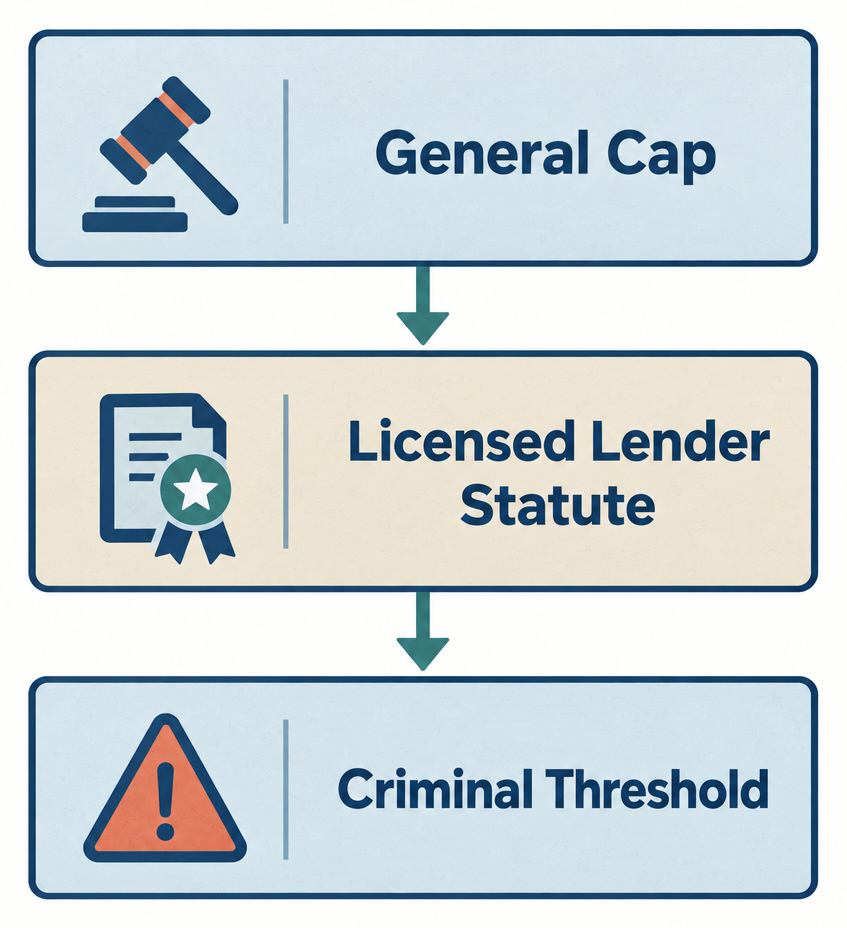
State legislatures write usury rules in three layers: a general cap that applies to anyone not otherwise exempt, special statutes for licensed lenders that override the general cap, and criminal penalties above a higher line. The general cap usually binds only private lenders, family loans, seller financing and unlicensed companies. Licensed consumer lenders, banks, credit unions, pawnbrokers and payday lenders almost always operate under their own statute with its own, higher, ceiling.
The table below shows the general civil and criminal lines in a handful of states as they stand in the statutes. We include it to illustrate the spread, not as a lookup for any specific loan; the licensed-lender exemptions in each state usually matter more.
| State | General contract cap | Criminal usury line | Key exemptions and notes |
|---|---|---|---|
| New York | 16% (General Obligations Law § 5-501) | 25% (Penal Law § 190.40) | Loans over $250,000 exempt from civil usury; over $2.5 million exempt from criminal; usurious loans are void |
| California | 10% for personal, family or household loans (Constitution Art. XV § 1) | None as a separate rate; usury is civil | Banks, credit unions and California Financing Law licensees exempt; payday loans capped by a separate statute |
| Texas | 10% default (Finance Code § 302.002), optional ceilings up to 18% or more under Chapter 303 | Contract rate above twice the legal cap is criminal | Credit access businesses arrange payday and title loans at fees far above the cap |
| Florida | 18% (Fla. Stat. § 687.02) | 25% misdemeanor, 45% felony (§ 687.071) | Loans over $500,000 may carry up to 25% |
| Georgia | 7% if nothing is written; up to 16% by contract on loans under $3,000 (O.C.G.A. § 7-4-2) | Payday lending itself is a crime (§ 16-17-1) | Any agreed rate on loans of $3,000 or more |
| Illinois | 9% general rate (815 ILCS 205/4) | None separate | Predatory Loan Prevention Act (2021) caps consumer loans at 36% APR for all lenders not exempt under federal law |
| Massachusetts | None stated; 20% is the trigger | 20% unless lender registers with the Attorney General (G.L. c. 271 § 49) | Registration makes higher rates legal, which is why the cap bites mostly on unregistered lenders |
| Delaware, Utah, South Dakota | No cap for licensed lenders or banks | Not applicable | Chosen as home states by card issuers and installment lenders |
A few patterns stand out. New York’s rule that a usurious loan is void, with the borrower owing neither interest nor principal, is the harshest in the country and explains why so many fintech contracts avoid New York governing law. California’s constitutional cap sounds strict until you read the exemption list, which covers almost every company that lends for a living. Texas has a strict-looking statute and some of the most expensive small loans in the country, because the credit access business model treats the lender’s fee as a brokerage charge rather than interest.
Payday and small-dollar loans
The sharpest state-by-state divide is on small loans under $1,000. A payday loan in a permissive state typically costs $15 per $100 for two weeks, the example the CFPB itself uses, which works out to a 391% APR. States handle that in one of three ways:
| Approach | Examples (as of 2025) | What a $300 loan can cost |
|---|---|---|
| Rate cap near 36% APR, payday stores mostly closed | Arizona, Colorado, Illinois, Montana, Nebraska, New Mexico, New York, New Jersey, North Carolina, South Dakota, Georgia, Massachusetts, DC | Under $10 in interest for two weeks |
| Fee-based cap on payday loans | California ($300 max loan, fee up to 15% of face amount), Florida ($500 max, 10% fee plus $5 verification), Michigan ($600 max, tiered fees) | $45 in California, about $35 in Florida |
| No meaningful cap on payday fees | Idaho, Nevada, Utah, Wisconsin, Texas via credit access businesses | Whatever the contract says; 400% to 600% APR is common |
Voters, not just legislatures, drew many of these lines. South Dakota’s Initiated Measure 21 (2016), Colorado’s Proposition 111 (2018) and Nebraska’s Initiative 428 (2020) each imposed a 36% cap by ballot with more than 70% support. Illinois’s 2021 law and New Mexico’s 2023 law came through the legislature. Surveys by the National Consumer Law Center and the Center for Responsible Lending count roughly 20 states plus the District of Columbia with caps at or near 36% for a typical $500 loan.
A worked cost example: the same $300 under three regimes
Usury law is abstract until you price a loan with it. Here is a $300 loan repaid over 14 days under a permissive payday statute, under a 36% APR cap, and from a federal credit union’s payday alternative loan program, which NCUA rules at 12 CFR 701.21(c)(7) cap at 28% APR plus an application fee of no more than $20.
| Loan | Amount | Fee or APR | Term | Total repaid |
|---|---|---|---|---|
| Payday loan, $15 per $100 | $300 | $45 fee (391% APR) | 14 days | $345.00 |
| Loan under a 36% cap | $300 | 36% APR, about $4.14 interest | 14 days | $304.14 |
| Credit union PAL at 28% | $300 | 28% APR, about $3.22 interest, plus up to $20 fee | 14 days | $303.22 to $323.22 |
The APR math is simple division. Take the fee, divide by the amount borrowed, divide by the number of days, and multiply by 365. For the payday loan: $45 divided by $300 is 0.15; 0.15 divided by 14 days is 0.0107 per day; times 365 is 3.91, or 391%. Regulation Z requires the lender to print that figure on the loan agreement, which is why a two-week loan with a “15% fee” shows an APR near 400%. The disclosure does not make the rate legal or illegal; only the state’s statute does that.
The credit union example shows a wrinkle. A $20 application fee on a two-week, $300 loan adds the equivalent of about 174 percentage points of APR if you annualize it, which is why NCUA excludes that fee from the 28% calculation and why PALs make more sense for loans of a few months than a few days.
Before you borrow
A loan priced above your state’s cap is not automatically unenforceable, because the lender may be a bank, a licensed lender or a buyer of bank-originated loans with a legal exemption. Assume you will owe what you signed for unless a court or regulator says otherwise, and price the loan by total dollars repaid, not by the monthly fee.
Who the caps do not bind
The list of exemptions explains most of the gap between the statute and the price you are quoted.
Banks and credit unions. Rate exportation lets any FDIC-insured bank charge its home-state rate nationwide, and federal credit unions follow the NCUA ceiling rather than state law. The 18% federal credit union cap has been extended repeatedly; the NCUA board’s most recent extension runs through September 2026.
Licensed lenders. Nearly every state has a consumer finance act, small loan act or installment loan act that sets a separate, higher cap for companies it licenses. California’s Financing Law, for example, caps loans of $2,500 to $9,999 at 36% plus the federal funds rate under a 2019 law, while leaving loans of $10,000 and up with no cap at all.
Commercial and business loans. Usury statutes grew up to protect households, and many states exclude business borrowers outright or set a high floor. New York bars corporations from raising civil usury as a defense (General Obligations Law § 5-521), though they can still assert criminal usury. Florida’s cap rises to 25% above $500,000. Merchant cash advances, which buy a slice of a business’s future receipts, are structured as purchases precisely so that usury law does not reach them; the New York Attorney General and the FTC have both sued cash advance companies on the theory that the “purchase” was really a loan.
Pawn, rent-to-own and retail installment contracts. Each usually has its own statute. Pawnbroker fees of 20% a month are legal in many states under pawn acts even though the same rate would be criminal usury on a loan.
Loans sold by banks to non-banks. Under the 2020 valid-when-made rules, a fintech that buys loans originated by a Utah bank keeps the Utah rate. Whether the bank or the fintech is the “true lender” is the open question in most rent-a-bank lawsuits, and state attorneys general in Colorado, Illinois and elsewhere have won settlements forcing rate reductions where they could show the bank bore none of the risk.
Tribal lenders. Companies owned by federally recognized tribes claim sovereign immunity from state usury laws. Courts have generally held that tribal immunity does not travel with the loan when a non-tribal business runs the operation, and the CFPB and several states have pursued those arrangements.
What happens when a loan is usurious
Remedies vary as widely as the caps, so the same loan can carry very different consequences across a state line.
- Forfeiture of interest. The most common civil remedy. The lender collects principal but no interest. Texas and many other states use this baseline.
- Multiple damages. Some states award the borrower twice or three times the excess interest. Texas Finance Code § 305.001 allows three times the usurious interest for violations that exceed twice the legal rate.
- Voiding the loan. New York treats a civilly usurious loan made by a non-exempt lender as void from the start; the borrower keeps the money and owes nothing. Massachusetts courts can void loans made in violation of the criminal statute.
- Criminal prosecution. Florida’s 45% felony line, New York’s 25% criminal line and Georgia’s ban on payday lending each carry potential jail time for the lender, though prosecutions are rare.
- Unenforceable collection. Many states say a loan that violates the lending licensing law is void, and that a debt collector cannot lawfully collect it. The CFPB has taken the position that attempting to collect a loan that is void under state law is itself an unfair practice.
Borrowers raise usury in two ways: as a defense when the lender sues, or as an affirmative claim, sometimes as a class action. Courts also look past labels. A “fee,” “points,” “membership charge” or “tip” can be treated as interest if it is really the price of the money. That is the issue regulators have pressed with earned wage access and cash advance apps, where “tips” and “express fees” can push a $100 advance to the equivalent of a 300% APR. The CFPB said in a 2024 interpretive rule that such charges are finance charges under Regulation Z for disclosure purposes, a position the current CFPB has proposed to withdraw, so that corner of the law is unsettled.
Your rights as a borrower
Even where the rate is legal, federal law gives you tools.
Under the Truth in Lending Act and Regulation Z, you are entitled to see the APR and finance charge in writing before you sign a closed-end loan, and in the account-opening disclosures for a credit card. If the APR on the paper does not match what you are being charged, the lender is in violation regardless of usury law, and TILA allows statutory damages.
Under the Military Lending Act, covered borrowers get a 36% all-in cap, no mandatory arbitration, and no requirement to allot pay. A lender that charges more cannot enforce the contract. Lenders check the Defense Manpower Data Center database before lending; you can check your own status there.
Under the CFPB’s payday lending rule, whose payment provisions took effect on March 30, 2025 after the Supreme Court upheld the agency’s funding in May 2024, a payday or vehicle title lender must stop trying to debit your bank account after two consecutive failed attempts unless you give new authorization. That does not cap the rate, but it stops the cascade of overdraft fees that makes a usurious loan more expensive still.
Under the Fair Debt Collection Practices Act, a third-party collector cannot collect interest or fees that the original contract or state law does not allow. Demanding interest above the state cap on a debt the collector bought is one of the most common FDCPA claims.
How to check whether a lender can legally charge its rate
- Find the lender’s license on NMLS Consumer Access or your state financial regulator’s license lookup.
- Identify which statute the license falls under; the licensing statute, not the general usury law, usually sets the cap.
- If the lender is a bank, check the FDIC BankFind database and note its home state, because that state’s rate applies.
- Compare the APR on your Regulation Z disclosure with the applicable cap.
- If the rate exceeds the cap and no exemption fits, file a complaint with your state attorney general and the CFPB.
Cheaper options and what to do about an overpriced loan
A usury cap does not help much if the only loan you can get is from a lender the cap does not reach. The options below cost less than almost anything priced above 36%.
Cheaper options first
Federal credit union payday alternative loans come in two forms: PAL I runs $200 to $1,000 at no more than 28% APR over one to six months, and PAL II runs up to $2,000 at no more than 28% APR over one to twelve months.
Employer pay advances and nonprofit emergency assistance usually carry no interest at all.
Nonprofit credit counseling agencies and creditor hardship plans can lower existing rates without a new loan.
If you already hold a loan you think is usurious, do not simply stop paying. Pull the loan agreement, note the disclosed APR, and run the license check above. Then complain to your state regulator and through the CFPB’s complaint portal, which forwards the complaint to the company and tracks its response. Many state attorneys general have dedicated rent-a-bank or payday complaint units, and complaints are how they build cases. A legal aid office can tell you whether your state’s remedy is forfeited interest, a void contract or something in between.
If a collector is pursuing a loan that is void under your state’s law, you can dispute the debt in writing within 30 days of the first notice under the FDCPA, which pauses collection until the collector verifies it.
Where the law is heading
Three fights will decide what usury means over the next few years. The first is the federal 36% cap: the Veterans and Consumers Fair Credit Act and similar bills would extend the Military Lending Act’s cap to everyone, and they have bipartisan sponsors but have not reached a floor vote. The second is the valid-when-made and true-lender question, which will be settled lender by lender in state attorney general actions and in cases like the Colorado opt-out litigation. The third is how regulators classify “tips” and “express fees” in app-based advances, which decides whether those products fall under state small-loan caps at all.
For borrowers the practical rule is older than any of those fights. The number that matters is the APR on the disclosure, the statute that matters is the one your lender is licensed under, and the cheapest credit is almost always the credit you arranged before the emergency.
FAQ
What is usury in simple terms?
Usury is charging interest above the maximum rate a state’s law allows. A loan priced over that limit is usurious, and depending on the state the lender can lose the interest, lose the whole loan, or face criminal charges.
Is there a federal usury law in the United States?
No general one. Federal law caps rates only for active-duty servicemembers and their dependents (36% under the Military Lending Act) and for federal credit unions (18% under NCUA rules). Everyone else is governed by state law, and federal banking law lets banks export their home state’s rate nationwide.
Why can my credit card charge 29% if my state’s usury cap is 12%?
Because the issuer is a bank, and under 12 U.S.C. § 85 and the Marquette decision a bank may charge the rate allowed in its home state, typically South Dakota, Delaware or Utah, which have no cap. Your state’s usury statute does not reach that bank.
What is the difference between civil and criminal usury?
Civil usury is exceeding the contract cap, which usually costs the lender its interest or the loan. Criminal usury is exceeding a higher line, 25% in New York and Florida for example, and exposes the lender to prosecution. A corporation in New York cannot plead civil usury but can plead criminal usury.
Are payday loans usurious?
Only where a state has not carved out a separate payday statute. In states with a 36% cap on small loans, a 391% APR payday loan is illegal and often void. In states like California or Florida, a fee-based payday law makes the same loan legal up to a set amount. In Texas, Utah and Nevada, there is no effective cap.
Do usury laws apply to business loans?
Often not, or only partly. Many states exempt commercial loans above a dollar threshold, bar corporations from raising usury as a defense, or allow any agreed rate for business purposes. Merchant cash advances are structured as purchases of receivables to stay outside usury law entirely.
What can I do if I think my loan is usurious?
Compare the disclosed APR with the cap in the statute your lender is licensed under, verify the license on NMLS Consumer Access or your state regulator’s site, and file complaints with your state attorney general and the CFPB. Legal aid can tell you whether your state’s remedy is forfeited interest, a void loan or multiple damages.
Laws and regulations referenced
- Truth in Lending Act, 15 U.S.C. 1601
- Regulation Z, 12 CFR Part 1026
- Fair Debt Collection Practices Act, 15 U.S.C. 1692
- Military Lending Act, 10 U.S.C. 987
- Military Lending Act rule, 32 CFR Part 232
- Servicemembers Civil Relief Act, 50 U.S.C. 3901
- CFPB payday lending rule, 12 CFR Part 1041
- FDIC deposit insurance
Links go to the official text on government sites.
Check, verify or complain
Sources
- americanbanker.com › news › south dakota approves 36 rate cap on payday lenders americanbanker.com
- nerdwallet.com › personal loans › learn › payday alternative loan pal nerdwallet.com
- postcommunitycu.com › payday alternative loans postcommunitycu.com

Elena writes about getting through a money emergency, assistance programs, budgeting on a tight income, banking basics and borrower rights. Her guides list the cheaper options first and link the agency or program that can actually help.