
Crypto can lose all of its value and is not protected by FDIC or SIPC insurance. This is education, not investment advice.
Pegged means fixed to something else. A pegged currency or stablecoin is set to trade at a stated rate against another asset, usually the US dollar, and someone promises to keep it there. We explain how a hard peg is held, why pegs break, and what US rules and tax law say about pegged stablecoins.
What pegged means in plain words
A peg is a wooden pin that holds something in place. That is the whole idea. When we say a currency is pegged, we mean its price is held in place against another currency, a basket of currencies, or a commodity like gold.
The Saudi riyal is a textbook example. The Saudi Arabian Monetary Authority has held it at 3.75 riyals per dollar since 1986. The Hong Kong dollar is another, pegged at HK$7.80 per US dollar by the Hong Kong Monetary Authority under a system that dates to October 1983, and kept within a trading band of HK$7.75 to HK$7.85 since May 2005.
In crypto, a pegged token is one designed to track an outside price. A dollar stablecoin is pegged at $1. A tokenized gold product is pegged to an ounce of gold. The word “pegged” tells us the target. It does not tell us how strong the promise is, and that is where the risk lives.
People also use “pegged” in everyday speech to mean sized up or categorized, as in “we had him pegged as a salesman.” The money meaning and the slang meaning share the same root: something fixed in position. Any dictionary will list both, but in finance the word almost always points to an exchange rate.
Hard peg versus soft peg
A hard peg is a single fixed rate backed by a strict mechanism. A soft peg allows the price to drift inside a band before the authority steps in.
| Peg type | How it works | Real example |
|---|---|---|
| Currency board (hard) | Every unit of local money is backed by reserves of the anchor currency, and the board converts on demand at the fixed rate | Hong Kong dollar at HK$7.75 to 7.85 per USD |
| Fixed rate with intervention (hard) | Central bank buys or sells its own currency to hold one rate | Saudi riyal at 3.75 per USD |
| Band (soft) | Currency floats inside a stated range around a central rate | Danish krone, held within 2.25% of a central euro rate under ERM II |
| Fiat-backed stablecoin (hard in design) | Issuer holds cash and Treasury bills and redeems one token for one dollar | USDC, USDT |
| Crypto-collateralized stablecoin | Users lock more crypto than the dollar value they mint, and liquidations protect the peg | DAI |
| Algorithmic stablecoin | Code mints and burns a sister token to push the price back to $1, often with little or no hard collateral | TerraUSD before May 2022 |
The strength of any peg comes down to one question: what happens when everyone wants out at the same time? A currency board or a fully reserved stablecoin can pay every holder. An algorithmic peg cannot.
How a hard peg is actually held
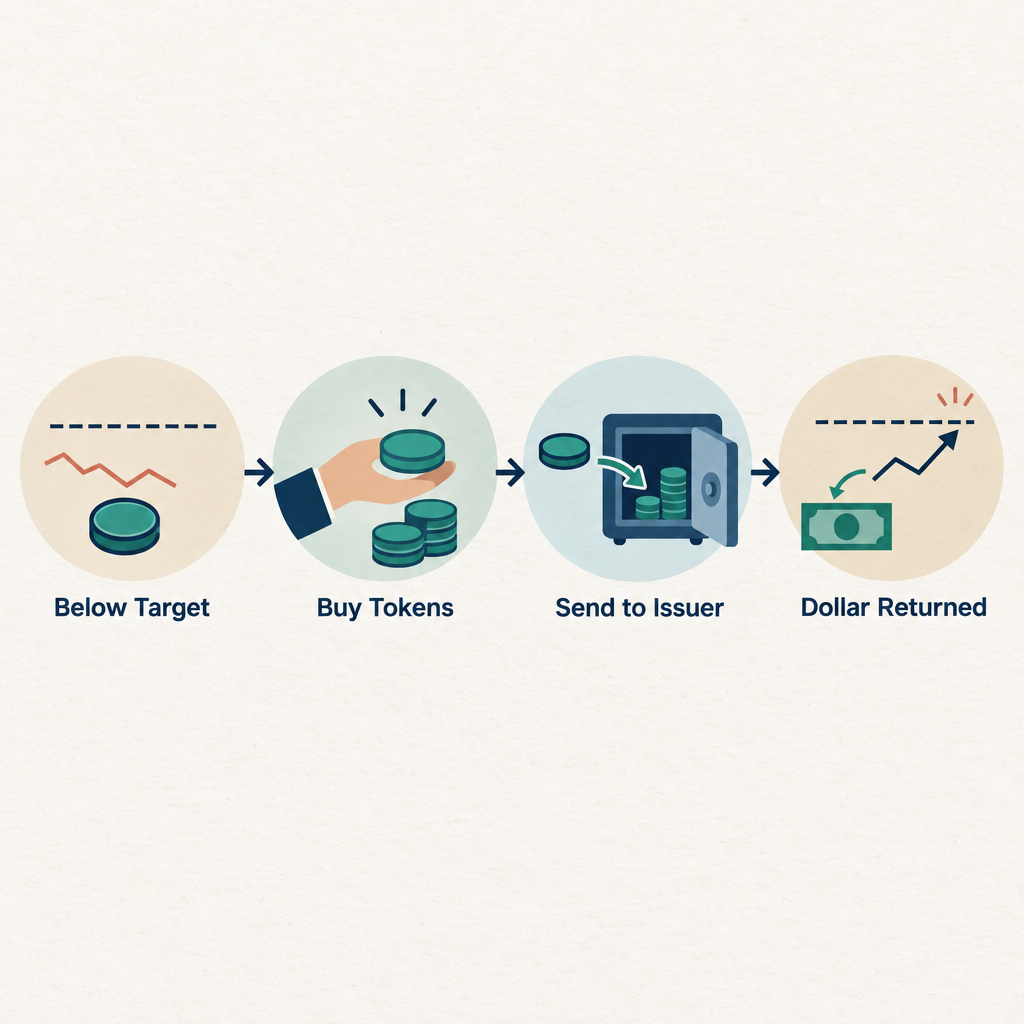
A peg is a promise plus a mechanism. The promise says “one of ours equals one of theirs.” The mechanism is what makes the promise true on a bad day.
For a national currency, the mechanism is reserves and intervention. If the market pushes the Hong Kong dollar toward the weak side of its band, the HKMA sells US dollars from its reserves and buys Hong Kong dollars until the rate moves back. If traders push it to the strong side, it does the reverse. Interest rates move with that flow, which is the price Hong Kong pays for the peg: it imports US monetary policy.
For a fiat-backed stablecoin, the mechanism is redemption. Circle, the issuer of USDC, and Tether, the issuer of USDT, both say that an eligible customer can send back tokens and receive dollars one for one. Arbitrage does the rest. If USDC trades at $0.99 on an exchange, a trader can buy it, redeem it for $1.00, and pocket the gap. That buying lifts the price back to $1.
Notice the weak points. Redemption usually requires an account with the issuer, minimum sizes, and identity checks. Retail holders mostly cannot redeem directly. They rely on exchanges and arbitrage traders, who may step back when the issuer looks shaky.
Why pegs break
Every broken peg has the same anatomy: the promise outruns the mechanism.
Britain left the European Exchange Rate Mechanism on 16 September 1992 after the Bank of England could not defend the pound against sellers led by George Soros’s fund. Argentina abandoned its one-to-one dollar peg in January 2002 after a run on the banks. The Swiss National Bank dropped its 1.20 franc-per-euro floor on 15 January 2015 without warning, and the franc jumped roughly 20% in minutes.
Crypto has its own list.
| Event | What happened | Outcome |
|---|---|---|
| TerraUSD (UST), May 2022 | Algorithmic peg relied on minting the LUNA token to absorb selling; a wave of redemptions overwhelmed it | UST fell to pennies, LUNA went near zero, and estimates of losses ran into the tens of billions of dollars |
| USDC, March 2023 | Circle disclosed about $3.3 billion of reserves at the failed Silicon Valley Bank | USDC dipped below $0.90 over a weekend, then recovered after US regulators guaranteed SVB deposits |
| Tether reserves, 2021 | The CFTC found Tether had misstated that USDT was fully backed by dollars at all times during 2016 to 2018 | $41 million CFTC penalty, plus an $18.5 million settlement with the New York Attorney General |
Terra’s yield pitch deserves a word. Its Anchor lending protocol paid around 20% a year on UST deposits, funded in part from reserves rather than real lending income. A payout that depends on fresh money coming in has the shape of a ponzi scheme even when the code is public. US prosecutors later charged founder Do Kwon with fraud.
Before you hold a stablecoin
A dollar stablecoin is not a dollar. It can lose all its value if the issuer fails or the mechanism breaks, and it is not insured by the FDIC or SIPC. Only a bank deposit carries FDIC coverage, up to $250,000 per depositor, per bank, per ownership category.
US rules for pegged stablecoins
For years, dollar stablecoins sat in a gap between banking law, securities law and money-transmission law. That changed in July 2025, when the Guiding and Establishing National Innovation for U.S. Stablecoins Act, known as the GENIUS Act, was signed into law.
The law creates a federal framework for “payment stablecoins.” Issuers must hold reserves at least one to one in cash, insured bank deposits, short-term Treasuries and similar assets, publish monthly reserve reports, and keep reserves separate from company money. It bars issuers from paying interest or yield to holders simply for holding the coin. Its main provisions take effect on a delayed schedule tied to regulators finishing their rules, so as of the law’s passage the market was still in transition.
Two things the law does not do: it does not make stablecoins FDIC insured, and it does not guarantee the peg. It raises the odds that an issuer can honor redemptions. It does not promise that the token will trade at $1 on every exchange every minute.
How to check a stablecoin's backing
- Find the issuer’s latest monthly reserve report on its own site, and note which accounting firm signed it.
- Read the reserve mix: cash and short Treasuries are strongest; loans, commercial paper or crypto are weaker.
- Read the redemption terms: who can redeem, minimum size, fees and how long it takes.
- Check the issuer’s regulator and any enforcement history with the CFTC, SEC or a state regulator.
- Compare the market price against $1 on more than one exchange.
How the IRS treats pegged stablecoins
Under IRS Notice 2014-21, the IRS treats virtual currency as property, and the IRS has confirmed that stablecoins count as digital assets. Pegging a token to the dollar does not turn it into a dollar for tax purposes.
In practice this means every sale, swap or purchase with a stablecoin is a taxable disposal. If you bought USDC at $1.00 and sold at $1.00, the gain is zero, but the transaction still belongs on your return. Buying a stablecoin at $0.97 during a depeg and later selling at $1.00 creates a capital gain. Starting with 2025 transactions, US brokers report digital asset sales on Form 1099-DA, so the IRS will see these trades.
Safer places for cash you cannot afford to lose
An FDIC-insured savings or money market deposit account covers up to $250,000 per depositor.
A Treasury bill bought through TreasuryDirect is backed by the US government.
An NCUA-insured credit union share account carries the same $250,000 limit.
FAQ
What does pegged mean for a currency?
A pegged currency has an exchange rate fixed by its central bank against another currency, a basket, or a commodity. The bank holds the rate by buying and selling reserves. The Saudi riyal, pegged at 3.75 per US dollar since 1986, is a clear example.
What is a hard peg?
A hard peg is one fixed rate with no trading band, held by a strict mechanism such as a currency board or full one-to-one reserves. A soft peg lets the price move inside a range before the authority intervenes.
Is a stablecoin the same as a pegged currency?
They share the idea of a fixed value, but a national peg is defended by a central bank with legal authority, while a stablecoin peg is defended by a private issuer’s reserves and redemption promise. Neither is guaranteed, and stablecoins carry no FDIC or SIPC insurance.
Why did USDC lose its peg in 2023?
Circle held about $3.3 billion of USDC reserves at Silicon Valley Bank when the bank failed in March 2023. Traders feared a shortfall and sold, pushing USDC below $0.90. The price recovered once federal regulators guaranteed SVB deposits in full.
Do I owe tax on a stablecoin that stays at $1?
Yes, each disposal must be reported, because the IRS treats stablecoins as property under Notice 2014-21. The gain is usually zero or a few cents, but the transaction still counts, and brokers now report sales on Form 1099-DA.
Laws and regulations referenced
- IRS Notice 2014-21 (virtual currency is property)
- IRS Form 1099-DA, Digital Asset Proceeds From Broker Transactions
- GENIUS Act (stablecoins), Public Law 119-27 (S. 1582)
- FDIC deposit insurance
Links go to the official text on government sites.
Sources
- irs.gov › filing › digital assets irs.gov · primary source
- fdic.gov › resources › deposit insurance › faq fdic.gov · primary source
- irs.gov › pub › irs drop › n 14 21.pdf irs.gov · primary source
- ncua.gov ncua.gov · primary source
- markethistories.com › en › the swiss franc shock when the snb abandoned its euro floor 2015 markethistories.com
- reuters.com › business › finance › circle says 33 bln usdc reserves stuck silicon valle… reuters.com
- coindesk.com › learn › the fall of terra a timeline of the meteoric rise and crash of … coindesk.com

Owen explains how crypto works for US readers: coins and tokens, buying and selling, wallets and self-custody, staking and DeFi. He sticks to how things work and what they cost, never price calls, and checks platform fees and licensing against the companies' own disclosures.