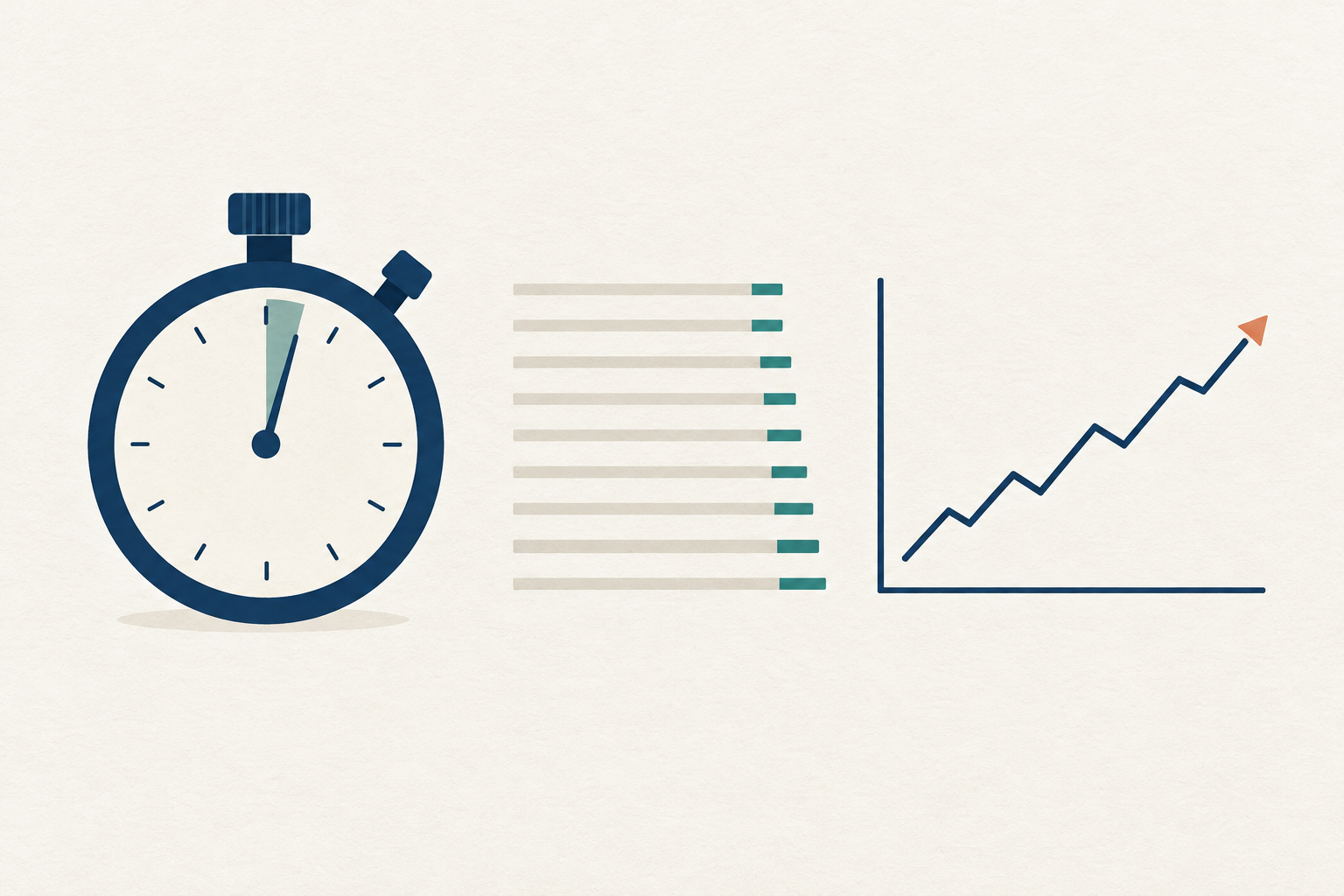
Scalping is a trading style built on holding a position for seconds or minutes and closing it for a tiny gain, often less than half a percent, then repeating the process dozens or hundreds of times a day. A scalp trader wins by stacking many small profits while cutting losers fast. In crypto, where markets run all night and fees are high, the math works against most people who try it, and we explain exactly why below.
Scalping defined
The plain scalping definition is this: a scalper tries to capture the smallest profitable move in a price and get out before the market has time to reverse. The trade is called a scalp trade. The person is a scalp trader or scalper. Scalp trading is the activity as a whole.
Three features separate scalping from every other style.
- Holding time is extremely short. Many scalps last under a minute.
- Profit targets are small, often measured in a few ticks or a few hundredths of a percent.
- Volume is high. Because each win is tiny, the scalper needs many of them.
A position that stays open for an hour is a day trade, not a scalp. A position that sits overnight is swing trading. The lines blur in practice, but the intent is different. A scalper is not betting on where Bitcoin will be tomorrow. The scalper is betting on where the next few trades will print.
How a scalp trade works
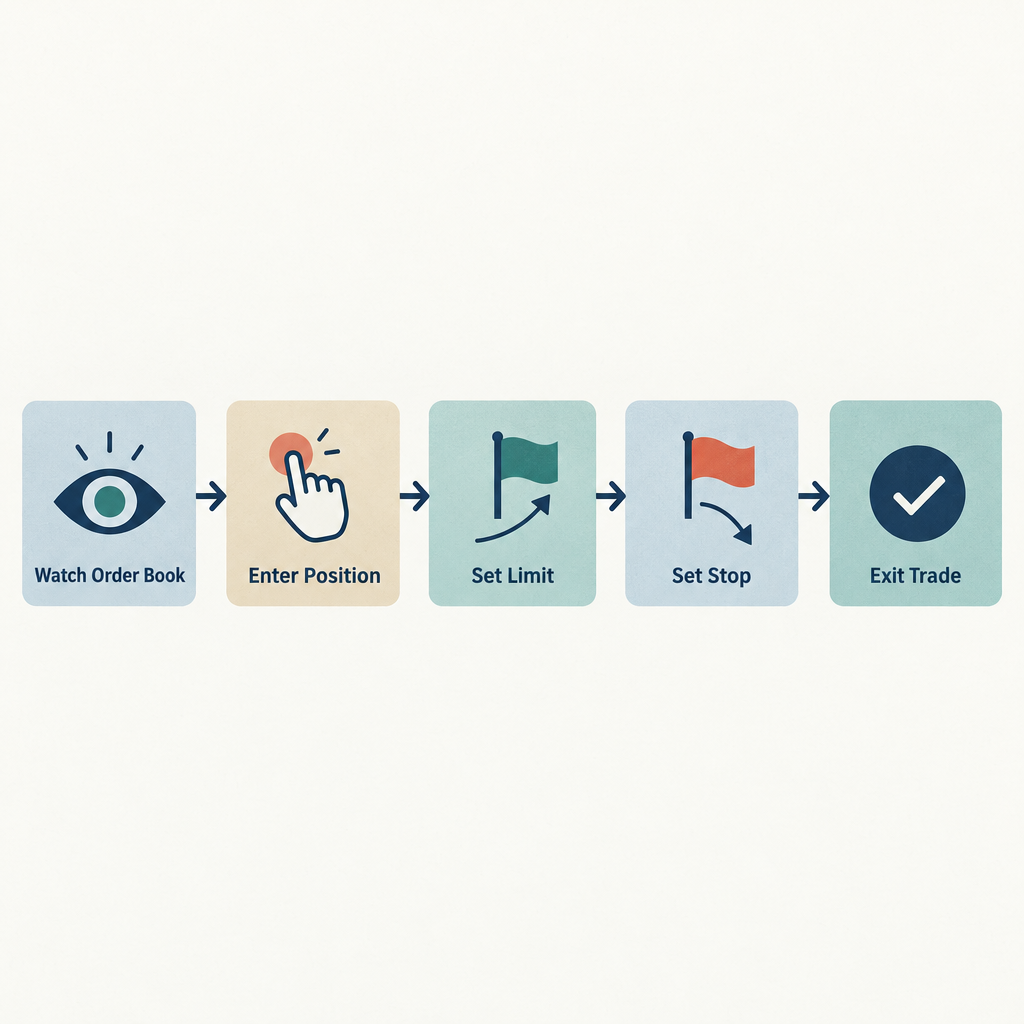
Every scalp runs through the same loop. We walk through one using numbers, with no suggestion that any of these prices are a forecast.
Suppose a scalper watches Ether trading around $3,000 on an exchange’s order book. The best bid is $2,999.90 and the best ask is $3,000.10, so the spread is $0.20. The scalper sees heavy buy orders stacked just below $2,999 and decides the price is unlikely to fall through them in the next minute.
- The scalper buys 0.5 ETH at $3,000.10 with a market order, paying the ask.
- A sell limit order is placed at $3,006.00, a gain of about 0.2%.
- A stop order is placed at $2,997.00, a loss of about 0.1%.
- Within 40 seconds the price ticks up, the limit fills, and the trade closes for a $2.95 gross profit on $1,500 of capital.
Before fees, that is a clean win. After fees it may not be. We come back to that, because the fee line is where most scalping stories end.
The tools scalpers lean on
A scalp trader almost never uses a daily chart. The working screen is a one-minute or tick chart, a level-two order book showing resting bids and asks, and a time-and-sales feed (the “tape”) showing every executed trade. Scalpers read the order book to guess where the next few trades will go. Momentum scalpers use short moving averages or volume spikes instead.
Order type matters a lot. A market order fills instantly but pays the taker fee and crosses the spread. A limit order sits on the book, may earn the lower maker fee, but might never fill. Scalpers who rely on market orders pay the highest possible cost per trade.
Scalping compared with other trading styles
The table below shows how scalping sits next to the two styles people most often confuse it with. Figures are typical ranges, not rules.
| Style | Holding period | Trades per day | Target per trade | Main cost driver | Time at the screen |
|---|---|---|---|---|---|
| Scalping | Seconds to minutes | 20 to several hundred | 0.05% to 0.5% | Fees and spread | Constant, every second |
| Day trading | Minutes to hours | 1 to 10 | 0.5% to 3% | Fees, slippage | Most of the session |
| Swing trading | Days to weeks | A few per week | 3% to 20% | Overnight gaps, funding | Daily check-ins |
Notice the direction of the cost column. The shorter the hold, the more fees matter relative to the gain. That is the structural problem with scalping and it never goes away.
Why fees decide whether scalping can work
Here is the number that matters more than any chart pattern. If a round trip (buy plus sell) costs 0.8% in fees and spread, the scalper needs to be right by more than 0.8% on average just to reach zero. Every scalp that gains 0.3% is a loss after costs.
US exchanges publish tiered fee schedules. The base tier, which applies to anyone trading under roughly $10,000 a month, is the one that matters for a new scalper. The figures below are the published base-tier rates at the time of our last review. Exchanges change them often, so the current fee page on each exchange is the source that counts.
| Venue (advanced or pro interface) | Base maker fee | Base taker fee | Round-trip cost using market orders |
|---|---|---|---|
| Coinbase Advanced | 0.40% | 0.60% | 1.20% |
| Kraken Pro | 0.25% | 0.40% | 0.80% |
| Gemini ActiveTrader | 0.20% | 0.40% | 0.80% |
Now put a realistic session against those numbers. Say a scalper trades $2,000 per position, 30 round trips a day, always with market orders on a venue charging 0.40% per side.
| Item | Per trade | Per session (30 trades) |
|---|---|---|
| Position size | $2,000 | $60,000 traded |
| Taker fee at 0.40%, buy side | $8.00 | $240 |
| Taker fee at 0.40%, sell side | $8.00 | $240 |
| Total fees | $16.00 | $480 |
| Gain needed to break even | 0.80% | 0.80% average |
| Fees as a share of a $5,000 account | 0.32% | 9.6% |
A scalper running this pattern burns almost 10% of a $5,000 account in fees every single day before any market losses. To be net positive, the average scalp has to beat 0.8%, and scalps by definition aim for far less than that. The spread adds more on top, since the buyer pays the ask and the seller receives the bid.
How to work out your breakeven move
- Find your maker and taker fee on the exchange’s current schedule.
- Add the fee for entering to the fee for exiting. That is your round-trip fee.
- Add the typical spread on your pair as a percentage of price.
- The total is the minimum average gain per scalp you need just to lose nothing.
Professional scalpers survive because they do not pay retail fees. High-volume tiers on the same exchanges drop maker fees to near zero. Proprietary trading firms run co-located servers that react in microseconds and pay rebates to provide liquidity. A person clicking a mouse on a laptop is competing against that, at twenty times the cost per trade.
Scalping trading styles
Not every scalper trades the same way. Four approaches show up most often.
Market-making scalps
The scalper places a bid slightly below the current price and an ask slightly above it, hoping both fill and the spread becomes the profit. This earns maker fees and can work in calm markets. It gets destroyed by a sudden one-way move that fills one side and leaves the scalper holding the bag.
Momentum scalps
The trader waits for a burst of volume or a break of a very short-term level, jumps in, and exits within a minute. This relies on market orders, so fees are at their worst. It also fails constantly on fake breakouts, which are more common in thin crypto pairs than in large-cap stocks.
Order-book or tape reading
The scalper watches large resting orders and the flow of executed trades, trying to read where big players are leaning. In crypto this is hard because many large orders are placed to be seen and then cancelled, a practice called spoofing that the CFTC has prosecuted in futures markets.
Cross-venue scalps
When the same coin trades at slightly different prices on two exchanges, a scalper buys on the cheaper venue and sells on the dearer one. This looks risk-free on paper. In practice, withdrawal times, network fees and the second price moving before the first trade settles eat most of the gap.
What a scalp trader actually risks
Before you scalp crypto
Crypto can lose all of its value, and nothing you hold on an exchange is FDIC or SIPC insured. A scalping account can also bleed to zero through fees alone, with no dramatic crash required.
The asset itself
Scalping does not remove the risk of the underlying coin. A scalper who is in a position when an exchange halts trading, a stablecoin breaks its peg or a token’s issuer is charged by the SEC is simply stuck. The short holding period limits exposure most of the time, but it offers no protection in the minute that matters.
No insurance behind the account
Bank deposits are backed by the FDIC up to $250,000 per depositor, per bank, per ownership category. Securities at a failed broker-dealer are protected by SIPC. Crypto on an exchange has neither. The FDIC said so plainly in a 2022 advisory after several crypto companies implied otherwise. When FTX collapsed in November 2022, customers became unsecured creditors in a bankruptcy. A scalper with a five-figure balance sitting on an exchange faces that risk every day.
Leverage and liquidation
Many scalpers use margin or perpetual futures because small moves on unleveraged capital do not produce meaningful dollars. Leverage turns a 1% adverse move into a 10% or 20% loss at 10x or 20x, and crypto venues liquidate automatically. If a leveraged account goes negative, exchange terms generally allow the company to pursue the shortfall, which can mean a debt collector eventually calling about money lost in a trade that lasted ninety seconds.
Slippage and outages
A stop order is a promise to try, not a guarantee of price. In a fast move, a stop at $2,997 can fill at $2,990. During the busiest minutes, exactly when scalpers are most active, exchanges have historically slowed, frozen or thrown errors. A scalper who cannot click out of a position is holding a day trade they never intended.
The evidence on short-term traders
The research is one-sided. A study of Brazilian equity futures traders published in 2020 by Chague, De-Losso and Giovannetti found that 97% of individuals who day traded for more than 300 days lost money, and only 1.1% earned more than the Brazilian minimum wage. Barber, Lee, Liu and Odean studied every day trader in Taiwan over fifteen years and found fewer than 1% could reliably earn positive returns after costs. Scalping sits at the most expensive, most frequent end of that spectrum.
Overtrading and tilt
Scalping rewards speed and punishes hesitation, which makes it a magnet for revenge trading after a loss. Thirty planned trades become eighty impulsive ones, and each one pays a fee. People under financial pressure are most exposed here. Scalping is not a way to cover a bill due Friday. A bad session can take the rent money in an afternoon. Someone short on cash should compare fixed-cost options first, and should know that even a payday loan, among the most expensive legal products, at least has a disclosed price. A scalp session does not.
US rules that touch scalping
Crypto scalping sits in a patchwork of rules. We separate what is law from what is only proposed.
The pattern day trader rule does not reach crypto spot
Under FINRA Rule 4210, a customer who makes four or more day trades within five business days in a margin account at a securities broker is flagged as a pattern day trader and must keep at least $25,000 in equity. This applies to stocks, options and other securities held at a FINRA member. Buying and selling Bitcoin on a crypto exchange is not covered. FINRA has proposed amendments to the rule, so the current text at finra.org is the one to check. Crypto ETFs and crypto-related stocks are securities and the rule does apply to scalping those.
Who regulates the venue
The CFTC treats Bitcoin and Ether as commodities and regulates futures on them. Under the Commodity Exchange Act, leveraged retail commodity transactions must take place on a CFTC-registered exchange unless actual delivery happens within 28 days, which is why offshore perpetual-futures platforms block US customers on paper and why using a VPN to reach them puts a trader outside every US protection. Spot crypto exchanges register with FinCEN as money services businesses and hold state money transmitter licenses, including New York’s BitLicense. Before scalping anywhere, confirm the venue appears in FinCEN’s MSB registrant search and your state regulator’s license lookup.
Market manipulation is still illegal
Spoofing, wash trading and pump-and-dump schemes violate the Commodity Exchange Act and, where tokens are securities, the Securities Exchange Act of 1934. A retail scalper is more likely to be a victim than a perpetrator, but anyone coordinating trades in a chat group to move a thin coin is taking legal risk on top of financial risk.
Lower-risk ways to learn the same skills
Paper trade on an exchange sandbox for at least a month and track fees as if they were real.
Trade a spot position with money you can lose entirely, no leverage, and keep a written log of every fill.
Focus on one highly liquid pair where the spread is a few hundredths of a percent, not a thin altcoin.
How the IRS treats scalping profits
Every closed scalp is a taxable event. There is no exception for small trades or short holds.
Under IRS Notice 2014-21, the IRS treats virtual currency as property. Each sale, and each swap of one coin for another, triggers a capital gain or loss equal to the sale proceeds minus cost basis. Because scalps are held for one year or less, every gain is short-term and taxed at ordinary income rates, which currently run up to 37% at the federal level. High earners may also owe the 3.8% net investment income tax. State income tax applies on top in most states.
| Tax question | How it works for a crypto scalper | Source |
|---|---|---|
| Is each scalp a taxable event? | Yes, every sale or crypto-to-crypto swap | IRS Notice 2014-21 |
| What rate applies? | Short-term capital gains at ordinary income rates, top federal bracket 37% | Internal Revenue Code and current brackets |
| Can losses offset gains? | Yes, capital losses offset capital gains, then up to $3,000 of ordinary income per year | Internal Revenue Code section 1211 |
| Does the wash sale rule apply? | Not to crypto as of this writing; section 1091 covers stock and securities, and Congress has proposed extending it | Internal Revenue Code section 1091 |
| Will the exchange report trades? | Yes, on Form 1099-DA, gross proceeds for 2025 sales onward, with cost basis added for later years | Treasury final regulations, 2024 |
| Who tracks basis across 500 trades a day? | You do, with exchange exports or tax software, lot by lot | IRS guidance on digital asset records |
Two points deserve emphasis. First, a scalper who makes 300 trades a day generates tens of thousands of taxable transactions a year, and the IRS expects each one reconciled on Form 8949. Second, a trader can finish the year with a net loss and still owe tax if gains landed in one tax year and the offsetting losses in the next. Form 1099-DA now puts those gross proceeds in front of the IRS, so the days of untracked scalping on US exchanges are over.
Some traders ask about the “trader tax status” election under Internal Revenue Code section 475, which lets qualifying securities and commodities traders mark positions to market and treat losses as ordinary. Whether and how that applies to spot crypto is unsettled, and anyone considering it needs a tax professional who works with active traders, not a general preparer.
Other meanings of scalping
The word shows up in three unrelated contexts, and search traffic for the term mixes them together.
Ticket scalping
Ticket scalping means buying event tickets and reselling them above face value. Federal law does not ban resale itself. The Better Online Ticket Sales Act of 2016, known as the BOTS Act, makes it illegal to use software to bypass purchase limits or security measures on ticket sites, and the FTC brought its first enforcement cases under it in 2021. Several states regulate resale through price caps, licensing or venue-area restrictions, and those rules vary widely.
Scalping in slang
In everyday speech, “scalping” or “getting scalped” means being overcharged or beaten badly, as in a sports team getting scalped. Among sneaker and console buyers, a scalper is someone who buys limited stock to flip it. The meaning is always the same at root: taking a thin slice off the top, quickly, often at someone else’s expense.
The historical practice
Scalping as the removal of a scalp from an enemy is documented in warfare across many cultures and eras. In North America it was practiced by some Indigenous nations before contact and was then expanded dramatically by European colonial governments, which paid cash bounties for scalps. We address this briefly in the FAQ because the question appears in search data, not because it relates to trading.
Who scalping can make sense for, and who it cannot
We will be direct. Scalping can be a viable approach for a trader with institutional-level fees, low-latency infrastructure, a tested edge in a specific market and enough capital that a bad day is a rounding error. That describes professional desks and automated market-making firms.
It is a poor fit for someone trading a few thousand dollars on a retail fee tier, learning the order book in real time, and hoping the activity replaces income. The fee math alone makes the outcome predictable. Add leverage, exchange risk and the tax burden of thousands of short-term transactions, and the expected result is a smaller account and a complicated return.
Anyone who still wants to learn the mechanics should treat it as expensive education, size positions so that a 100% loss changes nothing about next month’s budget, and keep every receipt.
FAQ
What is scalping in trading?
Scalping in trading is a style where a trader opens and closes a position within seconds or minutes to capture a very small price move, usually well under 1%, and repeats this many times a session. The scalper, or scalp trader, relies on volume of trades rather than size of gains. Fees and the bid-ask spread are the main obstacle, since every scalp must beat the round-trip cost just to break even.
What is scalping and why is it illegal?
Scalping in financial markets is legal. The illegal kind people usually mean is ticket scalping done with bots. The BOTS Act of 2016 makes it a federal violation to use software to get around ticket purchase limits or security checks, and the FTC enforces it. Resale itself is regulated at the state level, with some states capping markups or requiring licenses. In markets, the related illegal acts are spoofing and wash trading, which are forms of manipulation, not scalping.
What is scalping slang for?
As slang, scalping means profiting by skimming a quick margin, often unfairly. A ticket scalper or sneaker scalper flips scarce goods above retail. “Getting scalped” means being charged far too much or losing badly. In trading forums, “a scalp” simply means a very short trade.
Why did Native Americans practice scalping?
Historians document scalping as a wartime practice in several Indigenous North American cultures before European contact, where a scalp served as proof of a defeated enemy and carried spiritual or status meaning that varied by nation. The practice was then greatly expanded by colonial authorities, including governments in New England, New France and later Mexico, which paid bounties for Native scalps and in doing so encouraged settlers and soldiers to take part. It was never a uniquely Native American practice.
Is scalping crypto legal in the United States?
Yes, buying and selling crypto quickly on a licensed US exchange is legal. The FINRA pattern day trader rule and its $25,000 minimum apply to securities accounts, not to spot crypto. What is not legal is trading leveraged crypto futures on an offshore platform that is not registered with the CFTC, or using coordinated trades to manipulate a price. Every closed trade is still taxable under IRS rules treating crypto as property.
How much money does scalping take?
There is no legal minimum for crypto spot scalping, but the fee math sets a practical floor. A scalper paying 0.40% per side needs each trade to gain more than 0.8% before showing a profit, regardless of account size. Larger accounts reach lower fee tiers, which is one reason the style favors well-capitalized professionals over small retail traders. Whatever the amount, it should be money whose complete loss would not affect rent, food or debt payments.