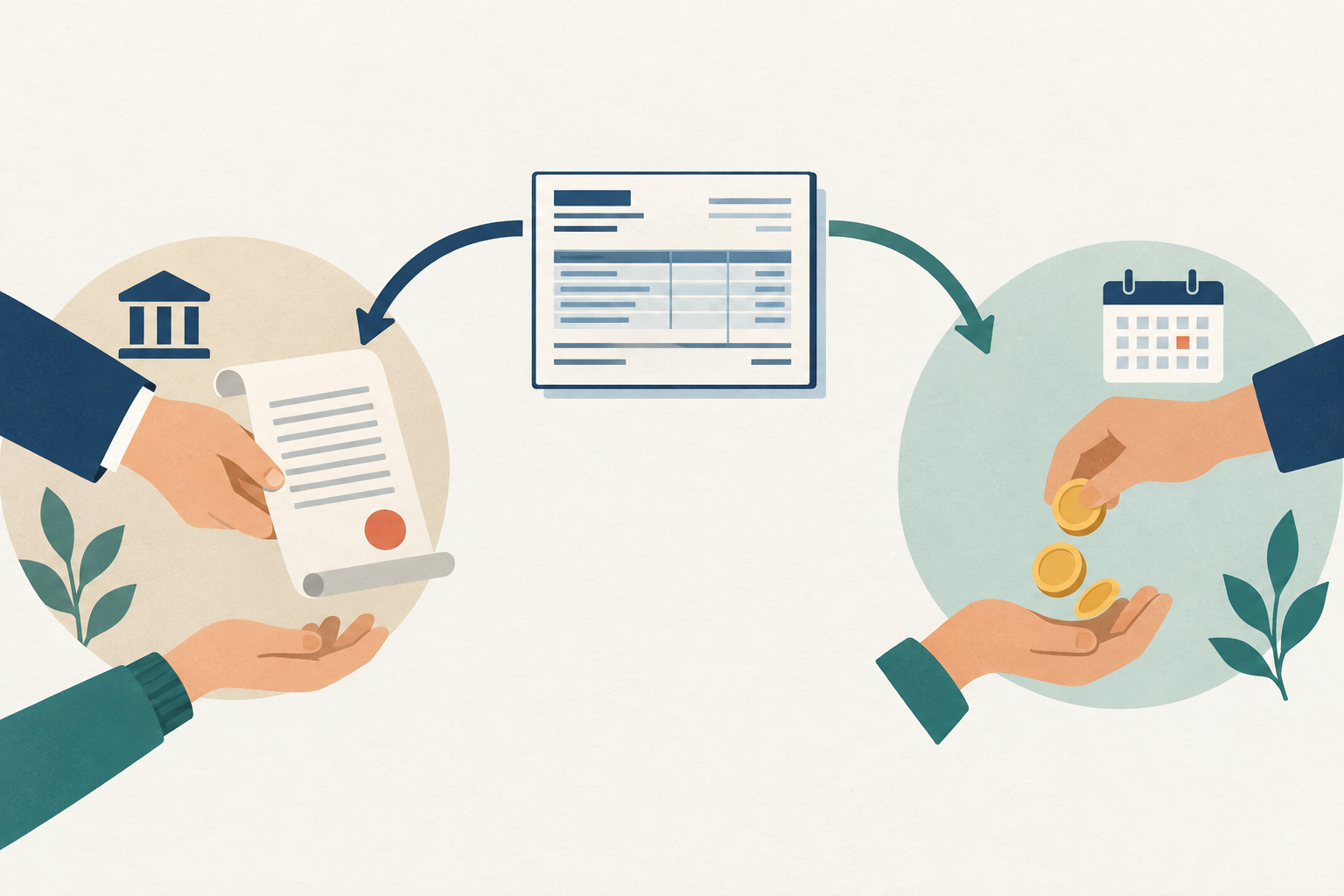
A paycheck loan is a short-term, high-cost loan repaid from your next pay, usually at $10 to $30 per $100 borrowed, which works out to roughly 400% APR. A paycheck advance lets you access wages you have already earned, sometimes free through an employer and sometimes for a few dollars through an app. The products look alike on a phone screen, but the gap in what you repay can be several hundred dollars.
Before you borrow
The biggest risk with a paycheck loan is paying the fee again two weeks later because the lump sum left you short. CFPB research found that four out of five payday loans are rolled over or followed by a new loan within 14 days, so a $60 fee becomes $240 or more before the principal moves.
Two products hide behind one search term
People type “paycheck loan” and mean two different things.
The first is a payday loan with a friendlier label. You borrow a few hundred dollars from a licensed lender, in a store or online, and agree to repay it plus a flat fee on your next payday. The lender takes a postdated check or an authorization to debit your bank account. Marketing calls this a cash advance on paycheck, a pay cash advance, or a “payday advance” depending on the state.
The second is earned wage access, usually sold as a paycheck advance, advance pay or “paycheck advance now.” Your employer or an app lets you pull part of the wages you have already worked for before payday arrives. The money is then deducted from your paycheck or your bank account when the real payroll lands.
The difference matters because one is credit at triple-digit rates and the other is, at best, your own money a few days early. At worst, the app version drifts toward payday pricing once you add express fees and tips.
How a paycheck loan works
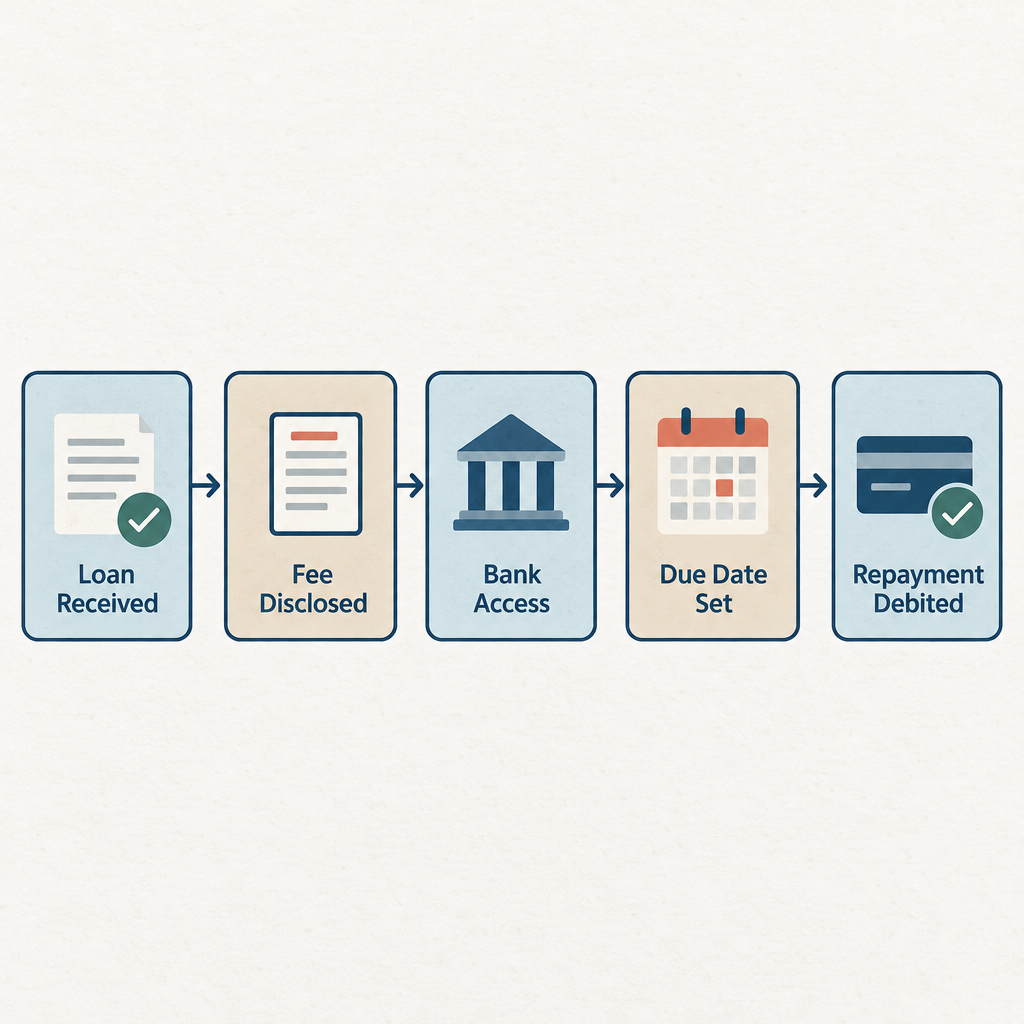
A storefront or online paycheck loan runs on a short cycle. You show proof of income, a checking account and ID. Most lenders do not pull a traditional FICO score. They run a soft check, use alternative data such as bank transaction history, or check specialty databases like Clarity or FactorTrust. That is what sits behind “no credit check” advertising. Approval is still a decision based on your income and your bank activity, and the price reflects the lender’s risk.
The term is usually 14 to 31 days. On the due date the lender deposits your check or debits your account for the full amount plus the fee. If you cannot cover it, many states allow a rollover or a back-to-back loan, and each one carries a fresh fee.
Applying for a paycheck loan online adds two issues. Some online lenders are not licensed in your state, and tribal or offshore lenders often charge far more than state law allows a local store to charge. Others are lead generators that sell your application to multiple companies, which is why a single search can trigger weeks of calls and texts. Marketing phrases like “urgent loans guaranteed approval” are a red flag rather than a feature, since no licensed lender can lawfully promise approval before it reviews an application.
If you want the full mechanics, our “payday loan” explainer walks through the fee structure state by state. The lending product is the same whatever the ad calls it.
How a paycheck advance works
Earned wage access comes in two forms, and they are priced very differently.
Employer-integrated advances
Your employer contracts with a provider that connects to its payroll and timekeeping. You can see earned-but-unpaid wages and transfer some of them, often up to 50% of what you have accrued. On payday the provider is repaid directly out of your check. Many employers pay the provider’s fee as a benefit, so a standard transfer costs you nothing. Instant transfers to a debit card may cost a dollar or two.
Direct-to-consumer apps
Apps that work without your employer connect to your bank account instead. They estimate your earnings from deposit history and advance a set amount, commonly $50 to $500, then debit your account on your next payday. They do not charge interest. They make money three ways: a monthly subscription, an “instant” or “lightning” transfer fee for same-day money, and an optional tip. A standard transfer that takes one to three business days is usually free.
The CFPB’s 2024 data spotlight on employer-partnered earned wage access found the typical worker made around 27 advances a year, and that once fees were counted the cost worked out to an APR above 100%. That is far cheaper than a paycheck loan, but it is not free money, and the pattern of repeat use looks a lot like payday borrowing.
What each option really costs
The honest way to compare a flat fee with an APR is to turn the fee into an APR. Divide the fee by the amount you received, multiply by 365, then divide by the number of days you had the money. A $60 fee on $400 for 14 days is 15%, times 365 divided by 14, which is 391% APR.
| Product | Amount | Fee or APR | Term | Total repaid | APR equivalent |
|---|---|---|---|---|---|
| Paycheck loan, paid on time | $400 | $15 per $100 ($60) | 14 days | $460 | 391% |
| Paycheck loan, rolled over 3 times | $400 | $60 x 4 ($240) | 56 days | $640 | 391% |
| App advance, instant transfer | $100 | $4.99 express fee | 10 days | $104.99 | 182% |
| App advance, standard transfer | $100 | $0 | 10 days | $100.00 | 0% |
| Employer advance, employer pays fee | $200 | $0 | 7 days | $200.00 | 0% |
| Credit union PAL I | $500 | 28% APR, $20 app fee | 6 months | about $562 | 28% plus fee |
| Credit card cash advance | $400 | 5% fee ($20) plus about 30% APR | 30 days | about $430 | roughly 90% |
Two things jump out. The paycheck loan is the only row where the fee restarts every two weeks without reducing what you owe. And the app advance can swing from 0% to triple digits depending on whether you tap the instant button. A $5.99 express fee on a $100 advance repaid in seven days is a 312% APR, which is payday-loan territory.
Side-by-side on the criteria that matter
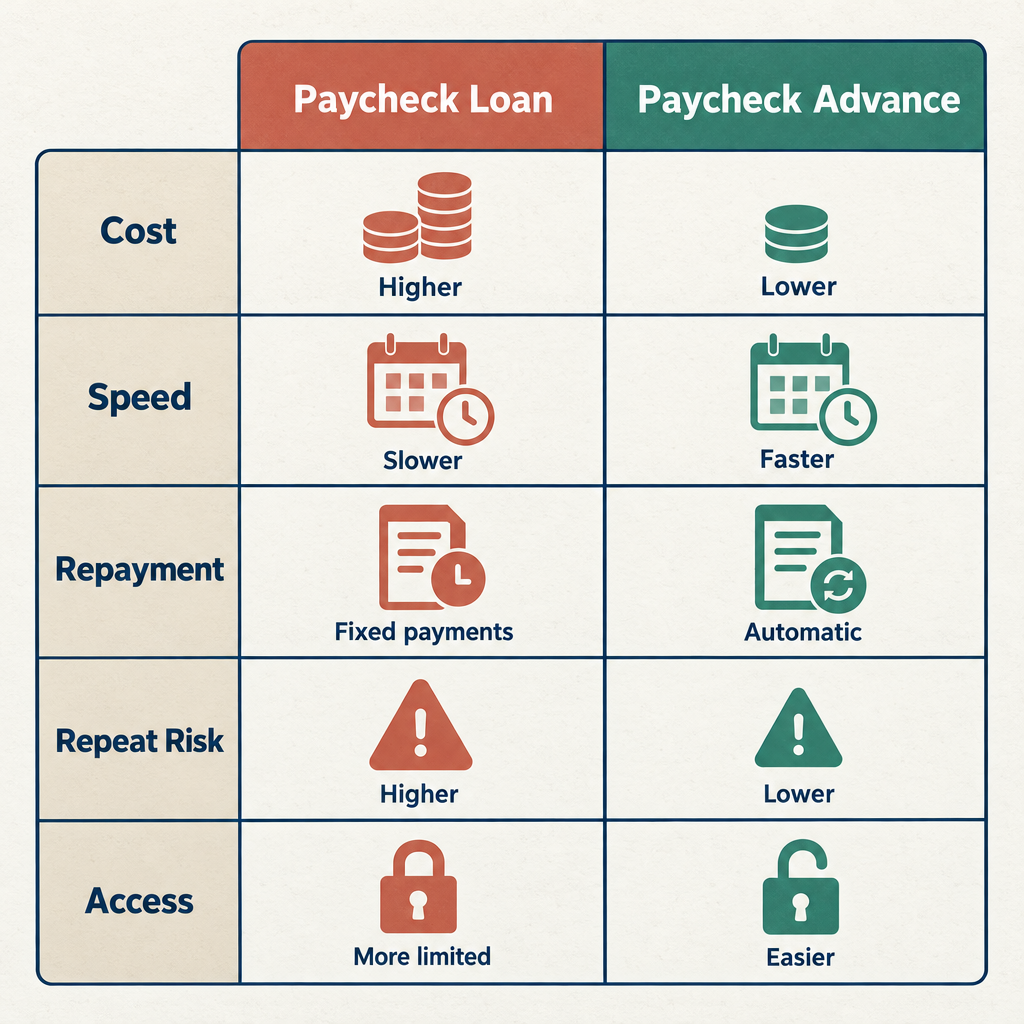
We compare on total cost, fees, transparency, licensing, complaint record and borrower protections, not on speed or convenience.
| Criterion | Paycheck loan | Employer advance | App advance | Credit union PAL |
|---|---|---|---|---|
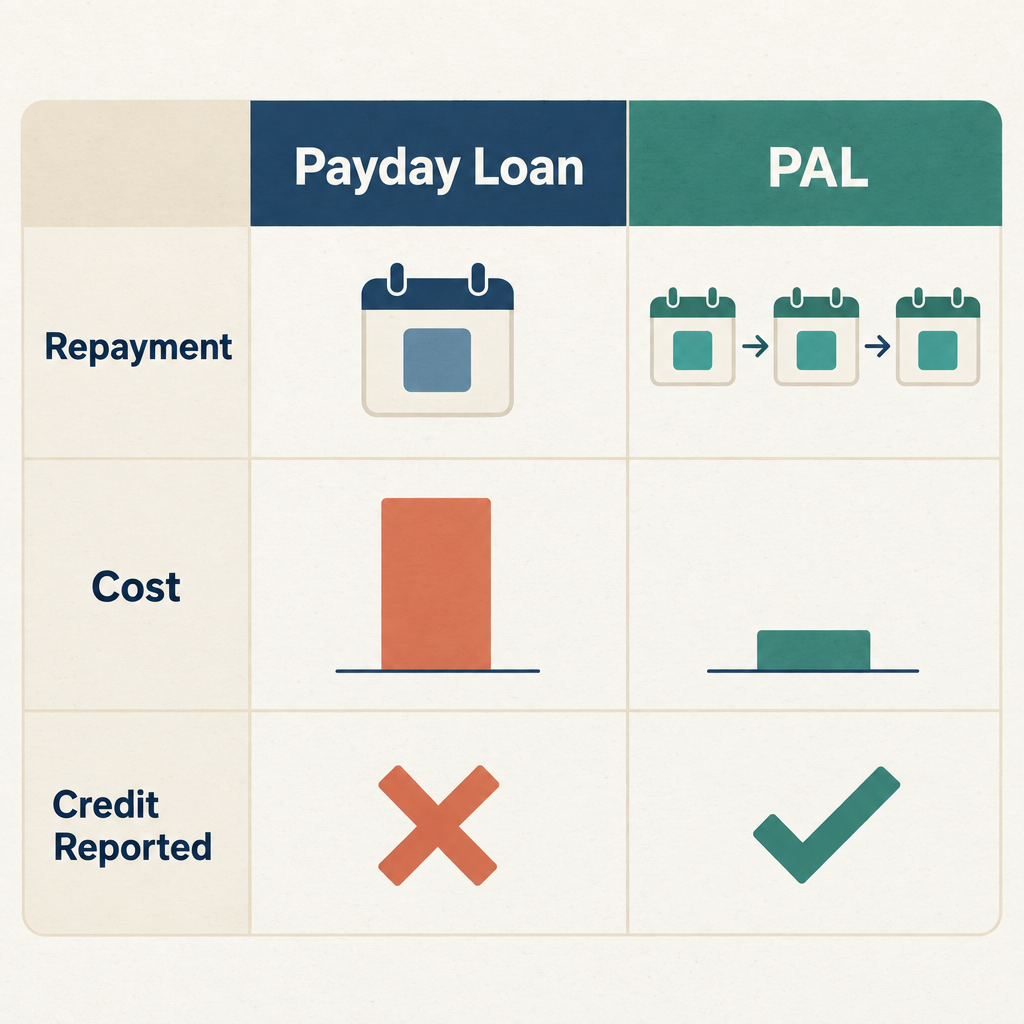
| Typical total cost | Highest | Lowest | Low to moderate | Low |
| Cost repeats if you are short | Yes, every term | No new fee | Only express fees | No, fixed schedule |
| APR disclosed up front | Required under Regulation Z | Usually not | Usually not | Required |
| Licensing | State lender license | Varies by state | Varies by state | Federal or state charter |
| Builds credit | No | No | No | Often yes |
| Can overdraft your account | Yes, via ACH | Rarely, payroll deduction | Yes, via ACH | No |
| Covered by Regulation E | Yes | Partly | Yes | Yes |
Paycheck loan from a licensed lender
Strengths: the price is disclosed as an APR under the Truth in Lending Act, the lender holds a state license you can verify, and the amount can reach $1,000 in states that allow it.
Weaknesses: the cost is extreme for a two-week loan, repayment is a single lump sum, and the business model relies on repeat borrowing. The CFPB’s 2017 payday rule, whose payment provisions took effect March 30, 2025, exists because lenders were hammering empty accounts with repeated debits.
Employer-integrated paycheck advance
Strengths: often free, repaid from payroll so it cannot overdraft your bank account, and the advance is capped at wages you have actually earned.
Weaknesses: only available if your employer offers it, your boss’s payroll vendor knows how often you use it, and repayment shrinks your next check at the moment you may need it most.
Direct-to-consumer paycheck advance app
Strengths: no employer involvement, standard transfers are usually free, and the amounts are small enough that the debt rarely snowballs.
Weaknesses: the real price is buried in subscriptions, express fees and suggested tips, the app’s debit can bounce and trigger overdraft fees at your bank, and many apps advertise an amount you will not qualify for until you have months of deposit history. Because most apps do not call the product a loan, they also do not give you a standardized APR, so comparing two apps takes real arithmetic.
Credit union payday alternative loan
Strengths: the NCUA caps PAL I loans at 28% APR with an application fee of no more than $20, amounts run $200 to $1,000, and terms run one to six months. PAL II allows up to $2,000 over up to 12 months with no waiting period. Payments report to credit bureaus at many credit unions.
Weaknesses: you need to join a credit union, PAL I requires one month of membership first, and funding is rarely same-day.
How to choose between them
Start with the question of whether you have already earned the money. If payday is five days away and you have worked the hours, a paycheck advance that costs nothing with a standard transfer is the cheapest route by a wide margin. Ask your HR or payroll department first, because an employer program is almost always cheaper than an app.
If the gap is bigger than one paycheck can cover, an advance just moves the hole forward a week. That is where people slide into a paycheck loan. Before you do, price a credit union PAL, a hardship plan with the bill you are trying to pay, or a credit card cash advance. All three cost a fraction of a payday product even when the credit card rate looks ugly.
Pick a paycheck loan only if the alternatives are closed to you, you can repay the full amount on the first due date without borrowing again, and the lender is licensed in your state. If any of those three is uncertain, the loan will likely cost more than the problem it solves.
Cheaper options first
Ask your employer about earned wage access or a payroll advance with no fee.
Call your utility, landlord or medical provider and ask for a payment plan before borrowing.
Price a credit union payday alternative loan, capped at 28% APR by the NCUA.
Dial 211 for local emergency assistance with rent, utilities and food.
Where paycheck loans are banned or capped
Paycheck loans are legal at triple-digit rates in a bit more than half the states. Roughly 20 states plus the District of Columbia either ban the product or cap small-loan rates at or around 36%, which makes classic two-week lending unprofitable. That group includes New York, New Jersey, Pennsylvania, Massachusetts, Connecticut, Maryland, Georgia, North Carolina, West Virginia, Vermont, Arizona, Arkansas, Colorado, Montana, South Dakota, Nebraska, New Hampshire, Illinois and New Mexico.
Where the loans are legal, state law sets the terms. California caps the check at $300 and the fee at 15% of the face amount, so you receive $255 and repay $300 within 31 days, which the Department of Financial Protection and Innovation itself describes as a 460% APR on a two-week term. Texas allows “credit access businesses” to broker loans with fees that often push APRs above 500%. An online lender advertising nationwide availability is either licensed state by state or operating outside your state’s rules, and you should assume the second until you confirm the first.
Paycheck advances are regulated differently and the map is still being drawn. Nevada, Missouri, Wisconsin, Kansas and South Carolina have passed laws that register earned wage access providers and treat them as something other than lenders. Connecticut went the other way and treats the fees as loan charges subject to its small-loan rate cap. California requires providers to register with the DFPI. At the federal level, the CFPB proposed an interpretive rule in July 2024 saying most paycheck advance products are credit under the Truth in Lending Act, then withdrew that proposal in 2025. As of this writing there is no settled federal rule, so your protections depend heavily on your state.
Your rights with either product
The Truth in Lending Act and Regulation Z (12 CFR 1026) require a licensed paycheck lender to show you the finance charge and APR in writing before you sign. If a lender quotes only a “fee” and refuses to state an APR, that is a disclosure violation.
The Electronic Fund Transfer Act and Regulation E govern the bank debits that both lenders and apps rely on. You can revoke an ACH authorization, and you can place a stop payment with your bank at least three business days before a scheduled debit. A lender cannot condition a loan on your agreeing to repay by preauthorized electronic transfer.
Under the CFPB’s payday lending rule, after two consecutive failed withdrawal attempts a covered lender must get a new, specific authorization from you before trying again. That provision became enforceable March 30, 2025.
The Military Lending Act caps the Military Annual Percentage Rate at 36% for active-duty servicemembers and their dependents, which effectively bars them from standard paycheck loans. The Servicemembers Civil Relief Act separately caps pre-service debts at 6%.
If a paycheck loan goes unpaid and is sold, the Fair Debt Collection Practices Act controls what a “debt collector” can say and do. Collectors cannot threaten arrest over a bounced loan check, call before 8 a.m. or after 9 p.m., or discuss your debt with your employer. The Fair Credit Reporting Act gives you the right to dispute inaccurate collection entries.
Complaints go to the CFPB complaint portal, your state’s banking or financial regulator, and the FTC through ReportFraud. If you believe a lender was an outright fraud, file with the FBI’s IC3 as well.
How to check a lender before you borrow
- Look the company up on NMLS Consumer Access and confirm a license for your state.
- Check your state regulator’s own license search, since some states license payday lenders outside NMLS.
- Search the CFPB complaint database for the company name and read the most recent complaints.
- Confirm the APR and finance charge appear in writing before you sign anything.
- Read the ACH authorization and note the exact date and amount of each scheduled debit.
FAQ
Is a paycheck loan the same as a payday loan?
Yes. “Paycheck loan,” “cash advance on paycheck” and “pay cash advance” are marketing names for the same short-term, single-payment loan regulated under state payday or deferred-deposit laws. The fee, term and legal protections are identical.
Is a paycheck advance a loan?
It depends on your state. Connecticut treats paycheck advance fees as loan charges. Nevada, Missouri, Wisconsin, Kansas and South Carolina regulate providers under separate earned wage access laws. Federally, the CFPB withdrew its 2024 proposal to treat them as credit, so there is no national answer yet.
Can I get a paycheck loan online with no credit check?
Online lenders usually skip the big three credit bureaus but still check your income, bank history and specialty databases. “No credit check” means a soft check or alternative data, not no review. Expect higher prices than a store in your state, and verify the license before sharing your bank login.
Do paycheck advances affect my credit score?
Almost never. Neither paycheck loans nor paycheck advance apps report on-time payments to Equifax, Experian or TransUnion. A defaulted paycheck loan can appear as a collection account, which does hurt your score. A credit union payday alternative loan is the only option in this comparison that routinely helps build credit.
What happens if the debit bounces?
Your bank may charge an overdraft or returned-item fee, often around $30, and the lender may add its own returned-payment fee where state law permits. A paycheck advance app typically will not charge a penalty but may cut off future advances. Under Regulation E and the CFPB payday rule, a lender needs fresh authorization after two consecutive failed attempts.
Which is cheaper for a $300 shortfall?
A free standard transfer through an employer program or app costs $0. A credit card cash advance costs roughly $15 in fees plus about $7 in interest for a month. A credit union PAL costs under $10 in interest for one month plus up to $20 to apply. A paycheck loan at $15 per $100 costs $45 for two weeks, and $90 if you roll it once.