

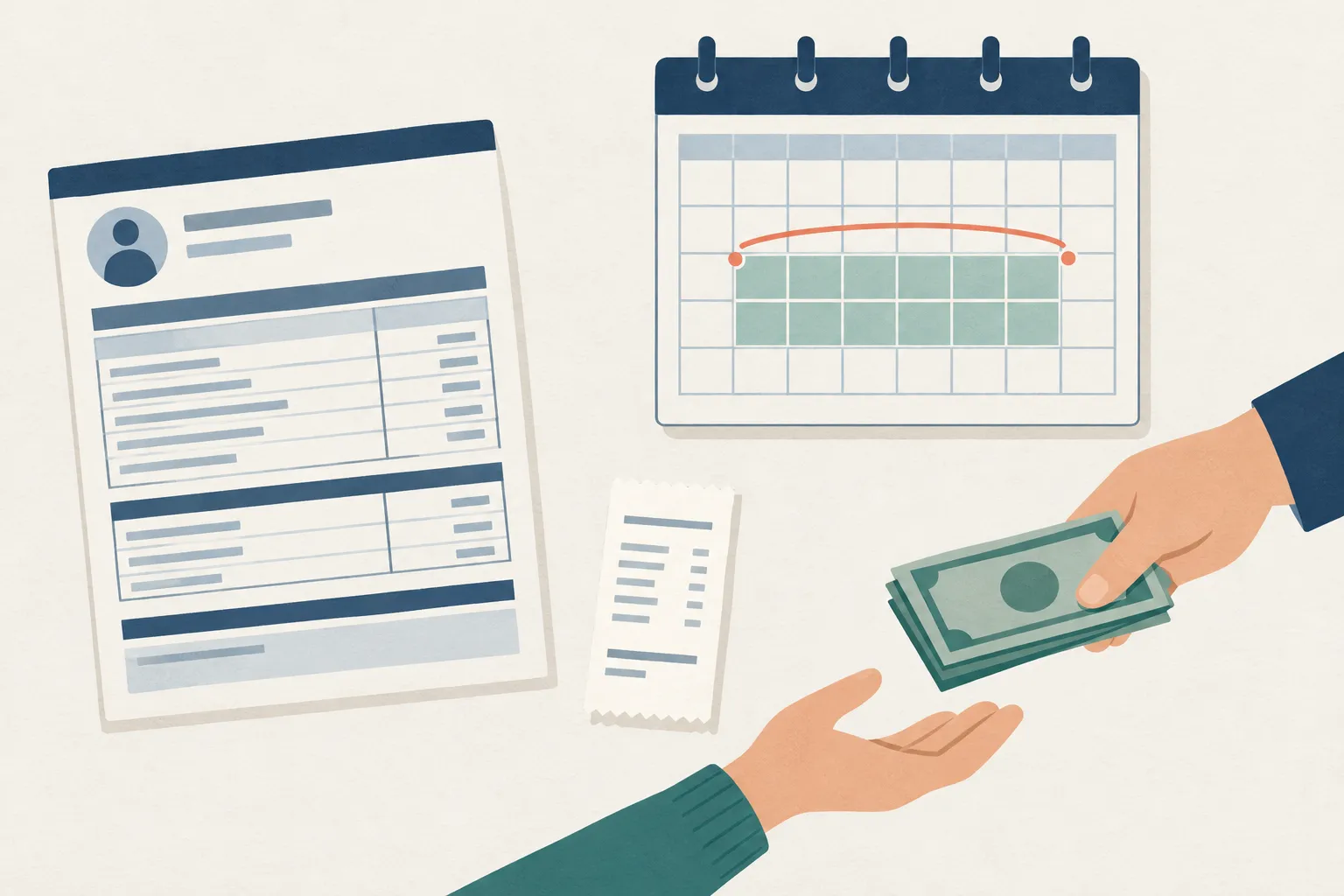
We do not lend money or arrange loans. Rates and rules change and differ by state, so check the lender's own disclosure before you sign.
A $15 fee on a $100 two-week loan doesn’t sound like much. Over a year it works out to an annual percentage rate (APR) of about 391%. A payday loan is a small, short-term cash loan, usually $500 or less. You repay it in one lump sum on your next payday, typically within two to four weeks. This guide covers how the product works, what it costs compared with other small loans, where it is legal and which rules protect you if you borrow.
Run the numbers
Key takeaways
- A payday loan is due in one lump sum, and the lender pulls payment straight from your bank account.
- A $15 fee per $100 over 14 days equals about 391% APR, and every rollover charges the full fee again.
- About 20 states plus DC ban the product or cap small-loan rates near 36% APR.
- A credit union payday alternative loan of $500 over six months at 28% APR costs about $42 in interest.
- Federal law requires an APR disclosure, caps loans to active-duty servicemembers at 36% and bans required autopay.
What a payday loan is
The Consumer Financial Protection Bureau (CFPB) defines a payday loan as a short-term, high-cost loan, generally for $500 or less, that is due on your next payday. In effect, you borrow against a paycheck you haven’t received yet.
The same product goes by several names: payday advance, cash advance, deferred deposit, check advance or “pay day loan.” Storefront shops and online lenders both sell it, and it works the same way under every label.
Two features set it apart from a bank personal loan. You repay the whole balance at once, not in monthly installments. And the lender holds a post-dated check or an electronic authorization to take the money from your bank account on the due date. That means the lender gets paid before you decide what else to pay that week.
How a payday loan works
You usually need proof of income (a pay stub or bank statements), a government ID and an open checking account. Approval often comes the same day. That speed is the main appeal when rent is due Friday and payday is the following Monday.
Most payday lenders don’t pull your file from Equifax, Experian or TransUnion. Many do check specialty databases that track payday borrowing, such as Clarity Services (owned by Experian) and FactorTrust (owned by TransUnion). Many states also require lenders to check a state database so you can’t hold more loans than the law allows.
- You write a check for the loan amount plus the fee, dated for your next payday, or you sign an ACH authorization for the same amount.
- The lender gives you cash or deposits the money. In a store this is often the same business day. Online it is usually the next business day.
- On the due date, the lender cashes the check or debits your account.
- If you can’t cover it, many states let you pay only the fee to “roll over” the loan for another pay period. Rollovers are where the cost multiplies.
What a payday loan costs
Payday lenders quote a fee per $100 borrowed, not an interest rate. The CFPB’s long-standing range is $10 to $30 per $100, with $15 per $100 common in states that allow the product. Converting the fee to an APR shows why regulators treat payday loans differently from bank loans.
The math works like this. A $15 fee on $100 is 15% of the amount borrowed. A year has 365 days, which is 26.07 periods of 14 days. Multiply 15% by 26.07 and you get 391%. The same formula puts a $10 fee at about 261% and a $30 fee at about 782%.
| Loan amount | Fee | Term | Total repaid | APR |
|---|---|---|---|---|
| $300 | $45 ($15 per $100) | 14 days | $345 | 391% |
| $500 | $75 ($15 per $100) | 14 days | $575 | 391% |
| $500 | $150 ($30 per $100) | 14 days | $650 | 782% |
| $500, original loan plus 4 rollovers | 5 fees × $75 = $375 | 10 weeks | $500 + $375 = $875 | 391% each period |
Study the last row. You pay the original fee and then four rollover fees, $375 in all, and you still owe the full $500. In ten weeks the lender has collected 75% of the principal without cutting your balance by a single dollar.
Before you borrow
The first fee isn’t the real risk. The risk is paying it again every two weeks because your next paycheck can’t absorb a lump-sum repayment. A $300 loan rolled over every two weeks at $45 a time costs $900 after 20 fees, about 40 weeks or roughly nine months, and you still owe the $300.
Under the Truth in Lending Act and Regulation Z (12 CFR 1026), a payday lender generally must give you the finance charge in dollars and the APR in writing before the loan is made. If a lender won’t show you an APR, walk away.
How payday loans differ from other small loans
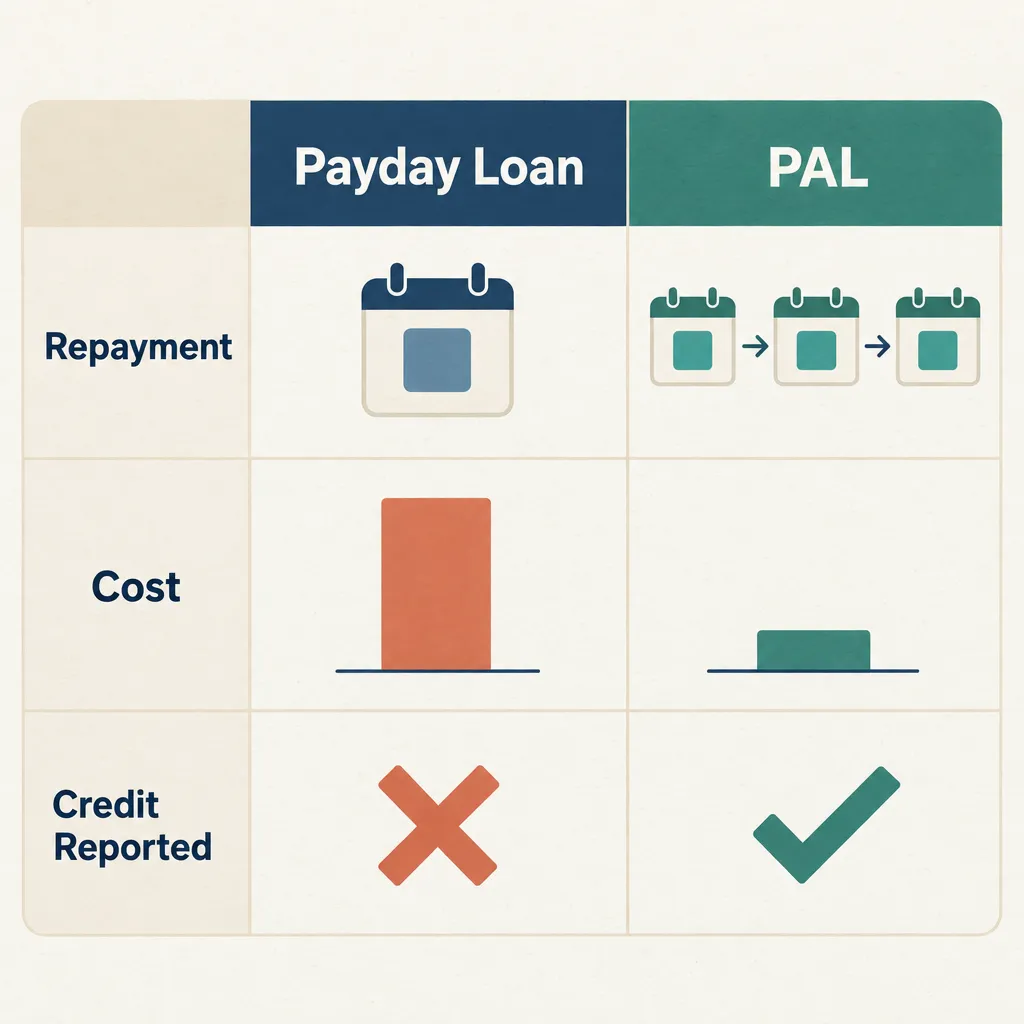
Ways to borrow a few hundred dollars range from roughly free to several hundred percent APR. The table uses typical terms. Your exact cost depends on your state and the lender’s own disclosure.
| Product | Typical size | Typical cost | Repayment | Credit reported? |
|---|---|---|---|---|
| Payday loan | $100 to $500 | $10 to $30 per $100, about 261% to 782% APR over 14 days | One lump sum in 2 to 4 weeks | Rarely, unless you default |
| High-cost installment loan | $500 to $5,000 | Triple-digit APR in many states | Monthly payments over months or years | Often |
| Auto title loan | $100 to $5,000 | About 25% per month, around 300% APR | Lump sum in 30 days; car is collateral | Rarely |
| Pawn loan | $20 to a few hundred | Charges set by state law, often steep | Repay and get the item back, or lose it | No |
| Credit card cash advance | Up to your cash limit | 3% to 5% fee plus a cash advance APR often near 30% | Minimum monthly payments | Yes |
| Cash advance app | Usually $20 to $500 | Tips, instant-transfer fees, subscriptions or a set fee per advance | Debited on your next payday | Usually not |
| Credit union payday alternative loan (PAL) | $200 to $2,000 | 28% APR cap, application fee up to $20 | 1 to 12 monthly payments | Yes |
Installment loans
An installment loan spreads what you owe over fixed monthly payments, which is easier to manage than a lump sum. But many payday lenders also sell installment loans at triple-digit APRs. A long term at a high rate can cost more in total dollars than one payday loan repaid on time, so compare the total repaid, not the monthly payment.
Auto title loans
A title loan uses your car as collateral. Costs are close to payday prices, and the lender can repossess the vehicle if you miss the balloon payment. If you lose the car you drive to work, a $500 problem can become a lost job.
Pawn loans
A pawn shop lends against an item you leave with it. If you don’t repay, you lose the item and nothing more. There’s no bank debit, no collection account and no credit damage. That makes pawn one of the lower-risk high-cost options, even though the charges are steep.
Credit card cash advances
A cash advance on a card you already have charges an upfront fee, usually 3% to 5%, plus interest from the day you withdraw, with no grace period. Here is a $500 advance held for one month with a 5% fee and a 30% APR:
| Item | Math | Cost |
|---|---|---|
| Cash advance fee | $500 × 5% | $25.00 |
| One month of interest | $500 × 30% ÷ 12 | $12.50 |
| Total repaid | $500 + $25.00 + $12.50 | $537.50 |
That’s expensive by credit card standards. It is still less than the $575 for a single two-week payday loan of the same size, and you get a month instead of two weeks.
Cash advance apps
Apps such as EarnIn, Dave and Brigit advance small amounts against your next paycheck. Depending on the app, you pay through optional tips, express-delivery fees, a monthly subscription or a set fee per advance. A $5 charge on a $100 advance repaid in 14 days works out to about 130% APR ($5 is 5% of $100, and 5% × 26.07 = 130%). In its July 2024 Data Spotlight on employer-linked earned wage products, the CFPB put the APR of a typical transaction at 109.5%. Workers averaged 27 advances a year. The dollar cost is usually much lower than a payday loan, but frequent use adds up, and the app still debits your account on payday.
Payday alternative loans from credit unions
Federal credit unions can offer payday alternative loans (PALs) under NCUA rules at 12 CFR 701.21. A PAL I runs $200 to $1,000 for one to six months and requires you to have been a member for at least one month first. A PAL II goes up to $2,000 for one to 12 months, and federal rules set no minimum membership period for it, so it can be available as soon as you join. Both cap the APR at 28% and the application fee at $20. A credit union can give you only one type of PAL at a time.
Here is the cost of $500 over six months at the 28% cap. The monthly rate is 28% ÷ 12 = 2.33%. That makes the payment about $90.26 a month. Six payments total about $541.58, so you pay about $42 in interest and about $542 in all. With the maximum $20 application fee, the most you’d pay is about $562. A two-week payday loan of the same $500 costs $575, and that’s before any rollover.
Where payday loans are legal
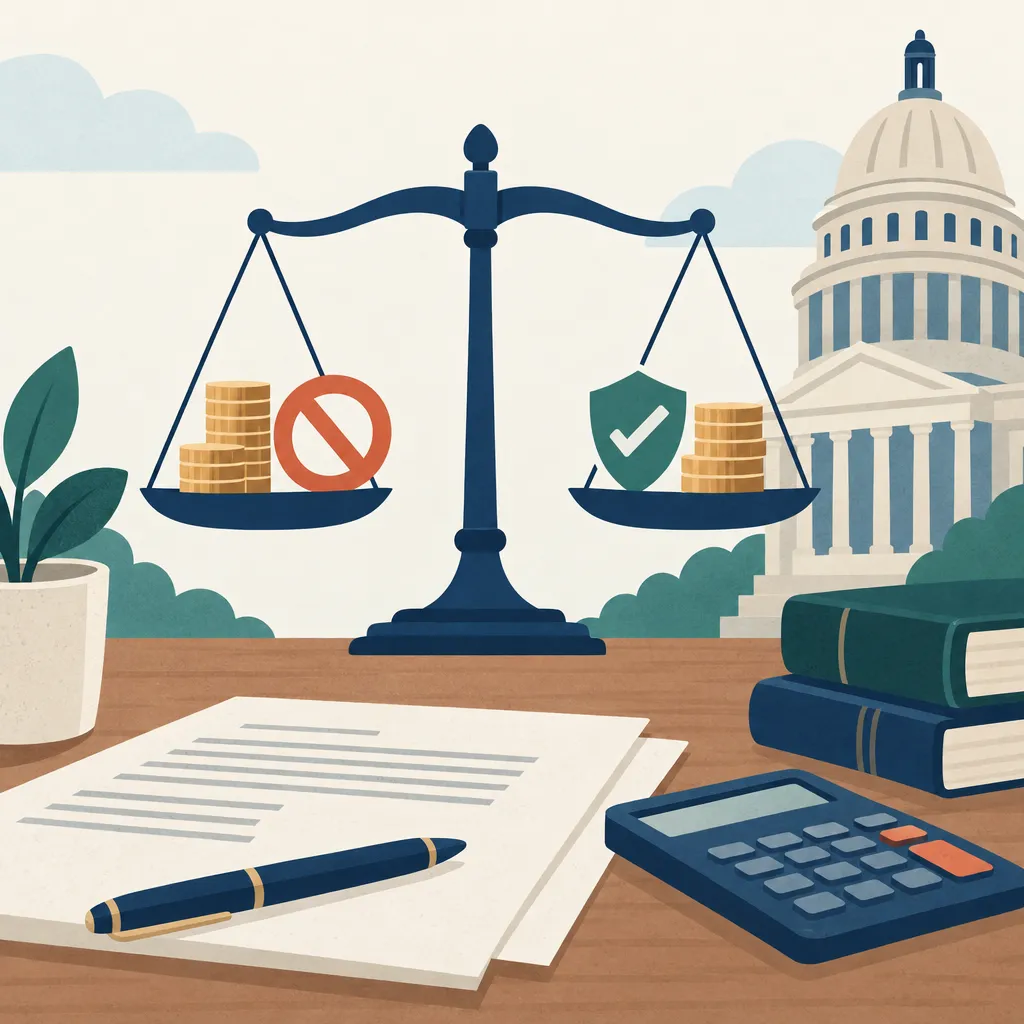
Whether you can get a payday loan depends on your state. About 20 states plus the District of Columbia either ban payday lending or cap small-loan rates near 36% APR, a level at which the two-week product can’t make money. The National Conference of State Legislatures keeps a state-by-state summary of these laws.
The longest-standing group of bans and caps includes:
- New York, New Jersey, Pennsylvania, North Carolina and Georgia
- Massachusetts, Connecticut, Maryland and Vermont
- Arizona, Arkansas, West Virginia, Montana and New Hampshire
States that capped rates more recently:
| State | Year | How |
|---|---|---|
| South Dakota | 2016 | Ballot measure, 36% cap |
| Colorado | 2018 | Ballot measure, 36% cap |
| Nebraska | 2020 | Ballot measure, 36% cap |
| Illinois | 2021 | Predatory Loan Prevention Act, 36% all-in cap |
| New Mexico | 2023 | Legislation, 36% cap |
| Minnesota | 2023 | Legislation, 36% all-in cap |
Illinois’s 36% cap applies to payday, installment and title loans alike, so the classic two-week payday loan has largely disappeared there.
Other states allow the product with limits:
- California. Under California’s Deferred Deposit Transaction Law, the check can’t exceed $300, the fee is capped at 15% of the check and the term can’t exceed 31 days. The Department of Financial Protection and Innovation (DFPI) gives this example: a $300 check at the maximum fee means you walk out with $255, and the $45 difference is the fee.
- Ohio. Ohio’s 2018 Short-Term Loan Act reform (House Bill 123, often called the Fairness in Lending Act) raised the maximum loan to $1,000 and set terms of 91 days to one year. A shorter loan is allowed only if each monthly payment stays at or below 6% of your gross or 7% of your net monthly income. Interest is capped at 28% a year, plus a monthly maintenance fee of no more than 10% of the loan or $30, whichever is less.
- Texas. In Texas, payday loans are arranged by “credit access businesses” licensed by the Office of Consumer Credit Commissioner (OCCC). The OCCC’s own consumer loan study says these transactions lack regulatory caps on fees and tend to cost more than any other loan product it tracks. You can read more on Texas’s credit access business rules.
A lender advertising “cash loans payday advance” nationwide online can’t override your state’s law. In a state that bans payday lending, a loan made to you there is generally void or unenforceable. Tribal and offshore lenders claim exemptions, and state attorneys general and the CFPB have repeatedly sued them.
Who a payday loan can make sense for
The list is short. A payday loan is defensible only if all four of these are true:
- You face a specific cost, such as overdraft fees, a utility shutoff or a late fee, that is larger than the payday fee.
- You’re certain your next paycheck covers the full repayment plus your normal bills.
- You’ve already ruled out the cheaper options below.
- You’ll borrow once and won’t roll over.
Did you know?
According to the CFPB’s 2014 Data Point on payday lending, more than 80% of payday loans are rolled over or followed by another loan within 14 days.
Most borrowers don’t fit the one-time profile, however confident they feel at the counter. The counter-argument deserves a fair hearing. For someone facing a $35 overdraft fee on each of several transactions, one $45 payday fee repaid on time can be the cheaper outcome. That holds only when the “repaid on time” part actually happens.
Why rollovers trap borrowers
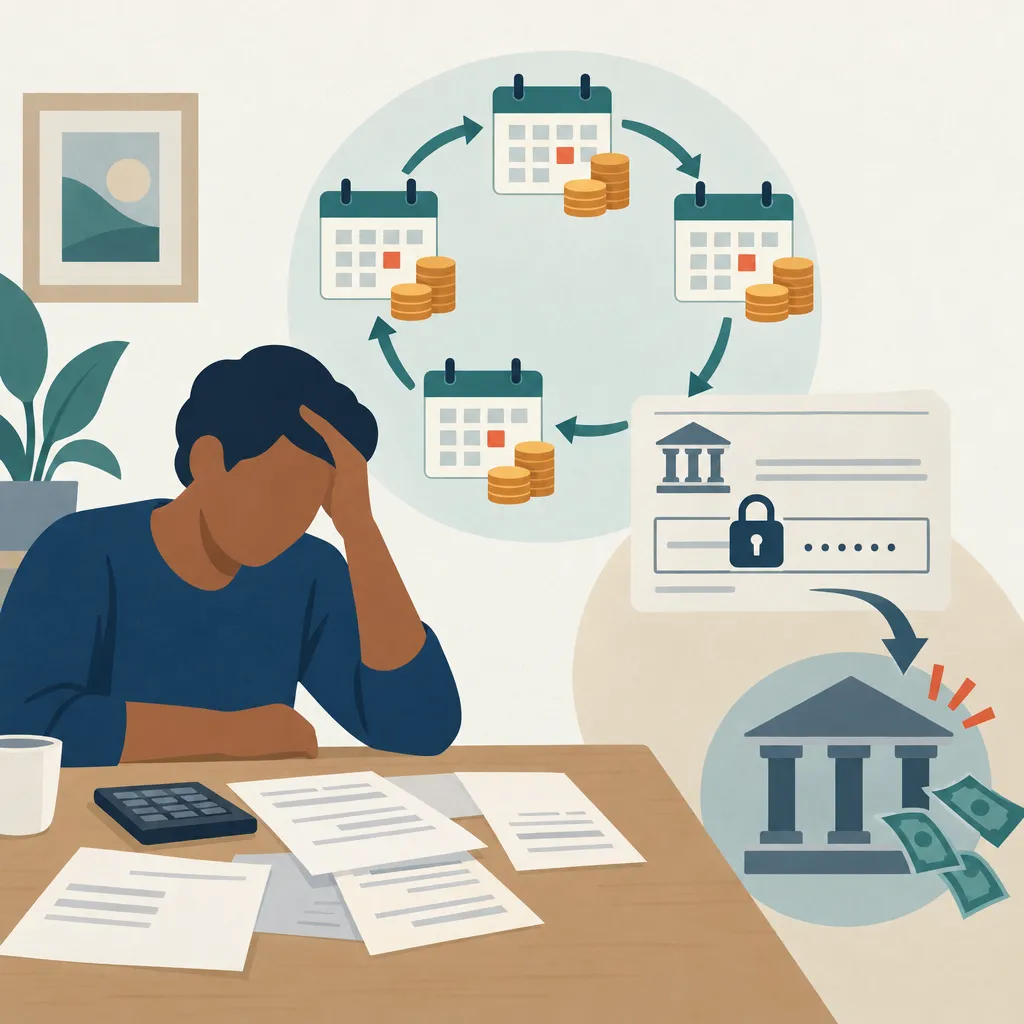
The lump-sum structure is the problem. If you borrow $500 because you came up $500 short this month, you probably won’t have $575 to spare two weeks later. Paying the $75 fee to push the due date back feels manageable. Doing it ten times costs $750 (10 × $75), and the $500 is still unpaid.
Because the lender holds your check or ACH authorization, a missed payment also has bank consequences. Each failed debit can bring an overdraft or returned-item fee from your bank on top of the lender’s own returned-payment fee. Lenders had to start complying with the payment provisions of the CFPB’s payday rule (12 CFR part 1041) on March 30, 2025, the compliance date set after the court stay ended. After two consecutive failed withdrawals, they bar the lender from trying again without your new authorization. As of November 2026 the rule is still on the books. However, the CFPB said in March 2025 that it wouldn’t prioritize enforcing it, and its 2026 regulatory agenda lists a plan to reconsider the remaining provisions. State law and your own bank’s rules on stopping payments still apply either way.
Payday loans also do nothing for your credit score. Most lenders don’t report on-time payments to the three major bureaus, so faithful repayment builds nothing. Defaulted loans are often sold to collectors who do report.
Cheaper options first
Ask your employer about a paycheck advance, or use a cash advance app’s free standard delivery. Ask a credit union about a payday alternative loan at no more than 28% APR. Call the biller, call 211 or contact a nonprofit credit counselor approved by the National Foundation for Credit Counseling before you borrow at triple digits.
Some large banks offer small-dollar loans to existing checking customers, repaid over about three months for a flat fee well below payday prices. Check your own bank’s app before you visit a payday store.
Your rights as a payday borrower
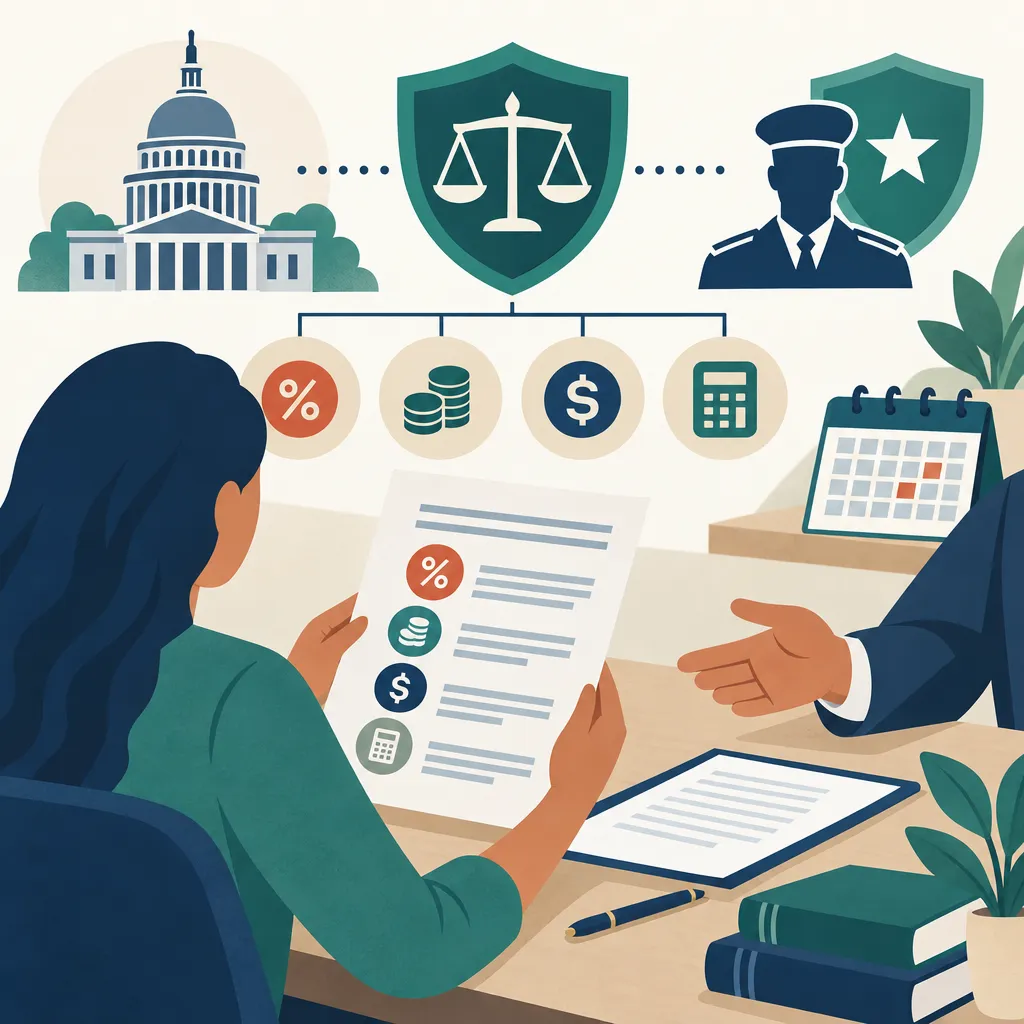
Federal and state law protect you more than most storefronts mention.
- Truth in Lending Act and Regulation Z. Before you sign, the lender must give you in writing the APR, the finance charge, the amount financed and the total of payments. The APR must be stated as a yearly rate even on a 14-day loan.
- Military Lending Act (32 CFR 232). Caps the Military Annual Percentage Rate at 36% for active-duty servicemembers and their dependents and bans mandatory arbitration in their loan contracts. A loan that breaks these rules is void.
- Electronic Fund Transfer Act and Regulation E (12 CFR 1005.10(e)). A lender can’t make repayment by preauthorized electronic transfer a condition of the loan. You can revoke an ACH authorization by notifying the lender and your bank. That stops future debits, but it doesn’t cancel the debt.
- Fair Debt Collection Practices Act. Covers third-party collectors who buy or service defaulted payday debt. They can’t threaten arrest, can’t call before 8 a.m. or after 9 p.m. your time, and can’t discuss your debt with your employer. A bounced post-dated check to a payday lender is generally a civil matter, not a crime. Threatening criminal charges is a common illegal collection tactic.
- Fair Credit Reporting Act. Lets you dispute a payday collection account on your credit report if it is inaccurate or can’t be verified.
State law adds limits on loan size, fees, rollovers and how many loans you can hold, plus licensing rules. In many states, a loan from an unlicensed lender can’t be enforced.
How to check a payday lender
- Search the lender’s name on NMLS Consumer Access to see which states license it.
- Confirm the license with your state regulator’s lookup, such as California’s DFPI or the Texas OCCC.
- Read the Regulation Z disclosure and find the APR before you sign.
- Search the CFPB complaint database for the lender’s complaint record.
- Report illegal fees, threats or unlicensed lending to the CFPB complaint portal, FTC ReportFraud or your state attorney general.
FAQ
How much can you borrow with a payday loan?
Most payday loans are $500 or less, and the limit depends on your state. In California the check can’t exceed $300. Ohio law caps short-term loans at $1,000.
Does a payday loan check your credit?
Most payday lenders skip the three major bureaus, which is why they advertise “no credit check.” They often use specialty databases such as Clarity Services and FactorTrust, along with state-mandated loan databases. So no bureau pull doesn’t mean no screening.
Do payday loans build credit?
Almost never. On-time payments usually go unreported. Unpaid loans sold to collectors often do show up and hurt your score.
What happens if I cannot repay a payday loan?
The lender will try to cash your check or debit your account, which can trigger bank fees. The CFPB rule bars a third attempt after two consecutive failures unless you authorize it again. The debt may go to collections, and the lender can sue you in civil court, but you can’t be jailed for owing a payday loan.
Can I cancel a payday loan after signing?
Some states give you until the end of the next business day to return the money without a fee. Your contract and your state regulator’s rules set the exact window.
Are online payday loans different from storefront loans?
The product is the same. Online lenders are more likely to operate without a state license, charge higher fees and rely on ACH debits, so checking the license on NMLS Consumer Access matters even more.
What is the difference between a payday loan and a cash advance?
Many lenders use the two terms for the same product. A credit card cash advance is something else: a 3% to 5% fee plus card interest, usually far cheaper than a payday loan. Cash advance apps are a third category, with smaller fees and repayment taken automatically from your next paycheck.
Before you sign anything
Work out the total you’d repay if you had to roll over three times. For a $500 loan at $15 per $100, that’s four fees of $75, or $300, on top of the $500. Compare that number with a credit union PAL, your bank’s small-dollar loan or a payment plan from the biller. If the payday option is still the cheapest after that test, borrow once and repay in full on the due date.
Laws and regulations referenced
- Truth in Lending Act, 15 U.S.C. 1601
- Regulation Z, 12 CFR Part 1026
- Fair Debt Collection Practices Act, 15 U.S.C. 1692
- Fair Credit Reporting Act, 15 U.S.C. 1681
- Electronic Fund Transfer Act, 15 U.S.C. 1693
- Regulation E (electronic transfers), 12 CFR Part 1005
- Military Lending Act, 10 U.S.C. 987
- Military Lending Act rule, 32 CFR Part 232
- CFPB payday lending rule, 12 CFR Part 1041
Links go to the official text on government sites.
Check, verify or complain

Dana writes US Financer's guides to payday loans, personal and installment loans, bad credit borrowing and cash advance apps. Every piece starts from what a loan really costs, works the numbers in a table, and checks what the lender's own disclosure and your state's rules…
Ruth is US Financer's standards editor. Every article goes through her checks before and after it is published: each rate, fee, cap, deadline and rule is matched against its primary source, every law named is linked to its official text, and anything that cannot be…
What changed
- Nov 24, 2026 Updated.
- Nov 12, 2026 Facts re-checked against official sources and updated; sources and links refreshed.
- Nov 12, 2026 Corrected the credit union payday alternative loan example: $500 over six months at 28% costs about $42 in interest ($542 in total), not $69.
- Oct 15, 2026 First published.
Comments are closed