

We do not lend money or arrange loans. Rates and rules change and differ by state, so check the lender's own disclosure before you sign.
Bad credit rarely stops a payday loan. Most payday lenders look at your income, your checking account and specialty databases rather than a FICO score, so a 500 score usually doesn’t decide the answer. The cost does, though. A typical fee of $15 per $100 works out to an APR of about 391% on a two-week loan, and repeat borrowing is where most borrowers get hurt. This guide covers what lenders actually check, what the loan costs, where it is legal, the cheaper options to try first, and your rights under federal and state law.
Run the numbers
Key takeaways
- Bad credit rarely blocks a payday loan. Lenders mostly check your income, your bank account and payday-specific databases.
- “Guaranteed approval” and “no credit check” are marketing phrases. A lender that guarantees approval in exchange for an upfront fee is a scam pattern the FTC warns about.
- A $400 loan at $15 per $100 costs $60 for two weeks. That is about 391% APR, and each rollover adds another $60.
- Credit union payday alternative loans are capped at 28% APR. Hardship plans and nonprofit counseling cost even less.
- Many states ban or cap payday loans. Servicemembers are protected by a 36% cap under the Military Lending Act.
Can you get a payday loan with bad credit?
Usually, yes. Most payday lenders don’t make the decision on your credit score. They want proof of regular income, an open checking account, a valid ID, and a clean record in the databases payday lenders share. A low FICO score, a past bankruptcy or thin credit rarely disqualifies you. Unpaid payday loans, bounced debits or several open loans can.
What payday lenders actually check
Many payday lenders skip a hard pull from the three national bureaus (Equifax, Experian and TransUnion). They do check other sources. The CFPB’s list of consumer reporting companies includes specialty agencies that serve this market. Clarity Services collects data on payday loans, installment loans, auto loans, check cashing and rent-to-own deals, and FactorTrust provides lending and bankruptcy data to payday lenders. These are consumer reports covered by the Fair Credit Reporting Act. You can request your file from them and dispute errors, just as you would with the big three.
Did you know?
According to the CFPB’s list of consumer reporting companies, Clarity Services, one of the main databases payday lenders check, is owned by Experian. A “no credit check” loan can still involve a credit bureau.
What “no credit check” and “guaranteed approval” really mean
When a lender says “no credit check,” it usually means no hard inquiry at Equifax, Experian or TransUnion. It almost never means no checks at all. Expect a soft or specialty-database check, income verification and a review of your bank account. Lenders that take on more risk make up for it with higher prices.
“Guaranteed approval” is a stronger warning sign. No licensed lender can promise approval before reviewing your application. The FTC warns that advance-fee loan scams target people with bad credit. They advertise loans “regardless of credit history,” then ask for a “processing” or “insurance” fee first and disappear once it’s paid. The FTC is direct about this: no legitimate lender will tell you that paying a fee guarantees a loan.
Can you get a loan with a 500 credit score?
A FICO score of 500 sits in the “poor” band (below 580). It shuts you out of most bank personal loans and credit cards at standard rates. It does not shut you out of payday loans, pawn loans or some credit union products. Some credit unions look at your membership history and direct deposits, not just your score, when you apply for a payday alternative loan. Taking a payday loan to “build credit” doesn’t work well, though. Payday lenders typically don’t report on-time payments to the three national bureaus. A defaulted loan sent to a collection agency can still end up on your report.
How much a payday loan costs: a worked example
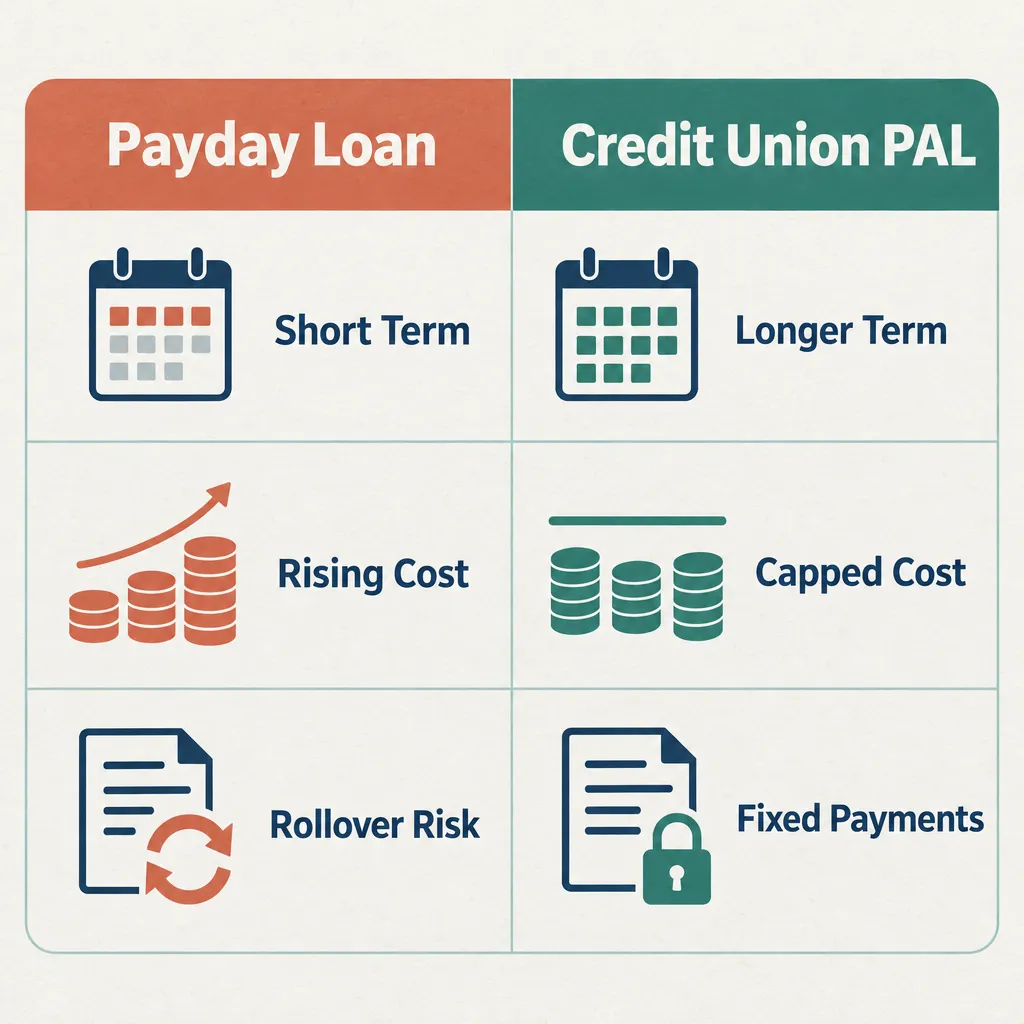
Payday fees usually run $10 to $30 per $100 borrowed, depending on state law. The CFPB says $15 per $100 is common. The fee looks small as a percentage, but the term is so short that the APR becomes very large once it is annualized.
Here is a $400 loan at that common fee, compared with a credit union payday alternative loan (PAL).
| Scenario | Amount | Fee or APR | Term | Total repaid |
|---|---|---|---|---|
| Payday loan, repaid on time | $400 | $60 fee (about 391% APR) | 14 days | $460 |
| Payday loan, rolled over 4 times | $400 | $60 per 2 weeks | 10 weeks | $700 ($300 in fees) |
| Credit union PAL | $400 | 28% APR, plus up to $20 application fee | 3 months | About $439 |
The APR math in plain words: $60 divided by $400 is 15% for 14 days. A year has about 26 two-week periods (365 ÷ 14 = 26.07). Multiply 15% by 26.07 and you get about 391%. That is the figure the Truth in Lending Act and Regulation Z (12 CFR 1026) require the lender to disclose in writing before you sign. If a lender tells you the loan “only costs 15%,” the CFPB tells borrowers to look at the APR on the disclosure. That number is what lets you compare it with a credit card or a PAL.
The PAL math: $400 at 28% APR repaid in three monthly payments of about $139.62 costs about $18.86 in interest. Add the maximum $20 application fee and the total is about $439, or $21 less than a single on-time payday loan and $261 less than the rollover scenario.
Why rollovers matter more than the first fee
The first $60 is not where most of the cost comes from. In its 2014 data point on storefront payday lending, the CFPB found that more than four out of five payday loans were rolled over or followed by another loan within 14 days. Only about 15% of borrowers repaid all their payday-loan debt when due without reborrowing within 14 days. The same research found that three out of five payday loans went to borrowers whose fees ended up exceeding the amount they first borrowed.
Before you borrow
The real risk is the cycle. If $460 in two weeks would leave you short on rent or groceries, you’ll probably need another loan, and each renewal adds the full fee again without paying down any of the principal.
Cheaper options to try first
Before you take a payday loan, try the options below in roughly this order. They cost less, and several work even with bad credit.
Cheaper options first
Ask your utility, landlord or hospital for a payment plan before borrowing.
Check a credit union for a payday alternative loan capped at 28% APR.
Call 211 for local emergency aid with rent, utilities and food.
Payday alternative loans from federal credit unions
Federal credit unions can offer two kinds of payday alternative loan under rules from the National Credit Union Administration (NCUA):
| Feature | PAL I | PAL II |
|---|---|---|
| Loan amount | $200 to $1,000 | Up to $2,000 |
| Term | 1 to 6 months | 1 to 12 months |
| Maximum APR | 28% | 28% |
| Application fee | Up to $20 | Up to $20 |
| Membership wait | At least 1 month | None, can apply on joining |
A credit union can offer you only one type of PAL at a time. These loans are repaid in installments, which avoids the single lump-sum payment that drives payday rollovers. Credit unions set their own approval criteria, so getting a PAL isn’t automatic. Many weigh your income and membership more than your score.
Hardship plans and payment arrangements
If a specific bill is the problem, call that creditor first. Utilities, hospitals, landlords and auto lenders often agree to payment plans or short deferrals, and that costs far less than a 391% loan. Nonprofit hospitals must have written financial assistance policies under federal tax rules, so ask for the application before paying a medical bill with a loan.
Employer advances and no-fee app advances
Some employers offer paycheck advances at no cost through payroll. Cash advance apps vary widely. Some charge subscription fees, “optional” tips or fees for instant transfers, and those turn into a high effective APR on a small, short advance. Read the app’s own fee schedule and do the same APR math as above before you count it as cheap.
Nonprofit credit counseling
If you’re behind on several debts, a nonprofit credit counseling agency (many belong to the National Foundation for Credit Counseling) can review your budget and may set up a debt management plan. Avoid any “debt relief” company that charges fees before it has settled or changed any of your debts.
Where payday loans are legal
Payday lending is a state-licensed business, and the rules differ a lot. The Consumer Federation of America counts 21 states plus the District of Columbia that prohibit high-cost, short-term payday loans, either by banning them outright or by capping rates low enough (often 36% APR) that storefront payday lending is effectively gone. That group includes New York, New Jersey, Pennsylvania, Massachusetts, Maryland, Georgia, Arkansas, Vermont, West Virginia and DC.
Several states moved to 36% caps more recently:
| State | Change | Year |
|---|---|---|
| Nebraska | 36% cap approved by voters in a ballot initiative | 2020 |
| Illinois | 36% cap under the Predatory Loan Prevention Act | 2021 |
| New Mexico | 36% cap on small loans | 2023 |
| Minnesota | 36% cap took effect | 2024 |
In states where payday loans are legal, laws commonly limit the loan size, the fee per $100, the number of rollovers, and how many loans you can have at once. Some require a cooling-off period between loans or an extended payment plan if you can’t repay. An online lender doesn’t escape your state’s law just by operating over the internet. Lenders that claim tribal or out-of-state status have been challenged by state regulators. If a lender won’t say which state licenses it, don’t borrow from it.
Servicemembers: the 36% Military Lending Act cap
If you’re on active duty or a covered dependent, the Military Lending Act caps the Military Annual Percentage Rate (MAPR) at 36% on payday loans, vehicle title loans, deposit advances and most installment loans. The MAPR counts fees and add-on products as well as interest. The CFPB also says lenders can’t roll over a payday loan for a servicemember unless the new terms are more favorable to the borrower. Military aid societies such as Army Emergency Relief, Navy-Marine Corps Relief Society and Air Force Aid Society offer interest-free emergency loans and grants.
How to check a payday lender before you borrow
A license matters more than anything a lender says about itself. Licensed lenders must follow your state’s fee caps and complaint process, and unlicensed ones often don’t.
How to check a lender
- Find your state’s financial regulator (often a Department of Financial Institutions, Banking or Business Oversight) and search its license lookup for the lender’s legal name.
- Search NMLS Consumer Access, which many states use to license consumer lenders.
- Read the Truth in Lending disclosure before signing and confirm the APR, finance charge, due date and total of payments.
- Search the CFPB’s consumer complaint database and your state attorney general’s actions for the company name.
- Walk away if anyone asks for an upfront fee, a gift card, a wire transfer or crypto before you get the loan.
What makes one lender better than another for bad credit
We don’t rank individual payday lenders. With bad credit, the meaningful differences between lenders are (in order of weight): a valid license in your state, the total cost in dollars and APR, whether repayment is in installments or a single lump sum, whether the lender offers an extended payment plan, and its complaint record. A lender that scores well on all five is still a 300%+ product in most states. That’s why a credit union PAL or a payment plan comes first.
Your rights as a payday borrower
Federal law gives you specific protections, even in states that allow payday lending.
The CFPB’s payment protections
Under the CFPB’s payday lending rule (12 CFR 1041), whose payment provisions took effect on March 30, 2025, a covered lender that has failed twice in a row to withdraw a payment from your account can’t try again without your new, specific authorization. The rule also requires written notice before the first withdrawal attempt and before unusual withdrawals. The rule’s original underwriting requirement, which would have forced lenders to check whether you could afford the loan, was rescinded in 2020. The CFPB said in 2025 that it would not prioritize enforcing the payment provisions. Its 2026 regulatory agenda lists a plan to reconsider them. Until a change is finalized, the provisions remain in the regulation, and state regulators can still enforce them.
Stopping automatic withdrawals
The Electronic Fund Transfer Act and Regulation E let you stop preauthorized electronic payments from your account. Notify your bank at least three business days before the scheduled transfer, and tell the lender in writing that you’re revoking authorization. A lender also can’t require you to repay by automatic transfers as a condition of getting credit. Stopping a payment doesn’t cancel the debt, so use that time to set up a plan you can actually afford.
Debt collection and credit reporting
If an unpaid payday loan goes to a third-party collector, the Fair Debt Collection Practices Act bars harassment, false threats of arrest or jail, and misrepresenting what you owe. The Fair Credit Reporting Act lets you dispute inaccurate entries with the national bureaus and with specialty agencies such as Clarity Services. The Equal Credit Opportunity Act bars lenders from discriminating based on race, sex, marital status, age or receipt of public assistance income.
Keep a paper trail
Save the loan agreement, every disclosure, and dated copies of any letter revoking payment authorization. Complaints to regulators move faster when you can show the documents.
Where to complain
If a lender charges more than your state allows, makes debits you didn’t authorize, or lets a collector threaten you, file complaints in more than one place:
- CFPB: the consumer complaint portal at consumerfinance.gov forwards your complaint to the company and tracks the response.
- Your state financial regulator and attorney general: they license payday lenders and enforce state fee caps.
- FTC: report advance-fee loan scams and fake lenders at ReportFraud.ftc.gov.
- FBI IC3: report online fraud that involved wire transfers, payment apps or crypto.
The next step if you’re short on cash this week
If you have a bill due before your next paycheck, start by calling the company you owe and asking for a payment arrangement. Then call a local credit union about a PAL, or 211 for emergency aid. Keep a payday loan as the last option. If you do take one, borrow only what you can repay in full on the due date, without a rollover.
FAQ
Do payday lenders check your credit?
Most don’t do a hard pull at Equifax, Experian or TransUnion. They usually verify your income and bank account and check specialty databases such as Clarity Services or FactorTrust. Those checks can flag unpaid payday loans or bounced payments, even when your FICO score never comes up.
Is there such a thing as guaranteed approval for a payday loan?
No. Licensed lenders review every application, and some get turned down. The FTC warns that “loans” which guarantee approval but ask for an upfront fee are a common scam aimed at people with bad credit.
Will a payday loan improve my credit score?
Rarely. Payday lenders typically don’t report on-time payments to the three national bureaus, so paying on time does little for your score. An unpaid loan sold to a collector can show up on your report and lower it.
What APR does a payday loan really have?
At the common fee of $15 per $100 on a two-week loan, the APR is about 391%. Fees range from about $10 to $30 per $100 depending on state law, so APRs vary. The Truth in Lending Act requires the lender to show the exact APR in writing before you sign.
Can I get a payday loan if I’m on benefits or unemployed?
Some lenders count regular benefit income such as Social Security or disability payments as income. Many require a job or recurring deposits. If your income is irregular, a payday loan is especially risky because the full balance is due in one payment. Ask a credit union, 211 or your state’s benefits office about assistance first.
Are online payday loans legal in my state?
Only if the lender is licensed where you live and your state allows payday lending. About 21 states plus DC ban payday loans or cap rates low enough to end them. Check your state regulator’s license lookup or NMLS Consumer Access before sharing your bank details with any online lender.
What happens if I can’t repay a payday loan?
The lender may try to debit your account, which can trigger bank overdraft or returned-payment fees. Ask whether your state requires the lender to offer an extended payment plan. Under the CFPB’s rule, after two failed withdrawal attempts in a row the lender needs your new authorization to try again. You can also stop the payments through your bank under Regulation E. A nonprofit credit counselor can help if you owe several lenders.
Can a payday lender have me arrested?
No. Failing to repay a payday loan is a civil debt matter, not a crime. The Fair Debt Collection Practices Act bars collectors from falsely threatening arrest or jail. Report any such threat to the CFPB and your state attorney general.
Laws and regulations referenced
- Truth in Lending Act, 15 U.S.C. 1601
- Regulation Z, 12 CFR Part 1026
- Fair Debt Collection Practices Act, 15 U.S.C. 1692
- Fair Credit Reporting Act, 15 U.S.C. 1681
- Equal Credit Opportunity Act, 15 U.S.C. 1691
- Electronic Fund Transfer Act, 15 U.S.C. 1693
- Regulation E (electronic transfers), 12 CFR Part 1005
- Military Lending Act, 10 U.S.C. 987
- CFPB payday lending rule, 12 CFR Part 1041
Links go to the official text on government sites.
Check, verify or complain

Dana writes US Financer's guides to payday loans, personal and installment loans, bad credit borrowing and cash advance apps. Every piece starts from what a loan really costs, works the numbers in a table, and checks what the lender's own disclosure and your state's rules…
Ruth is US Financer's standards editor. Every article goes through her checks before and after it is published: each rate, fee, cap, deadline and rule is matched against its primary source, every law named is linked to its official text, and anything that cannot be…
What changed
- Nov 13, 2026 First published.
Comments are closed