

We do not lend money or arrange loans. Rates and rules change and differ by state, so check the lender's own disclosure before you sign.
No legitimate payday lender approves you without checking anything. What a “no credit check” lender usually skips is a hard pull from Equifax, Experian or TransUnion. It still looks at your bank account, your income and specialty databases, and it charges a fee that the Consumer Financial Protection Bureau says equals an APR of almost 400% on a typical two-week loan. This guide explains what really gets checked, what the loan costs, where it is banned or capped, and which cheaper options to look at first.
Run the numbers
Key takeaways
- “No credit check” usually means no hard inquiry at the three big bureaus. Lenders still check specialty databases, bank data and income.
- No lawful lender can guarantee approval. A demand for an upfront fee before you get the money is a classic scam sign.
- A $400 loan at $15 per $100 for 14 days costs $60, which works out to about 391% APR.
- Twenty-one states plus the District of Columbia ban payday loans or cap them at 36% APR or less, so where you live changes what is legal.
- Credit union payday alternative loans (PALs) are capped at 28% APR. Look at them, and at fee-free advances, before any payday loan.
Do no credit check payday loans really exist?
Only in a narrow sense. Many payday lenders skip the hard inquiry at Equifax, Experian and TransUnion that a bank or card issuer would run. They still check other things before they lend, and the price makes up for the risk they take on.
The CFPB describes a payday loan as a short-term, high-cost loan, generally for $500 or less, that is usually due on your next payday. Lenders who advertise “no credit check” are making a claim about one kind of inquiry. They are not saying they check nothing, and they cannot promise you a yes.
What lenders check instead
Most payday and short-term lenders rely on four kinds of information:
- Specialty consumer reporting companies. The CFPB keeps a list of consumer reporting companies with a separate category for firms that serve short-term and subprime lenders. Clarity Services and FactorTrust have both appeared in that category. These files record past payday loans, bounced payments and unpaid balances. They are covered by the Fair Credit Reporting Act, so a lender needs a permissible purpose to pull them, and you can dispute errors in them just as you can at the big three.
- Your bank account. Most lenders want an active checking account and often permission to view your transaction history. They look at deposits, overdrafts and other loan payments.
- Income and employment. Pay stubs, benefit statements or direct-deposit records show whether you have money coming in by the due date.
- Identity and fraud screens. Your name, address, Social Security number and device data are matched against fraud databases.
A soft inquiry or a specialty-bureau check does not lower your FICO or VantageScore score the way a hard inquiry can. Skipping the hard pull does not make the loan safer or cheaper, though. It only means the lender is judging risk from data you may never have seen.
What “guaranteed approval” really means
“Guaranteed approval” is a marketing line, not a legal promise. A licensed lender has to verify your identity and decide whether to lend, and it can turn you down. If a lender says no because of something in a consumer report, the Fair Credit Reporting Act and the Equal Credit Opportunity Act require it to give you an adverse action notice, and you are entitled to a free copy of the report it used.
The Federal Trade Commission warns that it is illegal for companies doing business by phone in the US to promise you a loan and ask you to pay before they deliver it. If a “lender” guarantees approval and then asks for a processing fee, insurance fee or “first payment” by gift card, wire transfer or cryptocurrency, you are dealing with an advance-fee loan scam. Real lenders disclose their fees in writing and usually take them out of the loan or add them to what you repay.
Did you know?
According to the CFPB, almost 70% of payday loan borrowers take out a second payday loan within a month. Repeat borrowing, not the first loan, is where most of the cost builds up.
What a no credit check payday loan costs
A typical payday loan charges a flat fee per $100 borrowed. The CFPB uses $15 per $100 for two weeks as its standard example, which it says works out to an APR of almost 400%. The fee looks small because the term is so short. The APR shows what that price would be over a full year.
| Scenario | Amount | Fee or APR | Term | Total repaid |
|---|---|---|---|---|
| Payday loan, repaid on time | $400 | $60 fee ($15 per $100), about 391% APR | 14 days | $460 |
| Same loan, rolled over 3 times | $400 | $60 fee every two weeks, about 391% APR | 8 weeks | $640 ($240 in fees) |
| Federal credit union PAL I | $400 | 28% APR, plus up to $20 application fee | 3 monthly payments of about $139.62 | about $418.85, plus up to $20 |
Payday figures use the CFPB’s $15 per $100 example. State law sets the actual maximum fee, and some states ban these loans outright. PAL figures assume the full 28% APR cap allowed under NCUA rules. Your credit union may charge less.
The APR math in plain words
The $60 fee on $400 is 15% of the loan. You pay that 15% for 14 days of borrowing. A year has about 26 two-week periods (365 ÷ 14 = 26.07), so 15% × 26.07 comes to roughly 391% a year. That is the annual percentage rate the Truth in Lending Act and Regulation Z (12 CFR 1026) require the lender to print on your disclosure before you sign. The CFPB puts typical credit card APRs at about 12% to 30% for comparison.
What a rollover does
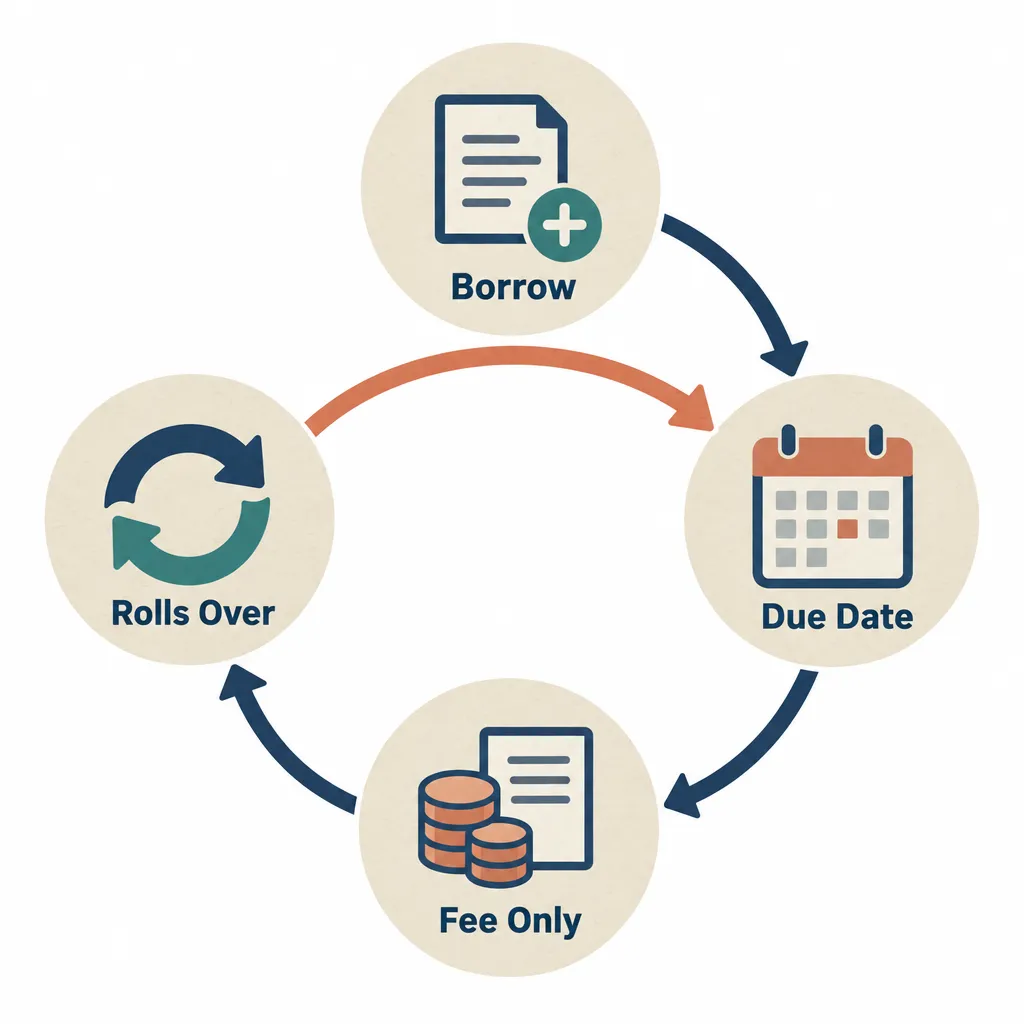
A rollover, or renewal, lets you pay only the fee and push the due date back two weeks. The CFPB notes that you are then charged another fee and still owe the full original balance. In the table above, the borrower who rolls over three times has paid $240 in fees over eight weeks and still owes the whole $400. Many states limit rollovers or require a payment plan, but where they are allowed, this is how a $400 problem grows into a $640 one.
Before you borrow
The real danger is the repeat loan. If paying back the full balance on your next payday would leave you short on rent or groceries, a payday loan is likely to turn into a string of fees rather than a one-time fix.
Cheaper options to try first
Most borrowers have at least one option that costs far less than a payday loan. The best choice depends on how fast you need the money and whether you belong to a credit union or work for an employer that offers wage advances.
Cheaper options first
Ask a federal credit union about a payday alternative loan, capped at 28% APR.
Check whether your employer offers earned wage access with no fee.
Call the company you owe and ask for a hardship plan or a due-date change before you borrow.
| Option | Typical cost | Speed | Main catch |
|---|---|---|---|
| Credit union PAL I | Up to 28% APR plus up to $20 fee | Often same day to a few days | You must be a member for at least one month |
| Credit union PAL II | Up to 28% APR plus up to $20 fee | Often same day to a few days | Only at credit unions that offer it |
| Employer earned wage access | Often free, sometimes a transfer fee | Minutes to one business day | Reduces your next paycheck |
| Cash advance app | Free standard transfer, optional fees and tips | Minutes (paid) to a few days (free) | Small amounts, fees can add up |
| Hardship plan with a creditor | Often no added cost | One phone call | Not every creditor agrees |
| Nonprofit credit counseling | Free or low-cost session | Days | Does not put cash in hand right away |
| Payday loan | About $15 per $100, about 400% APR | Same day | Rollovers and repeat borrowing |
Credit union payday alternative loans
The National Credit Union Administration lets federal credit unions offer two kinds of payday alternative loans:
- PAL I: $200 to $1,000, repaid over 1 to 6 months, for members of at least one month.
- PAL II: up to $2,000, repaid over 1 to 12 months, available as soon as you join.
Both are capped at 28% APR, and the application fee cannot be more than $20. NCUA rules also limit you to one PAL at a time and three in any six-month period, which is designed to stop the repeat-borrowing cycle. PALs are paid back in installments, not one lump sum, which makes the payments easier to manage. The trade-off is availability: not every credit union offers PALs, and you have to join first. Many credit unions open membership to anyone who lives or works in a certain area, so it is worth calling a local one before you go to a payday store.
Employer and app advances
Earned wage access (EWA) gives you part of the pay you have already earned before payday. In December 2025 the CFPB issued an advisory opinion concluding that “covered” EWA products are not credit under the Truth in Lending Act. These are typically employer-integrated programs that only advance wages already earned and charge no finance charges. That opinion withdrew a 2024 proposal that would have treated many of these products as loans. States can still regulate EWA under their own laws, and several do.
Cash advance apps that work directly with you, rather than through your employer, often offer a free standard transfer and charge for instant delivery or ask for a tip. Those small fees have a real APR. As an illustration, a $5 instant fee on a $100 advance repaid in seven days is 5% for one week, which annualizes to about 260%. Use the free transfer option when you can wait a day or two.
Hardship plans, bills and nonprofit help
If the money is for a bill, call that company before you borrow. Utilities, phone carriers, medical providers and landlords often agree to payment plans or short extensions. Nonprofit credit counseling agencies, many of them members of the National Foundation for Credit Counseling, can review your budget and set up a debt management plan. Local help also exists: 211 connects you with emergency rent, utility and food assistance, and the federal Low Income Home Energy Assistance Program (LIHEAP) helps with heating and cooling bills through state agencies.
Where payday loans are banned or capped
Payday lending is a state-by-state product. According to the Center for Responsible Lending, 21 states plus the District of Columbia prohibit payday lending or impose an interest-rate cap of 36% or less. In those places, storefront payday lending has largely disappeared.
States generally fall into three groups:
- Banned or capped at 36% or less: New York, New Jersey, Pennsylvania, Georgia, Arkansas and Massachusetts have long blocked typical payday loans through usury or small-loan laws. More recently, voters or legislatures in Colorado, Montana, South Dakota, Nebraska, Illinois, New Mexico and Minnesota adopted caps of 36% APR. Rhode Island passed a cap in 2025 that takes effect on January 1, 2027. Until then, payday loans there remain legal, at a typical rate the Center for Responsible Lending puts at 261% APR.
- Allowed with limits: Many states allow payday loans but cap the size and fee. California, for example, limits a deferred deposit transaction to a $300 check with a fee of up to 15%, so you receive $255.
- Allowed with few limits: Some states set looser limits, and triple-digit APRs are legal in many of them.
Two things trip up borrowers. First, an online lender has to follow the law of the state where you live, but some try to get around state caps through partnerships with out-of-state banks or by claiming tribal sovereign immunity. Second, a loan made in breach of your state’s licensing or rate rules may be void or uncollectable there. If an online lender is not licensed in your state, ask your state financial regulator before you pay anything more.
Your rights as a borrower
Federal law gives every payday borrower some protections, whatever their credit score. Here are the main ones:
- Truth in Lending Act and Regulation Z: the lender must disclose the finance charge and the APR in writing before you sign.
- Electronic Fund Transfer Act and Regulation E: a lender generally cannot require you to repay by automatic electronic withdrawals as a condition of the loan. You can revoke an authorization you gave and ask your bank to stop future debits.
- CFPB Payday Lending Rule (12 CFR 1041): the payment provisions say that after two failed attempts in a row to withdraw money from your account, a lender needs your new authorization before trying again, and it must send certain payment notices. Compliance became mandatory on March 30, 2025. The CFPB has said it will not prioritize enforcement of these provisions, and its 2026 regulatory agenda lists a plan to reconsider them. As of November 2026 the rule text has not been changed, and state attorneys general can still enforce it. The rule’s original ability-to-repay underwriting requirements were rescinded in 2020.
- Military Lending Act: active-duty servicemembers and their dependents cannot be charged more than a 36% military annual percentage rate (MAPR), which counts most fees, on covered loans including payday loans.
- Fair Credit Reporting Act: you can dispute inaccurate information with any consumer reporting company, including the specialty bureaus payday lenders use.
- Fair Debt Collection Practices Act: third-party debt collectors cannot harass you, lie about what you owe, or threaten arrest or criminal charges over an unpaid payday loan.
Protect your checking account
If a lender keeps trying to withdraw money you do not have, put your revocation in writing to both the lender and your bank. Each failed attempt can trigger a bank fee on top of the lender’s charges.
How to check a lender before you borrow
A license and a written fee disclosure matter far more than any “no credit check” promise. These checks take a few minutes.
How to check a lender
- Find the lender’s legal name and license number on its disclosures, not just its brand name.
- Search for it on NMLS Consumer Access, which many states use to license consumer lenders.
- Confirm the license on your state financial regulator’s own lookup, since not every state uses NMLS.
- Read the CFPB’s consumer complaint database for patterns such as surprise withdrawals or collection threats.
- Get the Truth in Lending disclosure with the APR and total repayment before you sign.
- Walk away if anyone asks for an upfront fee, gift cards, a wire transfer or crypto.
Red flags that show up again and again in FTC and state regulator warnings:
- Approval “guaranteed” before you have shared any financial details.
- Pressure to decide within minutes.
- No physical address or state license on the website.
- Requests for your online banking password, not just account and routing numbers.
- Unsolicited calls, texts or emails offering a loan.
Where to complain
You can file in more than one place. Each office handles a different part of the problem:
- CFPB complaint portal: for licensed lenders and collectors. The company is expected to respond, and complaints feed the public database.
- Your state financial regulator or attorney general: for licensing problems, illegal rates and unlicensed online lenders.
- FTC ReportFraud: for scams and deceptive ads, online or by phone at 877-382-4357.
- FBI Internet Crime Complaint Center (IC3): for online fraud, especially if you paid an advance fee or gave out bank login details.
- Your bank: to stop unauthorized withdrawals and dispute them under the Electronic Fund Transfer Act.
Who a payday loan can make sense for
There is an honest case for a payday loan, but it is narrow. It fits someone who faces a one-time, documented expense, has a fixed paycheck arriving within two weeks that covers the full balance plus the fee, has no access to a credit union PAL or an employer advance, and lives in a state where the loan is licensed and the fee is capped. For that borrower, a $60 fee can cost less than a string of overdraft fees or a late rent penalty.
That case falls apart if any one of those conditions is missing. If the next paycheck is already committed, the loan will probably be rolled over. And despite what lenders sometimes suggest, most payday lenders do not report on-time payments to the three major bureaus, so paying one off rarely builds your credit. A default, though, can still reach your credit file through a collection account.
FAQ
Will a no credit check payday loan affect my credit score?
The application usually does not, because there is no hard inquiry at Equifax, Experian or TransUnion. Paying on time usually does not help either, since most payday lenders do not report to those bureaus. Missing payments can hurt you: an unpaid loan sold to a collector can show up as a collection account, and specialty bureaus will record the default for future short-term lenders.
Can I get a payday loan with no bank account?
Some storefront lenders in states that allow payday lending accept a prepaid card or will lend against a paycheck, but most online lenders require a checking account. Lenders that skip the bank account often charge more or want a car title as collateral, which puts your vehicle at risk.
Is there a payday loan with guaranteed approval?
No. Every legitimate lender can turn you down. Treat any promise of guaranteed approval as marketing at best and an advance-fee scam at worst, especially if a fee is due before you get the money.
How much can I borrow?
The CFPB describes payday loans as generally $500 or less, and state law sets the actual maximum. California, for example, caps the check at $300. Ads offering up to $5,000 with no credit check usually describe high-cost installment loans or lead-generation forms that pass your data along to other lenders, not single-payment payday loans.
Are payday loans legal in my state?
It depends. Twenty-one states plus the District of Columbia ban them or cap rates at 36% APR or less, according to the Center for Responsible Lending, and Rhode Island’s cap starts January 1, 2027. Your state financial regulator’s website lists which small-dollar lenders are licensed where you live.
I’m in the military. Do different rules apply?
Yes. The Military Lending Act caps covered loans to active-duty servicemembers and their dependents at a 36% MAPR, which counts most fees. Each branch’s relief society, such as Army Emergency Relief or the Navy-Marine Corps Relief Society, also offers interest-free emergency loans or grants.
What should I do first if I’m short on money this week?
Write down the exact amount you need and the date it is due. Then call the company you owe about a payment plan, ask your credit union about a PAL, and check whether your employer offers a free wage advance. Many borrowers find that one of those three steps closes the gap for far less than $15 per $100.
Laws and regulations referenced
- Truth in Lending Act, 15 U.S.C. 1601
- Regulation Z, 12 CFR Part 1026
- Fair Debt Collection Practices Act, 15 U.S.C. 1692
- Fair Credit Reporting Act, 15 U.S.C. 1681
- Equal Credit Opportunity Act, 15 U.S.C. 1691
- Electronic Fund Transfer Act, 15 U.S.C. 1693
- Regulation E (electronic transfers), 12 CFR Part 1005
- Military Lending Act, 10 U.S.C. 987
- CFPB payday lending rule, 12 CFR Part 1041
Links go to the official text on government sites.
Check, verify or complain

Dana writes US Financer's guides to payday loans, personal and installment loans, bad credit borrowing and cash advance apps. Every piece starts from what a loan really costs, works the numbers in a table, and checks what the lender's own disclosure and your state's rules…
Ruth is US Financer's standards editor. Every article goes through her checks before and after it is published: each rate, fee, cap, deadline and rule is matched against its primary source, every law named is linked to its official text, and anything that cannot be…
What changed
- Nov 13, 2026 First published.
Comments are closed