
Runs in your browser. Nothing you type is sent or saved.
The loan calculator above tells you three things before you sign anything: the monthly payment, the total interest you will pay over the life of the loan, and how much faster the balance disappears if you add a little extra each month. You only need three numbers from the lender’s offer or your current statement: the loan amount, the APR and the term. If you are considering a loan you have not applied for yet, an honest guess at the APR is enough to see whether the payment fits your budget.
How to use the calculator
- Enter the Loan amount ($). Use the amount you will actually receive, or the current balance from your statement if you are checking an existing loan.
- Enter the Interest rate (APR) (%). Take it from the Truth in Lending disclosure on the offer, or from the “annual percentage rate” line on your statement. Do not use a monthly rate.
- Enter the Loan term and choose Years or Months in the Term in field. A 36-month loan is 3 with Years selected, or 36 with Months selected.
- Leave Extra payment each month (optional) ($) at 0 for the first run so you see the lender’s baseline numbers.
- Read the monthly payment, total interest and total of all payments. Compare the payment to what is left after rent, utilities and food on your pay stub, not to your gross pay.
- Run it again with an extra payment, a shorter term or a lower APR to see which change saves the most.
What each field means and the mistakes that throw the result off
Every loan payment calculator depends on getting four inputs right. Here is what each one does and where people go wrong.
Loan amount ($)
This is the principal: the money you borrow and must repay. The default is $10,000. Enter the amount financed, which is often less than the amount you asked for once an origination fee comes off the top. Under Regulation Z (12 CFR 1026.18), the lender must show you “amount financed” and “finance charge” separately, so use those figures rather than the headline number in an ad.
Common mistake: entering the price of the thing you are buying instead of the loan. If a used car costs $22,000 and you put $4,000 down, the loan amount is $18,000. The same goes for a boat loan calculator or pool loan calculator run: subtract the deposit first.
Interest rate (APR) (%)
The default is 12. Enter the annual percentage rate as a whole number, so 12 for 12%, not 0.12 and not 1 (the monthly rate). The calculator divides by 12 and by 100 on its own.
Two mistakes are common here. The first is using the “interest rate” from a mortgage-style quote when the APR is higher because of fees; the APR is the number that captures the real cost. The second is typing a fee-based price as if it were an APR. A payday loan that charges $15 per $100 for two weeks is not a 15% loan. Annualized, that fee works out to about 391% APR, and that is the number the Truth in Lending Act requires the lender to disclose.
Loan term
The default is 3 with Years selected. Pick Months in the Term in field if your offer is quoted in months, which is normal for auto, personal and installment loans. Entering 36 while Years is still selected models a 36-year loan and produces a tiny, meaningless payment, so check that toggle before you trust any result.
Extra payment each month (optional) ($)
This turns the tool into an early loan payoff calculator. Enter a fixed dollar amount you will add to every monthly payment. The calculator pays the balance down month by month with payment plus extra until it hits zero, then reports the interest saved. It assumes the lender applies the extra to principal, which is not automatic everywhere. More on that below.
The loan calculator formula, worked through twice
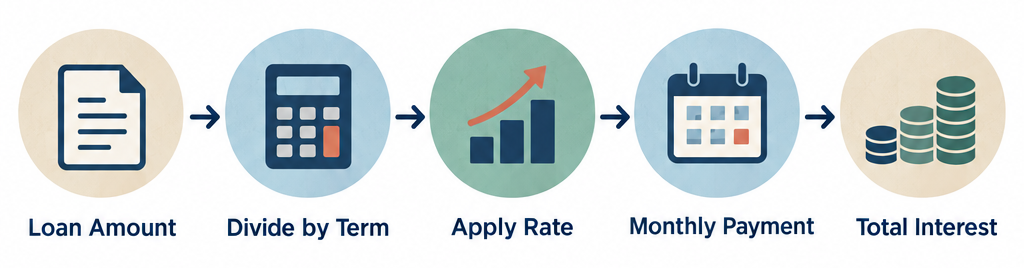
The tool uses the standard amortization formula for a fixed-rate loan with equal monthly payments, the same math behind every EMI calculator and most finance calculators:
Monthly payment = P × r ÷ (1 − (1 + r)^−n)
P is the loan amount, r is the APR divided by 12 and then by 100, and n is the number of monthly payments (years × 12). At 0% APR the formula breaks down because r is zero, so the calculator simply divides P by n.
Once the payment is known:
- Total interest = payment × n − P
- First payment interest = P × r, and the rest of that payment goes to principal
- Each later month, interest is charged on the smaller remaining balance, so the principal share grows
Worked example 1: the default inputs
Loan amount $10,000, APR 12%, term 3 years, no extra payment.
- Monthly rate: 12 ÷ 12 ÷ 100 = 0.01
- Number of payments: 3 × 12 = 36
- (1 + 0.01)^−36 = 1 ÷ 1.01^36 = 1 ÷ 1.43077 = 0.69892
- 1 − 0.69892 = 0.30108
- P × r = $10,000 × 0.01 = $100
- Payment = $100 ÷ 0.30108 = $332.14
Total of all payments: $332.14 × 36 = $11,957.04. Total interest: $11,957.04 − $10,000 = $1,957.04.
In the first month, interest is $10,000 × 0.01 = $100.00, so $232.14 of that first $332.14 goes to principal. By the final month almost the whole payment is principal, which is why paying extra early saves more than paying extra late.
Worked example 2: a $25,000 auto loan at 7.5% for 5 years
- Monthly rate: 7.5 ÷ 12 ÷ 100 = 0.00625
- Number of payments: 5 × 12 = 60
- 1.00625^60 = 1.45329, so (1 + r)^−n = 1 ÷ 1.45329 = 0.68809
- 1 − 0.68809 = 0.31191
- P × r = $25,000 × 0.00625 = $156.25
- Payment = $156.25 ÷ 0.31191 = $500.95
Total of all payments: $500.95 × 60 = about $30,057. Total interest: about $5,057. First-month interest: $156.25, with $344.70 going to principal.
Notice the pattern. The APR is lower than example 1, but the loan is bigger and runs two years longer, so the total interest is more than two and a half times as much. The payment looks manageable; the cost is in the term.
How the extra payment math works
Take the default loan and add $50 a month. The calculator applies $382.14 against the balance each month. After 30 full payments the balance is about $186, which clears in month 31 with a payment of roughly $188. Total interest falls to about $1,652, so the extra $50 saves about $305 and ends the loan five months early. The calculator’s “interest saved” line is simply the original total interest minus the interest paid under the faster schedule.
Quick reference: what rate and term do to a $10,000 loan
These tables were computed with the same formula the calculator uses. Fixed rate, equal monthly payments, no fees.
Same loan, different APR (36-month term)
| APR | Monthly payment | Total interest | Total repaid |
|---|---|---|---|
| 0% | $277.78 | $0 | $10,000.00 |
| 6% | $304.22 | $951.90 | $10,951.90 |
| 12% | $332.14 | $1,957.15 | $11,957.15 |
| 18% | $361.52 | $3,014.86 | $13,014.86 |
| 24% | $392.33 | $4,123.82 | $14,123.82 |
| 36% | $458.04 | $6,489.38 | $16,489.38 |
Same loan, different term (12% APR)
| Term | Monthly payment | Total interest | Total repaid |
|---|---|---|---|
| 1 year | $888.49 | $661.85 | $10,661.85 |
| 2 years | $470.73 | $1,297.64 | $11,297.64 |
| 3 years | $332.14 | $1,957.15 | $11,957.15 |
| 5 years | $222.44 | $3,346.67 | $13,346.67 |
| 7 years | $176.53 | $4,828.27 | $14,828.27 |
Stretching from 3 to 7 years cuts the payment by $155 a month and raises the interest bill by about $2,870. That trade is the whole game with installment loans, and it is why a lender’s sales pitch always leads with the payment.
Long-term secured loans: a $40,000 sailboat or pool loan at 9%
Boat, RV and pool financing often runs 10 to 20 years, which makes the term effect dramatic.
| Term | Monthly payment | Total interest | Total repaid |
|---|---|---|---|
| 10 years | $506.70 | $20,804 | $60,804 |
| 15 years | $405.71 | $33,028 | $73,028 |
| 20 years | $359.89 | $46,374 | $86,374 |
The 20-year payment is $147 lower than the 10-year payment. In exchange you pay $25,570 more in interest, which is well over half the price of the boat. A boat loan calculator should always be run at the shortest term you can afford, then compared against the dealer’s suggested term.
How to read the result and what to compare it against
A number on its own means little. Here is how to judge what the loan calculator shows you.
Is the APR high or low?
Use these benchmarks, which come from how US law and regulators already draw lines:
- Up to 18%: the ceiling federal credit unions can normally charge under NCUA rules. Rates in this range are typical for borrowers with solid credit on personal and auto loans.
- 28%: the maximum APR on an NCUA Payday Alternative Loan (PAL), a small-dollar product federal credit unions can offer at $200 to $1,000 for one to six months, or up to $2,000 for up to 12 months under the PAL II rules.
- 36%: the cap the Military Lending Act sets for service members and the line many state rate-cap laws use. Anything above 36% is high-cost credit by the standard regulators themselves apply.
- Triple digits: payday loans, many title loans and some online installment loans. A $500 payday advance rolled over four times can cost more in fees than the amount borrowed.
What to compare, in order
- Total interest, then the payment. Two offers with the same payment can differ by thousands in total cost if one runs longer.
- APR, not interest rate. The APR folds in origination fees. If an offer quotes a rate and a fee separately, the Truth in Lending disclosure will show the combined APR; use that.
- The payment against your real cash flow. Subtract rent, utilities, groceries, insurance and existing debt payments from your take-home pay. If the new payment eats most of what is left, the loan is too big even if you are approved.
- Prepayment terms. If the contract charges a penalty for paying early, the extra-payment savings the calculator shows will be smaller.
Cheaper and safer options to check first
Cheaper options first
A credit union PAL caps APR at 28% with a $20 maximum application fee.
Employer paycheck advances and some cash advance apps charge no mandatory fee.
Nonprofit credit counselors (NFCC members) negotiate hardship plans and lower rates on existing debt.
If the loan is to cover a bill, ask the biller for a payment plan before borrowing. Utilities, hospitals and the IRS all offer installment arrangements that usually cost less than any loan the calculator will model. Borrowers under pressure often search for a payday loan or no credit check loans because approval seems certain. Run those products through the calculator at their real APR first; the total of payments column usually settles the question.
Our personal loan calculator covers the fee-heavy side of unsecured lending in more depth, including how an origination fee changes the amount financed.
Before you borrow
The lowest payment is almost never the cheapest loan. A longer term or an extra payment both change the total, so decide on total interest first and let the payment follow. Any loan you cannot repay from income you already have is a loan that will cost more than the calculator shows.
Using the calculator for refinancing, 401(k) loans and credit-score shopping
As a loan refinance calculator
Run it twice. First, enter your current balance, your current APR and the months remaining; the total interest line is what you will pay if you do nothing. Then enter the new loan’s amount (your balance plus any fees rolled in), the new APR and the new term. Compare total interest, not payments. A refinance that lowers the payment by stretching a loan with 24 months left back out to 60 months often raises your total cost even at a lower rate.
As a borrow-401(k) calculator
A 401(k) loan is amortized the same way, so the formula fits. Under Internal Revenue Code Section 72(p), the plan can lend you up to the lesser of $50,000 or half your vested balance, repaid within five years in substantially level payments, with a longer term allowed only for buying a primary residence. The interest you enter goes back into your own account, so the “total interest” line is money you keep. What the calculator cannot show is the hidden cost: the balance you borrowed stops growing in the market, and if you leave your job with a balance outstanding, the unpaid amount is treated as a distribution unless you repay or roll it over by your tax filing deadline for that year.
With a FICO loan savings calculator
FICO publishes a tool that estimates the APR a borrower in each score band is likely to be offered for auto loans and mortgages. It does not tell you the cost. Take the APR it gives for your score band and the band above, enter both here, and the difference in total interest is what improving your score is worth on that loan.
Alongside a rent affordability calculator
Rent tools such as RentCafe’s use the common 30% rule, which mirrors HUD’s definition of a housing cost burden: spending more than 30% of gross income on housing. The loan calculator does not know your rent. Add the monthly payment it produces to your rent and existing debt payments, and if the total crosses 40% to 45% of gross income, the loan will crowd out everything else.
Make extra payments count
Call the servicer and confirm that extra money is applied to principal, not held as a prepayment of next month’s installment. Ask whether a prepayment penalty applies; the Truth in Lending disclosure must state it. Then round up: the default loan paid at $350 instead of $332.14 clears about two months early.
The US rules behind the numbers
Truth in Lending Act and Regulation Z (12 CFR 1026). For closed-end consumer loans, the lender must disclose the APR, the finance charge, the amount financed and the total of payments before you are obligated. Those four figures map directly onto the calculator’s inputs and outputs. The disclosed APR must generally be accurate to within one-eighth of a percentage point. If the lender’s total of payments does not match what you compute from its own APR and term, ask why before signing.
State rate caps. The maximum APR on a small loan depends on where you live. Many states cap consumer installment and small-loan rates at or near 36%, while others allow payday or title lending at triple-digit APRs through fee structures. Texas is the clearest example of the second group: texas payday loan laws allow credit access businesses to add fees on top of the loan’s interest, so the disclosed APR can run well above what the headline rate suggests. Check your state regulator’s license lookup for the lender and the rate cap that applies to the loan type.
Military Lending Act (10 U.S.C. § 987, implemented at 32 CFR Part 232). Active-duty service members and their dependents cannot be charged more than a 36% Military Annual Percentage Rate on most consumer credit, including payday, installment and vehicle title loans. The MAPR counts fees and add-on products that an ordinary APR may leave out. If the calculator shows a loan above 36% and you are a covered borrower, the lender is likely violating the law.
IRS Notice 2014-21. The IRS treats cryptocurrency as property. Borrowing against crypto with a lender is generally not a taxable event by itself, but if the lender sells your collateral to cover a margin call, that sale is a disposal and can trigger capital gains tax. Crypto-backed loans also carry risks this calculator cannot model: the collateral can fall in value, the platform can fail, and the assets are not FDIC or SIPC insured.
What the calculator leaves out
This is an amortized loan calculator, which covers personal loans, auto loans, boat and pool financing, student loans in standard repayment, 401(k) loans and fixed-rate mortgages. It does not handle three other structures you will see:
- Deferred payment loans, where you repay one lump sum of principal plus accrued interest at maturity. The cost is simply P × (1 + r)^n for compound interest, or P × (1 + annual rate × years) for simple interest.
- Bond-style loans, where you pay interest periodically and the whole principal at maturity. Monthly cost is P × r; the balance never falls until the end.
- Balloon and interest-only loans, common in some auto leases and commercial lending. The regular payment looks small because a large balance is due at the end.
It also ignores origination fees, credit insurance, GAP coverage and late fees. Add any fee that is financed to the loan amount, and treat any fee paid up front as part of the real cost even though it does not appear in the result.
FAQ
Is this a loan repayment schedule calculator?
It produces the key schedule numbers: the fixed payment, the first month’s interest and principal split, total interest and the payoff month with extra payments. The split shifts every month, with interest shrinking as the balance falls. If you need the full month-by-month table, the first-payment figures and the formula above let you build it in a spreadsheet.
How is an EMI calculator different from this loan calculator?
It is not. “EMI” stands for equated monthly installment and uses the same formula, P × r ÷ (1 − (1 + r)^−n). The term is simply more common outside the US.
Can I use it as a loan amount calculator to work backward from a payment?
Yes, by trial. Enter the APR and term, then adjust the Loan amount ($) until the payment matches what you can afford. At 12% over 3 years, every $1,000 borrowed costs about $33.21 a month, so a $300 budget supports a loan of roughly $9,000.
Does a boat loan calculator or pool loan calculator need different math?
No. A sailboat loan or pool loan is a secured installment loan, usually at a fixed rate over 10 to 20 years. The math is identical; the difference is that long terms make total interest far larger than the monthly payment suggests, as the $40,000 table above shows.
How much does an extra payment save on a loan payoff calculator?
It depends on the APR and how much is left. On the default $10,000 loan at 12% over 3 years, an extra $50 a month saves about $305 and ends the loan five months early. The same $50 on a 20-year boat loan saves far more because the interest runs for longer.
Why is my lender’s payment higher than the calculator’s?
The usual reasons are an origination fee added to the amount financed, credit insurance or GAP coverage rolled into the loan, or a quoted “interest rate” that is lower than the APR. Compare the lender’s total of payments against the calculator using the disclosed APR; Regulation Z requires that disclosure before you commit.
Can I use it for a 401(k) loan?
Yes. Enter the amount, the plan’s interest rate and the repayment term, which under Internal Revenue Code Section 72(p) is normally five years or less. The interest shown goes back into your own account, but the lost investment growth and the risk of a taxable distribution if you leave your job are not captured.
What counts as a high APR on a personal or installment loan?
Regulators draw the line at 36%, the Military Lending Act cap and the ceiling many states use. Credit union PALs top out at 28%. Anything above 36% is high-cost credit, and triple-digit APRs on a payday advance or paycheck loan usually mean the fees will exceed the principal within a few rollovers.
Guides that use this calculator
- What is an installment loan and how does it work
- Ohio Loan Laws: Payday, Title and Installment Rules
- Florida Loan Laws: Payday, Title and Installment Rules
- Wisconsin Loan Laws: Payday, Title and Installment Rules
- Missouri Loan Laws: Payday, Title and Installment Rules
- Alabama Loan Laws: Payday, Title and Installment Rules
Comments are closed