


General information, not legal advice. Laws change, so confirm with the official statute, your state regulator or a licensed attorney before you act.
Payday lending is legal in Utah, and the state sets no cap on interest or fees. The main limit is time. Under Utah Code § 7-23-401, a lender cannot charge interest on a payday loan for more than 10 weeks from the day the loan was made. Car title loans and installment loans are also legal with no rate ceiling, so it pays to know your rights and the cheaper options before you borrow.
Run the numbers
Key takeaways
- Utah caps neither the rate nor the fee on payday, title or installment loans (Utah Code § 15-1-1).
- A payday lender can charge interest for no more than 10 weeks from the loan date, and you can cancel at no cost by 5 p.m. the next business day.
- You can ask for a no-fee extended payment plan with at least four equal payments, and a lender cannot threaten jail.
- Wage garnishment needs a court judgment and is capped at the lesser of 25% of disposable pay or the amount above $217.50 a week.
- A federal credit union payday alternative loan is capped at 28% APR.
How Utah Law Treats Interest in General
Utah lets lenders and borrowers agree on almost any interest rate. Utah Code § 15-1-1 says the parties to a lawful contract “may agree upon any rate of interest.” The 10% legal rate in that section only applies when a contract names no rate.
So Utah protects borrowers through registration, disclosure, time limits and repayment rights, not through a price cap. Many other states cap the price itself. California payday loan laws, for example, limit the fee to 15% of the check and the loan to $300. Utah has nothing like that.
Payday and Short-Term Loans in Utah
A payday loan is legal in Utah, where the law calls it a “deferred deposit loan.” The Check Cashing and Deferred Deposit Lending Registration Act, Utah Code Title 7, Chapter 23, sets the rules. Any lender making these loans to Utah residents must register with the Utah Department of Financial Institutions (DFI).
| Rule | What Utah law says | Source |
|---|---|---|
| Interest or fee cap | None | Utah Code § 15-1-1; Title 7, Ch. 23 |
| Maximum loan amount | No fixed dollar limit | Title 7, Ch. 23 |
| Maximum interest period, including extensions | 10 weeks from the date the loan is executed | Utah Code § 7-23-401 |
| Rollovers | Only if you ask for one | Utah Code § 7-23-401 |
| Cancel the loan | Return the money by 5 p.m. the next business day at no cost | Utah Code § 7-23-401 |
| Extended payment plan | At least once in 12 months, at least four equal payments, no added fees | Utah Code § 7-23-403 |
| Fee schedule | Must be posted and disclosed | Utah Code § 7-23-401 |
| Criminal threats | Lender may not threaten or use criminal process to collect | Utah Code § 7-23-401 |
| License | Registration with DFI required | Title 7, Ch. 23 |
The 10-week limit and rollovers
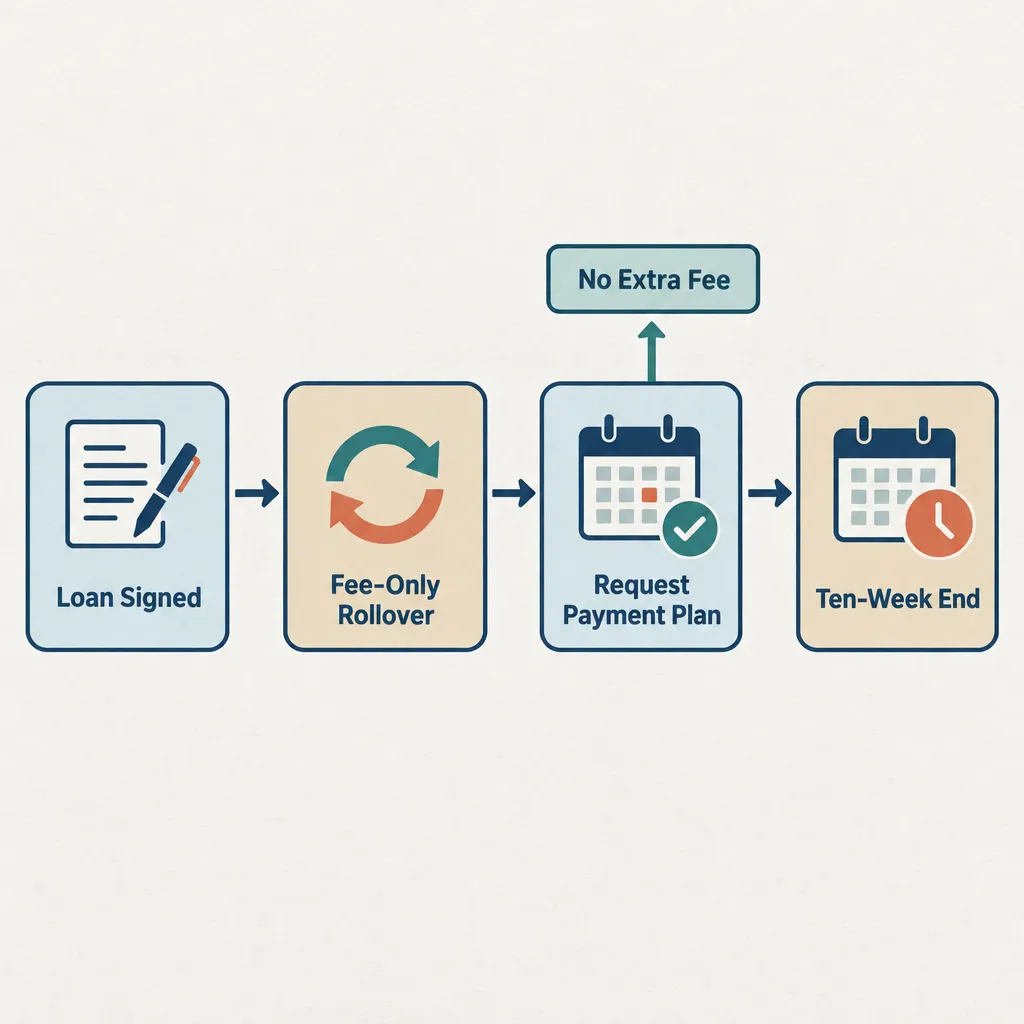
The 10-week rule matters because many borrowers “roll over” a loan by paying only the fee. In Utah, a lender can only roll over a loan if you ask for it, and it cannot keep charging interest past 10 weeks from the original loan date. After that point, the fee cycle has to stop.
The extended payment plan
The extended payment plan is the protection to use first if you cannot pay. Under Utah Code § 7-23-403, you can ask for a plan at least once in any 12-month period. It must let you repay in at least four equal payments, and the lender cannot charge you extra for it. While you keep up with the plan, the lender cannot start collection. If you default, the lender must send you a notice offering the plan before it can sue you. Ask for the plan in writing before the due date.
Changes and pending bills
The core payday rules did not change in 2025 or 2026. In the 2025 General Session, S.B. 329, “Deferred Deposit Lending Modifications,” would have given borrowers until the third business day to cancel a loan and added an ability-to-repay inquiry. The Senate amended it on March 4, 2025, but it did not pass and died on March 7, 2025. The next-business-day cancellation rule still applies as of November 2026.
The DFI has to report deferred deposit data to the Legislature each year, including the average APR. Its 34th annual report, for July 2013 to June 2014, showed an average APR of 466%.
What a Utah payday loan can cost
Utah sets no fee cap, so this example uses a common price of $25 per $100 borrowed. The numbers are only an illustration. Your lender’s disclosure shows the real cost, and the payday loan calculator lets you try other amounts.
| Scenario | Amount | Fee or APR | Term | Total repaid |
|---|---|---|---|---|
| Payday loan, repaid on time | $400 | $100 fee (about 652% APR) | 14 days | $500 |
| Same loan, rolled over every 2 weeks up to the 10-week limit | $400 | $500 in fees (5 × $100) | 10 weeks | $900 |
| Federal credit union PAL I | $400 | 28% APR plus $20 fee | 3 months | $438.80 |
The math works like this:
- The fee. $25 per $100 on $400 is 4 × $25 = $100.
- The APR. $100 ÷ $400 = 25% for 14 days. A year has 365 ÷ 14 = 26.07 two-week periods, so 25% × 26.07 = about 652% a year.
- The rollover. 10 weeks is five 14-day periods. Five fees of $100 cost $500, plus the $400 you borrowed, so you repay $900.
- The PAL. At 28% APR (2.333% a month), three equal monthly payments are $139.60 each, which comes to $418.80. That is $400 in principal and $18.80 in interest. Add the $20 application fee and the total is $438.80.
Car Title Loans in Utah
Title loans are legal in Utah under the Title Lending Registration Act, Utah Code Title 7, Chapter 24. Under Utah Code § 7-24-202, a title lender must register with the DFI, post a notice of its terms, follow the federal Truth in Lending Act and the Utah Consumer Credit Code, and check your income, obligations and employment to make sure you can repay. An online title lender cannot roll over a loan unless you ask for it, and cannot make more than one title loan on the same vehicle at a time. Like payday loans, title loans have no interest cap.
If you fall behind, the lender can repossess the car. For many Utahns the car is how they get to work, so the risk goes beyond money. This example uses a $1,000 title loan at 25% per month:
| Amount | Fee | Term | APR | Total repaid |
|---|---|---|---|---|
| $1,000 | $250 | 30 days | About 304% | $1,250 |
The APR math: $250 ÷ $1,000 = 25% for 30 days. Multiply by 365 ÷ 30 (12.17) and you get about 304% a year. Repay on time and you pay $1,000 + $250 = $1,250.
Car loans for bad credit in Utah are a different product. They are dealer or bank loans to buy a vehicle, and the Utah Consumer Credit Code covers them. Rates can still be high. Compare the APR on the Truth in Lending disclosure before you sign.
Installment and Personal Loans in Utah
An installment loan in Utah falls under the Utah Consumer Credit Code, Utah Code Title 70C. The code lets the creditor and borrower agree on the finance charge, so there is no state rate cap on installment loans for bad credit in Utah either. Nonbank consumer lenders must register with the DFI.
This example uses a $1,500 installment loan at 160% APR, repaid over 12 months:
| Amount | APR | Term | Monthly payment | Total repaid |
|---|---|---|---|---|
| $1,500 | 160% | 12 months | $257.30 | $3,087.60 |
160% APR is 13.33% a month. Twelve equal payments of $257.30 come to 12 × $257.30 = $3,087.60. That is the $1,500 you borrowed plus $1,587.60 in finance charges, more than the loan itself.
What “no credit check” really means
When ads offer Utah loans with no credit check, it usually means the lender skips a hard pull from Equifax, Experian or TransUnion. It may still run a soft check, pull data from specialty reporting agencies, or look at the deposits in your bank account. You almost always pay more for this.
Loans in Utah for bad credit work the same way. No lawful lender can guarantee approval.
Online and Tribal Lenders
Utah’s registration laws cover any lender making payday, title or consumer loans to Utah residents, including online lenders. An online lender that is not registered with the DFI is a red flag.
Some online lenders say they are tied to a Native American tribe and claim tribal sovereign immunity protects them from state law. Courts and regulators have pushed back, especially when the tribe has little real role in the business. Even so, enforcing Utah law against these lenders can be slow.
Protect your bank account
Under the Electronic Fund Transfer Act and Regulation E, you can stop a lender’s automatic debits. Tell your bank at least three business days before the scheduled payment, and also revoke the authorization in writing with the lender.
Check the DFI’s registration list before you give anyone your bank login or sign an ACH authorization.
Debt Collection and Wage Garnishment in Utah
A third-party debt collector must follow the Fair Debt Collection Practices Act. Utah’s payday statute separately bars lenders from threatening jail or criminal charges over an unpaid loan.
A lender or collector needs a court judgment before it can garnish your wages. Utah Code § 70C-7-103 caps garnishment for consumer credit debts at the same level as the federal Consumer Credit Protection Act.
| Limit | Rule |
|---|---|
| Maximum garnishment | The lesser of 25% of weekly disposable earnings or the amount above 30 times the federal minimum wage |
| Weekly protected amount at the $7.25 federal minimum wage | 30 × $7.25 = $217.50 |
| Statute of limitations on written contracts | 6 years (Utah Code § 78B-2-309) |
| Other protected property | Utah Exemptions Act, Utah Code Title 78B, Ch. 5, Part 5 |
Here is how the cap works. If your disposable pay is $600 a week, 25% is $150 and the amount above $217.50 is $382.50, so the most that can be taken is $150. If you take home $260, 25% is $65 but the amount above $217.50 is only $42.50, so the cap is $42.50.
If you are sued, respond by the deadline on the summons. Ignoring a lawsuit usually leads to a default judgment.
Federal Rules That Apply Everywhere
- Truth in Lending Act and Regulation Z (12 CFR 1026): every lender must disclose the APR and the total finance charge before you sign.
- Military Lending Act: active-duty service members and their dependents cannot be charged more than a 36% military annual percentage rate on covered loans, including payday and title loans. This protects families at Hill Air Force Base.
- Fair Debt Collection Practices Act: collectors cannot harass you, lie, or threaten actions they cannot legally take.
Help That Costs Less
Cheaper options first
Ask a Utah credit union about a payday alternative loan. Call 211 for local emergency help. Ask your creditor for a hardship plan before you borrow.
Credit union payday alternative loans. Under NCUA rules at 12 CFR 701.21(c)(7)(iii), a PAL I runs from $200 to $1,000 for one to six months. A PAL II goes up to $2,000 for one to 12 months. Both are capped at 28% APR, with an application fee of no more than $20. Not every credit union offers PALs, so ask your local branch.
Financial assistance in Utah. Check these programs before you borrow:
- The Utah Department of Workforce Services runs SNAP, the Family Employment Program for cash assistance, and child care help.
- The HEAT program helps with utility bills.
- Utah 211 connects you to local rent, food and emergency programs.
Debt relief programs in Utah. Nonprofit credit counseling agencies can set up a debt management plan. Under the Uniform Debt-Management Services Act, Utah Code Title 13, Chapter 42, debt management providers that serve Utah residents must register with the Utah Division of Consumer Protection. Be wary of any firm that charges big fees before it settles a single debt.
How to Check a Lender and File a Complaint
How to check a Utah lender
- Get the lender’s full legal name and any registration or NMLS number.
- Search the Utah Department of Financial Institutions’ registration list.
- Check NMLS Consumer Access if the lender lists an NMLS number.
- Read the Truth in Lending disclosure for the APR and total cost.
- Search the CFPB complaint database for the company’s name.
For financial dispute resolution, where you complain depends on the problem:
- Utah DFI: registered payday, title and consumer lenders.
- Utah Division of Consumer Protection: scams and debt relief firms.
- CFPB complaint portal: lenders and collectors nationwide.
- FTC ReportFraud: fraud reports.
Before you borrow
Utah caps neither payday nor title loan prices, so a short-term loan can easily cost more in fees than you borrowed. If you cannot repay on the due date, ask in writing for the no-fee extended payment plan before you default.
FAQ
Is there a maximum interest rate on payday loans in Utah?
No. Utah Code § 15-1-1 lets the parties agree on any rate, and the deferred deposit statute adds no cap. The main limit is that a lender cannot charge interest for more than 10 weeks from the date the loan was made.
Can I go to jail for not paying a payday loan in Utah?
No. Utah Code § 7-23-401 bars lenders from threatening or using criminal process to collect. A lender can sue you in civil court. It must first send you a notice offering an extended payment plan, and if it wins a judgment, it can garnish your wages only within legal limits.
Can I cancel a payday loan in Utah?
Yes. You can cancel the loan at no cost if you return the full amount by 5 p.m. on the next business day. A 2025 bill to extend that to the third business day did not pass.
How much can be garnished from my paycheck in Utah?
The lesser of 25% of your weekly disposable earnings or the amount above $217.50 a week. These limits come from Utah Code § 70C-7-103 and federal law, and a creditor needs a court judgment first.
Are online payday lenders legal in Utah?
Only if they are registered with the Utah Department of Financial Institutions. Check the DFI’s registration list before you give out your bank details or sign anything.
Laws and regulations referenced
- Utah Code Title 7, Chapter 23 (Check Cashing and Deferred Deposit Lending Registration Act)
- Truth in Lending Act, 15 U.S.C. 1601
- Regulation Z, 12 CFR Part 1026
- Fair Debt Collection Practices Act, 15 U.S.C. 1692
- Electronic Fund Transfer Act, 15 U.S.C. 1693
- Regulation E (electronic transfers), 12 CFR Part 1005
- Military Lending Act, 10 U.S.C. 987
Links go to the official text on government sites.
Check, verify or complain
Sources
- ecfr.gov › current › title 12 › chapter VII › subchapter A › part 701 › section 701.21 ecfr.gov · official source
- federalregister.gov › documents › 2019 › 10 › 01 › 2019 20821 › payday alternative loans federalregister.gov · official source
- moneyzap.com › blog › title loan calculator moneyzap.com
- sltrib.com › news › politics › 2020 › 11 › 27 › interest typical utah sltrib.com
- bluebeebankruptcy.com › payday loans title loans bankruptcy bluebeebankruptcy.com
- paidnice.com › usury laws by state paidnice.com
- bluebeebankruptcy.com › blog › bankruptcy stop wage garnishment bluebeebankruptcy.com
- flashcashadvance.com › cash advance › california flashcashadvance.com
- morlg.com › utah law and payday loans part one morlg.com

Elena writes about getting through a money emergency, assistance programs, budgeting on a tight income, banking basics and borrower rights. Her guides list the cheaper options first and link the agency or program that can actually help.
Ruth is US Financer's standards editor. Every article goes through her checks before and after it is published: each rate, fee, cap, deadline and rule is matched against its primary source, every law named is linked to its official text, and anything that cannot be…
What changed
- Nov 13, 2026 Facts re-checked against official sources and updated; sources and links refreshed.
- Oct 27, 2026 First published.
Comments are closed