A credit union is a not-for-profit financial cooperative owned by the people who keep money in it, and joining usually takes one small deposit plus proof that you fit its membership rules. This explainer covers what a credit union is, who qualifies, what membership actually costs, the loan rate caps that make credit unions cheaper than many lenders, and the federal laws that protect you once you are a member.
What a credit union is
The credit union definition in federal law is a cooperative association organized to promote thrift among its members and create a source of credit for provident purposes. That language comes from the Federal Credit Union Act, passed in 1934 and still the governing statute for every federally chartered credit union.
In plain words, a credit union is a bank-like institution that its customers own. When you join, you buy one share, usually priced between $5 and $25, and that share makes you a part owner with one vote at the annual meeting. There are no outside shareholders. Any surplus goes back to members as lower loan rates, higher savings yields, fewer fees, or occasional bonus dividends.
Credit unions offer most of what a bank does: checking (called a share draft account), savings (a share account), certificates (the credit union version of a CD), credit cards, auto loans, mortgages, personal loans and mobile banking. Many smaller ones also offer services banks rarely bother with, such as free financial counseling or small emergency loans.
The National Credit Union Administration (NCUA) charters and supervises federal credit unions. State-chartered credit unions answer to their state regulator, and nearly all of them also carry NCUA insurance. NCUA data shows roughly 4,400 federally insured credit unions serving more than 140 million members as of 2025.
Credit union vs bank: the differences that matter
| Feature | Credit union | Bank |
|---|---|---|
| Who owns it | Members | Shareholders |
| Profit goal | Return value to members | Return profit to investors |
| Who can use it | People who meet eligibility rules | Anyone |
| Deposit insurance | NCUSIF, up to $250,000 | FDIC, up to $250,000 |
| Federal cap on loan rates | 18% APR for federal credit unions | No federal cap for most loans |
| Federal income tax | Exempt | Taxed |
| Primary regulator | NCUA or state regulator | OCC, FDIC, Federal Reserve or state |
The tax exemption is real, and it is why credit unions can run thinner margins. Federal credit unions are exempt under Internal Revenue Code section 501(c)(1), and state-chartered ones under section 501(c)(14). The trade-off is that credit unions must restrict who can join, which brings us to eligibility.
Who can join: the field of membership
Every credit union has a “field of membership,” a set of rules approved by its regulator that says who is eligible. The Federal Credit Union Act allows three basic types.
Single common bond. One employer, one union, one church, one association. The classic example is a credit union that serves employees of a hospital or a school district.
Multiple common bond. Several unrelated groups under one roof. A credit union might serve employees of 300 different companies plus members of a dozen associations.
Community. Anyone who lives, works, worships or attends school in a defined geographic area, often a county or a metro region. These are the easiest to qualify for if you live in the right place.
Most credit unions also extend eligibility to the family of a member. “Family” is usually defined broadly to include spouses, parents, children, siblings, grandparents, grandchildren and anyone living in the member’s household. If your sister belongs, you likely qualify too.
The association route
Here is the part many people miss. A large share of credit unions include one or more associations in their field of membership, and some of those associations exist mainly so people can join. You pay a one-time membership fee or donation, often $5 to $20, to a nonprofit the credit union partners with, and that makes you eligible. The credit union will tell you on its eligibility page which associations count. Check the fee before you commit; you are paying it on top of the share deposit.
Once a member, always a member
Most federal credit unions adopt a bylaw provision that keeps you eligible even after you leave the employer, move out of the area or drop the association. As long as you keep your share account open with the minimum balance, your credit union membership continues for life. Ask about this before you join if you expect to move.
How to become a member
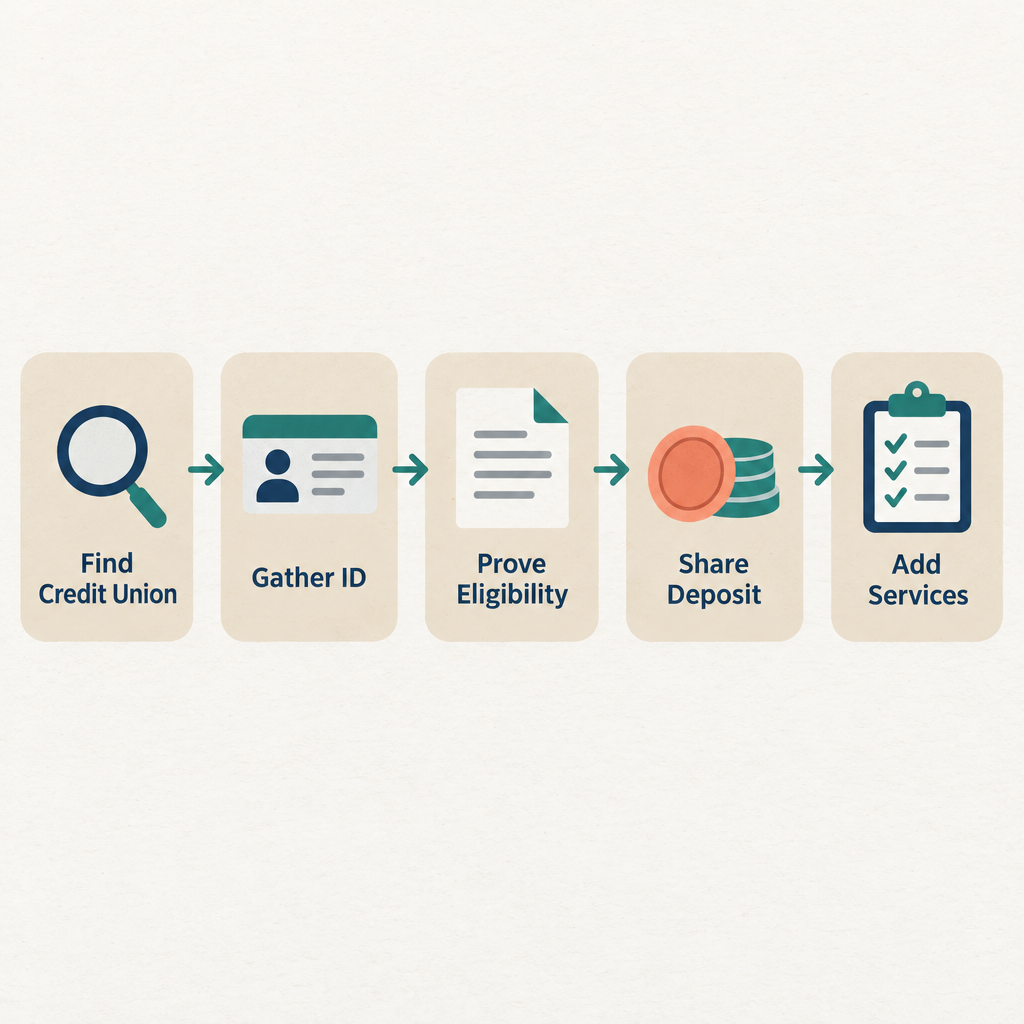
Joining is a short process, usually online, that takes about 15 minutes.
How to join a credit union
- Find a credit union whose field of membership you fit, using the NCUA’s Credit Union Locator or the credit union’s own eligibility page.
- Gather a government photo ID, your Social Security number or ITIN, and a current address.
- Provide proof of eligibility if asked: a pay stub, an address in the service area, a relative’s membership, or an association receipt.
- Pay the par value share deposit, typically $5 to $25, into a savings account to open your membership.
- Add checking, a card or other services once the share account is open.
Two things to know before step four. First, the share deposit is yours, but it usually has to stay in the account to keep your membership active. Second, many credit unions screen new members through ChexSystems or Early Warning Services, the same consumer reporting agencies banks use. Under the Fair Credit Reporting Act you can request a free copy of your ChexSystems report and dispute errors, which matters if a past overdraft is blocking you. Some credit unions offer a “second chance” checking account for people with a rough ChexSystems history.
What membership costs
The honest answer: usually almost nothing. The share deposit is refundable when you close the account. Monthly fees on basic checking are often zero, and when they exist they tend to be lower than at large banks. Where credit unions really separate from other lenders is on loan pricing, because of two federal caps.
The Federal Credit Union Act sets a 15% ceiling on loan rates but lets the NCUA board raise it temporarily. The board has held the ceiling at 18% APR since 1987, renewing it in 18-month blocks. That cap applies to credit cards, personal loans and nearly every other loan a federal credit union makes. State-chartered credit unions follow their own state’s usury laws instead, which are often similar or stricter.
The second cap covers Payday Alternative Loans, or PALs, which the NCUA created so members have a cheaper substitute for a payday loan. Under 12 CFR 701.21(c)(7), a PAL I is $200 to $1,000 with a one to six month term, and a PAL II is up to $2,000 with a one to twelve month term. Both carry a maximum APR of 28% and an application fee of no more than $20. PAL I requires one month of membership first; PAL II does not.
A worked example: PAL vs payday loan
| Product | Amount | Fee or APR | Term | Total repaid |
|---|---|---|---|---|
| Credit union PAL | $500 | 28% APR plus $20 fee | 6 monthly payments | About $562 |
| Storefront payday loan | $500 | $15 per $100 borrowed (about 391% APR) | 14 days | $575 |
| Credit union personal loan | $1,000 | 18% APR | 12 monthly payments | About $1,100 |
Here is the math in plain words. At 28% APR, the monthly rate is 28 divided by 12, or about 2.33%. A $500 loan paid over six months works out to roughly $90 a month, so you pay around $42 in interest, plus the $20 fee, for a total near $562. The payday loan costs $75 for two weeks, which sounds smaller, but a $75 charge on $500 for 14 days is a 391% annual rate. If you roll it over twice, you have paid $225 in fees and still owe the original $500.
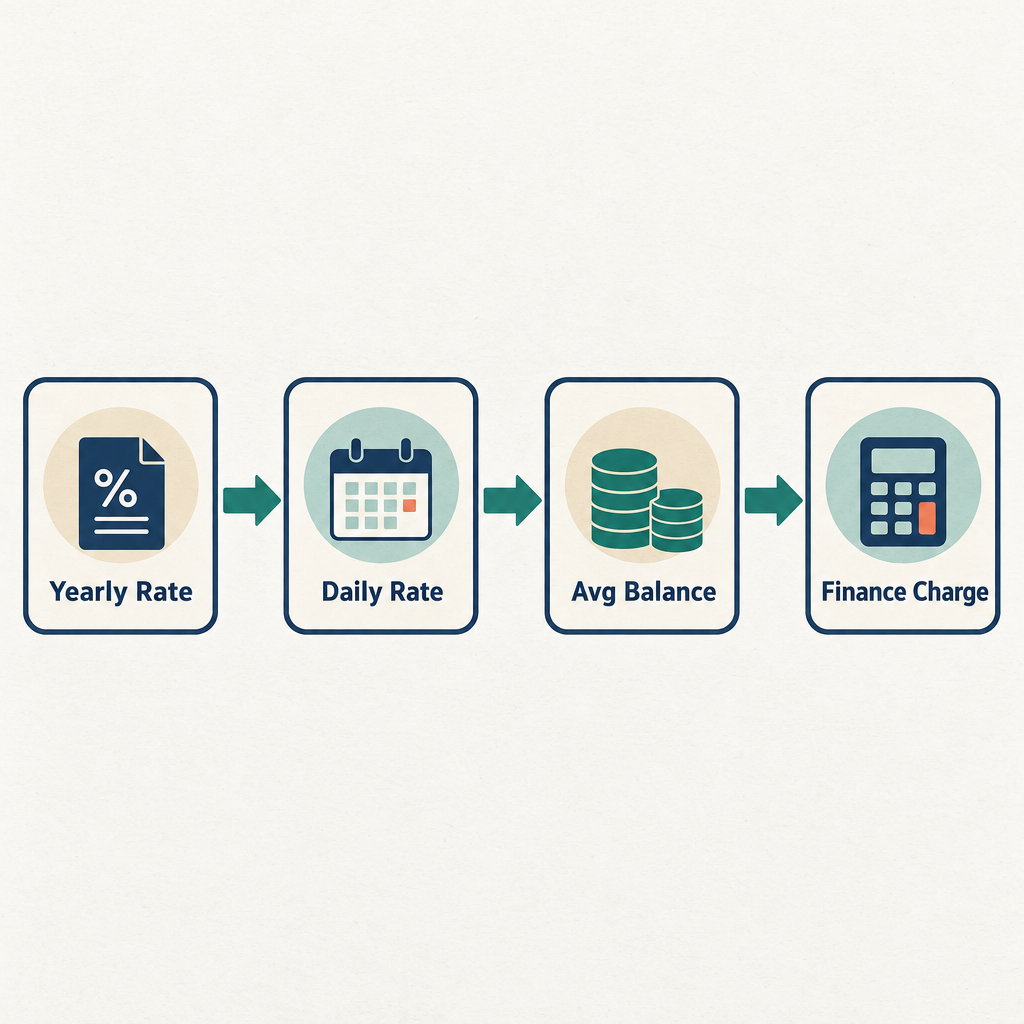
A credit union credit card at the 18% cap compares the same way. If you want to see how that rate turns into a monthly charge, “credit card apr explained” walks through the daily interest math.
Before you borrow
A credit union loan is still a loan. Missing payments damages your credit report, and the credit union can take money from your share accounts to cover a defaulted balance, a right it reserves in most loan agreements. Borrow only what you can repay on schedule.
Credit unions for military members
Service members, veterans and their families have some of the largest fields of membership in the country open to them. Navy Federal Credit Union, the biggest credit union in the US by assets, serves active duty, reserve and retired members of every branch, Department of Defense and Coast Guard civilians, veterans, and their family and household members. Pentagon Federal Credit Union opens its doors to anyone who makes a small savings deposit, so military affiliation is not required. Service Credit Union, Andrews Federal Credit Union and Security Service Federal Credit Union also serve military communities and typically have branches on or near bases.
A note on USAA: it is a bank and insurer, not a credit union, though it serves a similar population.
Two federal laws add protection for military borrowers at any lender, credit unions included. The Military Lending Act caps the Military Annual Percentage Rate at 36% on most consumer credit extended to active duty service members and their dependents, and it bans mandatory arbitration on those loans. The Servicemembers Civil Relief Act caps interest at 6% on debts you took on before entering active duty, once you give the lender written notice and a copy of your orders.
Cheaper options first
Ask your credit union about a PAL before any payday or online installment loan.
Many employers and some credit unions offer no-fee small advances or hardship plans.
Nonprofit credit counseling agencies can set up a debt management plan at little or no cost.
State availability and insurance
Credit unions exist in every state and the District of Columbia, but the specific one you want may not serve your area. Community charters are geographic, so a credit union in Ohio generally cannot take a member in Texas unless that person qualifies through an employer, an association or a family tie.
Insurance is the other state wrinkle. Every federal credit union is insured by the National Credit Union Share Insurance Fund, which covers up to $250,000 per member, per credit union, per ownership category, backed by the full faith and credit of the United States. Most state-chartered credit unions carry the same NCUA insurance. A small number of state credit unions in a handful of states are privately insured instead, with no federal backing. Those credit unions must disclose this at the branch and on their website under federal rules. Before you deposit, confirm NCUA coverage using the NCUA’s Research a Credit Union tool.
Your rights as a credit union member
Credit unions follow nearly the same consumer protection rules as banks.
- Truth in Lending Act and Regulation Z (12 CFR 1026) require clear disclosure of the APR, finance charge and payment schedule on every loan and credit card.
- Truth in Savings Act, applied to credit unions through NCUA regulation 12 CFR Part 707, requires disclosure of dividend rates, fees and minimum balances on share accounts.
- Electronic Fund Transfer Act and Regulation E limit your liability for unauthorized debit card and electronic transactions when you report them promptly, and give you dispute rights.
- Equal Credit Opportunity Act bars the credit union from denying you a loan based on race, sex, religion, national origin, age, marital status or receipt of public assistance.
- Fair Credit Reporting Act governs how the credit union reports your accounts to credit bureaus and gives you the right to dispute errors.
- Fair Debt Collection Practices Act does not usually cover the credit union collecting its own loans, but it does apply to any third-party debt collector the credit union hires.
You also hold governance rights no bank customer has: one vote per member for the board of directors, the right to attend the annual meeting, and the right to nominate candidates.
Where to complain
For a federal credit union with under $10 billion in assets, file with the NCUA Consumer Assistance Center. Credit unions above $10 billion are supervised by the Consumer Financial Protection Bureau, which takes complaints about any credit union through its complaint portal. State-chartered credit unions answer first to the state regulator that chartered them. Suspected fraud goes to the FTC at ReportFraud and, for online scams, the FBI’s IC3.
FAQ
Can anyone join a credit union?
Almost everyone can join some credit union, but not every credit union. Between community charters, family eligibility and association-based routes, most people can find at least one they qualify for. The restriction is on which credit union, never on whether you qualify for any.
Is my money safe in a credit union?
Yes, if the credit union is federally insured. The NCUSIF protects up to $250,000 per member per ownership category, the same level as FDIC coverage at a bank. Verify coverage on the NCUA website before you deposit.
Does joining a credit union affect my credit score?
Opening a share account does not involve a credit inquiry at most credit unions. Applying for a loan or credit card triggers a hard inquiry just as it would anywhere else.
What does credit union membership cost per year?
Usually nothing beyond the one-time share deposit, which stays in your account and is returned if you close it. Some accounts carry monthly fees if you fall below a minimum balance, so read the fee schedule the credit union must give you under Truth in Savings rules.
Can I keep my membership if I change jobs?
At most credit unions, yes. The common “once a member, always a member” bylaw keeps your membership active as long as your share account stays open with the minimum balance.