Credit card APR, short for annual percentage rate, is the yearly interest rate your card issuer charges on any balance you do not pay off by the due date. Issuers apply it as a tiny daily rate, so a 24.99% APR works out to about 0.068% of your balance every day, and that adds up to roughly $20 a month on a $1,000 balance. Pay the full statement balance on time and the purchase APR never touches you at all.
What credit card APR actually means
APR is the number lenders must show you under the Truth in Lending Act and its implementing rule, Regulation Z (12 CFR 1026). It is written as a yearly figure so you can compare cards, but your issuer never charges it once a year.
Instead, the issuer divides the APR by 365 to get a daily periodic rate. That daily rate is applied to your balance every day of the billing cycle, and the results are added up on your statement as the finance charge.
For a credit card, APR and the interest rate are the same thing. That is different from a mortgage or a car loan, where the APR includes closing costs and fees on top of the interest rate. A card’s annual fee, late fee or foreign transaction fee is charged separately and is not folded into the APR.
Most card APRs are also variable. Your rate is built from an index, almost always the U.S. prime rate, plus a fixed margin the issuer sets based on your credit. The prime rate moves with the Federal Reserve’s target rate, so when the Fed raises or cuts rates, your card APR follows within a billing cycle or two.
The different APRs on one card
A single card usually carries four or five separate rates. The cardholder agreement lists them in a federally required table often called the Schumer box, and each one applies to a different kind of balance.
| Type of APR | What it applies to | What makes it different |
|---|---|---|
| Purchase APR | Everyday spending | Only charged if you carry a balance past the grace period |
| Balance transfer APR | Debt moved from another card | Often a 0% intro rate, plus a 3% to 5% transfer fee |
| Cash advance APR | ATM withdrawals, cash-like transactions | Higher rate, no grace period, plus a fee |
| Penalty APR | Your whole balance after a serious misstep | Can top 29.99%; triggered by payments 60+ days late |
| Introductory or promotional APR | New purchases or transfers for a set window | Expires on a fixed date, then the regular rate applies |
Under Regulation Z (12 CFR 1026.53), when you pay more than the minimum, the issuer must apply the extra to the balance with the highest APR first. That rule matters if you have a cash advance sitting at 29.99% next to purchases at 0%.
How the grace period lets you skip interest entirely
Your statement closes, then you have a window before the payment is due. If you paid the previous statement in full, new purchases made during that cycle carry no interest as long as you also pay this statement in full by the due date. That window is the grace period.
Federal law requires issuers to deliver your statement at least 21 days before the due date (12 CFR 1026.5(b)(2)(ii)), so the grace period on purchases is typically 21 to 25 days.
Two things kill the grace period. Carry even a small balance into the next cycle and interest starts on new purchases from the day you buy. Take a cash advance and interest starts the same day, grace period or not. Once you lose it, most issuers require two consecutive statements paid in full before it comes back.
How to calculate credit card interest using APR
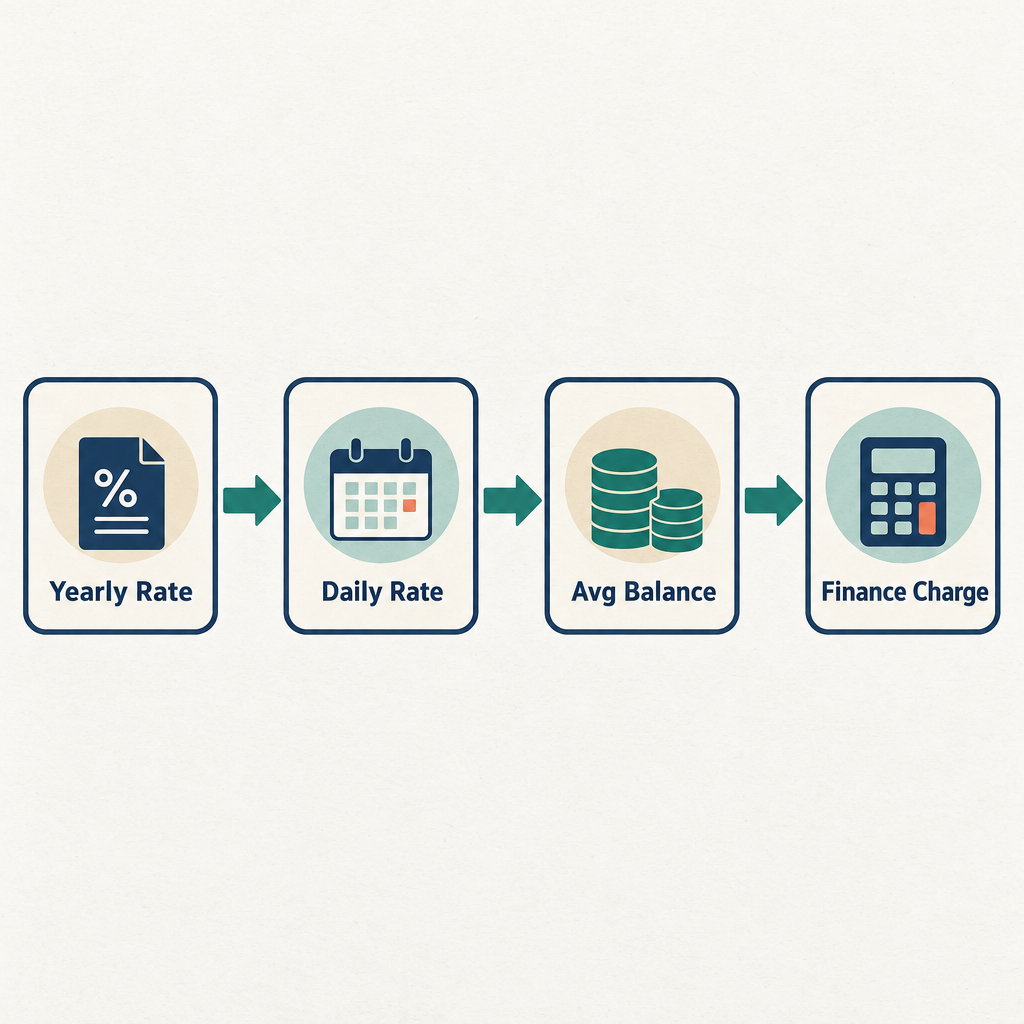
The math behind your finance charge is simple once you see it laid out. Issuers use the average daily balance method, which means every day’s balance counts, not just the number on the statement.
How to estimate a month of interest
- Divide your APR by 365 to get the daily periodic rate (24.99% ÷ 365 = 0.0685%).
- Add up your balance at the end of each day in the cycle and divide by the number of days to get the average daily balance.
- Multiply the average daily balance by the daily rate, then by the days in the cycle.
- Compare the result with the “interest charged” line on your statement to check the issuer’s figure.
Using those steps, a $1,000 average daily balance at 24.99% APR over a 30-day cycle costs about $20.50. Many issuers compound daily, meaning each day’s interest is added to the balance before the next day’s charge, which nudges that figure slightly higher.
What carrying a balance really costs
The headline APR looks abstract. The total you repay does not. Here is what happens to a $1,000 purchase balance at 24.99% depending on how you pay it down, with a cash advance added for comparison.
| Scenario | Amount | APR and fees | Time to pay off | Total repaid |
|---|---|---|---|---|
| Pay in full by due date | $1,000 | 24.99%, grace period applies | 1 month | $1,000 |
| Pay $100 a month | $1,000 | 24.99% | About 12 months | About $1,120 |
| Pay $30 a month (near minimum) | $1,000 | 24.99% | About 58 months | About $1,725 |
| Cash advance, paid over 12 months | $1,000 | 29.99% plus 5% fee ($50) | 12 months | About $1,220 |
The $30-a-month row is the one that traps people. Nearly $725 in interest on a $1,000 balance, spread over almost five years, is why the CARD Act of 2009 requires every statement to show how long it will take to clear your balance making only minimum payments (12 CFR 1026.7(b)(12)). Look for that box on your next statement.
The scale is enormous nationally. The CFPB’s 2023 Consumer Credit Card Market Report found cardholders paid more than $100 billion in interest in 2022, and the Federal Reserve’s G.19 consumer credit release has shown the average rate on accounts assessed interest sitting above 20% since 2023.
Before you carry a balance
Once you carry a balance, you lose the grace period and pay interest on every new purchase from the day you make it. Minimum payments at a 25% APR can stretch a modest balance into years of repayment and nearly double the original cost.
What counts as a good APR
There is no single good number, because your rate is priced on your credit profile. Issuer disclosures for 2025 and 2026 show a consistent pattern: rewards cards for strong credit typically start in the high teens, mainstream cards for fair credit land in the mid to high 20s, and store cards and cards for rebuilding credit often sit at or above 30%.
A useful benchmark is the federal credit union ceiling. The Federal Credit Union Act caps loan rates at federal credit unions at 15% unless the NCUA board raises the limit, and the board has set that ceiling at 18% for many years. A card rate under 18% is genuinely competitive. Anything above the Fed’s reported average deserves scrutiny.
Your APR only matters if you carry a balance. If you pay in full every month, a 29.99% card and a 15.99% card cost the same amount of interest: zero. In that case, fees and rewards are the only numbers worth comparing.
How to lower the APR you already have
Issuers do cut rates on request, especially for cardholders with on-time payment histories. Call the number on the back of the card, cite your history and any lower offers you have received, and ask for a reduction. A no costs you nothing.
If you are struggling, ask about a hardship program. Most large issuers run them, and they can temporarily cut the APR to single digits or zero in exchange for a fixed payment plan. Nonprofit credit counseling agencies affiliated with the National Foundation for Credit Counseling can negotiate similar terms through a debt management plan.
Cheaper options first
Pay the statement balance in full each month and the purchase APR costs you nothing.
A credit union card or personal loan often runs under 18%, well below the national card average.
Issuer hardship programs and nonprofit credit counseling can cut rates without new borrowing.
A 0% balance transfer can help if you can clear the debt before the promotion ends, but the 3% to 5% transfer fee is real money and the rate jumps on a fixed date. A cash advance is almost never the answer. For true emergencies, a credit union payday alternative loan, capped by the NCUA at 28% APR with an application fee of no more than $20, costs far less than a cash advance and vastly less than a “payday loan“. Compare any “loans emergency” option against your existing card’s purchase APR before borrowing new money.
State rules and who gets capped rates
Credit card APRs rarely fall under “usury laws” in your own state. Since the Supreme Court’s 1978 decision in Marquette National Bank v. First of Omaha, a national bank can charge the rate allowed by the state where it is chartered to customers anywhere in the country, under 12 U.S.C. § 85. That is why so many issuers sit in Delaware, South Dakota and Utah, states with no rate cap on cards.
Two federal laws do cap rates for specific groups. The Military Lending Act limits the military annual percentage rate on cards for active-duty service members and their dependents to 36%, including most fees. The Servicemembers Civil Relief Act caps interest at 6% on debts you took on before entering active duty, as long as you ask the issuer and provide orders.
Your rights on rate changes
The CARD Act, enforced through Regulation Z, gives you specific protections against surprise rate hikes.
- The issuer cannot raise the APR on your existing balance during the first year after opening the account, except when a promotional rate ends, the index on a variable rate rises, or you fall 60 days behind (12 CFR 1026.55).
- Any rate increase on new purchases requires 45 days’ written notice (12 CFR 1026.9(c)(2)), and you have the right to reject the increase and pay off your existing balance at the old rate.
- A penalty APR can only hit your existing balance if a payment is at least 60 days late, and the issuer must restore the original rate after six consecutive on-time payments (12 CFR 1026.55(b)(4)).
- Issuers that raised your rate for any reason must review the account at least every six months and reduce the rate if the reason no longer applies (12 CFR 1026.59).
- Double-cycle billing, which charged interest on balances you had already paid, is banned (12 CFR 1026.54).
If an issuer breaks these rules, file a complaint through the CFPB’s online complaint portal. National banks also answer to the Office of the Comptroller of the Currency, and federal credit unions to the NCUA. If an unpaid balance is sold or sent to a “debt collector“, the Fair Debt Collection Practices Act controls what that collector can say and do, and the collector cannot add interest your original agreement did not allow.
FAQ
Is APR charged monthly or yearly on a credit card?
Neither, strictly. The APR is divided by 365 and charged daily on your unpaid balance, then totaled on your monthly statement as the finance charge.
What is the difference between APR and interest rate on a credit card?
On a credit card they are the same number. APR only differs from the interest rate on products like mortgages, where upfront fees are rolled into the APR.
Does APR matter if I pay my balance in full?
No. Paying the full statement balance by the due date keeps the grace period active, and the purchase APR never applies. Cash advances are the exception, since they accrue interest from day one.
Why did my credit card APR go up without my doing anything?
Most card APRs are variable and tied to the prime rate. When the Federal Reserve raises rates, your APR rises automatically, and issuers do not have to give 45 days’ notice for index-driven changes.
What is a penalty APR and how do I get rid of it?
A penalty APR, often around 29.99% or higher, can apply after a payment is 60 or more days late. Under Regulation Z the issuer must restore your original rate after six straight on-time payments.
Can a credit card charge more than my state’s usury limit?
Usually yes. Federal law lets a national bank export the rate rules of its home state, so a card issued from Delaware or South Dakota is not bound by the cap where you live.
Laws and regulations referenced
- Truth in Lending Act, 15 U.S.C. 1601
- Regulation Z, 12 CFR Part 1026
- Fair Debt Collection Practices Act, 15 U.S.C. 1692
- Military Lending Act, 10 U.S.C. 987
- Servicemembers Civil Relief Act, 50 U.S.C. 3901
Links go to the official text on government sites.
Check, verify or complain
Sources
- consumerfinance.gov › rules policy › regulations › 1026 › 7 consumerfinance.gov · primary source
- wearecalculator.com › calculator › loans and debt › credit card interest calculator wearecalculator.com
- creditinterestcalculator.com creditinterestcalculator.com
- experian.com › blogs › ask experian › what is payday loan alternative experian.com
- americascreditunions.org › news media › news › ncua extends 18 interest rate ceiling september 2027 americascreditunions.org
- cardratings.com › credit card interest calculator cardratings.com

Elena writes about getting through a money emergency, assistance programs, budgeting on a tight income, banking basics and borrower rights. Her guides list the cheaper options first and link the agency or program that can actually help.