We do not lend money or arrange loans. Rates and rules change and differ by state, so check the lender’s own disclosure before you sign.
An emergency loan is any fast borrowing you use to cover a surprise bill, usually a personal loan, a payday loan, a cash advance app or a credit card cash advance. The cheapest versions cost under 30% APR and the most expensive top 400% APR, so the product you pick matters more than how fast the money arrives. This guide explains how emergency loans work, what each type really costs, which states restrict them and what your legal rights are when you borrow.
What emergency loans are
“Emergency loan” is a marketing label, not a legal category. No federal law defines one. When a lender advertises emergency loans, it is selling one of the ordinary products below, often with same-day or next-day funding added as the hook.
The Federal Reserve’s Survey of Household Economics and Decisionmaking has found for several years running that roughly 37% of US adults could not cover a $400 surprise expense with cash or its equivalent. That gap is the market these lenders serve. Some serve it fairly. Others price the loan at a level that creates the next emergency.
The main types you will see:
- Unsecured personal loans from banks, credit unions and online lenders, usually $1,000 to $50,000, repaid in fixed monthly payments over one to seven years.
- Payday loans, typically $100 to $500, due in full on your next payday with a flat fee.
- Cash advance apps that front a portion of your paycheck, often $20 to $500, and pull it back on payday.
- Credit card cash advances, which draw cash against your card’s limit at a higher rate than purchases.
- Auto title loans, secured by your car, usually for 30 days.
- Payday alternative loans (PALs), a regulated small loan offered only by federal credit unions.
A “payday loan” and a personal loan can both be advertised as emergency loans, yet one costs around 400% APR and the other might cost 12%. Reading the actual disclosure, not the headline, is the whole game.
How emergency loans work, step by step
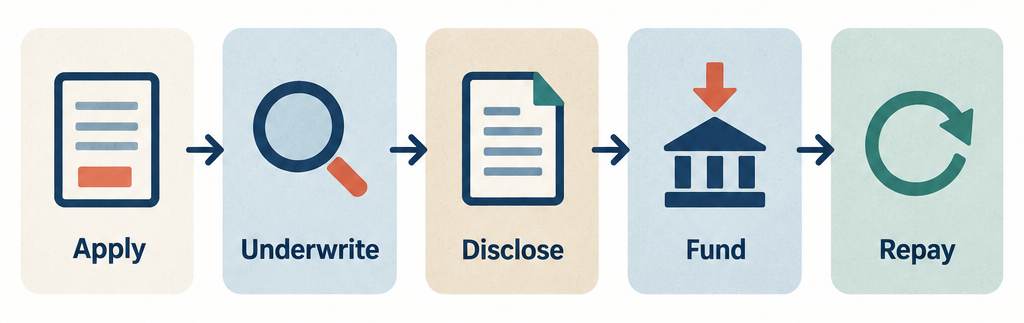
Most emergency lenders follow the same path, and knowing it helps you spot where the costs hide.
Application. Online lenders ask for identity, income, a bank account and a Social Security number. Many run a soft credit inquiry first, which does not affect your score, then a hard inquiry only if you accept an offer. “No credit check” offers usually mean the lender checks a different database (bank transaction data or a subprime bureau such as Clarity) and prices the loan high to cover the risk.
Underwriting. Personal loan lenders look at your credit score, debt-to-income ratio and income. Payday lenders mostly want proof of a paycheck and an active checking account. Cash advance apps read your bank history to estimate your next deposit.
Disclosure. Under the Truth in Lending Act and Regulation Z (12 CFR 1026), any lender offering closed-end consumer credit must give you the APR, the finance charge, the amount financed and the total of payments before you sign. If a lender will not show you the APR, that alone is a reason to walk away.
Funding. Direct deposit by ACH takes one business day for most lenders. Same-day funding usually means an instant debit card push, and some lenders or apps charge an extra fee for it.
Repayment. Personal loans are repaid monthly. Payday loans and app advances are repaid in a lump sum from your checking account on payday. That lump-sum structure is why the CFPB found most payday borrowers end up re-borrowing: the full amount plus fee leaves a hole in the next paycheck.
What an emergency loan really costs
The table shows what common products cost on a realistic borrowing amount. APR converts every fee into an annual rate so you can compare a two-week loan against a 12-month loan on equal terms. The math in plain words: divide the fee by the amount borrowed, divide by the number of days you have the money, and multiply by 365.
| Product | Amount | Cost | Term | Total repaid | Approximate APR |
|---|---|---|---|---|---|
| Credit union PAL I | $500 | 28% APR plus $20 application fee | 6 months | About $562 | 28% plus fee |
| Credit card cash advance | $500 | 5% fee ($25) plus 29.99% APR, no grace period | 30 days | About $538 | Roughly 90% on a 30-day payoff |
| Online personal loan, fair credit | $1,000 | 36% APR | 12 months | About $1,206 | 36% |
| Cash advance app | $100 | $4.99 express fee, no tip | 7 days | $104.99 | About 260% |
| Auto title loan | $500 | 25% monthly finance charge | 30 days | $625 | 300% |
| Payday loan | $500 | $15 per $100 | 14 days | $575 | 391% |
The payday figure is the CFPB’s own standard example. The title loan figure matches the typical 25% monthly charge the CFPB documented in its title lending research, where it also found about one in five title borrowers lost their vehicle to repossession.
Cash advance apps look cheap in dollars, which is exactly the problem. A $4.99 express fee on a $100 advance for one week works out to roughly 260% APR. The CFPB’s 2024 analysis of earned wage access products found a typical advance cost over 100% APR once express fees and voluntary “tips” were counted. Apps that let you wait two or three business days for free are much cheaper, so the fee is really a charge for speed.
For personal loans, the Federal Reserve’s G.19 consumer credit release has put the average 24-month personal loan rate at banks in the low double digits during 2025, near 12%. That rate goes to borrowers with good credit. Borrowers with scores below about 640 commonly see 25% to 36%, and most mainstream online lenders stop at 36%.
Before you borrow
The biggest risk is not the first fee but the second loan. CFPB research found about four in five payday loans are rolled over or followed by a new loan within 14 days, which turns a $75 fee into hundreds of dollars over a year.
Who an emergency loan can make sense for
A regulated emergency loan can be a reasonable choice when all of these are true:
- The expense is unavoidable and has a real deadline, such as a car repair you need to get to work or a utility shutoff notice.
- You have a specific plan to repay it from income within the term, not from another loan.
- The APR is 36% or lower, which is the cap the Military Lending Act sets for service members and the benchmark most consumer advocates use.
- You have already checked the cheaper options below and they are not available in time.
It rarely makes sense to borrow at 300% or more. The CFPB’s data shows that borrowers at those rates typically spend more on fees over a year than they originally borrowed.
Cheaper options first
Before any loan over 36% APR, run through these. Several are free, and most can be arranged in a day or two.
Cheaper options first
A federal credit union PAL is capped at 28% APR and takes a few days to set up.
Hospital charity care, utility hardship plans and dialing 211 can erase the bill instead of financing it.
A no-fee paycheck advance from your employer or an app’s free standard-speed option costs nothing.
1. Credit union payday alternative loans. Under NCUA rules at 12 CFR 701.21(c)(7), a PAL I is $200 to $1,000 over one to six months, with an APR capped at 28% and an application fee of no more than $20. A PAL II goes up to $2,000 over up to 12 months with no minimum membership period. You need to join the credit union, which often requires living or working in its area or a small donation to a partner association.
2. Ask the biller for a plan. Utilities in most states must offer deferred payment arrangements and cannot disconnect during certain weather conditions. Nonprofit hospitals are required under Internal Revenue Code section 501(r) to have a written financial assistance policy, and many write off bills entirely for households under 200% to 400% of the federal poverty level. Ask for the charity care application before paying anything.
3. Local and federal assistance. Dialing 211 connects you to the United Way’s directory of local emergency help for rent, utilities and food. The Low Income Home Energy Assistance Program (LIHEAP) covers heating and cooling bills. Catholic Charities, the Salvation Army and St. Vincent de Paul run emergency bill funds in most counties. None of this has to be repaid.
4. Employer or free app advance. Many employers now offer earned wage access through payroll at no cost to you. If you use a cash advance app, the standard-speed transfer is usually free and arrives in one to three business days.
5. A 0% credit card or your existing card’s purchase rate. Charging a car repair to a card at 24% APR and paying it off in two months costs far less than any payday product. Avoid the cash advance feature, which carries a fee and starts charging interest immediately.
6. Retirement account emergency withdrawal. Under the SECURE 2.0 Act, participants in employer plans such as a 401(k), 403(b) or governmental 457(b) that have adopted the provision can take up to $1,000 per year for a personal emergency without the 10% early withdrawal penalty, with the option to repay it within three years. The withdrawal is still taxed as ordinary income, and the provision is generally not available for IRAs. A 401(k) loan, where your plan allows one, lets you borrow up to 50% of your vested balance or $50,000, whichever is less, and the interest goes back into your own account.
Where emergency loans are restricted by state
Availability depends on where you live, and no lender can legally offer every product everywhere.
Payday lending is banned or capped at or near 36% APR in roughly 20 states and the District of Columbia, including New York, New Jersey, Pennsylvania, Massachusetts, Connecticut, Maryland, North Carolina, Georgia, Arizona, Arkansas, Colorado, Illinois, New Mexico, Nebraska, Montana, South Dakota and Vermont. In those states a lender advertising 400% APR loans is either a tribal lender or operating illegally, and state “usury laws” generally make such loans void or uncollectible.
Auto title loans are legal in only about half of states. Personal installment loans are available everywhere, but the maximum rate a licensed lender can charge varies widely by state and loan size. Cash advance apps operate nationally, though several states, including Connecticut and Maryland, have brought them under their small loan laws.
If you are on active duty or a dependent, the Military Lending Act caps the Military Annual Percentage Rate at 36% on most consumer credit no matter which state you are in, and it bans mandatory arbitration clauses in those contracts.
How to check a lender before you sign
How to check a lender
- Search the company on NMLS Consumer Access to confirm it holds a license in your state.
- Confirm the license with your state’s banking or financial regulator lookup.
- Read the Truth in Lending disclosure and find the APR and total of payments.
- Search the CFPB complaint database for the lender’s name.
- Refuse any lender that asks for an upfront fee, gift cards or crypto to “release” the loan.
That last point is the single most common emergency loan scam the FTC reports. A legitimate lender never asks you to pay before funding. Scammers also copy real lenders’ names, so match the license number, not just the brand.
Your rights as a borrower
Several federal laws apply to emergency loans, and lenders cannot contract around them.
Truth in Lending Act and Regulation Z. You are entitled to a written APR and finance charge before you are bound. For loans with a prepayment penalty or balloon payment, that must be disclosed too.
Equal Credit Opportunity Act. A lender cannot deny or price a loan based on race, sex, marital status, age, national origin, religion or because your income comes from public assistance. If you are denied, you must receive an adverse action notice giving the reason or telling you how to get it.
Fair Credit Reporting Act. You can pull your reports from all three bureaus free every week at AnnualCreditReport.com, and you can dispute errors, which the bureau must investigate within 30 days. If a lender denies you based on your report, the notice must name the bureau.
Electronic Fund Transfer Act and Regulation E. A lender cannot require you to repay by automatic debit as a condition of credit (15 U.S.C. 1693k). You can revoke an ACH authorization by notifying the lender and your bank, and your bank must honor a stop payment on a recurring debit if you give it three business days’ notice.
Fair Debt Collection Practices Act. If the loan goes to a third-party “debt collector,” that collector cannot call before 8 a.m. or after 9 p.m., contact you at work after you say not to, threaten arrest or lie about what you owe. Debt collectors also cannot collect on a loan that was void under your state’s law.
Military Lending Act and Servicemembers Civil Relief Act. Covered borrowers get the 36% MAPR cap, and the SCRA lets active-duty members reduce pre-service debts to 6% interest on request.
To complain, use the CFPB complaint portal, which forwards your complaint to the company and tracks its response. Report fraud at FTC ReportFraud or, for online scams, the FBI’s Internet Crime Complaint Center (IC3).
FAQ
How fast can I get an emergency loan?
Cash advance apps and some online lenders can fund within minutes to a debit card, usually for an express fee. Standard ACH funding takes one business day. Credit union PALs can take a few days if you must join first.
Can I get an emergency loan with bad credit?
Yes, but the price rises sharply below a 640 score. Licensed personal loan lenders generally cap out at 36% APR. Payday and title lenders accept almost anyone and charge 300% to 400% APR. A credit union PAL is the cheapest widely available option for thin or damaged credit.
Do emergency loans affect my credit score?
Personal loans from banks, credit unions and most online lenders report to the bureaus, so on-time payments help and missed ones hurt. Most payday lenders and cash advance apps do not report at all, which means they do not build credit either. Any hard inquiry can lower a score by a few points for up to a year.
What is the difference between an emergency loan and a payday loan?
A payday loan is one kind of emergency loan, repaid in a single lump sum on your next payday at a flat fee that works out to about 391% APR. Other emergency loans, such as personal loans and PALs, are repaid in monthly installments at far lower rates.
Are there emergency loans that are actually free?
Employer paycheck advances, the standard-speed option on most cash advance apps and the SECURE 2.0 $1,000 retirement emergency withdrawal carry no fee. Charity care, 211 referrals and LIHEAP are grants, not loans, and never need repayment.
Laws and regulations referenced
- Truth in Lending Act, 15 U.S.C. 1601
- Regulation Z, 12 CFR Part 1026
- Fair Debt Collection Practices Act, 15 U.S.C. 1692
- Fair Credit Reporting Act, 15 U.S.C. 1681
- Equal Credit Opportunity Act, 15 U.S.C. 1691
- Electronic Fund Transfer Act, 15 U.S.C. 1693
- Regulation E (electronic transfers), 12 CFR Part 1005
- Military Lending Act, 10 U.S.C. 987
- Servicemembers Civil Relief Act, 50 U.S.C. 3901
Links go to the official text on government sites.
Check, verify or complain
Sources
- irs.gov › retirement plans › plan participant employee › 401k resource guide plan p… irs.gov · primary source
- ftc.gov › legal library › browse › statutes › military lending act ftc.gov · primary source
- sciencedirect.com › science › article › abs › pii › S1544612324006962 sciencedirect.com
- coveredusa.org › en › blog › hospital charity care 501r forgiveness coveredusa.org
- experian.com › blogs › ask experian › what is payday loan alternative experian.com
- getoutofdebt.org › 241821 › wells fargo military scra class action arbitration getoutofdebt.org

Elena writes about getting through a money emergency, assistance programs, budgeting on a tight income, banking basics and borrower rights. Her guides list the cheaper options first and link the agency or program that can actually help.