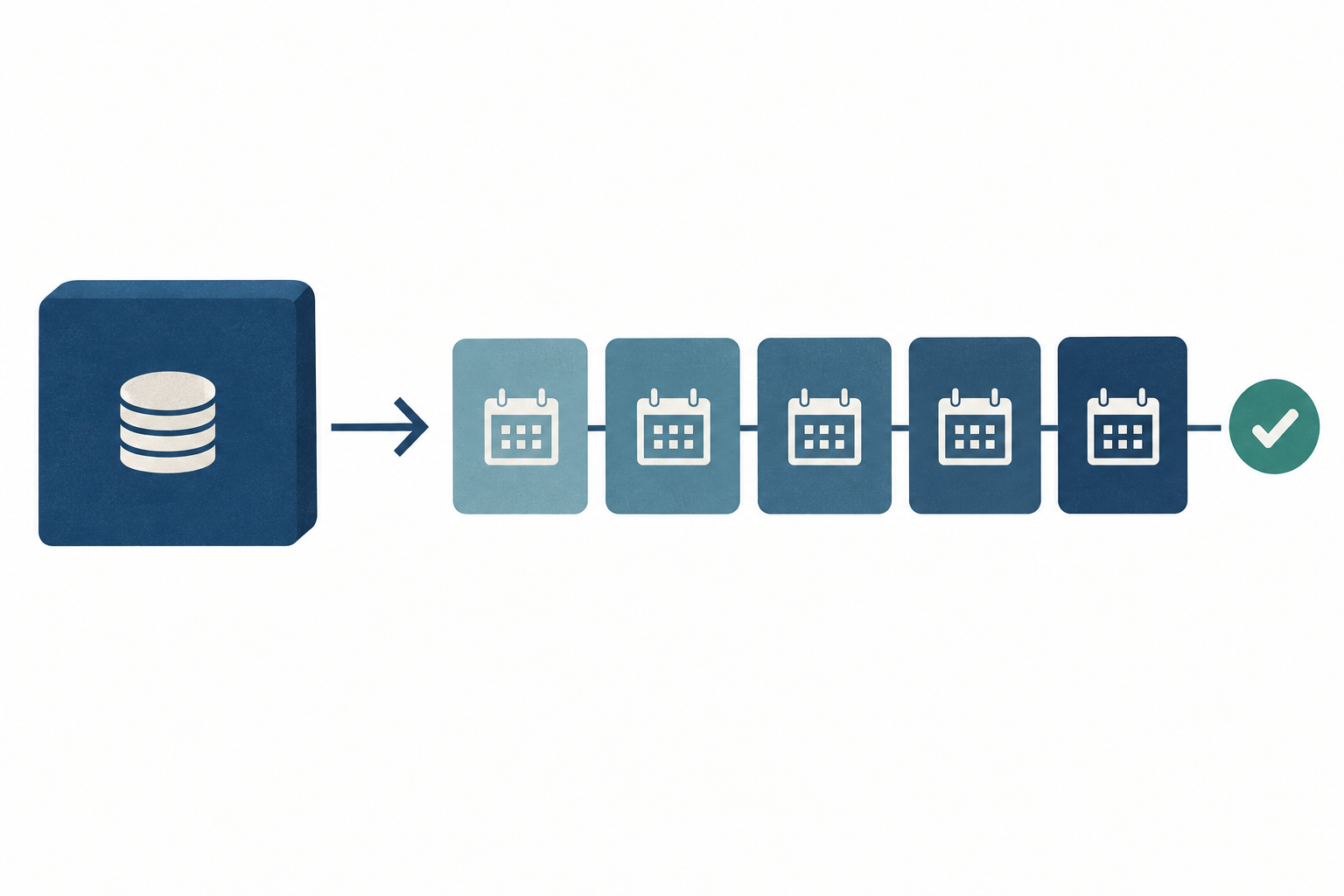
An installment loan is money you borrow in one lump sum and pay back in a set number of scheduled payments, usually monthly, until the balance hits zero. Mortgages, auto loans, student loans and most personal loans all work this way. The structure is simple, but the price ranges from under 10% APR at a credit union to triple digits at some online lenders, so the definition matters less than the math.
Installment loan definition in plain words
“Installment” just means a portion of a debt paid at an agreed time. When you borrow on installment, you agree to a fixed schedule: this much, on this date, for this many months. Each payment covers that month’s interest plus a slice of the principal. By the final payment the account closes.
That is the core difference from a credit card or a line of credit. Those are revolving credit: you can borrow, repay and borrow again, and your payment changes with your balance. An installment loan is closed-end credit. You get the money once, and the lender tells you the exact payoff date before you sign.
The term “installment buying” comes from the same idea. Retailers have sold furniture, sewing machines and cars on payment plans since the 1800s, and General Motors created its own finance arm, GMAC, in 1919 so buyers could pay for a car over time. Modern buy-now-pay-later plans split into four payments are the latest version of the same thing.
How an installment loan works
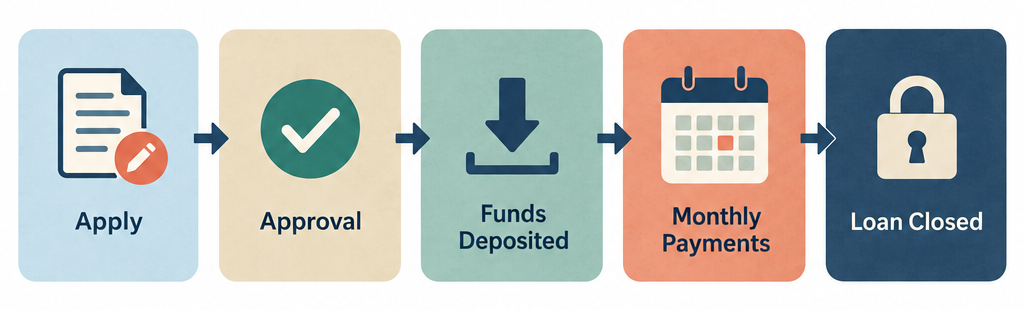
Here is the full cycle for a typical consumer installment loan:
- You ask a lender for a specific amount, say $2,000, over a specific term, say 24 months.
- The lender checks your credit, income and existing debts, then quotes an interest rate and any fees.
- Before you sign, the lender must give you a Truth in Lending disclosure. Under Regulation Z (12 CFR 1026.18), it must show the amount financed, the finance charge, the APR, the total of payments and the payment schedule.
- You receive the money, usually by deposit to your bank account within one to five business days.
- You make the same payment each month. Early on, most of it is interest. Later, most of it is principal. This is called amortization.
- After the last payment the loan is paid in full and reported as closed on your credit file.
The APR is the number to compare. It is the yearly cost of the loan expressed as a percentage, and under the Truth in Lending Act it has to include interest as well as mandatory fees such as an origination charge. That is why two loans with the same interest rate can have different APRs.
What the same $2,000 costs at different rates
Rates on installment loans vary more than on almost any other consumer product. The table below shows the same $2,000 borrowed over 24 months at three rates you might actually be offered, plus a 6-month credit union payday alternative loan for a smaller amount. Figures are rounded to the nearest dollar and assume standard monthly amortization with no extra fees unless noted.
| Loan | Amount | APR | Term | Monthly payment | Total repaid | Cost of borrowing |
|---|---|---|---|---|---|---|
| Credit union personal loan | $2,000 | 12% | 24 months | $94 | $2,260 | $260 |
| Bank or online lender, fair credit | $2,000 | 36% | 24 months | $118 | $2,834 | $834 |
| High-cost online installment loan | $2,000 | 160% | 12 months | $343 | $4,117 | $2,117 |
| Federal credit union PAL (28% APR plus $20 fee) | $1,000 | 28% | 6 months | $181 | $1,103 | $103 |
The 160% figure is not hypothetical. Several online installment lenders disclose APRs in that range on their own rate pages, often by partnering with out-of-state banks to get around state caps. At that price you pay back more than double what you borrowed in a single year, and a longer term makes it worse, not better.
Here is the plain-words version of the APR math. At 36% APR on a 24-month loan, you are paying roughly 3% of the outstanding balance in interest each month. In month one that is about $60 on a $2,000 balance. As the balance falls, the interest portion falls with it, which is why the total interest ($834) is less than 36% of $2,000 times two years ($1,440).
Before you borrow
The APR and the term decide what you really pay, and a low monthly payment can hide a very expensive loan. Always read the “total of payments” line on the Truth in Lending disclosure before you sign anything.
Examples of installment loans
Consumer installment loans cover a wide range of amounts and terms:
- Mortgages: $100,000 and up, typically 15 or 30 years, secured by the home.
- Auto loans: a few thousand to $50,000 or more, usually 36 to 84 months, secured by the vehicle.
- Federal student loans: Direct Loans default to a 10-year standard repayment plan, with income-driven options that stretch much longer.
- Unsecured personal loans: typically $1,000 to $50,000 over 1 to 7 years, from banks, credit unions and online lenders.
- Credit union payday alternative loans (PALs): under NCUA rules, PAL I loans run $200 to $1,000 over 1 to 6 months, and PAL II loans run up to $2,000 over up to 12 months, both capped at 28% APR with an application fee of no more than $20.
- Small-dollar online installment loans: $300 to $5,000 over 3 to 24 months, often at the highest APRs in the market.
- Buy-now-pay-later plans: typically four payments over six weeks with no interest if paid on time, though late fees apply.
A payday loan is not an installment loan in the traditional sense. It is a single balloon payment due on your next payday, usually at $15 per $100 borrowed, which the CFPB calculates at roughly 391% APR on a two-week loan. Some storefront lenders now sell “payday installment loans” that stretch the same pricing over months. Longer is not cheaper when the rate stays that high.
Installment credit vs. revolving credit
| Feature | Installment loan | Revolving credit (credit card, line of credit) |
|---|---|---|
| How you get money | One lump sum | Borrow as needed up to a limit |
| Payment | Fixed amount, fixed schedule | Minimum payment that changes with the balance |
| End date | Set at signing | None while the account stays open |
| Rate | Usually fixed | Usually variable |
| Credit score effect | Payment history and credit mix | Payment history and credit utilization |
For your credit score, both count heavily toward payment history, which FICO weights at 35% of the score. Installment loans do not affect credit utilization the way a card balance does, and having both types counts toward credit mix, which FICO weights at 10%. If you carry a card balance month to month, it is worth understanding how card interest compounds daily; our “credit card apr explained” article walks through that math.
Pros and cons of installment loans
Strengths
- You know the exact payment and payoff date before you commit.
- Fixed rates protect you if market rates rise.
- A long term can make a large purchase affordable in monthly terms.
- On-time payments build positive credit history.
Weaknesses
- You cannot re-borrow repaid money without applying again.
- Origination fees of 1% to 10% are common on personal loans and come out of your proceeds.
- Some lenders charge prepayment penalties, so paying early does not always save money.
- A long term at a high APR can cost more in interest than the amount borrowed.
- Secured loans put the car or home at risk if you fall behind.
Where installment loans are capped or restricted
State law, not federal law, sets most price limits on consumer installment loans, and the picture is uneven. Illinois caps consumer loans at a 36% all-in APR under its Predatory Loan Prevention Act, which took effect in 2021. New Mexico adopted a 36% cap on most small loans starting in 2023. Colorado voters capped payday loans at 36% in 2018. Several other states, including Delaware, Utah and Idaho, have no general rate cap on small installment loans, which is why triple-digit APRs are legal there.
Many high-cost online lenders route loans through a partner bank chartered in a permissive state and argue that state’s rules apply. Courts and state attorneys general have challenged this “rent-a-bank” model with mixed results. The practical point for you: the rate you are offered depends on your state, and a lender that quotes 36% in one state may quote 160% in another.
Cheaper options first
Ask your local credit union about a personal loan or payday alternative loan; federal credit unions cap most loans at 18% APR under NCUA rules.
Call your utility, landlord or medical provider about a hardship or payment plan before borrowing to pay them.
Nonprofit credit counseling agencies and 211 can point you to local assistance for rent, food and utilities.
If you are borrowing for a sudden bill, our guide on “loans emergency” compares those options in more detail. And if your credit is thin, be skeptical of “no credit check loans“; most lenders run a soft pull or use bank data, and the trade-off for skipping a hard credit check is usually a much higher price.
Your rights when you take an installment loan
- Truth in Lending Act / Regulation Z (12 CFR 1026): the lender must disclose the APR, finance charge, amount financed, total of payments and schedule before you sign.
- Equal Credit Opportunity Act / Regulation B: a lender cannot deny you based on race, sex, marital status, age, religion, national origin or receipt of public assistance, and must tell you the specific reasons for a denial within 30 days.
- Fair Credit Reporting Act: you can get a free credit report, dispute errors, and you are entitled to a notice if adverse information in your report led to worse terms.
- Electronic Fund Transfer Act / Regulation E (12 CFR 1005.10(e)): a lender cannot require you to repay by automatic electronic debit as a condition of getting the loan.
- Military Lending Act (32 CFR 232): active-duty servicemembers and their dependents cannot be charged more than 36% Military APR on most consumer loans, and the lender cannot require arbitration.
- Servicemembers Civil Relief Act: interest on debts you took on before active duty is capped at 6% while you serve.
- Fair Debt Collection Practices Act: if the loan goes to a third-party collector, that collector cannot harass you, call at unreasonable hours or misrepresent what you owe.
How to check a lender before you sign
- Look the company up on NMLS Consumer Access and confirm it holds a consumer lending license in your state.
- Search the CFPB complaint database for the lender’s name and read how it responds.
- Find the APR and total of payments on the disclosure, and ask whether there is a prepayment penalty.
- Confirm the lender will report your payments to the credit bureaus if building credit is a goal.
- Walk away from any lender that asks for an upfront fee before funding; that is a classic advance-fee scam.
If a lender breaks these rules, you can file a complaint with the CFPB, your state attorney general or state banking regulator, and the FTC through ReportFraud.
FAQ
What is an installment loan?
An installment loan is a closed-end loan you receive as a lump sum and repay in fixed, scheduled payments over a set term. Each payment includes interest and principal, and the loan is paid off by a date set when you sign. Mortgages, car loans, student loans and personal loans are all installment loans.
Are installment loans hard to get?
It depends on the lender and your credit. Banks and credit unions typically want a FICO score in the mid-600s or higher and a manageable debt-to-income ratio. Online lenders will approve lower scores, but at higher APRs, sometimes above 100%. Credit union payday alternative loans require only that you have been a member for about a month and have a steady income.
Is installment loan trustworthy?
The product itself is standard, regulated credit. The lender is what you need to vet. A trustworthy lender is licensed in your state, shows the APR and total cost before you commit, never asks for money upfront, and reports to the credit bureaus. Check NMLS Consumer Access and the CFPB complaint database before you sign.
What credit score is needed for an installment loan?
There is no single minimum. Prime rates from banks generally start around a 670 FICO score, and the lowest advertised rates usually require 720 or higher. Scores in the 580 to 660 range can still qualify with many online lenders and credit unions, but expect APRs between 20% and 36%. Below 580, offers tend to be high-cost or secured. A denial must come with specific reasons under the Equal Credit Opportunity Act, so you will know what to fix.