

We do not lend money or arrange loans. Rates and rules change and differ by state, so check the lender's own disclosure before you sign.
Auto rates for used cars run about 2 to 6 percentage points higher than new-car rates. Experian’s first-quarter 2025 data puts the average used car loan APR at roughly 6.8% for the strongest credit scores and above 21% for the weakest. Your credit score sets the starting point. The loan term, the car’s age, your down payment and where you borrow then push that rate up or down.
PROPOSEDRelated consumer alert, Oct 27
NJ Assemblyman Onyema proposes state rules for buy now, pay later plansRun the numbers
Before you borrow
A long term and a high APR together can make a $20,000 used car cost $30,000 or more. You can also end up owing more than the car is worth for years.
Current used car loan rates by credit score
Lenders price auto loans in credit tiers. The table below shows Experian’s average rates by tier from its State of the Automotive Finance Market report for the first quarter of 2025. These are averages, not offers. Your own quote can land above or below them.
| Credit tier (score) | Average new car APR | Average used car APR |
|---|---|---|
| Super prime (781–850) | 5.18% | 6.82% |
| Prime (661–780) | 6.70% | 9.06% |
| Near prime (601–660) | 9.83% | 13.74% |
| Subprime (501–600) | 13.22% | 18.99% |
| Deep subprime (300–500) | 15.81% | 21.58% |
Two patterns stand out. First, the gap between new and used widens as scores fall. Second, the jump from prime to near prime is large. Moving your score across the 660 line can matter more than any other single step.
What a good used car loan rate looks like
A good used car loan rate is one at or below the average for your credit tier. With a score above 780, anything near 7% is in line with the market. With a score in the low 600s, 13% to 14% is typical, and a quote far above that deserves a second opinion.
Use the tier table as a benchmark when a dealer or lender quotes you. Ask for the APR, the term and the total of payments in writing. Then compare offers on those three numbers, not on the monthly payment alone.
What a used car loan really costs
APR is the yearly cost of the loan, including interest and certain finance charges, expressed as a percentage. A 9.06% APR works out to about 0.755% a month, charged on whatever balance you still owe. Early payments go mostly to interest, and later payments go mostly to principal.
The table shows a $20,000 used car loan over 60 months at each tier’s average rate. Totals are rounded to the nearest dollar.
| Amount financed | APR | Term | Monthly payment | Total repaid | Total interest |
|---|---|---|---|---|---|
| $20,000 | 6.82% | 60 months | $394 | $23,659 | $3,659 |
| $20,000 | 9.06% | 60 months | $416 | $24,946 | $4,946 |
| $20,000 | 13.74% | 60 months | $463 | $27,760 | $7,760 |
| $20,000 | 18.99% | 60 months | $519 | $31,123 | $11,123 |
| $20,000 | 21.58% | 60 months | $548 | $32,857 | $12,857 |
The same car costs about $9,200 more for a deep subprime borrower than for a super prime one. Fees can push the real cost higher. Some lenders charge a prepaid finance charge, such as a loan origination fee. Truth in Lending rules then fold that fee into the APR, so the APR on your disclosure can sit above the note rate.
How the loan term changes the total
A longer term lowers the monthly payment and raises the total cost. Here is the same $20,000 loan at 9.06% across common terms.
| Term | Monthly payment | Total repaid | Total interest |
|---|---|---|---|
| 36 months | $637 | $22,915 | $2,915 |
| 48 months | $498 | $23,917 | $3,917 |
| 60 months | $416 | $24,946 | $4,946 |
| 72 months | $361 | $25,999 | $5,999 |
| 84 months | $322 | $27,081 | $7,081 |
Stretching from 48 to 84 months saves about $176 a month and costs about $3,160 more overall. In practice the gap is often wider, because many lenders charge a higher rate on longer terms. You can test your own numbers with a loan calculator before you shop.
What affects your used car loan rate
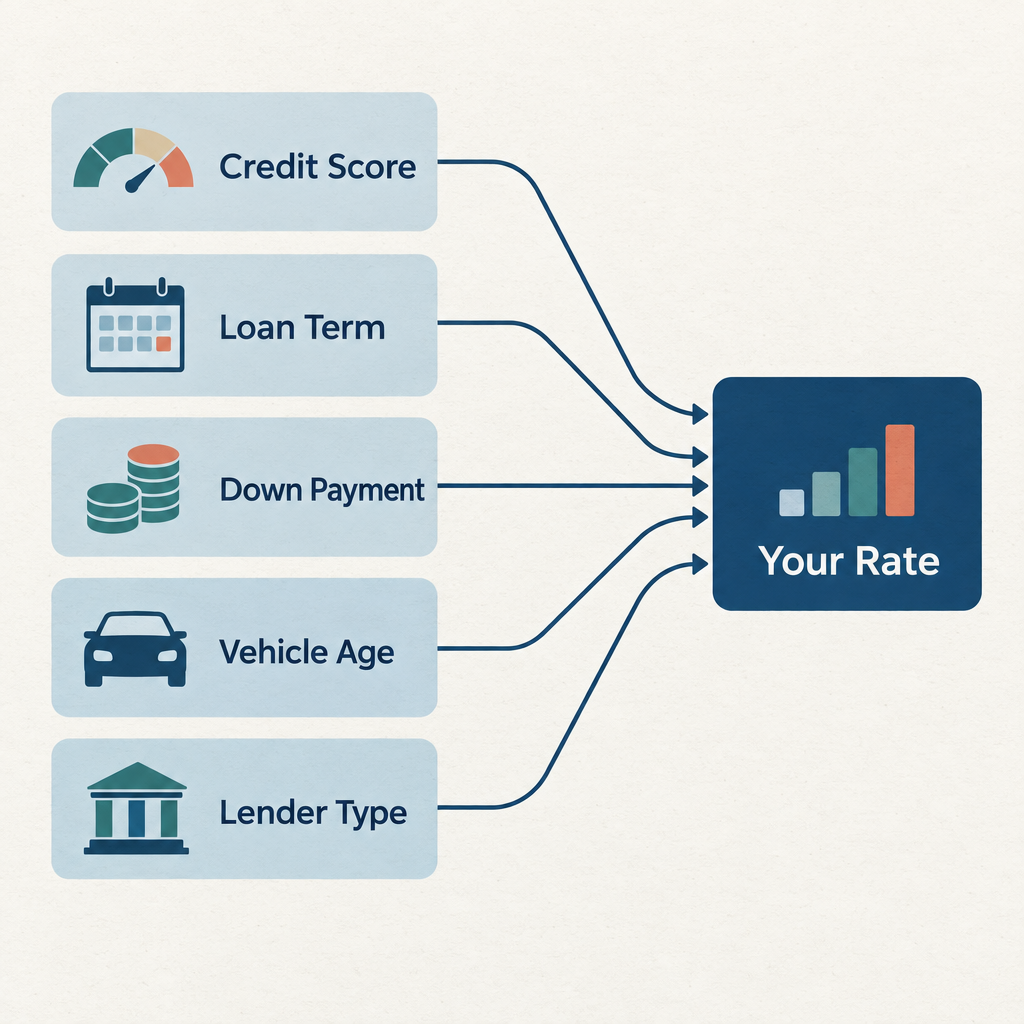
A used car loan is a secured installment loan: the car is the collateral, and you repay in fixed monthly amounts. Lenders set the rate based on how likely you are to repay and how much they could recover if you don’t.
- Credit score and history. This is the biggest factor. Late payments, collections and high card balances all raise your rate.
- Debt-to-income ratio. Lenders compare your monthly debt payments to your income. A high ratio can mean a higher rate or a smaller approved amount.
- Loan term. Longer terms carry more risk for the lender and often a higher APR.
- Down payment and loan-to-value. Borrowing close to or above the car’s value raises the rate. That includes rolling in negative equity from a trade-in.
- Vehicle age and mileage. Older, higher-mileage cars lose value faster and break down more often. Many lenders charge more for them or set age and mileage limits.
- Where you borrow. Credit unions, banks, captive finance companies and buy-here-pay-here dealers price very differently.
- Dealer markup. When a dealer arranges financing, the lender often lets the dealer add points on top of the lender’s “buy rate.” The dealer keeps part of that extra interest.
- The wider rate environment. Auto rates follow broader borrowing costs, so the same profile can get a different quote a year later.
How to get a lower rate
You can’t change the market, but you can control what the lender sees.
How to shop for a used car loan
- Pull your free credit reports and dispute any errors first.
- Get a preapproval from a credit union or bank before visiting dealers.
- Do all your rate shopping within about two weeks.
- Ask the dealer to beat your preapproval in writing.
- Compare APR, term and total of payments side by side.
- Decline add-ons you don’t want before signing.
On timing, FICO scoring models count multiple auto loan inquiries made within a short window as one inquiry. Depending on the version, that window runs 14 to 45 days. VantageScore uses 14 days. Keeping your shopping to two weeks covers both.
A preapproval gives you a firm number to negotiate against. It also separates the price of the car from the price of the loan. Dealers sometimes blend the two to hide a high rate behind a “low” monthly payment. Our guide to what happens when you apply for a loan explains the hard pull and documents involved.
Add-ons raise the amount financed and so the total interest. Common ones include GAP coverage, extended service contracts and paint protection. Federal law doesn’t require you to buy them to get financing. Ask for prices with and without each one.
Cheaper options first
Credit unions often price used car loans below banks and dealers, and federal credit unions can’t charge more than 18% APR.
A cheaper car with a bigger down payment can cut both the rate and the total cost.
Never use a payday loan or payday advance to fund a down payment; that stacks a triple-digit APR on top of your car loan.
Used car loans and the new auto interest tax deduction
The One Big Beautiful Bill Act, signed in July 2025, created a federal deduction of up to $10,000 a year in auto loan interest for tax years 2025 through 2028. It applies only to new vehicles whose final assembly happened in the United States. The law requires that the original use of the vehicle start with you, so used car loans do not qualify. The deduction also phases out at higher incomes. Don’t count on a tax break when you budget for a used car payment.
State rules and availability
Auto lending is regulated mostly at the state level. Many states have motor vehicle retail installment sales laws. These set maximum finance charges for dealer-arranged loans, and some states tie the cap to the vehicle’s age. Others set no specific cap for some lenders. Licensing rules for sales finance companies and buy-here-pay-here dealers also vary.
Before you sign, check your lender or dealer with your state’s financial regulator or attorney general. Lenders that hold a mortgage-style license may also appear in NMLS Consumer Access.
Borrowing against a car you already own is different. That’s a title loan, not a purchase loan. Title loans are banned or tightly capped in many states. See our pages on Texas payday loan laws and California payday loan laws for two examples of how far state rules can differ.
Your rights as a used car borrower
- Truth in Lending Act and Regulation Z (12 CFR 1026). Before you sign, the lender or dealer must disclose the APR, finance charge, amount financed and total of payments.
- Equal Credit Opportunity Act. Lenders can’t price or deny credit based on race, color, religion, national origin, sex, marital status, age or receipt of public assistance. If you’re denied, you’re entitled to an adverse action notice with the reasons or how to request them.
- Fair Credit Reporting Act. If your credit report leads to worse terms, you’re entitled to a risk-based pricing notice or a credit score disclosure. You can also dispute errors for free.
- FTC Used Car Rule. Dealers must post a Buyers Guide on used cars showing whether the car is sold “as is” or with a warranty.
- Military Lending Act and Servicemembers Civil Relief Act. Loans to buy a car that are secured by that car are generally exempt from the Military Lending Act’s 36% cap. The Servicemembers Civil Relief Act, however, can cap interest at 6% on loans you took out before active duty.
Federal law gives you no three-day cooling-off period to cancel a car purchase. Watch for “spot delivery,” where you drive off before financing is final and are later called back to sign at a higher rate. The CFPB has warned about this practice. Don’t sign a contract with blanks, and keep copies of everything.
If something goes wrong, you can file a complaint with the CFPB, the FTC at ReportFraud, or your state attorney general.
FAQ
Why are used car loan rates higher than new car rates?
Used cars lose value less predictably and are harder to resell after a repossession. Lenders also can’t count on manufacturer-subsidized promotional rates, which mostly apply to new cars. Experian’s data shows the gap at every credit tier.
What is a good interest rate for a used car with a 700 credit score?
A 700 score falls in Experian’s prime tier, where the average used car APR was 9.06% in the first quarter of 2025. A quote near or below that is competitive. A much higher quote is worth comparing against a credit union preapproval.
Can I get a used car loan with bad credit?
Many lenders do lend to subprime borrowers, but averages for scores below 600 run around 19% to 22%. “Guaranteed approval” ads usually mean high rates, large down payments or buy-here-pay-here terms. A cosigner, a bigger down payment or a few months of credit repair can lower the price.
Does a longer loan term lower my rate?
No. Longer terms usually carry the same or a higher APR. They lower the monthly payment only by spreading the debt over more months, which raises the total interest.
Should I take dealer financing or get my own loan?
Get your own preapproval first, then let the dealer try to beat it. Dealer financing can be competitive, but the dealer can mark up the lender’s rate. Your preapproval is the best check against that.
Laws and regulations referenced
- Truth in Lending Act, 15 U.S.C. 1601
- Regulation Z, 12 CFR Part 1026
- Fair Credit Reporting Act, 15 U.S.C. 1681
- Equal Credit Opportunity Act, 15 U.S.C. 1691
- Military Lending Act, 10 U.S.C. 987
- Servicemembers Civil Relief Act, 50 U.S.C. 3901
Links go to the official text on government sites.
Check, verify or complain
Sources

Dana writes US Financer's guides to payday loans, personal and installment loans, bad credit borrowing and cash advance apps. Every piece starts from what a loan really costs, works the numbers in a table, and checks what the lender's own disclosure and your state's rules…

Ruth is US Financer's standards editor. Every article goes through her checks before and after it is published: each rate, fee, cap, deadline and rule is matched against its primary source, every law named is linked to its official text, and anything that cannot be…
Comments are closed