Payday loans are legal in Texas, and the state’s 10% interest cap barely touches them. Lenders operate as credit access businesses under Texas Finance Code Chapter 393, which lets them charge an uncapped “fee” on top of a third-party loan that carries interest of no more than 10% a year. The result is that a two-week loan in Texas routinely costs more than 400% APR, and the only hard limits on loan size and rollovers come from city ordinances, not state law.
Run the numbers
How Texas got a 10% cap and 500% payday loans
The Texas Constitution, Article XVI, Section 11, says interest above 10% a year is usury unless the Legislature authorizes something higher. Texas Finance Code Section 302.001 repeats that 10% figure as the default rate when no other statute applies. On paper, that looks like one of the strictest usury laws in the country.
In practice, two other parts of the Finance Code do most of the work. Chapter 303 lets lenders use “optional rate ceilings” that float with market rates, with a floor of 18% and a ceiling that can reach as high as 28% under Section 303.009(c). Chapter 342 then lets licensed consumer lenders charge more than that on small loans through a bracketed rate structure.
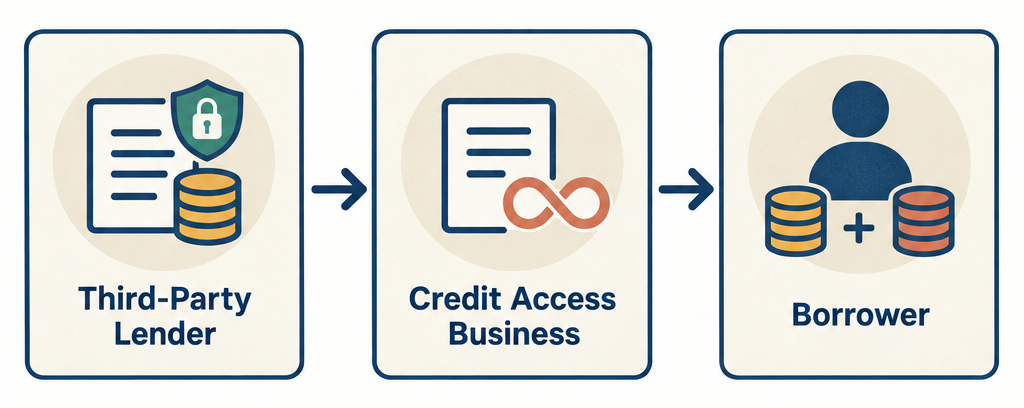
Payday and title lenders use neither route. They register as credit access businesses (CABs) under Chapter 393, the Credit Services Organizations Act. A CAB does not technically lend you money. It arranges a loan from a separate third-party lender, who charges interest at or below 10%, and the CAB charges you a separate fee for “arranging” and “guaranteeing” the loan. Texas law does not cap that fee. The 10% cap applies only to the lender’s slice, which is usually a small fraction of what you pay.
The Legislature licensed this model in 2011 through House Bills 2592 and 2594, effective January 1, 2012. Those bills created Subchapter C-1 (Sections 393.221 through 393.224) for disclosures and Subchapter G (Sections 393.601 through 393.628) for licensing. They did not add a rate cap, a loan limit, a rollover limit or a statewide database. As of October 2026, no bill to cap CAB fees has passed, though versions have been filed in most sessions since.
Payday and short-term loans in Texas
A payday loan in Texas is a single-payment loan, usually due on your next pay date, secured by a postdated check or an authorization to debit your bank account. Chapter 393 calls it a “deferred presentment transaction” (Section 393.601). Most Texas CABs also offer multi-payment versions, which the statute treats the same way.
What the state does and does not limit
| Rule | Texas state law | Citation |
|---|---|---|
| Maximum loan amount | None set by statute | Finance Code Ch. 393 |
| Maximum CAB fee | None set by statute | Finance Code Ch. 393 |
| Interest on the underlying loan | 10% a year | Tex. Const. Art. XVI, §11; Finance Code §302.001 |
| Minimum or maximum term | None set by statute | Finance Code Ch. 393 |
| Rollover or renewal limit | None statewide | Finance Code Ch. 393 |
| Cooling-off period | None | Finance Code Ch. 393 |
| Statewide loan database | None | Finance Code Ch. 393 |
| License required | Yes, from the OCCC | Finance Code §393.603 |
| Fee schedule posted in store and online | Required | Finance Code §393.222 |
| Written disclosure with APR comparison | Required before signing | Finance Code §393.223 |
| Threatening criminal charges over a bounced check | Prohibited | Finance Code §393.201(c) |
The disclosure rules are the main consumer protection you get at the state level. Under Section 393.223, the CAB must hand you a form approved by the Finance Commission that shows the fee, the interest, the APR, and how the cost compares with other kinds of credit. Section 393.222 requires the full fee schedule to be posted where you can read it before you sign. If a store cannot show you a posted schedule and a written disclosure, it is already breaking the law.
What a Texas payday loan really costs
OCCC’s annual credit access business data reports have shown, year after year, that single-payment payday loans in Texas carry APRs in the hundreds of percent. The exact fee varies by company, so the table below uses an illustrative $22 fee per $100 for 14 days, which is in the range Texas CABs have reported. Check the posted schedule for the real number.
| Loan | Fee and interest | Term | Total repaid | APR (approx.) |
|---|---|---|---|---|
| $300 single-payment payday loan | $66 CAB fee plus about $1.15 interest at 10% | 14 days | about $367 | about 580% |
| $500 single-payment payday loan | $110 CAB fee plus about $1.92 interest | 14 days | about $612 | about 580% |
| $500 rolled over three times | Four fees of $110 each plus interest | 56 days | about $948 | about 580% |
The APR math is simple. Divide the total charge by the amount borrowed ($67.15 divided by $300 equals 0.224), divide that by the number of days (14), then multiply by 365. That gives roughly 5.8, or 580%. Truth in Lending Act disclosures under Regulation Z (12 CFR 1026) must show you this figure before you sign, and Texas law requires it on the state disclosure form as well.
The rollover line is the one to study. Every renewal charges a fresh fee without reducing what you owe. OCCC data has repeatedly shown that most single-payment payday loan revenue in Texas comes from refinances rather than new loans.
The older Chapter 342 payday loan rule
You will see 7 Texas Administrative Code Section 83.604 cited in search results as the Texas payday loan rule. That rule, and Finance Code Chapter 342, Subchapter F, govern deferred presentment loans made directly by a licensed consumer lender under the state’s capped rate brackets. Almost no lender uses that route, because the allowed charges are far lower than what a CAB can collect. If you want to know whether your lender is a true regulated lender or a CAB, look at your contract: a CAB agreement names a separate “lender” and lists a separate CAB fee.
Local ordinances fill the gap
More than 45 Texas cities adopted a model ordinance drafted by the Texas Municipal League, starting with Dallas and Austin in 2011 and later including San Antonio, Houston, El Paso and Fort Worth. The ordinance applies to any CAB operating inside city limits.
| Ordinance rule | Payday loans | Auto title loans |
|---|---|---|
| Loan size cap | 20% of gross monthly income | Lesser of 3% of gross annual income or 70% of vehicle value |
| Maximum installments | Four | Four |
| Principal reduction per payment | At least 25% | At least 25% |
| Rollovers or renewals | No more than three | No more than three |
| City registration | Required | Required |
One important caveat, dated October 2026. House Bill 2127 (2023), often called the Texas Regulatory Consistency Act, added Finance Code Section 1.004, which bars cities from regulating in any field occupied by the Finance Code. It took effect September 1, 2023. A Travis County district court declared the law unconstitutional before it took effect, an appeals court later reversed that ruling, and the question of whether payday ordinances survive is still working through the courts. Some cities continue to enforce their ordinances. If you live in a city with an ordinance, call the city’s code enforcement or regulatory office and ask whether it is still being enforced.
Car title loans in Texas
Texas car title and payday loans come from the same statute and often from the same storefronts. A title loan is a “motor vehicle title loan” under Finance Code Section 393.601: you hand over the title to a vehicle you own outright, the CAB arranges a loan from a third-party lender, and the CAB charges its own fee. Interest on the lender’s portion stays at or under 10%; the CAB fee is uncapped.
Most Texas title loans are structured as 30-day single-payment loans. The fee is charged again each month you renew. Below is an illustrative example using a 25% monthly charge, which is within the range OCCC data has reported for single-payment auto title loans in the state.
| Loan | Monthly charge | Term | Total repaid | APR (approx.) |
|---|---|---|---|---|
| $1,000 title loan, paid in full | $250 | 30 days | $1,250 | about 304% |
| $1,000 title loan, renewed 5 times | $250 × 6 | 180 days | $2,500 | about 304% |
| $2,500 title loan, renewed 11 times | $625 × 12 | 360 days | $10,000 | about 304% |
The third row is not an exaggeration. If you only ever pay the monthly fee, a year of renewals on $2,500 costs $7,500 and you still owe the original $2,500.
Repossession rules
Texas has no title-loan-specific repossession statute. The lender’s rights come from Article 9 of the Uniform Commercial Code as adopted in Texas Business and Commerce Code Chapter 9. Under Section 9.609, the lender may repossess the car without going to court as long as it does not “breach the peace,” which in practice means no breaking into a locked garage and no physical confrontation. Under Sections 9.610 and 9.615, the lender must sell the car in a commercially reasonable way, return any surplus to you, and can sue you for a deficiency if the sale does not cover the debt plus allowed costs.
Many Texas title lenders install GPS trackers or starter-interrupt devices as a condition of the loan. Your contract will say so. Read it before you sign, and keep a copy.
Because the city ordinances cap title loans at 70% of the vehicle’s value and require principal reduction, a lender outside an ordinance city can lend against the full value and renew indefinitely. That is the main reason title-loan repossession rates in Texas vary so much by location.
Installment and personal loans: Chapter 342 and the rate brackets
An installment loan in Texas can come from three very different kinds of lender, and the law treats each one differently.
Licensed Chapter 342 lenders
Any company making consumer loans at more than 10% interest must hold a regulated lender license from the OCCC under Finance Code Section 342.051. Chapter 342 sets two rate structures. Subchapter E (Section 342.201) covers larger loans with a tiered add-on interest structure. Subchapter F (Sections 342.251 through 342.260) covers small loans and allows an acquisition charge plus a monthly installment account handling charge instead of a conventional interest rate.
The dollar brackets in both subchapters are adjusted for inflation every year under Finance Code Section 341.203, and the OCCC publishes the new figures each July. Because the brackets move annually, this article does not quote them. The current table is on the OCCC’s website under “regulated lenders.”
What matters for you: a Chapter 342 loan has a real rate ceiling, must be repaid in substantially equal installments, and carries capped late fees. A $500 Subchapter F loan is expensive by credit-card standards but far cheaper than a CAB loan of the same size.
CAB installment loans
The same credit access businesses that make payday loans also offer “installment” products arranged under Chapter 393. The name is the same, the law is not. A CAB installment loan has no rate ceiling, and the fee can be charged on every installment. Texas Appleseed and OCCC reports have documented CAB installment loans with APRs between 200% and 600%. If your contract names a CAB and a separate lender, you are in Chapter 393, not Chapter 342, regardless of what the product is called.
Banks and credit unions
State and national banks lend under their own charters and federal law. Texas-chartered credit unions are supervised by the Texas Credit Union Department; federal credit unions by the National Credit Union Administration. Federal credit union loans are capped at 18% APR under the NCUA’s standing rate ceiling, with the payday alternative loan exception described below.
Loans in Texas with bad credit
Ads promising a bad credit loan in Texas with “guaranteed approval” are describing a CAB loan, a pawn loan under Texas Finance Code Chapter 371, or a lead-generation site that sells your application to the highest bidder. No licensed lender guarantees approval; what they mean is that they use a soft credit pull or alternative data and price the loan for the risk. Pages that push urgent loans guaranteed approval are selling speed, and the price of speed in Texas is an uncapped CAB fee.
Cheaper paths exist even with poor credit: a credit union payday alternative loan, a Chapter 342 lender that reports to the credit bureaus, a secured credit card, or a hardship plan from the creditor you are trying to pay. Run any offer through a personal loan calculator before signing so you see total repayment, not just the monthly payment.
Online payday loans in Texas, and tribal lenders
Texas payday loans online fall under the same law as storefront loans. Finance Code Section 393.603 requires a CAB license for any business that obtains credit for Texas consumers, and Section 342.051 requires a regulated lender license for anyone making Chapter 342 loans to Texas residents. The lender’s physical location does not change that. An online lender in Delaware or Utah lending to someone in Houston needs a Texas license, and the OCCC can and does take action against unlicensed ones.
Three categories of online lender cause trouble:
- Unlicensed out-of-state lenders. Common and illegal. The OCCC has issued cease-and-desist orders against companies in this group. A contract from an unlicensed lender is still a debt, but the lender has weak legal footing to enforce it in Texas courts and cannot lawfully charge above 10%.
- Tribal lenders. These companies claim sovereign immunity through affiliation with a federally recognized Native American tribe and say Texas law does not apply. Courts have split on how far that immunity reaches, and the OCCC generally cannot force a tribe into state licensing. You can still file a complaint with the Consumer Financial Protection Bureau, which has sued tribal-affiliated lenders. Treat a tribal loan as one you will have almost no state remedies against.
- Lead generators. The site collects your application and sells it. You may hear from a dozen lenders, some licensed, some not. Texas requires lead generators that arrange credit to register as credit services organizations, but enforcement is thin.
How to check a Texas lender's license
- Ask the company for its OCCC license number. CABs and regulated lenders must display it.
- Search the OCCC’s online license lookup (the ALECS consumer search) by company name.
- Cross-check on NMLS Consumer Access, since Texas issues most lender licenses through NMLS.
- For a bank or credit union, use the FDIC BankFind or NCUA credit union locator instead.
- If you cannot find the license, do not sign, and report the company to the OCCC.
One more federal rule matters for online loans. Under the Electronic Fund Transfer Act and Regulation E (12 CFR 1005.10(e)), a lender cannot require you to repay by preauthorized electronic debit as a condition of getting the loan. Any lender that says “we only do ACH” is violating federal law.
Bank account debits: the risk nobody reads about in the contract
Most Texas payday loans are repaid by automatic withdrawal. That is where the real damage often starts. Each failed debit can trigger a bank overdraft or returned-item fee, and the lender may try again several times in one day.
The CFPB’s payday lending rule at 12 CFR Part 1041 now limits this. Since March 30, 2025, when the rule’s payment provisions took effect after years of litigation, a covered lender that has two consecutive failed withdrawal attempts must stop and get a fresh authorization from you before trying again (12 CFR 1041.8). Lenders must also give you advance notice before an unusual withdrawal.
You also have the right under Regulation E (12 CFR 1005.10(c)) to revoke a preauthorized debit by telling your bank at least three business days before the scheduled withdrawal. Put it in writing to both the bank and the lender. Revoking the debit does not cancel the debt; it only changes how you pay it.
Debt collection and wage garnishment limits in Texas
Texas gives borrowers two layers of collection protection: the federal Fair Debt Collection Practices Act and the state’s own Texas Debt Collection Act, Finance Code Chapter 392.
The Texas Debt Collection Act
Chapter 392 is broader than the federal law in one key way: it covers original creditors as well as third-party collectors. That means the payday lender itself, not just an agency it hires, has to follow these rules.
- Section 392.301 bans threats and coercion, including threatening to file criminal charges when you have not committed a crime.
- Section 392.302 bans harassment, including repeated or continuous calls intended to harass.
- Section 392.303 bans unfair or unconscionable means, such as collecting fees or interest the contract or law does not authorize.
- Section 392.304 bans false or misleading statements, including misrepresenting the amount owed or claiming to be an attorney or government agency.
- Section 392.101 requires third-party collectors to post a $10,000 surety bond with the Texas Secretary of State before collecting from Texas residents.
- Section 392.307, added in 2019, bars debt buyers from suing or arbitrating on a time-barred debt and says a payment on a time-barred debt does not restart the clock.
If a collector violates Chapter 392, Section 392.403 lets you sue for an injunction and actual damages, and Section 392.404 makes the violation a deceptive trade practice under the Texas Deceptive Trade Practices Act, which opens the door to additional damages and attorney’s fees.
Criminal charges over a bounced payday check
This comes up constantly in Texas. Finance Code Section 393.201(c) prohibits a credit access business from threatening or pursuing criminal charges over a check or debit authorization you gave as security, unless there is actual forgery, fraud or theft. A 2014 Texas Appleseed review found more than 1,500 criminal complaints filed by payday lenders against borrowers across a handful of counties, which prompted the OCCC to issue guidance reminding CABs of the rule. If a lender or collector says you will be arrested for a bounced payday check, that is a violation, and you should report it to the OCCC and the Texas Attorney General.
Wage garnishment
Texas is one of a handful of states where a private creditor cannot garnish your wages for a consumer debt. Article XVI, Section 28 of the Texas Constitution and Property Code Section 42.001(b)(1) exempt current wages for personal services from garnishment. The exceptions are court-ordered child support, spousal maintenance, and debts collected under federal law such as unpaid federal taxes and defaulted federal student loans.
The protection ends when wages land in your bank account. A creditor with a court judgment can serve a writ of garnishment on your bank and freeze the account. Texas does not exempt bank deposits as such, though funds that are traceable to exempt sources (Social Security, for example, which is protected under 42 U.S.C. §407) remain protected and you can file to claim them.
Other property exemptions
| Property | Texas exemption | Citation |
|---|---|---|
| Homestead | Unlimited value; 10 acres urban, 100 acres rural (200 for a family) | Property Code Chapter 41 |
| Personal property | Up to $100,000 for a family, $50,000 for a single adult, in total | Property Code §42.001(a) |
| Vehicles | One motor vehicle per licensed household member, within the personal property cap | Property Code §42.002(a)(9) |
| Current wages | Fully exempt from garnishment | Tex. Const. Art. XVI, §28 |
| Retirement accounts | Exempt | Property Code §42.0021 |
How long a lender can sue
The statute of limitations on a written contract or debt in Texas is four years under Civil Practice and Remedies Code Section 16.004. After that, a lender or debt buyer can still ask you to pay, but it cannot win a lawsuit if you raise the limitations defense, and under Finance Code Section 392.307 a debt buyer cannot file one at all. A new written promise to pay can revive an expired debt under Civil Practice and Remedies Code Section 16.065, so do not sign any “acknowledgment” a collector sends on an old account without understanding what it does.
Help that costs less in Texas
High-cost credit should be the last option, not the first. The list below is ordered roughly from cheapest to most expensive.
Cheaper options first
A federal credit union payday alternative loan costs no more than 28% APR by federal rule.
2-1-1 Texas connects you to utility, rent and food assistance that does not have to be repaid.
Nonprofit credit counselors registered with the OCCC can set up a repayment plan for a small fee or none.
Credit union payday alternative loans
Federal credit unions can make payday alternative loans (PALs) under NCUA rules at 12 CFR 701.21(c)(7). PAL I loans run from $200 to $1,000, with terms of one to six months, an APR capped at 28%, and an application fee of no more than $20. You need to have been a member for at least one month. PAL II loans go up to $2,000 for up to 12 months with the same rate cap and no waiting period. A $500 PAL repaid over three months costs about $23 in interest plus the application fee, against roughly $330 in fees for three consecutive two-week payday loans of the same size. Many Texas credit unions open membership by county of residence or employer, and some state-chartered credit unions offer similar small-dollar products under Texas Credit Union Department rules.
Texas utility assistance and other state programs
- Comprehensive Energy Assistance Program (CEAP). Texas’s version of the federal LIHEAP program, run by the Texas Department of Housing and Community Affairs through local community action agencies. It pays electric and gas bills for households at or below 150% of the federal poverty level, with priority for seniors, people with disabilities and families with young children. Apply through your county’s community action agency.
- Weatherization Assistance Program. Also through TDHCA. Free insulation, air sealing and HVAC repairs that lower bills permanently.
- 2-1-1 Texas. A statewide referral line operated by the Texas Health and Human Services Commission. Call or search online for rent, utility, food and medical assistance in your area, including local church and charity funds that cover one-time emergencies.
- SNAP, TANF and Medicaid. Apply through the Your Texas Benefits portal run by HHSC. TANF includes a one-time emergency cash payment option for qualifying families.
- Texas Veterans Commission Fund for Veterans’ Assistance. Grants to local organizations that provide emergency financial help to veterans and their families.
- Unemployment benefits. Through the Texas Workforce Commission if you have lost work.
Several pandemic-era programs, including Texas Rent Relief and the Texas Homeowner Assistance Fund, have closed. Any website claiming they are still taking applications is out of date or a scam.
Debt relief programs in Texas
Any company offering a debt relief program in Texas that collects your payments or negotiates with creditors must register with the OCCC as a debt management or debt settlement services provider under Finance Code Chapter 394. The OCCC’s website lists registered providers. Nonprofit credit counseling agencies affiliated with the National Foundation for Credit Counseling set up debt management plans that typically reduce interest without adding to your debt.
Debt settlement companies are a different animal. They tell you to stop paying creditors while you save into an escrow account, then negotiate lump-sum settlements. Your credit takes a hit, creditors can sue in the meantime, and the Federal Trade Commission’s Telemarketing Sales Rule (16 CFR 310.4(a)(5)) bans these companies from charging a fee before they settle a debt. Forgiven debt over $600 is also taxable income under IRS rules unless you qualify for the insolvency exclusion. Treat any Texas debt relief program that asks for money up front as a red flag.
Nonprofit credit counselors and legal aid offices such as Texas RioGrande Legal Aid and Lone Star Legal Aid can also walk you through financial dispute resolution options with a lender, including the OCCC complaint process and small-claims court.
Getting out of a Texas payday loan legally
There is no state-mandated extended payment plan in Texas, unlike Florida or Washington. You still have options.
- Ask the lender for a no-cost payment plan in writing. Some CABs offer one; ordinance cities require principal reduction on each installment.
- Revoke the bank debit under Regulation E if the withdrawals are causing overdrafts, then pay on a schedule you can keep.
- Refinance into a PAL or Chapter 342 installment loan at a fraction of the rate.
- Check whether the lender is licensed. An unlicensed lender cannot collect more than 10% interest and may not be able to enforce the contract at all.
- Consider bankruptcy if the payday loan is one of many debts. Payday loans are generally dischargeable in Chapter 7, with limited exceptions for loans taken shortly before filing.
Federal rules that apply everywhere
Three federal laws sit on top of the Texas rules no matter which lender you use.
The Truth in Lending Act and Regulation Z (12 CFR 1026) require every lender, including CABs and tribal lenders, to disclose the finance charge and the APR in writing before you are obligated. A missing or inaccurate APR disclosure gives you a claim for statutory damages.
The Military Lending Act (10 U.S.C. §987 and 32 CFR Part 232) caps the Military Annual Percentage Rate at 36% for active-duty service members and their dependents, bans mandatory arbitration in those contracts, and bars lenders from requiring access to a bank account or vehicle title as security. A payday or title loan to a covered borrower above 36% MAPR is void from the start. The Servicemembers Civil Relief Act separately lets active-duty borrowers reduce interest on pre-service debts to 6%.
The Fair Debt Collection Practices Act (15 U.S.C. §1692 and following) and Regulation F (12 CFR Part 1006) govern third-party collectors nationwide. Regulation F presumes that more than seven calls in seven days about one debt is harassment, requires a validation notice within five days of first contact, and bars collectors from suing on time-barred debt. The Fair Credit Reporting Act gives you the right to dispute inaccurate collection entries on your credit report.
How to check a lender and file a complaint in Texas
The Office of Consumer Credit Commissioner licenses and examines CABs, regulated lenders, pawnshops and debt management providers. Its consumer helpline is 800-538-1579, and it accepts complaints online. The OCCC can order refunds, fine licensees and revoke licenses. It cannot act against a bank, a credit union or a tribal lender.
For debt collection complaints, including threats of arrest, file with the Texas Attorney General’s Consumer Protection Division and, for a collector’s bond, with the Texas Secretary of State. Complaints about banks go to the Texas Department of Banking (state banks) or the Office of the Comptroller of the Currency (national banks). Credit union complaints go to the Texas Credit Union Department or the NCUA.
File with the Consumer Financial Protection Bureau in every case. The CFPB forwards complaints to the company, which must respond within 15 days, and its public complaint database lets you see a lender’s record before you borrow. Suspected fraud, including fake “loan approval” calls that demand an upfront fee, goes to the FTC’s ReportFraud site and the FBI’s Internet Crime Complaint Center.
Keep every document: the contract, the Section 393.223 disclosure form, the fee schedule, receipts, bank statements showing debits, and screenshots of texts. Texas complaints move faster with paperwork attached.
Before you borrow
Texas does not cap the fee on a payday or title loan, and nothing in state law stops a lender from renewing it every two weeks or every month until you have paid several times the amount you borrowed. If you cannot repay the full balance plus fee on the due date without borrowing again, the loan is not a fit.
FAQ
Are payday loans legal in Texas?
Yes. They are made through credit access businesses licensed under Texas Finance Code Chapter 393. The state’s 10% interest cap applies only to the third-party lender’s portion; the CAB fee has no statutory limit, which is why APRs commonly exceed 400%.
Is there a limit on how much I can borrow with a Texas payday loan?
Not under state law. Roughly 45 cities, including Houston, Dallas, San Antonio, Austin, El Paso and Fort Worth, adopted ordinances capping payday loans at 20% of gross monthly income and title loans at the lesser of 3% of gross annual income or 70% of the vehicle’s value. Those ordinances have been in legal limbo since House Bill 2127 took effect in September 2023, so check with your city.
Can a payday lender have me arrested in Texas?
No. Finance Code Section 393.201(c) bars credit access businesses from threatening or pursuing criminal charges over a bounced check or failed debit unless there was actual fraud or theft. Threatening arrest also violates the Texas Debt Collection Act, Section 392.301. Report it to the OCCC and the Texas Attorney General.
Can a payday lender garnish my wages in Texas?
No private creditor can garnish wages for a consumer debt in Texas, under Article XVI, Section 28 of the Texas Constitution. A lender with a court judgment can garnish your bank account, though, so money becomes vulnerable once it is deposited.
Do online payday lenders have to follow Texas law?
Yes, if they lend to Texas residents. They need an OCCC license under Finance Code Section 393.603 or Section 342.051. Tribal lenders claim immunity from state law, and the OCCC usually cannot reach them, so file with the CFPB if you have a problem with one.
How long does a lender have to sue me over a payday loan in Texas?
Four years from the default, under Civil Practice and Remedies Code Section 16.004. A debt buyer cannot sue on a time-barred debt at all under Finance Code Section 392.307, and a payment does not restart the clock, but a new signed promise to pay can.
Laws and regulations referenced
- Truth in Lending Act, 15 U.S.C. 1601
- Regulation Z, 12 CFR Part 1026
- Fair Debt Collection Practices Act, 15 U.S.C. 1692
- Regulation F (debt collection), 12 CFR Part 1006
- Fair Credit Reporting Act, 15 U.S.C. 1681
- Electronic Fund Transfer Act, 15 U.S.C. 1693
- Regulation E (electronic transfers), 12 CFR Part 1005
- Military Lending Act, 10 U.S.C. 987
- Military Lending Act rule, 32 CFR Part 232
- Servicemembers Civil Relief Act, 50 U.S.C. 3901
- CFPB payday lending rule, 12 CFR Part 1041
Links go to the official text on government sites.
Check, verify or complain
Sources
- texasattorneygeneral.gov › sites › default › files › opinion files › opinion › 2019 › kp 0277.pdf texasattorneygeneral.gov · primary source
- cdfifund.gov › node › 1030716 cdfifund.gov · primary source
- texas.public.law › statutes › tex. fin. code section 342.051 texas.public.law
- sciencedirect.com › science › article › abs › pii › S1544612324006962 sciencedirect.com
- nber.org › system › files › working papers › w28765 › w28765.pdf nber.org
- texas.public.law › statutes › tex. fin. code title 5 chapter 393 texas.public.law
- codes.findlaw.com › tx › finance code › fin sect 393 622 codes.findlaw.com

Elena writes about getting through a money emergency, assistance programs, budgeting on a tight income, banking basics and borrower rights. Her guides list the cheaper options first and link the agency or program that can actually help.

Ruth is US Financer's standards editor. Every article goes through her checks before and after it is published: each rate, fee, cap, deadline and rule is matched against its primary source, every law named is linked to its official text, and anything that cannot be…
Comments are closed