An IDO (initial DEX offering) is a token sale run through a decentralized exchange or a launchpad that feeds one, where buyers pay in crypto from their own wallets and the token starts trading on-chain minutes after the sale closes. It is the DeFi successor to the 2017-era ICO, with more automation and, usually, less paperwork. We explain the mechanics, the memecoin version, the US legal picture and what the IRS expects.
Before you join an IDO
Most IDO tokens trade below their sale price within months, and a meaningful share go to zero. There is no deposit insurance, no cooling-off period and usually no one to sue if the team vanishes.
What an IDO actually is
The acronym means initial DEX offering. A project creates a new token, sets a sale price and a hard cap, and sells an allocation to the public through a decentralized exchange or a launchpad that routes to one. The first widely cited IDO was Raven Protocol’s sale on Binance DEX in June 2019, and the format spread across Ethereum, BNB Chain, Solana and Polygon from 2020 onward.
Three things separate an IDO from a traditional stock IPO. There is no underwriter and no registration statement with the SEC. Settlement happens in a smart contract rather than through a broker. And the token gets a trading market the same day, because the project pairs part of the raised funds with new tokens in a liquidity pool.
How a launchpad sale works, step by step
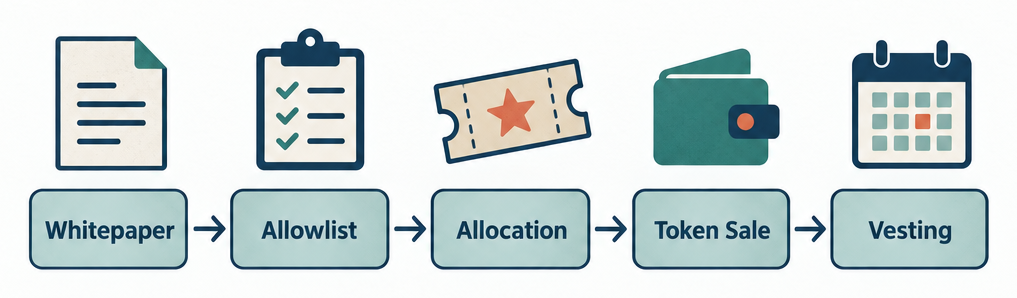
Launchpads such as Polkastarter, DAO Maker and Seedify sit between projects and buyers. They screen (lightly) the projects, run the allocation lottery and host the claim contract. The flow is similar across most of them.
A typical IDO on a launchpad
- The project publishes a whitepaper, tokenomics and sale parameters: price, hard cap, vesting schedule.
- The launchpad opens an allowlist. Most require KYC, and most tier allocations by how much launchpad token you have staked.
- A lottery or guaranteed round assigns allocations, often $100 to $500 per wallet.
- On sale day you send USDC, ETH or SOL to the sale contract from your wallet.
- At the token generation event (TGE) the project adds liquidity to a DEX and unlocks a first tranche, often 10% to 25%.
- Remaining tokens vest over weeks or months, claimable from the launchpad contract.
The staking requirement is the launchpad’s business model. To qualify for a decent tier you must buy and lock its native token, which means you are already exposed to one volatile asset before the sale begins.
IDO vs ICO vs IEO
| Feature | ICO (2017 style) | IEO | IDO |
|---|---|---|---|
| Who runs the sale | Project itself | Centralized exchange | DEX or launchpad |
| Custody of your funds | Project’s wallet | Exchange account | Your own wallet to a contract |
| KYC | Often none | Exchange’s KYC | Varies, usually launchpad KYC |
| Day-one liquidity | Not guaranteed | Exchange listing | DEX pool at TGE |
| Typical vetting | None | Exchange due diligence | Light launchpad screening |
The IDO model fixed the ICO’s worst problem, projects that raised millions and never listed anywhere. It did not fix the quality of the projects, and it added a new failure mode: a liquidity pool the team can drain.
Memecoin launchpads: IDOs stripped to the bone
A memecoin launchpad takes the IDO idea and removes the whitepaper, the allowlist and the team. Pump.fun on Solana is the best-known example. Anyone pays a small fee to mint a token, buyers purchase along a bonding curve that raises the price with each buy, and once the curve fills (a fixed SOL threshold) the launchpad moves liquidity to a DEX automatically.
The pitch is fairness: no presale, no insider allocation, same curve for everyone. The reality is that bots and the creator’s own wallets often buy first and sell into the crowd. Research by on-chain analytics firms has repeatedly found that only a tiny fraction of tokens created on these platforms reach the DEX stage, and fewer still hold any value a month later. Treat a memecoin launchpad as entertainment spending, not investing.
The risks, in plain terms
Rug pulls. The team removes the liquidity it added at TGE, leaving holders unable to sell. Locked liquidity (verifiable on a third-party locker) reduces but does not remove this risk, since the team can still dump unlocked tokens.
Soft rugs. Nobody steals anything. The team simply stops shipping, and the token drifts toward zero.
Contract exploits. A honeypot contract lets you buy but blocks selling. A hidden mint function lets the deployer create unlimited supply. Neither shows up in a glossy website.
Vesting cliffs. Private-round investors who paid a fraction of your price unlock their tokens on a schedule. Those unlock dates are sell pressure you can see coming if you read the tokenomics.
Structural losses. Launchpad staking, gas fees, failed transactions during a gas war and slippage on a thin pool all cost money before the token moves at all.
Some projects are outright fraud dressed as an IDO. If returns are promised, if referral rewards dominate the pitch, or if “staking yield” comes from new buyers, read about how a crypto “ponzi scheme” operates before sending anything. The same caution applies to launchpads selling NFT mints; our “nft explained” piece covers how those differ from fungible tokens.
US rules: what is law and what is not
The SEC has applied the Howey test to token sales since its 2017 DAO Report, and it has brought enforcement actions against ICO issuers including Kik and Telegram. A token sold to raise money for a project whose team promises to build value is a strong candidate for a security, whatever the sale is called. Most launchpads geoblock US IP addresses for exactly this reason, and some exclude US persons in their KYC flow.
Two newer items matter, and we grade them carefully. In February 2025 the SEC’s Division of Corporation Finance issued a staff statement saying meme coins, as the staff defined them, are generally not securities. That is staff guidance, not a rule, not a court decision and not a safe harbor for the platforms that sell them. Separately, Congress has been working on market-structure legislation (the CLARITY Act passed the House in 2025) that would split oversight between the SEC and the CFTC. Until a bill is signed, that is a proposal, not law.
Memecoin launchpads have also drawn private lawsuits in US federal courts alleging they sold unregistered securities. Those cases are unresolved, so we would not assume either outcome.
IRS treatment of IDO tokens
The IRS treats crypto as property under Notice 2014-21. Three taxable moments follow from that:
| Event | Tax consequence |
|---|---|
| Paying ETH or SOL into the sale | Disposal of the ETH or SOL; gain or loss on it |
| Receiving the new token | Establishes cost basis (what you paid, in dollars) |
| Selling or swapping the token | Capital gain or loss, short-term if held a year or less |
Airdropped or reward tokens from a launchpad count as ordinary income at fair market value when you gain control of them, per Revenue Ruling 2023-14’s logic on staking rewards. Report sales on Form 8949 and Schedule D. Centralized brokers now issue Form 1099-DA, but DEXs and launchpads generally do not, since Congress repealed the DeFi broker reporting rule in April 2025. The reporting burden is on you, and wallet-level records are the only defense in an audit.
FAQ
What does IDO stand for?
Initial DEX offering: a token sale conducted on a decentralized exchange or through a launchpad that lists the token on one at launch.
Is an IDO legal in the United States?
Running one is risky for the issuer if the token meets the Howey test, and most launchpads block US participants. Buying is not illegal for an individual, but you get none of the disclosures or remedies a registered offering provides.
How much money do people put into an IDO?
Launchpad allocations are usually capped between $100 and $500 per wallet, plus the cost of staking the launchpad’s token to qualify.
Can I lose everything in an IDO?
Yes. Tokens can go to zero through a rug pull, an exploit or plain failure, and no FDIC or SIPC coverage applies to crypto.
What is a memecoin launchpad?
A platform that lets anyone create and sell a token through a bonding curve with no vetting, no allowlist and no roadmap. It is the IDO model with every safeguard removed.