Crypto can lose all of its value and is not protected by FDIC or SIPC insurance. This is education, not investment advice.
An NFT, short for non-fungible token, is a unique digital record stored on a blockchain that says who controls a specific item, usually a piece of digital art, a game item, a music file or a membership pass. You can trade it, prove you hold it and move it between wallets, but it is not insured, its value can fall to zero, and the IRS taxes it as property. This guide explains how NFTs actually work, what they cost, where the risks sit and how US tax rules apply.
NFT meaning: what “non-fungible” means
Fungible means interchangeable. One dollar bill is worth exactly the same as any other dollar bill, and one bitcoin is the same as any other bitcoin. You can swap them with nobody caring which one they got.
Non-fungible means one of a kind. A signed first-edition book, a house, your passport. Each has its own identity and history, so you cannot swap it one-for-one with another and call it even.
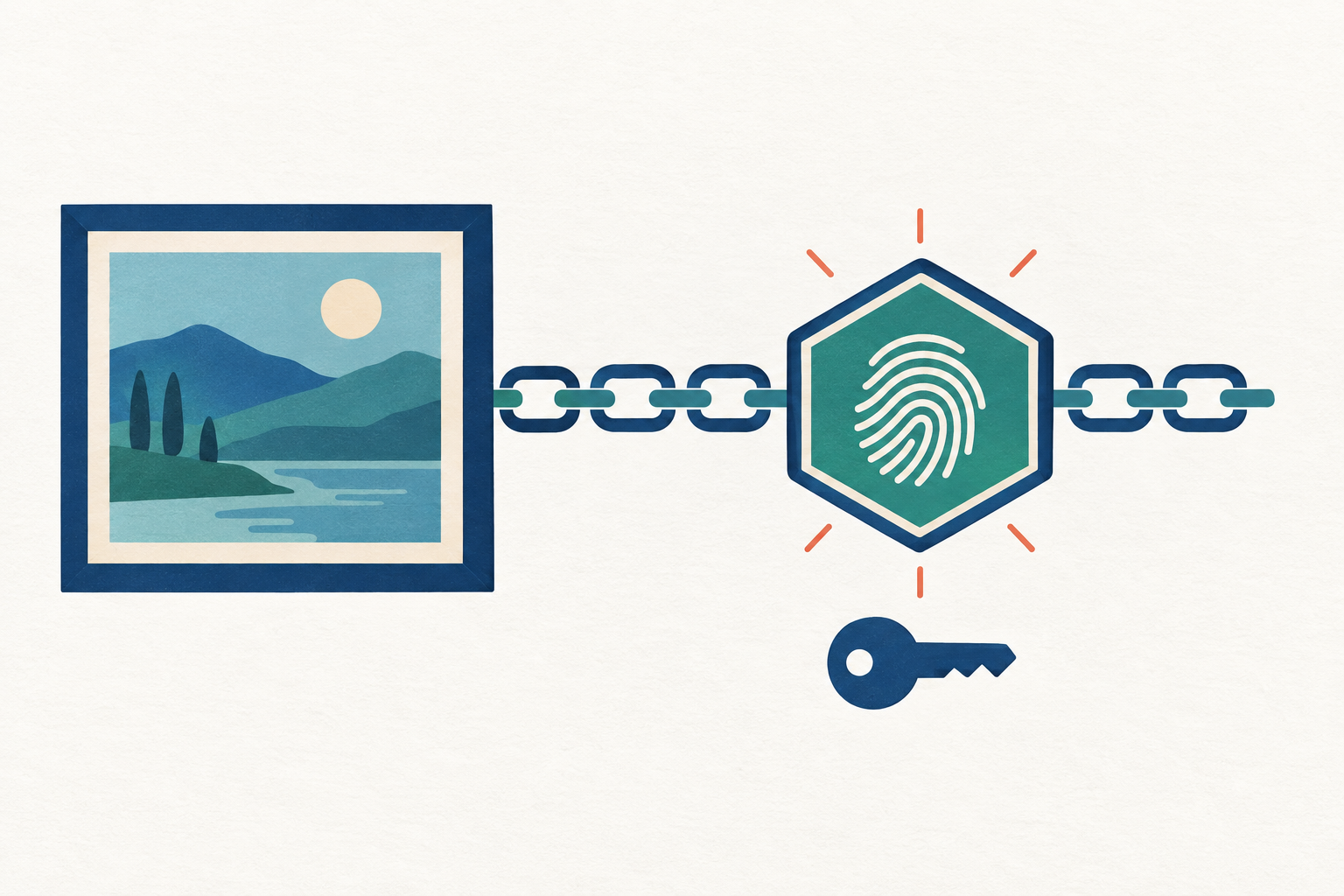
An NFT applies that idea to digital files. Before NFTs, a JPEG could be copied a million times with no way to say which copy was “the” original. An NFT creates a single blockchain entry tied to that file, with a serial number and an owner address. The file itself can still be copied. The token cannot.
| Feature | Fungible token (bitcoin, ETH, USDC) | Non-fungible token (NFT) |
|---|---|---|
| Interchangeable? | Yes, every unit identical | No, each token has a unique ID |
| Divisible? | Yes, down to fractions | Usually no, you hold whole tokens |
| Typical use | Money, payments, trading | Art, collectibles, game items, tickets, memberships |
| Ethereum standard | ERC-20 | ERC-721, ERC-1155 |
| Value driver | Supply, demand, utility as money | Scarcity, creator, community, utility of the specific item |
How NFTs work, step by step
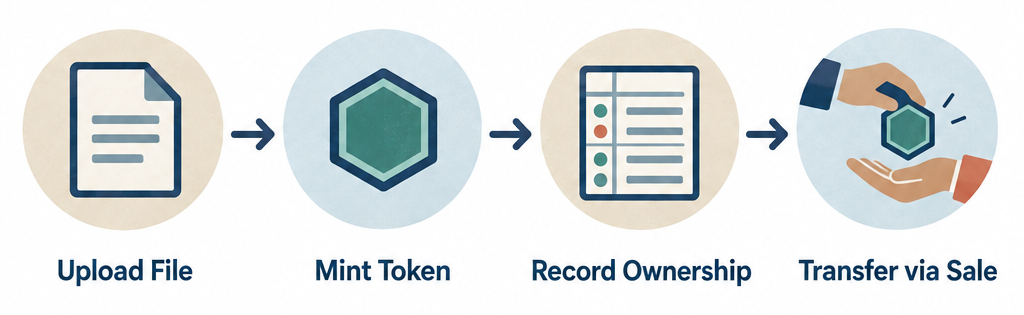
An NFT lives inside a smart contract, which is a program running on a blockchain. On Ethereum, most NFTs follow the ERC-721 standard, finalized in 2018, which defines a token with a unique ID and an owner. ERC-1155 came later and lets one contract issue both unique items and batches of identical items, which is why games prefer it.
Creating an NFT is called minting. The creator uploads a file, writes the metadata (name, description, traits) and calls the contract to issue the token. The token points to the file’s location. Many projects store the actual image on IPFS, a decentralized file system, while some store it on a regular web server. That distinction matters, and we come back to it under risks.
Ownership is just an entry saying “token #4821 belongs to wallet 0xAB12…”. When you sell, the contract updates that entry. Anyone can look up the full history on a block explorer such as Etherscan. That public, tamper-resistant record is the whole point.
You hold NFTs in a crypto wallet. Software wallets like MetaMask or Phantom hold the private keys on your device. A hardware wallet keeps keys offline. Whoever controls the keys controls the NFT, so losing a seed phrase or signing a malicious transaction loses the token for good. There is no customer service line that can reverse it.
What you actually own
This is where many buyers get burned. Holding an NFT typically does not give you copyright. You own the token. The creator usually keeps the intellectual property unless the project’s license says otherwise. Some collections, including Bored Ape Yacht Club, grant holders commercial rights to their specific image. Many others grant personal display rights only. Read the license before you assume you can print T-shirts.
Where NFTs show up in practice
Profile-picture collections such as CryptoPunks and Bored Ape Yacht Club drove the 2021 boom. Holders used them as social identity, and some projects attached community perks: private chat rooms, event access, merchandise drops.
Games use NFTs for characters, land and gear. Axie Infinity’s play-to-earn model drew millions of players in 2021, mostly in the Philippines and Venezuela, before its in-game token collapsed and the Ronin bridge was hacked for roughly $600 million in March 2022. NBA Top Shot sold officially licensed video highlights as NFTs on the Flow blockchain.
Beyond collectibles, NFTs have been tested for concert tickets, domain names (Ethereum Name Service addresses like yourname.eth are NFTs), music royalties and tokenized real-world assets. Bitcoin joined the field in January 2023 when the Ordinals protocol enabled inscriptions on individual satoshis.
| Notable sale | Date | Reported price | Why it mattered |
|---|---|---|---|
| Beeple, “Everydays: The First 5000 Days” | March 2021 | $69.3 million at Christie’s | First major auction house NFT sale |
| CryptoPunk #5822 | February 2022 | About $23.7 million (8,000 ETH) | Highest CryptoPunk sale on record |
| Jack Dorsey’s first tweet | March 2021 | About $2.9 million | Resold attempt in 2022 drew bids under $300 |
| Bored Ape Yacht Club | Launched April 2021 | Mint price 0.08 ETH, roughly $190 then | Became the signature “club membership” NFT |
Those headline prices tell you what a handful of items fetched at the peak. They say nothing about what a typical NFT is worth, which is usually very little.
What it costs to create, buy or sell an NFT
NFTs have fees at every step. Blockchain “gas” pays validators to process your transaction, marketplaces take a cut, and many contracts pay the original creator a royalty on each resale. Gas on Ethereum swings with network traffic; in 2021 a single mint could cost over $100, while quiet periods and layer-2 networks like Polygon or Base bring it under a dollar.
Here is a worked example for selling an NFT you bought for $500 on an Ethereum marketplace. The fee percentages are illustrative; check each marketplace’s current disclosure.
| Item | Amount |
|---|---|
| Purchase price | $500 |
| Gas to buy (variable) | $8 |
| Sale price six months later | $650 |
| Marketplace fee at 2.5% | $16.25 |
| Creator royalty at 5% | $32.50 |
| Gas to list and transfer | $6 |
| Net proceeds before tax | $595.25 |
| Gain subject to tax | About $87 |
Notice how a $150 paper profit shrinks to under $90 once fees come out, before any tax. On a $50 NFT the same fee structure can wipe out the gain entirely.
Before you spend money on an NFT
Most NFTs minted in 2021 and 2022 now trade for a tiny fraction of their peak or do not trade at all. Treat any money spent as money you can afford to lose completely, because there is no deposit insurance, no refund mechanism and often no buyer when you want out.
The main risks
Total loss of value. NFTs are illiquid. A fungible coin can be sold on an exchange in seconds; an NFT needs a specific buyer who wants that specific item. When demand dries up, the price does not fall gradually, it simply stops existing. Several research firms tracking NFT markets reported in 2023 that the large majority of collections had a market value near zero. If you look up a “capitulation definition” in crypto, the NFT market in late 2022 is a textbook case.
No insurance. FDIC insurance covers bank deposits. SIPC covers brokerage accounts. Neither covers crypto or NFTs. If a marketplace fails, is hacked or freezes withdrawals, you are an unsecured creditor at best.
Custody and phishing. The most common way people lose NFTs is signing a transaction they did not understand. A fake mint page asks you to “approve” and the signature hands a scammer permission to move everything in your wallet. Wallet drainers stole hundreds of millions of dollars in crypto and NFTs across 2022 and 2023, according to blockchain security firms.
Broken links. If the token points to an image on a normal web server and the project shuts down, you own a token that points at nothing. Projects that store files on IPFS or fully on-chain are more durable.
Wash trading and rug pulls. Because anyone can trade with themselves across two wallets, volume and price history can be faked. Chainalysis documented wash trading across NFT marketplaces in its crypto crime reports. A rug pull is when founders take mint money and disappear, which happened repeatedly in 2021 and 2022.
Legal uncertainty. Some NFT sales have been treated as unregistered securities offerings. In August 2023 the SEC charged Impact Theory, which agreed to pay about $6.1 million, and in September 2023 it charged Stoner Cats 2, which paid a $1 million penalty. Both projects had marketed NFTs with promises about future value. The agency’s stance softened in 2025, when it closed its OpenSea investigation without charges, but a project that sells tokens with investment promises still carries securities-law risk for its creators and holders.
Lower-risk ways to learn
Set up a test wallet with nothing in it and practice signing on a testnet before touching real funds.
Claim a free mint from a known project to see how gas and metadata work.
Keep any NFT you care about in a hardware wallet separate from the wallet you use to interact with new sites.
US rules and taxes on NFTs
The IRS has treated virtual currency as property since Notice 2014-21, and that framework extends to NFTs. Buying an NFT with ETH is a taxable disposal of the ETH. Selling the NFT later is a second taxable event. Minting your own and selling it produces ordinary income, and creator royalties are ordinary income too.
In March 2023 the IRS issued Notice 2023-27, announcing it intends to treat certain NFTs as collectibles using a “look-through” test: if the NFT represents a collectible under the tax code, such as artwork or a gem, the NFT is a collectible. Long-term gains on collectibles are taxed at a maximum 28% rate instead of the 0%, 15% or 20% rates for other capital assets. Short-term gains are ordinary income either way.
Every Form 1040 now asks whether you received, sold or disposed of a digital asset during the year. Answer it honestly. Starting with sales on or after January 1, 2025, US brokers including custodial marketplaces must report gross proceeds on Form 1099-DA, so the IRS will see centralized-platform sales directly. Our “1099-da” explainer walks through what the form includes. Peer-to-peer and self-custody sales are not on that form but remain taxable.
| Event | Tax treatment |
|---|---|
| Buy NFT with ETH | Capital gain or loss on the ETH spent |
| Sell NFT held under one year | Short-term gain, ordinary income rates |
| Sell NFT held over one year | Long-term gain, up to 28% if a collectible |
| Mint and sell your own NFT | Ordinary income, possibly self-employment tax |
| Receive creator royalties | Ordinary income |
| Receive an airdropped NFT | Ordinary income at fair market value when you gain control |
| NFT becomes worthless | No deduction until you sell or abandon it |
Keep records of every wallet address, transaction hash, date and dollar value at the time. Rev. Proc. 2024-28 requires taxpayers to track cost basis wallet by wallet from 2025 onward, which makes casual record-keeping expensive to fix later.
How to check an NFT project before spending anything
- Find the official contract address from the project’s verified social account, then confirm it on a block explorer.
- Read the license to learn what rights, if any, come with the token.
- Check where the image is stored: on-chain, IPFS, or a plain URL that can vanish.
- Look at holder distribution; a few wallets holding most of the supply is a warning sign.
- Search the founders’ names and the project on the SEC’s litigation releases and the FTC’s scam alerts.
- Report fraud to the FBI’s IC3 and the FTC at ReportFraud if you are targeted.
FAQ
What does NFT mean?
NFT stands for non-fungible token. “Non-fungible” means unique and not interchangeable, and “token” means a blockchain entry controlled by a wallet. Put together, it is a one-of-a-kind digital certificate of control over a specific item.
Are NFTs still a thing?
Yes, but the market is much smaller than in 2021 and 2022. Trading activity, floor prices and new-project launches all fell steeply after the peak, and many 2021 collections have no active buyers. The technology continues to be used for gaming items, domain names, event tickets and tokenized assets, where the uniqueness of each token matters more than speculation.
Are NFTs worth anything anymore?
A small number of established collections, such as CryptoPunks, still trade for meaningful sums. The vast majority of NFTs are worth whatever a buyer will pay, and for most that is close to nothing. Research from several analytics firms in 2023 and 2024 found most collections had little or no trading volume. Price depends entirely on demand for that specific item.
How much is 1 NFT worth?
There is no standard price, because there is no standard NFT. One can sell for a few cents or for tens of millions of dollars, and the same token can drop from thousands to zero if interest fades. The only way to estimate value is to look at recent verified sales of comparable items in the same collection and ask whether those sales were real rather than wash trades.
Do I owe tax if my NFT lost value?
Only when you dispose of it. Selling at a loss lets you claim a capital loss, which offsets gains and up to $3,000 of ordinary income a year, with the rest carried forward. Simply holding a worthless NFT creates no deduction.
Laws and regulations referenced
- IRS Notice 2014-21 (virtual currency is property)
- IRS Form 1099-DA, Digital Asset Proceeds From Broker Transactions
- FDIC deposit insurance
Links go to the official text on government sites.
Check, verify or complain

Owen explains how crypto works for US readers: coins and tokens, buying and selling, wallets and self-custody, staking and DeFi. He sticks to how things work and what they cost, never price calls, and checks platform fees and licensing against the companies' own disclosures.