

Crypto can lose all of its value and is not protected by FDIC or SIPC insurance. This is education, not investment advice.
General information, not tax advice. Confirm with the IRS form instructions or a tax professional before you file.
Form 1099-DA, titled “Digital Asset Proceeds From Broker Transactions,” is the IRS form US crypto exchanges and other custodial brokers use to report your sales of cryptocurrency, stablecoins and NFTs. It covers sales made on or after January 1, 2025, and the first copies went out to customers in February 2026. If you sold crypto through a US platform, the IRS has a record of your proceeds, and your return needs to match it.
WARNINGRelated consumer alert, Nov 11, 2026
Michigan AG Nessel warns homeowners to vet solar contracts and financing before signingRun the numbers
Key takeaways
- Form 1099-DA reports your gross proceeds to the IRS, and the IRS matches it against your return.
- Forms for 2025 sales usually showed no cost basis, so you have to supply it on Form 8949.
- From 2026 sales on, brokers also report basis for assets you bought in the same account on or after January 1, 2026.
- Under Notice 2025-33, brokers do not backup withhold on crypto sales made in 2025 or 2026.
- DeFi swaps, self-custody trades and staking rewards are still taxable, even though they will not appear on a 1099-DA.
What Form 1099-DA is
Form 1099-DA is a broker’s report of your crypto sales, sent to both you and the IRS. It does not create a new tax. The IRS has treated crypto as property since IRS Notice 2014-21, so every sale, swap or spend of a digital asset has always produced a gain or loss. The new part is that a third party now tells the IRS about it.
Brokers have reported stock sales on Form 1099-B for decades. Crypto had nothing similar until Congress amended Section 6045 of the Internal Revenue Code in the Infrastructure Investment and Jobs Act of 2021. That law widened the definition of “broker” to cover businesses that handle digital asset sales for customers. Treasury finalized the rules in Treasury Decision 10000, published in the Federal Register on July 9, 2024. The IRS released a draft of Form 1099-DA in April 2024 and finalized it separately as the form brokers use to meet those reporting requirements.
The simplest way to picture it is a 1099-B rebuilt for crypto. It lists what you sold, how many units, when you sold them and what you got back. For newer purchases it also shows what you paid, and that figure is the one that decides your tax.
Who sends it and who gets one
The form comes from custodial “digital asset brokers,” businesses that hold your crypto and carry out sales for you. You should get one if you are a US customer of such a business and you sold, swapped or spent a digital asset through it during the year. The broker sends you a copy and files a matching copy with the IRS.
As of November 2026, the businesses required to file include:
- Centralized exchanges that hold customer assets, such as Coinbase, Kraken and Gemini
- Hosted wallet providers that take custody of your coins
- Crypto ATMs and kiosks
- Certain payment processors that settle crypto payments for merchants, which the regulations call digital asset payment processors (PDAPs)
Several groups are not covered. Miners and validators are not brokers just because they confirm transactions. Self-custody wallet software that never touches your keys does not report. Decentralized finance front ends were going to be covered by a separate rule, Treasury Decision 10021 from December 2024. Congress repealed it under the Congressional Review Act, and the repeal was signed into law on April 10, 2025. That means a swap you make from your own wallet through a decentralized protocol does not produce a 1099-DA. It is still taxable, and you still have to report it yourself.
De minimis thresholds
Brokers can leave some small sales off the form. The IRS set out these thresholds in the Form 1099-DA instructions and in its January 2026 corrections to the 2025 instructions:
| Type of sale | Threshold | How it works |
|---|---|---|
| Qualifying stablecoins (optional method) | $10,000 a year in gross proceeds | Below this total, the broker can skip reporting. Above it, the broker can report the year’s stablecoin sales as a single total instead of trade by trade. |
| Specified NFTs (optional method) | $600 a year in gross proceeds | Below this total, the broker can skip reporting. Above it, the broker reports your specified NFT sales under the aggregation rules. |
| Payment processor (PDAP) sales | $600 a year | Certain qualifying payment processor sales need not be reported unless the year’s total passes $600, under the applicable rules. |
These thresholds only decide what the broker reports. Every sale, however small, is still taxable to you.
How the form works, year by year
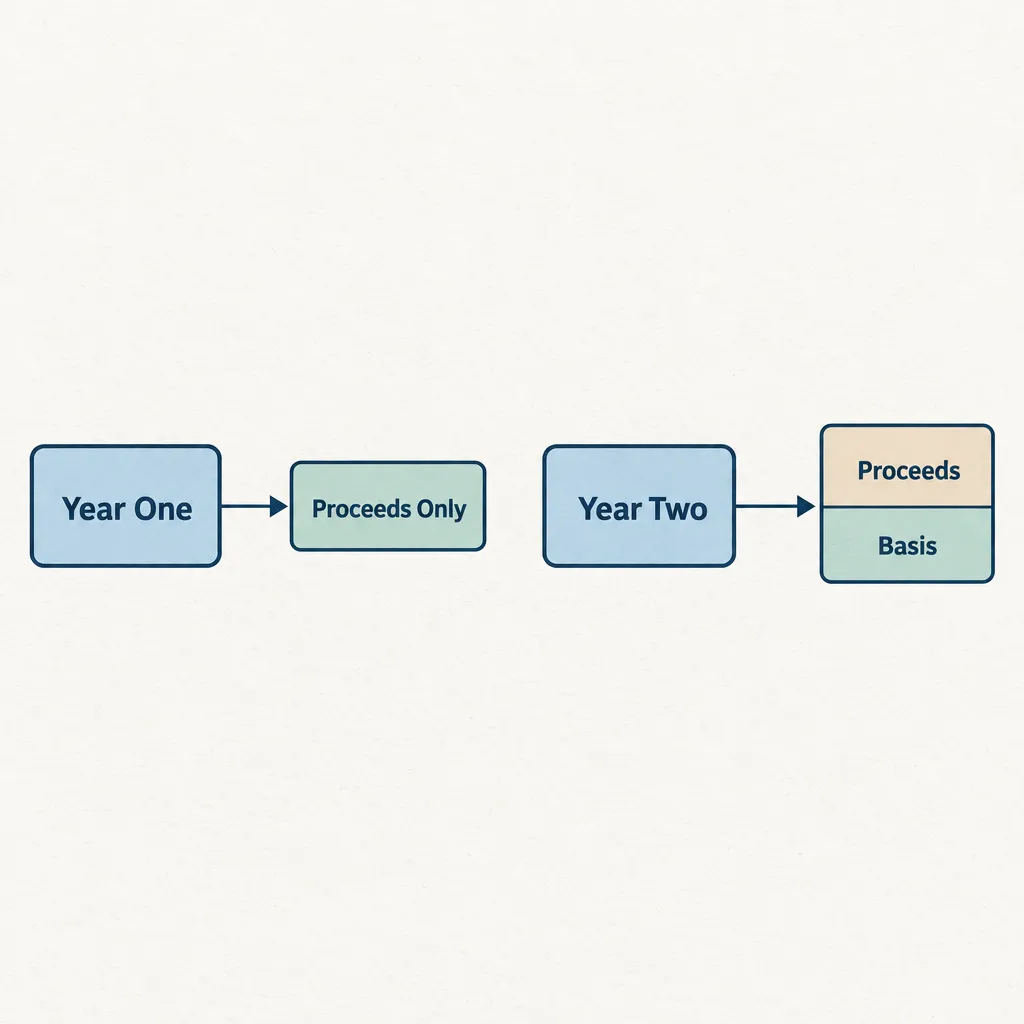
The rules were phased in over two tax years, and that phase-in causes most of the confusion. The 2025 forms showed proceeds only. From 2026 sales onward, the forms add cost basis for newer purchases.
| Tax year | What the broker reports | When you receive it |
|---|---|---|
| 2025 sales | Gross proceeds only; basis box generally blank | Was due February 17, 2026 |
| 2026 sales | Proceeds, plus cost basis for assets bought on or after January 1, 2026 in that same account | Mid-February 2027 |
| 2027 and later | Same as 2026, with more assets counting as “covered” over time | Mid-February each year |
The usual deadline for these statements is February 15. When that date lands on a weekend or federal holiday, it moves to the next business day, which is why the 2025 forms were due February 17, 2026.
Covered versus noncovered assets
Whether the broker reports your basis depends on whether the asset is “covered.” A covered digital asset is one you bought through the broker on or after January 1, 2026 and kept in that same account until you sold it. The broker knows the purchase price, so it has to report it.
Anything bought before 2026, or moved in from another wallet or exchange, is “noncovered.” For those, the broker reports the proceeds, leaves basis to you and ticks a box telling the IRS that basis was not reported. Almost every 2025 sale was noncovered by definition, so your first 1099-DA almost certainly showed proceeds with no basis next to them.
Transactions left off for now
The IRS also set aside some transaction types it was not ready to handle. Notice 2024-57 says brokers do not have to report wrapping and unwrapping tokens, liquidity pool deposits and withdrawals, staking, crypto lending, short sales and notional principal contracts until Treasury and the IRS issue further guidance. The notice has no end date. These activities can still give you taxable income. They just will not show up on this form.
Did you know?
According to IRS Notice 2024-57, brokers will not face penalties for leaving staking, lending and liquidity pool transactions off Form 1099-DA, and that relief runs until Treasury and the IRS issue further guidance. The income from those activities can still be taxable to you.
What the form actually shows
A 1099-DA can report several transactions, and most brokers send a single consolidated statement that lists every transaction. The main fields are:
- A name and identifier for the digital asset
- The number of units sold
- The date you acquired the asset, if the broker knows it
- The date you sold it
- Gross proceeds, usually the dollar value you received after any fees the broker deducted
- Cost or other basis, when the asset is covered
- A checkbox showing whether basis was reported to the IRS
- Whether the gain or loss is short-term or long-term, when the broker can tell
- Any federal income tax withheld
The 2024 drafts of the form asked for wallet addresses, transaction hashes and the exact time of each sale. The IRS dropped those fields after public comments, and the final form does not include them.
Proceeds can also come in another crypto, not only in cash. If you trade ETH for SOL on an exchange, the broker reports the fair market value of the SOL you received as your proceeds from selling the ETH. Swaps count as sales for tax purposes, and they always have.
In March 2026, Treasury and the IRS proposed regulations that would make it easier for brokers to deliver 1099-DA statements electronically. Those rules are only a proposal so far. The IRS has said brokers may follow them for statements sent on or after January 1, 2027.
Why a proceeds-only form can cost you money
A form that shows what you sold for, but not what you paid, can make your tax look far higher than it is. The IRS runs an automated program that matches the 1099s it receives against the income on your return. If a 1099-DA shows $45,000 in proceeds and your return shows nothing, the system does not assume you broke even. It can treat the full $45,000 as gain and send you a CP2000 notice proposing extra tax, interest and a 20% accuracy-related penalty under Section 6662.
Here is how the numbers can play out, assuming a 15% long-term capital gains rate applies to you:
| Item | Sale reported correctly | Sale left off the return |
|---|---|---|
| Sold | 0.5 BTC on a US exchange | 0.5 BTC |
| Proceeds on the 1099-DA | $45,000 | $45,000 |
| Cost basis | $38,000 (bought in 2024) | Blank, noncovered |
| Gain taxed | $45,000 − $38,000 = $7,000 | Up to the full $45,000 |
| Tax at 15% | $7,000 × 15% = $1,050 | $45,000 × 15% = $6,750 |
| 20% accuracy penalty | $0 | $6,750 × 20% = $1,350 |
| Total before interest | $1,050 | $6,750 + $1,350 = $8,100 |
The difference is $8,100 − $1,050 = $7,050, and you can avoid all of it. You report the sale on Form 8949 with your own basis, carry the total to Schedule D, and the proceeds on your return match what the broker filed. You then pay tax on the $7,000 you actually made. If a notice does arrive, you can answer it with your basis records and the IRS can adjust the proposed amount.
Ignoring the notice costs the most. Interest on unpaid balances adds up daily, and the IRS can file liens, levy bank accounts and, for some older inactive accounts, pass the debt to a private debt collector under its private collection program. Reconciling the form the first time you file makes these problems much less likely.
Tracking basis under the new rules
Coins bought before 2026 are generally noncovered, so the broker does not report your basis and proving it is up to you. The IRS has set four rules for how you do that.
Wallet-by-wallet accounting
Basis has to be tracked separately for each account and wallet. Revenue Procedure 2024-28 ended the informal “universal” method many investors used, where every coin across every exchange went into one big pool. As of January 1, 2025, each exchange account and wallet has its own basis. The revenue procedure gave a safe harbor for assigning your existing unused basis to specific wallets, but you had to make the allocation, or set the rules for it, before January 1, 2025. If you missed that window, you have to trace basis to each wallet from your actual purchase and transfer records. Keep notes on how you did it.
FIFO is the default
If you do not pick which units you are selling, the regulations treat the oldest units in that account as sold first (“first in, first out,” or FIFO). For coins you bought cheaply years ago, FIFO can produce the biggest possible gain.
Specific identification
You can choose which lots to sell, which often lowers your gain. Under the regulations, you have to make that choice no later than the time of the sale, and the broker has to be able to record it. Most exchanges could not do this yet, so Notice 2025-7 let you rely on your own books and records to identify the units you sold in 2025. Notice 2026-20, released in March 2026, extends that relief through the end of 2026. It only covers units held with a custodial broker. Starting January 1, 2027, the standard rule applies unless the IRS extends the relief again. Your identification may not match the basis the broker reports for 2026, so keep records that explain any difference.
Transfers between platforms
When you move coins from one exchange to another, the receiving exchange does not know what you paid. The final regulations do not require brokers to pass basis information to each other, so you have to carry that number across platforms yourself. Keep the original purchase confirmation, the transfer record and the dates.
How to reconcile your 1099-DA
- Download every 1099-DA and the broker’s full transaction history for the year.
- Check that the proceeds on the form match the total of your sales in the history export.
- Pull your own basis for each sale from purchase records, earlier tax forms or your tracking records.
- Enter each sale on Form 8949, using the box for basis not reported to the IRS when the form marks the asset noncovered.
- Carry the totals to Schedule D and answer “Yes” to the digital asset question on Form 1040.
- Keep the records for as long as you need them to support your return. The usual assessment period is three years after filing, but exceptions can make it longer.
Reconcile with the broker's numbers first
Before you change any figure, compare your proceeds total with the 1099-DA and find any differences. Any adjustment for fees or basis then goes in the columns built for it on Form 8949, and the IRS matching program can see why your gain differs from the broker’s proceeds.
Backup withholding: on hold through 2026
Brokers do not have to backup withhold on crypto sales made in 2025 or 2026. Normally a broker must withhold 24% of your proceeds and send it to the IRS if you have not given it a valid taxpayer identification number. Notice 2024-56 waived that for 2025 sales while brokers built their systems. Notice 2025-33, announced by the IRS on June 12, 2025, extended the waiver to sales made in 2026.
The relief gets narrower after that. For 2027 sales, Notice 2025-33 lets brokers rely on an IRS TIN-matching result instead of a certified number for certain existing customers. It also limits how much brokers must withhold on crypto-for-crypto trades for sales made before January 1, 2028. New customers and anyone whose number does not match get no such protection.
Here is what that means for you. If your exchange account has an outdated or missing Social Security number, or you never certified it on Form W-9, fix it before 2027. On a $10,000 sale, 24% withholding takes $10,000 × 24% = $2,400 out of your proceeds. You can claim it back as a credit on your return, but you do not get that money back until you file.
Risks the form does not change
A 1099-DA is a tax form. It does nothing to protect your money. Crypto can lose all of its value, and keeping it on an exchange adds custody risk on top of price risk. Coins held on an exchange are not FDIC insured like bank deposits and are not covered by SIPC like securities in a brokerage account. When FTX collapsed in 2022, customers spent years in bankruptcy proceedings trying to get their assets back.
Before you file
The biggest mistake is reporting nothing because the basis box is blank. The IRS has the proceeds figure either way, and a return that leaves out the sale invites a notice that taxes the full amount.
Losses follow their own rules. Capital losses offset capital gains, and up to $3,000 of net capital loss a year ($1,500 if married filing separately) can offset ordinary income, with the rest carried forward. Say you have a $2,000 gain from one sale and a $9,000 loss from another. The net loss is $9,000 − $2,000 = $7,000. You deduct $3,000 against other income this year and carry $7,000 − $3,000 = $4,000 into next year. A 1099-DA showing a sale below your basis is useful proof of that loss. Coins that became worthless while you still hold them are harder to deal with: without a sale or other disposition, you usually have no deductible loss.
What a 1099-DA is not
The form only covers sales and other dispositions. Other kinds of crypto income are reported elsewhere, or not at all:
- Staking and mining rewards are ordinary income when you gain control of them, under Revenue Ruling 2023-14. An exchange may report larger amounts on Form 1099-MISC, but the income is taxable at any amount.
- Airdrops and hard forks are ordinary income at their fair market value when you receive them.
- Crypto paid to you for goods or services may show up on a Form 1099-K from a payment platform or a Form 1099-NEC from a client, not on a 1099-DA.
- Real estate bought with crypto is reported by the closing agent on Form 1099-S for closings on or after January 1, 2026, with the fair market value of the digital asset shown.
Getting no form at all changes nothing either. Self-custody trades, foreign exchanges and DeFi activity all still have to be reported. The 1099-DA gives the IRS part of the picture, and your return has to give the whole thing. US Financer’s crypto tax guides cover staking income, capital losses and wallet records in more detail.
Free help first
IRS Free File supports Form 8949 for filers under its income limit. VITA and Tax Counseling for the Elderly sites prepare returns free for eligible taxpayers. The Taxpayer Advocate Service can help if a notice is causing hardship and normal channels have stalled.
Official sources behind this guide
The rules on this page come from primary documents: Section 6045 of the Internal Revenue Code, Treasury Decision 10000 in the Federal Register, the IRS Instructions for Form 1099-DA and the January 2026 corrections to them, IRS Notices 2014-21, 2024-56, 2024-57, 2025-7, 2025-33 and 2026-20, Revenue Procedure 2024-28, Revenue Ruling 2023-14, and the IRS’s March 2026 proposed regulations on electronic delivery. Dates and thresholds were checked against irs.gov as of November 2026.
FAQ
What is Form 1099-DA in plain terms?
It is the tax form a US crypto exchange or other custodial broker files to report your digital asset sales to the IRS, with a copy to you. It lists the asset, the units, the dates and your gross proceeds. For assets bought on the platform from January 1, 2026 onward, it also shows your cost basis.
When did Form 1099-DA start?
Brokers started tracking sales on January 1, 2025. The first forms, covering 2025 sales, were due to customers by February 17, 2026. Basis reporting covers assets bought on or after January 1, 2026 and first appears on the forms for 2026 sales, due in mid-February 2027.
Do I owe tax on the proceeds number?
No. You owe tax on your gain, which is proceeds minus basis. If the form shows only proceeds, you add the basis on Form 8949, and the difference, if it is positive, is your taxable gain.
I did not get a 1099-DA. Do I still report my crypto sales?
Yes. You have to report your sales whatever paperwork you receive. Sales from a self-custody wallet, a decentralized exchange or a foreign platform are taxable even though no US broker reports them.
What if the form is wrong?
Ask the broker for a corrected form. If it will not correct it, report the right figures on Form 8949, use the adjustment columns to explain the difference and keep the records that support your numbers. The IRS will still see the broker’s version.
Does Form 1099-DA report swaps between two cryptocurrencies?
Yes. Trading one digital asset for another counts as selling the one you gave up, and the broker reports the fair market value of what you received as your proceeds.
Will my exchange withhold tax from my crypto sales?
Not for 2025 or 2026 sales. Notice 2025-33 relieves brokers of backup withholding for those years. From 2027, a broker may withhold 24% if it does not have a valid, matching taxpayer identification number for you, so check that your account details are correct now.
Can I still choose which coins I sold for 2026?
Yes, for units held with a custodial broker. Notice 2026-20 lets you identify the units you sold in 2026 using your own records. Starting in 2027, the identification has to go through the broker unless the IRS extends the relief again.
Will the IRS see my wallet addresses on the form?
No. The IRS removed wallet addresses, transaction hashes and time-of-day fields from the final form after public comments on the 2024 drafts.
Laws and regulations referenced
- IRS Notice 2014-21 (virtual currency is property)
- IRS Revenue Ruling 2023-14 (staking rewards)
- IRS Form 1099-DA, Digital Asset Proceeds From Broker Transactions
- IRS Form 8949, Sales and Other Dispositions of Capital Assets
- IRS Schedule D (Form 1040), Capital Gains and Losses
- FDIC deposit insurance
Links go to the official text on government sites.

Nadia covers crypto taxes, scams and the rules around digital assets: IRS guidance, broker reporting, federal and state regulation, and how to spot and report fraud. She separates what is law from what is only proposed and links the official text.
Ruth is US Financer's standards editor. Every article goes through her checks before and after it is published: each rate, fee, cap, deadline and rule is matched against its primary source, every law named is linked to its official text, and anything that cannot be…
What changed
- Nov 12, 2026 Facts re-checked against official sources and updated; sources and links refreshed.
- Nov 12, 2026 Corrected the IRS notice that extended backup withholding relief: Notice 2025-33.
- Oct 15, 2026 First published.
Comments are closed