

Crypto can lose all of its value and is not protected by FDIC or SIPC insurance. This is education, not investment advice.
General information, not tax advice. Confirm with the IRS form instructions or a tax professional before you file.
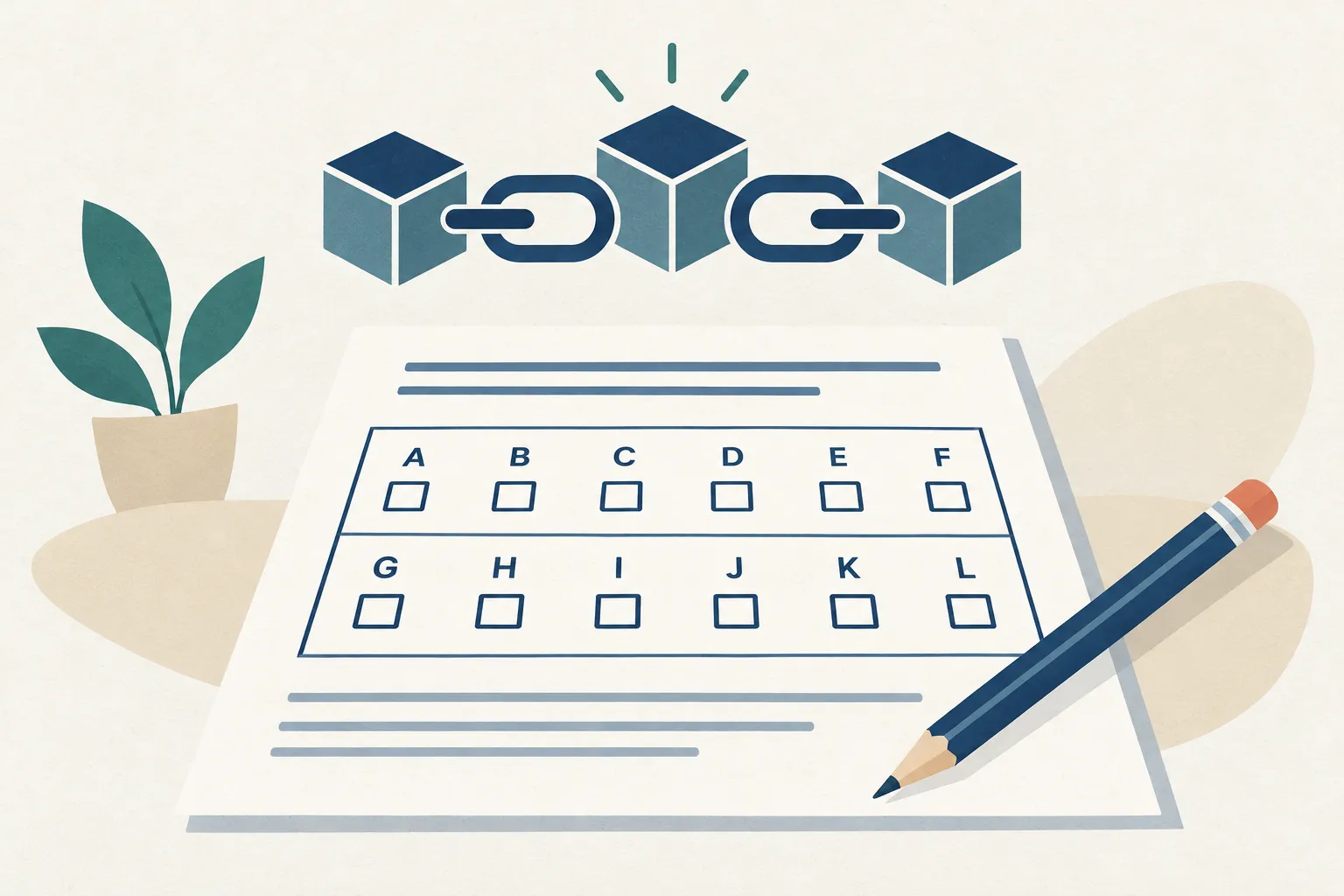
The 2025 Form 8949 has six new checkboxes, G through L, and under the IRS instructions crypto and other digital assets can no longer be reported in Box C or F. Anyone who sold stock, funds, real estate or other capital assets in 2025 uses this form to list each sale and carry the totals to Schedule D (Form 1040). The biggest change this year is for digital assets: many first-year Forms 1099-DA show proceeds with a blank cost basis, and if you don’t rebuild that basis yourself, you can end up paying tax on money you never made.
WARNINGRelated consumer alert, Nov 11, 2026
Michigan AG Nessel warns homeowners to vet solar contracts and financing before signingRun the numbers
Key takeaways
- Stock and fund sales still use Boxes A to F. Crypto sold in 2025 goes in Box G, H or I (short-term) or J, K or L (long-term), never C or F.
- For 2025 sales, brokers had to report gross proceeds on Form 1099-DA, but reporting basis was optional.
- A blank basis box doesn’t mean your basis is zero. Rebuild it from your records and use Box H or K.
- A wash sale goes on Form 8949 with code W, and the disallowed loss is added to the basis of the replacement shares.
- If you’re filing late or fixing a 2025 return, use the 2025 forms. Form 1040-X corrects a return you already filed.
Fact-checked
We checked these key facts against the sources named, on November 13, 2026:
- Up to $3,000 of net capital loss against other income, or $1,500 if married filing separately (source: kiplinger.com)
- Worked example, Part I with Box H checked: “2 ETH” | 03/03/2025 | 09/15/2025 | $7,000 | $5,000 | (h) $2,000 (source: irs.gov)
- If you had copied the blank basis as zero, Schedule D would show $16,000 of gain instead of $9,000, overstating your income by $7,000 (source: harness.co)
- At a 22% ordinary rate on the extra $5,000 of short-term gain ($1,100) and 15% on the extra $2,000 of long-term gain ($300), that’s $1,400 of tax you don’t owe (source: taxfoundation.org)
- Form 1040-X corrects a return you already filed. Form 8949, Sales and Other Dispositions of Capital Assets, is the IRS form where you list each sale of a capital asset (source: irs.gov)
Form 8949 for 2025: the short answer
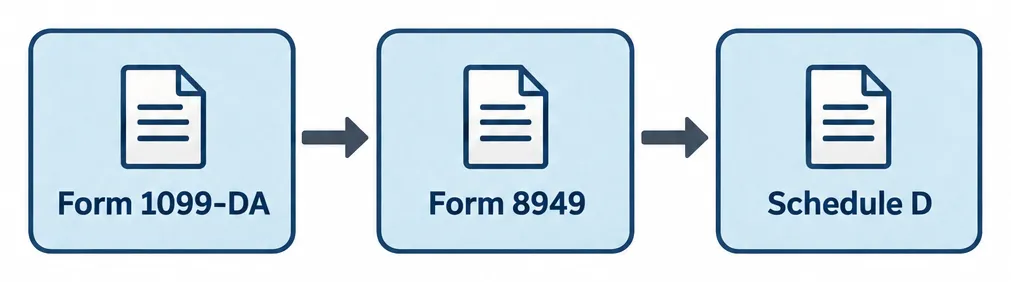
Form 8949, Sales and Other Dispositions of Capital Assets, is the IRS form where you list each sale of a capital asset. Its totals go to Schedule D, and Schedule D’s net result goes to Form 1040.
- What it does: it lines up what brokers reported on Forms 1099-B, 1099-DA and 1099-S with what you report, including any corrections.
- Who files it: anyone who sold, exchanged or otherwise disposed of stock, funds, crypto or other capital assets in 2025, unless an exception covers every sale.
- What’s new: Boxes G, H and I in Part I and J, K and L in Part II, for digital assets only.
- When you can skip it: when a 1099-B or 1099-DA shows basis was reported to the IRS and no adjustment is needed. Those totals go straight on Schedule D line 1a or 8a.
- Where totals go: Schedule D, then Form 1040 line 7a.
Download the official 2025 Form 8949 PDF and instructions
The IRS posts the form and the 2025 Instructions for Form 8949 on irs.gov under Forms and Instructions. The PDF can be filled in on screen or printed and completed by hand. Once the 2026 versions are published, the 2025 files move to the Prior Year Forms and Instructions page as f8949–2025.pdf and i8949–2025.pdf. The same page has the 2025 Schedule D and the 2025 Instructions for Schedule D (Form 1040), Cat. No. 24331I, dated December 11, 2025.
How to make sure you have the 2025 revision, not 2026
Check the year printed in the top right corner of the form and the year in the instructions title. A late or amended 2025 return has to use the form marked 2025.
Check the year before you print
The IRS “current revision” link switches to the newest form as soon as it’s published. Before you fill anything in, make sure the PDF header says 2025.
Do you have to file Form 8949?
Yes, if you sold or disposed of a capital asset in 2025 and at least one of those sales doesn’t qualify for the aggregate exception. Under IRS rules, all of these count:
- Selling stock, ETFs or mutual fund shares
- Selling crypto for dollars, trading one coin for another, or spending crypto on goods or services
- Selling real estate reported on Form 1099-S, unless it’s excluded as a main home sale with no taxable gain
- A nonbusiness bad debt, which is treated as a short-term capital loss
The crypto items are on this list because the IRS treats crypto as property under IRS Notice 2014-21. That means every sale, swap, or purchase paid for with crypto can be a taxable disposal, the same as selling a share of stock.
Property used in a trade or business goes on Form 4797, not Form 8949. Publication 544 explains which form a given sale belongs on, Publication 550 covers investment income including wash sales, and Publication 551 explains how basis works.
When you can skip Form 8949
The instructions allow aggregate reporting. If your 1099-B or 1099-DA shows basis was reported to the IRS and you need no adjustment or code, you can enter the combined totals directly on Schedule D line 1a (short-term) or line 8a (long-term). A wash-sale amount on the 1099-B counts as an adjustment, so those sales still go on Form 8949. The IRS’s Schedule D instructions for corporations and partnerships apply the same rule to digital assets, and they add that if the basis in 1099-DA box 1g is wrong, the sale has to go on Form 8949.
For most stock investors with covered shares and no wash sales, aggregate reporting covers everything. For 2025 crypto, few sales qualify, because most brokers didn’t report basis.
Sales you must report even with no 1099
A missing 1099 doesn’t make a sale tax-free. Self-custody wallet trades, decentralized exchange swaps and transactions on platforms that sent no form all still go on Form 8949. Use Box I (short-term) or Box L (long-term) for digital assets, and Box C or F for other assets.
What changed for 2025: Boxes G to L and Form 1099-DA
The 2025 Form 8949 gives digital assets their own boxes so the IRS can match them against the new Form 1099-DA. The IRS instructions say digital-asset transactions can’t be reported under Box C or F. Boxes A through F work as before for stocks, bonds, funds and other non-digital assets.
Box G and Box J
Use these for short-term (G) or long-term (J) digital-asset sales reported on a Form 1099-DA that shows basis was reported to the IRS. Under the 2025 Form 8949 instructions, Box G is for a short-term transaction for which basis was reported to the IRS.
Box H and Box K
Use these for short-term (H) or long-term (K) sales reported on a Form 1099-DA that shows no basis, or shows that basis wasn’t reported to the IRS. Most 2025 crypto sales through US exchanges end up in these boxes.
Box I and Box L
Use these for short-term (I) or long-term (L) digital-asset sales that weren’t reported to you on a 1099-DA or 1099-B.
Why most 2025 1099-DAs show no basis
The IRS instructions for Form 1099-DA phase in reporting over two stages. For 2025 sales, brokers had to report gross proceeds, and reporting basis was voluntary. Starting with 2026 sales, reporting both proceeds and basis is mandatory for covered assets. A covered digital asset is one acquired on or after January 1, 2026, in an account where the broker provides custody. Our guide to Form 1099-DA explained for crypto investors covers the form in more detail.
| Item | 2025 sales | 2026 and later sales |
|---|---|---|
| Gross proceeds (box 1f) | Required | Required |
| Cost basis (box 1g) | Voluntary | Required for covered assets |
| Covered asset | Not applicable for basis | Acquired on or after Jan 1, 2026, in broker custody |
| Coins bought earlier or moved in from an outside wallet | No broker basis | Still noncovered |
| Backup withholding | Relief under Notice 2024-56 | Relief extended through 2026 by Notice 2025-33 |
Did you know?
According to the IRS’s Form 1099-DA instructions, brokers had to report gross proceeds for 2025 sales, but reporting cost basis was voluntary. That’s why many 2025 forms show a sale amount with an empty basis box.
Notice 2025-33 gave brokers more time on backup withholding. It didn’t delay 1099-DA reporting of 2025 gross proceeds, so the IRS already has your proceeds figures.
Which box do I check? (A to L picker)
Ask three questions: Is it a digital asset? Did you get a 1099-B or 1099-DA? Was basis reported to the IRS? Then use a separate Form 8949 page for each box you check.
| Box | Part | Asset type | Reported to you on | Basis reported to IRS? | Example |
|---|---|---|---|---|---|
| A | I (short-term) | Non-digital | 1099-B | Yes | Stock held 4 months, basis on 1099-B |
| B | I | Non-digital | 1099-B | No | Older fund shares, basis missing |
| C | I | Non-digital | No 1099-B | Not applicable | Nonbusiness bad debt |
| G | I | Digital asset | 1099-DA | Yes | Exchange reported basis voluntarily |
| H | I | Digital asset | 1099-DA (or 1099-B) | No | Typical 2025 exchange sale |
| I | I | Digital asset | None | Not applicable | Self-custody wallet swap |
| D | II (long-term) | Non-digital | 1099-B | Yes | Stock held 3 years |
| E | II | Non-digital | 1099-B | No | Shares bought before 2011 (noncovered) |
| F | II | Non-digital | No 1099-B | Not applicable | Privately sold collectible |
| J | II | Digital asset | 1099-DA | Yes | Basis reported, held over a year |
| K | II | Digital asset | 1099-DA (or 1099-B) | No | Coins bought in 2022, sold in 2025 |
| L | II | Digital asset | None | Not applicable | Long-held coins sold on a DEX |
Short-term means you held the asset one year or less, and long-term means more than one year. To count the holding period, start the day after you acquired the asset and include the day you sold it.
People often ask whether a 1099-DA without basis goes in Box B or Box H. For digital assets it’s H, or K if long-term. Box B is for non-digital assets on a 1099-B.
One page per box
Never mix boxes on one page. Box H sales and Box I sales need separate Form 8949 pages, even if there’s only one sale in each.
Worked example used in the next three steps
The figures below are round, illustrative numbers, not market prices. Suppose you made two sales through one exchange in 2025:
- Sale 1 (short-term): bought 2 ETH on March 3, 2025, for $5,000 including fees. Sold them on September 15, 2025, for $7,000.
- Sale 2 (long-term): bought 0.1 BTC on January 10, 2023, for $2,000 including fees. Sold it on November 20, 2025, for $9,000.
The exchange’s 2025 Form 1099-DA shows proceeds for both sales, with the basis box blank and box 2 unchecked. A second example later in this guide walks through a stock sale with a wash sale on Form 1099-B.
Step 1: Read your Form 1099-DA
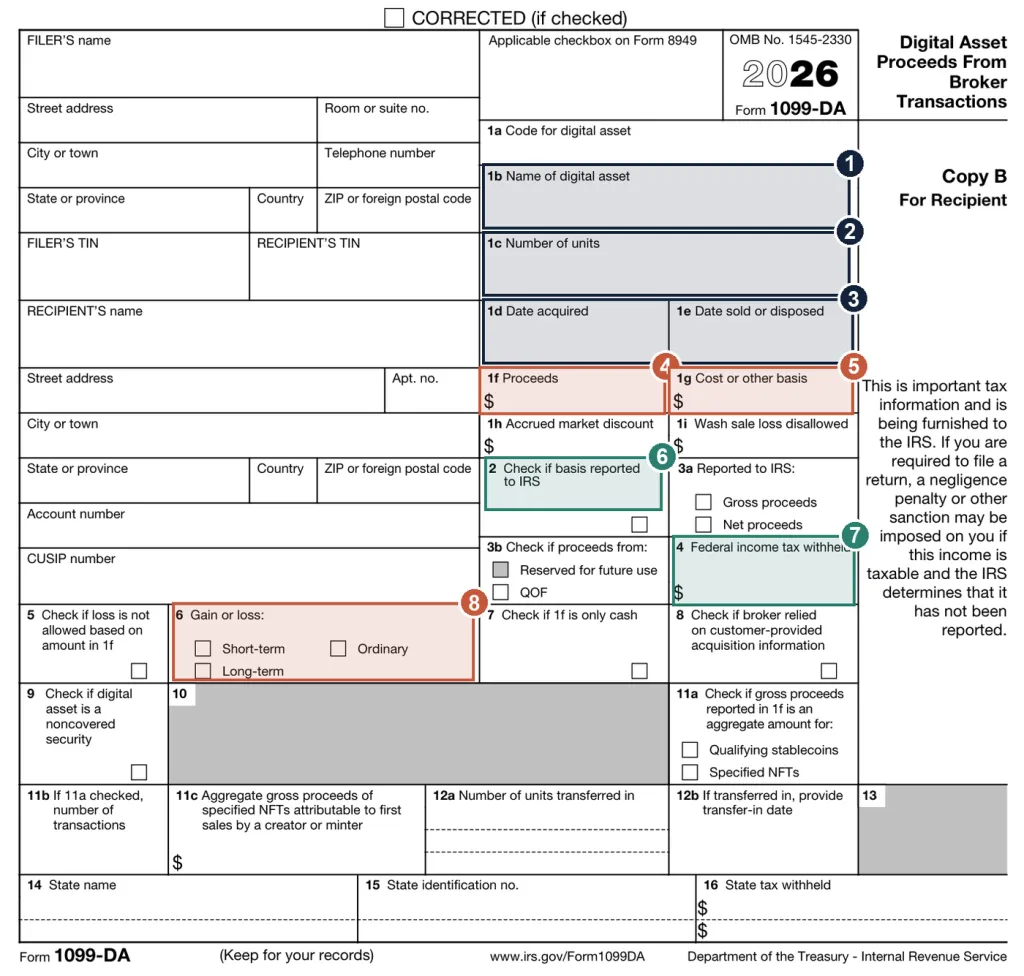
Your 1099-DA shows which coin was sold, how much, when, and whether the IRS received your basis. Go through it box by box before you start on Form 8949.
- Box 1b, name of digital asset: the coin’s name, such as Ethereum. You’ll need it for column (a).
- Box 1c, number of units: the exact quantity disposed of, which can run to many decimal places. Copy it exactly. In the example, that’s 2 ETH and 0.1 BTC.
- Boxes 1d and 1e, date acquired and date sold or disposed: for 2025, the acquisition date in box 1d was optional, so it’s often blank. Take it from your purchase records. Box 1e is the sale date.
- Box 1f, proceeds: gross proceeds. This is the figure the IRS will match. In the example, $7,000 and $9,000.
- Box 1g, cost or other basis: often empty on 2025 forms. A blank box means basis wasn’t reported. It doesn’t mean your basis was $0.
- Box 2, check if basis reported to IRS: if checked, the sale goes in Box G or J. If not, use H or K. Here it isn’t checked.
- Box 4, federal income tax withheld: any backup withholding. Enter it as a payment on Form 1040, not on Form 8949.
- Box 6, short-term, long-term or ordinary: the broker’s classification. It may be blank when basis wasn’t reported, so check the holding period against your own dates.
Our explainer on phantom income in crypto covers situations where you can owe tax without selling.
Never accept a zero basis
If box 1g is blank, rebuild your basis from purchase confirmations or exchange history, including trading fees. Our crypto cost basis guide explains the lot methods. Leaving basis at zero taxes the entire sale amount as profit.
Step 2: Fill in Form 8949
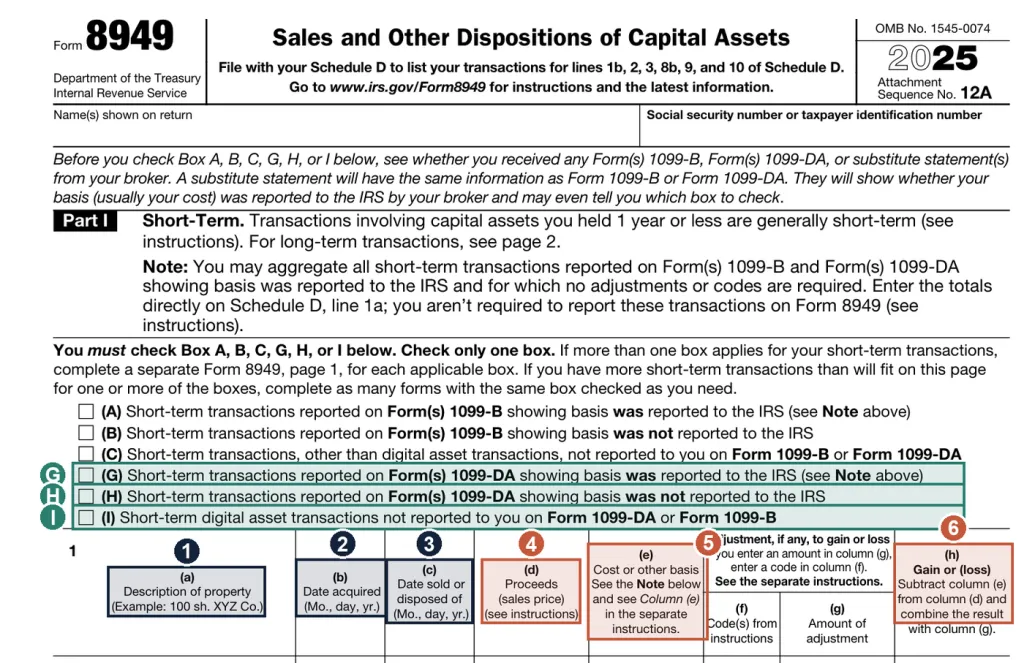
Check one box at the top of each part, then fill in one row per sale across columns (a) through (h). Part I (page 1) is for short-term sales and Part II (page 2) is for long-term sales.
The short-term digital-asset checkboxes:
- G: short-term, reported on a 1099-DA with basis reported to the IRS.
- H: short-term, reported on a 1099-DA or 1099-B, with basis not reported.
- I: short-term, not reported to you on a 1099-DA or 1099-B.
Part II on page 2 uses J, K and L the same way for long-term sales. Then the columns:
- Column (a), description: the full name or symbol plus exact units, such as “2 ETH.” The IRS instructions require both for digital assets. For stock, write the number of shares and the company, such as “100 sh. XYZ.”
- Column (b), date acquired: the purchase date. You can write “VARIOUS” when one row covers lots bought on different dates.
- Column (c), date sold or disposed of: the date of the sale, trade or spending.
- Column (d), proceeds: the 1099-DA box 1f or 1099-B box 1d figure, or your own figure if no form was issued.
- Column (e), cost or other basis: what you paid plus acquisition fees.
- Column (h), gain or loss: column (d) minus column (e), combined with any adjustment in column (g).
Worked example, Part I with Box H checked: “2 ETH” | 03/03/2025 | 09/15/2025 | $7,000 | $5,000 | (h) $2,000. Part II with Box K checked: “0.1 BTC” | 01/10/2023 | 11/20/2025 | $9,000 | $2,000 | (h) $7,000.
How to fill out each column
| Column | What to enter | 2025 note | Common mistake |
|---|---|---|---|
| (a) | Asset and quantity | Digital assets need name or symbol plus exact units | Writing “crypto” or leaving out units |
| (b) | Date acquired | “VARIOUS” allowed for multiple lots | Using the transfer-in date instead of the purchase date |
| (c) | Date sold | Includes coin-to-coin trades and spending | Leaving out crypto spent on purchases |
| (d) | Proceeds | Match 1099-DA box 1f or 1099-B box 1d | Netting fees twice |
| (e) | Basis | Often your own figure for 2025 crypto | Entering $0 because box 1g was blank |
| (f) | Code(s) | Explains any column (g) amount | A code with no amount, or the reverse |
| (g) | Adjustment | Negative amounts in parentheses | Wrong sign |
| (h) | Gain or loss | (d) minus (e), combined with (g) | Arithmetic errors across pages |
Columns (d) and (e): proceeds and basis
Proceeds should match what the broker reported so the IRS’s matching system lines up. Corrections go in basis and adjustments. If the 1099-DA shows a basis you know is wrong, report the correct figure. The instructions use code B and a column (g) adjustment for that.
Columns (f) and (g): adjustment codes
The Form 8949 instructions list single-letter codes. These are the ones crypto and stock sellers see most:
- B: the basis shown on the 1099-B or 1099-DA is incorrect.
- T: the form shows the wrong holding period (short-term vs long-term).
- E: selling expenses not reflected on the form.
- W: nondeductible wash-sale loss. Enter the disallowed amount as a positive number in column (g). The wash sale rule in Section 1091 covers stock and securities, so it mostly affects brokerage sales. Our wash-sale rule explainer covers the “substantially identical” test.
- L: other nondeductible losses.
- M: multiple transactions reported on one row, with an attached statement.
- Z: gain deferred by investing in a qualified opportunity fund (opportunity zones).
- O: an adjustment no other code covers.
Do you have to list every trade? Not always. The instructions allow one summary row per box with code M, as long as you attach a statement giving the same details as Form 8949. E-filers send that statement with Form 8453.
Step 3: Carry the totals to Schedule D
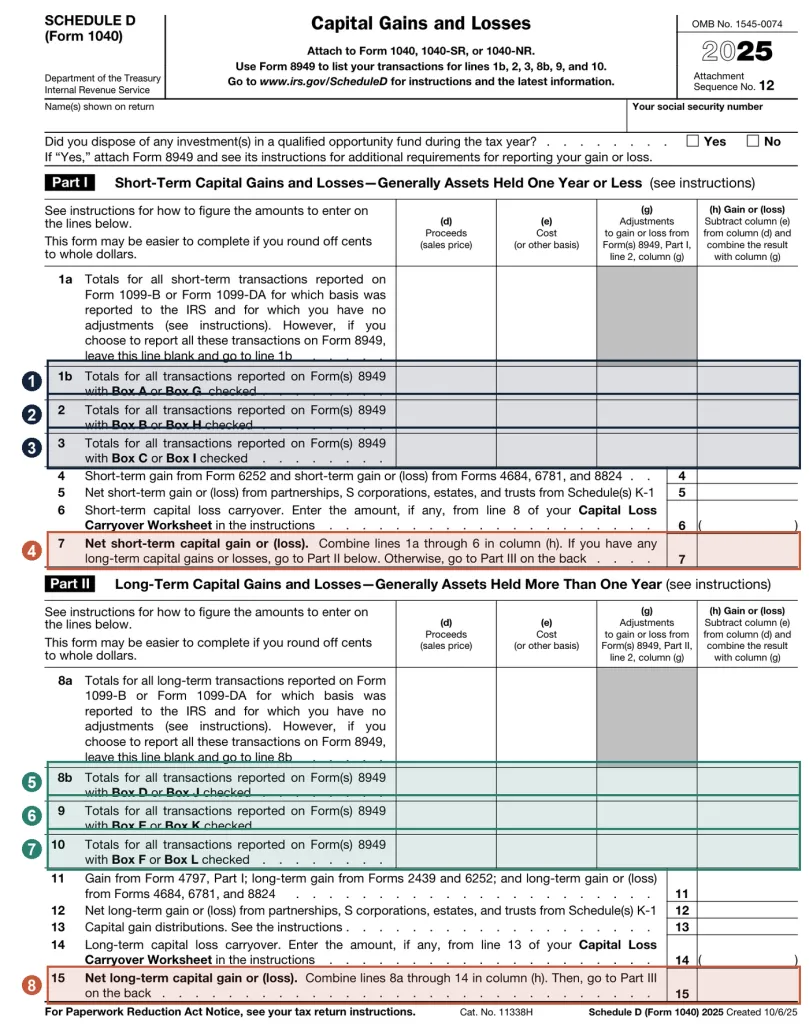
Each Form 8949 box has its own Schedule D line. Add up columns (d), (e), (g) and (h) across each box’s pages and enter the totals on that line. Our Schedule D guide covers the rest of the form line by line.
- Line 1b: totals from Form 8949 with Box A or G checked.
- Line 2: totals from Box B or H. Example: $7,000 proceeds, $5,000 basis, $2,000 gain.
- Line 3: totals from Box C or I.
- Line 7, net short-term gain or loss: the sum of lines 1a through 6. Example: $2,000.
- Line 8b: totals from Box D or J.
- Line 9: totals from Box E or K. Example: $9,000 proceeds, $2,000 basis, $7,000 gain.
- Line 10: totals from Box F or L.
- Line 15, net long-term gain or loss: the sum of lines 8a through 14. Example: $7,000.
Line 16 combines lines 7 and 15, so the example shows $9,000. That net gain goes on Form 1040 line 7a.
Here’s what’s at stake. If you had copied the blank basis as zero, Schedule D would show $16,000 of gain instead of $9,000, overstating your income by $7,000. At a 22% ordinary rate on the extra $5,000 of short-term gain ($1,100) and 15% on the extra $2,000 of long-term gain ($300), that’s $1,400 of tax you don’t owe. A crypto profit calculator can help you check the gain on each lot, but the figures on your return have to come from your own records.
| Scenario | Proceeds | Basis entered | Reported gain | Extra tax (22% ST, 15% LT) |
|---|---|---|---|---|
| Correct basis | $16,000 | $7,000 | $9,000 | $0 |
| Blank basis copied as $0 | $16,000 | $0 | $16,000 | $1,400 |
Where to find the 2025 Schedule D worksheets
The 2025 Instructions for Schedule D (Form 1040) include the Capital Loss Carryover Worksheet and the Schedule D Tax Worksheet. Use the Schedule D Tax Worksheet if line 18 (28% rate gain, such as collectibles) or line 19 (unrecaptured section 1250 gain) is more than zero. Otherwise, the Qualified Dividends and Capital Gain Tax Worksheet in the Form 1040 instructions works out your tax.
Capital loss limit and carryover
If your losses exceed your gains, you can deduct up to $3,000 of net loss against other income ($1,500 if married filing separately). The rest carries forward with no time limit.
To bring in a loss carried over from 2024, complete the Capital Loss Carryover Worksheet in the 2025 Schedule D instructions using your 2024 return. Its results go on Schedule D line 6 (short-term) and line 14 (long-term) as negative numbers.
Second worked example: a stock sale with a wash sale
A wash sale happens when you sell stock or securities at a loss and buy substantially identical stock within 30 days before or after the sale. Publication 550 disallows the loss for that year, but it isn’t lost for good: the disallowed amount is added to the basis of the replacement shares, and the holding period of the original shares carries over to them.
The figures are illustrative. You bought 100 shares of XYZ on March 2, 2009, for $6,000. Shares bought before 2011 are generally noncovered, so your broker’s 2025 Form 1099-B shows proceeds but says basis wasn’t reported to the IRS. You sold all 100 shares on October 6, 2025, for $4,500, a $1,500 loss. On October 20, 2025, 14 days later, you bought 100 XYZ shares again for $4,700.
Because the shares are long-term and basis wasn’t reported, the sale goes in Part II with Box E checked. Brokers generally track wash sales only for covered shares in the same account, so here you work out the adjustment yourself.
| Column | Entry |
|---|---|
| (a) Description | 100 sh. XYZ |
| (b) Date acquired | 03/02/2009 |
| (c) Date sold | 10/06/2025 |
| (d) Proceeds | $4,500 |
| (e) Cost or other basis | $6,000 |
| (f) Code | W |
| (g) Adjustment | $1,500 |
| (h) Gain or loss | $0 |
The math in plain words: $4,500 minus $6,000 is a $1,500 loss, and adding back the $1,500 disallowed in column (g) leaves zero in column (h). The Box E totals go on Schedule D line 9. Your new XYZ shares have a basis of $6,200 ($4,700 paid plus the $1,500 disallowed loss), and because the 2009 holding period carries over, a later sale of those shares is long-term.
A few edge cases change the result:
- Timing: if you had bought back on November 10, 2025 (35 days later), there would be no wash sale, and the full $1,500 long-term loss would go in column (h).
- Fewer shares: if you bought back only 40 shares, only 40% of the loss ($600) would be disallowed. Publication 550 matches replacement shares to sold shares in the order you bought them.
- IRAs and spouses: a repurchase in your IRA or Roth IRA, or by your spouse, also triggers the rule.
- Covered shares: if the 1099-B shows basis reported and lists the disallowed loss in box 1g, use Box A or D with code W. A wash-sale amount rules out aggregate reporting on line 1a or 8a.
2025 capital gains tax rates
Long-term gains are taxed at 0%, 15% or 20% depending on taxable income. Short-term gains are taxed at your ordinary income rates. The figures below are the 2025 thresholds from Rev. Proc. 2024-40.
| Filing status | 0% up to | 15% up to | 20% above |
|---|---|---|---|
| Single | $48,350 | $533,400 | $533,400 |
| Married filing jointly | $96,700 | $600,050 | $600,050 |
| Head of household | $64,750 | $566,700 | $566,700 |
| Married filing separately | $48,350 | $300,000 | $300,000 |
The net investment income tax adds 3.8% when modified AGI is above $200,000 (single) or $250,000 (married filing jointly). One extra day of holding can matter: an asset held one year or less is short-term, while one held more than one year qualifies for long-term rates, so check your exact acquisition and sale dates.
Stablecoins, NFTs and transfers between wallets
Some 1099-DAs report qualifying stablecoin and NFT sales on an aggregate basis instead of sale by sale. Your Form 8949 entries still have to reconcile to those numbers.
Under the optional aggregate method, brokers generally don’t have to report qualifying stablecoin sales of $10,000 or less, and above that they can report a single total. Either way, you still report any gain or loss. Stablecoin gains are usually tiny because both the purchase and sale prices are about $1, but tiny isn’t zero. For specified NFTs, the form may use a generic description. On Form 8949, describe the assets as specifically as your records allow and make your proceeds match the aggregate total.
Moving coins between your own wallets isn’t a sale. It is, however, the main reason basis goes missing. If you move coins from Coinbase to a cold wallet and later sell them on another exchange, the second exchange treats them as noncovered and has no record of what you paid. To fix this, bring the original purchase records forward, enter that basis in column (e), and use Box H or K.
Did you know?
The IRS’s 2025 Form 8949 instructions say digital assets go in Box I or L even when no 1099 was issued. Boxes C and F, the old “no form” boxes, can no longer be used for crypto.
Already past the 2025 filing season? Filing late or amending
As of November 2026, both the April 15, 2026, deadline and the October 15, 2026, extension deadline have passed. You can still file or fix a 2025 return using the 2025 forms.
You never filed for 2025
File now with the 2025 Form 1040, Schedule D and Form 8949. If you owe tax, penalties and interest grow every month, so filing sooner costs less. If you’re owed a refund, you generally have three years from the original due date to claim it.
You filed but used the wrong box or basis
File Form 1040-X with corrected Forms 8949 and Schedule D. Our Form 1040-X guide explains how amended returns are processed. Common fixes include moving a sale from Box C to Box I, replacing a zero basis with your real cost, and adding a missed code W. If you overstated gains, the amendment can get you a refund. You generally have three years from filing, or two years from paying, whichever is later.
You received a corrected 1099-DA or 1099-B
Compare the corrected figures with your return, and amend if the change affects your tax. If the IRS sends a notice proposing more tax based on 1099-DA proceeds, respond by the deadline on the notice and include your basis records. Don’t just pay a bill that treats your proceeds as pure profit.
Software problems and when to get help
If your tax software put the wrong box letter on your 8949, find the setting that controls the reporting category or form type for each sale, then check the printed form. A crypto tax tool that doesn’t support Boxes G through L doesn’t follow the 2025 instructions. In that case, enter the totals by hand or switch to a program that does.
An enrolled agent or CPA is worth paying when you have hundreds of trades, DeFi or staking activity, missing records, an IRS notice, or losses big enough to carry forward for years. This guide explains the forms and isn’t tax advice for your situation.
Records to keep
Keep anything that shows what you paid and when. Keep basis records until the period of limitations ends for the year you sell, which is usually three years after filing. That period becomes six years if you underreport income by more than 25%.
- Trade confirmations and full exchange CSV histories, including fees
- Wallet transfer logs showing transaction IDs and dates
- Brokerage statements showing repurchase dates for any wash sale
- Your basis worksheet or lot-by-lot calculations
- Every 1099-DA, 1099-B and corrected form
- Copies of the filed Form 8949, Schedule D and any 1040-X
Save exports before an account closes
Download your full transaction history from every exchange and brokerage each year. Platforms shut down, merge or limit access to old history, and without it you can’t rebuild your basis.
Before you file
Form 1099-DA and Form 1099-B report your proceeds to the IRS. If you leave a sale off your return or report it with zero basis, the mismatch can lead to a tax bill or an overpayment.
As a last check before you sign, compare the proceeds totals on your 1099-DA and 1099-B with your Form 8949 proceeds totals, box by box. If they don’t match and you can’t explain the difference, expect the IRS to ask about it.
FAQ
What are the instructions for Form 8949 in 2025?
The IRS publishes the 2025 Instructions for Form 8949 on irs.gov. They cover the new digital-asset Boxes G through L, column-by-column rules, adjustment codes, and the exceptions that let you report totals or attach a summary statement.
Do I have to report Form 8949 on my tax return?
You file it with Schedule D if you sold capital assets in 2025, unless every sale qualifies for aggregate reporting on Schedule D line 1a or 8a. Sales with no 1099 still have to be reported.
Where can I get a 2025 Form 8949 PDF?
On irs.gov, under Forms and Instructions. After the 2026 version replaces it, go to the Prior Year Forms and Instructions page and look for f8949–2025.pdf.
Is there a printable Form 8949?
Yes. The IRS PDF can be filled in on screen and printed, or printed blank and completed by hand. Use the continuation pages if one page per box isn’t enough.
Where can I find the Schedule D worksheets for 2025?
In the 2025 Instructions for Schedule D (Form 1040). That booklet contains the Capital Loss Carryover Worksheet and the Schedule D Tax Worksheet.
What is the difference between Form 8949 and Schedule D?
Form 8949 lists your individual sales. Schedule D adds up those totals, nets short-term against long-term, applies the loss limit, and sends the result to Form 1040.
Which box do I check on Form 8949 for crypto in 2025?
For most exchange sales, H (short-term) or K (long-term), because 2025 1099-DAs rarely report basis. Use G or J only if box 2 is checked, and I or L if you got no 1099-DA.
What do Boxes G, H and I mean on Form 8949?
They’re for short-term digital assets. G means basis was reported to the IRS, H means basis wasn’t reported, and I means no 1099-DA or 1099-B was issued.
Do I need Form 8949 if I got a 1099-B with basis reported?
Not if you need no adjustments. You can enter the totals on Schedule D line 1a or 8a. Any code or correction, including a wash sale shown in 1099-B box 1g, means the sale goes on Form 8949.
How do I report a wash sale on Form 8949?
Report the sale as usual, put code W in column (f) and enter the disallowed loss as a positive number in column (g). The disallowed amount is added to the basis of the replacement shares you bought within 30 days before or after the sale.
What if my 1099-DA shows no cost basis?
Calculate it from your purchase records, enter it in column (e), and check Box H or K. You owe tax on your gain, not on the full proceeds.
How much capital loss can I deduct for 2025?
Up to $3,000 of net capital loss against other income, or $1,500 if married filing separately. The rest carries forward to 2026.
Laws and regulations referenced
- IRS Notice 2014-21 (virtual currency is property)
- IRS Form 1099-DA, Digital Asset Proceeds From Broker Transactions
- IRS Form 8949, Sales and Other Dispositions of Capital Assets
- IRS Schedule D (Form 1040), Capital Gains and Losses
- Wash sale rule, 26 U.S.C. 1091
Links go to the official text on government sites.
Sources
- Instructions for Form 8949 (2025) irs.gov · official source
- 2025 Instructions for Form 8949 Sales and Other Dispositions of Capital Assets irs.gov · official source
- Instructions for Form 1099-DA irs.gov · official source
- 2025 Instructions for Form 1099-DA irs.gov · official source
- Instructions for Schedule D (Form 1040) (2025) irs.gov · official source
- Instructions for Schedule D (Form 1120) irs.gov · official source
- Rev. Proc. 2024-40 irs.gov · official source
- Notice 2024-56 irs.gov · official source
- IRS provides additional transition relief for brokers (Notice 2025-33) irs.gov · official source
- Instructions for Form 8949 (2025) irs.gov · official source
- Form 8949 2025 Sales and Other Dispositions of Capital Assets irs.gov · official source
- About Form 8949 irs.gov · official source
- IRS provides additional transitional relief for certain digital asset brokers journalofaccountancy.com
- Capital gains tax rates kiplinger.com
- Form 1099-DA digital asset reporting greenbacktaxservices.com
- Schedule D 2025: report capital gains and losses kb.olt.com
- 1099-DA Box 11 aggregate stablecoin and NFT reporting ustax.tools
- TurboTax Community: 1099-DA stablecoins optional aggregate reporting ttlc.intuit.com
- Koinly feedback: support for new 8949 boxes G, H, I feedback.koinly.io
- How to read Form 1099-DA coinledger.io
- How to Use IRS Form 8949 for Capital Gains and Losses blog.taxact.com

Nadia covers crypto taxes, scams and the rules around digital assets: IRS guidance, broker reporting, federal and state regulation, and how to spot and report fraud. She separates what is law from what is only proposed and links the official text.
Ruth is US Financer's standards editor. Every article goes through her checks before and after it is published: each rate, fee, cap, deadline and rule is matched against its primary source, every law named is linked to its official text, and anything that cannot be…
What changed
- Nov 13, 2026 First published.
Comments are closed