

We are not a credit repair, debt relief or debt collection company and offer no services. Rules differ by state, so confirm with the agency or a nonprofit counselor before you act.
A goodwill letter is a short, polite request asking your lender to delete an accurate late payment from your credit reports as a courtesy. Send one only after the account is current and only when the late payment was a one-time slip with a clear reason. No federal law requires the lender to agree, and several large banks say they won’t. If you only need the wording, go straight to the section titled “Goodwill letter template (copy and edit)” further down.
Run the numbers
Key takeaways
- You send a goodwill letter to the creditor, never to Experian, Equifax or TransUnion.
- It asks a favor. Chase says it has a policy against goodwill letters, and Bank of America is reported to refuse them.
- If the late payment is wrong, dispute it under the Fair Credit Reporting Act instead. A dispute is a legal right.
- FICO data shows one 30-day late can cut a 780 score by roughly 90 to 110 points, and the mark can stay for 7 years.
- Anyone who charges to remove accurate late payments is promising something the law doesn’t let them deliver.
On this page
- Goodwill letter: the short answer
- Is a goodwill letter the right tool? A 30-second decision guide
- Why creditors often say no
- What a single late payment costs you, in numbers
- When a goodwill letter has the best chance
- How to write a goodwill letter, step by step
- Goodwill letter template (copy and edit), with three samples
- Mail, email, phone or chat? Where to send it
- Creditor policies, plus what Reddit and myFICO users say
- After you send it: timelines and follow-up
- If the answer is no
- Student loans, mortgages and collections
- Beware anyone selling late-payment removal
- FAQ
Fact-checked
We checked these key facts against the sources named, on November 13, 2026:
- Payment history is 35% of a FICO Score, the largest single factor according to myFICO (source: myfico.com)
- The duty comes from Section 623 of the Fair Credit Reporting Act, codified at 15 U.S.C. §1681s-2 (source: govinfo.gov)
- Most lenders report in Metro 2, the standard data format maintained by the Consumer Data Industry Association (CDIA) (source: cdiaonline.org)
- FICO data reported by Fox Business shows a single 30-day delinquency can drop a 780 score by roughly 90 to 110 points (source: foxbusiness.com)
- Most creditors respond within two to six weeks, though no law sets a deadline (source: bankrate.com)
Goodwill letter: the short answer
A goodwill letter asks your creditor to stop reporting a late payment that really happened. It has the best chance when you have one isolated late, the account is now current and you’ve been a customer for years. Even then, many lenders say no, and some refuse as a matter of policy. If the creditor refuses, the late payment counts against you less as it ages and drops off your reports after seven years.
Is a goodwill letter the right tool? A 30-second decision guide
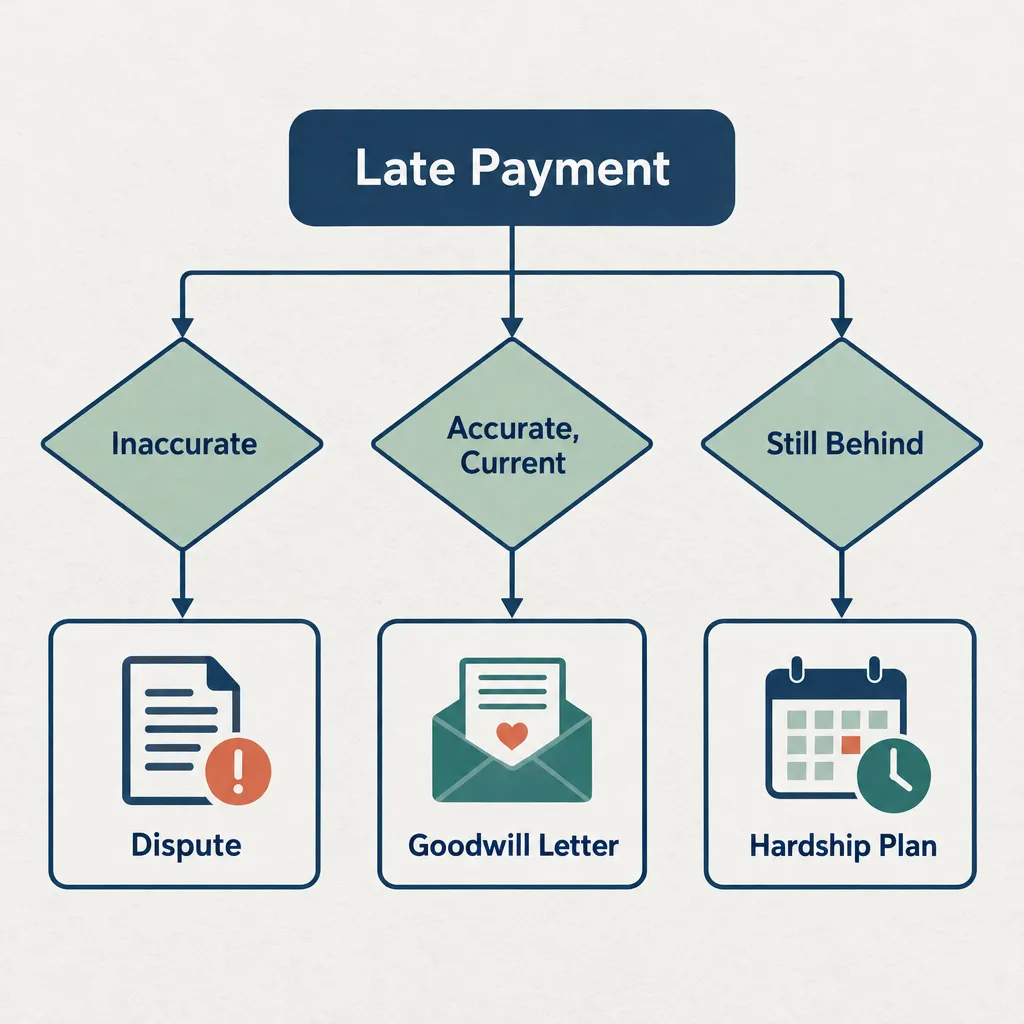
A goodwill letter only fits one situation: the late payment is accurate, it happened once, and you’ve caught up. In any other situation, a different tool works better or nothing will help except time.
- Is the late payment wrong? Maybe you paid on time, the account isn’t yours or the dates are off. Then don’t ask for goodwill. File a dispute with the credit bureaus or the lender. The Consumer Financial Protection Bureau (CFPB) publishes a free sample credit report dispute letter for exactly this, and our guide to writing a credit dispute letter walks through it.
- Is it accurate, a single event, and is the account current? Send a goodwill letter.
- Are you still behind? Call the lender about a hardship plan first. A goodwill request while the account is past due almost always fails.
- Has the account gone to collections or been charged off? A goodwill letter rarely helps here. Experian’s guidance, updated April 2026, says these letters won’t resolve charge-offs, collections or bankruptcy.
- Do you have several lates over months or years? Pay on time from here on and let the marks age off.
| Tool | Use when | Send to | Legal right? | Typical outcome |
|---|---|---|---|---|
| Goodwill letter | Late payment is accurate, isolated, account current | The creditor | No, it’s a courtesy request | Often declined; some lenders refuse by policy |
| Credit dispute | Information is inaccurate or incomplete | The credit bureau, the creditor (furnisher) or both | Yes, under the Fair Credit Reporting Act | Bureau must investigate, generally within 30 days |
| Pay-for-delete | Unpaid collection account | The collection agency | No | Many collectors won’t agree; the original late stays |
| Hardship request | You’re struggling now and can’t keep up | The creditor’s hardship or collections team | No federal right; programs vary by lender | Lower payments or deferral; doesn’t erase past lates |
Goodwill letter vs. credit dispute
A dispute says “this is wrong.” A goodwill letter says “this is right, but please forgive it.” The Fair Credit Reporting Act makes bureaus investigate disputes and correct or delete information they can’t verify. Nothing in the law makes a creditor act on a goodwill request.
Dispute first if it's an error
If you paid on time or the account isn’t yours, skip the goodwill letter and dispute the entry. You have a legal right to a dispute. You have no right to goodwill.
Goodwill letter vs. pay-for-delete
Pay-for-delete is a deal with a collection agency: you pay the debt, it deletes the collection entry. It deals with a different problem from a late payment on an open account. Even when a collector agrees, the original creditor’s late-payment history usually stays. If a debt collector contacts you about a debt you don’t recognize, a debt validation letter is the right first step, not a goodwill request.
Goodwill letter vs. hardship letter
A hardship letter asks for help going forward, such as a lower payment or a pause. A goodwill letter asks for relief from something in the past. If you’re still struggling, start with a hardship letter. A creditor can’t forgive a late payment while new ones keep coming.
Why creditors often say no
Creditors that report to the bureaus (the law calls them “furnishers”) have a legal duty to report accurately. Deleting a late payment that really happened makes the record less accurate. That’s why some banks treat goodwill requests as something they can’t do, rather than something they simply won’t do.
The duty comes from Section 623 of the Fair Credit Reporting Act, codified at 15 U.S.C. §1681s-2. It bars furnishers from reporting information they know or have reasonable cause to believe is inaccurate. Most lenders report in Metro 2, the standard data format maintained by the Consumer Data Industry Association (CDIA). Metro 2 includes a 24-month payment-history field for each account, so a late payment is a coded monthly data point, not a loose note in a file.
Big issuers say this out loud. Chase’s credit education page on goodwill letters, published in September 2025, says the bank has a policy against them because of a credit reporting requirement, so a letter to Chase is very unlikely to work however well it’s written. NerdWallet reported in March 2026 that Chase and Bank of America both say they won’t honor late-payment removal letters because of their reporting obligations. Rod Griffin of Experian told Credit Karma that “in most instances, a goodwill letter won’t result in removal,” and pointed to lenders’ legal and contractual duty to report accurately.
So if your bank says it’s “legally required to report accurately,” that’s true. It isn’t just a brush-off. The law doesn’t flatly ban a creditor from changing its reporting. But many large lenders have decided the compliance risk isn’t worth it.
Credit unions and smaller lenders sometimes have more room, because a person with authority may read your letter instead of a policy team. No one publishes success rates for goodwill letters, so the stories on the myFICO forums and Reddit are anecdotes, not odds. The section on creditor policies below sorts out which of those tactics conflict with what lenders have said.
What a single late payment costs you, in numbers
One 30-day late can do serious damage, and higher scores tend to fall further. Payment history is 35% of a FICO Score, the largest single factor according to myFICO. FICO data reported by Fox Business shows a single 30-day delinquency can drop a 780 score by roughly 90 to 110 points.
Timing matters as much as the size of the drop. myFICO says a recent late payment hurts more than several older ones. The damage is biggest in the first months and shrinks as you add on-time payments, even though the entry stays visible for years.
When a late payment gets reported
According to Experian, creditors generally report a payment as late only once it’s at least 30 days past due. If you pay a few days late, you may owe a late fee, but your credit report usually won’t show it. Lates are reported in steps: 30, 60, 90 days and beyond. Each step does more damage.
Worked example: a card payment is due March 5, 2026, and you pay it on April 12, 2026. That’s 38 days past due, so the issuer may report a 30-day late for March, depending on its reporting cycle. The entry can stay on your reports until about March 2033. Most of the score damage comes in the first year or two.
How the 7-year clock works
Most accurate negative information can be reported for seven years, and bankruptcy for ten, according to the Federal Trade Commission’s consumer guidance on credit and your rights. The FTC also says no one can legally remove accurate, timely negative information. Our guide on how long late payments stay on your credit report covers the clock in more detail.
| Item | How long it can be reported | Clock starts |
|---|---|---|
| Single late payment (30+ days) | 7 years | The missed payment |
| Series of late payments on one account | 7 years | The first missed payment in the series (original delinquency date) |
| Collection account | 7 years | Original delinquency on the underlying debt |
| Charge-off | 7 years | Original delinquency on the account |
| Bankruptcy | Up to 10 years | Filing |
Did you know?
According to Experian, if you miss several payments in a row, the whole series drops off seven years after the first missed payment, not the last. Each later late doesn’t restart the clock.
Is it worth sending a letter about one 30-day late from three years ago? The stakes are lower than for a recent late, because much of the score damage has already faded. A letter still costs only postage, though. It’s most worth sending if you’re about to apply for a mortgage or car loan and every point counts.
When a goodwill letter has the best chance
Your odds are best when the late payment looks like a one-time accident in an otherwise clean history. Go through this checklist before you write:
- It’s your first late payment on this account, ideally on any account.
- The account is current and has been for several months.
- You’ve been a customer for years, with on-time payments before and since.
- You can name a specific reason, ideally with proof: a hospital stay, a natural disaster, an autopay or bank glitch, or a move that sent the bill to the wrong address.
- You haven’t already been turned down several times for the same request.
- The lender isn’t one that publicly refuses goodwill requests.
“My autopay failed and now I have a 30-day late. Will they remove it?” There’s no guarantee. But this is one of the stronger cases, especially if a bank letter or statement shows the failed transfer and you paid as soon as you noticed. If the lender’s system caused the failure, that’s no longer a goodwill question. It may be an error you can dispute.
How to write a goodwill letter, step by step
A good goodwill letter fits on one page, names the exact account and month, takes responsibility, explains what changed and makes one clear request. Gather everything first so the letter is specific.
What you need before you start:
- Copies of your reports from all three bureaus
- The account number (or its last four digits) and the creditor’s correct mailing address
- The exact month and year the late payment was reported
- Proof the account is now current
- Supporting documents, if you have them (hospital discharge papers, a bank’s letter about an autopay failure, an insurance claim)
Keep the proof
Attach copies of your documents, never originals. Keep a copy of everything you send, plus the certified mail receipt, so you can point to dates if the creditor approves and a bureau doesn’t update.
- Pull all three reports. Free weekly reports from Equifax, Experian and TransUnion are permanent and available only through AnnualCreditReport.com or 1-877-322-8228, according to the FTC. Note the exact month the late was reported and which bureaus show it.
- Confirm it’s accurate. If anything is wrong, switch to a dispute.
- Bring the account current. If you can, wait a few months of on-time payments before you ask.
- Gather proof of the reason for the late payment.
- Write one page using the template below.
- Find the right address. Call customer service and ask where to mail a credit reporting or goodwill request.
- Send it by certified mail with return receipt, or through the lender’s secure message center.
- Track it. Write down the send date and set reminders for 30 and 45 days.
What to include
- Your name, address, phone and account number (last four digits are enough in an email)
- The exact month and year of the late payment
- A one- or two-sentence explanation of what happened
- A plain statement that you take responsibility
- What has changed since, such as autopay set up, an emergency fund or recovery from illness
- Your history with the creditor, such as years as a customer or on-time payments since
- One clear request: remove the late payment from the reports it sends to all bureaus
What to leave out
- Threats or legal claims. Saying the late payment “violates the FCRA” when it’s accurate weakens your request.
- Long stories. One paragraph on the cause is enough.
- Anything untrue. A false claim could cross into fraud, and it undermines the request.
- Demands or deadlines. You’re asking a favor.
Should you mention that you’re buying a house? One short, true sentence about an upcoming mortgage application is fine, because it explains why this matters now. Don’t lead with it. The reason for the late payment and your history do more of the persuading.
Goodwill letter template (copy and edit)
This free template works for credit cards, auto loans, mortgages and private loans. Replace everything in square brackets, delete what doesn’t apply and keep it to one page.
[Your full name]
[Your street address]
[City, state ZIP]
[Phone number][Date you send the letter]
[Creditor name]
[Department, if customer service gave you one]
[Creditor mailing address]Re: Goodwill request, account ending in [Last 4 digits]
Dear [Department, or “Customer Relations Team”],
I have been a [Creditor name] customer since [Year]. I am writing to ask you to consider a goodwill adjustment to the late payment reported on my account for [Month and year].
That payment was late because [One or two sentences on what happened]. I take full responsibility for the missed payment. I brought the account current on [Date paid], and I have paid on time every month since.
To prevent this from happening again, I have [What you changed, for example set up autopay for the minimum payment and payment reminders].
Apart from this one payment, my history with you has been [Describe, for example on time for six years]. I understand that you report accurately and are not obligated to make any change. As a courtesy, I respectfully ask that you remove the [30-day] late payment for [Month and year] from the information you report to Equifax, Experian and TransUnion.
I have enclosed [List of documents, or delete this sentence]. Thank you for considering my request. You can reach me at [Phone] or [Email].
Sincerely,
[Signature]
[Printed name]
Sample: autopay or bank error
My payment for [Month and year] was scheduled through autopay, but the transfer from my [Bank name] account failed after I changed accounts, and I did not catch the failed payment notice. As soon as I noticed, I paid the full balance due on [Date]. I have enclosed a letter from [Bank name] confirming the failed transfer, and I now check every payment confirmation.
Sample: medical or family emergency
In [Month and year], I was hospitalized from [Date] to [Date] and could not manage my bills during my recovery. I paid the past-due amount on [Date], once I was home. A copy of my discharge paperwork is enclosed. I have since set up automatic payments so that my account stays current if I am ever unavailable again.
Sample: student loan servicer
I am writing about my [Federal or private] student loan account, number ending in [Last 4 digits]. My payment for [Month and year] was late because [Reason, for example MY loan was transferred to your company and MY payments went to the previous servicer]. The account has been current since [Date], and I am enrolled in automatic debit. I respectfully ask that you remove the late payment reported for [Month and year] as a courtesy.
If a servicer transfer caused the late payment and your payment records show you paid on time, treat it as an error and dispute it.
Mail, email, phone or chat? Where to send it
Send your goodwill letter to the creditor, and use a channel that leaves a record. Certified mail with return receipt gives you the strongest proof. A secure message through the lender’s website is also fine if the lender uses it for credit reporting questions.
| Channel | Strengths | Weaknesses |
|---|---|---|
| Certified mail, return receipt | Proof of delivery and date; reaches a department that keeps records | Slowest; costs postage |
| Secure message or email | Fast; automatic written record | May go to front-line staff who can’t change reporting |
| Phone | Instant answer; you can ask for the right department | No paper trail unless you take notes and ask for written confirmation |
| Chat | Quick way to get the right mailing address | Agents rarely have authority to change credit reporting |
Can I email a goodwill letter? Yes, if the lender accepts credit reporting requests by email or secure message. Put the account (last four digits only) and the late-payment month in the subject line, and save a copy. Some credit unions recommend mail because a mailed letter tends to reach the people who handle reporting. If an email gets a canned reply, send the same letter by mail.
Executive office or customer service? Start by asking customer service for the right address for credit reporting requests. The executive-office route is covered with the other community tactics in the next section.
Don’t send it to Experian, Equifax or TransUnion. The bureaus get information from creditors and from other sources, such as public records. They won’t delete an accurate late payment because you ask nicely. Only the creditor can agree to a goodwill change, though a bureau can also correct or delete information after a dispute if it is inaccurate or can’t be verified.
Creditor policies: what’s publicly known
Public policies are rare, and most of what circulates online is forum anecdote. The table below separates what lenders have said themselves from what others have reported. Ask your own lender before writing, because policies change. Sources were checked in November 2026.
| Creditor | Stated or reported policy | Status | Source |
|---|---|---|---|
| Chase | Has a policy against goodwill letters because of a credit reporting requirement | Confirmed | Chase credit education page, September 2025 |
| Bank of America | Doesn’t honor goodwill adjustment requests | Reported | The Points Guy; NerdWallet, March 2026 |
| American Express | No specific goodwill policy listed on its website | Unknown | The Points Guy |
| Capital One | No published policy; forum users report both removals and flat refusals | Unknown | myFICO forums (anecdotal) |
| Discover | Its education content says card issuers don’t have to forgive late payments, and asking comes with no guarantee | Unknown (no published goodwill policy) | Discover card education page |
| Federal student loan servicers | Each servicer sets its own goodwill policy | Varies | Credible, 2025–2026 |
| Credit unions and smaller lenders | Case by case; no published policies or success data | Unknown | None published |
A “no” from a lender with a stated refusal policy is the expected answer, not a sign your letter was badly written. For Capital One, Discover and American Express, you can ask, but plan on the late payment staying.
What Reddit and myFICO users say works (and what doesn’t)
Forum threads on Reddit’s r/CRedit and the myFICO forums are full of goodwill success stories and just as many refusals. NerdWallet, which summarized Reddit advice in its March 2026 guide, cautions that anonymous posts can’t be verified. Treat every tactic below as anecdote, and check it against what the lender itself has said.
| Community tactic | What users report | How it squares with lender policy |
|---|---|---|
| Writing to the executive or president’s office | Some say letters there got a more careful review; r/CRedit users keep lists of executive contacts | A stated refusal policy applies whoever reads the letter. Send one copy, not a flood |
| Sending repeated letters over months | NerdWallet’s Reddit summary says persistence sometimes paid off | One Discover customer on myFICO reported four denials, each citing the FCRA’s accuracy rules. Repeats rarely change a policy answer |
| Mentioning an upcoming mortgage | Often cited as the reason a reviewer said yes | Fine as one true sentence. No lender says it changes its decision |
| Calling instead of mailing | Some report quick yeses from a phone rep; others say reps can’t touch reporting | A verbal yes means little. Ask for written confirmation naming the account, month and bureaus |
| Writing your own words, not a pasted template | Users say a specific, personal letter reads better than a copied one | Consistent with every lender’s emphasis on a documented reason |
The pattern across the threads matches the official guidance: the success stories tend to involve one late, a long history and a documented reason. Tactics don’t override a bank’s stated policy.
After you send it: timelines and follow-up
No law gives a creditor a deadline to answer a goodwill letter, and it doesn’t have to answer at all. That’s the key difference from a dispute. Under the Fair Credit Reporting Act, a bureau generally has 30 days to investigate a dispute, according to the CFPB, or 45 days if you dispute after getting your free annual report. True North Federal Credit Union says, in guidance updated October 2026, that most creditors respond to goodwill requests within two to six weeks.
| Step | When | What to do |
|---|---|---|
| Send the letter | Day 0 | Certified mail with return receipt; keep a copy and note the date |
| Wait for a reply | Weeks 2–6 | Watch your mail and the lender’s message center |
| Follow up once | Days 30–45 | A short, polite note referring to your first letter and its date |
| If approved | On approval | Ask for written confirmation naming the account, month and bureaus |
| Check the result | 1–2 months after approval | Pull all three reports at AnnualCreditReport.com |
| If denied | 6+ months later | One retry, only if your record has improved |
If the creditor removed it at one bureau but not the others, contact the creditor again and attach its written approval. Ask it to update its reporting to every bureau it reports to. If one bureau still shows the late payment after that, file a dispute with that bureau and include the creditor’s letter. At that point the entry no longer matches what the creditor says it reports.
Applying for a mortgage soon? A goodwill letter usually can’t fix things on a tight timeline, given a response time of several weeks plus bureau updates. Tell your loan officer about the late payment early. If you get a written approval, ask whether the lender can request a rapid rescore once the change is documented.
If the answer is no
A refusal is the most common result, and it doesn’t hurt your credit. You have a few reasonable options, but sending letter after letter isn’t one of them.
- Retry once, later. After six or more months of on-time payments, send one updated letter. Repeating the same request rarely changes the answer.
- Call once. A polite call to the credit reporting team or executive office sometimes reaches someone with more authority. Ask for the outcome in writing.
- Ask for hardship help if you’re still struggling. Avoiding the next late payment matters more than erasing the last one. If a car loan is the strain, our guide on what to do if you can’t afford your car payment covers your options.
- Rebuild while it ages. Pay on time, keep card balances low and let recency work in your favor. Free nonprofit credit counseling can help you build a plan.
When the creditor breaks the rules, not just says no. Refusing a goodwill request is legal. These are different:
- It confirms a removal in writing and doesn’t follow through.
- It reports the late payment for the wrong month or amount.
- It ignores a proper dispute.
For any of those, file a complaint through the CFPB’s online complaint portal, and consider your state attorney general’s consumer protection office. A consumer attorney or local legal aid office can tell you whether the reporting violates the Fair Credit Reporting Act, which lets courts award attorney’s fees in successful cases. This article is general information, not legal advice.
Student loans, mortgages and collections
Student loans and mortgages are where many late payments show up for people under money pressure. Collections are where goodwill letters work least.
Student loans. Federal student loans typically aren’t reported late to the bureaus until about 90 days past due. A late on a federal loan means a long delinquency, which makes goodwill harder. Each federal servicer sets its own goodwill policy. Private lenders follow their own rules and may report at 30 days. Servicer transfers cause many disputed lates, so check your payment records before you write.
Mortgages. A recent mortgage late weighs heavily when you try to refinance or buy again. Mortgage servicers do respond to goodwill requests, but they often decline. If the late came from a servicing transfer, an escrow problem or a payment the servicer misapplied, treat it as an error and dispute it.
Collections and charge-offs. Experian says goodwill letters won’t resolve collections or charge-offs. A collection agency didn’t extend you credit, so it has no customer relationship to protect. Your rights there come from the Fair Debt Collection Practices Act. If you want a debt collector to stop contacting you, a cease and desist letter to the collector is the tool for that.
Beware anyone selling late-payment removal
No one can legally remove accurate, timely negative information from your credit report, according to the FTC. A company that promises to delete an accurate late payment for a fee is selling something it can’t deliver.
The Credit Repair Organizations Act (15 U.S.C. §1679 and following) generally bars credit repair companies from charging before they’ve fully performed the services they promised, with a limited exception for certain services paid under a written contract with specified terms. The CFPB also notes you can dispute errors yourself for free. And under the CFPB’s direct dispute rule (12 CFR 1022.43), a creditor can decline a dispute it reasonably believes was prepared by a credit repair organization. Paying someone to send letters can backfire.
Red flags:
- Asks for payment before doing any work
- Promises to remove accurate late payments, or “guarantees” a score increase
- Tells you to dispute accurate information as inaccurate
- Suggests a “new credit identity” or a different identification number
- Won’t explain your rights in writing or give you a contract with a cancellation period
Report credit repair scams to the FTC at ReportFraud.ftc.gov, to the CFPB and to your state attorney general.
Before you send
A goodwill letter is a request, not a right. Many lenders say no, and some refuse as policy. Don’t pay anyone who promises to remove accurate late payments, and never claim a correct entry is wrong to get it deleted.
The realistic next step
Start with this week’s free reports from all three bureaus. If the late payment is wrong, dispute it. If it’s accurate, isolated and you’re current, send one careful letter to a lender that hasn’t ruled goodwill out. Either way, every on-time month from here on keeps working for you while you wait for an answer.
FAQ
How successful are goodwill letters?
No lender or regulator publishes success rates. Experian’s Rod Griffin says that in most cases a goodwill letter won’t lead to removal, and Chase and Bank of America say they don’t honor them. Your best chance is a single late payment, a current account, a long history and a documented reason.
Can you provide an example of a goodwill letter?
Yes. The template in this guide covers the full one-page letter, and three sample paragraphs show how to explain an autopay failure, a medical emergency and a student loan servicer transfer. Swap in your own dates and documents rather than sending the wording unchanged.
Can I email a goodwill letter?
Yes, if the creditor accepts credit reporting requests by email or secure message. Save a copy, and include the account’s last four digits and the late-payment month. If you get a canned reply, send the same letter by certified mail to the address customer service gives you.
Do I send a goodwill letter to Experian or to the creditor?
Send it to the creditor. Experian, Equifax and TransUnion collect information from creditors and other sources, and they won’t delete accurate information on request. Only the creditor can agree to a goodwill removal.
Does Discover or Capital One accept goodwill letters?
Neither publishes a goodwill policy. Discover’s own education content says card issuers don’t have to forgive late payments. Capital One customers on the myFICO forums report both removals and flat refusals. You can ask, but don’t count on a yes.
Do Reddit goodwill tips actually work?
Some people report success with executive-office letters or repeated requests, but those are unverified anecdotes. They don’t override a lender’s stated policy, and repeated letters to a lender that has already said no rarely change the answer.
How long does a goodwill letter take?
Most creditors respond within two to six weeks, though no law sets a deadline. Follow up once after 30 to 45 days. If the creditor approves, allow a month or two for the change to show at each bureau, then check all three reports.
Can a goodwill letter remove a collection or charge-off?
Rarely. Experian says goodwill letters won’t resolve collections or charge-offs, which point to serious, long delinquencies. Those entries can be reported for seven years from the original delinquency date. If the information is wrong, dispute it. If you don’t recognize a collection debt, send a debt validation letter.
Laws and regulations referenced
Links go to the official text on government sites.
Check, verify or complain
Sources
- FTC: Permanent access to free weekly credit reports consumer.ftc.gov · official source
- FTC: Credit and your consumer rights bulkorder.ftc.gov · official source
- CFPB: Sample credit report dispute letter files.consumerfinance.gov · official source
- CFPB: How do I dispute an error on my credit report? consumerfinance.gov · official source
- CFPB: How to avoid credit repair service scams consumerfinance.gov · official source
- CFPB: 12 CFR 1022.43 Direct disputes consumerfinance.gov · official source
- Chase: Goodwill letters chase.com
- NerdWallet: Goodwill letter nerdwallet.com
- The Points Guy: Late payment and your credit score thepointsguy.com
- Credit Karma: Goodwill letter creditkarma.com
- Experian: What is a goodwill letter? experian.com
- Experian: Can one 30-day late payment hurt your credit score? experian.com
- myFICO: Late payments myfico.com
- Fox Business: This 1 mistake could tank your credit score by 100 points foxbusiness.com
- True North FCU: How to write a goodwill letter truenorthfcu.org
- 15 U.S.C. 1681s-2 customsmobile.com
- CDIA: Metro 2 information cdiaonline.org
- TransUnion: Data reporting FAQs transunion.com

Marcus covers credit scores, credit reports and getting out of debt: consolidation, nonprofit counseling, settlement and what debt collectors may and may not do. He works from the federal laws that apply, CFPB guidance and the credit bureaus' published rules.
Ruth is US Financer's standards editor. Every article goes through her checks before and after it is published: each rate, fee, cap, deadline and rule is matched against its primary source, every law named is linked to its official text, and anything that cannot be…
What changed
- Nov 13, 2026 First published.
Comments are closed