

Results are estimates for comparison, not financial advice. Your lender's or card issuer's own disclosure shows the exact cost.
Runs in your browser. Nothing you type is sent or saved.
On the Repayment Assistance Plan, a single borrower with a $50,000 adjusted gross income pays $166.67 a month. One more dollar of income raises that to $208.34. The student loan repayment calculator above shows your RAP payment, how long payoff takes, how much gets cancelled and what the Tiered Standard plan would charge instead. Before you start, have four numbers ready: your total federal loan balance, your average interest rate, the AGI from your latest tax return and the number of dependents you claim.
Your money, in brief
- RAP charges 1% to 10% of your whole AGI, minus $50 a month per dependent. The lowest payment is $10.
- Interest your payment doesn’t cover is never charged, and your principal drops at least $50 a month (or by your full payment, if that’s smaller).
- After 360 qualifying payments, whatever is left is cancelled. Under current law, the cancelled amount is federally taxable.
- RAP counts toward Public Service Loan Forgiveness. No tier of the Tiered Standard plan does.
- Single borrowers earning under about $34,000 or over $70,000 often pay less on IBR, if their loans still qualify for it.
On this page
- The Repayment Assistance Plan in 30 seconds
- Where RAP stands as of November 2026
- How to fill in the student loan repayment calculator
- How is the RAP payment calculated?
- Quick-reference: sample monthly RAP payments
- RAP vs. IBR vs. Tiered Standard vs. SAVE and PAYE
- Is RAP worth it? Pros and cons
- Does RAP qualify for PSLF?
- Is RAP forgiveness taxed?
- How do I apply for RAP, and can I switch out?
- FAQ
How to use it
- Log in to StudentAid.gov and open your dashboard. Add up the current balances of your federal loans and enter the total in Total federal student loan balance ($). Your servicer’s monthly statement shows the same figures.
- Find each loan’s rate on the same page or in your loan offer. Enter a balance-weighted average in Average interest rate (%).
- Take adjusted gross income from line 11 of your latest Form 1040 and enter it in Adjusted gross income (AGI) ($). If your income has dropped since you filed, estimate it from your current pay stubs.
- Enter the number of dependents on your federal return in Dependents you claim. Don’t count yourself.
- Read the RAP payment, the payoff time, the amount cancelled and the two standard-plan figures. Then change AGI by a few thousand dollars to see how close you are to a bracket line.
Fact-checked
We checked these key facts against the sources named, on November 27, 2026:
- At $80,001 the payment is $533.34 (source: edfinancial.studentaid.gov)
- At $50,000 you pay 4%: $2,000 a year, or $166.67 a month (source: ticas.org)
- At $50,001 you pay 5%: $2,500.05 a year, or $208.34 a month (source: ticas.org)
- At a $50,000 AGI with no dependents, that’s 4% × $50,000 ÷ 12 = $166.67 (source: edfinancial.studentaid.gov)
- For one person in 2026 that’s $23,940, based on the HHS guideline of $15,960 (source: aspe.hhs.gov)
The Repayment Assistance Plan in 30 seconds
The Repayment Assistance Plan (RAP) is the federal income-driven repayment plan created by the One Big Beautiful Bill Act, Public Law 119-21, signed on July 4, 2025. It opened on July 1, 2026. Your payment is a percentage of your total AGI, reduced by $50 a month for each dependent, and any balance left after 360 qualifying payments is cancelled.
For federal loans disbursed on or after July 1, 2026, RAP is the only income-driven plan. The only other choice for those loans is the Tiered Standard plan. If your loans are older, you can move to RAP now or stay in an older plan, subject to the deadlines covered below.
| Feature | RAP rule |
|---|---|
| Payment basis | 1% to 10% of total AGI, by $10,000 band |
| Annual minimum base | $120 if AGI is $10,000 or less |
| Dependent reduction | $50 a month per dependent |
| Monthly floor | $10 |
| Unpaid interest | Not charged |
| Principal match | Up to $50 a month |
| Forgiveness | After 360 qualifying payments (30 years) |
| PSLF | Qualifying plan |
| Parent PLUS loans | Not eligible |
Where RAP stands as of November 2026
RAP has been live on StudentAid.gov since July 1, 2026, and the Department of Education’s final regulations are in force. The RISE final rule (91 FR 23768) was published in the Federal Register on May 1, 2026 and took effect July 1, 2026. On launch day, Under Secretary Nicholas Kent reported nearly 46,000 applications.
New borrowers (loans on or after July 1, 2026)
Loans disbursed on or after July 1, 2026 have two plans available: RAP and Tiered Standard. None of the older income-driven plans can be used for them. A Direct Consolidation Loan made on or after July 1, 2026 also counts as a new loan.
The new-loan rule reaches back to your older loans as well. The StudentAid.gov Income-Driven Repayment Plan Request form says that if you have a new loan first disbursed on or after July 1, 2026, all your Direct Loans, whenever they were disbursed, must be repaid under the Tiered Standard plan or RAP. Borrowing again, or consolidating now, can therefore close off IBR for all of your debt.
Borrowers with older loans
If all your loans were disbursed before July 1, 2026, you can stay in Income-Based Repayment (IBR), Pay As You Earn (PAYE) or Income-Contingent Repayment (ICR), or you can switch to RAP. Under section 82001 of Public Law 119-21, PAYE and ICR close to existing borrowers on July 1, 2028. Borrowers still on either plan by then must move to another eligible plan or be moved into RAP. IBR (Higher Education Act section 493C) is not sunset. It stays available after July 1, 2028 for loans disbursed before July 1, 2026, as long as you take out no new loan.
The One Big Beautiful Bill Act also dropped IBR’s partial financial hardship requirement when it was enacted, according to a Federal Student Aid Dear Colleague letter dated July 18, 2025. You no longer need a low income relative to your debt to get into IBR.
Forbes contributor Adam S. Minsky reported on November 25, 2026 that the Department was telling some borrowers they had been put in the wrong version of IBR. That version is limited to people who first borrowed on or after July 1, 2014. MOHELA sent the notices, and borrowers have 90 days to choose a new plan or risk being moved to one with a higher payment. If you get one of these letters, check the date of your first federal loan on StudentAid.gov.
Did you know?
The Education Department said fewer than 0.1% of borrowers were wrongly put into the newer, more generous version of IBR, according to news reports on the November 2026 MOHELA notices.
Former SAVE borrowers
The SAVE plan is ending. In December 2025, the U.S. Department of Education announced an agreement with the State of Missouri to stop new SAVE enrollments, deny pending applications and move SAVE borrowers into legal repayment plans. Servicers began sending 90-day notices on July 1, 2026, so the earliest automatic move was September 29, 2026.
Borrowers who pick nothing are placed on a standard plan, often with a much higher bill than they had under SAVE. In a November 17, 2026 Forbes article, Minsky reported that final 30-day notices had gone out, but the Department hadn’t yet moved many borrowers.
Pick before you're placed
If you’re on SAVE and got the 90-day letter, choose a plan yourself. Run your numbers for both RAP and IBR in the StudentAid.gov Loan Simulator, then apply for the cheaper one. If you do nothing, you’ll be put on a standard plan.
How to fill in the student loan repayment calculator
Each field matches one input in either the RAP formula or the standard amortization formula. Most wrong results come from a handful of input mistakes, which are listed after the fields.
Total federal student loan balance ($)
Enter the current principal plus any unpaid interest on all your federal Direct and FFEL loans. Leave out private loans, because RAP doesn’t cover them. Your balance sets your Tiered Standard term. It also sets how much RAP’s subsidies matter, because a bigger balance means more interest that your payment may not cover.
Average interest rate (%)
If your loans carry different rates, weight each rate by its balance. Take $20,000 at 5.5% and $10,000 at 7.5%: (20,000 × 5.5 + 10,000 × 7.5) / 30,000 gives 6.17%. A simple average of the two rates (6.5%) would overstate your interest.
Adjusted gross income (AGI) ($)
Use AGI, not salary. AGI is gross income minus “above-the-line” deductions such as traditional 401(k) contributions taken through payroll, HSA contributions and the student loan interest deduction. On Form 1040 it is line 11. If you’re married and file jointly, enter your combined AGI.
Dependents you claim
Count the dependents on your federal return. Each one takes $50 off the monthly payment, down to the $10 floor. This field doesn’t change the Tiered Standard result, because fixed plans ignore family size.
Common input mistakes
- Entering gross salary. A $55,000 salary with $5,000 in pre-tax 401(k) contributions is a $50,000 AGI. Entered as $55,000, it lands in the 5% band at $229.17 a month; the correct $50,000 is in the 4% band at $166.67, a $62.50 difference.
- Including private or Parent PLUS loans. Neither can go on RAP, so including them overstates your balance and understates the subsidy.
- Using last year’s AGI after a big pay cut. You can document your current income instead. The calculator only reflects what you enter.
- Counting yourself or your spouse as a dependent. The field is for dependents you claim, such as children.
- Expecting the 30-year result to come true exactly. The calculator holds AGI, dependents and rate fixed. Real RAP payments are recalculated every year.
How is the RAP payment calculated?
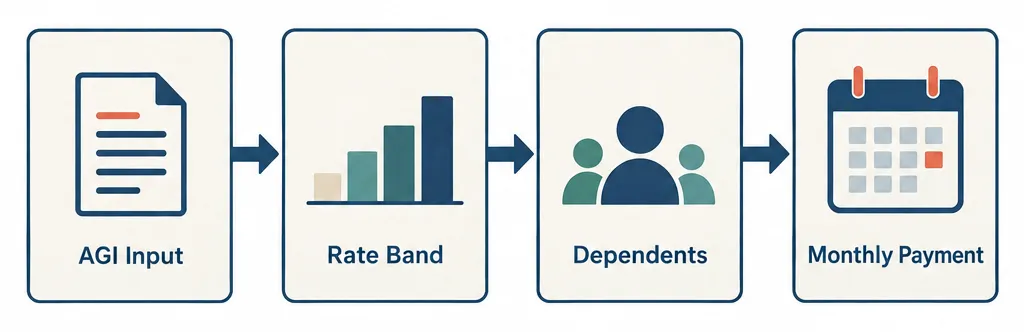
Take your AGI, multiply it by the percentage for its $10,000 band, divide by 12 and subtract $50 for each dependent. The payment is never less than $10. Under Higher Education Act section 455 as amended by Public Law 119-21, the percentage applies to your whole AGI, not just the part above a threshold.
The formula, step by step
- Find your band. AGI of $10,000 or less gives a flat $120 a year. Above that, the rate is 1% for $10,001 to $20,000, 2% for $20,001 to $30,000, and one point more for each $10,000 band after that, up to 10% above $100,000.
- Base payment = AGI × band percentage (or $120).
- Monthly payment = base ÷ 12 − ($50 × dependents), with a minimum of $10.
- Each month: any interest your payment doesn’t cover is not charged. If your payment cuts principal by less than $50, the Department reduces principal by the difference, up to the lesser of $50 or your payment.
- After 360 qualifying payments, any remaining balance is cancelled.
The bracket table
| AGI band | Annual base payment | Monthly before dependents |
|---|---|---|
| $10,000 or less | $120 | $10.00 |
| $10,001 to $20,000 | 1% ($100 to $200) | $8.33 to $16.67 (floor: $10) |
| $20,001 to $30,000 | 2% ($400 to $600) | $33.33 to $50.00 |
| $30,001 to $40,000 | 3% ($900 to $1,200) | $75.00 to $100.00 |
| $40,001 to $50,000 | 4% ($1,600 to $2,000) | $133.34 to $166.67 |
| $50,001 to $60,000 | 5% ($2,500 to $3,000) | $208.34 to $250.00 |
| $60,001 to $70,000 | 6% ($3,600 to $4,200) | $300.01 to $350.00 |
| $70,001 to $80,000 | 7% ($4,900 to $5,600) | $408.34 to $466.67 |
| $80,001 to $90,000 | 8% ($6,400 to $7,200) | $533.34 to $600.00 |
| $90,001 to $100,000 | 9% ($8,100 to $9,000) | $675.01 to $750.00 |
| $100,001 and up | 10% | $833.34 and up |
Dependents and the $10 minimum
Each dependent takes a flat $50 off the monthly payment. Take a single parent with two children and a $40,000 AGI: $1,200 ÷ 12 = $100, minus $100, leaves $0. The $10 floor then sets the payment at $10. No RAP borrower pays $0, while IBR can still produce a $0 payment at low incomes.
Did you know?
Under the RAP formula in Higher Education Act section 455, a borrower with three dependents pays the $10 minimum at any AGI up to $48,000, because 4% of $48,000 is $160 a month, and three $50 credits bring that down to exactly $10.
Married borrowers: joint vs. separate filing
If you file jointly, RAP uses your combined AGI. If your spouse also has federal student loans, your payment is reduced in proportion to your share of the couple’s combined federal debt. If you file separately, RAP uses only your own AGI and your own dependents.
Filing separately often lowers the RAP payment when your spouse earns more than you do. It can also raise your household’s tax bill and cost you some credits. Work out both before you decide.
Worked example 1: the calculator’s default inputs
The defaults are a $30,000 balance, a 6.5% rate, a $50,000 AGI and no dependents.
- Band. $50,000 falls in the $40,001 to $50,000 band, so the rate is 4% of AGI.
- Base. 0.04 × $50,000 = $2,000 a year.
- Monthly. $2,000 ÷ 12 = $166.67. There are no dependents, and the payment is well above $10.
- Month one. Interest is $30,000 × 0.065 ÷ 12 = $162.50. The payment covers it and leaves $4.17 for principal. That’s less than $50, so the Department adds a $45.83 principal match and the balance falls by exactly $50.
- Later months. As the balance falls, the interest shrinks and so does the match. Once the balance drops below about $21,540, monthly interest falls under $116.67. From then on the payment alone cuts principal by more than $50, and the match stops. Because the payment always covers interest here, no interest is waived. The whole $3,901 subsidy is principal match.
- After 30 years. 360 payments of $166.67 add up to about $60,001. About $4,899 is still owed and gets cancelled.
- Comparison. A $30,000 balance falls in the 15-year Tiered Standard tier: $261.33 a month and $47,040 in total. The classic 10-year standard plan would be $340.64 a month and $40,877 in total.
| Plan | Monthly payment | Term | Total repaid | Cancelled |
|---|---|---|---|---|
| RAP | $166.67 | 30 years | About $60,001 | About $4,899 |
| Tiered Standard (15-year tier) | $261.33 | 15 years | $47,040 | $0 |
| 10-year standard | $340.64 | 10 years | $40,877 | $0 |
RAP costs $94.66 a month less than the 15-year tier, but you pay about $12,961 more over the life of the loan and could face a tax bill on the $4,899 cancelled. Here, a lower payment and a lower total cost pull in opposite directions.
Worked example 2: a low income and a large balance
Take a $60,000 balance at 7%, an AGI of $35,000 and one dependent.
- Band. $35,000 falls in the $30,001 to $40,000 band, so the rate is 3%.
- Base. 0.03 × $35,000 = $1,050 a year.
- Monthly. $1,050 ÷ 12 = $87.50, minus $50 for one dependent, gives $37.50.
- Month one. Interest is $60,000 × 0.07 ÷ 12 = $350.00. The $37.50 payment covers $37.50 of it, and the other $312.50 is not charged. The payment cuts principal by $0, so the match is the lesser of $50 or the payment: $37.50. The balance falls to $59,962.50.
- Over 30 years with nothing changed. The balance falls by $37.50 every month, or $13,500 in total. You pay 360 × $37.50 = $13,500. About $46,500 is cancelled at the end. Over that time, roughly $98,400 of interest is never charged.
- Comparison. A $60,000 balance falls in the 20-year tier. Using P × r / (1 − (1 + r)^−n) with r = 0.07 ÷ 12 and n = 240, the payment is about $465.18 a month, or $111,643 in total. A 10-year schedule would cost about $696.64 a month.
This is the case RAP was built for. Without the interest waiver, this balance would grow every month.
Quick-reference: sample monthly RAP payments
These figures use the same rule as the calculator. Use the table to check a result or to see how dependents change a bill.
| AGI | 0 dependents | 1 dependent | 2 dependents |
|---|---|---|---|
| $10,000 | $10.00 | $10.00 | $10.00 |
| $25,000 | $41.67 | $10.00 | $10.00 |
| $30,000 | $50.00 | $10.00 | $10.00 |
| $40,000 | $100.00 | $50.00 | $10.00 |
| $50,000 | $166.67 | $116.67 | $66.67 |
| $50,001 | $208.34 | $158.34 | $108.34 |
| $60,000 | $250.00 | $200.00 | $150.00 |
| $75,000 | $437.50 | $387.50 | $337.50 |
| $90,000 | $600.00 | $550.00 | $500.00 |
| $100,000 | $750.00 | $700.00 | $650.00 |
| $120,000 | $1,000.00 | $950.00 | $900.00 |
| $150,000 | $1,250.00 | $1,200.00 | $1,150.00 |
The $50,000 vs. $50,001 cliff
Because the percentage applies to your whole AGI, crossing a band line raises your entire payment. At $50,000 you pay 4%: $2,000 a year, or $166.67 a month. At $50,001 you pay 5%: $2,500.05 a year, or $208.34 a month. That one dollar of income costs about $500 a year.
The jump gets bigger in higher bands. At $80,000 a single borrower pays $466.67 a month. At $80,001 the payment is $533.34.
Check how close you are to a band line
If your AGI sits just above a $10,000 line, lawful pre-tax contributions to a 401(k), 403(b) or HSA lower your AGI and can drop you a full percentage point. Type a slightly lower AGI into the calculator to see what getting back under the line is worth.
Why you can’t get a $0 payment anymore
RAP’s floor is $10 a month, even with $0 income or several dependents. Under IBR, a $0 payment is still possible when AGI is below 150% of the poverty guideline. For one person in 2026 that’s $23,940, based on the HHS guideline of $15,960. If your loans were disbursed before July 1, 2026, IBR is the only plan left that can produce a $0 payment.
The interest subsidy and $50 principal match
RAP has two subsidies. Unpaid interest is waived, so your balance can’t grow from interest as long as you pay on time. And your principal falls by at least $50 a month, or by your full payment if that’s less. Together they prevent the negative amortization that left many borrowers on older plans owing more than they borrowed.
Here’s a three-month view of worked example 2 ($60,000 at 7%, $37.50 payment):
| Month | Starting balance | Interest | Covered by payment | Waived | Principal match | Ending balance |
|---|---|---|---|---|---|---|
| 1 | $60,000.00 | $350.00 | $37.50 | $312.50 | $37.50 | $59,962.50 |
| 2 | $59,962.50 | $349.78 | $37.50 | $312.28 | $37.50 | $59,925.00 |
| 3 | $59,925.00 | $349.56 | $37.50 | $312.06 | $37.50 | $59,887.50 |
Should you make extra payments on RAP?
If your payment doesn’t cover the interest, a small extra payment is mostly wasted. The money goes to interest that would have been waived anyway. If your payment comfortably covers the interest, as in the default example, extra payments do reduce principal and interest.
The answer depends on whether you expect forgiveness. If you plan to pay the loan in full, extra payments help. If you’re aiming for PSLF or expect a balance to be cancelled, they mostly reduce the amount forgiven. If you plan to pay in full, you can model the effect in a debt payoff calculator first.
The student loan standard repayment plan: Tiered Standard
The Tiered Standard plan charges a fixed payment over 10, 15, 20 or 25 years, depending on how much you owe. The payment is P × r / (1 − (1 + r)^−n), where P is the balance, r is the annual rate ÷ 12 and n is the number of months. That’s the same amortization math any loan calculator or interest calculator uses.
| Total borrowed | Term | Sample payment at 6.5% | PSLF-qualifying? |
|---|---|---|---|
| Under $25,000 ($20,000 example) | 10 years | $227.10 | No |
| $25,000 to under $50,000 ($30,000) | 15 years | $261.33 | No |
| $50,000 to under $100,000 ($75,000) | 20 years | $559.17 | No |
| $100,000 or more ($120,000) | 25 years | $810.25 | No |
Even the 10-year tier, which looks like the old 10-year standard plan, doesn’t count toward Public Service Loan Forgiveness. The calculator still shows the classic 10-year figure, because older loans can still use the 10-year standard plan and it shows your lowest possible total cost.
Reading your result: what it means and what to compare
Your RAP figure is an estimate for the first year, not a 30-year promise. Compare three things: the monthly payment against your budget, the total paid against the standard plans, and the amount cancelled against the tax you might owe on it.
What to compare
- RAP vs. your Tiered Standard tier. If the standard payment fits your budget and you aren’t going for PSLF, the fixed plan usually costs less in total.
- RAP vs. IBR (older loans only). See the crossover table below.
- The cancelled amount. A large figure means RAP’s subsidies are doing a lot of the work. It also means a possible tax bill decades from now.
- The sensitivity. Imagine your AGI rising 3% a year. Payments rise with income, so the amount actually cancelled is usually smaller than the calculator shows.
Cheaper or safer options to look at first
If you can’t afford any payment right now, which relief you can get depends on when your loans were made. Loans made before July 1, 2027 keep the economic hardship and unemployment deferments until they’re paid off. Public Law 119-21 removes both deferments for loans made on or after July 1, 2027, and limits forbearance on those loans to nine months in any 24-month period. For those borrowers, RAP’s $10 floor and that limited forbearance are what’s left. A consolidation loan made after July 1, 2027 may fall under the new rules too, so check StudentAid.gov before consolidating.
Cheaper options first
Loans made before July 1, 2027 can still use economic hardship or unemployment deferment, so ask your servicer which ones you qualify for.
Nonprofit credit counselors affiliated with the NFCC can review your whole budget for little or no cost.
Never pay a private company to enroll you in a federal plan. Applying on StudentAid.gov is free.
If high-cost credit card balances are crowding out your student loan payment, a credit card payoff calculator shows what you’d gain by clearing them first. Federal student loans are rarely discharged in bankruptcy, so how Chapter 13 bankruptcy and repayment plans interact is a question for a lawyer, not a guess.
Before you switch plans
Three things can’t be undone. RAP months never count toward IBR, ICR or PAYE forgiveness. Any new federal loan or consolidation on or after July 1, 2026 limits all your Direct Loans to RAP or Tiered Standard. And PAYE and ICR close for good on July 1, 2028, while IBR stays open for loans disbursed before July 1, 2026.
RAP vs. IBR vs. Tiered Standard vs. SAVE and PAYE
RAP usually beats the older plans at middle incomes and loses to IBR at low and higher incomes. It also stretches forgiveness to 30 years, compared with 20 or 25 under IBR.
| Feature | RAP | IBR | Tiered Standard |
|---|---|---|---|
| Payment | 1% to 10% of total AGI | 10% (or 15% for pre-July 2014 borrowers) of AGI above 150% of poverty guideline | Fixed amortized amount |
| Cap | None | Capped at 10-year standard payment | Not applicable |
| Minimum | $10 | $0 | Full amortized payment |
| Family size | $50 a month per dependent | Raises the poverty allowance | Ignored |
| Unpaid interest | Waived | Charged (partial subsidy early on) | Fully paid |
| Forgiveness | 360 payments | 20 or 25 years | None needed |
| PSLF | Yes | Yes | No |
| Hardship and unemployment deferment | Only on loans made before July 1, 2027 | Yes (IBR loans predate July 1, 2026) | Only on loans made before July 1, 2027 |
| Who can use | Most Direct Loans, not Parent PLUS | Loans disbursed before July 1, 2026, with no newer loan | All Direct Loans |
RAP vs. IBR
For a single borrower with no dependents, using the 2026 poverty guideline of $15,960 (150% = $23,940), before IBR’s cap:
| AGI | RAP | IBR at 10% | IBR at 15% |
|---|---|---|---|
| $25,000 | $41.67 | $8.83 | $13.25 |
| $30,000 | $50.00 | $50.50 | $75.75 |
| $40,000 | $100.00 | $133.83 | $200.75 |
| $50,000 | $166.67 | $217.17 | $325.75 |
| $60,000 | $250.00 | $300.50 | $450.75 |
| $75,000 | $437.50 | $425.50 | $638.25 |
| $90,000 | $600.00 | $550.50 | $825.75 |
| $120,000 | $1,000.00 | $800.50 | $1,200.75 |
Against 10% IBR, RAP is cheaper from about $34,000 to $70,000 of AGI. IBR is cheaper below and above that range, apart from a thin slice near $80,000. IBR’s cap at the 10-year standard payment widens the gap for high earners with modest balances: on a $30,000 balance at 6.5%, IBR never charges more than $340.64. RAP has no cap.
Dependents change the picture. Each extra household member lowers a 10% IBR payment by about $71 a month, against $50 under RAP. Compared with the 15% version of IBR, RAP is cheaper at nearly every income above $30,000.
If your RAP payment comes out higher than your IBR estimate, these are the usual reasons: RAP charges a percentage of all your income, not just the part above an allowance, and it has no cap.
Run both plans
If your AGI is around $70,000 to $90,000, or you’re married filing jointly, run RAP and IBR side by side in the StudentAid.gov Loan Simulator before choosing. The calculator above covers only RAP and the standard plans.
RAP vs. SAVE
SAVE is being shut down, so it’s no longer a real option. Former SAVE borrowers with older loans are choosing between RAP, IBR and a standard plan. Most will pay more than they did under SAVE, which charged less and protected more of their income.
RAP vs. PAYE
PAYE charges 10% of income above 150% of the poverty guideline, capped at the standard payment, and forgives the balance after 20 years. It closes to existing borrowers on July 1, 2028. If you’ll stay on an income-driven plan past that date, IBR is the main alternative to RAP that remains.
RAP vs. Tiered Standard
If you can afford the Tiered Standard payment, it costs less in total. RAP gives you a lower payment based on income, PSLF eligibility and the two subsidies.
Which one fits you
| Your situation | Plans open to you | Usually worth a close look |
|---|---|---|
| New borrower, loans on or after July 1, 2026 | RAP, Tiered Standard | RAP if going for PSLF or income is low relative to debt |
| Loans made on or after July 1, 2027, job loss or hardship | RAP, Tiered Standard | RAP at the $10 floor; no hardship or unemployment deferment, forbearance capped at 9 months in 24 |
| Ex-SAVE, older loans | RAP, IBR, standard | Compare RAP and IBR at your AGI |
| PSLF seeker, older loans | RAP, IBR | Whichever payment is lower |
| On PAYE or ICR today | PAYE or ICR until July 1, 2028, then IBR or RAP | Move before the deadline so you aren’t placed in RAP |
| Parent PLUS borrower | No RAP | See the Parent PLUS section below |
| High earner, modest balance | Whatever your loans allow | Standard plan or IBR (capped) |
| Married, both with loans | RAP, IBR | Compare joint and separate filing |
Is RAP worth it? Pros and cons
RAP is worth it when the interest waiver and PSLF eligibility outweigh a 30-year term. That’s usually the case for public service workers and for borrowers whose debt is large relative to their income. It’s a poor fit for high earners with modest balances and for anyone who can afford a fixed payment and would rather pay less in total.
What works in your favor
- Interest your payment doesn’t cover is waived, so on-time payments can’t make your balance grow.
- The principal match cuts your balance by at least $50 a month (or by your full payment, if that’s smaller).
- RAP counts toward PSLF, and for loans disbursed on or after July 1, 2026 it’s the only plan that does.
- Each dependent takes $50 a month off the payment.
- Qualifying months on IBR, PAYE or ICR count toward RAP’s 360.
What works against you
- The $10 floor means a $0 payment is no longer possible.
- Forgiveness takes 360 payments, compared with 20 or 25 years under IBR.
- The rate applies to your whole AGI, so a single dollar over a band line raises the entire payment.
- There’s no cap, so high earners can pay more than they would on a 10-year standard plan.
- Forgiveness outside PSLF is federally taxable under current law.
- Credit flows one way: RAP months don’t count if you go back to IBR, PAYE or ICR.
The policy debate is sharp. The Institute for College Access & Success (TICAS), an advocacy group that opposed the law, argues that RAP breaks with the design of every earlier income-driven plan and charges the lowest-income borrowers disproportionately more. Supporters, including Preston Cooper of the American Enterprise Institute, argue that a small minimum payment keeps borrowers engaged in repayment. Brookings researchers note that the government saves little from the $10 minimum compared with the law’s other provisions.
Who can use RAP, and the Parent PLUS exception
Most Direct Loans can go on RAP. That includes Direct Subsidized, Unsubsidized and Grad PLUS loans, and Direct Consolidation Loans that didn’t repay Parent PLUS loans. Parent PLUS loans, and consolidation loans that repaid them, are excluded. Private loans are never eligible.
Parent PLUS: the IBR route vs. Tiered Standard only
Parents with Parent PLUS loans aren’t automatically stuck. Under the One Big Beautiful Bill Act, a Direct Consolidation Loan made before July 1, 2026 that repaid Parent PLUS loans can enroll in IBR. Parent PLUS loans disbursed on or after July 1, 2026, and consolidations made after that date, can only use the Tiered Standard plan. Before any new consolidation, check which plans the new loan will be allowed to use.
Does RAP qualify for PSLF?
Yes. RAP is a qualifying PSLF plan under section 82001 of Public Law 119-21 and the RISE final rule, effective July 1, 2026. Your PSLF count keeps rising while you’re on RAP, as long as you work full time for a qualifying employer and pay on time. For loans disbursed on or after July 1, 2026, RAP is the only plan that counts toward PSLF.
Some servicer pages still say RAP doesn’t qualify. That conflicts with the law and the final rule. Go by StudentAid.gov and the PSLF count on your dashboard. A Department spokesperson told reporters that switching plans should not directly disrupt PSLF standing.
Two points matter for PSLF planning. First, late payments don’t count. Second, because PSLF cancels whatever is left, the cheapest qualifying payment wins. For a single borrower with an AGI above roughly $70,000, that can be IBR.
Is RAP forgiveness taxed?
Yes, under current federal law. RAP cancels your remaining balance after 360 qualifying payments, and that cancelled amount generally counts as taxable income. Earlier qualifying months under IBR, PAYE or ICR count toward the 360. That credit only flows one way: RAP months don’t count toward IBR, ICR or PAYE forgiveness if you go back.
The American Rescue Plan Act’s exclusion for forgiven student debt expired December 31, 2025. According to the IRS Taxpayer Advocate Service, income-driven forgiveness after that date is generally federally taxable as ordinary income. PSLF stays tax-free under Internal Revenue Code section 108(f)(1). If your debts exceed your assets when the debt is cancelled, the insolvency exclusion, claimed on IRS Form 982, may shield part of it.
| Example | Amount cancelled | Federal rate assumed | Estimated federal tax |
|---|---|---|---|
| Worked example 1 | $4,899 | 22% | About $1,078 |
| Worked example 2 | $46,500 | 22% | About $10,230 |
Setting aside even $20 a month in a savings account would cover much of a bill like these over 30 years. States treat cancelled debt differently, so check your state’s rules.
How do I apply for RAP, and can I switch out?
You apply for RAP through the free income-driven repayment application on StudentAid.gov. You can later move between RAP and the Tiered Standard plan. If all your loans were disbursed before July 1, 2026, IBR also stays open to you.
- Log in to StudentAid.gov with your account username and password (your FSA ID).
- Open the income-driven repayment application and select RAP, or ask for the plan with the lowest payment.
- Give the Department consent to get your federal tax information from the IRS. Your AGI then updates automatically each year.
- List your household and dependents, and your spouse’s information if you’re married.
- Submit the application and save the confirmation. Watch for your servicer’s notice of the new payment.
You have to recertify every year, and the IRS consent takes care of it. If you have older loans, you can choose PAYE or ICR only until July 1, 2028. IBR stays open after that date for loans disbursed before July 1, 2026, provided you haven’t taken out a newer loan. Wherever you move, RAP months won’t count toward forgiveness under IBR, PAYE or ICR. Keep copies of every notice, your tax returns and your PSLF employment certifications.
If your bill or plan placement looks wrong
Errors have been common since the SAVE wind-down. Act quickly, because the payment your servicer bills is the one that counts.
- Compare the servicer’s notice with your StudentAid.gov dashboard, and check both the plan name and the payment.
- Run your numbers in the calculator above. If the bill doesn’t match the RAP rule, ask your servicer (such as Edfinancial or MOHELA) in writing to recalculate it.
- Ask for a short administrative forbearance while the fix is processed, and confirm how that time counts toward PSLF.
- If it isn’t resolved, contact the FSA Ombudsman through StudentAid.gov and file a complaint with the Consumer Financial Protection Bureau (CFPB).
- Your state attorney general can help too. The Massachusetts Attorney General, for example, runs a student loan assistance unit.
Official rules that apply
The rules behind this calculator come from these official sources, current as of November 27, 2026:
- One Big Beautiful Bill Act (Public Law 119-21), signed July 4, 2025, published on congress.gov and govinfo.gov. Section 82001 created RAP and the Tiered Standard plan, closes PAYE and ICR on July 1, 2028 and changed IBR. Other provisions end economic hardship and unemployment deferments for loans made on or after July 1, 2027.
- Higher Education Act of 1965, section 455 (20 U.S.C. 1087e) as amended: the RAP formula, subsidies and 360-payment forgiveness. Section 493C governs IBR.
- RISE final rule, 91 FR 23768 (Federal Register, May 1, 2026; effective July 1, 2026): RAP’s operating rules and its PSLF status.
- Federal Student Aid Dear Colleague letter of July 18, 2025 (fsapartners.ed.gov): provisions that took effect on enactment, including the IBR changes.
- StudentAid.gov Income-Driven Repayment Plan Request form: the rule limiting all Direct Loans to RAP or Tiered Standard once a borrower has a loan disbursed on or after July 1, 2026.
- Internal Revenue Code section 108 and IRS Form 982: tax treatment of cancelled debt, including the PSLF exclusion and the insolvency exclusion.
- StudentAid.gov: plan descriptions, the Loan Simulator, the IDR application and the FSA Ombudsman.
- Consumer Financial Protection Bureau complaint portal at consumerfinance.gov, for servicer problems.
The number to watch is the AGI you’ll report when you recertify. One dollar over a band line raises your entire payment, and AGI is the input you have the most lawful control over.
FAQ
What is a repayment assistance plan?
The Repayment Assistance Plan is a federal income-driven plan created by Public Law 119-21. It opened July 1, 2026. It charges 1% to 10% of your AGI, minus $50 a month per dependent, with a $10 minimum. Any balance left after 360 qualifying payments is cancelled.
How is my RAP payment calculated?
Multiply your AGI by its band percentage, divide by 12 and subtract $50 for each dependent. The payment never drops below $10. At a $50,000 AGI with no dependents, that’s 4% × $50,000 ÷ 12 = $166.67.
How much should I expect to pay per month for a $30,000 student loan?
At 6.5%, a $30,000 balance costs $340.64 a month on a 10-year standard plan and $261.33 on the 15-year Tiered Standard tier. On RAP, your income sets the payment, not your balance. At a $50,000 AGI it’s $166.67 a month.
Is the repayment assistance plan worth it?
RAP is usually worth it if you’re going for PSLF or your income is low relative to your debt. It can also make sense if your AGI is between about $34,000 and $70,000 and your loans also qualify for IBR. If you can afford a standard payment and don’t expect forgiveness, the standard plans cost less in total.
Is RAP better than IBR?
It depends on your income. For a single borrower with no dependents on 10% IBR, RAP is cheaper from about $34,000 to $70,000 of AGI, and IBR is cheaper outside that range. RAP also waives unpaid interest, which IBR doesn’t.
Does RAP count for PSLF?
Yes. RAP is a qualifying PSLF plan under Public Law 119-21 and the RISE final rule. Your count keeps rising as long as you pay on time while working for a qualifying employer. No Tiered Standard tier qualifies.
Do my years in IBR carry over if I switch to RAP?
Yes. Qualifying months from earlier income-driven plans count toward RAP’s 360 payments. It doesn’t work in reverse: RAP months won’t count toward IBR, ICR or PAYE forgiveness if you switch back.
Will IBR still exist after July 1, 2028?
Yes, for loans disbursed before July 1, 2026. Only PAYE and ICR close on that date. If you take out a new federal loan or consolidation on or after July 1, 2026, all your Direct Loans are limited to RAP or Tiered Standard.
Can I still get an economic hardship or unemployment deferment?
Yes, if your loans were made before July 1, 2027. For loans made on or after that date, Public Law 119-21 removes both deferments and limits forbearance to nine months in any 24-month period.
What happens to SAVE borrowers now?
Servicers have been sending notices since July 1, 2026. Borrowers who don’t choose a plan are moved to a standard plan. Choose RAP or IBR yourself so you don’t end up with a higher fixed bill.
Can Parent PLUS loans use RAP?
No. A consolidation loan made before July 1, 2026 that repaid Parent PLUS loans can use IBR. Parent PLUS loans and consolidations made after that date can only use the Tiered Standard plan.
Does filing taxes separately lower my RAP payment?
It often does if your spouse has income. Separate filers use only their own AGI and dependents. Compare what you’d save on the payment with any extra tax you’d owe from filing separately.
Will I owe taxes when RAP forgives my balance after 30 years?
Under current law, yes. The American Rescue Plan Act exclusion ended December 31, 2025, so RAP forgiveness counts as federal taxable income unless you’re insolvent. PSLF forgiveness is still tax-free.
Is there any way to get a $0 payment anymore?
Not on RAP, where the minimum is $10. IBR can still produce a $0 payment if your AGI is below 150% of the poverty guideline ($23,940 for one person in 2026) and your loans were disbursed before July 1, 2026.
Guides that use this calculator
- Can you discharge student loans in bankruptcy
- CFPB Complaints Q3 2026: The Most Complained-About Banks, Lenders and Collectors
- Debt relief for veterans and disabled veterans
- Goodwill letter to remove a late payment: template and what to expect
- What is an installment loan and how does it work
Laws and regulations referenced
Links go to the official text on government sites.
Check, verify or complain
Sources
- Reimagining and Improving Student Education: Federal Student Loan Program Final Regulations (91 FR 23768) govinfo.gov · official source
- RISE Final Regulations, Federal Register federalregister.gov · official source
- Annual Update of the HHS Poverty Guidelines (2026) govinfo.gov · official source
- Repayment Assistance Plan (RAP) - Edfinancial Services edfinancial.studentaid.gov · official source
- Repayment Assistance Plan (RAP) - Mass.gov mass.gov · official source
- Federal Student Loan Program Provisions Effective Upon Enactment Under the One Big Beautiful Bill Act fsapartners.ed.gov · official source
- U.S. Department of Education Announces Agreement with Missouri to End SAVE Plan ed.gov · official source
- What to know about student loan forgiveness and your taxes - Taxpayer Advocate Service taxpayeradvocate.irs.gov · official source
- Nearly 46,000 Borrowers Applied for the New RAP Student Loan Plan on Day One thecollegeinvestor.com
- How the Repayment Assistance Plan (RAP) Works thecollegeinvestor.com
- RAP and PSLF - Tate Law tateesq.com
- Tiered Standard and PSLF - Tate Law tateesq.com
- What Is the New Repayment Assistance Plan (RAP)? nerdwallet.com
- Student Loan Repayment Assistance Plan (RAP) savingforcollege.com
- SAVE borrowers who pick nothing get moved to the standard plan themoneyoverview.com
- Education Department Threatens Student Loan Borrowers, But Hasn't Followed Through Yet forbes.com
- Education Department Kicks Student Loans Off Lawful Repayment Plan, Sparking Fury forbes.com
- Welcome to 2026: Some Student Loan Forgiveness Is Now Taxable - NASFAA nasfaa.org
- Income-Based Options - Student Loan Borrower Assistance studentloanborrowerassistance.org
- A Bad RAP - TICAS ticas.org

Dana writes US Financer's guides to payday loans, personal and installment loans, bad credit borrowing and cash advance apps. Every piece starts from what a loan really costs, works the numbers in a table, and checks what the lender's own disclosure and your state's rules…
Ruth is US Financer's standards editor. Every article goes through her checks before and after it is published: each rate, fee, cap, deadline and rule is matched against its primary source, every law named is linked to its official text, and anything that cannot be…
What changed
- Nov 27, 2026 First published.
Comments are closed