Runs in your browser. Nothing you type is sent or saved.
This credit card payoff calculator shows how many months it takes to clear a balance at a fixed monthly payment, how much interest you pay along the way, and what payment you need to be debt-free by a date you choose. You need three numbers from your latest statement: the balance, the purchase APR, and the minimum payment, plus an honest figure for what you can afford each month.
How to use the calculator
- Open your most recent statement and copy the “New Balance” into Card balance ($). Use the full statement balance, not the minimum due.
- Find the APR in the “Interest Charge Calculation” section near the bottom of the statement and type it into Card APR (%). If purchases and cash advances carry different rates, use the purchase APR for a purchase balance.
- Choose what you want from the I want to field: Pay a fixed amount each month, or Be debt-free by a date.
- For the fixed option, enter a realistic Monthly payment ($). Check your pay stub and your bank’s monthly outflows before picking a number you cannot keep up.
- For the date option, pick a payoff month and read the required payment the tool returns.
- Compare the result against the minimum payment warning box printed on your statement, then rerun with a higher payment to see how much interest you save.
What each field means and the mistakes that throw the result off
The calculator has four inputs. Each one is simple, but a wrong value in any of them produces a payoff date that is months off.
Card balance ($). This is the amount you owe right now. Use the statement balance or the current balance from your online account, whichever is higher if you have charged since the statement closed. People sometimes enter the credit limit by mistake, which inflates the result.
Card APR (%). Enter the annual percentage rate as a whole number, so 22 for a 22 percent card, not 0.22. The calculator divides by 100 for you. Pull it from the statement rather than from memory, because issuers can raise the rate on new purchases with 45 days’ notice under Regulation Z, and many cards carry a variable rate tied to the prime rate. If you want the background on how that number is set and applied, our piece on “credit card apr explained” walks through purchase, cash advance and penalty rates.
I want to. Pick Pay a fixed amount each month when you know your budget and want to see how long payoff takes. Pick Be debt-free by a date when the deadline matters more, for example a wedding, a house purchase or a job change, and you want the monthly figure that gets you there.
Monthly payment ($). This is the amount you will actually send every month, not the minimum the issuer asks for. Minimum payments on most US cards are a small percentage of the balance plus that month’s interest, so they shrink as the balance falls and stretch payoff out for years.
The common input errors we see readers make:
- Using the minimum payment as the fixed payment. The result is accurate but depressing, and it understates what a stable, fixed payment does.
- Mixing up the cash advance APR and the purchase APR. Cash advance rates often run several points higher and start accruing interest the day of the advance.
- Forgetting a promotional rate end date. If you are on a 0 percent balance transfer that expires in four months, run the calculator twice: once at 0 percent for four months, then again at the go-to rate on whatever is left.
- Entering a combined balance across several cards with one APR. If the cards carry different rates, run each one separately.
How the credit card payoff calculator does the math
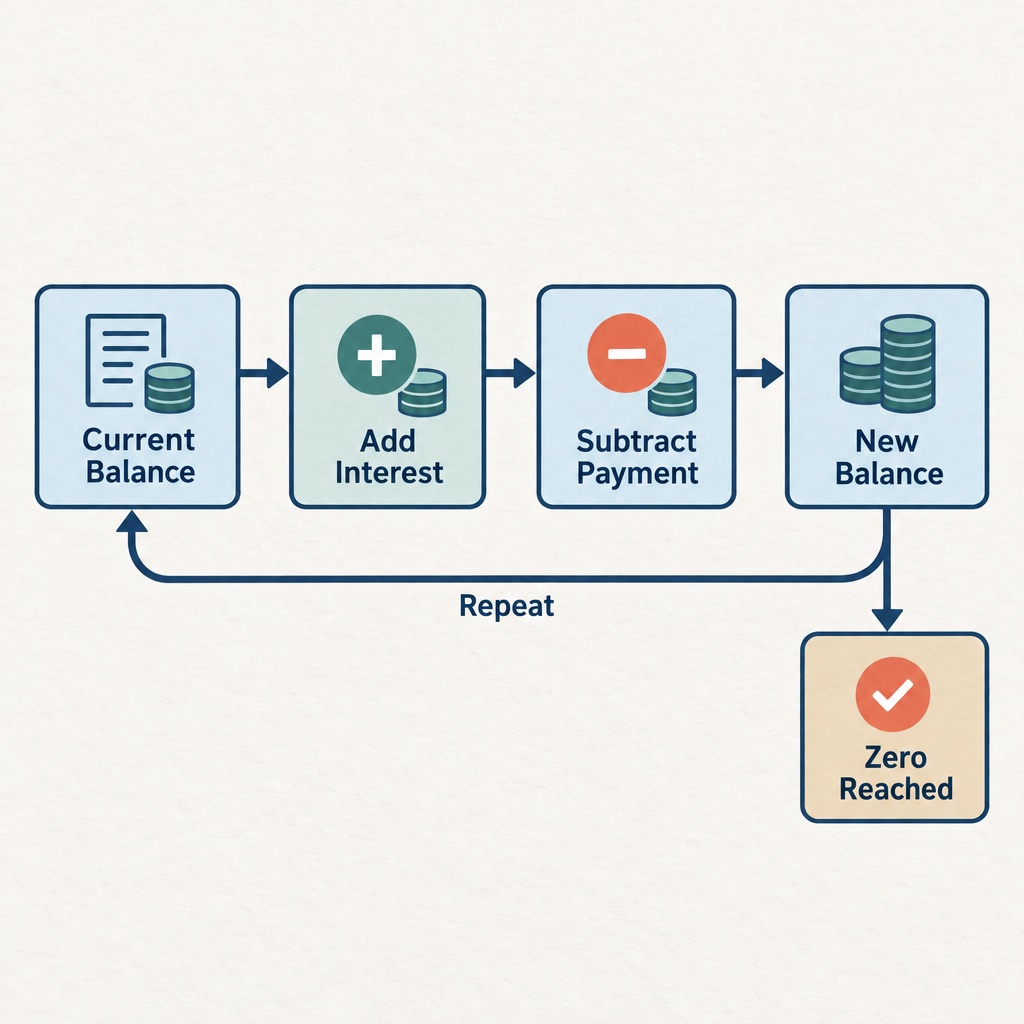
The tool uses two formulas, one for each mode. Both assume you add no new charges and the APR stays fixed for the whole period.
Fixed payment mode
Each month the calculator adds interest, then subtracts your payment:
Interest for the month = balance x APR / 12 / 100
New balance = old balance + interest – payment
It repeats that until the balance hits zero. The final month’s payment is only what is left, so the last payment is smaller than the others. If your payment does not cover the first month’s interest, the balance grows instead of shrinking and the card is never paid off; the calculator will tell you so rather than show a date.
Payoff date mode
When you pick a target date, the calculator works out the number of months, n, and the monthly rate, r, where r = APR / 12 / 100. Then it solves the standard level-payment formula:
Payment needed = balance x r / (1 – (1 + r)^-n)
That is the same formula a loan calculator uses for a fixed-rate installment loan. It finds the one payment that, repeated n times, lands the balance at exactly zero.
Walking through the default example
With the default inputs of a $5,000 balance, 22 percent APR and a $200 monthly payment, here is what happens.
Monthly rate: 22 / 12 / 100 = 0.018333, or about 1.83 percent a month.
Month 1: interest = 5,000 x 22 / 12 / 100 = $91.67. New balance = 5,000 + 91.67 – 200 = $4,891.67. Only $108.33 of your first $200 actually reduced the debt.
Month 2: interest = 4,891.67 x 0.018333 = $89.68. New balance = 4,891.67 + 89.68 – 200 = $4,781.35.
Month 3: interest = 4,781.35 x 0.018333 = $87.66. New balance = $4,669.01.
The interest charge falls a little each month, so a slightly larger share of every payment goes to principal. After 33 full payments of $200, the remaining balance plus its last month of interest comes to $149.88, which is the 34th and final payment. The calculator reports:
| Result | Value |
|---|---|
| Time to pay it off | 2 years 10 months |
| Total interest | $1,749.88 |
| Total paid | $6,749.88 |
| Interest in the first month | $91.67 |
Total paid is 33 x $200 + $149.88 = $6,749.88, and total interest is that figure minus the original $5,000.
A second example in payoff-date mode
Say you owe $8,000 at 26 percent and want it gone in 24 months.
Monthly rate: r = 26 / 12 / 100 = 0.021667.
Growth factor: (1 + r)^24 = (1.021667)^24 = 1.672717.
Discount factor: (1 + r)^-24 = 1 / 1.672717 = 0.597830.
Denominator: 1 – 0.597830 = 0.402170.
Numerator: 8,000 x 0.021667 = $173.33.
Payment needed = 173.33 / 0.402170 = $431.00 a month, rounded to the nearest dollar.
Over 24 months that is about $10,344 paid in total, so roughly $2,344 goes to interest. If $431 is more than you can manage, stretching to 36 months at the same rate drops the payment to about $322, but total interest climbs to around $3,600. The calculator makes that trade-off visible before you commit.
Quick reference: what it takes to clear $5,000
These figures come from the same formulas the calculator uses. The first table is payoff-date mode: the fixed monthly payment that retires a $5,000 balance in 12, 24 or 36 months at four common APRs.
| APR | 12 months | 24 months | 36 months |
|---|---|---|---|
| 18% | $458.40 | $249.62 | $180.76 |
| 22% | $467.97 | $259.39 | $190.95 |
| 26% | $477.65 | $269.37 | $201.45 |
| 30% | $487.44 | $279.56 | $212.26 |
Notice how little the APR moves a 12-month payment: only about $29 a month separates 18 percent from 30 percent. The rate matters far more when payoff stretches out.
The second table is fixed-payment mode: a flat $200 a month on $5,000, with the final partial payment included. Interest figures are rounded to the nearest dollar.
| APR | Months to payoff | Total interest |
|---|---|---|
| 18% | 32 | about $1,314 |
| 22% | 34 | $1,750 |
| 26% | 37 | about $2,280 |
| 30% | 40 | about $2,945 |
The third table answers the credit card vs personal loan question for the same $5,000. The card column is the default scenario. The loan columns use the payoff-date formula over 36 months and add a 5 percent origination fee, which many personal lenders deduct from the amount they send you; to net $5,000 you would borrow about $5,263.
| Option | Monthly payment | Months | Total interest and fees |
|---|---|---|---|
| Card at 22%, $200/month | $200 | 34 | $1,750 |
| Loan at 12%, 36 months, 5% fee | $174.81 | 36 | $1,293 |
| Loan at 18%, 36 months, 5% fee | $190.28 | 36 | $1,850 |
A consolidation loan only wins when the rate is clearly lower than the card and you stop using the card afterward. At 18 percent with a fee, the loan costs more than the card does with steady $200 payments. You can test your own offer with our “personal loan calculator“.
Reading your result and what to do with it
A good way to judge the output is to look at three things: the share of your first payment eaten by interest, the number of months, and the total interest as a percentage of the balance.
In the default example, interest takes $91.67 of the first $200, about 46 percent. Anything above half means you are mostly renting the debt rather than retiring it. If the payment barely covers interest, the calculator will show decades or never, and the fix is either a bigger payment or a lower rate.
Total interest of $1,750 on $5,000 works out to 35 percent of the balance. Under three years and under about a third of the balance is a manageable result for a card in the low twenties. Five years or more, or interest approaching the original balance, is the signal to change the plan rather than grind it out.
Compare the result against the minimum payment warning on your statement. Regulation Z, at 12 CFR 1026.7(b)(12), requires card issuers to print how long payoff takes if you pay only the minimum, the total you would pay, and the monthly amount needed to clear the balance in 36 months. If your calculator result is close to the issuer’s 36-month figure, you are already on a reasonable path.
Cheaper and safer options to check before adding new debt
Run these before you consider any new loan:
Ask the issuer for a hardship plan. Most large issuers have internal programs that cut the APR temporarily, sometimes to single digits, in exchange for closing the card to new purchases. You call the number on the back of the card and ask. Rerun the calculator at the offered rate.
Nonprofit credit counseling and a debt management plan. Agencies accredited by the National Foundation for Credit Counseling negotiate reduced rates across all your cards and consolidate them into one monthly payment, usually over three to five years. There is a monthly fee, generally modest, and the plan shows on your credit report but is not a loan.
A credit union card. Federal credit unions are capped by the NCUA at an 18 percent APR on all loans including credit cards, and many charge well under that. If you qualify, moving the balance there can beat most bank cards without a balance transfer fee. Our guide on “credit union membership” explains who can join.
A 0 percent balance transfer, with the fee priced in. Transfer fees of 3 to 5 percent are common, so moving $5,000 costs $150 to $250 up front. Paying $200 a month on $5,150 at 0 percent clears it in about 26 months with no further interest, which beats the default scenario by roughly $1,600. The catch is approval: these offers generally need good credit, and if your score is low you are more likely to see the kind of cards covered in “bad credit for credit cards“, with higher rates and no promotional period.
Two tricks that change the numbers fast
Make a payment the day your statement closes and a second one mid-cycle; interest accrues on the daily balance, so splitting $200 into two $100 payments shaves a little off each month.
Redirect any windfall straight to the card and rerun the calculator; a one-time $500 on the default balance cuts about four months and roughly $300 of interest.
Before you borrow to pay off a card
A consolidation loan or balance transfer only lowers your cost if the new rate plus fees is clearly below the card’s APR and the old card stays at zero. Readers who take the loan and then rebuild the card balance end up with two debts and a bigger monthly outflow than they started with.
Avoid anything advertised as “urgent loans guaranteed approval” to cover card payments. Those products typically carry triple-digit APRs, and swapping a 22 percent debt for a 300 percent one makes every row in the tables above look cheap.
The US rules that shape what you pay
Truth in Lending Act and Regulation Z (12 CFR 1026). Card issuers must disclose the APR, fees and grace period in a standardized table at application and account opening, and every statement must show the interest charge calculation, the minimum payment warning and the 36-month payoff figure. Under 12 CFR 1026.9, the issuer must give 45 days’ written notice before raising the rate on new purchases, and under 12 CFR 1026.55 it cannot raise the rate on an existing balance unless you are more than 60 days late, a promotional rate ends, or the card has a variable rate tied to an index.
State rate caps. Most states cap interest on consumer loans, but those caps rarely touch credit cards. Since the Supreme Court’s 1978 decision in Marquette National Bank v. First of Omaha, a national bank may charge the rate allowed by its home state to customers anywhere, which is why so many issuers are based in states without a cap. The practical ceiling for you is the issuer’s own pricing and the 18 percent NCUA cap if the card comes from a federal credit union.
Military Lending Act. Active-duty service members and their dependents are “covered borrowers,” and credit card accounts opened for them cannot exceed a 36 percent Military Annual Percentage Rate, a figure that folds in most fees. The Servicemembers Civil Relief Act separately caps interest at 6 percent on debts you took on before entering active duty, if you notify the lender.
Crypto and the IRS. Some readers sell cryptocurrency to pay down a card. Under IRS Notice 2014-21 the IRS treats crypto as property, so a sale is a taxable event: you report the gain or loss on Form 8949 and Schedule D, and a gain can create a tax bill the following April. Include that in the comparison, and remember crypto can lose all its value and is not FDIC or SIPC insured.
FAQ
How does a credit card interest calculator work?
It multiplies your balance by the APR, divides by 12 and then by 100 to get one month’s interest, adds that to the balance and subtracts your payment. The calculator above repeats that loop until the balance reaches zero and reports the months and total interest. Real issuers compute interest on the average daily balance, so the exact charge on your statement can differ by a few dollars, but the payoff timeline tracks closely.
What is the difference between this and a paying off credit card debt calculator that uses the minimum payment?
Minimum payment calculators let the payment shrink as the balance falls, which is what happens if you pay only what the issuer asks. This tool holds the payment fixed. For most people the fixed version is the useful one, because it shows what a steady budget line does to the debt. The minimum-only timeline is already printed on your statement under the minimum payment warning.
Why does the calculator say my card will never be paid off?
Your payment is smaller than the first month’s interest. On a $5,000 balance at 22 percent that threshold is $91.67; at 30 percent it is $125. Any payment at or below that number leaves the balance flat or growing. Raise the payment, lower the rate through a hardship plan or transfer, or both.
Can I use a pay off credit card calculator for several cards at once?
Only if they share an APR. Otherwise run each card separately, then add the payments. To decide which card gets extra money, most people either pay the highest-rate card first, which minimizes total interest, or the smallest balance first, which clears a card sooner. The calculator will show the interest cost of either order if you run both scenarios.
How accurate is the credit card vs personal loan calculator comparison?
The math is exact for a fixed-rate loan with no prepayment penalty, but the result depends on the rate you are actually offered, the origination fee and the term. Enter the figures from the lender’s Truth in Lending disclosure, not the “rates from” number in the ad, and add the fee to the amount borrowed. If the all-in cost is not clearly below the card column, the loan is not worth taking.
What APR counts as high on a credit card?
The Federal Reserve’s G.19 consumer credit release tracks the average rate on card accounts that carry a balance, and that average has sat above 20 percent in recent releases. Anything in the high twenties or above is expensive by that measure, and a penalty APR, which can be triggered by a payment more than 60 days late, often runs near 30 percent. Federal credit union cards are capped at 18 percent.
Does the credit card debt payoff calculator include annual fees or late fees?
No. It assumes no new charges and a fixed APR, and it ignores annual fees, late fees and returned payment fees. If your card charges an annual fee, add it to the balance in the month it posts and rerun. A late payment can also trigger a penalty rate, which would push the real payoff date well past what the tool shows.
Can I use this as an interest calculator for a store card or a retail financing plan?
Yes for standard store cards, which work like any other revolving account. Deferred-interest promotions are different: if any balance remains when the promotional period ends, the issuer charges interest retroactively from the purchase date. For those, use the Be debt-free by a date option and set the date before the promotion expires, so the payment you see is the one that avoids the back interest.
Comments are closed