Runs in your browser. Nothing you type is sent or saved.
The interest calculator above shows what a balance turns into once interest starts compounding, and how much of the final number is money you put in versus money the rate added. You need four figures: the amount you are starting with, the annual rate, the number of years, and how often the interest compounds. If you plan to add money each month, have that figure ready too.
How to use the calculator
- Enter your Starting amount ($). For a savings account, use the current balance from your statement. For a debt that is growing untouched, use the balance from your most recent bill.
- Enter the Annual interest rate (%). A bank discloses this as the interest rate, not the APY, on the account disclosure. A loan offer or credit card statement lists it as the APR.
- Enter Years. Use the length of a CD term, the time until you need the money, or how long a balance might sit unpaid.
- Pick the Interest type. Most savings accounts compound daily or monthly. Choose Simple interest only when the agreement says interest is not added to principal.
- Enter a Monthly deposit (optional) ($), or set it to 0. A fixed transfer from your paycheck is the most realistic figure here.
- Read all four outputs together: Balance, Interest earned, Your deposits, and the Effective annual yield (APY).
What each field in the interest calculator means
Starting amount ($). The balance on day one. The default is $1,000. If you are opening a new account with nothing, enter 0 and rely on the monthly deposit.
Annual interest rate (%). The stated yearly rate before compounding, entered as a plain number. Type 4.5 for 4.5 percent, not 0.045. The most common mistake is typing the APY here. A bank advertising a 4.59% APY is paying a 4.50% rate compounded monthly, and the calculator will compute the APY for you from the rate. Entering the APY as the rate double counts the compounding.
Years. Whole years or decimals both work. Eighteen months is 1.5.
Interest type. Five choices: Compound monthly (the default), Compound daily, Compound quarterly, Compound yearly, and Simple interest. The difference between daily and monthly is small at savings rates, but it is real, and the comparison table below shows exactly how small.
Monthly deposit (optional) ($). Money added at the end of each month. The default is $100. Because each deposit lands at month end, the first deposit earns interest for one month less than the starting amount. Leave this at 0 to see pure growth on a lump sum.
Three more mistakes we see often. People enter a monthly rate as an annual rate (a 2% monthly card rate is 24% a year). People forget that a promotional savings rate usually expires after a few months, so a five-year projection at the teaser rate overstates the result. And people use this tool to model a loan they are paying down, which it does not do. A loan with scheduled payments needs a loan calculator or, for a car, a car payment calculator, because those tools shrink the balance each month as you pay.
How the interest calculator does the math
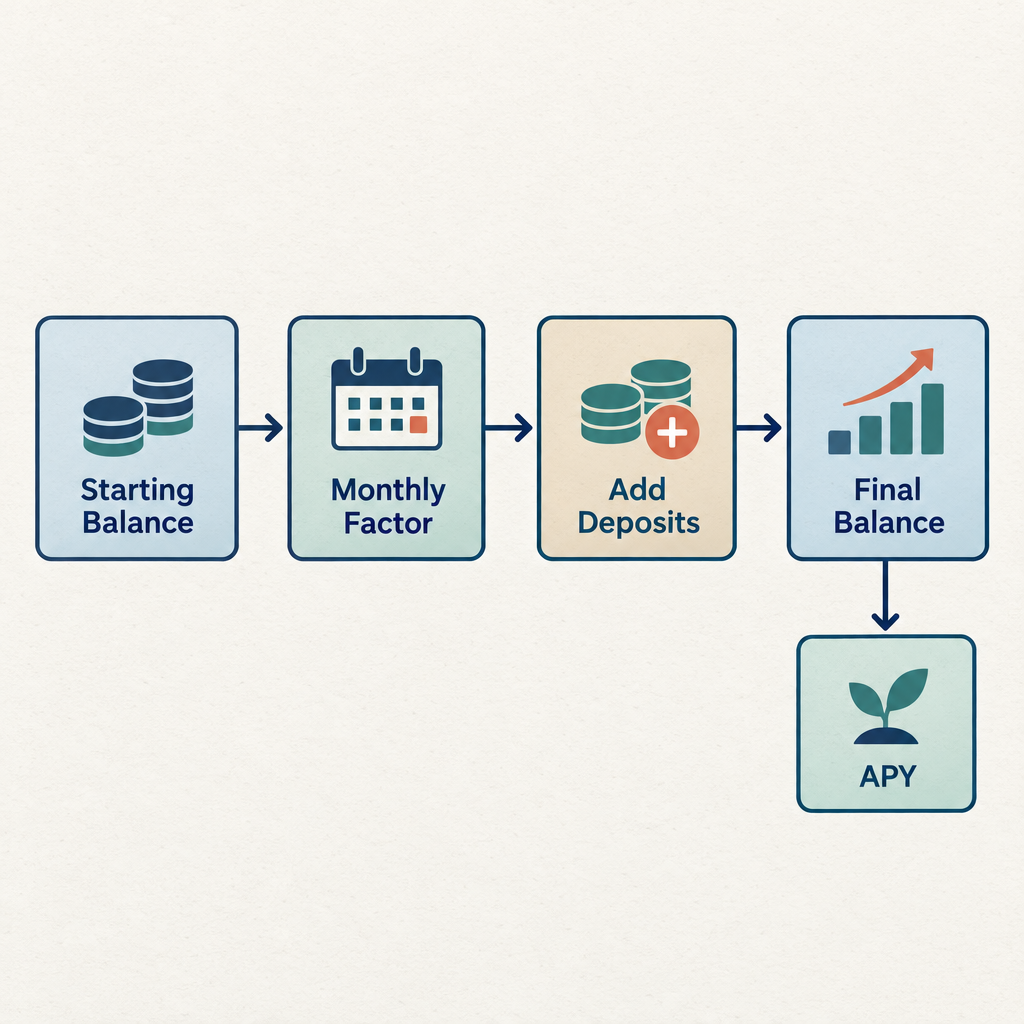
The calculator converts your annual rate into a monthly growth factor, then applies that factor month by month. With k compounding periods a year (12 for monthly, 365 for daily, 4 for quarterly, 1 for yearly), the monthly growth g is:
g = (1 + rate / k)^(k / 12) – 1
Your Starting amount is multiplied by (1 + g) raised to the number of months. Each monthly deposit is multiplied by (1 + g) raised to the months remaining after it was made. The two pieces added together are the balance.
APY, the Effective annual yield line, is (1 + rate / k)^k – 1. It is the rate you would actually earn over a full year once compounding is counted.
For Simple interest, the starting amount becomes start × (1 + rate × years), and each deposit earns rate × (months remaining / 12) on itself with nothing reinvested.
Your deposits is everything you put in, the starting amount plus every monthly deposit. Interest earned is the balance minus that total.
The default example, step by step
Inputs: $1,000 start, 4.5% rate, 5 years, Compound monthly, $100 monthly deposit.
- Monthly growth. k is 12, so g = (1 + 0.045/12)^(12/12) – 1 = 0.00375. That is 0.375% per month.
- Months. 5 years × 12 = 60.
- Growth factor. (1.00375)^60 = 1.25180. The starting $1,000 becomes $1,251.80.
- Deposits. Sixty deposits of $100, the first growing for 59 months and the last for 0. Added up, that is $100 × (1.25180 – 1) / 0.00375 = $100 × 67.1456 = $6,714.55.
- Balance. $1,251.80 + $6,714.55 = $7,966.35.
- Your deposits. $1,000 + (60 × $100) = $7,000.00.
- Interest earned. $7,966.35 – $7,000.00 = $966.35.
- APY. (1.00375)^12 – 1 = 0.0459, shown as 4.59%.
Those are the four figures the calculator prints with the defaults: $7,966.35 balance, $966.35 interest, $7,000.00 deposits, 4.59% APY.
A second example: $5,000 at 4% daily for 3 years with $200 a month
Say you have $5,000 in a high-yield savings account paying a 4.00% rate compounded daily, you add $200 at the end of each month, and you want to know where you stand in three years.
- Monthly growth. k is 365, so g = (1 + 0.04/365)^(365/12) – 1. The daily rate is 0.0001096. Raised to 30.4167 days, the factor is 1.0033387, so g = 0.0033387, or about 0.334% a month.
- Months. 36.
- Growth factor. (1.0033387)^36 = 1.12749. The $5,000 becomes $5,637.45.
- Deposits. $200 × (1.12749 – 1) / 0.0033387 = $200 × 38.1852 = $7,637.04.
- Balance. $5,637.45 + $7,637.04 = $13,274.49.
- Your deposits. $5,000 + (36 × $200) = $12,200.
- Interest earned. $13,274.49 – $12,200 = $1,074.49.
- APY. (1 + 0.04/365)^365 – 1 = 0.0408, shown as 4.08%.
Notice the deposits did most of the work. Of the $13,274 balance, $12,200 came out of your pocket. Interest added just over $1,000 in three years. That is the honest picture of saving at typical rates: the habit matters more than the yield.
Interest earned at different rates
Same defaults ($1,000 start, $100 a month, 5 years, Compound monthly), with only the rate changed:
| Annual rate | Monthly g | Balance after 5 years | Interest earned | APY |
|---|---|---|---|---|
| 0.50% | 0.04167% | $7,099.66 | $99.66 | 0.50% |
| 1.00% | 0.08333% | $7,201.15 | $201.15 | 1.00% |
| 2.00% | 0.16667% | $7,409.82 | $409.82 | 2.02% |
| 3.00% | 0.25000% | $7,626.29 | $626.29 | 3.04% |
| 4.50% | 0.37500% | $7,966.35 | $966.35 | 4.59% |
| 5.00% | 0.41667% | $8,083.97 | $1,083.97 | 5.12% |
The gap between a large-bank savings account paying well under 1% and a high-yield account paying around 4% to 5% is roughly $900 over five years on this pattern. Moving the same money is a one-afternoon task.
How much compounding frequency changes the answer
Same defaults again, with only the Interest type changed:
| Interest type | Monthly g | Balance after 5 years | Interest earned | APY |
|---|---|---|---|---|
| Simple interest | n/a | $7,888.75 | $888.75 | 4.50% |
| Compound yearly | 0.36748% | $7,945.36 | $945.36 | 4.50% |
| Compound quarterly | 0.37360% | $7,962.44 | $962.44 | 4.58% |
| Compound monthly | 0.37500% | $7,966.35 | $966.35 | 4.59% |
| Compound daily | 0.37568% | $7,968.26 | $968.26 | 4.60% |
Daily compounding beats monthly by $1.91 over five years. Marketing copy that leans hard on “compounded daily” is selling you less than two dollars. The rate and the APY are what deserve your attention, and Regulation DD requires banks to state the APY on a uniform basis so you can compare across institutions without redoing the math.
How time changes the answer
Defaults once more, with only Years changed:
| Years | Your deposits | Balance | Interest earned | Interest as share of balance |
|---|---|---|---|---|
| 1 | $2,200 | $2,271.00 | $71.00 | 3.1% |
| 2 | $3,400 | $3,600.39 | $200.39 | 5.6% |
| 5 | $7,000 | $7,966.35 | $966.35 | 12.1% |
| 10 | $13,000 | $16,686.80 | $3,686.80 | 22.1% |
| 20 | $25,000 | $41,267.90 | $16,267.90 | 39.4% |
In year one, interest is 3% of the balance. By year twenty it is nearly 40%. That curve is why the same tool that looks underwhelming for a short-term savings goal looks very different for a retirement account, and it is also why an unpaid debt at a high rate becomes dangerous quickly.
Compare offers on APY, not frequency
Two accounts with the same APY pay you the same money over a year no matter how they compound. Put each bank’s stated rate and compounding into the calculator and read the APY line; if the APY matches the bank’s advertised APY, you entered the rate correctly.
How to read the result
For savings. Judge the Interest earned line against the national picture. The FDIC publishes national average deposit rates every month, and the average savings rate has sat far below what online banks and many credit unions pay. If your APY is below 1% while insured online accounts advertise 4% or more, you are leaving money on the table for no extra risk, as long as the new account is FDIC or NCUA insured and your balance stays under $250,000 per depositor, per institution, per ownership category.
Also check the APY line against the bank’s own disclosure. If the calculator’s APY comes out higher than the bank advertises, you probably entered the APY as the rate.
For a debt sitting unpaid. Enter the balance as Starting amount, the APR as the rate, choose Compound daily (most credit cards apply a daily periodic rate to the balance), and set Monthly deposit to 0. A $1,000 card balance at a 24% APR, compounded daily, works out to an effective rate of about 27.11% and reaches roughly $1,271.15 in one year with no payments and no new purchases; if the issuer compounded monthly instead, the effective rate would be 26.82% and the balance $1,268.24. Real statements will differ slightly because issuers calculate interest on an average daily balance and add fees, so treat the result as a floor. How issuers build that charge is covered in our piece on credit card APR explained.
For a loan you are considering. The calculator shows what the interest rate does to a balance, not what you will pay on an amortizing loan. For that, a personal loan calculator will give the monthly payment and total interest. Still, this tool answers one useful question: what does the lender earn on your money each year once compounding is included? A payday loan with a $15 fee per $100 for two weeks is a 391% APR, and no savings account on earth outruns that.
Before you borrow
Any debt whose effective rate is higher than the APY on your best savings account is destroying wealth faster than saving builds it. Pay the high-rate balance down before building a large cash cushion, and treat anything above 36% APR as an emergency to escape, not a product to use.
Cheaper options first
Federal credit unions offer payday alternative loans capped at 28% APR under NCUA rules, with a maximum $20 application fee.
Many employers now offer earned wage access with no fee, and most utilities and medical providers will set up a hardship payment plan if you ask.
Nonprofit credit counselors certified by the NFCC can set up a debt management plan that often lowers card rates to single digits.
If the issue is a short-term cash gap rather than a rate problem, the calculator will not help, but our rundown of legit ways to make money fast lists options that pay the same day without a loan.
US rules that shape the numbers you enter
Truth in Savings Act and Regulation DD (12 CFR 1030). Banks must disclose the interest rate, the APY, the compounding and crediting frequency, and any minimum balance to earn the stated rate. The APY formula in Regulation DD is the same one the calculator uses: 100 × [(1 + interest/principal)^(365/days in term) – 1]. Credit unions follow the NCUA’s parallel rule in 12 CFR Part 707.
Truth in Lending Act and Regulation Z (12 CFR 1026). Lenders must disclose the APR and the finance charge before you sign. For closed-end loans, the APR already accounts for required fees, so enter the APR, not the note rate, when you model a debt. Credit card statements must show the APR for each balance type and the interest charged that cycle.
State rate caps and usury laws. There is no federal cap on consumer interest rates for most lenders. States set their own ceilings, and they differ widely. California’s Fair Access to Credit Act, in force since January 1, 2020, caps loans of $2,500 to under $10,000 at 36% plus the federal funds rate, and the California Deferred Deposit Transaction Law limits a payday loan to $300 with a fee of no more than 15% of the check. Texas, by contrast, lets credit access businesses under Finance Code Chapter 393 charge fees on top of the loan with no statutory limit, which is why triple-digit APRs are common there. Our guides to California payday loan laws and Texas payday loan laws go through each state’s limits, and our usury laws explainer covers how the caps work and when out-of-state lenders can get around them.
Military Lending Act (10 U.S.C. 987, 32 CFR Part 232). Active-duty servicemembers and their dependents cannot be charged more than a 36% Military Annual Percentage Rate on most consumer credit, including payday, title and installment loans and credit cards. The MAPR counts fees and add-on products that an ordinary APR may leave out. The Servicemembers Civil Relief Act separately caps interest at 6% on debts taken on before active duty, once the borrower gives notice.
Crypto “interest” and the IRS. Platforms that pay yield on deposited crypto are not banks, and the balance is not FDIC or SIPC insured; several such platforms froze withdrawals and went bankrupt in 2022, and customers lost money. Under IRS Notice 2014-21, crypto is property, and the IRS treats rewards you receive as ordinary income at their fair market value on the day you gain control of them (Revenue Ruling 2023-14 addresses staking rewards directly). You then owe capital gains tax on any later rise when you sell. You can model a crypto yield in the calculator, but the rate can drop to zero overnight and the principal can lose all its value. That is not a savings account, and we do not treat it as one.
FAQ
Is this an interest rates calculator or a compound interest calculator?
Both. With any of the four Compound options selected it is a compound interest calculator. With Simple interest selected it is a simple interest calculator. Either way you enter an annual rate and it tells you what that rate turns a balance into over time.
How does the simple interest calculator option differ from compounding?
Simple interest is charged or earned on the original amount only. Compound interest is earned on the original amount plus every bit of interest already added. On the default $1,000 and $100 a month for five years at 4.5%, simple earns $888.75 in total ($225.00 on the $1,000 starting amount plus $663.75 on the sixty month-end deposits, none of it reinvested), while monthly compounding earns $966.35, a difference of $77.60. Over 20 years the gap becomes thousands.
Can I use it as a saving interest rate calculator for a CD?
Yes. Enter the deposit as Starting amount, the CD’s stated rate, the term in years, the compounding the bank discloses, and 0 for Monthly deposit, since most CDs do not accept additions. Compare the APY line with the bank’s advertised APY to confirm your inputs.
Why is the APY higher than the rate I typed?
Because compounding adds interest on interest within the year. A 4.5% rate compounded monthly produces 4.59% over twelve months. The more often interest is credited, the wider the gap, but at savings-account rates it never grows beyond a few hundredths of a percent.
Is it an interest rate calculator for loans too?
It shows what a rate does to an unpaid balance, which is useful for a card or a deferred-interest balance you are not paying. It does not amortize a loan with fixed payments. For that use a loan calculator, which reduces the balance each month.
Why doesn’t the first deposit earn a full month of interest?
Deposits are counted at the end of each month, which matches a paycheck transfer that lands after the month’s interest has already been credited. The last deposit therefore earns nothing, and the balance includes it at face value.
Does the calculator include taxes on the interest?
No. Savings interest is taxable as ordinary income at the federal level and in most states, and your bank reports it on Form 1099-INT once it reaches $10. Multiply Interest earned by your marginal rate to estimate what you keep.
What rate should I enter when an account has a promotional rate?
Run two scenarios. First, the promotional rate for the promotional period only. Then the standard rate for the rest of your horizon, using the balance from the first run as the new Starting amount. Projecting the teaser rate across five years is the most common way people overestimate their savings.
Comments are closed