


We are not a credit repair, debt relief or debt collection company and offer no services. Rules differ by state, so confirm with the agency or a nonprofit counselor before you act.
There’s no federal program that forgives a veteran’s credit card debt just because they served. Real debt relief for veterans does exist, though, and it depends on who you owe. VA can waive, reduce or pause its own overpayment and copay debts. The Department of Education cancels federal student loans for veterans rated totally and permanently disabled. Bankruptcy law keeps VA disability pay out of the means test. This guide sorts each kind of debt by who holds it and gives the deadline, the form and the contact for each, as of November 15, 2026.
WARNINGRelated consumer alert, Nov 12, 2026
Pennsylvania AG warns veterans who paid Trajector to consider bankruptcy claimsRun the numbers
Key takeaways
- Find out who holds the debt before you do anything else. VA, DFAS, the IRS, the Department of Education and private creditors each have their own relief process.
- For VA debt letters dated on or after January 26, 2026, you have 1 year to ask for a waiver, not 180 days.
- Federal law (38 U.S.C. § 5301) generally protects VA disability pay from private creditors, which changes how you should handle credit card debt.
- If you have a 100% permanent and total rating or TDIU, you qualify for federal student loan discharge.
- So-called “veteran debt relief grants” that pay off credit cards aren’t a federal program. Nonprofit grants are small, one-time payments with strict eligibility rules.
Before you pay anyone
The two costliest mistakes are ignoring a VA debt letter and paying a company for help you can get free. If you ignore the letter, VA can withhold your benefits and later refer the debt to the Treasury. Accredited Veterans Service Officers file VA waivers and appeals at no cost.
Fact-checked
We checked these key facts against the sources named, on November 15, 2026:
- At 24% APR, the card charges 2% a month (source: consumerfinance.gov)
- VA Form 5655, the Financial Status Report, is how VA judges hardship (source: va.gov)
- For billing questions, call the VA Health Resource Center at 866-400-1238 (source: va.gov)
- VA said its 2022 credit reporting rule cut negative debt reporting by 99% (source: news.va.gov)
- A creditor that cancels $600 or more generally files Form 1099-C, and the forgiven amount can count as taxable income (source: irs.gov)
The short answer: what debt relief veterans can and can’t get
What you can get depends on the creditor, not on your veteran status alone. Here’s what actually exists in 2026:
- VA debts. The U.S. Department of Veterans Affairs can waive, compromise, pause or spread out benefit overpayments and medical copay debts.
- Federal student loans. The U.S. Department of Education discharges them for veterans rated 100% permanent and total or receiving TDIU.
- Bankruptcy. The HAVEN Act keeps VA and DoD service-connected disability pay out of the means test.
- Private debt. No federal program forgives credit card or personal loan debt for veterans. You have the same tools every consumer has: hardship programs, debt management plans, settlement and bankruptcy. You also get extra leverage because your benefits are protected.
- Emergencies. Nonprofits such as VFW Unmet Needs and Operation Homefront make one-time grants, paid straight to the creditor, to veterans who meet their eligibility rules.
First: figure out who you owe
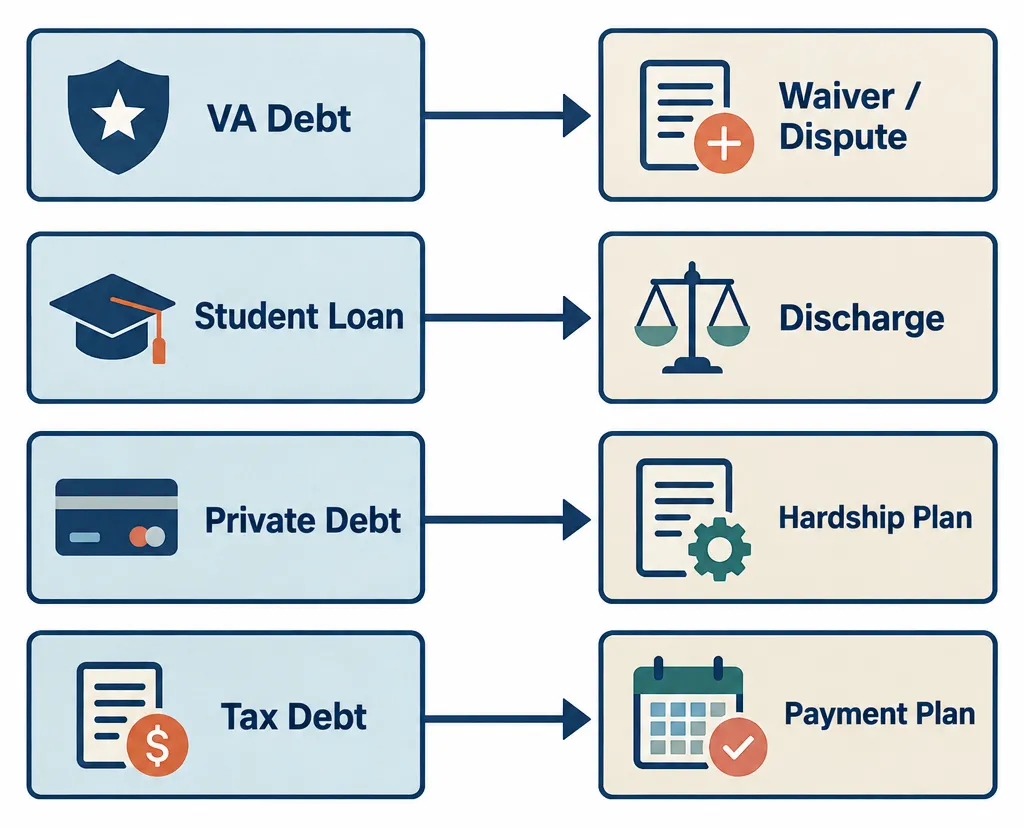
Look at the letterhead before anything else. Each agency or company runs its own process, and a waiver request sent to the wrong one does nothing.
| Debt type | Who holds it | Relief that exists | Key deadline | Where to send the request |
|---|---|---|---|---|
| Benefit overpayment (compensation, pension, GI Bill) | VA Debt Management Center | Dispute, waiver, compromise, hardship suspension, repayment plan, appeal | 30 days to dispute; 1 year to request a waiver | Ask VA, 800-827-0648, or DMC, PO Box 11930, St. Paul, MN 55111 |
| Medical copay bills | VA health care billing (Health Resource Center) | Waiver, compromise, repayment plan, hardship exemption from future copays | File early; older VA pages still say 180 days from the statement | 866-400-1238 or the online copay relief request |
| VA debt referred for collection | U.S. Department of the Treasury (Treasury Offset Program, Cross-Servicing) | Payment arrangement; VA may still take payment if the debt is only in offset | Notice at least 60 days before referral | Contact on the Treasury letter; also call the DMC |
| Military pay debt after separation | Defense Finance and Accounting Service (DFAS) | Dispute, then waiver or remission (DD Form 2789) | Retirees: within 5 years of the debt’s discovery | AskDFAS, or DFAS-IN, Dept. 3300, 8899 East 56th Street, Indianapolis, IN 46249-3300 |
| Federal student loans | Department of Education / Federal Student Aid | Total and Permanent Disability (TPD) discharge | Respond to the match letter | The discharge servicer named in the letter |
| Federal taxes | IRS | Payment plan, offer in compromise, Taxpayer Advocate Service | Date on the IRS notice | Address on the notice |
| Credit cards, medical bills, personal loans | Bank, lender or debt collector | Hardship plan, debt management plan, settlement, bankruptcy | About 30 days to dispute after a collector’s validation notice | The creditor or collector, in writing |
VA benefit overpayment letters
These come from the VA Debt Management Center. An overpayment means VA paid you more than you were owed. Common causes are a dependent coming off your award, a school enrollment change under the GI Bill, or income that affects pension. Legally it’s a debt and VA expects it back unless you get a waiver or prove the amount is wrong.
VA medical copay bills
Copay statements come from VA health care, not the DMC. Questions go to the VA Health Resource Center at 866-400-1238, and relief requests follow the copay process described below.
Treasury Offset letters
A letter from the Treasury’s Bureau of the Fiscal Service means a federal debt is close to collection or already in it. VA’s debt guidance says unpaid debts go to the Treasury after 120 days. Under Treasury rules, the agency must write to you at least 60 days before sending a debt to the Treasury Offset Program.
DFAS military pay debt after separation
DFAS debt and VA debt are different things. A DFAS debt comes from military pay: unearned leave, a bonus you have to repay, separation pay or a final-pay error. DFAS has its own waiver and remission process on DD Form 2789. DFAS says it can’t process a waiver while you’re disputing the debt. If the amount is wrong, settle that first, then ask for a waiver. A retiree must apply within 5 years of the date a pay official discovered the debt.
Private creditors and collectors
Banks, card issuers, hospitals and collectors are covered by consumer law, mainly the Fair Debt Collection Practices Act and the Fair Credit Reporting Act. Your veteran status doesn’t change your balance with them. It does change what they can legally collect from, as the credit card section explains. If a collector contacts you, the first step is usually a debt validation letter.
VA overpayment debt: dispute, waiver, compromise or payment plan
You have six tools. If the amount is wrong, dispute it within 30 days. If the debt is valid but repaying it would be unfair or cause hardship, ask for a waiver within 1 year. If neither fits, request a payment plan or a compromise.
| Option | What it does | Form needed | Deadline | Best when |
|---|---|---|---|---|
| Dispute | Challenges whether you owe it or how much | Written statement | Within 30 days to avoid collection | VA miscalculated or credited the wrong months |
| Waiver | Forgives all or part of the debt | VA Form 5655 plus a statement | 1 year from your first debt letter | The debt is valid but collecting it is against “equity and good conscience” |
| Compromise offer | Settles for a lump sum below the balance | VA Form 5655 | No fixed limit; earlier is better | You can raise some cash but not the full amount |
| Hardship suspension | Temporarily pauses collection | Financial details (VA may ask for Form 5655) | While the hardship lasts | Your income dropped suddenly |
| Repayment plan under 5 years | Monthly payments instead of full withholding | None: Ask VA, phone or mail | Before or after withholding starts | You can afford a modest monthly amount |
| Repayment plan of 5 years or more | Longer, smaller payments | VA Form 5655 | Same | Your budget can’t handle a shorter plan |
| Appeal | Reconsideration or a Board of Veterans’ Appeals review | Reconsideration request or Board Appeal | 1 year from the waiver decision letter | The waiver was denied |
Old vs. new VA debt deadlines
The 180-day waiver deadline is gone for new letters. A VA final rule implementing the Cleland-Dole Act gives you 1 year to request a waiver for debt letters dated on or after January 26, 2026. VA’s current guidance says the year runs from the date of your first debt letter. Many forums and older guides still say 180 days.
| Action | Before January 26, 2026 | Now |
|---|---|---|
| Request a waiver of a benefit overpayment | 180 days | 1 year from the first debt letter |
| Dispute to avoid collection | 30 days | 30 days |
| Board Appeal of a waiver decision | 1 year from the decision letter | 1 year from the decision letter |
Did you know?
Before 2026, you had only 180 days to request a VA waiver. Under the final rule implementing the Cleland-Dole Act, letters dated January 26, 2026 or later give you a full year. Letters dated before that are still under the old 180-day limit.
Dispute vs. waiver: you can file both
They answer different questions. A dispute says VA got the numbers wrong. A waiver says the debt is real, but collecting it would be unfair. You can file both at once, and that’s often the smart move. If the dispute fails, your waiver request is already on file inside the window.
The waiver standard comes from 38 CFR 1.965, “equity and good conscience.” VA weighs several factors:
- whether you were at fault, and how that compares with VA’s own fault
- whether repaying would cause undue hardship
- whether collecting would defeat the purpose of the benefit
- whether keeping the money would unjustly enrich you
- whether you relied on the payments to your detriment
Under 38 U.S.C. § 5302, a waiver is barred if there was fraud, misrepresentation or bad faith.
Here’s an example. VA keeps paying the dependent rate for a child who left school, and you’d reported it. Fault leans toward VA. If your only income is a modest compensation award, that’s the kind of case these factors were written for.
Protect both windows
If the amount looks wrong, send a written dispute within 30 days of the letter so collection doesn’t start. File a waiver request in the same envelope so your 1-year window is covered too. Keep that first letter, because the waiver clock runs from the date printed on it.
Filling out VA Form 5655 without hurting your case
VA Form 5655, the Financial Status Report, is how VA judges hardship. You need it for waivers, compromise offers and repayment plans of 5 years or more. You don’t need it for plans under 5 years. In an October 6, 2026 Federal Register notice, the Debt Management Center said it no longer requires the form for certain actions. It also said use of the form has gone up and down with policy changes and with collections restarting.
To keep the form from weakening your case:
- List every real monthly expense: rent or mortgage, utilities, car payment, insurance, medical costs, child support, groceries, phone.
- Use the same numbers you can show on bank statements. VA may check them.
- Explain any spike or temporary cost in a short attached statement.
- Don’t round expenses down to look responsible. Leaving costs out makes it look like you can afford to repay.
What happens to your monthly benefit while VA decides
If you don’t respond, VA collects by withholding your monthly benefit. For many veterans that means a large part of the check, or the whole thing. If VA started withholding your whole disability check, call the Debt Management Center at 800-827-0648 (1-612-713-6415 from overseas), weekdays 7:30 a.m. to 7 p.m. ET. Ask for a repayment plan with a smaller withholding amount. A plan under 5 years doesn’t require Form 5655. For example, a $3,600 overpayment spread over 36 months works out to $100 a month. Repaying it by withholding a $1,800 check takes two full months of no income. VA says that asking for help within the time limit can help you avoid late fees, interest and other collection actions.
If the waiver is denied
You can first ask the Committee of Waivers and Compromises to reconsider. You can also go to the Board of Veterans’ Appeals. You have 1 year from the date on the waiver decision letter to request a Board Appeal, unless the claim is contested. Bring new evidence, such as medical bills or proof that you reported the change on time.
VA medical copay debt
VA offers the same basic relief for copays: a waiver, a compromise, or a monthly repayment plan. There’s also a separate hardship determination that stops future copays. For billing questions, call the VA Health Resource Center at 866-400-1238.
Copays have a few rules of their own:
- Relief for existing bills. You can request a waiver, compromise or repayment plan online, or by letter, and you can ask for a hearing. A waiver or compromise normally needs Form 5655. VA’s product documents describe a streamlined waiver path on Form 5655 that lets qualifying veterans skip sections, and it applies only to copay debts.
- Exemption from future copays. A hardship determination on VA Form 10-10HS exempts you from outpatient and inpatient copays for the rest of the calendar year. It doesn’t cover pharmacy copays.
- Timing. VA’s newer debt guidance gives a 1-year waiver window, but older VA copay pages still say 180 days from the billing statement. Aim to file within 180 days so either reading works for you.
In May 2026, VA withdrew a proposed rule that would have changed how copayment fees are waived, saying it was no longer needed. The current process stays in place.
When VA reports debt to credit bureaus
Under a VA final rule effective March 4, 2022, VA may report a debt to credit bureaus only if both of these are true:
- The debt is $25 or more.
- VA has used up its other ways to collect.
A waiver, a dispute or a repayment plan by itself doesn’t reach your credit report.
Did you know?
VA said its 2022 credit reporting rule cut negative debt reporting by 99%. Before the rule, about 60,000 VA debts were reported to credit bureaus each year.
Billing errors and the $272 million correction
You shouldn’t have to pay copays you were billed by mistake. Dispute them in writing and ask for a corrected statement. Mistakes like this have happened at scale: VA announced it would cancel more than $272 million in medical copay debt caused by technical errors in its payment processing system. If your bill doesn’t match your visits, or you have a service-connected exemption, raise it with the Health Resource Center before you pay.
What happens if you ignore a VA debt
Ignoring the letter makes things worse. First VA withholds your benefits. After 120 days of delinquency, the debt goes to the Treasury. The Treasury Offset Program can then take your federal tax refund and other federal payments, including part of Social Security benefits. Debts sent on to Treasury’s Cross-Servicing Program can pick up extra collection fees.
VA says that if a debt has gone only to the Treasury Offset Program and not to Cross-Servicing, it may still be able to accept your payments. Call the DMC before you assume it’s out of VA’s hands. Credit reporting comes last, only after VA has used up its other collection efforts, including notice and a chance to dispute or request relief.
Credit card and other private debt
Credit card debt isn’t forgiven for veterans. That’s the honest answer. What you do have is a set of standard consumer tools, plus a legal protection that matters a lot if you live on VA benefits.
The worked example below shows what a $5,000 card balance costs under each option. The interest rates and fees are assumptions for illustration only. The math is ordinary amortization.
| Option | Amount | APR or fee (assumed) | Term | Total repaid |
|---|---|---|---|---|
| Keep paying the card at $200 a month | $5,000 | 24% APR | About 35 months | About $7,000 |
| Debt management plan at $200 a month | $5,000 | 8% APR plus the agency’s monthly fee | About 28 months | About $5,490 plus fees |
| Settlement at 50% through a for-profit firm | $5,000 | 20% fee on the enrolled debt | 24 to 48 months typical | $2,500 + $1,000 fee = $3,500, plus possible tax on $2,500 forgiven |
| Roll into a VA cash-out refinance | $5,000 | 6.5% for 30 years | 360 months | About $11,380, secured by your home |
Here’s how the APR math works. At 24% APR, the card charges 2% a month. On $5,000 that’s $100 of interest in the first month, so only $100 of a $200 payment goes to the balance. Cut the rate to 8% and only about $33 goes to interest, so the balance drops three times as fast. The refinance row has the lowest rate and the highest total, because the debt is stretched over 30 years and your house is now the collateral. Our debt payoff calculator lets you run your own balances.
Cheaper options first
Call the card issuer and ask for its hardship program before paying any company. Many issuers lower the rate or pause fees for a set period.
A nonprofit credit counseling agency in the National Foundation for Credit Counseling (NFCC) network can review your budget for free or at low cost.
If you’re behind on a car loan, that’s a different problem: see what to do if you can’t afford your car payment.
Settlement trade-offs. Settling a debt usually damages your credit, because you stop paying while the firm negotiates. Under the FTC’s Telemarketing Sales Rule, debt relief companies that sell by phone can’t charge fees until they’ve settled at least one of your debts. A creditor that cancels $600 or more generally files Form 1099-C, and the forgiven amount can count as taxable income. If your debts were larger than your assets at the time, the insolvency exclusion (claimed on IRS Form 982) can shelter some or all of it.
Consolidation trade-offs. A VA cash-out refinance turns unsecured card debt into debt backed by your house. If you fall behind on a credit card, you get collection calls. If you fall behind on a mortgage, you can lose the home. Veterans receiving VA disability compensation are exempt from the VA funding fee, but that doesn’t fix the core risk.
Can creditors take my VA disability pay?
Generally, no. Under 38 U.S.C. § 5301, VA benefits are protected from private creditors’ claims, attachment, levy and seizure, both before and after you receive them. There are narrow exceptions, such as debts owed to the federal government and some support orders. A Treasury rule, 31 CFR Part 212, requires your bank to protect two months of directly deposited federal benefits when a garnishment order arrives.
If you’re 100% P&T and buried in credit card debt, this is your strongest point. A card issuer can sue and win a judgment. It still can’t collect that judgment from your VA compensation. Keep benefits in an account that gets no other deposits, so the protected money is easy to trace.
Settlement when your only income is VA pay
Veterans whose only income is exempt benefits are often called “judgment-proof.” A lawsuit gets the creditor very little. That changes the math. Paying a settlement firm 20% to negotiate may make little sense when the collector can’t take your income anyway. Bankruptcy filing fees may not make sense either.
The honest counterpoint: judgments can last for years, and some states let creditors renew them. They can attach to property you get later, such as an inheritance or a home. If your situation might change, a clean bankruptcy discharge can still be worth it. If collectors keep calling, a cease and desist letter to the debt collector stops most contact under the FDCPA.
Tell collectors what they can't touch
If your only income is VA disability pay, say so in writing to each creditor and collector, and include proof of the source of your benefits. It often changes what a settlement is worth to them, and it puts them on notice before they try to garnish your account.
SCRA and MLA: who still qualifies
Both laws mostly protect people who are still serving. The Servicemembers Civil Relief Act caps interest at 6% on debts taken on before active duty, and veterans who are no longer on active duty generally lose that protection. The Military Lending Act caps the Military Annual Percentage Rate at 36% on most consumer credit for active-duty members and their dependents. If you go back on active duty from the Guard or Reserve, the protections apply again. The Consumer Financial Protection Bureau takes complaints about both.
Bankruptcy for veterans
Bankruptcy is often the cleanest fix for heavy private debt, and veterans get two advantages here. The HAVEN Act (Honoring American Veterans in Extreme Need Act of 2019), signed August 23, 2019, removed VA and DoD service-connected disability benefits from “current monthly income” under 11 U.S.C. § 101(10A). That income is what the means test measures. Separately, under 11 U.S.C. § 707(b)(2)(D), a disabled veteran whose debts arose mainly during active duty is exempt from the means test altogether.
Did you know?
From 2005 until the HAVEN Act passed in 2019, VA disability pay counted as income on the bankruptcy means test while Social Security disability did not. Holland & Knight’s review of the law says this pushed some disabled veterans into 5-year Chapter 13 plans.
Chapter 7 wipes out most unsecured debt in a few months if you pass the means test or are exempt from it. Chapter 13 is a 3- to 5-year repayment plan that can save a house or car from foreclosure or repossession. Tell your attorney exactly which income is VA or DoD disability pay, and bring award letters so the means test forms leave it out. Free or low-cost help is available through legal aid offices, law school veterans clinics and state bar referral programs. Student loans are hard to discharge in bankruptcy, which is one reason the next section matters.
Student loan discharge for disabled veterans
If you have a 100% permanent and total VA rating, or a total disability rating based on individual unemployability (TDIU), you qualify for a Total and Permanent Disability (TPD) discharge of your federal student loans. Discharges based on VA records generally skip the 3-year income-monitoring period that applies to other TPD routes.
You often don’t have to start the process. The Department of Education and VA renewed their records-matching agreement in 2026. It lasts 18 months and identifies veterans eligible for TPD discharge. Matched borrowers get a letter explaining their eligibility. If you think you qualify and haven’t heard anything, contact Federal Student Aid and send your VA rating letter.
The trade-off is that refinancing federal loans into a private loan takes them out of the federal system. A disabled veteran who refinances can lose the right to have those loans canceled through TPD. Private student loans aren’t covered by the federal program, although some private lenders have their own disability policies.
Tax debt
IRS debt has its own relief options, and veteran status doesn’t erase it. Your main options:
- Payment plans. Short-term plans and longer installment agreements spread the balance out. Interest and penalties keep accruing until it’s paid.
- Offer in compromise. The IRS accepts less than the full amount when it’s unlikely to collect the whole balance. Your income, expenses and assets decide whether it’s accepted.
- Taxpayer Advocate Service. An independent office within the IRS that helps when IRS problems cause financial hardship or normal channels have failed.
Two protections help here. VA disability compensation isn’t taxable income. Under 26 U.S.C. § 6334(a)(10), service-connected disability benefits are also exempt from IRS levy. Remember that settled consumer debt can create taxable income on a 1099-C unless the insolvency exclusion applies.
Emergency grants and nonprofit help
Disabled veteran debt relief grants exist only as small, one-time nonprofit awards. They cover current essential bills, and the money goes to the creditor, not to you. None of them will pay off credit cards.
| Program | Who’s eligible | Stated award limit | Paid to | How to confirm |
|---|---|---|---|---|
| VFW Unmet Needs | Service members and eligible dependents listed in DEERS, reviewed case by case | Up to $5,000 in recent VFW and state releases; older listings show less | The creditor, for current bills | 866-789-6333 |
| Operation Homefront Critical Financial Assistance | E-1 to E-6 with DEERS dependents who meet set criteria, or post-9/11 wounded, ill or injured | Not a fixed published cap | Service providers, or a grocery card | 877-264-3968 |
| USA Cares | Post-9/11 service members, veterans and families with basic-needs emergencies | Case by case | Housing, utility and other providers | The program’s current eligibility rules |
| Army Emergency Relief, Navy-Marine Corps Relief Society, Air Force Aid Society | Active duty, retirees and families; most veterans who separated without retiring don’t qualify | Need-based | Often the provider | Your branch’s society |
| VA Supportive Services for Veteran Families (SSVF) | Very low-income veteran families who are homeless or at risk | Temporary rent and utility help | Landlords and utilities | National Call Center for Homeless Veterans, 877-424-3838 |
Operation Homefront says outright that it can’t help with credit card or personal loan payments. That’s typical of these programs. If your VA benefits haven’t started and bills are due, contact SSVF about housing costs, VFW Unmet Needs about current essential bills, and a county veterans service office about local funds.
For VA debt cases, use an accredited Veterans Service Officer from DAV, the American Legion, VFW or your county or state veterans office. They file waivers, disputes and appeals at no charge.
Avoiding “veteran debt relief” scams
Some veteran debt relief companies are legitimate, licensed credit counselors. Many others are fee-driven settlement firms or unaccredited “consultants.” Red flags:
- They ask for a fee before settling any debt. The FTC’s Telemarketing Sales Rule bans that for phone sales.
- They promise “government grants” or a federal “Veteran Debt Relief Act” that pays off credit cards. No such law exists.
- They charge to prepare a VA waiver, claim or appeal without VA accreditation. Only accredited attorneys and agents can charge, and only in limited situations.
- They tell you to stop talking to VA or to your creditors.
- They push a cash-out refinance as the answer to card debt.
How to check who you're dealing with
- Look up the person or group in VA’s Office of General Counsel accreditation search.
- Check a debt relief company’s license with your state regulator or attorney general.
- Confirm a credit counseling agency’s NFCC membership.
- Report scams to the FTC at ReportFraud, the CFPB complaint portal, or your state attorney general.
Spouses and survivors. A spouse or survivor who gets a VA debt letter in their own name, for example for survivor benefits, has the same dispute and waiver rights. A veteran’s debts don’t automatically pass to a spouse. They’re generally paid from the estate, unless the spouse co-signed or held a joint account.
FAQ
Do veterans qualify for debt forgiveness?
For some debts, yes. VA can waive its own overpayment and copay debts, and veterans rated 100% P&T or TDIU qualify for federal student loan discharge. Private debts like credit cards aren’t forgiven because you served.
Does the VA actually have a debt relief program?
Yes, for debts owed to VA. The Debt Management Center and VA health care offer disputes, waivers, compromise offers, hardship suspensions and repayment plans. VA doesn’t pay off debts you owe anyone else.
What is the best debt relief for veterans?
It depends on who you owe. For VA debt, file a dispute or waiver on time. For heavy private debt with only VA income, a debt management plan or bankruptcy usually beats paying a settlement firm. The best choice is usually the cheapest one that fits your income.
Is there a way for veterans to get out of debt?
Yes. Sort your debts by creditor, protect the VA deadlines, call card issuers about hardship plans, and talk to a nonprofit credit counselor. Consider bankruptcy if your debts are more than you can repay. Some people also find Debtors Anonymous helpful for the habits side.
Are there debt relief grants for veterans?
Only small nonprofit emergency grants, such as VFW Unmet Needs and Operation Homefront. They pay current essential bills directly to the creditor, and they don’t cover credit card balances.
Are there debt relief grants for disabled veterans?
There’s no federal grant program for disabled veterans’ debts. Disabled veterans can apply to the same nonprofit programs as other veterans, and some programs focus on post-9/11 wounded veterans. Their biggest protections are legal ones: exempt benefits, the HAVEN Act and TPD discharge.
Can veterans get credit card debt forgiven?
Not through any veteran program. A settlement can reduce the balance, and bankruptcy can discharge it. Both hurt your credit, and a settlement may create taxable income.
Is there a Veteran Debt Relief Act?
No law by that name forgives veterans’ consumer debt. The laws that actually help are the HAVEN Act, the Cleland-Dole Act’s waiver changes, the SCRA and the MLA.
How long do I have to request a VA overpayment waiver?
1 year from your first debt letter, if the letter is dated on or after January 26, 2026. Letters dated earlier are still under the old 180-day limit.
Can the VA take my disability check to pay a debt?
Yes, for debts owed to VA. VA can withhold benefits to recover its own overpayments. A repayment plan, a waiver request or a dispute filed within 30 days can lower or stop the withholding. Private creditors generally can’t take VA disability pay.
Will a VA waiver or payment plan hurt my credit score?
No. Asking for a waiver or making plan payments doesn’t get reported. VA may report debts of $25 or more, but only after its other collection efforts, including notice and a chance to dispute or request relief. Circumstances such as catastrophic disability or free VA care may affect withholding or relief.
The best next step is to find your most recent debt letter today, check its date, and figure out which deadline applies to you. Once that deadline is protected, you have time to work out the rest.
Laws and regulations referenced
- Fair Debt Collection Practices Act, 15 U.S.C. 1692
- Fair Credit Reporting Act, 15 U.S.C. 1681
- Military Lending Act, 10 U.S.C. 987
- Servicemembers Civil Relief Act, 50 U.S.C. 3901
Links go to the official text on government sites.
Check, verify or complain
Sources
- Options to request help with VA debt | Veterans Affairs va.gov · official source
- VA debt management | Veterans Affairs va.gov · official source
- Federal Register, October 6, 2026: VA Form 5655 information collection notice govinfo.gov · official source
- Federal Register, May 8, 2026: Withdrawal of proposed copayment waiver rule govinfo.gov · official source
- VA reduces negative debt reporting to credit bureaus by 99% va.gov · official source
- VA to relieve veterans of over $272 million in medical bills gray.house.gov · official source
- Financial hardship assistance for VA copay bills va.gov · official source
- Financial Hardship - Health Benefits va.gov · official source
- How the Treasury Offset Program works fiscal.treasury.gov · official source
- Treasury Debt Management Services fact sheet fiscal.treasury.gov · official source
- DFAS waivers and remissions: current or former military members dfas.mil · official source
- DFAS waivers: retired military members dfas.mil · official source
- Nevada Department of Veterans Services: grants to veterans veterans.nv.gov · official source
- Military Lending Act (MLA) | CFPB consumerfinance.gov · official source
- One Year to Request a VA Overpayment Waiver: What Veterans Need to Know About the New Rule gardberglaw.com
- Overpayment and Copayment Debts Product Brief (VA.gov team) github.com
- VA resumes collection of debts from benefits overpayments, medical co-pays militarytimes.com
- President Signs HAVEN Act to Assist Veterans in Bankruptcy Matters hklaw.com
- 2026 Federal Register notice: Education and VA computer matching agreement for TPD discharge policyrisk.com
- Debt relief for borrowers with disabilities studentloanborrowerassistance.org
- VA disability and student loan forgiveness hillandponton.com
- Disabled veterans, military retirees on track for 3.6 percent benefit increase in 2027 legion.org
- Can veterans get their credit card debt forgiven? cbsnews.com
- VFW Unmet Needs eligibility criteria vfworg-cdn.azureedge.net
- Operation Homefront Critical Financial Assistance eligibility operationhomefront.org
- Operation Homefront Critical Financial Assistance operationhomefront.org

Marcus covers credit scores, credit reports and getting out of debt: consolidation, nonprofit counseling, settlement and what debt collectors may and may not do. He works from the federal laws that apply, CFPB guidance and the credit bureaus' published rules.
Ruth is US Financer's standards editor. Every article goes through her checks before and after it is published: each rate, fee, cap, deadline and rule is matched against its primary source, every law named is linked to its official text, and anything that cannot be…
What changed
- Nov 15, 2026 First published.
Comments are closed