

General information, not legal advice. Laws change, so confirm with the official statute, your state regulator or a licensed attorney before you act.
Payday loans are effectively illegal in Arkansas. The state constitution caps interest at 17% a year for most lenders, and the Arkansas Supreme Court ruled in 2008 that payday “fees” count as interest. The last storefront closed in 2009, but online lenders still market to Arkansans. Last updated November 15, 2026.
Run the numbers
Key takeaways
- Arkansas Constitution Amendment 89 caps most consumer loans at 17% a year, and fees count toward that cap.
- No payday, car title or high-rate installment lender can legally charge an Arkansas resident triple-digit APRs.
- Online, tribal and offshore lenders still target Arkansans. The Attorney General treats these loans as illegal and takes complaints about them.
- Under Regulation E you can stop automatic debits by telling your bank at least three business days before the scheduled payment.
- Arkansas allows 5 years to sue on a written contract, and a partial payment can restart that clock.
Fact-checked
We checked these key facts against the sources named, on November 15, 2026:
- A $5 express fee on a $100 advance repaid in 10 days is 5% for 10 days, or about 182.5% a year (source: consumerfinance.gov)
- Voters approved Amendment 89 in November 2010 by 448,711 to 250,167, according to the official ballot results (source: sos.arkansas.gov)
- PAL I loans run from $200 to $1,000 for one to six months, and you must have been a member for at least a month (source: ncua.gov)
- The state constitution caps interest at 17% a year for most lenders, and the Arkansas Supreme Court ruled in 2008 that payday “fees” count as interest (source: law.justia.com)
Are payday loans legal in Arkansas? The short answer for 2026
No. Under Amendment 89 to the Arkansas Constitution, nonbank lenders can’t charge more than 17% a year. A two-week payday loan with a typical fee works out to an APR of several hundred percent, so it can’t be made legally. The Arkansas Attorney General says every storefront has been shut down, and that the same loans now come in online.
There is one exception: federally insured banks and credit unions. Amendment 89 lets them charge the rate federal law allowed them as of March 1, 2009. That exception is narrow. It doesn’t cover a storefront, an app-based lender or an online company that isn’t a bank.
What counts as a payday loan under Arkansas law
Arkansas has no payday loan statute today, so there is no legal definition to qualify under. The working definition is the product itself: a small loan, usually a few hundred dollars, due in full on your next payday. You repay it with a post-dated check or an automatic debit from your bank account. What makes a loan illegal is the total cost, whatever the lender calls it. A product sold as a “cash advance,” a “deferred deposit,” a “line of credit” or an “installment loan” falls under the 17% cap all the same.
Are there still payday loans available in Arkansas?
You won’t find a legal one. The AG’s office says it has worked since 2008 to eliminate payday lending “in all its forms,” including high-rate “installment” loans. The ads you still see for Arkansas payday loans, same day loans in Arkansas, or emergency loans in Arkansas with no credit check usually come from online companies. Many of them are unlicensed, based offshore, or claim tribal immunity. The ad being online doesn’t make the loan legal.
The law behind the ban: Amendment 89 and the 17% cap
Payday lending is illegal in Arkansas because of the state constitution, which ranks above any statute. Voters approved Amendment 89 in November 2010 by 448,711 to 250,167, according to the official ballot results. It replaced the old usury clause in Article 19, Section 13.
The 17% annual cap
For a loan or contract not covered by one of its other sections, Amendment 89 sets the maximum lawful rate at 17% per year. The rule covers consumer lenders, finance companies, car title lenders and online lenders lending to Arkansans. The Arkansas Supreme Court upheld the amendment in Forrester v. Martin in June 2011, and the 17% cap remains in force as of November 2026.
Why banks are treated differently
Under federal law, a national bank can “export” the interest rate allowed in its home state. Amendment 89 handles this by letting federally insured depository institutions charge whatever rate federal preemption allowed them on March 1, 2009. That is why a credit card from an out-of-state bank can lawfully charge more than 17%. A nonbank company that calls itself a bank’s “partner” sits in a gray area, so check who actually holds the loan and who collects it.
Fees count as interest
You can’t get around the cap by renaming the charge. In McGhee v. Arkansas State Board of Collection Agencies, decided November 6, 2008, the Arkansas Supreme Court voted 6-0 to strike down the 1999 Check-Cashers Act. That act had declared that payday fees were not interest. Justice Paul Danielson wrote that the fees “clearly constitute interest,” as NBC News reported. Legal Newsline reported that the act had allowed loans with annual rates above 550%.
| Example | Fee or interest | Term | APR | Legal in Arkansas? |
|---|---|---|---|---|
| $350 payday loan (from 2008 ruling coverage) | $50 fee | 14 days | About 372% | No |
| Same $350 at the 17% cap | $2.28 interest | 14 days | 17% | Yes |
| $300 payday loan rolled over repeatedly (AG example) | More than $500 in fees | Months | Triple digits | No |
| $1,000 car title loan, 25% monthly fee | $250 fee | 30 days | About 304% | No |
| Same $1,000 at the 17% cap | $13.97 interest | 30 days | 17% | Yes |
| $500 installment loan at 17% | $25.07 interest | 6 monthly payments of about $87.51 | 17% | Yes |
Here is the APR math for the first row, which works the same way for any short loan. Divide the fee by the amount borrowed ($50 ÷ $350 = 14.3%). Then multiply by the number of loan periods in a year (365 ÷ 14 = 26.1). 14.3% × 26.1 is roughly 372%. News coverage of the ruling rounded it to 371%. The AG’s office says a borrower typically ends up paying more than $800 to clear a $300 payday loan once it has been renewed over and over.
Did you know?
The Arkansas Supreme Court’s 2008 decision against payday lending was unanimous. NBC News reported the vote as 6-0, and Justice Paul Danielson wrote that the fees “clearly constitute interest.”
Timeline: how Arkansas ended payday lending (1999–2026)
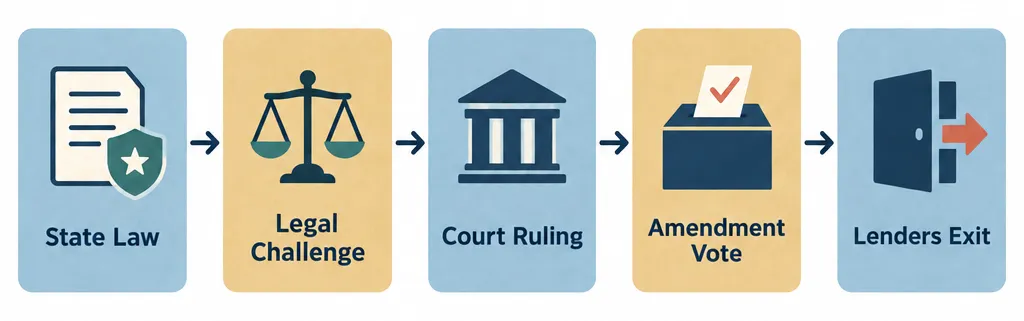
Arkansas went from licensing payday lenders to banning them in about ten years. Courts, the Attorney General and voters each played a part, and lawmakers came back in 2017 to close a later loophole. The table below gives the key dates and what each one changed for borrowers.
| Date | Event | What it means for borrowers | Source |
|---|---|---|---|
| 1999 | Check-Cashers Act declares payday fees “not interest” | Storefronts open statewide at triple-digit APRs | Arkansas Supreme Court record |
| March 2008 | AG Dustin McDaniel tells payday lenders to stop making illegal loans | Many storefronts begin closing | Contemporary reporting |
| Nov. 6, 2008 | McGhee ruling, 6-0, strikes down the act | Fees legally count as interest | Arkansas Supreme Court |
| 2009 | Last payday lender in the state shuts down | No legal storefronts remain | Arkansas Advocates for Children and Families |
| Nov. 2010 | Voters approve Amendment 89 | 17% cap written into the constitution | Official ballot results |
| June 2011 | Forrester v. Martin upholds Amendment 89 | Cap survives legal challenge | Arkansas Supreme Court |
| 2011 | Legislature repeals the payday lending statute | No legal framework for payday lending remains | NCSL |
| 2016 | CashMax opens as a credit services organization | New workaround appears | Arkansas Democrat-Gazette |
| June 24, 2016 | AG Leslie Rutledge settles with Western Sky Financial, CashCall and related parties | Illegal online loans to Arkansans voided | Arkansas AG |
| April 2017 | CashMax closes its North Little Rock store | Workaround collapses | Arkansas Democrat-Gazette |
| Aug. 1, 2017 | Act 944 of 2017 takes effect | CSO fees count as interest | Arkansas Code |
| March 30, 2025 | CFPB payment provisions (12 CFR 1041) take effect | Limits on repeated failed debits | CFPB |
| July 2026 | CFPB regulatory agenda lists reconsidering the remaining payday rule | Federal protections could change | CFPB agenda |
The Center for Responsible Lending has estimated that Arkansans save about $77 million a year in fees because payday lending is gone, a figure Arkansas Advocates for Children and Families cited in 2017. That number is a model estimate, not a measured total. Still, it gives a sense of how much money the old storefronts drew out of the state.
Loopholes lenders have tried, and where they stand now
Since 2008, lenders have tried at least four ways around the 17% cap. Lawmakers or the AG have closed the clearest ones. Online lenders keep trying, because enforcing Arkansas law against a company that may not even be in the United States takes time.
| Model | How it works | Status in 2026 | Law |
|---|---|---|---|
| Check-casher / deferred deposit | Fee on a post-dated check, called “not interest” | Illegal | McGhee (2008); Amendment 89 |
| Credit services organization (CSO) | Third party lends at 17%; broker adds large “credit services” fee | Fee counts as interest; model shut down | Act 944 of 2017, Ark. Code § 4-91-202 |
| Car title “sale and lease-back” | Borrower “sells” the car and leases it back | Treated as a disguised title loan; illegal above 17% | Amendment 89; AG enforcement |
| Tribal or offshore online lender | Claims Arkansas law doesn’t apply | AG treats as illegal; settlements have voided loans | Amendment 89; AG settlements |
| Bank-partner loan | Nonbank markets a loan made by an out-of-state bank | Depends on who is the true lender | Amendment 89 bank provision |
Credit services organizations and Act 944 of 2017
The CSO model split one loan into two charges. An outside lender charged interest at or under 17%, and a “credit services organization” added a separate brokerage fee. The Arkansas Democrat-Gazette reported a 2016 CashMax loan with $24.75 in third-party interest and a $268.50 CSO fee. AARP Arkansas said the arrangement let lenders charge Arkansans up to 280% APR.
Sen. Jason Rapert sponsored SB658, which became Act 944 of 2017, the Credit Repair Services Organizations Act of 2017. Gov. Asa Hutchinson signed it, and it took effect August 1, 2017. Under Act 944, the fees you pay a CSO in connection with the loan are treated as interest, so the combined charge falls under the 17% cap. CashMax closed its North Little Rock store weeks after lawmakers passed the bill.
Did you know?
In a 2016 CashMax loan reported by the Arkansas Democrat-Gazette, the actual interest was $24.75 but the “credit services” fee was $268.50. Act 944 of 2017 was written to close exactly that gap.
Tribal and offshore online lenders
Some online lenders say Arkansas law doesn’t reach them because they are tied to a Native American tribe or based overseas. The AG’s position is that a loan made to an Arkansas resident must follow Arkansas’s constitution. In 2016 the office settled with Western Sky Financial, CashCall and related parties over online loans at rates as high as 342%. The settlement was reported at $750,000 and voided the outstanding loans to Arkansas consumers. A tribal or offshore claim is an argument the lender makes in its own favor. It isn’t a license to lend in Arkansas.
High-rate “installment” loans
Spreading payments over several months doesn’t change the math. Any installment loans in Arkansas from a nonbank lender must stay at or under 17% APR. The AG’s office names high-rate “installment” lending as a form of payday lending it has worked to stop.
Car title loans in Arkansas
Arkansas title loans are banned in practice for the same reason payday loans are. No statute names title loans directly, but the usual 25% monthly fee works out to about 300% APR, far above the 17% cap. Under former AG Dustin McDaniel, the office sued a Lonoke County pawnbroker over auto title loans priced above 300%. The suit alleged the loans were disguised as a vehicle sale with a lease-back to the borrower.
The danger with title loans arkansas residents find online, or just across a state line, is the car. Once the lender holds your title, it can try to repossess the vehicle you need to get to work. If an Arkansas title lender charged you more than 17% a year, report it to the AG before you hand over the car or make more payments.
Installment and personal loans: rate caps and licensing
For nonbank lenders, legal installment loans in Arkansas top out at 17% APR under Amendment 89. Banks and credit unions can charge more because of the federal-preemption provision. The table above shows that a 17% loan is cheap compared with payday pricing: $500 over six months costs about $25 in interest. That low ceiling is exactly why many high-cost lenders won’t make small loans in the state at all.
There’s a downside. A 17% cap means borrowers with poor credit often can’t get a small personal loan from a mainstream lender. That pushes some people toward illegal online offers or across a state line. The legal options for that group are in the section on help that costs less, below.
Online lenders: does Arkansas law apply, and how to check a license
Yes. In the AG’s view, an online lender that lends to an Arkansas resident falls under Arkansas law, wherever the company says it is based. The AG’s payday page says storefronts are gone but the loans are still offered online. Before you share bank details with any company:
How to check an online lender
- Find the company’s legal name, physical address and state of incorporation in the loan agreement, not the ad.
- Look for the APR in the Truth in Lending Act disclosure box. If it is above 17% and the lender is not a bank, the loan breaks Arkansas law.
- Search the company in NMLS Consumer Access, which lists many state licenses across the country.
- Check the CFPB’s public complaint database and the AG’s consumer alerts for the company name.
- If the lender says it is a bank or a bank partner, confirm the bank on the FDIC’s BankFind tool and ask in writing who owns the loan.
Border cities: borrowing in Missouri, Oklahoma or Texas
All six states that border Arkansas allow some form of payday or high-cost lending, so a storefront is never far from Texarkana, Fort Smith or the Bella Vista and Fayetteville area. Generally, a loan you take out in person in another state follows that state’s law, and the Arkansas AG has little power to cancel it. If the lender later sues, it may have to do so in an Arkansas court. Don’t count on that protecting you, though. The loan will still be just as expensive.
I already took an online payday loan. What now?
Stop the automatic withdrawals first, then build a paper trail, then file a complaint with the AG. Keep the order. Each step protects your bank account while the next one is under way. The process is laid out below.
What to do about an illegal online loan
- Find the APR, the lender’s legal name and its address in your loan papers or emails.
- Send the lender a written notice revoking its authorization to debit your account, and keep a copy.
- Tell your bank in writing to stop future debits from that lender at least three business days before the next one.
- Ask the bank to place a stop-payment order, and watch your account for new attempts.
- File an online complaint with the AG’s Consumer Protection Division and ask it to contact the lender about canceling the loan.
- Keep every statement, email, text and call log in one folder.
Stopping withdrawals from your bank account
The Electronic Fund Transfer Act and Regulation E (12 CFR 1005.10) give you the right to stop preauthorized transfers. You do it by notifying your bank at least three business days before the scheduled debit. The bank can ask for written confirmation within 14 days. Revoke the authorization with the lender too, so it can’t claim you still consented.
Closing your bank account looks like an easy way out, but it has costs. The AG’s office warns that a lender may still sue you, and the office can’t act as your attorney. Unpaid debits can also lead to overdraft fees or a report to an account-screening company, which can make it harder to open a new account.
The CFPB two-failed-withdrawals rule
The payment provisions of the Consumer Financial Protection Bureau’s Payday Lending Rule, 12 CFR 1041, took effect March 30, 2025. After two consecutive withdrawal attempts fail for lack of funds, a covered lender needs your new, specific authorization before it tries again. The rule is still on the books. However, the CFPB said in March 2025 that it wouldn’t prioritize enforcing it, and its July 2026 regulatory agenda lists reconsidering the remaining provisions. As of this update, those provisions haven’t been formally changed.
Stop the debits in writing
Revoke ACH authorization with both the lender and your bank, date both letters, and keep copies. If debits keep coming after you notify your bank in time, dispute them with the bank under Regulation E.
Filing a complaint with the Arkansas Attorney General
Attorney General Tim Griffin’s Consumer Protection Division takes online complaints about payday lenders and payday loan debt collectors at arkansasag.gov. Attach your loan agreement, payment records and any collection messages. A complaint doesn’t erase a debt automatically. But the office’s past settlements with online lenders have voided loans for Arkansas residents, and a complaint puts your loan on the record.
Check the APR before you pay
Before sending another payment, find the APR on your loan agreement. If it is above 17%, you lived in Arkansas when you borrowed, and the lender is not a bank, file a complaint and ask the AG’s office to request that the loan be canceled.
Can you get in trouble for not paying back a payday loan in Arkansas?
Not in criminal court. An unpaid loan is a civil debt, and nobody goes to jail in Arkansas for owing money to a lender. A lender or debt buyer can still sue you, and if it wins a judgment it can try to garnish your wages or bank account. With an illegal loan, the lender has its own problem: the 17% cap gives you a usury defense, and it has to sue in a court that applies Arkansas law.
Debt collector threats and your FDCPA rights
The Fair Debt Collection Practices Act bars third-party collectors from threatening arrest, falsely saying you committed a crime, or threatening actions they can’t legally take or don’t intend to take. Regulation F (12 CFR 1006) presumes a collector is harassing you if it calls more than seven times in seven days about one debt. You can demand in writing that a collector stop contacting you. Arkansas also requires collection agencies to be licensed by the Arkansas State Board of Collection Agencies, the same board named in the McGhee case.
A collector who says you’ll be “charged with check fraud” over a payday loan is using one of the most common scare tactics. Only a prosecutor can file criminal charges, and a collector who threatens charges it has no power to bring breaks the FDCPA. Write down the date, the caller’s name and company, and what was said. Then report it to the AG and the CFPB.
If you are sued
Never ignore a summons. If you don’t respond by the deadline printed on it, the lender can win by default. Your possible defenses include the usury cap, the statute of limitations, and asking the plaintiff to prove it owns the debt. Legal Aid of Arkansas and its arlawhelp.org site help people with low incomes. If you’re working with an attorney, bring the full loan agreement.
Wage garnishment limits in Arkansas
Garnishment starts only after a court judgment. Federal law caps it at 25% of disposable weekly earnings or the amount above $217.50 a week, whichever is less. Arkansas adds its own protection: under Ark. Code § 16-66-208, the first $25 a week of a laborer’s or mechanic’s net wages is fully exempt. More can be protected through the state’s personal-property exemption, which is $500 for a married person or head of family and $200 for a single person (Ark. Code § 16-66-218). You have to claim these exemptions. The court doesn’t apply them on its own.
Can a payday loan come after you after 7 years? Arkansas’s statute of limitations
Usually not through a lawsuit, as long as the clock hasn’t restarted. Arkansas gives creditors five years to sue on a written contract (Ark. Code § 16-56-111) and three years on oral contracts and open accounts (Ark. Code § 16-56-105). The time generally runs from the date of default. After it runs out, the debt is “time-barred.” You can raise that as a defense in court, but you have to raise it.
| Debt type | Time limit | Statute | What restarts the clock |
|---|---|---|---|
| Written loan agreement or note | 5 years | Ark. Code § 16-56-111 | Voluntary partial payment or written acknowledgment |
| Oral contract or open account | 3 years | Ark. Code § 16-56-105 | Payment or written promise to pay (check before paying) |
| Credit report listing | 7 years from first delinquency | Fair Credit Reporting Act | Nothing; payment does not reset reporting |
The catch is in § 16-56-111(b): a partial payment or written acknowledgment of the debt tolls the limitation period. Arkansas courts have held that the payment must be voluntary. So a $20 “good faith” payment on a six-year-old loan can give a creditor fresh time to sue. The credit report rule is separate. Under the Fair Credit Reporting Act, most negative entries drop off seven years after the first delinquency no matter what you pay later.
Hold off on "good faith" payments
Don’t make a partial payment on an old debt until you know whether it’s past Arkansas’s limitation period. A small voluntary payment can restart the five-year clock on a written contract.
Which states have banned payday loans? How Arkansas compares
Most states allow payday lending. The National Conference of State Legislatures counts 37 states with statutes that specifically permit it. Arkansas belongs to the smaller group that doesn’t, either because it never had a law, let the law expire, or repealed it. NCSL notes that Arizona and North Carolina let their statutes lapse, while Arkansas (2011), New Mexico (2017) and the District of Columbia (2007) repealed theirs.
That explains why Texas has payday stores on every corner and Arkansas has none. Texas allows lenders to run as credit access businesses under a CSO-style model. Arkansas closed that door with Act 944. Maryland is another state where interest caps keep payday storefronts out. You can see how its rules compare in our article on Maryland payday loan laws, and our guides to Ohio and Illinois payday loan laws show two states that kept payday lending but capped it.
Help that costs less: legal ways to get short-term cash in Arkansas
The cheapest legal option is usually a federal credit union’s Payday Alternative Loan. After that come a payment plan with the company you owe, nonprofit credit counseling, and public assistance for specific bills. None of them is guaranteed. Each one costs far less than an illegal online loan.
Cheaper options first
Ask a credit union about a Payday Alternative Loan, capped at 28% APR.
Call the utility, landlord or medical billing office and ask for a hardship plan before you borrow.
Dial 2-1-1 to find local rent, utility and food help in Arkansas.
Credit union payday alternative loans
National Credit Union Administration rules at 12 CFR 701.21(c)(7) allow two kinds of small loans. PAL I loans run from $200 to $1,000 for one to six months, and you must have been a member for at least a month. PAL II loans go up to $2,000 for one to twelve months, with no waiting period. Both cap the APR at 28%, limit the application fee to $20, and prohibit rollovers. Credit unions don’t have to offer PALs, so ask before you apply.
| Option | Amount | Cost | Term | Total repaid |
|---|---|---|---|---|
| PAL II at 28% APR | $1,000 | $83.17 interest plus up to $20 fee | 6 monthly payments of about $180.53 | About $1,103 |
| Installment loan at 17% APR | $500 | $25.07 interest | 6 monthly payments of about $87.51 | About $525 |
| Online payday loan at 342% (Western Sky’s top rate) | $1,000 | Hundreds of dollars over a few months | Varies | Far above the amount borrowed |
Cash advance apps: what to check
Cash advance apps and earned wage access products are the 2026 version of the small, fast loan. Some charge no mandatory fee but push “express” fees or tips. To judge one, add up every dollar you’d pay and turn it into an APR. A $5 express fee on a $100 advance repaid in 10 days is 5% for 10 days, or about 182.5% a year. Read the app’s fee schedule, check whether it debits you automatically on payday, and find out whether skipping the tip changes your limit.
Debt relief and financial assistance in Arkansas
Real debt relief in Arkansas starts with nonprofit credit counseling. Agencies that belong to the National Foundation for Credit Counseling can set up a debt management plan, which may lower interest rates on credit cards. Debt settlement companies are a different business. The FTC’s Telemarketing Sales Rule bars them from charging fees before they actually settle a debt, so any company that wants money up front is a red flag.
For Arkansas financial assistance with a specific bill, Arkansas 2-1-1 connects callers to local rent, utility and food programs. The federal Low Income Home Energy Assistance Program helps with heating and cooling bills through local community action agencies.
Help for service members
The Military Lending Act (10 U.S.C. 987) caps the military annual percentage rate at 36% for active-duty service members and their dependents. That rate includes most fees and add-on products. In Arkansas the state’s 17% cap is already lower for nonbank lenders, but the MLA follows you if you take out a loan in another state or from a bank. Military relief societies such as Air Force Aid Society, which serves airmen at Little Rock Air Force Base, offer interest-free emergency help.
Federal rules that apply in every state
Three federal laws protect you in Arkansas and everywhere else. The Truth in Lending Act and Regulation Z (12 CFR 1026) require lenders to show the APR and total finance charge before you sign. The Military Lending Act sets the 36% cap for covered service members. The Fair Debt Collection Practices Act bars third-party collectors from harassment, false threats and deception. The CFPB takes complaints under all three.
How to spot an illegal payday loan offer
If an ad promises fast cash to an Arkansas resident at payday prices, assume it’s illegal until you see a valid APR at or under 17% and a bank or licensed lender behind it. Watch for these warning signs:
- “Guaranteed $500 payday loan” or “need a payday loan immediately, approved in minutes.” Lenders that follow the law don’t guarantee approval.
- An APR in the triple digits, or no APR shown at all.
- A request for your online banking username and password, or for a post-dated check.
- A claim that tribal sovereignty or offshore status puts the loan beyond Arkansas law.
- No physical address, or only a P.O. box or foreign address.
- Terms that automatically renew or “roll over” the loan for an extra fee.
- A collector who threatens arrest, jail or criminal charges.
Fraud is also common. Some fake lenders ask for an “insurance” or “processing” fee up front and then disappear. Report these to the FTC at ReportFraud.ftc.gov and, if money moved online, to the FBI’s Internet Crime Complaint Center.
Before you borrow
In Arkansas, any nonbank lender charging more than 17% a year is breaking the state constitution, and giving it access to your bank account can lead to repeated debits that are hard to stop. Check the APR and the lender’s identity before you share account details.
FAQ
Are payday loans legal in Arkansas in 2026?
No. Amendment 89 caps nonbank loans at 17% a year, and the 2008 McGhee ruling held that payday fees count as interest. No licensed payday storefronts have operated in the state since 2009, and the payday statute was repealed in 2011.
What is the maximum interest rate allowed in Arkansas?
For nonbank lenders, 17% per year under Amendment 89. Federally insured banks and credit unions can charge the rate federal law allowed them on March 1, 2009. That’s why some credit cards issued to Arkansans carry higher rates.
Do I have to pay back an illegal online payday loan in Arkansas?
The AG’s office treats loans above 17% to Arkansas residents as illegal, and its past settlements have voided such loans. Whether a lender could win in court depends on your loan’s facts. Stop the automatic debits, file a complaint with the AG, and if you’re sued, answer and raise the usury defense, ideally with help from Legal Aid of Arkansas.
The lender says it’s tribal and Arkansas law doesn’t apply. Is that true?
That is the lender’s argument, not settled law. Arkansas has gone after online lenders with tribal and offshore ties, including Western Sky Financial and CashCall. A tribal claim doesn’t make a 300% loan legal to offer an Arkansas resident, so report it to the AG.
Can I go to jail for not paying a payday loan in Arkansas?
No. Unpaid loans are civil debts. A lender can sue you and seek a judgment, but no one is jailed for the debt itself. A collector who threatens arrest or check fraud charges to make you pay is breaking the Fair Debt Collection Practices Act.
Is it legal to drive to Oklahoma or Missouri for a payday loan?
Generally yes. A loan made in person in another state usually follows that state’s law, and the Arkansas AG has limited power over it. You give up the protection of the 17% cap, though. Before you go, compare it with a credit union PAL, which by law can’t exceed 28% APR.
If you are holding an expensive loan right now, the single most useful step is to find the APR on the agreement today. If it’s above 17%, you lived in Arkansas when you borrowed, and the lender isn’t a bank, the loan breaks the state constitution. Revoke the debit authorization with your bank, then file a complaint with the Attorney General.
Laws and regulations referenced
- Truth in Lending Act, 15 U.S.C. 1601
- Regulation Z, 12 CFR Part 1026
- Fair Debt Collection Practices Act, 15 U.S.C. 1692
- Regulation F (debt collection), 12 CFR Part 1006
- Fair Credit Reporting Act, 15 U.S.C. 1681
- Electronic Fund Transfer Act, 15 U.S.C. 1693
- Regulation E (electronic transfers), 12 CFR Part 1005
- Military Lending Act, 10 U.S.C. 987
- CFPB payday lending rule, 12 CFR Part 1041
Links go to the official text on government sites.
Check, verify or complain
Sources
- Payday Lending/Check Cashing - Arkansas Attorney General arkansasag.gov · official source
- Finances - Arkansas Attorney General arkansasag.gov · official source
- Payday Lending Rule FAQs - CFPB consumerfinance.gov · official source
- Arkansas Court of Appeals opinion on Ark. Code 16-56-111 opinions.arcourts.gov · official source
- NCUA Payday Alternative Loans final rule (PALs II), Federal Register govinfo.gov · official source
- NCUA letter on CFPB payday rule amendments ncua.gov · official source
- AG Griffin announces $45 million settlement with Block, Inc. arkansasag.gov · official source
- Ark. court strikes down payday lending law - NBC News nbcnews.com
- Arkansas S.C. rules Check-Cashers Act unconstitutional - Legal Newsline legalnewsline.com
- Push and pull for payday lenders - Arkansas Advocates for Children and Families aradvocates.org
- Arkansas Supreme Court upholds interest rate amendment - Talk Business & Politics talkbusiness.net
- Arkansas Interest Rate Limit, 2010 - Ballotpedia ballotpedia.org
- Payday Lending State Statutes - NCSL ncsl.org
- Critic calls CashMax abusive as 2nd opens in Arkansas nwaonline.com
- Governor Hutchinson signs into law bill closing predatory lenders loophole - AARP Arkansas states.aarp.org
- Arkansas Democrat-Gazette, April 29, 2017 pressreader.com
- Arkansas Attorney General Announces Settlement With Online Payday Lender - Mondaq mondaq.com
- Arkansas AG Settles Payday Lending Lawsuit for $750,000 goodwinlaw.com
- Arkansas AG sues Lonoke County pawnbroker washingtonexaminer.com

Elena writes about getting through a money emergency, assistance programs, budgeting on a tight income, banking basics and borrower rights. Her guides list the cheaper options first and link the agency or program that can actually help.
Ruth is US Financer's standards editor. Every article goes through her checks before and after it is published: each rate, fee, cap, deadline and rule is matched against its primary source, every law named is linked to its official text, and anything that cannot be…
What changed
- Nov 15, 2026 First published.
Comments are closed