

General information, not legal advice. Laws change, so confirm with the official statute, your state regulator or a licensed attorney before you act.
Payday lending is still legal in Illinois, but since March 23, 2021 every payday, car title and consumer installment loan from a non-bank lender has been capped at 36% APR under the Predatory Loan Prevention Act (815 ILCS 123). A loan priced above that cap is void under state law, and the lender has no right to collect principal, interest or fees. As of November 2026 that rule is unchanged, and it is the first thing to know before you sign anything.
Run the numbers
Key takeaways
- Non-bank consumer loans in Illinois are capped at 36% APR under 815 ILCS 123, and the cap counts most fees.
- A loan above 36% is void: you owe no principal, interest or fees on it.
- Payday loans must also follow 815 ILCS 122: no rollovers, two open loans at most, and a repayment plan after 35 days.
- Since January 1, 2026, Illinois protects more property from creditors, including the first $1,000 in a bank account.
- A credit union payday alternative loan at 28% APR or less is cheaper than any legal installment loan.
What changed in 2021 and why it matters
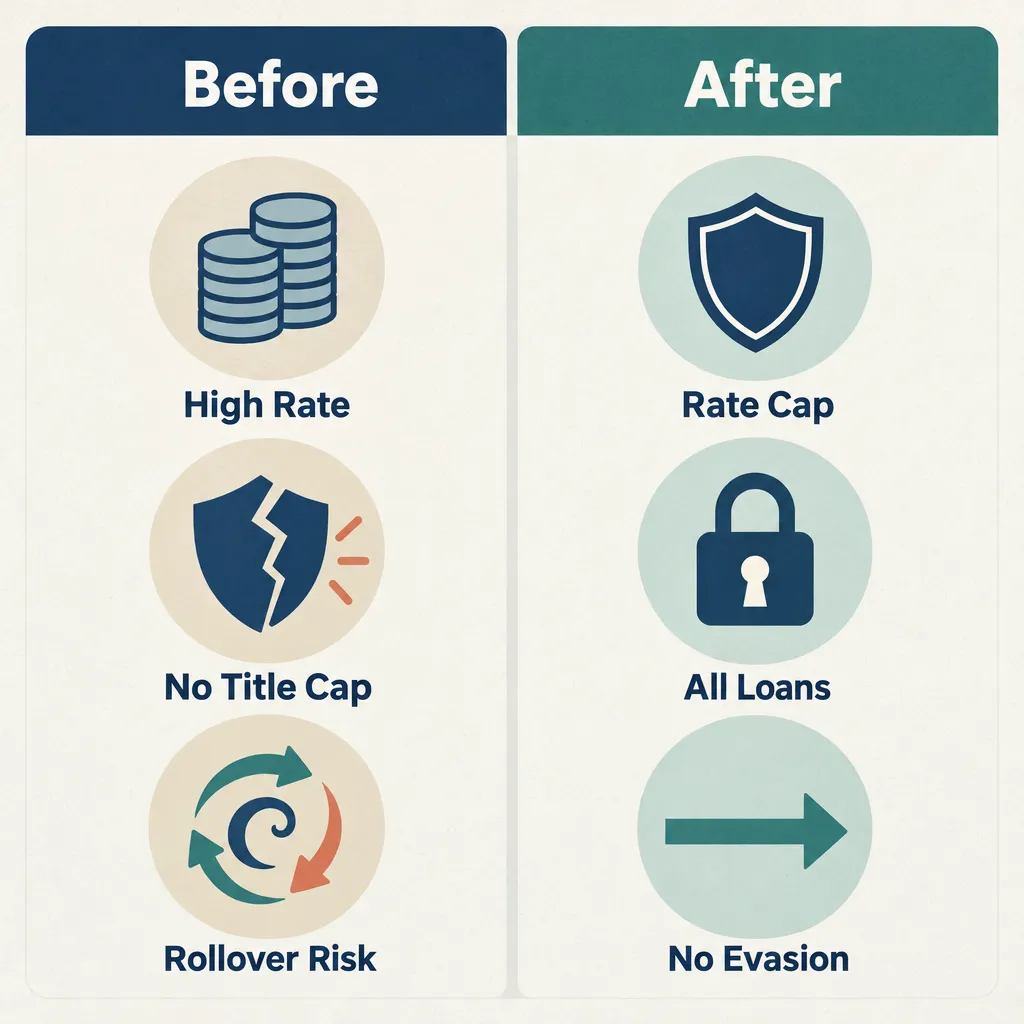
In 2021 Illinois replaced several different price limits with one 36% APR ceiling, and the cap applies to almost every non-bank consumer loan. Before that, the state ran a two-track system for about 15 years. The Payday Loan Reform Act (815 ILCS 122) let storefront lenders charge up to $15.50 per $100 borrowed, about 404% APR on a 14-day loan. The Consumer Installment Loan Act (205 ILCS 670) allowed up to 99% APR on certain small consumer loans of $4,000 or less. Title loans had no rate cap at all.
Senate Bill 1792, signed by Governor J.B. Pritzker as Public Act 101-0658, created the Predatory Loan Prevention Act (PLPA). Section 15-5-5 is the rate cap: a lender may not contract for or receive charges above a 36% annual percentage rate on a consumer loan. The Act calculates that rate with the “military annual percentage rate” method from the federal Military Lending Act. That means most charges count toward the 36%, including application fees, credit insurance and add-on products. Calling interest a “fee” instead does not get a lender under the cap.
Section 15-5-10 sets the penalty. A loan made in violation of the Act is null and void, and no person may collect, attempt to collect, receive or retain any principal, fee, interest or charge on it.
Banks, savings banks, savings and loan associations, credit unions and insurance companies are exempt because other state and federal laws regulate them. Every other lender making consumer loans to Illinois residents is covered, including online lenders based in other states. The anti-evasion section, 15-5-15, reaches arrangements where a non-bank claims to be only an agent or “service provider” for a bank. If the loan is above 36% and the non-bank holds the predominant economic interest, markets the loan or is structured to evade the cap, Illinois treats it as the lender.
The practical result: many storefront payday and title lenders stopped offering those products in Illinois after 2021, because the old business model does not work at 36%. The Woodstock Institute, a Chicago research group that pushed for the cap, has since published research arguing the PLPA is still working while warning that high-cost lenders keep looking for ways around it.
Rules changed or pending in 2025 and 2026
The 36% cap itself has not changed, but the laws around it have. Here is the status as of November 2026.
| Change | Status | What it means for you |
|---|---|---|
| Public Act 104-0120 (SB 1738): higher exemptions from creditors | Law, effective January 1, 2026 | More of your home, car and bank account is protected from judgment creditors |
| Illinois buy now, pay later consumer protection law | Enacted in 2026; compliance starts January 1, 2028 or earlier if IDFPR sets a date by rule | BNPL lenders get new licensing and conduct rules; BNPL loans already fall under the PLPA’s 36% cap |
| HB 3455: change to how APR is calculated under the PLPA | Bill only; referred to the House Rules Committee on February 18, 2025, with no later action | Not law; the military APR method still applies |
| SB 1685 / HB 1279: replace the Debt Settlement Consumer Protection Act with a Debt Resolution Services Act | Bills only; SB 1685 referred to Senate Assignments on February 5, 2025 | Not law; the current debt settlement act still applies |
| CFPB payday rule payment provisions (12 CFR 1041) | In effect since March 30, 2025; the CFPB said it would not prioritize enforcement | The two-failed-debit limit is still in federal regulations |
Payday and short-term loans in Illinois
Payday loans are legal in Illinois only at 36% APR or less, and they must also follow the structural rules of the Payday Loan Reform Act. That Act is still on the books, so its limits on loan size, rollovers and repeat borrowing apply alongside the PLPA’s price cap.
Maximum loan amount
Under 815 ILCS 122/2-5, a lender cannot make a payday loan if the payments due in the first month, combined with your other outstanding payday loans, exceed the lesser of $1,000 or 25% of your gross monthly income. For “installment payday loans,” the longer-term version defined in the Act, the income limit is 22.5% of gross monthly income.
Worked example: if you earn $2,800 a month gross, 25% of that is $2,800 × 0.25 = $700. Because $700 is less than $1,000, the most a lender can lend you on a standard payday loan is $700, whatever the lender would like to approve.
Fees and rates
The old $15.50 per $100 figure no longer applies. The PLPA’s 36% cap overrides it.
| Loan terms | Pre-2021 payday loan | Payday loan under the PLPA |
|---|---|---|
| Amount borrowed | $500 | $500 |
| Fee or interest | $77.50 ($15.50 per $100) | $6.90 |
| Term | 14 days | 14 days |
| APR | About 404% | 36% |
| Total repaid | $577.50 | $506.90 |
The APR math in plain words: divide the finance charge by the amount borrowed, then multiply by the number of 14-day periods in a year (365 ÷ 14 = 26.07). For the old loan, $77.50 ÷ $500 = 0.155, and 0.155 × 26.07 = 4.04, or about 404%. At 36% APR, the two-week charge is $500 × 0.36 × 14 ÷ 365 = $6.90, so you repay $500 + $6.90 = $506.90.
Term limits
A standard payday loan in Illinois must run at least 13 days. An installment payday loan must run between 112 and 180 days and be repaid in substantially equal installments. A lender cannot set a due date shorter than the minimum term just because your next paycheck lands sooner.
Rollovers, open-loan limits and the state database
Illinois bans rollovers. A payday lender cannot renew or refinance a payday loan, and you cannot have more than two payday loans outstanding at any one time.
To enforce those limits, the Act requires every licensed payday lender to check a state-certified consumer reporting service before making a loan. This real-time database is run by a vendor under contract with the Illinois Department of Financial and Professional Regulation (IDFPR). If you already have two loans open, or you are inside a cooling-off period, the database tells the lender no.
Cooling-off period and repayment plan
After you have been in payday loan debt for more than 45 consecutive days, you cannot take another payday loan for seven days. The cooling-off rule is meant to stop borrowers from paying off one loan and immediately taking out the next.
The repayment plan right under 815 ILCS 122/2-40 matters more for most struggling borrowers. If you have had payday loans outstanding for 35 consecutive days, any payday loan still outstanding on day 35 becomes payable under a repayment plan if you ask for one. The statute sets the terms:
- At least four equal installments, with at least 13 days between them.
- A total plan term of no more than 90 days.
- No extra fees or finance charges for asking for or using the plan.
- The lender must prepare the plan agreement within 48 hours of your request, and the first payment cannot be due until at least 13 days after you both sign.
- The lender cannot require postdated checks for plan payments, and cannot refuse or delay your right to a plan.
Worked example: a $600 balance on day 35 becomes four payments of $600 ÷ 4 = $150, spaced at least 13 days apart, with nothing added on top.
Ask for the plan in writing
If you reach day 35 on a payday loan, request the repayment plan in writing and keep a copy. The lender has 48 hours to prepare the agreement and cannot charge you for it.
Other borrower protections in the Payday Loan Reform Act
- Returned payment fees: a lender may charge no more than one fee, capped at $25, if your check or ACH debit bounces.
- No criminal threats: a lender cannot threaten you with criminal prosecution over a bounced check tied to a payday loan.
- No wage assignments: payday lenders cannot take an assignment of your wages as collateral.
- Plain disclosures: the lender must give you a written agreement that lists the APR, the fees and your rights.
The contrast with neighboring states is sharp. Our page on Missouri payday loan laws covers a state where interest and fees can reach 75% of the original loan amount, and Wisconsin payday loan laws describes a market with no rate cap at all. Borrowing across the state line can cost ten times as much.
Car title loans in Illinois
Car title loans are legal in Illinois only at 36% APR or less, and few licensed lenders still offer them. Title loans were always made under the Consumer Installment Loan Act and IDFPR’s title-secured loan rules in the Illinois Administrative Code (38 Ill. Adm. Code 110). Those rules capped a title loan at $4,000, limited monthly payments to 50% of gross monthly income and restricted refinancing. What they never did, before 2021, was limit the interest rate, and triple-digit APRs were common.
The PLPA closed that gap. A title lender now faces the same 36% all-in cap as any other consumer lender, and a title loan priced above it is void. The product rarely pays for itself at that rate once a lender adds the cost of appraising the car and recording a lien.
| Loan terms | Pre-2021 title loan (200% APR example) | Title loan under the PLPA (36% APR) |
|---|---|---|
| Amount borrowed | $1,000 | $1,000 |
| Term | 6 monthly payments | 6 monthly payments |
| Monthly payment | $276.19 | $184.60 |
| Total repaid | $1,657.14 | $1,107.60 |
| Finance charge | $657.14 | $107.60 |
How the payments are calculated: the monthly rate is the APR divided by 12 (200% ÷ 12 = 16.67%; 36% ÷ 12 = 3%). The standard loan formula is payment = amount × monthly rate ÷ (1 − (1 + monthly rate) raised to the power of minus the number of payments). At 3%, that gives $184.60, and $184.60 × 6 = $1,107.60, so the finance charge is $1,107.60 − $1,000 = $107.60. At 16.67%, the payment is $276.19, and $276.19 × 6 = $1,657.14.
If a storefront or website offers Illinois residents a loan against a car title at anything like the old prices, it is operating outside state law. If you still hold a title loan signed before March 23, 2021, the law in force at the time governs it; the cap does not rewrite older contracts. Repossession follows the Illinois Uniform Commercial Code (810 ILCS 5/9-609 and following sections), which allows a lender to repossess after default without a court order as long as it does not breach the peace, and requires notice before the vehicle is sold.
Installment and personal loans in Illinois
Most legal small-dollar borrowing in Illinois now happens through licensed installment lenders, and every one of those loans is capped at 36% APR. The Consumer Installment Loan Act (205 ILCS 670) requires a person in the business of making consumer installment loans of $40,000 or less to hold an IDFPR license, subject to statutory exemptions. The Act used to allow 99% APR on small loans; since 2021 the PLPA’s cap applies regardless of loan size.
How an installment loan works in Illinois today:
- Licensing is mandatory. A consumer installment lender must be licensed by IDFPR unless it is a bank or credit union. Licensed lenders appear in IDFPR’s license lookup and, for most, on the Nationwide Multistate Licensing System’s NMLS Consumer Access site.
- The 36% is all-in. Because the PLPA uses the Military Lending Act’s method, origination fees, monthly “maintenance” fees and insurance sold with the loan all count. A lender charging 29.99% interest plus a $150 origination fee on a $1,000 six-month loan exceeds the cap, because the fee counts toward the APR and the combined APR comes out well above 36%.
- Payment limits. For small consumer loans, monthly payments cannot exceed 22.5% of your gross monthly income.
- Prepayment. You can pay off a consumer installment loan early without a penalty.
Here is the same $2,000 loan at the old 99% ceiling and at today’s 36% cap:
| Loan terms | Small consumer loan at 99% APR (pre-2021) | Installment loan at 36% APR (current cap) |
|---|---|---|
| Amount borrowed | $2,000 | $2,000 |
| Term | 12 monthly payments | 12 monthly payments |
| Monthly payment | $268.84 | $200.92 |
| Total repaid | $3,226.08 | $2,411.04 |
| Finance charge | $1,226.08 | $411.04 |
The math: at 36%, the monthly rate is 3%, the formula gives a payment of $200.92, and $200.92 × 12 = $2,411.04. At 99%, the monthly rate is 8.25%, the payment is $268.84, and $268.84 × 12 = $3,226.08.
Thirty-six percent is not cheap. It is the line federal law draws for service members between mainstream and predatory credit, and it still costs $411.04 to borrow $2,000 over a year on the amortizing loan above. If the full $2,000 stayed outstanding for the whole year, interest would be $2,000 × 0.36 = $720. Try the cheaper alternatives below first.
Installment loans for bad credit in Illinois
Lenders that advertise “installment loans for bad credit” in Illinois face the same 36% rule as everyone else. A weaker credit profile changes the loan size, the term and your odds of approval, not the legal rate ceiling. Some licensed lenders use alternative data such as bank account cash flow or rent history instead of a FICO score. That is often a soft credit check, but it is still underwriting. “No credit check” and “guaranteed approval” are marketing phrases, not legal categories, and no licensed Illinois lender can promise approval before reviewing your application.
Same-day and online installment loans in Illinois
Illinois law does not forbid same-day funding. A licensed lender can approve an online application and send money by ACH the same business day. The law requires the lender to hold an IDFPR license (or be a bank or credit union) and to price the loan at or under 36% APR. A site that promises same-day cash but will not show its APR until after you apply is a warning sign. The Truth in Lending Act requires the APR in the disclosure before you are bound.
Online and tribal lenders: does Illinois law apply?
Yes. The PLPA applies to any consumer loan made to an Illinois resident, whether the lender sits in Chicago, Delaware or offshore. The anti-evasion section targets the “rent-a-bank” model, where an online lender partners with an out-of-state bank to borrow the bank’s exemption. If the non-bank partner markets the loan, holds the predominant economic interest or is structured to evade the cap, Illinois treats it as the lender.
Tribal lenders are the hard case. Some online lenders affiliated with federally recognized tribes argue that sovereign immunity exempts them from state usury laws. Illinois regulators take the position that loans to Illinois residents above 36% are void whatever the lender’s tribal status, and that the state can act against the non-tribal companies that service, collect or market them. Courts in other states have split on these questions. For you, the practical picture: a tribal online loan at 300% APR is very likely unenforceable in an Illinois court, but you may still face aggressive collection calls and repeated ACH debits, and stopping them can take work.
Before borrowing from any online lender:
- Search the company’s legal name in IDFPR’s license lookup for a Consumer Installment Loan Act or Payday Loan Reform Act license.
- Search NMLS Consumer Access and confirm Illinois appears among its licensed states.
- If the site claims to be a bank or credit union, verify it with FDIC BankFind or the NCUA credit union locator. Fintech brands are rarely banks themselves.
- Find the APR in the disclosure. If it is missing or above 36%, the loan is not legal in Illinois.
If you already took an illegal online loan, you can stop the debits. Under the Electronic Fund Transfer Act and Regulation E (12 CFR 1005.10), you can stop preauthorized transfers by notifying your bank at least three business days before the next scheduled debit. The payment provisions of the CFPB’s payday lending rule (12 CFR 1041) took effect March 30, 2025. They bar covered lenders from trying to debit your account again after two consecutive failed attempts unless you give a new authorization. On March 28, 2025 the CFPB said it would not prioritize enforcement of those provisions, and its regulatory agenda lists a planned reconsideration, but as of November 2026 the rule remains in the federal regulations.
Stop the debits in writing
Tell your bank in writing that you revoke the lender’s ACH authorization, at least three business days before the next debit, and send the lender a copy. Keep both letters with your loan papers.
Debt collection and wage garnishment limits in Illinois
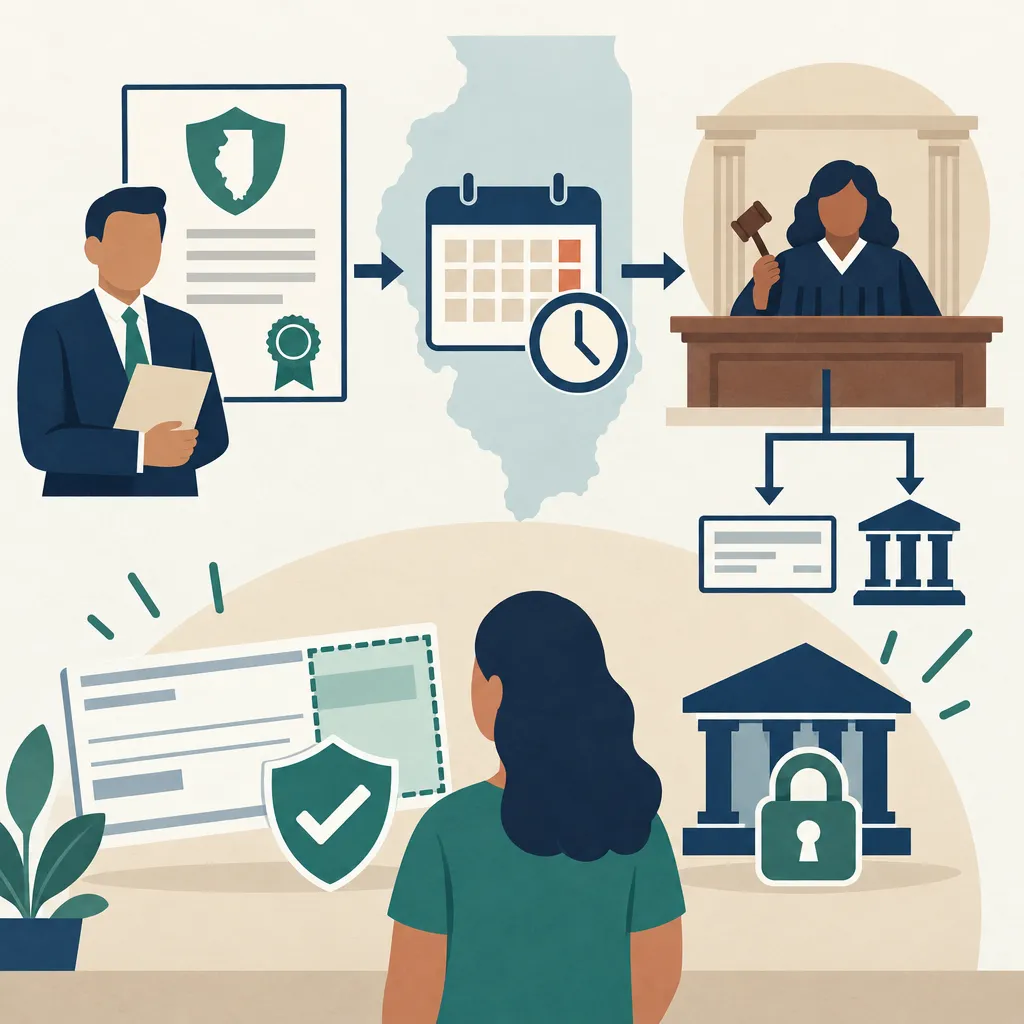
Illinois licenses collection agencies, limits how long creditors can sue, and protects more of your paycheck than federal law does. A creditor needs a court judgment before it can take your wages or bank account.
Who regulates collectors
Collection agencies operating in Illinois must be licensed under the Collection Agency Act (225 ILCS 425), which IDFPR administers. The Act bars threats, profanity, false statements about the amount owed, and contact with your employer beyond verifying employment or carrying out a garnishment. The Consumer Fraud and Deceptive Business Practices Act (815 ILCS 505) gives the Illinois Attorney General and private plaintiffs a second tool against deceptive collection.
Statute of limitations on debt
Under 735 ILCS 5/13-206, a creditor has 10 years to sue on a written contract. Under 735 ILCS 5/13-205, the limit for oral contracts and unwritten accounts is 5 years. Illinois courts have treated some credit card debts as unwritten when the full agreement was never signed, which pushes those cases toward the 5-year limit; it depends on the paperwork in your account. An old debt can still be paid voluntarily, and a payment or written acknowledgment can restart the clock, so get advice before paying anything on an old account.
A judgment can be enforced for 7 years and revived within 20 years under 735 ILCS 5/12-108. Since January 1, 2020, consumer debt judgments of $25,000 or less accrue post-judgment interest at 5% a year instead of the general 9% rate (735 ILCS 5/2-1303).
Wage garnishment limits
Under 735 ILCS 5/12-803, a creditor can take the lesser of two amounts from your weekly wages for a consumer debt: 15% of gross weekly wages, or the amount by which weekly disposable earnings exceed 45 times the hourly minimum wage. The Illinois minimum wage reached $15.00 an hour on January 1, 2025 and is still $15.00 as of November 2026, so the protected floor is 45 × $15.00 = $675 a week in disposable earnings. Federal law (15 U.S.C. 1673) uses 30 times the federal $7.25 minimum, or $217.50.
| Scenario (weekly pay) | Illinois limit (735 ILCS 5/12-803) | Federal limit (15 U.S.C. 1673) |
|---|---|---|
| Gross $1,000, disposable $800 | Lesser of $150 (15% of gross) or $125 ($800 − $675) = $125 | Lesser of $200 (25% of disposable) or $582.50 ($800 − $217.50) = $200 |
| Gross $800, disposable $650 | $0 (disposable is below the $675 floor) | Lesser of $162.50 or $432.50 = $162.50 |
| Gross $2,000, disposable $1,600 | Lesser of $300 or $925 = $300 | Lesser of $400 or $1,382.50 = $400 |
Illinois employers apply whichever limit protects you more. These limits cover ordinary creditors such as lenders and collectors. Child support, federal tax levies and defaulted federal student loans follow their own rules and can take more. A creditor must win a judgment and then obtain a wage deduction order before your employer withholds anything, and the Payday Loan Reform Act bars payday lenders from using wage assignments as a shortcut.
Bank accounts and property
Public Act 104-0120, effective January 1, 2026, raised several Illinois exemptions for the first time in years. As of November 2026:
| Exemption | Before January 1, 2026 | From January 1, 2026 |
|---|---|---|
| Homestead (735 ILCS 5/12-901) | $15,000 | $50,000 per person; $100,000 when two or more people own the home |
| Motor vehicle (735 ILCS 5/12-1001) | $2,400 | $3,600 |
| Tools of the trade | $1,500 | $2,250 |
| “Wildcard” personal property | $4,000 | $4,000, of which $1,000 is applied automatically to a bank, savings bank or credit union account |
Social Security, SSI, unemployment, TANF and other public benefits are exempt entirely. Outside the automatic $1,000, you generally have to claim exemptions at a court hearing, so respond quickly to any citation or levy notice.
Did you know?
Under Public Act 104-0120, effective January 1, 2026, the first $1,000 in an Illinois debtor’s bank or credit union account is applied automatically as exempt, part of the $4,000 personal property exemption in 735 ILCS 5/12-1001.
Debt relief in Illinois: rules and fee limits
Illinois licenses both for-profit debt settlement companies and nonprofit debt management agencies, and both face limits on what they can charge and when. Two state statutes and one federal rule matter.
The Debt Settlement Consumer Protection Act (225 ILCS 429) requires for-profit debt settlement companies to hold an IDFPR license. Section 125 bars a provider from charging any fee of a type, amount or timing the section does not allow, and settlement fees are tied to settlements actually reached. If you cancel, Section 135 requires the provider to refund all fees except the application fee and any settlement fee already earned. Bills introduced in 2025 (SB 1685 and HB 1279) would replace this Act with a Debt Resolution Services Act, but as of November 2026 they have not passed. The federal Telemarketing Sales Rule (16 CFR 310.4(a)(5)) separately bans advance fees for debt relief sold by phone: no fee until at least one debt is settled and you have made a payment under that settlement.
The Debt Management Service Act (205 ILCS 665) covers agencies that run debt management plans. They also need an IDFPR license and face fee limits in the Act and IDFPR rules. Nonprofit counselors affiliated with the National Foundation for Credit Counseling or the Financial Counseling Association of America typically offer a free first session and a plan that lowers credit card interest through agreements with creditors rather than settlement.
Bankruptcy remains the formal route. Illinois has opted out of the federal exemption list, so Illinois filers use the state exemptions above, including the higher 2026 amounts. A Chapter 7 case can discharge payday loans, installment loans and most unsecured debt. Legal Aid Chicago, Prairie State Legal Services and Land of Lincoln Legal Aid handle consumer debt and bankruptcy matters for income-eligible residents at no charge.
Help that costs less than a loan

The cheapest options in Illinois cost nothing or charge less than the 36% cap: credit union payday alternative loans, public assistance, and payment plans with utilities and hospitals. Try these before any installment loan.
Cheaper options first
A federal credit union payday alternative loan runs 28% APR or less with a $20 maximum application fee. Township General Assistance and IDHS emergency programs give cash or bill help with no repayment. Dial 211 for a referral to local rent, utility and food help.
Credit union payday alternative loans
Federal credit unions can offer two kinds of payday alternative loans under NCUA rules at 12 CFR 701.21(c)(7)(iii) and (iv). A PAL I runs $200 to $1,000 for one to six months. A PAL II runs up to $2,000 for one to 12 months, with no minimum membership period. Both are capped at 28% APR with an application fee of no more than $20. Illinois has many federally and state-chartered credit unions, and community charters often let you join based on where you live or work.
| Loan terms | Federal credit union PAL (28% APR) | Illinois installment loan (36% APR cap) |
|---|---|---|
| Amount borrowed | $1,000 | $1,000 |
| Term | 6 monthly payments | 6 monthly payments |
| Monthly payment | $180.54 | $184.60 |
| Interest | $83.24 | $107.60 |
| Application fee | $20 maximum | Must fit inside the 36% all-in rate |
| Total repaid | $1,103.24 | $1,107.60 |
The math: at 28%, the monthly rate is 28% ÷ 12 = 2.333%, the payment is $180.54, and $180.54 × 6 = $1,083.24, or $83.24 in interest. Adding the $20 fee gives $1,103.24. The gap on a six-month loan is only $4.36, but a PAL also builds a credit union relationship, is reported to credit bureaus, and comes with a complaint route through the NCUA.
Illinois assistance programs
- LIHEAP (Low Income Home Energy Assistance Program): run by the Illinois Department of Commerce and Economic Opportunity through local community action agencies. It pays part of heating and electric bills and helps with reconnection. Applications open each fall, with priority periods for seniors, people with disabilities and households with young children.
- Township General Assistance: the Illinois Public Aid Code (305 ILCS 5/Article VI) requires townships to run General Assistance for people who do not qualify for other aid. Benefit levels vary by township, so call your township supervisor’s office.
- IDHS programs: the Illinois Department of Human Services runs SNAP, TANF cash assistance for families with children, and emergency help for families facing eviction or utility shutoff. Apply through the ABE (Application for Benefits Eligibility) portal or a local Family Community Resource Center.
- Rental help: the Illinois Housing Development Authority has run court-based rental assistance for tenants with an active eviction case. Funding and open programs change, so check IHDA’s current program list rather than older news coverage.
- 211: United Way of Illinois operates the 211 line statewide, with referrals to food pantries, utility funds, medication help and transportation.
- Legal aid: Illinois Legal Aid Online publishes free guides and court forms for debt cases, wage deduction hearings and bankruptcy.
Other lower-cost moves
Ask your gas or electric utility for a deferred payment arrangement; Illinois Commerce Commission rules require regulated utilities to offer them. Ask your employer about a no-fee payroll advance or an earned wage access benefit with no mandatory charge. Call your hospital’s financial assistance office before paying a medical bill, since the Hospital Uninsured Patient Discount Act (210 ILCS 89) requires Illinois hospitals to discount bills for eligible uninsured patients. None of these charge 36%.
Federal rules that apply in Illinois too
Several federal laws apply on top of Illinois law for every borrower in the state, and they give you rights a state regulator cannot take away.
The Truth in Lending Act and Regulation Z (12 CFR 1026) require every lender to disclose the APR, finance charge, amount financed and total of payments before you are obligated. If those numbers are missing or wrong, you may have a claim for statutory damages.
The Military Lending Act (10 U.S.C. 987, with rules at 32 CFR 232) caps the all-in rate at 36% MAPR for active-duty service members and their dependents nationwide, bans mandatory arbitration in covered loans and prohibits using a vehicle title as security in most cases. Illinois borrowed the same rate method, so civilians in Illinois now get essentially the same price protection as service members. The Servicemembers Civil Relief Act separately lets active-duty members cap interest on debts taken out before service at 6%.
The Fair Debt Collection Practices Act (15 U.S.C. 1692 and following) governs third-party collectors everywhere. It bans calls before 8 a.m. or after 9 p.m., contact at work when the collector knows your employer forbids it, false threats of arrest, and collection activity after a timely written dispute until the collector verifies the debt. Regulation F (12 CFR 1006) presumes that more than seven calls in seven days about one debt is harassment. The Fair Credit Reporting Act lets you dispute inaccurate collection accounts on your credit report.
Did you know?
The CFPB’s payday rule payment provisions at 12 CFR 1041 took effect on March 30, 2025, but two days earlier, on March 28, the CFPB announced it would not prioritize enforcing them. The rule was deprioritized, not repealed.
How to check a lender’s license and file a complaint
Illinois consumer lenders are licensed and examined by the Illinois Department of Financial and Professional Regulation’s Division of Financial Institutions, at idfpr.illinois.gov. The Illinois Attorney General’s Consumer Protection Division enforces the Consumer Fraud Act and the PLPA alongside IDFPR.
How to check an Illinois lender
- Get the lender’s exact legal name from its loan agreement or website footer, not only the brand name.
- Search that name in IDFPR’s license lookup and confirm an active Consumer Installment Loan Act or Payday Loan Reform Act license.
- Cross-check on NMLS Consumer Access, where Illinois appears among the company’s state licenses if it holds one.
- Read the loan disclosure for the APR. A covered loan above 36% is void under 815 ILCS 123.
- If the lender claims to be a bank or credit union, verify it on FDIC BankFind or the NCUA credit union locator.
- Search the CFPB’s public complaint database for the company to see its complaint pattern.
If something goes wrong, it is normal to file with more than one agency:
- IDFPR Division of Financial Institutions: licensed payday, installment, title or collection agency conduct, and unlicensed lending.
- Illinois Attorney General Consumer Protection Division: deceptive practices, illegal online loans, tribal lender collection and debt settlement violations.
- CFPB complaint portal: any lender, collector or credit reporting dispute. The CFPB forwards the complaint and companies generally respond within 15 days.
- FTC ReportFraud: scams, fake lenders and advance-fee loan schemes.
- FBI IC3: online fraud where money was stolen.
Keep every contract, text, email and bank statement. A loan that is void under the PLPA means you owe nothing on it, including principal, but you need the paperwork to prove the rate.
Before you borrow
Even at the legal 36% cap, a $2,000 one-year installment loan costs $411.04 in interest, and an illegal online or tribal loan can cost several times that while draining your account through repeated debits. Check the license and the APR first, and use free assistance before any loan.
FAQ
Are payday loans legal in Illinois right now?
Yes, but only at 36% APR or less as of November 2026. The Payday Loan Reform Act (815 ILCS 122) still sets the structural rules: the $1,000 or 25%-of-income maximum, the two-loan limit, the ban on rollovers and the 45-day cooling-off trigger. The Predatory Loan Prevention Act (815 ILCS 123) caps the price. Because that price is a fraction of pre-2021 payday fees, few storefronts still offer payday loans, and online offers to Illinois residents at higher rates are illegal.
What happens if I took a loan above 36% APR in Illinois?
Under 815 ILCS 123/15-5-10, the loan is null and void, and no one may collect principal, interest or fees on it. The lender may still try to debit your account or sell the debt. You can revoke ACH authorization with your bank under Regulation E, dispute the debt in writing with any collector, and file complaints with IDFPR, the Illinois Attorney General and the CFPB.
Can a payday lender in Illinois garnish my wages or have me arrested?
A lender cannot garnish without a court judgment, and it can never have you arrested over a bounced check tied to a payday loan. The Payday Loan Reform Act bars threats of criminal prosecution and wage assignments. If a lender sues and wins, 735 ILCS 5/12-803 limits withholding to the lesser of 15% of gross wages or weekly disposable pay above $675, as of November 2026.
Are car title loans still available in Illinois?
Only under the 36% cap, and very few licensed lenders offer them at that price. Any lender advertising triple-digit title loans to Illinois residents is breaking state law. Title loans signed before March 23, 2021 remain governed by the rules in force when they were made.
How do I know if an online installment lender is licensed in Illinois?
Search the company’s legal name in IDFPR’s license lookup and on NMLS Consumer Access. A licensed lender shows an active Consumer Installment Loan Act license and discloses an APR of 36% or less. Banks and credit unions are exempt from the state license but must appear in FDIC or NCUA records. If none of those checks finds the company, it is not a lawful option.
How much of my bank account can a creditor take in Illinois?
Since January 1, 2026, the first $1,000 in a bank or credit union account is applied automatically as exempt under 735 ILCS 5/12-1001, as part of the $4,000 personal property exemption. Social Security, SSI, unemployment and other public benefits are fully protected. Claim any other exemptions at the court hearing listed on the citation or levy notice.
Can I get emergency money in Illinois without paying 36%?
Often, yes. Many credit unions fund payday alternative loans quickly at 28% APR or less. Employer payroll advances with no fee, utility deferred payment plans, township General Assistance and IDHS emergency programs can cover a gap without interest. A call to 211 is the fastest way to find local emergency funds that never have to be repaid.
Laws and regulations referenced
- Payday Loan Reform Act (815 ILCS 122)
- Predatory Loan Prevention Act (815 ILCS 123)
- Truth in Lending Act, 15 U.S.C. 1601
- Regulation Z, 12 CFR Part 1026
- Fair Debt Collection Practices Act, 15 U.S.C. 1692
- Regulation F (debt collection), 12 CFR Part 1006
- Fair Credit Reporting Act, 15 U.S.C. 1681
- Electronic Fund Transfer Act, 15 U.S.C. 1693
- Regulation E (electronic transfers), 12 CFR Part 1005
- Military Lending Act, 10 U.S.C. 987
- Military Lending Act rule, 32 CFR Part 232
- Servicemembers Civil Relief Act, 50 U.S.C. 3901
- CFPB payday lending rule, 12 CFR Part 1041
Links go to the official text on government sites.
Check, verify or complain
Sources
- weltman.com › publication illinois governor signs the consumer fairness act taking … weltman.com
- federalstatelaw.com › questions › wage garnishment limits il federalstatelaw.com
- debthammer.org › illinois payday loan laws debthammer.org
- hysliplegal.com › blog › can medical debt collectors garnish wages illinois hysliplegal.com
- law.justia.com › codes › illinois › 2013 › chapter 815 › act 815 ilcs 122 › article 2 law.justia.com
- elitepersonalfinance.com › best loans il elitepersonalfinance.com
- ustatesloans.org › law › il ustatesloans.org
- codes.findlaw.com › il › chapter 815 business transactions › il st sect 815 122 2 5 codes.findlaw.com

Elena writes about getting through a money emergency, assistance programs, budgeting on a tight income, banking basics and borrower rights. Her guides list the cheaper options first and link the agency or program that can actually help.
Ruth is US Financer's standards editor. Every article goes through her checks before and after it is published: each rate, fee, cap, deadline and rule is matched against its primary source, every law named is linked to its official text, and anything that cannot be…
What changed
- Nov 24, 2026 Updated.
- Nov 12, 2026 Facts re-checked against official sources and updated; sources and links refreshed.
- Oct 16, 2026 First published.
Comments are closed