Payday lending is legal in Wisconsin, and the state sets no cap on the fees or interest a licensed lender can charge. What the law does limit is size and structure: under Wis. Stat. § 138.14 a payday loan cannot exceed $1,500 or 35 percent of your gross monthly income, whichever is less, cannot run longer than 90 days, and can be renewed only once.
Run the numbers
Payday and short-term loans in Wisconsin
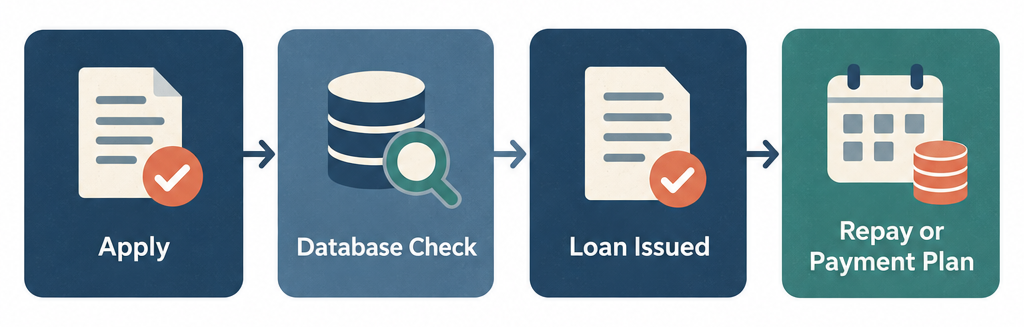
Wisconsin’s payday statute, Wis. Stat. § 138.14, defines a payday loan as a loan of 90 days or less where you give the lender a check or electronic funds transfer authorization that the lender agrees to hold before presenting it for payment. Lenders need a payday lender license from the Wisconsin Department of Financial Institutions (DFI), and the department runs a statewide database that every licensee must check before funding a loan.
The main rules you can hold a lender to:
- Size: your outstanding payday loans cannot total more than $1,500, including fees, or 35 percent of your gross monthly income, whichever is lower.
- Term: no payday loan may run longer than 90 days.
- Renewals: the lender may renew a payday loan only once. A renewal means paying only the fees and rolling the principal forward.
- Repayment plan: if you cannot pay at the end of the term (or the renewed term), § 138.14(11g) requires the lender to offer you a plan of four equal installments timed to your paydays, with no extra fees.
- Cooling-off period: after you pay a loan in full, the lender must wait 24 hours before giving you a new one.
- After maturity: interest on an unpaid balance is capped at 2.75 percent per month.
- Cancellation: you may rescind the loan, returning the money, before the close of business on the next business day.
What is missing is a price cap. Wisconsin is one of the few states where the fee itself is set by the market. In DFI’s annual reports on payday lending, average APRs have run in the hundreds of percent. Bills introduced in recent legislative sessions would have capped payday loans at 36 percent and broadened the definition to catch loans structured to dodge § 138.14. None had passed as of October 2026, so the statute described here is still the law.
What a Wisconsin payday loan costs
Because there is no cap, this is an illustration using a fee lenders commonly charge, not a legal limit.
| Loan | Fee | Term | Total repaid | APR |
|---|---|---|---|---|
| $500 | $75 ($15 per $100) | 14 days | $575 | 391% |
| $500, renewed once | $75 + $75 | 28 days | $650 | 391% |
| $500 on the 4-installment plan after renewal | no new fees | 4 paydays | $650 ($125 × 4 plus $150 already paid) | n/a |
The APR math: $75 is 15 percent of $500 for 14 days. There are about 26 fourteen-day periods in a year, and 15 percent × 26 = 391 percent. A payday loan also gives the lender direct access to your bank account, which is why a bounced debit can stack bank overdraft fees on top of the loan fee.
Car title loans in Wisconsin
Title loans are legal under Wis. Stat. § 138.16, which the legislature restored in 2011 after a partial veto had briefly banned them. A title lender must hold a licensed-lender license under § 138.09. The loan cannot exceed 50 percent of the vehicle’s retail value, and the term cannot exceed six months. You may rescind by the close of the next business day by returning the money.
If you default, the lender must send you written notice and give you at least 20 days to catch up before repossessing the car. If the car is sold, the lender must return any surplus to you and cannot collect a deficiency. There is no rate cap, so a lender charging 25 percent per month on a $1,000 loan, a common title-loan price, collects $250 for one month: $1,250 total at a 300 percent APR.
Installment and personal loans in Wisconsin
Wisconsin’s general usury statute, § 138.05, sets a 12 percent annual ceiling, but it exempts banks, credit unions, savings institutions and lenders licensed under § 138.09. Licensed lenders may charge whatever rate the contract states. In practice there is no installment loan cap in Wisconsin, and triple-digit APRs on installment loans are legal if disclosed.
What does apply is the Wisconsin Consumer Act, Wis. Stat. chs. 421 to 427, which covers consumer credit of $25,000 or less. It limits late fees, requires a notice of right to cure before a lender can sue or repossess, and lets you recover damages when a lender violates it.
| Installment loan | APR | Term | Monthly payment | Total repaid |
|---|---|---|---|---|
| $2,000 | 150% | 12 months | about $330 | about $3,965 |
| $2,000 | 28% (credit union PAL) | 12 months | about $194 | about $2,325 |
“Installment loans Wisconsin no credit check” and “direct lender installment loans Wisconsin” are marketing phrases, not legal categories. Licensed lenders usually run a soft inquiry or check alternative data, and they price the missing credit check into the rate. If an ad promises guaranteed approval, that is a red flag, not a feature.
Online and tribal lenders
Any lender making payday loans to Wisconsin residents, including online lenders, needs the same DFI license. Loans made without one violate § 138.14, and DFI has published consumer alerts about unlicensed online and tribal lenders. Tribal lenders claim sovereign immunity from state law, and DFI’s practical reach over them is limited, which is why the safest step is to confirm a license before you sign.
How to check a lender
- Search the lender’s name in DFI’s licensee lookup on wdfi.org.
- Cross-check the company in NMLS Consumer Access.
- Compare the APR on the contract with the Truth in Lending disclosure box.
- Refuse any lender that asks for a fee before funding or will not name its license number.
Debt collection and wage garnishment limits
The Wisconsin Consumer Act’s collection chapter, Wis. Stat. § 427.104, applies to original creditors as well as collection agencies. It bars threats of violence or arrest, calls at unusual hours, contacting your employer except to verify employment, and claiming legal rights the collector does not have. Collection agencies must also be licensed by DFI under § 218.04. Debt settlement and debt adjustment companies need an adjustment service company license under § 218.02, so a “Wisconsin debt relief” firm without one is operating illegally.
On garnishment, Wis. Stat. § 812.34 exempts 80 percent of your disposable earnings, so a judgment creditor can take at most 20 percent. If your household income is below the federal poverty line, or you receive need-based public assistance, your wages are fully exempt. A creditor needs a court judgment first; the statute of limitations on a written contract is six years under § 893.43. If a lender or collector gets it wrong, our page on “financial dispute resolution” walks through your options.
Help that costs less
Cheaper options first
Credit union payday alternative loans: $200 to $2,000 at no more than 28% APR under NCUA rules.
Wisconsin Home Energy Assistance Program (WHEAP), FoodShare and BadgerCare Plus free up cash for bills.
Emergency Assistance through Wisconsin Works (W-2) for families facing eviction or utility shutoff.
Dial 211 Wisconsin to find county assistance and nonprofit credit counseling. Many Wisconsin employers and some cash advance apps offer small advances at no fee, and a written hardship plan from your utility or landlord costs nothing.
Federal rules that apply everywhere
The Truth in Lending Act and Regulation Z (12 CFR 1026) require every lender to disclose the APR and finance charge before you sign. The Military Lending Act caps the total cost at a 36 percent Military APR for active-duty service members and their dependents. The Fair Debt Collection Practices Act covers third-party collectors nationwide, and the Fair Credit Reporting Act gives you the right to dispute errors.
How to file a complaint
Complain first to DFI’s Bureau of Consumer Affairs through wdfi.org, which licenses payday lenders, licensed lenders and collection agencies. You can file the same complaint with the Consumer Financial Protection Bureau’s complaint portal, and report outright fraud to the FTC at ReportFraud.
Before you borrow
Wisconsin caps how much you can borrow, not what it costs. A $500 payday loan renewed once can cost $150 in fees in four weeks, and the lender can debit your bank account directly.
FAQ
Is there a cap on payday loan interest in Wisconsin?
No. Wis. Stat. § 138.14 caps the loan size at $1,500 or 35 percent of gross monthly income and the term at 90 days, but sets no limit on fees. Only after the loan matures is interest capped at 2.75 percent per month.
How many payday loans can I have at once in Wisconsin?
As many as fit under the combined $1,500 or 35 percent-of-income ceiling. DFI’s database lets lenders see your outstanding loans and blocks any loan that would push you over.
Can a Wisconsin payday lender have me arrested for a bounced check?
No. Failing to repay is a civil debt. Threatening arrest or criminal charges violates Wis. Stat. § 427.104, and the lender’s remedy is a lawsuit, then garnishment of up to 20 percent of disposable earnings.
Are title loans legal in Wisconsin?
Yes, under § 138.16, limited to 50 percent of the vehicle’s retail value and six months. The lender must give 20 days’ notice before repossession and cannot sue you for a deficiency after selling the car.
Does Wisconsin law protect me from an online lender in another state?
If the lender has a DFI license, yes. If it does not, the loan violates § 138.14, but collecting damages from an out-of-state or tribal lender can be difficult. Compare how neighbors handle this under “missouri payday loan laws“, where the structure is similar but caps differ.
Laws and regulations referenced
- Truth in Lending Act, 15 U.S.C. 1601
- Regulation Z, 12 CFR Part 1026
- Fair Debt Collection Practices Act, 15 U.S.C. 1692
- Fair Credit Reporting Act, 15 U.S.C. 1681
- Military Lending Act, 10 U.S.C. 987
Links go to the official text on government sites.
Check, verify or complain
Sources
- dfi.wi.gov › Pages › ConsumerServices › WisconsinConsumerAct › WhatIsWCA dfi.wi.gov · primary source
- docs.legis.wisconsin.gov › 2017 › statutes › statutes › 138 › 14 › 12 › e docs.legis.wisconsin.gov · primary source
- dfi.wi.gov › Pages › FinancialServices › LicensedFinancial › PaydayLender dfi.wi.gov · primary source
- docs.legis.wisconsin.gov › misc › lc › issue briefs › 2024 › consumer protection › ib wisconsin consumer a… docs.legis.wisconsin.gov · primary source
- lendingtree.com › personal › payday alternative loan lendingtree.com
- paydayloaninfo.org › states › wisconsin paydayloaninfo.org
- ustatesloans.org › law › wi ustatesloans.org

Elena writes about getting through a money emergency, assistance programs, budgeting on a tight income, banking basics and borrower rights. Her guides list the cheaper options first and link the agency or program that can actually help.

Ruth is US Financer's standards editor. Every article goes through her checks before and after it is published: each rate, fee, cap, deadline and rule is matched against its primary source, every law named is linked to its official text, and anything that cannot be…
Comments are closed