

General information, not legal advice. Laws change, so confirm with the official statute, your state regulator or a licensed attorney before you act.
Payday loans are legal in Florida, but only from lenders licensed by the Florida Office of Financial Regulation (OFR) under the Deferred Presentment Act, Part IV of Chapter 560, Florida Statutes. As of November 2026, a single-payment payday loan is capped at $500. The fee cannot exceed 10% of the amount advanced plus a verification fee of up to $5, and you may hold only one such loan at a time anywhere in the state. This page also covers car title loans, installment loans, online and tribal lenders, debt collection limits and where to complain.
Run the numbers
Your money, in brief
- A Florida payday loan tops out at $500 and a 10% fee, about 287% APR on a 14-day loan.
- Rollovers are banned and a statewide database limits you to one open payday loan at a time.
- If you can’t repay, you can get a 60-day grace period with no added fees by going to credit counseling.
- Consumer finance loans can now charge up to 36% on the first $10,000, raised from 30% on July 1, 2024.
- If a head of family earns $750 or less a week in disposable pay, a judgment creditor cannot garnish those wages.
Payday and short-term loans in Florida
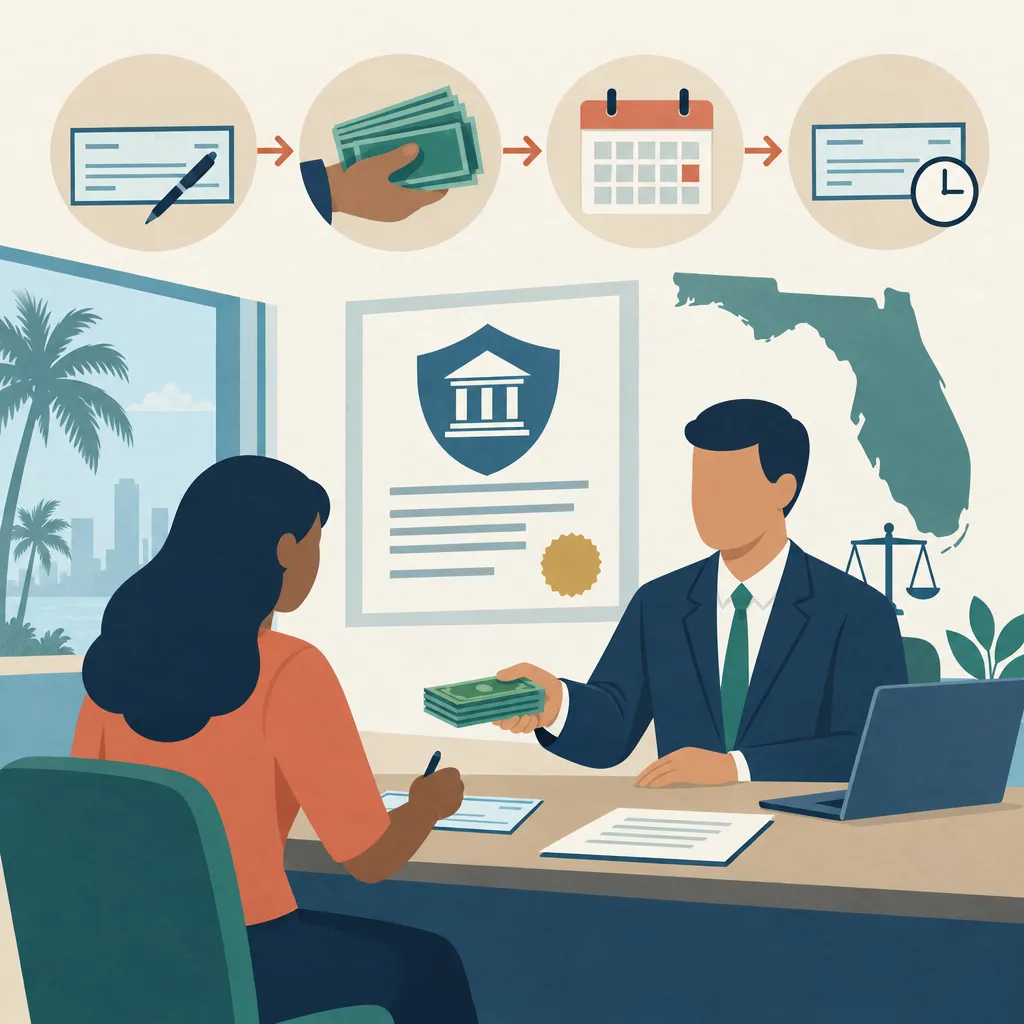
Florida’s statutes never use the words “payday loan.” The legal name is a deferred presentment transaction. You write a check or authorize an electronic debit, the lender gives you cash now, and it agrees to hold the check until a later date. Every company offering this product must hold a money services business license under Chapter 560 and must declare its deferred presentment activity to OFR under s. 560.403, F.S. Lending without that license is a crime under Chapter 560, and OFR keeps a public list of licensees. Every Florida statute cited on this page is published on the Florida Legislature’s official code site, Online Sunshine (leg.state.fl.us).
Since July 1, 2019, Florida has allowed two payday products, both governed by s. 560.404, F.S. The first is the traditional single-payment loan. The second came from Chapter 2018-26, Laws of Florida (2018’s SB 920, signed by Governor Rick Scott). It is a deferred presentment installment transaction that can be larger and run longer. Our guide to the payday loan explains the product in general. The table below sets out how Florida’s two versions differ.
| Rule | Single-payment deferred presentment | Deferred presentment installment |
|---|---|---|
| Statute | s. 560.404, F.S. | s. 560.404, F.S. (added 2018, effective 2019) |
| Maximum amount | $500, excluding fees | $1,000, excluding fees |
| Term | 7 to 31 days | 60 to 90 days |
| Fee cap | 10% of the amount advanced | 8% of the outstanding balance every two weeks |
| Verification fee | Up to $5 | Up to $5 |
| Rollovers | Prohibited | Prohibited |
| Loans at once | One, statewide | One, statewide |
| Cooling-off | 24 hours after paying off | 24 hours after paying off |
| Prepayment penalty | None allowed | None allowed |
What the fee cap means in dollars
On a 14-day loan, a 10% fee works out to an APR of nearly 287%. The Truth in Lending Act and Regulation Z (12 CFR 1026) require the lender to give you that APR in writing before you sign. The examples below use the maximum fee plus the $5 verification fee. To get the APR, divide the total charge by the amount borrowed, then multiply by the number of loan periods in a year (365 ÷ days in the term).
| Loan | Fee | Term | Total repaid | APR (plain math) |
|---|---|---|---|---|
| $500 single-payment | $50 + $5 verification = $55 | 14 days | $555 | $55 ÷ $500 = 11%; 11% × (365 ÷ 14 = 26.07) ≈ 287% |
| $500 single-payment | $50 + $5 verification = $55 | 31 days | $555 | 11% × (365 ÷ 31 = 11.77) ≈ 130% |
| $300 single-payment | $30 + $5 verification = $35 | 14 days | $335 | $35 ÷ $300 = 11.67%; 11.67% × 26.07 ≈ 304% |
| $1,000 installment | $297.89 in biweekly fees + $5 verification = $302.89 | 6 biweekly payments (84 days) | $1,302.89 | 8% per two weeks × 26 periods = 208% before the $5 fee |
How the installment row works: the statute charges 8% on whatever balance is still unpaid every two weeks. With six roughly equal payments, five are $216.32 and the last is $216.29, which comes to $1,297.89. The biweekly fees are $80.00, $69.09, $57.32, $44.60, $30.86 and $16.02, for a total of $297.89. Add the $5 verification fee and you repay $1,302.89 in total.
Short single-payment loans carry the highest APR because the same flat fee is spread over fewer days. Our payday loan calculator runs the same math on other amounts and terms.
Rollovers, the database and the 24-hour rule
Florida bans rollovers outright. A licensed provider cannot renew, extend or refinance a deferred presentment loan, and it cannot take a new check to pay off an old one. To enforce this, s. 560.404 requires every provider to check a statewide database run for OFR before each transaction. The database shows whether you already have an open deferred presentment loan with any Florida lender, single-payment or installment. If you do, the provider must turn you down.
Once you pay off a loan, the database also blocks any new loan for 24 hours. The Center for Responsible Lending has long argued, based on OFR database data, that this gap is too short. Its analyses found that most Florida payday loans go to people who take seven or more a year. The Legislature has not lengthened the cooling-off period, and no bill to do so passed in the 2025 or 2026 sessions.
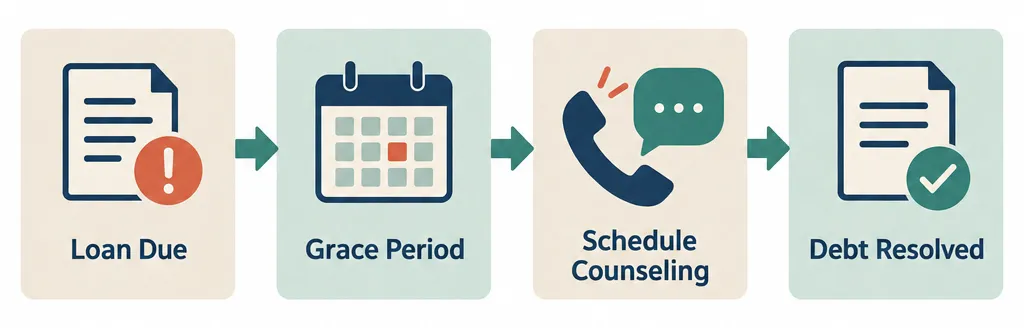
The 60-day grace period you can claim
Section 560.404 gives you a right most states don’t. If you can’t redeem your check when the loan is due, the provider must give you a 60-day grace period with no extra charges. There are two conditions:
- You make an appointment with a consumer credit counseling agency within 7 days after the loan’s end date.
- You finish the counseling within the 60 days.
While you meet those conditions, the provider cannot deposit your check, charge a fee or pursue collection. The statute requires the lender to give you written notice of the grace period, so ask for it.
Criminal threats and bounced checks
A payday debt in Florida is a civil debt, not a crime. The deferred presentment statute bars a provider from using your check as the basis for a worthless-check prosecution and from threatening criminal action over an unpaid loan. If someone says the sheriff will arrest you over a payday loan, it is either a rogue lender or, much more often, a scammer. The complaints section below covers this scam.
Same-day loans and “bad credit” offers
Licensed storefront lenders often fund single-payment loans the same day, and licensed online lenders usually send the money by ACH the next business day. Speed doesn’t change the rules: the $500 or $1,000 cap, the fee cap and the database check apply to every licensed deferred presentment loan. Chapter 560 doesn’t require a credit score, and most providers look at your income and the state database rather than a full credit report.
Car title loans in Florida
Title lending is governed by the Florida Title Loan Act, Chapter 537, Florida Statutes, passed in 2000. The Act caps interest at 30% a year on the first $2,000, which is tight enough that Florida’s licensed title loan industry is small next to Georgia, Alabama or Texas.
| Rule | Florida Title Loan Act requirement | Citation |
|---|---|---|
| Who may lend | Only a title loan lender licensed by OFR | s. 537.004, F.S. |
| Interest cap | 30% per year on the first $2,000; 24% on $2,000.01 to $3,000; 18% above $3,000; simple interest only | s. 537.011, F.S. |
| Term | 30 days, extendable in 30-day periods by written agreement | s. 537.011, F.S. |
| Possession | You keep driving the car; the lender holds the title | Chapter 537 generally |
| Repossession and sale | Written notice before sale, right to redeem, surplus returned to you | s. 537.012, F.S. |
| Loan | Annual rate | Term | Interest (plain math) | Total repaid |
|---|---|---|---|---|
| $1,000 title loan | 30% | 30 days | $1,000 × 0.30 × 30 ÷ 365 = $24.66 | $1,024.66 |
That is the most interest a licensed Florida title lender can lawfully charge on that loan. Some storefronts quote $250 a month on a $1,000 title loan, which is common in states with no cap. In Florida, that quote means the lender is unlicensed or the loan is not a Chapter 537 title loan. Interest above what Chapter 537 allows is prohibited.
Why many Florida “title loans” are something else
A lender can make a consumer finance loan under Chapter 516 instead and take your car title as collateral. That is legal if the lender holds a Chapter 516 license. The loan then follows Chapter 516’s higher interest tiers, not Chapter 537’s. Read the heading on the contract. If it says “consumer finance loan” or “installment loan secured by motor vehicle,” the title loan protections in s. 537.012 don’t apply. In that case, the lender’s default and repossession rights come from the Uniform Commercial Code as adopted in Chapter 679, Florida Statutes.
Neither product requires a court order to repossess your car, but the lender cannot “breach the peace.” Breaking into a locked garage, threatening you or lying about having legal authority all count, and they can make the lender liable. After a repossession, you are entitled to written notice of the sale and to any money the sale brings in above what you owe plus reasonable costs. Personal property left in the car is still yours.
Installment and personal loans in Florida
Larger or longer loans are governed by the Florida Consumer Finance Act, Chapter 516, Florida Statutes. It covers loans of $25,000 or less from nonbank lenders that charge more than 18% a year, from storefront finance companies to most online installment lenders that serve Florida. Banks and credit unions operate under their own charters and are not Chapter 516 licensees. Our guide to the installment loan explains how these loans are structured.
Section 516.031, F.S., sets tiered maximum rates. Until mid-2024, the caps were 30% a year on the first $3,000 of principal, 24% on the part between $3,000 and $4,000, and 18% above $4,000. CS/HB 1347 (Chapter 2024-276, Laws of Florida) was signed by Governor Ron DeSantis in June 2024 and took effect July 1, 2024. It raised the tiers to:
- 36% a year on the first $10,000 of principal
- 30% on the part between $10,000 and $20,000
- 24% on the part between $20,000 and $25,000
As of November 2026, those are the tiers in the current statute. They must be charged as simple interest, never add-on interest.
Other Chapter 516 rules that matter to you:
- A lender may charge a delinquency fee on a payment only if it is at least 12 days late. The 2024 law raised this from 10 days.
- Interest is charged on the unpaid principal balance, not added up front, and you can prepay at any time without penalty.
- Each location must be licensed by OFR. Since the 2024 law, a lender cannot open a branch before it is licensed.
- Under s. 516.02, F.S., a loan made in willful violation of the licensing requirement is void. The lender then has no right to collect principal, interest or charges.
- Credit insurance may be offered but cannot be a condition of the loan.
| Loan | Rate | Term | Monthly payment | Total repaid | Interest |
|---|---|---|---|---|---|
| $2,000 consumer finance loan | 36% (current first-tier cap) | 12 months | $200.92 | $2,411.04 | $411.04 |
| $2,000 consumer finance loan | 30% (pre-July 2024 cap) | 12 months | $194.97 | $2,339.64 | $339.64 |
| $5,000 consumer finance loan | 36% | 24 months | $295.24 | $7,085.76 | $2,085.76 |
The math: at 36%, the monthly rate is 3% (36 ÷ 12). Each payment covers that month’s 3% interest on the remaining balance plus some principal, and the payments are sized so the balance reaches zero on time. Twelve payments of $200.92 come to $2,411.04. On the 2024 change alone, the same $2,000 loan now costs up to $71.40 more.
The 36% figure matches the Military Lending Act ceiling. Most consumer groups treat it as the upper limit for affordable small-dollar credit, but it is still expensive: on the $5,000 example, more than $2,000 of your payments go to interest.
Installment loans for bad credit in Florida
In Florida, Chapter 516 lenders are the main source of installment loans for people with credit scores below 600. They usually report to at least one credit bureau, which payday lenders generally don’t. Subprime borrowers are typically priced at or near the 36% cap, not at the single-digit rates banks advertise.
Loans that fall outside Chapter 516 and other specific lending laws are generally subject to Florida’s usury law in Chapter 687. Section 687.02, F.S., caps simple interest at 18% a year, and s. 687.071, F.S., makes knowingly charging more than 25% criminal usury. Our article on usury laws explains how those two statutes interact with exemptions for licensed lenders.
Online and tribal lenders
Florida law applies to any lender that lends to Florida residents, wherever its servers or offices are. An online lender offering deferred presentment loans needs the same Chapter 560 license as a storefront, and an online installment lender needs a Chapter 516 license. OFR has said so repeatedly in consumer alerts and has issued cease-and-desist orders against unlicensed online lenders. The 2024 consumer finance law also added tools against unlicensed online lending.
Tribal lenders cause the most confusion. A lender owned by a federally recognized tribe will claim sovereign immunity from Florida law and often quotes APRs of 400% or more, far above anything a Florida licensee could charge. Courts have split on whether that immunity covers loans to consumers off tribal land. The Consumer Financial Protection Bureau and several state attorneys general have sued tribal lending operations.
In practice, OFR cannot license, examine or easily discipline a tribal lender, so a public warning may be all it can do. Federal law still applies, though:
- The Truth in Lending Act requires an APR disclosure.
- The Electronic Fund Transfer Act and Regulation E (12 CFR 1005) bar a lender from making automatic electronic repayment a condition of the loan.
- The Military Lending Act caps the rate at 36% for covered service members.
How to check a lender's Florida license
- Open the license search on the Florida Office of Financial Regulation’s website, flofr.gov, and search by company name.
- Confirm the license type: money services business with deferred presentment for payday loans, consumer finance for installment loans, title loan lender for Chapter 537 loans.
- Check that the licensed name matches your contract and that the license is active, not surrendered or revoked.
- If the lender says it is a bank, search the FDIC’s BankFind; for a credit union, use the NCUA’s Credit Union Locator.
- Search the CFPB’s public complaint database for the company name to see what other borrowers have reported.
If a lender isn’t in OFR’s search and isn’t a chartered bank or credit union, treat everything it promises as unenforceable and probably illegal. Its loans also won’t show up in Florida’s deferred presentment database, so it can’t see your other loans and may pile a fourth or fifth loan on top of them.
Debt collection and wage garnishment limits in Florida
Florida gives you two layers of protection against abusive debt collectors. The federal Fair Debt Collection Practices Act covers third-party collectors and debt buyers. Florida’s own Consumer Collection Practices Act (FCCPA), ss. 559.55 to 559.785, Florida Statutes, goes further: it also covers original creditors, including the payday lender, title lender or finance company that made your loan.
What collectors in Florida cannot do
Section 559.72, F.S., lists the banned practices. Anyone collecting a consumer debt in Florida may not:
- Contact you between 9 p.m. and 8 a.m. your time without your prior consent.
- Talk to your employer about the debt before getting a judgment, except to verify employment.
- Contact you directly once they know a lawyer represents you on the debt.
- Threaten force, violence, arrest or criminal prosecution, or pretend to be a lawyer or government agent.
- Fake legal papers, use profane language, or tell the debt to anyone without a legitimate business need to know.
- Try to collect a debt they know is not legitimate, or claim a legal right they know doesn’t exist.
A collector that breaks s. 559.72 is liable under s. 559.77, F.S., for your actual damages, statutory damages of up to $1,000, punitive damages where warranted, and your attorney’s fees. You have two years to sue. Separately, every consumer collection agency working in Florida must register with OFR under s. 559.553, F.S., and you can look up a registration the same way you look up a lender.
Statute of limitations on loan debt
A creditor has five years from the breach to sue on a written contract under s. 95.11(2)(b), F.S., and that covers nearly every loan agreement. An oral contract or open account gets four years under s. 95.11(3). A judgment, once won, can be enforced for 20 years.
The limitations period is a defense you have to raise in court. A collector can still call, write and ask for payment on a time-barred debt, but it cannot sue or threaten to sue. A payment or a written acknowledgment of the debt can restart the clock, so get advice before paying anything on an old account.
Wage garnishment limits
A creditor needs a court judgment before it can garnish your wages in Florida. For anyone who supports a dependent, the exemptions in s. 222.11, F.S., are among the most generous in the country.
| Your status | Disposable earnings | What a judgment creditor can take |
|---|---|---|
| Head of family | $750 per week or less | Nothing |
| Head of family | More than $750 per week | Nothing, unless you agreed to garnishment in writing; then the federal limit applies |
| Not head of family | Any amount | Federal limit under 15 U.S.C. 1673: the lesser of 25% of disposable earnings or the amount above 30 times the federal minimum wage (30 × $7.25 = $217.50 per week) |
You count as head of family if you provide more than half the support for a child or other dependent. Under s. 222.11(3), the exemption also covers those wages for six months after they are deposited in your bank account, as long as you can trace them.
To use the exemption, you must file a claim of exemption with the court by the deadline on the garnishment notice, usually 20 days, so never ignore court papers. Social Security, SSI, veterans’ benefits and most public assistance are exempt under federal law whatever your family status. Under 31 CFR Part 212, banks must automatically protect two months of directly deposited federal benefits.
Article X, Section 4 of the Florida Constitution also protects your primary home from most judgment creditors, with no dollar limit (there are acreage limits). This homestead protection is a big reason unsecured lenders in Florida push hard for voluntary payment plans rather than lawsuits.
Federal rules that apply everywhere
Federal laws sit on top of every Florida rule above:
- Truth in Lending Act and Regulation Z (12 CFR 1026): before you sign any payday, title or installment loan, the lender must disclose in writing the APR, finance charge, amount financed and total of payments.
- Military Lending Act (10 U.S.C. 987, implemented at 32 CFR Part 232): caps the Military Annual Percentage Rate at 36% for active-duty service members and their dependents, bans mandatory arbitration and bans using a vehicle title as security. In practice, that rules out standard payday and title loans for this group.
- Fair Debt Collection Practices Act (15 U.S.C. 1692 and following): governs third-party collectors and debt buyers. The CFPB’s Regulation F (12 CFR 1006) limits them to seven call attempts in seven days per debt and requires a validation notice.
- Fair Credit Reporting Act: gives you the right to dispute any inaccurate loan or collection account on your credit report.
Help that costs less
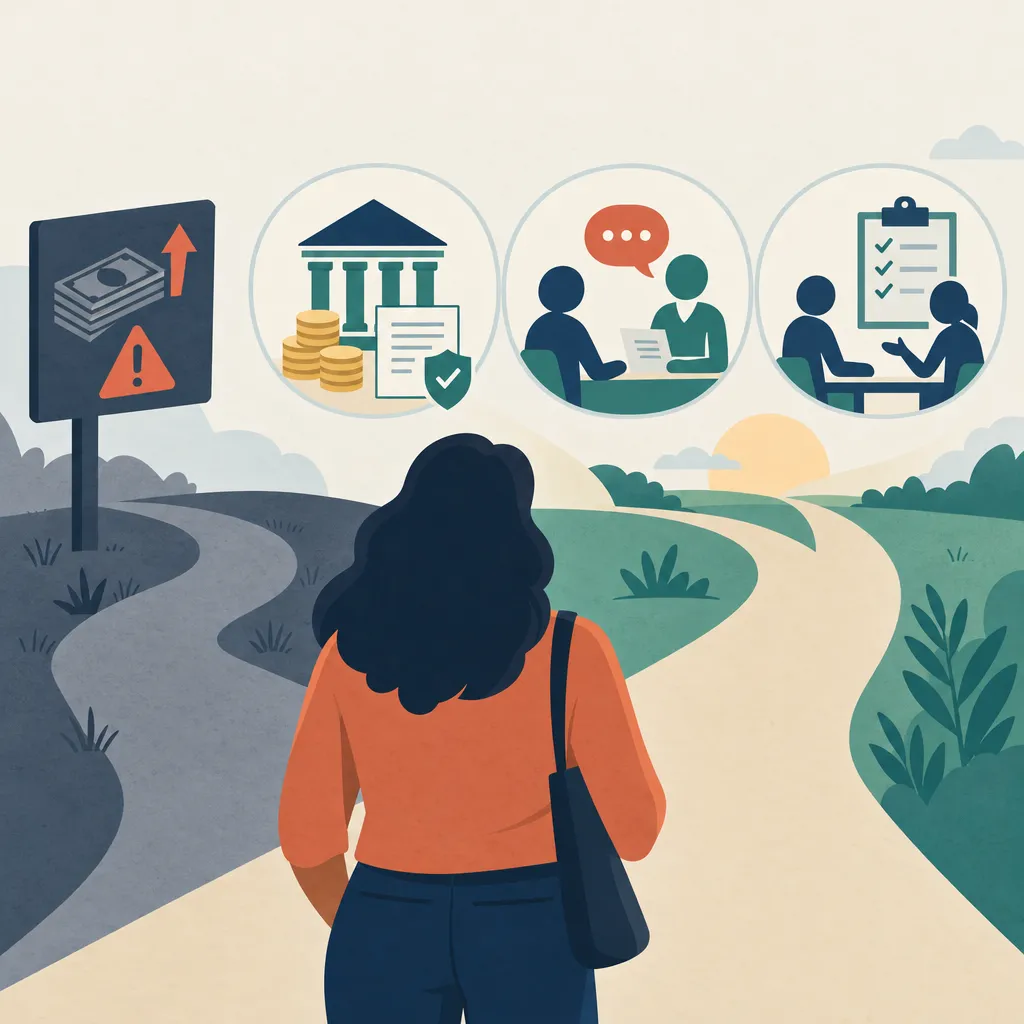
Every product above costs more than the options in this section. Florida’s rules make payday loans less dangerous than in Texas or Missouri, but a 287% APR is still a last resort.
Cheaper options first
Federal credit union payday alternative loans are capped at 28% APR under NCUA rules. Hardship plans from the companies you owe, and nonprofit credit counseling, cost little or nothing. Florida’s Temporary Cash Assistance, LIHEAP and 2-1-1 referrals are free if you qualify.
Credit union payday alternative loans
Federal credit unions can offer Payday Alternative Loans under NCUA regulation 12 CFR 701.21(c)(7):
- PAL I: $200 to $1,000 for one to six months, after at least one month of membership.
- PAL II: up to $2,000 for one to twelve months, with no waiting period.
Both are capped at 28% APR, with an application fee of no more than $20 and no rollovers. Florida has many community-chartered credit unions open to anyone who lives or works in a given county or region.
| Loan | Rate and fee | Term | Payments | Total repaid |
|---|---|---|---|---|
| $500 PAL | 28% APR + $20 application fee | 3 months | 3 × $174.51 = $523.53, plus $20 fee | $543.53 |
| $500 payday loan | 10% fee + $5 verification | 14 days | 1 × $555 | $555 |
The PAL costs $43.53 for three months, compared with $55 for two weeks of a payday loan, and you get six times as long to repay.
Employer and app advances
In Florida, earned wage access apps and employer advance programs are not regulated as loans under Chapter 560. As of November 2026, Florida has no earned wage access law. The 2025 bills that would have required providers to register (SB 422 and HB 1391) died in committee in June 2025. A federal earned wage access bill advanced in the U.S. House Financial Services Committee in 2026 but is not law.
Many apps charge nothing for standard delivery and ask for an optional tip. On a small advance, though, instant-delivery fees and tips can add up to a triple-digit APR, so skip both if you can wait a day or two. Your employer’s payroll department may also offer a free one-time advance against hours you have already worked.
Nonprofit credit counseling and debt management
If you’re facing a pile of existing debts rather than a one-time shortfall, a nonprofit credit counseling agency can set up a debt management plan. It combines your unsecured payments into one and often lowers the interest rates. Florida regulates these agencies under ss. 817.801 to 817.806, Florida Statutes, which cap their fees and set rules for handling your payments. Look for an agency accredited by the Council on Accreditation and approved by the U.S. Trustee Program.
For-profit debt settlement is a different business. The FTC’s Telemarketing Sales Rule (16 CFR 310.4(a)(5)) bars these companies from charging any fee until they settle a debt and you make a payment under the settlement. Settlement often damages your credit for years.
With Florida’s homestead and head-of-family exemptions, Chapter 7 or Chapter 13 bankruptcy can cost less than years of settlement fees. A consultation with a Florida bankruptcy attorney or with Legal Services of Florida is usually free.
Florida financial assistance programs that exist
These programs are run by Florida agencies or their local partners. None of them charge fees or require a credit check.
| Program | What it provides | Who runs it |
|---|---|---|
| Temporary Cash Assistance (TCA) | Monthly cash for low-income families with children, time-limited | Florida Department of Children and Families, through ACCESS Florida |
| SNAP (food assistance) | Monthly grocery benefits on an EBT card | Florida Department of Children and Families, through ACCESS Florida |
| LIHEAP | Help with electric and gas bills, including crisis help after a disconnection notice | Florida Department of Commerce, through local community action agencies |
| EHEAP | Energy bill help for households with a member aged 60 or older | Florida Department of Elder Affairs, through Area Agencies on Aging |
| Weatherization Assistance Program | Free energy-efficiency repairs to cut utility bills | Florida Department of Commerce, through local agencies |
| Florida KidCare and Medicaid | Low-cost or free health coverage for children and eligible adults | Florida Healthy Kids Corporation and the Agency for Health Care Administration |
| 2-1-1 | Referrals to local help with rent, utilities, food and prescriptions | Regional 2-1-1 providers, by phone or text |
County governments also run emergency assistance offices, such as Miami-Dade Community Action and Human Services, Hillsborough County Social Services and Orange County Family Services. They can pay a one-time rent or utility bill for residents facing eviction or shutoff, funded partly by federal Community Services Block Grant money. FPL, Duke Energy Florida and TECO run bill assistance funds with charities such as the Salvation Army and Catholic Charities. Calling 2-1-1 is the fastest way to find what’s open in your county.
How to check a lender and file a complaint
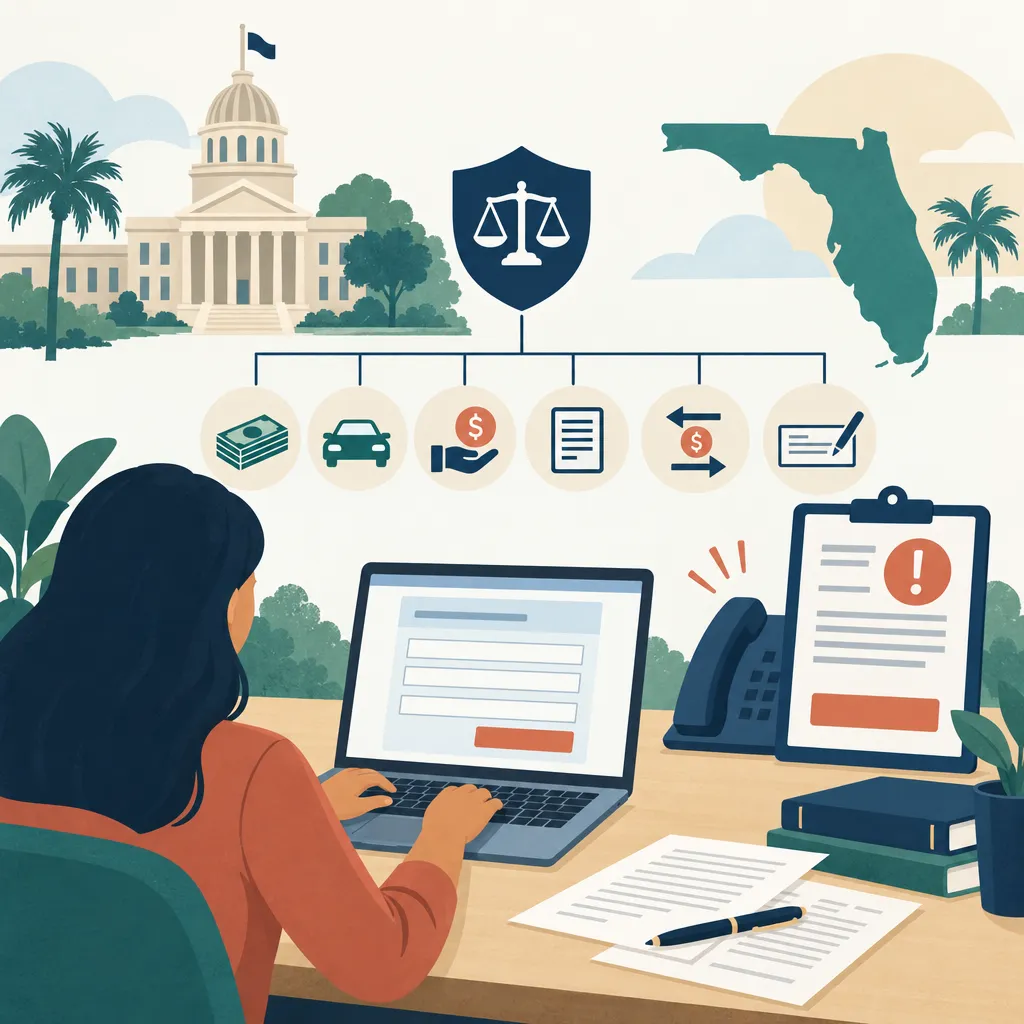
The Florida Office of Financial Regulation in Tallahassee licenses payday lenders, title lenders, consumer finance companies, collection agencies, money transmitters and check cashers. Its official website is flofr.gov, and its Division of Consumer Finance handles licensing and exams. OFR’s consumer line is (850) 487-9687.
You can file a complaint online through OFR’s Online Services (you’ll need to register) or by mailing its paper form. Collection agency complaints use a separate form. Under Florida’s public records law, what you send OFR may be made public. OFR can investigate licensees and unlicensed lenders, revoke licenses and refer criminal cases to prosecutors. It cannot represent you in a lawsuit or order a refund in a private dispute.
For federal help, file with the Consumer Financial Protection Bureau at consumerfinance.gov/complaint or call (855) 411-2372. The CFPB sends your complaint to the company, which generally must respond within 15 days. It then publishes the complaint, without your name, in its public database. Payday, title and installment lenders, debt collectors and credit bureaus all fall under its jurisdiction.
Other places to report:
- Deceptive advertising or scams: the Florida Attorney General’s Consumer Protection Division at 1-866-9-NO-SCAM (1-866-966-7226), and the FTC at ReportFraud.ftc.gov.
- Online lending fraud by a fake company: the FBI’s Internet Crime Complaint Center at ic3.gov.
When a complaint doesn’t settle the matter, our guide to financial dispute resolution covers arbitration, small claims court and escalating to a regulator.
Payday loan scams that target Floridians
OFR and the Florida Attorney General both warn about a scam aimed at people who once applied for a payday loan online. A caller posing as a collector, process server or “pre-litigation” officer says you owe on an old payday loan. They threaten arrest or a visit at work unless you pay right away by gift card, wire or prepaid debit card. The caller often has your Social Security number and bank details, taken from a lead-generation site you once filled out.
Red flags:
- Threats of arrest, jail or “criminal charges” over a loan. Florida law bans this even for real payday debts.
- A demand for payment by gift card, cryptocurrency, wire transfer or payment app.
- Refusal to mail you a written validation notice, which the FDCPA requires within five days of first contact.
- A company name that isn’t in OFR’s collection agency registry.
- Pressure to pay a “settlement” within the hour.
Hang up. Pull your free credit reports at AnnualCreditReport.com to check whether any such account exists, and report the call to the Attorney General and the FTC. If you really did have a loan with a licensed lender, call the lender using the number on your contract, never a number the caller gives you.
Before you borrow
A Florida payday loan at the legal maximum costs 11% of the amount borrowed for two weeks, close to 287% APR. Research on OFR’s database data shows that the 24-hour cooling-off period does little to stop chains of back-to-back loans. Try the credit union, employer and assistance options above first, and never borrow from a company you can’t find in OFR’s license search.
How Florida compares to other states
Florida sits in the middle of the national range. Its caps are real and enforced through a statewide database, which puts it ahead of Texas, where the “credit access business” model leaves fees effectively uncapped, and Missouri, which allows fees of up to 75% of principal over the life of a loan. It is far more permissive than states that cap all small loans at 36% APR, which effectively bans payday lending.
You can compare our coverage of texas payday loan laws, california payday loan laws, alabama payday loan laws, missouri payday loan laws and wisconsin payday loan laws. Among those states, Florida’s free 60-day grace period tied to credit counseling stands out, and so does its real-time statewide database.
| State | Max single-payment loan | Fee or rate cap | Database |
|---|---|---|---|
| Florida | $500 | 10% + $5 verification | Yes, statewide |
| California | $300 | 15% of face amount | No statewide database |
| Alabama | $500 | 17.5% of amount advanced | Yes, statewide |
| Missouri | $500 | Fees up to 75% of principal over the loan | No |
| Texas | No effective cap under the CAB model | No effective cap | No |
Where Florida law has changed or could change
Florida’s rules have changed several times since 2018, and one federal rule is still in doubt:
- Chapter 2018-26 (2018): created the $1,000 installment product, effective July 1, 2019. Lawmakers passed it ahead of a federal CFPB underwriting rule that was later rescinded.
- CS/HB 1347 (Chapter 2024-276): raised consumer finance rates to 36% on the first $10,000 and moved the delinquency-fee trigger to 12 days, effective July 1, 2024.
- Earned wage access (2025): registration bills SB 422 and HB 1391 died in June 2025.
- 36% APR caps: bills to cap all small loans at 36% APR have been filed in past sessions and have never made it out of committee.
At the federal level, the payment provisions of the CFPB’s Payday Lending Rule (12 CFR Part 1041) took effect March 30, 2025. They bar a lender from trying to debit your account again after two failed attempts in a row unless you give new permission. They cover Florida payday loans and short-term title loans. In 2025 the CFPB said it would not prioritize enforcing these provisions, and its 2026 regulatory agenda lists a plan to reconsider them. As of November 2026, no proposed change has been published, so the rule stays in force.
FAQ
How many payday loans can I have at once in Florida?
One. Section 560.404, F.S., limits you to a single open deferred presentment loan statewide, and licensed lenders must confirm that in the OFR database before funding. After you pay it off, you must wait 24 hours before taking another. If a lender gives you a second loan while the first is still open, it is unlicensed or breaking the law, and you can report it to OFR.
Can a payday lender in Florida garnish my wages?
Only after suing you and winning a judgment, and only within the limits of s. 222.11, F.S. If you are a head of family earning $750 or less a week in disposable pay, your wages cannot be garnished at all. Under the Florida Consumer Collection Practices Act, the lender also cannot contact your employer about the debt before a judgment.
Is it legal for a title loan company in Florida to charge 25% a month?
No. The Florida Title Loan Act caps interest at 30% a year on the first $2,000, which is 2.5% a month, with lower rates above that. A quote of 25% a month is far above both the Title Loan Act’s limits and the Chapter 516 consumer finance rate caps, so find out which license the lender holds and what type of loan it is offering. Check the license at flofr.gov and report the lender if it doesn’t appear.
What happens if I can’t pay my Florida payday loan on time?
You’re entitled to a 60-day grace period with no added fees if you book credit counseling within 7 days after the due date and finish it within the 60 days. The lender cannot threaten arrest or criminal charges over the check. If the loan goes to collections, both the FDCPA and Florida’s FCCPA limit how collectors can contact you, and the lender has five years to sue under s. 95.11.
Did Florida raise the interest rate cap on personal loans?
Yes. Since July 1, 2024, licensed consumer finance lenders can charge up to 36% a year on the first $10,000, 30% on the part from $10,000 to $20,000, and 24% from $20,000 to $25,000. Before that, the top rate was 30% on the first $3,000. Payday and title loan caps did not change.
Can I get a loan with bad credit in Florida without using a payday lender?
Yes, though the rate will still be high. Chapter 516 consumer finance companies lend to borrowers with poor credit at rates up to the statute’s tiered caps, which start at 36% on the first $10,000, and federal credit union payday alternative loans are capped at 28% APR, though each credit union sets its own approval standards. Secured credit cards, credit-builder loans and employer advances are also open to people with damaged credit and cost far less than a payday loan.
Where do I report an unlicensed online lender that gave me a loan in Florida?
Report it to the Florida Office of Financial Regulation at flofr.gov or (850) 487-9687, the CFPB at consumerfinance.gov/complaint, and the Florida Attorney General at 1-866-9-NO-SCAM. Keep copies of the loan agreement, every email and the bank statements showing the debits. Under s. 516.02, F.S., a consumer finance loan made in willful violation of the licensing rules is void, which gives you a defense if the lender or a debt collector ever sues.
Laws and regulations referenced
- Florida Statutes (2025), Chapter 560, Part IV (Deferred Presentment, ss. 560.402 to 560.408)
- Florida Statutes (2025), Chapter 516 (Consumer Finance)
- Truth in Lending Act, 15 U.S.C. 1601
- Regulation Z, 12 CFR Part 1026
- Fair Debt Collection Practices Act, 15 U.S.C. 1692
- Regulation F (debt collection), 12 CFR Part 1006
- Fair Credit Reporting Act, 15 U.S.C. 1681
- Electronic Fund Transfer Act, 15 U.S.C. 1693
- Regulation E (electronic transfers), 12 CFR Part 1005
- Military Lending Act, 10 U.S.C. 987
- Military Lending Act rule, 32 CFR Part 232
- CFPB payday lending rule, 12 CFR Part 1041
- Bankruptcy Code, Chapter 13, 11 U.S.C. 1301
Links go to the official text on government sites.
Check, verify or complain
Sources
- flsenate.gov › Session › Bill › 2024 › 1347 › Analyses › h1347z1.IBS.PDF flsenate.gov · official source
- flsenate.gov › Laws › Statutes › 2022 › Chapter687 › All flsenate.gov · official source
- wmnf.org › florida governor signs bill for higher interest rates consumer loans wmnf.org

Elena writes about getting through a money emergency, assistance programs, budgeting on a tight income, banking basics and borrower rights. Her guides list the cheaper options first and link the agency or program that can actually help.
Ruth is US Financer's standards editor. Every article goes through her checks before and after it is published: each rate, fee, cap, deadline and rule is matched against its primary source, every law named is linked to its official text, and anything that cannot be…
What changed
- Nov 24, 2026 Updated.
- Nov 13, 2026 Facts re-checked against official sources and updated; sources and links refreshed.
- Oct 16, 2026 First published.
Comments are closed