
Payday lending is legal in Tennessee. The Deferred Presentment Services Act lets licensed stores charge a fee of up to 15% of the check amount, caps the check at $500, limits the term to 31 days and bans rollovers. Most storefronts now push “flex loans” instead, which run on a different statute with a much higher effective rate, so the cap that protects you depends on which contract you sign.
Run the numbers
How payday loans really work in Tennessee
Tennessee calls payday lending “deferred presentment.” You write a post-dated personal check, the lender gives you cash for less than the face amount and agrees to hold the check until your next payday. The rules live in Title 45, Chapter 17 of the Tennessee Code, the Deferred Presentment Services Act, and the lender must hold a license from the Tennessee Department of Financial Institutions under Tenn. Code Ann. § 45-17-103.
The fee and how it turns into an APR
Under Tenn. Code Ann. § 45-17-112, a licensee may charge a fee of no more than 15% of the face amount of the check. Note that the percentage applies to the check, not to the cash you walk out with. If the check is $500, the fee is $75 and you receive $425.
That matters for the math. Paying $75 to use $425 for two weeks works out to about 17.6% for the period. Multiply by the 26 two-week periods in a year and the annual percentage rate lands near 460%. Stretch the same loan to the full 31 days allowed and the APR is still roughly 208%. The lender has to print the APR on your contract because the Truth in Lending Act and Regulation Z (12 CFR 1026) apply to every closed-end consumer loan in the country.
| Check amount | Fee (15% of check) | Cash you receive | Term | APR (approx.) | Total you repay |
|---|---|---|---|---|---|
| $300 | $45 | $255 | 14 days | 460% | $300 |
| $500 | $75 | $425 | 14 days | 460% | $500 |
| $500 | $75 | $425 | 31 days | 208% | $500 |
Size, term and how many loans you can hold
The same section caps the face amount of a single check at $500. A licensee may hold no more than two checks from one customer at a time, and the combined face value of those checks cannot exceed $500. So the real ceiling at any one store is $500 in checks, which means at most $425 in your pocket.
The term is capped at 31 days. There is no statutory minimum, so a lender can set the due date on your very next payday even if that is four days away.
Rollovers are banned, but there is no database
Tennessee does not allow a licensee to renew, roll over or extend a deferred presentment agreement. The law expects you to pay the check off in full and then, if you want, open a brand-new transaction. In practice that is a “back-to-back” loan and it costs another full fee.
Unlike Florida or Alabama, Tennessee has never set up a statewide real-time database to track how many payday loans a person has open. The two-check, $500 limit is written as a restriction on what one licensee may hold. Nothing in the system automatically stops you from walking across the parking lot and borrowing from a second store, which is how borrowers end up juggling several checks at once. If you want to see how a database state handles this, our piece on “florida payday loan laws” explains the 24-hour cooling-off rule there.
What happens when the check bounces
If the lender deposits your check and it is returned, the debt becomes a plain civil debt. The Act limits a licensee’s use of the criminal bad-check process: the fact that your check bounced because the money was not there is not, by itself, grounds to have you charged. Criminal exposure is reserved for situations like writing the check on an account you had already closed or stopping payment to avoid repaying. Any threat of jail for an ordinary bounced payday check is a red flag you should report, which we cover below.
Flex loans: the product that replaced the payday loan
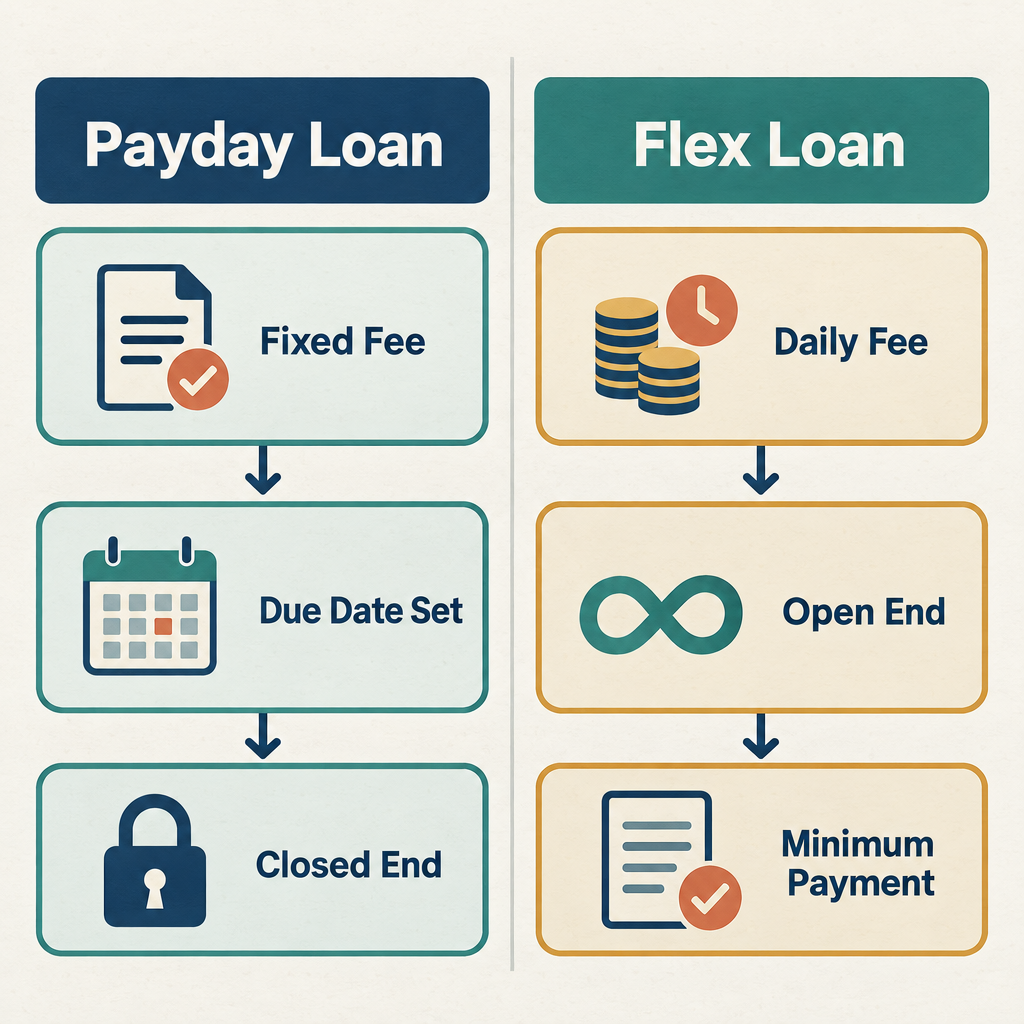
Walk into most Tennessee storefronts today and you will be offered a “flex loan,” not a payday loan. These are open-end lines of credit authorized by the Tennessee Flexible Credit Act, Title 45, Chapter 12 of the Tennessee Code, which the legislature passed in 2014. The Act allows credit lines up to $4,000, eight times the payday cap, and the pricing is built in two layers.
The first layer is interest, capped at 24% per year. The second is a daily “customary fee” of up to 0.7% of the outstanding principal. That fee is where the cost hides. Seven-tenths of a percent a day is about 255% a year on its own, so the combined annualized rate on a flex loan runs close to 280%. Because the account is open-end, you can pay the minimum each period for as long as you like while the principal barely moves.
Flex loan vs payday loan: cost breakdown
Here is what $1,000 of borrowing looks like across the three main options a Tennessean can reach. The flex loan assumes you make minimum payments that cover only interest and the daily fee for a year, which is the pattern lenders’ own disclosures warn about. The payday loan is shown as two $500 checks held 14 days each, repeated every two weeks for a year, which is not legal at one store but is how stacked loans across stores behave.
| Product | Statute | Rate structure | Cost to carry $1,000 for 30 days | Cost over 12 months (interest and fees only) |
|---|---|---|---|---|
| Flex loan | Tenn. Code Ann. Title 45, Ch. 12 | 24% interest plus 0.7% per day fee | About $230 | About $2,760 |
| Payday loan (two stores, repeated) | Tenn. Code Ann. § 45-17-112 | 15% of check per transaction | About $320 (two fee cycles) | About $3,900 |
| Credit union PAL (28% APR, 6 months) | 12 CFR 701.21(c)(7) | Max 28% APR, up to $20 fee | About $23 | About $104 total, loan paid off |
The flex loan looks cheaper than a repeated payday loan in this table, and that is exactly how it is marketed. The problem is that nobody is forced to repay a flex loan on a schedule. A payday check at least comes due. The Tennessee Lookout and other state outlets have reported on how flex loan balances, once a borrower defaults, turn into General Sessions court judgments and wage garnishments, and those garnishments are the real reason this product matters to you.
Tennessee title loans
Car title lending is legal under the Tennessee Title Pledge Act, Title 45, Chapter 15 of the Tennessee Code. You hand over the title to a vehicle you own outright, keep driving it and receive a loan secured by the car. The lender must hold a title pledge license from the Department of Financial Institutions.
What a title pledge lender can charge
Tenn. Code Ann. § 45-15-111 allows two charges. Interest is capped at 2% per month. On top of that the lender may add a “customary fee” to cover operating costs of up to one-fifth of the original principal, which is 20%, for each 30-day period. Add them together and a title loan costs 22% of the principal every month, an annualized rate of about 264%.
The Act also caps the size of a title pledge loan. The statutory limit is $2,500 per pledged vehicle title under Tenn. Code Ann. § 45-15-115(3), and the Department of Financial Institutions has said a lender may make a separate loan of up to $2,500 to the same borrower against a different vehicle’s title.
Term, renewals and the 5% rule
Under Tenn. Code Ann. § 45-15-113, a title pledge agreement has an initial term of 30 days and may be renewed in 30-day increments. The law does not cap the number of renewals. What it does require is that starting with the third renewal, you reduce the original principal by at least 5% each time you renew. That rule is meant to stop a loan from sitting at full principal forever, but a 5% step-down on a 22%-per-month loan is a slow walk.
| Month | Payment due | Principal paid | Balance after payment | Cumulative paid |
|---|---|---|---|---|
| 1 (initial term) | $220 | $0 | $1,000 | $220 |
| 2 (1st renewal) | $220 | $0 | $1,000 | $440 |
| 3 (2nd renewal) | $220 | $0 | $1,000 | $660 |
| 4 (3rd renewal) | $270 | $50 | $950 | $930 |
| 5 (4th renewal) | $259 | $50 | $900 | $1,189 |
| 6 (5th renewal) | $248 | $50 | $850 | $1,437 |
After six months on a $1,000 title loan you have paid $1,437 and still owe $850. If you stopped renewing after month three and paid the balance in full, your total cost would be $1,660 for borrowing $1,000 for 90 days.
Repossession and what the lender cannot do
If you default, the lender may take possession of the vehicle. The Act requires a holding period after default before the car can be sold so you have a chance to redeem it by paying what is owed; read your contract for the exact notice and timing, because the lender must follow the statute’s schedule, not its own. The Act also makes the car the lender’s remedy. A licensed title pledge lender cannot sue you for a deficiency if the sale brings less than the balance. If a lender or collector demands a shortfall on a Tennessee title pledge loan, that demand is worth a complaint.
Installment loans in Tennessee
Longer-term installment loans, the kind repaid in fixed monthly payments over several months or years, generally fall under the Tennessee Industrial Loan and Thrift Companies Act, Title 45, Chapter 5 of the Tennessee Code. Lenders making these loans need an industrial loan and thrift certificate of registration from the Department of Financial Institutions unless they are a bank, credit union or another exempt lender.
The rate cap
Tennessee’s general interest law is Title 47, Chapter 14. Tenn. Code Ann. § 47-14-103 sets the maximum rate for written contracts at the “applicable formula rate.” Section 47-14-102 defines that formula rate as four percentage points above the average prime loan rate, with a ceiling of 24% per year. The state publishes the current formula rate, and because of the ceiling it has sat at 24% during most periods of elevated prime rates.
Industrial loan and thrift companies price off that formula rate under Tenn. Code Ann. § 45-5-301, and the Act permits certain additional charges, such as a loan fee tied to the original principal and late charges. The practical effect is that a licensed Tennessee installment lender’s stated interest rate should top out at the formula rate, while the APR on your Truth in Lending disclosure can run higher once fees are folded in. If a contract shows an interest rate above 24% and the lender is not operating under the Flexible Credit Act or the Title Pledge Act, ask which statute it claims allows that rate, and check the license type with the regulator.
Why the license type matters more than the brand name
The same storefront in Tennessee can hold a deferred presentment license, a title pledge license, a flex loan license and an industrial loan and thrift registration at once. The sign out front does not tell you which law governs your loan. Your contract does. Before signing anything, find the line that names the statute, then match it to the caps in this article. A $1,500 loan written under the Industrial Loan and Thrift Act is a fundamentally different product from a $1,500 flex loan, even if the monthly payment looks similar on the first statement.
Online and tribal lenders
Tennessee law follows the borrower, not the lender’s mailing address. The Department of Financial Institutions has taken the position that any company making deferred presentment, title pledge or flex loans to Tennessee residents needs the corresponding Tennessee license, including companies that operate only online. A lender that is licensed in Nevada or Utah but not in Tennessee is not supposed to be lending to you at Tennessee storefront rates, let alone above them.
Tribal lenders are the hard case. These companies are owned by or affiliated with federally recognized tribes and claim sovereign immunity from state regulation, which means they argue Tennessee’s caps do not apply and Tennessee courts cannot reach them. Courts have gone different directions on those claims, and the CFPB and several state attorneys general have pursued cases against lenders that used tribal arrangements to charge rates far above state limits. If you borrow from one, assume you will have no Tennessee remedy if something goes wrong.
The verification steps are the same for any online lender. Look the company up in the Department of Financial Institutions’ licensee search. Check NMLS Consumer Access, the national licensing database, for a Tennessee license record. If the company’s website says it is “not subject to state law” or lists an address on tribal land with no Tennessee license, you are looking at an unlicensed lender from Tennessee’s point of view.
Federal rules that apply everywhere
A few federal laws sit on top of everything above, no matter which Tennessee statute your loan falls under.
The Truth in Lending Act, implemented by Regulation Z (12 CFR 1026), requires the lender to disclose the finance charge and APR in writing before you sign. The APR is the one number that lets you compare a 15% payday fee against a 22% monthly title charge on equal terms.
The Military Lending Act (10 U.S.C. § 987, implemented by 32 CFR 232) caps the Military Annual Percentage Rate at 36% for active-duty service members and their dependents on payday loans, title loans, installment loans and most other consumer credit. Because 36% is far below Tennessee’s payday and title pricing, most storefronts simply decline covered borrowers. The Servicemembers Civil Relief Act separately caps interest at 6% on debts you took on before active duty, once you ask.
The Electronic Fund Transfer Act and Regulation E (12 CFR 1005) bar a lender from requiring you to repay by preauthorized electronic debit as a condition of getting the loan. You can agree to it, but it cannot be mandatory, and you can revoke it by notifying your bank at least three business days before the next debit.
The Fair Debt Collection Practices Act (15 U.S.C. § 1692 et seq.) governs third-party collectors who come after you later, which is the subject of the next section.
Debt collection and wage garnishment limits in Tennessee
When a payday, flex or installment loan goes unpaid, the lender usually either collects in-house or sells the account to a collection agency. In Tennessee, collection agencies must be licensed by the Tennessee Collection Service Board under the Tennessee Collection Service Act, Tenn. Code Ann. § 62-20-101 et seq. The Board sits inside the Department of Commerce and Insurance and takes complaints about licensed and unlicensed collectors.
What collectors cannot do
The federal Fair Debt Collection Practices Act applies to third-party collectors nationwide. It bans calls before 8 a.m. or after 9 p.m. in your time zone, bans contact at work once you say your employer does not allow it, bans threats of arrest or of actions the collector cannot legally take, and requires a written validation notice. Under the CFPB’s Regulation F (12 CFR 1006), a collector who calls more than seven times in seven days about one debt is presumed to be harassing you.
Tennessee’s own rule for payday lenders adds a layer: a licensed deferred presentment lender collecting its own debt cannot use the threat of criminal bad-check prosecution as a collection tool for a check that simply bounced. Report any collector, first-party or third-party, who tells you that you will be arrested for a payday loan.
The statute of limitations
Tenn. Code Ann. § 28-3-109(a)(3) gives a creditor six years from the date of default to sue on a contract, which covers loan agreements. A collector can still ask you to pay after six years, but it cannot win in court if you raise the time bar as a defense. Be careful: a partial payment or a written acknowledgment of the debt can restart the clock. Once a creditor does win a judgment, Tenn. Code Ann. § 28-3-110 gives it ten years to enforce, and that period can be extended.
Wage garnishment: how much they can take
A lender needs a court judgment before it can garnish your wages for a consumer debt in Tennessee. Payday and flex lenders typically file in General Sessions court, and if you do not show up, the judgment is entered by default. Once a judgment exists, Tenn. Code Ann. § 26-2-106 caps the garnishment at the lesser of two numbers: 25% of your weekly disposable earnings, or the amount by which your weekly disposable earnings exceed 30 times the federal minimum wage. At the current $7.25 federal minimum, that threshold is $217.50 a week.
Tennessee adds a dependent exemption on top. Under Tenn. Code Ann. § 26-2-107, you can shield an additional $2.50 per week for each dependent child under 16 who lives with you in Tennessee, but you have to file the claim with the court to get it.
| Weekly disposable earnings | 25% of earnings | Amount over $217.50 | Maximum garnishment (lesser of the two) |
|---|---|---|---|
| $217.50 or less | – | $0 | $0 |
| $250 | $62.50 | $32.50 | $32.50 |
| $300 | $75.00 | $82.50 | $75.00 |
| $450 | $112.50 | $232.50 | $112.50 |
| $600 | $150.00 | $382.50 | $150.00 |
“Disposable earnings” means pay after legally required deductions such as federal taxes and Social Security, not after your rent or your car payment. Social Security, SSI, VA benefits and most other federal benefits are protected from garnishment for consumer debts under federal law, and banks must protect two months of directly deposited benefits when a garnishment order arrives.
Bank account garnishment and exemptions
A judgment creditor can also garnish a bank account. Tennessee lets you protect a set dollar amount of personal property, including cash and bank balances, under Tenn. Code Ann. § 26-2-103, but only if you file an exemption claim with the court. The homestead exemption in Tenn. Code Ann. § 26-2-301 protects a portion of equity in your home, with larger amounts for joint owners, people over 62 and parents of minor children. These exemptions are not automatic. Legal aid can help you file them, and we list those offices below.
Debt relief in Tennessee: what is regulated and what to avoid
Searches for “debt relief Tennessee” return a wall of ads, so it helps to sort the options by who regulates them.
Nonprofit credit counseling agencies set up debt management plans, where you make one monthly payment and the agency distributes it to your creditors, often with reduced interest. Tennessee regulates these providers under the Uniform Debt-Management Services Act, Tenn. Code Ann. § 47-18-5501 et seq., which requires registration with the state, caps setup and monthly fees, and requires a written agreement you can cancel. Payday and flex loans can be included in a plan if the lender agrees, and many Tennessee lenders do once an account is delinquent.
Debt settlement companies promise to negotiate lump-sum payoffs for less than you owe. The same Tennessee Act covers them, and the FTC’s Telemarketing Sales Rule (16 CFR 310.4(a)(5)) bars any company that sells settlement services by phone from charging a fee until a debt is actually settled and you have made at least one payment under the settlement. Any company asking for money upfront is breaking that rule. Settlement also wrecks your credit score while you stop paying, and forgiven debt over $600 can be taxable income under IRS rules unless you were insolvent.
Bankruptcy is the court-supervised option. Chapter 7 discharges payday, flex, title and installment debt outright in a few months. Chapter 13 puts you on a three-to-five-year payment plan and can let you keep a car that a title lender would otherwise repossess. Tennessee has opted out of the federal bankruptcy exemptions, so you use the Tennessee exemptions in Title 26, Chapter 2. A payday lender that depos a post-dated check after you file can be violating the automatic stay, which is a reason to tell your trustee immediately.
Watch for these red flags in any Tennessee debt relief pitch: a guarantee that creditors will accept a specific percentage, advice to stop communicating with your creditors entirely, a request for payment before any debt is settled, or a company that cannot show you its Tennessee registration.
Help that costs less
Every product above is expensive. Before you borrow at 208% or 280%, these options are worth a real look, and several of them cost nothing.
Cheaper options first
Federal credit union payday alternative loans top out at 28% APR under NCUA rules.
2-1-1 Tennessee connects callers to local rent, utility and food assistance.
Your utility, landlord or lender may offer a hardship or payment plan if you ask before you miss a payment.
Credit union payday alternative loans
Federal credit unions can offer two kinds of payday alternative loans under 12 CFR 701.21(c)(7). PAL I loans run from $200 to $1,000, carry terms of one to six months, and cap the APR at 28% with an application fee of no more than $20. You must have been a member for at least one month. PAL II loans, authorized in 2019, go up to $2,000 for one to twelve months with no membership waiting period. Many Tennessee credit unions open membership to anyone who lives or works in a given county. On the $1,000 example from our table, a six-month PAL at 28% costs about $84 in interest plus the fee. A flex loan carried for the same six months costs over $1,300.
State and local programs that exist right now
The Low Income Home Energy Assistance Program, LIHEAP, is run in Tennessee by the Tennessee Housing Development Agency through a network of local community action agencies and pays part of a qualifying household’s heating or cooling bill directly to the utility. The Tennessee Department of Human Services handles SNAP food benefits and Families First, the state’s cash assistance program for families with children. If you have no money for food this week, SNAP applications flagged as emergencies can be processed in seven days. Dialing 2-1-1 reaches a United Way specialist who can point you to church funds, Salvation Army rent help and county-level programs that never advertise.
Free legal help
Tennessee has four regional legal aid organizations: Legal Aid Society of Middle Tennessee and the Cumberlands, Legal Aid of East Tennessee, West Tennessee Legal Services and Memphis Area Legal Services. The statewide HELP4TN line, run by the Tennessee Alliance for Legal Services, routes you to the right one. They handle garnishment exemption claims, debt collection defense and bankruptcy for people who qualify by income, and a lawyer showing up to a General Sessions hearing changes outcomes.
Other low-cost moves
Ask your employer whether it offers earned wage access through its payroll provider; employer-sponsored programs often carry no fee. Call the creditor you are trying to pay and ask for a hardship arrangement. Utilities in Tennessee are generally required to offer payment plans before disconnecting, and medical providers almost always accept interest-free installments if you ask. A $400 bill paid over four months at no interest beats any loan in this article.
How to check a lender’s license and file a complaint
Every payday, flex, title and industrial loan lender in Tennessee is supposed to appear in the licensee records of the Tennessee Department of Financial Institutions, whose site is tn.gov/tdfi. The Department’s Compliance Division examines these companies and takes consumer complaints, and it can order refunds when it finds overcharges.
How to check a Tennessee lender
- Get the company’s exact legal name from your contract, not just the sign on the building.
- Search that name in the Department of Financial Institutions’ licensee lookup and confirm the license type matches your loan.
- Cross-check in NMLS Consumer Access and look for a Tennessee license record and any public enforcement actions.
- Search the company name in the CFPB consumer complaint database to see how it handles disputes.
- If anything does not match, do not sign, and report the mismatch to the Department.
For complaints, you have several doors. The Department of Financial Institutions handles licensed lenders and unlicensed lending. The Collection Service Board at the Department of Commerce and Insurance handles collection agencies. The Tennessee Attorney General’s Division of Consumer Affairs takes general unfair-practice complaints under the Tennessee Consumer Protection Act. At the federal level, the CFPB complaint portal forwards your complaint to the company and requires a response within 15 days, and its complaint data becomes public. For outright fraud, use the FTC’s ReportFraud site and, for online scams, the FBI’s IC3.
How Tennessee compares with its neighbors
Tennessee borders eight states, and the rules change at every line. Two neighbors ban payday lending outright. Georgia’s Payday Lending Act of 2004 makes it a crime, and North Carolina let its payday law expire in 2001 and has enforced its 36% small-loan cap since. Arkansas voters wrote a 17% usury cap into the state constitution, which killed payday lending there in 2009.
| State | Payday status | Max loan | Fee or rate cap | Rollovers |
|---|---|---|---|---|
| Tennessee | Allowed | $500 check | 15% of check | Banned |
| Alabama | Allowed | $500 | 17.5% of amount advanced | One rollover |
| Missouri | Allowed | $500 | Fees up to 75% of principal over loan life | Up to six renewals |
| Kentucky | Allowed | $500 | $15 per $100 | Banned |
| Mississippi | Allowed | $500 | $20 per $100 up to $250; $21.95 above | Banned |
| Georgia | Banned | – | 10% small-loan cap | – |
| North Carolina | Banned | – | 36% small-loan cap | – |
| Arkansas | Banned | – | 17% constitutional cap | – |
The practical point for a Tennessee reader is that crossing into Georgia or North Carolina does not get you a cheaper legal payday loan; it gets you none. Crossing into Alabama or Missouri gets you a more expensive one with rollovers allowed. If you live near a border, our pieces on “alabama payday loan laws” and “missouri payday loan laws” walk through those states in the same detail as this one. Readers who moved from a tightly regulated state such as Ohio, which rebuilt its rules in 2018 with a 28% interest cap plus limited fees, often find Tennessee’s flex loan pricing a shock; our “ohio payday loan laws” article shows what that model looks like.
Why Tennessee’s rules play out the way they do
Three features of the Tennessee system explain most of the borrower complaints the Department and the CFPB receive. First, the payday fee is calculated on the check rather than the cash, which makes 15% feel smaller than the 17.6% it is. Second, there is no database, so the two-check limit is easy to stack across stores. Third, and most important, the Flexible Credit Act created a product with no required payoff date at nearly 280% a year, and that product has displaced the payday loan it was pitched as an improvement on.
Once a flex balance goes to judgment, Tennessee’s garnishment formula lets a creditor take up to a quarter of your paycheck for years. A borrower who took $1,000 in 2022, defaulted after paying $1,500 in fees, and was sued in 2023 can still be garnished in 2033. That is why we spend more words on garnishment exemptions and legal aid than on interest rates. The rate gets you into the hole; the court process is what keeps you there.
Bills to cap the daily flex loan fee or to lower the overall rate have been introduced in Nashville in several recent sessions. None had become law as of this writing, and the figures in this article reflect the statutes as currently codified. If you are reading this more than a few months after publication, confirm the current caps with the Department of Financial Institutions before relying on them.
Before you borrow
A Tennessee flex loan has no required payoff date and can cost about 280% a year, and an unpaid balance can become a wage garnishment of up to 25% of your paycheck for a decade. Exhaust every no-cost option and the 28% credit union alternative first.
FAQ
Can you get in trouble for not paying back a payday loan in Tennessee?
Not criminal trouble, in the normal case. An unpaid payday or flex loan is a civil debt. The lender can report it to credit bureaus, sell it to a licensed collector and sue you in General Sessions court, and after a judgment it can garnish wages under Tenn. Code Ann. § 26-2-106. Criminal bad-check charges are limited to situations such as writing the check on an account you had already closed or stopping payment to avoid repaying. A collector who threatens arrest over an ordinary bounced payday check is violating the Fair Debt Collection Practices Act, and you should report it to the Department of Financial Institutions and the CFPB.
Which states have banned payday loans?
Roughly 20 states and the District of Columbia either ban payday lending or cap small-loan rates around 36%, which drives the product out. The list includes Tennessee’s neighbors Georgia, North Carolina and Arkansas, along with Arizona, Colorado, Connecticut, Illinois, Maryland, Massachusetts, Minnesota, Montana, Nebraska, New Hampshire, New Jersey, New Mexico, New York, Pennsylvania, South Dakota, Vermont and West Virginia. Tennessee allows payday loans with a 15% fee and $500 check limit, and allows flex loans up to $4,000 at a far higher effective rate.
What is the Sunshine law in Tennessee?
Tennessee’s Sunshine Law is the Open Meetings Act, Tenn. Code Ann. § 8-44-101 et seq. It requires that meetings of governmental bodies, including legislative committees, be open to the public with advance notice. It has nothing to do with lending directly, but it is why you can watch or read the committee hearings where payday and flex loan bills are debated. Its companion, the Tennessee Public Records Act, Tenn. Code Ann. § 10-7-503, lets you request records from state agencies, including enforcement records held by the Department of Financial Institutions.
What disqualifies you from getting a payday loan in Tennessee?
Because a Tennessee payday loan is built on a personal check, you need an open checking account in your name; a closed or frozen account disqualifies you. You must be at least 18 and show a source of income. A licensee cannot hold more than two of your checks or more than $500 in combined face value, so existing loans at that store will block a new one. Active-duty service members and their dependents are effectively excluded because the Military Lending Act caps their rate at 36%. An open bankruptcy case also stops most lenders.
Are Tennessee title loans legal, and can the lender take my car?
Yes on both counts. The Tennessee Title Pledge Act allows loans up to $2,500 secured by a vehicle title, at 2% monthly interest plus a customary fee of up to 20% of the original principal per month. If you default, the lender can repossess after the holding period in the Act, then sell the car. Tennessee law makes the car the lender’s remedy, so a licensed title pledge lender cannot pursue you for a deficiency after the sale.
Is there a cooling-off period or a payday loan database in Tennessee?
No to both. Tennessee law bans rollovers but does not require a waiting period between paying off one deferred presentment loan and taking out another, and the state has no real-time database tracking payday loans across lenders. The two-check, $500 limit applies to what a single licensee holds. That gap is a major reason borrowers end up with several loans at once, and it is a sharp contrast with database states such as Florida and Alabama.
Laws and regulations referenced
- Truth in Lending Act, 15 U.S.C. 1601
- Regulation Z, 12 CFR Part 1026
- Fair Debt Collection Practices Act, 15 U.S.C. 1692
- Regulation F (debt collection), 12 CFR Part 1006
- Electronic Fund Transfer Act, 15 U.S.C. 1693
- Regulation E (electronic transfers), 12 CFR Part 1005
- Military Lending Act, 10 U.S.C. 987
- Military Lending Act rule, 32 CFR Part 232
- Servicemembers Civil Relief Act, 50 U.S.C. 3901
Links go to the official text on government sites.
Check, verify or complain
Sources
- ecfr.gov › current › title 32 › subtitle A › chapter I › subchapter M › part 232 ecfr.gov · primary source
- tn.gov › tdfi › mortgage consumer lending › tpl › tdfi tpl faq tn.gov · primary source
- legalclarity.org › tennessee statute of limitations on judgments what to know legalclarity.org
- aocg.com › flex aocg.com
- experian.com › blogs › ask experian › what is payday loan alternative experian.com

Elena writes about getting through a money emergency, assistance programs, budgeting on a tight income, banking basics and borrower rights. Her guides list the cheaper options first and link the agency or program that can actually help.

Ruth is US Financer's standards editor. Every article goes through her checks before and after it is published: each rate, fee, cap, deadline and rule is matched against its primary source, every law named is linked to its official text, and anything that cannot be…
Comments are closed