

General information, not legal advice. Laws change, so confirm with the official statute, your state regulator or a licensed attorney before you act.
Payday loans are legal in Delaware. A short-term loan can be no larger than $1,000, and each borrower can take no more than five of them in any 12-month period. The state sets no limit on the interest or fees a licensed lender charges, which makes Delaware one of the most expensive states for small-dollar borrowing. That makes the few protections that do exist more important to know.
Run the numbers
Key takeaways
- Delaware limits how often you can borrow (five short-term loans a year, four rollovers), not how much a loan can cost.
- A short-term consumer loan is $1,000 or less with a term under 60 days, and you can cancel it by returning the money before the close of the next business day.
- Title loans cannot run past 180 days, and the lender must offer a workout plan before it repossesses your car.
- Delaware wage garnishment is capped at 15% of wages, which is stricter than the 25% federal limit.
- As of November 2026, Delaware has no APR cap. The latest cap bill, HB 143, never got out of committee.
How Delaware regulates small loans
Delaware has no separate payday loan act. Payday, title and installment lenders all operate under Title 5, Chapter 22 of the Delaware Code, titled “Licensed Lenders.” Any company in the business of lending to Delaware consumers needs a license from the Office of the State Bank Commissioner unless it is a bank, credit union or other exempt institution (5 Del. C. § 2202).
What the chapter leaves out matters most. Under 5 Del. C. § 2229, a licensee may charge interest “at such daily, weekly, monthly, annual or other periodic percentage rate or rates as the agreement governing the loan provides.” In plain terms, the contract sets the rate. Delaware’s general usury statute, 6 Del. C. § 2301, sets the legal rate at 5 percentage points above the Federal Reserve discount rate, but licensed lenders are not bound by that ceiling. Our explainer on usury laws shows which states cap rates and which, like Delaware, largely do not.
Delaware chose to limit how often a person can borrow instead of capping the price. House Bill 289, passed in 2012 and effective January 1, 2013, did three things:
- It raised the short-term loan threshold from $500 to $1,000.
- It added the five-loans-per-year rule.
- It required a statewide database that lenders must check before every loan.
Those rules are in 5 Del. C. § 2235A and § 2235B. As of November 2026, no later law has changed these limits or added a rate cap.
The Commissioner does treat short-term lending as a higher-risk business. Its 2026 renewal application charges licensed lenders $250 per location plus a $1,500 surcharge per location for short-term consumer and title lenders. Lender licenses expire on December 31 each year, and the renewal deadline for 2027 licenses is December 1, 2026.
Payday and short-term loans in Delaware
Delaware law never says “payday loan.” The legal term is “short-term consumer loan.” Under 5 Del. C. § 2227, that means a loan of $1,000 or less made to an individual that charges interest or fees, has a stated repayment period of less than 60 days, and is not secured by a vehicle title. Online loans and loans backed by a post-dated check or an ACH authorization both fall under these rules if they meet that definition.
Maximum amount and term
The ceiling is $1,000 and the term must be under 60 days. Before 2013 the threshold was $500 with the same under-60-day term. Raising the dollar figure brought more products under the loan-count limit. A lender can write a loan of 60 days or longer, but then it is an ordinary licensed-lender loan, and neither the five-loan limit nor the database requirement applies. That is one reason many high-cost lenders in Delaware now offer multi-month installment products.
Fees and interest
Delaware sets no fee cap and no APR cap. Section 2229 lets a licensee charge whatever rate the written agreement states. The Truth in Lending Act still requires the lender to disclose the finance charge and the APR in writing before you sign (Regulation Z, 12 CFR 1026.18), so you will see the price. Delaware law just does nothing to keep it low.
The table below starts with the $15-per-$100 fee the CFPB uses as its standard payday example, then adds two higher tiers that are common in states without caps. To get the APR, divide the fee by the amount borrowed, then multiply by the number of loan periods in a year (365 divided by the term in days). A payday loan calculator does the same math.
| Loan amount | Fee | Term | Total repaid | APR (how it is calculated) |
|---|---|---|---|---|
| $300 | $45 ($15 per $100) | 14 days | $345 | $45 ÷ $300 = 15%; 15% × (365 ÷ 14 = 26.07) = 391% |
| $500 | $100 ($20 per $100) | 30 days | $600 | $100 ÷ $500 = 20%; 20% × (365 ÷ 30 = 12.17) = 243% |
| $1,000 | $250 ($25 per $100) | 30 days | $1,250 | $250 ÷ $1,000 = 25%; 25% × 12.17 = 304% |
| $500, original loan plus 4 rollovers | 5 × $75 ($15 per $100) = $375 | 5 × 14 days = 70 days (10 weeks) | $375 + $500 = $875 | About 391% APR throughout |
The last row shows the real risk. Each rollover pays only the $75 fee. After the original loan and four rollovers, the borrower has paid $375 and still owes the full $500.
Use the next-day cancellation right
Every Delaware short-term consumer loan must come with a right of rescission (5 Del. C. § 2227 and § 2235A). If you return the full amount borrowed by the close of business on the next business day, the loan is cancelled. Ask for written confirmation and keep it.
Rollovers and the five-loan limit
Two rules in 5 Del. C. § 2235A work together:
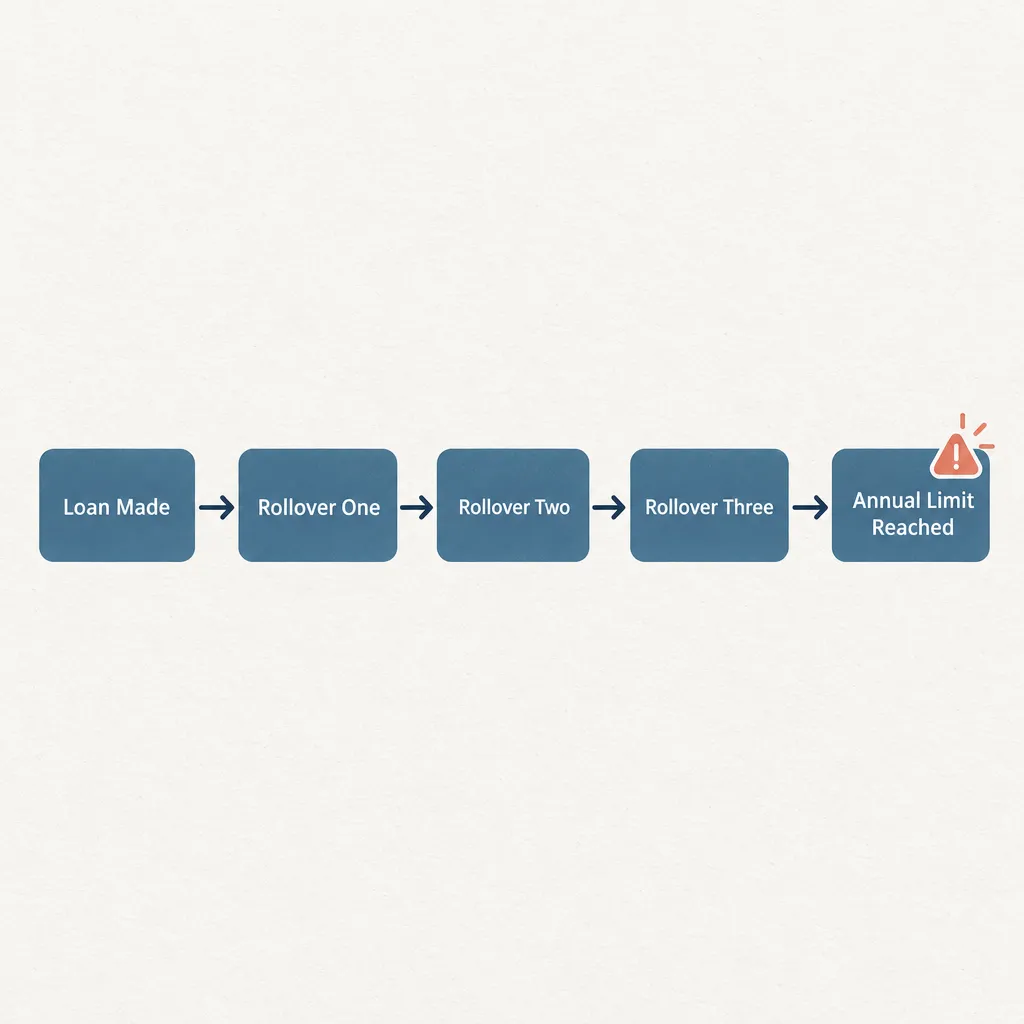
- A licensee may not roll over a short-term consumer loan more than four times.
- A licensee may not make a short-term consumer loan that would give the borrower more than five such loans from all licensees combined in any 12-month period. Rollovers and refinancings count as new loans for this limit.
In practice, five transactions a year is the maximum, however they are structured. One loan rolled over four times uses all five. So do five separate loans repaid in full. Either way, no Delaware licensee can legally make a sixth until the oldest loan falls outside the 12-month window.
The statewide database
Section 2235B told the State Bank Commissioner to run a database that lets lenders check a borrower’s loan count in real time. Regulation 2210 in Title 5 of the Delaware Administrative Code sets out how licensees must check the system before funding a loan and record every loan, rollover and payoff. A lender that skips the check and makes a sixth loan is breaking state law. That gives you leverage in a dispute.
No cooling-off period
Delaware has no waiting period between loans. Some states require a day or more after a run of back-to-back loans, but Delaware relies only on the annual count. If you cannot repay, ask the lender in writing for a repayment plan and keep a copy. Any refinancing still counts toward your five.
Same-day loans in Delaware
Searches for same-day loans in Delaware mostly turn up the licensed short-term lenders described above, plus cash advance apps and online lenders. Fast funding does not change the legal category. A $400 loan funded in an hour and due in two weeks is a short-term consumer loan. It counts toward your five and must be recorded in the database.
Be wary of any site that promises same-day money with “no credit check” or “guaranteed approval.” These are marketing phrases, not legal terms. Behind them there is usually a soft credit check or a review of alternative data, a higher price to cover the lender’s risk, and sometimes an unlicensed lender operating outside Delaware’s rules.
Car title loans in Delaware
Title loans are legal in Delaware under their own subchapter of the Licensed Lenders chapter (5 Del. C. Chapter 22, Subchapter V, beginning at § 2250). Delaware added this subchapter in 2010. As with payday loans, lawmakers chose procedural limits over a price cap.
What the title loan law requires
Under § 2250, a title loan is a loan from a licensee to one or more people that:
- is secured by a motor vehicle title,
- is not used to buy that vehicle, and
- has an original term of 180 days or less.
The main protections are:
- 180-day ceiling. Under § 2254, no rollover may extend repayment beyond 180 days from the date the loan money was paid out.
- Written disclosures before signing. These include a notice that the loan is meant for short-term cash needs, not long-term financial problems.
- Next-day rescission. You can cancel by returning the money by the end of the next business day.
- A workout before repossession. After a default, the lender must offer a workout agreement before it takes the car or sues. Every workout must reduce the unpaid balance by at least 10% each month, and you get at least 10 business days to accept. While you keep up with the workout, you are not in default and the lender cannot take the vehicle.
- Repossession only under the UCC. The lender must follow the default rules in Part 6 of Article 9 of Title 6, and any money left from a sale after the debt and costs are paid belongs to you.
Delaware sets no interest cap on title loans. Lenders usually price them monthly. In states without caps, 25% per month is common, which works out to 25% × 12 = 300% APR. The 180-day limit stops a title loan from rolling over forever, but six months at that price still costs more than the amount borrowed.
| Title loan amount | Monthly interest | Months before payoff | Interest paid | Total repaid |
|---|---|---|---|---|
| $1,000 | 25% ($250) | 1 | $250 × 1 = $250 | $1,250 |
| $1,000 | 25% ($250) | 3 | $250 × 3 = $750 | $1,750 |
| $1,000 | 25% ($250) | 6 (the legal maximum) | $250 × 6 = $1,500 | $2,500 |
| $2,500 | 20% ($500) | 6 | $500 × 6 = $3,000 | $5,500 |
These figures are illustrations, since Delaware law sets no rate. They show that a title loan can cost two to three times the amount borrowed within its legal term. The collateral is also a car you probably need to get to work.
Repossession in practice
Because the lender holds your title, it does not have to sue before it repossesses. That makes the workout requirement your main protection. Ask for a workout in writing and keep a copy. On a $1,500 unpaid balance, the 10% rule means the first month of the plan has to bring the balance down by at least $150. A lender that repossesses without offering a workout is breaking the licensing law, and you can report it to the State Bank Commissioner. After a sale, ask for a written accounting that shows the sale price, the costs deducted and any surplus owed to you.
Installment and personal loans in Delaware
Delaware installment loans come from banks, credit unions and licensed lenders under Chapter 22. These are loans repaid in scheduled payments over months or years. A non-bank lender needs a Delaware license under 5 Del. C. § 2202, and § 2229 lets the contract set the rate.
That means Delaware installment loans can range from a credit union’s 18% APR to 150% or more from an online lender. The Truth in Lending disclosure is the only reliable way to compare offers. Regulation Z requires it to show the APR, the finance charge in dollars, the total of payments and the payment schedule before you sign.
The table below shows standard amortized payments on a $2,000 loan repaid in 12 monthly payments. The formula is payment = loan × r ÷ (1 − (1 + r)^−12), where r is the APR divided by 12. Total repaid is 12 × the payment, and the finance charge is the total minus $2,000.
| $2,000 loan, 12 monthly payments | APR | Monthly payment | Total repaid | Finance charge |
|---|---|---|---|---|
| Credit union personal loan | 18% | $183.36 | $2,200.32 | $200.32 |
| Mid-cost licensed lender | 36% | $200.92 | $2,411.04 | $411.04 |
| High-cost online installment loan | 99% | $268.84 | $3,226.08 | $1,226.08 |
| Very high-cost installment loan | 150% | $330.39 | $3,964.68 | $1,964.68 |
The 36% row matters for two reasons. It is the federal ceiling for active-duty service members and their dependents under the Military Lending Act. Many consumer advocates and state legislatures also treat it as the line between affordable credit and a debt trap. Delaware draws no such line for civilians. Our ohio payday loan laws page explains how Ohio moved to a 28% interest rate with capped fees in 2019. Delaware made the opposite choice and kept its contract-rate rule.
Retail installment contracts
When you finance a purchase through a store or dealer (furniture, appliances, some cars), Delaware’s retail installment sales law in Title 6 of the Delaware Code applies instead. Those contracts still require Truth in Lending disclosures, and the Attorney General’s consumer protection rules apply if the seller misrepresents the terms.
Online and tribal lenders: does Delaware law apply?
Delaware law applies to any lender making loans to Delaware residents, wherever the lender is based. A company in Texas or Nevada that advertises to people in Wilmington or Dover needs a Chapter 22 license. For short-term loans it must also count each loan toward the five-per-year limit and use the database. Because Delaware has no rate cap, many online lenders are licensed here, so “online” alone is not a warning sign. “Unlicensed” is.
Two kinds of lender need extra caution.
Tribal lenders. Some online lenders are owned by or affiliated with Native American tribes and claim sovereign immunity from state law. Courts have disagreed on how far that immunity reaches, and the CFPB and several state attorneys general have sued lenders that used a tribal affiliation as a shield. For a borrower, the practical risks are that the lender may ignore the five-loan limit, may not report to the Delaware database, and may be hard to sue or complain about. The State Bank Commissioner has little power over a tribal lender that holds no Delaware license.
Lenders with no license anywhere. These are the real danger. Lending to Delaware residents without a license is a violation the Commissioner can act on. Unlicensed operations are also where most fraud happens: upfront “processing” fees, fake collection threats and unauthorized bank withdrawals.
How to check a lender's license in Delaware
- Get the lender’s exact legal name and NMLS ID number from its website footer or loan documents.
- Search that name or ID on NMLS Consumer Access and look for an active Delaware license from the Office of the State Bank Commissioner.
- Compare it with the latest monthly licensed lender list on banking.delaware.gov, which shows each license’s status and expiration date.
- If the lender appears in neither place, treat the offer as unlicensed and do not share your bank account details.
The license check works the same way for online lenders, storefronts and title lenders. A lender that says it “doesn’t need a license because it’s online” or “operates under tribal law” is telling you how it is likely to behave if you fall behind.
Debt collection and wage garnishment in Delaware
When a payday, title or installment loan goes unpaid, three sets of rules apply:
- the federal Fair Debt Collection Practices Act, which covers third-party debt collectors,
- Delaware’s Consumer Fraud Act, which bans deceptive practices by anyone, and
- Delaware’s rules on court judgments and wage garnishment.
What collectors cannot do
The Fair Debt Collection Practices Act (15 U.S.C. § 1692 and following) covers collection agencies, debt buyers and attorneys who collect consumer debts for someone else. It does not cover the original lender collecting its own loan, although the CFPB can still act against lenders for unfair or deceptive practices. Under the FDCPA and the CFPB’s Regulation F (12 CFR 1006), a third-party debt collector cannot:
- Call before 8 a.m. or after 9 p.m. your time. Calling about one debt more than seven times in seven days is presumed to be harassment.
- Threaten arrest or criminal charges over an unpaid consumer loan. In Delaware, an unpaid payday loan is a civil debt, not a crime.
- Contact your employer about the debt beyond confirming your job and address, or tell other people that you owe money.
- Keep contacting you after you ask in writing for contact to stop, except to confirm it will stop or to tell you about a specific legal action.
- Collect fees or interest that the original contract and Delaware law do not allow.
Within five days of first contacting you, a collector must send a validation notice with the amount owed, the creditor’s name and your right to dispute. If you dispute in writing within the 30-day validation period, the collector must stop collecting until it mails you verification of the debt.
Delaware has no fair debt collection law of its own for private collectors, so the FDCPA is the main tool. The Delaware Consumer Fraud Act (6 Del. C. § 2511 and following) fills some gaps. It bans deception in selling or advertising merchandise, which Delaware courts have read to include credit. The Consumer Protection Unit of the Delaware Department of Justice enforces it.
Statute of limitations
In Delaware, you generally have three years to be sued on a contract claim (10 Del. C. § 8106). If a lender or debt buyer sues more than three years after your default, you have a limitations defense, but you have to raise it yourself because the court will not. A small payment or a written acknowledgment of the debt can restart the clock, so get advice before paying anything on an old account.
Wage garnishment
Delaware is stricter than most states here. Federal law (Title III of the Consumer Credit Protection Act, 15 U.S.C. § 1673) lets a judgment creditor take up to 25% of disposable earnings. Low earners are protected further: the creditor can take only the amount of weekly disposable earnings above 30 times the federal minimum wage, if that is less. Delaware’s statute, 10 Del. C. § 4913, protects 85% of wages, so an ordinary creditor can take no more than 15%.
Before anything comes out of your paycheck, the creditor must sue you and win a judgment in the Justice of the Peace Court, the Court of Common Pleas or Superior Court, and then get a writ. For a worker earning $800 a week, that means at most $800 × 15% = $120 a week, compared with up to $200 under the federal limit.
| Collection issue | Delaware rule | Source |
|---|---|---|
| Garnishment limit for consumer debt | 15% of wages (85% exempt) | 10 Del. C. § 4913 |
| Federal garnishment ceiling | 25% of disposable earnings | 15 U.S.C. § 1673 |
| Time limit to sue on a contract debt | 3 years | 10 Del. C. § 8106 |
| Criminal threats over an unpaid payday loan | Prohibited; civil debt only | FDCPA, 15 U.S.C. § 1692e |
| Collector call frequency | More than 7 calls in 7 days per debt presumed harassment | 12 CFR 1006.14 |
Bank account debits
Most payday and online installment lenders collect through automatic ACH withdrawals, and two federal protections apply.
First, the Electronic Fund Transfer Act and Regulation E (12 CFR 1005.10(e)) bar a lender from requiring automatic payments as a condition of the loan. You can also stop preauthorized payments by telling your bank at least three business days before the next scheduled debit.
Second, the payment provisions of the CFPB’s payday lending rule (12 CFR 1041.8) took effect on March 30, 2025. They bar covered lenders from trying a third withdrawal after two consecutive attempts have failed, unless you give a new authorization.
The CFPB said in March 2025 that it would not prioritize enforcing the rule, and its 2026 regulatory agenda, released in July 2026, plans a proposal to reconsider it. As of November 2026, though, the rule text is unchanged and still in force. Repeated failed withdrawals are what pile up $30-plus bank fees, which often cost more than the loan itself.
Help that costs less than a payday loan
Because Delaware sets no price ceiling, the gap between a payday loan and the next-cheapest option is wider here than in a capped state. The resources below all serve Delaware residents.
Cheaper options first
A federal credit union payday alternative loan caps the APR at 28% and the application fee at $20.
Delaware 2-1-1 connects callers with emergency rent, utility and food help that does not have to be repaid.
A written hardship plan with the original creditor usually beats taking a new loan to pay an old bill.
Credit union payday alternative loans
Federal credit unions can offer two small-loan products under NCUA rules (12 CFR 701.21(c)(7)(iii) and (iv)):
- PAL I: $200 to $1,000 over one to six months, with an APR capped at 28% and an application fee of no more than $20. You must have been a member for at least one month.
- PAL II: up to $2,000 over as long as 12 months, with the same caps and no membership waiting period.
Here is the cost of a $1,000 PAL repaid over six months at 28%. On a standard amortization schedule, the monthly rate is 28% ÷ 12 = 2.333%, which gives six equal payments of about $180.54. Over six months that is 6 × $180.54 = $1,083.24, or $83.24 in interest. Adding the $20 fee brings the total cost to $103.24. A $1,000 title loan at 25% a month costs $250 in the first month alone.
Delaware credit unions include Del-One Federal Credit Union, Dover Federal Credit Union and Stepping Stones Community Federal Credit Union in Wilmington, a certified community development financial institution (CDFI) that serves lower-income members. Not every credit union offers PALs, so ask about small-dollar or emergency loans by name.
State and local assistance
- Delaware 2-1-1: the statewide referral line for emergency financial help, run through United Way of Delaware.
- $tand By Me: a partnership between the state and United Way of Delaware that offers free one-on-one financial coaching, including budgeting and dealing with creditors.
- Delaware Division of Social Services: runs SNAP, TANF cash assistance and General Assistance, with screening for all three through one application.
- Low Income Home Energy Assistance Program (LIHEAP): run in Delaware through Catholic Charities. It helps pay heating and cooling bills and can prevent the utility shutoff that often leads to a payday loan.
- Delaware State Housing Authority: runs the Delaware Emergency Mortgage Assistance Program for homeowners who fell behind after a job loss or medical event.
- Delaware Community Reinvestment Action Council (DCRAC): provides free financial counseling and tax preparation.
Other lower-cost routes
- Nonprofit credit counseling. Agencies that belong to the National Foundation for Credit Counseling can set up a debt management plan that lowers credit card interest without a new loan.
- Hospital financial assistance. Federal tax law (26 U.S.C. § 501(r)) requires nonprofit hospitals to have financial assistance policies. Ask about charity care before you pay a medical bill with a payday loan.
- Earned wage access and cash advance apps. Employer-based earned wage access with no fee, or an app’s free standard transfer, costs less than any licensed short-term loan. Optional tips and express fees can push the effective APR back into triple digits, though.
Federal rules that apply in Delaware
Several federal laws apply to every lender in Delaware on top of state rules:
- Truth in Lending Act and Regulation Z (12 CFR 1026): require a written disclosure of the APR, finance charge, amount financed and total of payments before you are bound. A lender that hides the APR or quotes only a “fee” is breaking federal law.
- Military Lending Act (10 U.S.C. § 987; 32 CFR Part 232): caps the military annual percentage rate at 36% for active-duty service members and their dependents, and bans mandatory arbitration and car-title security in covered loans. Families at Dover Air Force Base are protected whatever Delaware law allows.
- Servicemembers Civil Relief Act (50 U.S.C. § 3937): limits interest to 6% on debts taken on before active duty, once the service member gives written notice.
- Fair Debt Collection Practices Act (15 U.S.C. § 1692): governs third-party collectors, as described above.
- Fair Credit Reporting Act (15 U.S.C. § 1681): lets you dispute inaccurate loan information on your credit reports and requires the company that reported it to investigate.
- Equal Credit Opportunity Act (15 U.S.C. § 1691): bars lenders from denying credit based on race, sex, age, marital status, receipt of public assistance and other protected traits, and requires a written explanation of any denial.
How to check a lender’s license and file a complaint
Two Delaware agencies share enforcement:
- Office of the State Bank Commissioner: licenses and examines every non-bank lender under Chapter 22, so lending and licensing problems go here.
- Consumer Protection Unit of the Delaware Department of Justice: enforces the Consumer Fraud Act, so deceptive ads, fake collectors and scams go here.
The CFPB also takes complaints about lenders and collectors nationwide. It forwards each one to the company, which generally responds within 15 days.
| Problem | Where to go | What they can do |
|---|---|---|
| Lender broke the 5-loan limit, skipped the database or is unlicensed | Office of the State Bank Commissioner, Dover (banking.delaware.gov) | Examine, fine, suspend or revoke the license |
| Title lender repossessed without offering a workout | Office of the State Bank Commissioner | Enforce the title loan subchapter of 5 Del. C. Chapter 22 |
| Deceptive ads, fake “legal” threats, upfront-fee loan scams | Delaware DOJ Consumer Protection Unit | Investigate under the Consumer Fraud Act |
| Collector harassment, false threats, withdrawals you did not authorize | CFPB complaint portal (consumerfinance.gov/complaint) | Require a company response and feed enforcement data |
| Online loan fraud, identity theft tied to a loan application | FBI IC3 (ic3.gov) and FTC ReportFraud (reportfraud.ftc.gov) | Track and investigate fraud networks |
| Unlicensed lender operating in Delaware | State Bank Commissioner and CFPB | State license action plus federal review |
When you file, include the loan agreement, the Truth in Lending disclosure, screenshots of the lender’s website and any texts or call logs. For a database or five-loan dispute, list the date and amount of every short-term loan you took in the past 12 months. The Commissioner can check the database record to confirm them.
The CFPB’s public complaint database can be searched by state and product. Complaints about payday, title and personal loans most often involve unexpected fees or interest and problems with unauthorized withdrawals. Both issues tie directly to the disclosure and payment rules above, so cite those rules by name when you write your complaint.
How Delaware compares with its neighbors
Delaware regulates how often people borrow rather than what loans cost, which sets it apart from its neighbors:
- Pennsylvania caps small-loan charges under its Consumer Discount Company Act and Loan Interest and Protection Law, and has no licensed storefront payday lenders.
- Maryland caps small-loan interest at 33% a year under its Consumer Loan Law.
- New Jersey has a 30% criminal usury ceiling that keeps payday lenders out entirely.
That is why Delaware storefronts tend to cluster near the Pennsylvania and Maryland lines.
| State | Payday lending | Rate or fee cap | Loan-frequency limits |
|---|---|---|---|
| Delaware | Legal | None | 5 loans per 12 months; 4 rollovers |
| Pennsylvania | Effectively banned | Small-loan rate cap under the CDCA | Not needed |
| Maryland | Effectively banned | 33% APR on small loans | Not needed |
| New Jersey | Effectively banned | 30% criminal usury cap | Not needed |
People who live in Delaware but work in Maryland or Pennsylvania sometimes ask which state’s law applies. A Delaware-licensed lender lending to a Delaware resident is governed by Delaware law, no matter where the paycheck comes from. Delaware is not alone in this approach. Our texas payday loan laws page covers another state with no effective rate cap, where local ordinances and disclosure rules do most of the work.
Recent changes and pending bills (as of November 2026)
As of November 2026, Delaware’s small-loan rules have not changed since the 2012 amendments, and no APR cap has been enacted. Lawmakers have tried several times:
| Bill | General Assembly | Proposed cap | Outcome |
|---|---|---|---|
| HB 446 | 148th | 100% a year on alternative financial services | Not enacted |
| HB 279 | 150th (2020) | 20% APR on short-term and title loans | Not enacted |
| HB 143 | 152nd (introduced May 10, 2023) | 20% APR on short-term consumer loans and title loans | Assigned to the House Economic Development/Banking/Insurance & Commerce Committee; no further action |
None of these bills passed, and no successor became law in the 153rd General Assembly’s 2025 and 2026 sessions.
Did you know?
According to the General Assembly’s bill record, HB 143 would have capped Delaware payday and title loans at 20% APR. That is below the 28% federal credit unions can charge on payday alternative loans. The bill never got past committee referral.
The federal picture is unsettled but has not changed. The CFPB’s 2017 ability-to-repay requirements for payday loans were rescinded in 2020 and never took effect. Only the payment-withdrawal provisions survived, in force since March 30, 2025, and the CFPB’s 2026 regulatory agenda signals it may propose changes to them. Before you rely on any rule for a specific loan, check the current text of 5 Del. C. Chapter 22 on the Delaware Code Online site run by the General Assembly.
Before you borrow
Delaware limits how many short-term loans you can take, not what they cost. A $500 loan at $20 per $100 costs $100 every 30 days, and a title loan can legally run six months at prices that double the debt. Use the free and 28%-capped options first, and never give bank account access to a lender you cannot find on NMLS Consumer Access.
FAQ
Are payday loans legal in Delaware?
Yes. Lenders licensed by the Office of the State Bank Commissioner under 5 Del. C. Chapter 22 can make short-term consumer loans of up to $1,000 with terms under 60 days. Each borrower is limited to five such loans, rollovers included, in any 12-month period. The state does not cap the interest rate or fees.
How many payday loans can I have in Delaware?
Five in any rolling 12-month period, under 5 Del. C. § 2235A. Rollovers and refinancings count toward the five, and a single loan cannot be rolled over more than four times. Lenders must check the state database before each loan, so a licensed lender should refuse a sixth.
Can I cancel a payday loan in Delaware?
Yes. Every short-term consumer loan must include a right of rescission. If you return the full amount borrowed by the close of business on the next business day, the loan is cancelled. Title loans have the same next-day right.
What is the maximum interest rate on a loan in Delaware?
Licensed lenders have no maximum under Delaware law. Section 2229 of Title 5 allows whatever rate the written agreement states, for payday, title and installment loans alike. Federal law does set ceilings for military borrowers: a 36% military APR on covered credit to active-duty service members and their dependents under the Military Lending Act, and generally 6% on qualifying debts taken on before active duty under the Servicemembers Civil Relief Act.
Are car title loans legal in Delaware?
Yes, from licensed lenders under Subchapter V of 5 Del. C. Chapter 22. A rollover cannot extend repayment beyond 180 days from when the money was paid out. After a default, the lender must offer a workout plan that cuts the balance by at least 10% a month before it repossesses. Any surplus from a sale belongs to you. There is no interest rate cap.
Can a payday lender garnish my wages in Delaware?
Only after it sues you and wins a judgment. Even then, 10 Del. C. § 4913 protects 85% of your wages, so an ordinary creditor can take no more than 15%, well below the 25% federal maximum. A collector who claims it can garnish your pay without a court judgment, or threatens arrest, is violating the Fair Debt Collection Practices Act.
Is Delaware going to cap payday loan rates?
Not under current law. As of November 2026, no rate-cap bill has passed. The latest, HB 143 from 2023, proposed a 20% APR cap on short-term and title loans and stalled in a House committee. Delaware still relies on the five-loan limit and the statewide database.
How do I know if an online lender is licensed in Delaware?
Search the lender’s name or NMLS ID on NMLS Consumer Access and confirm it shows an active Delaware license from the Office of the State Bank Commissioner. Then check that it appears on the Commissioner’s latest licensed lender list on banking.delaware.gov. If the lender is missing from both, do not share bank account information, and report the offer to the Commissioner and the CFPB.
Laws and regulations referenced
- Delaware Code, Title 5, Chapter 22, Subchapter III (Closed End Credit), including Section 2235A (Short-term Consumer Loans)
- Delaware Code, Title 5, Chapter 22, Subchapter V (Title Loans)
- Truth in Lending Act, 15 U.S.C. 1601
- Regulation Z, 12 CFR Part 1026
- Fair Debt Collection Practices Act, 15 U.S.C. 1692
- Regulation F (debt collection), 12 CFR Part 1006
- Fair Credit Reporting Act, 15 U.S.C. 1681
- Equal Credit Opportunity Act, 15 U.S.C. 1691
- Electronic Fund Transfer Act, 15 U.S.C. 1693
- Regulation E (electronic transfers), 12 CFR Part 1005
- Military Lending Act, 10 U.S.C. 987
- Military Lending Act rule, 32 CFR Part 232
- Servicemembers Civil Relief Act, 50 U.S.C. 3901
- CFPB payday lending rule, 12 CFR Part 1041
Links go to the official text on government sites.
Check, verify or complain
Sources
- consumerfinance.gov › rules policy › final rules › debt collection practices regulation f consumerfinance.gov · official source
- militaryonesource.mil › financial legal › legal › servicemembers civil relief act militaryonesource.mil · official source
- experian.com › blogs › ask experian › what is payday loan alternative experian.com
- nolo.com › legal encyclopedia › delaware wage garnishment laws nolo.com
- ustatesloans.org › law › de ustatesloans.org
- recordinglaw.com › us laws › debt collection › delaware debt collection laws recordinglaw.com
- consumerfinancemonitor.com › 2020 › 07 › 07 › cfpb issues final rule rescinding payday loan rule ability… consumerfinancemonitor.com
- delawarepublic.org › 2012 06 13 › delaware moves to limit payday loans delawarepublic.org

Elena writes about getting through a money emergency, assistance programs, budgeting on a tight income, banking basics and borrower rights. Her guides list the cheaper options first and link the agency or program that can actually help.
Ruth is US Financer's standards editor. Every article goes through her checks before and after it is published: each rate, fee, cap, deadline and rule is matched against its primary source, every law named is linked to its official text, and anything that cannot be…
What changed
- Nov 13, 2026 Facts re-checked against official sources and updated; sources and links refreshed.
- Oct 16, 2026 First published.
Comments are closed