Runs in your browser. Nothing you type is sent or saved.
The debt payoff calculator above takes up to four debts and the extra cash you can add each month, then shows how long each payoff order takes and how much interest each one costs. With the default numbers it reports that the avalanche order clears everything in 2 years 7 months for $3,377.44 in interest, while paying only minimums costs $6,711.33. You need three figures per debt: the current balance, the APR, and the minimum payment, all of which sit on your most recent statement.
How to use the calculator
- List every debt you want in the plan: credit cards, a personal loan, a car loan, medical bills on a payment plan.
- Copy each balance from the newest statement or the lender’s online account page, not from memory.
- Find the APR on the statement’s interest charge section or in the Truth in Lending disclosure you received at opening.
- Enter the minimum payment printed on the statement. For an installment loan, that is the regular monthly payment.
- Put a realistic surplus in Extra you can pay each month. Check your pay stub against your actual bills before choosing it.
- Read the three results side by side and note the dollar gap between avalanche and snowball before you pick an order.
What each field means and the mistakes that skew results
The calculator has four identical blocks (Debt 1 through Debt 4) and one shared field at the bottom. Debt 4 is optional. Leave its balance, APR and minimum at 0 and the tool ignores it.
Debt 1 balance ($) through Debt 4 balance ($) are the amounts you owe right now. Use the statement balance, not the “available credit” figure and not a payoff quote that already includes next month’s interest.
Debt 1 APR (%) through Debt 4 APR (%) are annual rates. Enter 24, not 0.24 and not 2.0. The calculator divides by 12 and by 100 on its own. If a card carries two rates, a purchase rate and a cash advance rate, enter the rate that applies to most of the balance, or split the card into two debts.
Debt 1 minimum payment ($) through Debt 4 minimum payment ($) are the smallest amounts the lender will accept each month. For cards, that is the number on the statement. For a car loan or personal loan, it is your fixed installment.
Extra you can pay each month ($) is the surplus above all the minimums combined. This is the single most important input, and the default of $200 is only a placeholder.
Four mistakes come up again and again:
- Entering a promotional 0% rate for a balance transfer card without remembering the rate jumps when the promo ends. The calculator assumes the rate never changes.
- Putting the total budget in the extra field. If your minimums add up to $475 and you can afford $675 total, the extra is $200, not $675.
- Typing a minimum that is below the interest charge. On a $6,000 balance at 24%, interest alone is $120 a month, so a $100 minimum would make the balance grow forever and the result is meaningless.
- Including a mortgage. The math works, but a $250,000 balance swamps every other debt and the result stops being useful for the cards and loans you can actually attack. Our “loan calculator” is the better fit for a mortgage.
How the debt payoff calculator does the math
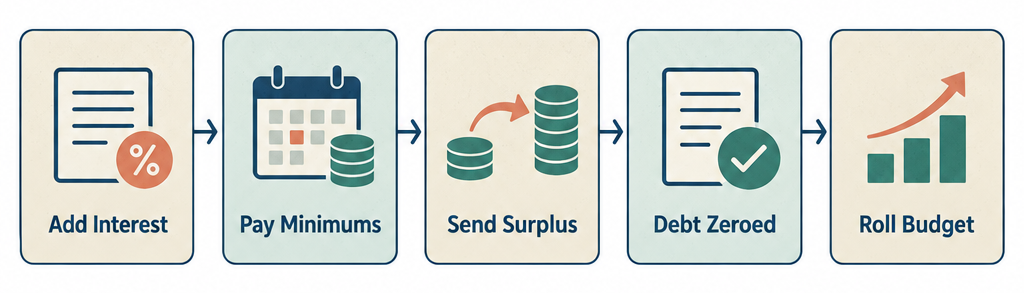
Every result on the page comes from one loop that runs month by month. Here it is in plain words.
- Add up all minimums plus the extra. That is your monthly budget, and it never changes.
- At the start of each month, add interest to every debt: balance × APR ÷ 12 ÷ 100.
- Pay every minimum.
- Send whatever budget is left to one target debt. Snowball targets the smallest balance. Avalanche targets the highest APR.
- When a debt hits zero, its minimum stays in the budget and flows to the next target. If the target needs less than the surplus, the leftover also moves on that same month.
- Repeat until every balance is zero. Count the months and total the interest.
The minimum-payments-only line runs the same loop with no extra and no targeting, so each debt gets its minimum and nothing more.
The default example, step by step
The defaults are three debts: $6,000 at 24% with a $180 minimum, $2,500 at 18% with a $75 minimum, and $9,000 at 9% with a $220 minimum, plus $200 extra.
Budget: $180 + $75 + $220 + $200 = $675 every month.
Month 1 interest:
| Debt | Balance | Monthly rate | Interest added |
|---|---|---|---|
| Debt 1 | $6,000 | 24 ÷ 12 ÷ 100 = 2.0% | $120.00 |
| Debt 2 | $2,500 | 18 ÷ 12 ÷ 100 = 1.5% | $37.50 |
| Debt 3 | $9,000 | 9 ÷ 12 ÷ 100 = 0.75% | $67.50 |
| Total | $17,500 | $225.00 |
So $225 of your first $675 disappears into interest. Only $450 reduces what you owe.
Under snowball, the target is Debt 2 because $2,500 is the smallest balance. Month 1 for Debt 2: $2,500 + $37.50 interest − $75 minimum − $200 extra = $2,262.50. Debt 1 ends month 1 at $5,940 and Debt 3 at $8,847.50. Debt 2 keeps taking $275 a month and is gone in 10 months, which the calculator reports as the first debt paid off. That $275 then rolls onto Debt 1, the next-smallest balance, giving it $455 a month. Debt 3 is last. Total: 2 years 8 months and $3,580.47 in interest.
Under avalanche, the target is Debt 1 because 24% is the highest APR. Month 1 for Debt 1: $6,000 + $120 − $180 − $200 = $5,740. Debt 2 ends at $2,462.50 and Debt 3 at $8,847.50. Debt 1 takes $380 a month and clears in about 20 months. Then $380 rolls to Debt 2 at 18%, and finally everything hits Debt 3. Total: 2 years 7 months and $3,377.44 in interest.
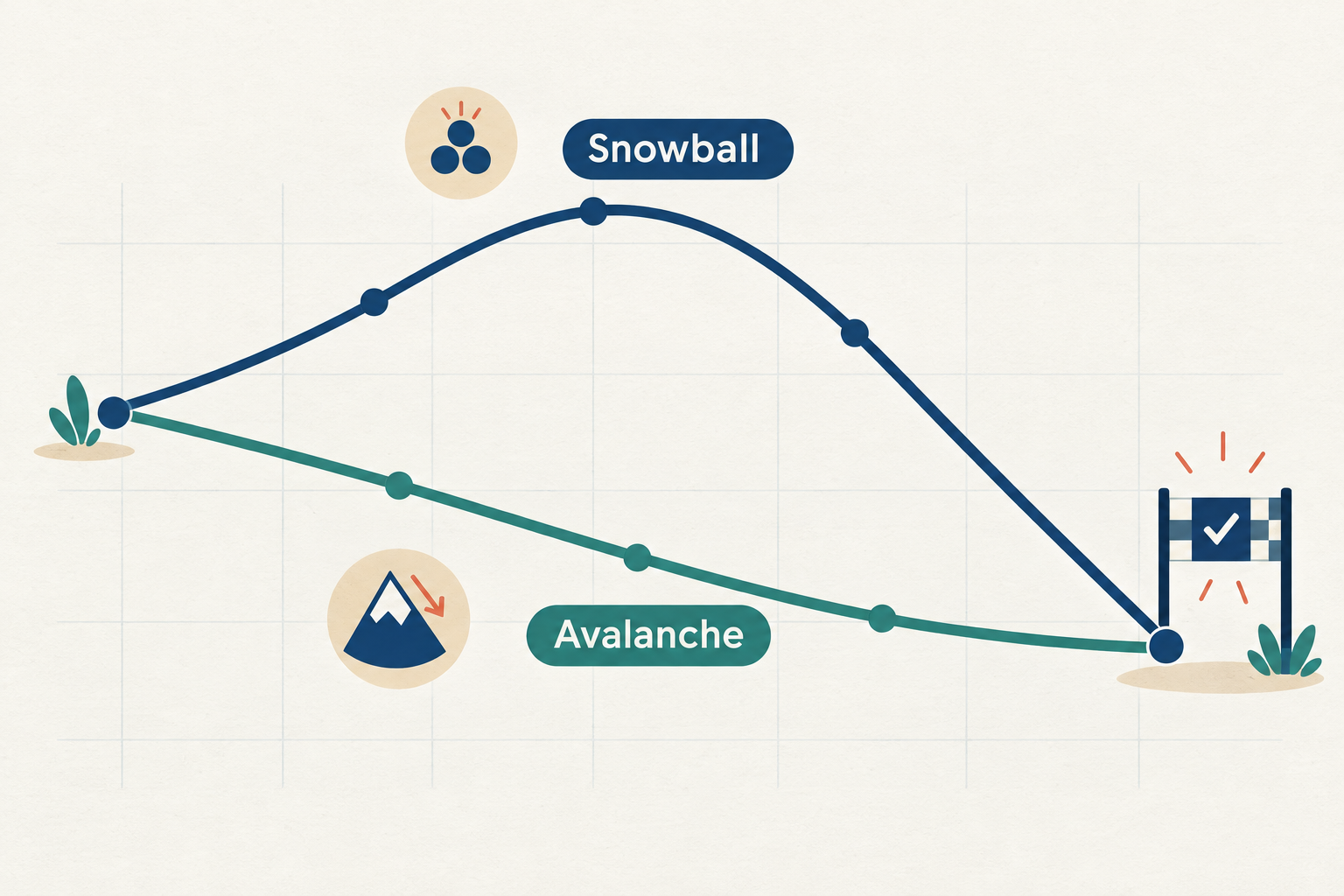
Avalanche wins by $203.03 and one month. The gap is modest because the two methods converge after the first payoff: once Debt 2 is gone under snowball, Debt 1 is both the smallest remaining balance and the highest rate, so both orders attack it next.
Minimums only costs $6,711.33, almost double either plan. That is what the $200 extra buys you.
A second example with the arithmetic shown
Two debts this time. Debt A: $800 at 12%, minimum $40. Debt B: $1,500 at 24%, minimum $60. Extra: $100. Budget: $40 + $60 + $100 = $200. Monthly rates are 1% on A and 2% on B. We round to the cent each month; the calculator carries full decimals, so its totals can differ by a few cents.
Snowball targets A (smaller balance). A gets $140, B gets $60.
| Month | Debt A interest | Debt A after payment | Debt B interest | Debt B after payment |
|---|---|---|---|---|
| 1 | $8.00 | $668.00 | $30.00 | $1,470.00 |
| 2 | $6.68 | $534.68 | $29.40 | $1,439.40 |
| 3 | $5.35 | $400.03 | $28.79 | $1,408.19 |
| 4 | $4.00 | $264.03 | $28.16 | $1,376.35 |
| 5 | $2.64 | $126.67 | $27.53 | $1,343.88 |
| 6 | $1.27 | $0 (paid $127.94) | $26.88 | $1,298.70 |
In month 6 the $140 covers A’s $127.94 with $12.06 left over, which goes straight to B that same month ($1,343.88 + $26.88 − $60 − $12.06 = $1,298.70). From month 7, B gets the full $200.
Month 7: $1,298.70 + $25.97 − $200 = $1,124.67. Month 8: + $22.49 − $200 = $947.16. Month 9: + $18.94 − $200 = $766.10. Month 10: + $15.32 − $200 = $581.42. Month 11: + $11.63 − $200 = $393.05. Month 12: + $7.86 − $200 = $200.91. Month 13: + $4.02 − $200 = $4.93. Month 14: + $0.10, pay $5.03, done.
Snowball interest: $27.94 on A plus $277.09 on B = $305.03 over 14 months. Check: 13 × $200 + $5.03 = $2,605.03 = $2,300 borrowed + $305.03.
Avalanche targets B (higher rate). B gets $160, A gets $40.
Debt B: $1,500 → $1,370.00 → $1,237.40 → $1,102.15 → $964.19 → $823.47 → $679.94 → $533.54 → $384.21 → $231.89 → $76.53 after month 10. Month 11: $76.53 + $1.53 = $78.06, paid in full with $81.94 left over.
Debt A over the same ten months: $768.00, $735.68, $703.04, $670.07, $636.77, $603.14, $569.17, $534.86, $500.21, $465.21. Month 11: $465.21 + $4.65 − $40 − $81.94 = $347.92. Month 12: + $3.48 − $200 = $151.40. Month 13: + $1.51, pay $152.91, done.
Avalanche interest: $74.85 on A plus $178.06 on B = $252.91 over 13 months. Check: 12 × $200 + $152.91 = $2,552.91 = $2,300 + $252.91.
Avalanche saves $52.12 and one month. Minimums only would take about three years and cost roughly $700, because B at 2% a month with a $60 payment barely moves early on.
Quick reference: what interest costs per month
The interest step is just balance × APR ÷ 12 ÷ 100. This table shows that cost per $1,000 of balance, which lets you estimate any debt in your head.
| APR | Monthly rate | Interest per $1,000 per month | Per $1,000 per year (no paydown) |
|---|---|---|---|
| 6% | 0.50% | $5.00 | $60.00 |
| 9% | 0.75% | $7.50 | $90.00 |
| 12% | 1.00% | $10.00 | $120.00 |
| 18% | 1.50% | $15.00 | $180.00 |
| 24% | 2.00% | $20.00 | $240.00 |
| 29.99% | 2.50% | $24.99 | $299.90 |
| 36% | 3.00% | $30.00 | $360.00 |
Use it to sanity-check your minimums. A $5,000 card at 29.99% eats $124.95 in interest each month, so a $125 minimum would leave the balance flat.
Reading your result
Three numbers matter most. Look at them in this order.
Months to debt-free. Anything under three years with a surplus you can actually sustain is a workable plan. Past five years, the extra is too small for the balances, and a change in strategy (below) will do more than reordering.
Total interest versus minimums only. This gap is your reward for the extra payment. In the defaults it is more than $3,100. If the gap is tiny, your extra is too small to matter or your rates are already low.
Avalanche minus snowball. This is the price of choosing the motivational order. The defaults show $203.03. The two-debt example shows $52.12. The gap grows when the smallest balance carries a low rate and a large high-rate debt sits behind it. It shrinks to almost nothing when rates are within a few points of each other.
A fair test: if the avalanche saving is under one month of your extra payment, either order is fine and you should pick the one you will stick with. Research on debt repayment, including work published by the Initiative for Financial Decision-Making and in the Journal of Consumer Research, finds people are more likely to keep going after an early win, which is the entire case for snowball.
Make snowball cost less
Run snowball, note the first-payoff month, then run avalanche. If the first debt in both orders clears within a few months of each other, take the avalanche order and still get the quick win.
Re-enter your real balances every three months. Minimums on cards fall as balances fall, so the fixed budget here understates how fast you can go if you hold your payment steady.
Cheaper and safer options to check before you commit
The calculator assumes your rates are fixed. Lowering them is the one lever that beats either payoff order, and the cheapest routes come first.
Hardship or rate-reduction programs from the current lender. Most card issuers run internal hardship plans that cut the rate for 6 to 12 months. There is no fee and no new loan. Ask by phone and request the terms in writing.
Nonprofit credit counseling and a debt management plan. A counselor at an agency approved by the Department of Justice’s U.S. Trustee Program, or a member of the National Foundation for Credit Counseling, negotiates reduced rates on cards and you make one payment to the agency. Plans typically run three to five years and carry a monthly fee that most states cap. Rerun the calculator with the reduced rates to see the effect.
Credit union payday alternative loans. For small balances, federal credit unions offer PALs under NCUA rules at a maximum 28% APR with capped application fees, far below typical card cash advance rates.
Debt consolidation with a personal loan or balance transfer. This only helps if the new APR, after fees, is lower than the weighted rate you pay now. Run the numbers through our “personal loan calculator” first, and remember a balance transfer fee of 3% to 5% is interest paid up front.
Debt settlement means paying less than you owe. Settlement companies charge a percentage of the enrolled debt, your accounts go delinquent while you save up, and forgiven amounts over $600 generally arrive on a Form 1099-C as taxable income. The FTC bans these companies from charging a fee before a debt is actually settled under the Telemarketing Sales Rule. Treat it as a last step before bankruptcy, not a first.
Before you borrow to consolidate
A consolidation loan with a lower rate only saves money if you stop adding to the cards you just emptied. The CFPB has repeatedly found that many borrowers run the old cards back up and end up with both debts, so close or freeze the paid-off cards if you go this route.
If a debt on your list has already been sold to a “debt collector“, the balance may be growing by interest the collector is not allowed to add in some states. Verify the amount in writing before entering it.
The US rules that shape these numbers
Truth in Lending Act and Regulation Z (12 CFR 1026). Every APR you enter comes from a disclosure the law requires. Card issuers must show the APR on each statement, and the CARD Act amendments require a minimum payment warning (12 CFR 1026.7(b)(12)) stating how long payoff takes at the minimum and what it costs to pay off in 36 months. That box is a built-in sanity check for the minimum-only line here.
State rate caps. Roughly 20 states and the District of Columbia cap small-dollar installment loan APRs at or near 36%, and payday lending is banned or effectively banned in a similar group. Credit cards issued by national banks follow the law of the bank’s home state, which is why card rates of 29.99% are legal in states with lower caps. If a debt on your list carries a rate above your state’s cap, look up the lender on NMLS Consumer Access and your state regulator’s license search.
Military Lending Act (10 U.S.C. § 987, 32 CFR Part 232). Active-duty servicemembers and their dependents cannot be charged more than a 36% Military Annual Percentage Rate on most consumer credit, including cards opened while covered. The Servicemembers Civil Relief Act separately caps interest at 6% on debts taken on before active duty, if you notify the lender. Both can cut the APR you enter.
Fair Debt Collection Practices Act. A third-party collector must send a validation notice with the amount owed, and you can dispute within 30 days. Do not enter a collector’s number in the calculator until it has been validated.
IRS Notice 2014-21. If you are weighing selling cryptocurrency to pay these balances, the IRS treats crypto as property. Selling triggers a capital gain or loss that goes on Form 8949. Factor the tax into whether the sale beats the interest you would otherwise pay.
Fair Credit Reporting Act. Paying down cards lowers your credit utilization, which usually helps your score, but paying off an installment loan early does not hurt it. The calculator ignores credit effects entirely.
FAQ
What is the difference between a debt payoff calculator and a debt payoff planner?
Nothing meaningful. A debt payoff planner usually adds a month-by-month schedule you can follow. The tool above gives you the totals and the first payoff date for each method, which is what you need to choose an order and set a budget.
Why does the calculator say avalanche saves only $203 on the default numbers?
Because after the first payoff, both orders attack the same debt. Snowball clears the $2,500 card at 18% first, then moves to the $6,000 card at 24%, which is also where avalanche starts. The orders differ for only 10 months, so the interest gap stays small.
Does the snowball method ever cost less than avalanche?
Not in this math. Avalanche always produces the lowest interest or ties. Snowball can only match it when the smallest balance also carries the highest rate, in which case both methods target the same debt from the start.
Why are my real minimum payments going down while the calculator keeps them fixed?
Card minimums are typically a percentage of the balance, often 1% plus interest or a floor of $25 to $35. The calculator holds your budget flat, which is the whole point of a payoff plan: you keep paying the old amount instead of letting the lender shrink it. The minimum-only line uses fixed minimums too, so a real minimum-only payoff takes longer and costs more than $6,711.33.
Should I include my car loan or mortgage?
A car loan, yes, if you want it in the plan, though its rate is often lower than your cards and both methods will leave it for last. A mortgage, no. Its size distorts the result and the “car payment calculator” and “loan calculator” handle those debts on their own.
What if I have more than four debts?
Combine the smallest ones. Add their balances and minimums, and enter a weighted APR: multiply each balance by its rate, add those products, then divide by the combined balance. Two debts of $1,000 at 20% and $3,000 at 12% give (20,000 + 36,000) ÷ 4,000 = 14%.
Can I use this as a credit card payoff calculator for one card?
Yes. Enter one card, leave the other three at zero, and put your extra in the last field. The avalanche and snowball lines will match since there is only one target. For single-card questions, our “credit card payoff calculator” also shows the payment needed to hit a chosen date.
Does paying off debt this way affect my debt-to-income ratio?
Only when a debt is fully paid, because lenders use minimum payments, not balances, to compute the ratio. Each payoff removes that minimum from the equation. Our “debt to income ratio calculator” shows the effect before you apply for a mortgage or car loan.
Comments are closed