
Runs in your browser. Nothing you type is sent or saved.
This debt to income ratio calculator shows what share of your gross monthly pay already goes to debt, which is the first number a mortgage or loan underwriter looks at after your credit score. Have three things nearby before you start: a recent pay stub, your latest statements for every loan and credit card, and your lease or mortgage statement. The result tells you where you stand against the 36% and 43% lines most lenders use.
How to use the calculator
- Enter Gross monthly income (before tax). Take the gross pay line on your pay stub and convert it to a monthly figure. Biweekly pay × 26 ÷ 12, weekly pay × 52 ÷ 12.
- Enter Rent or mortgage payment. Use the full amount on your lease, or the total mortgage payment including escrow for taxes and insurance from your servicer’s statement.
- Enter Car payments, Student loan payments and Credit card minimum payments from the “minimum due” or “payment amount” line on each statement.
- Enter Other loan payments and support: personal loans, buy now pay later plans, court-ordered child support, and any cosigned loan you are legally on.
- Read the result. You get your debt-to-income ratio, total monthly debt payments, housing ratio, and how much payment room you have before you cross 36%.
What each field means and the mistakes that throw the number off
The calculator has six fields. Every one of them has a common way to get it wrong, and a wrong input gives you a false sense of security before you apply for anything.
Gross monthly income (before tax). This is pay before federal and state tax, Social Security, Medicare, health premiums and 401(k) contributions come out. Lenders use gross, so the calculator does too. If you are self-employed, lenders generally use net profit after business expenses, averaged over the last two tax returns, so use that figure rather than total sales. Overtime, bonus and commission usually count only when you have a two-year history of receiving them.
The most common mistake here is typing take-home pay. On a $5,000 gross salary, take-home is often around $3,800 to $4,100 depending on your state and withholding. Using the lower figure inflates your DTI by ten points or more.
Under the Equal Credit Opportunity Act and Regulation B (12 CFR 1002), a lender cannot discount income because it comes from part-time work, a pension, or public assistance. Child support or alimony you receive counts as income if you choose to disclose it. You can enter those sources here if they are regular and documented.
Rent or mortgage payment ($). For renters, enter the rent you actually pay. For homeowners, enter principal, interest, property taxes, homeowners insurance and any HOA dues or mortgage insurance. Underwriters call this the full housing payment, and they count all of it. Entering only principal and interest is the second most common error and can hide several points of DTI.
Car payments ($). The monthly payment on every auto loan or lease in your name. A lease counts in full. If you cosigned your child’s car loan, lenders count that too unless you can show 12 months of payments made by someone else.
Student loan payments ($). Enter the payment on your statement. If you are on an income-driven plan with a $0 payment, your statement payment is $0, but mortgage lenders may substitute a figure. Fannie Mae’s Selling Guide allows a documented $0 income-driven payment, but if no payment shows on your credit report at all it uses 1% of the outstanding balance or a fully amortizing payment. FHA, under its Handbook 4000.1 rules updated in 2021, uses the actual payment if it is above $0 and otherwise 0.5% of the balance. On a $40,000 balance that is $200 a month at FHA’s rule, or $400 under Fannie Mae’s 1% fallback. Run the calculator both ways if your loans are in forbearance or deferment.
Credit card minimum payments ($). Add up the minimum due on each card, not what you usually pay and not the balance. If a card shows no minimum, Fannie Mae guidelines use 5% of the balance. Cards you pay in full each month still count by their reported minimum because the underwriter sees the statement balance, not your habit.
Other loan payments and support ($). Personal loans, medical payment plans, buy now pay later installments that report to the bureaus, furniture financing, 401(k) loans only if the lender asks, and court-ordered child support. Alimony you pay is treated differently by some programs: Fannie Mae lets the lender subtract it from your income instead of adding it as debt, which produces a lower ratio. Enter it here for a conservative view.
What you leave out: utilities, cell phone, groceries, gas, daycare, insurance premiums you pay directly, and income taxes. DTI is a debt measure, not a budget. A 30% DTI can still leave you short every month if the rest of your spending is high, which is why a separate budget calculator is worth running alongside this one.
The formula, the default example, and a second one worked by hand
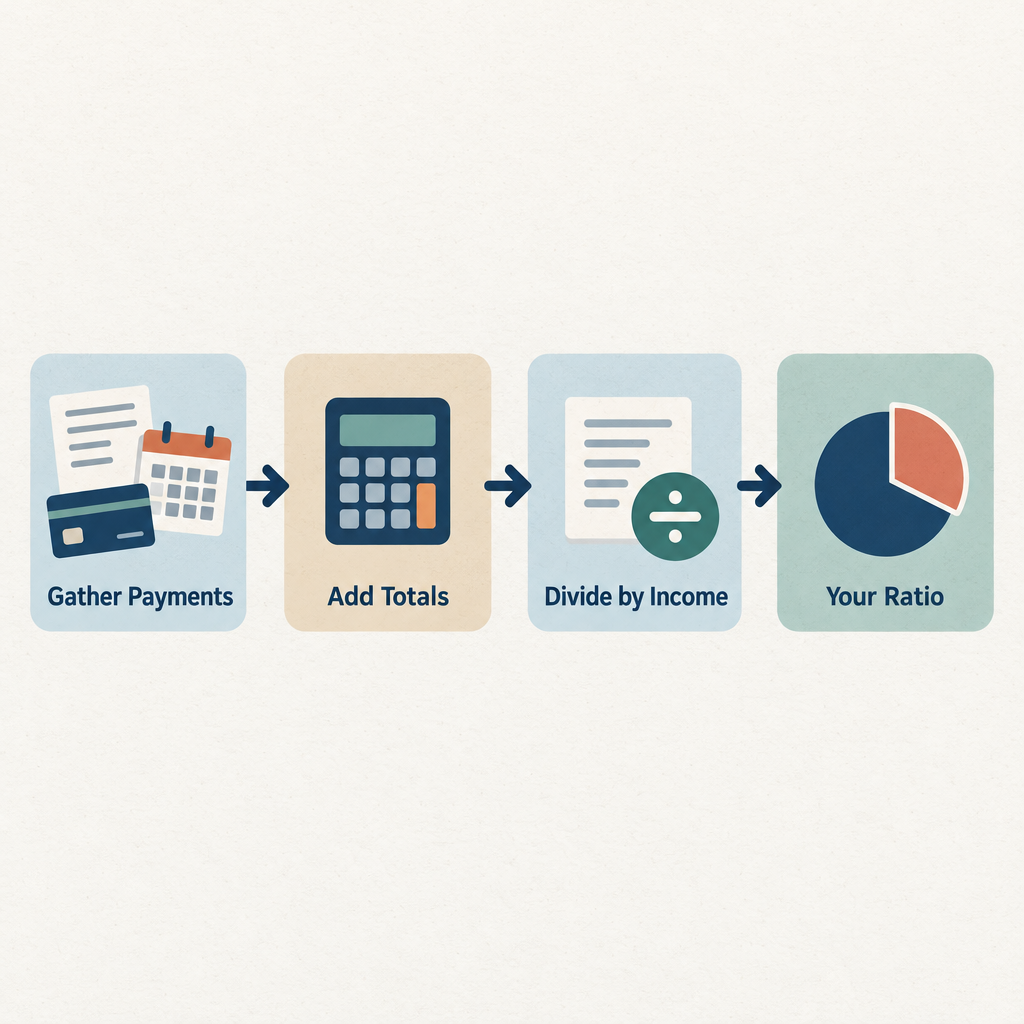
The calculator uses two formulas.
Debt-to-income ratio = (rent or mortgage + car payments + student loans + credit card minimums + other loan payments and support) ÷ gross monthly income × 100.
Housing ratio = rent or mortgage ÷ gross monthly income × 100.
The first is what lenders call the back-end ratio. The second is the front-end ratio. Both are expressed as a percentage of gross pay, and the calculator rounds each to one decimal place.
The default inputs, step by step
With the numbers the calculator loads by default:
- Add the five debt fields: $1,400 + $350 + $200 + $100 + $0 = $2,050.00 in monthly debt payments.
- Divide by gross income: $2,050 ÷ $5,000 = 0.41.
- Multiply by 100: 41.0% debt-to-income ratio.
- Housing ratio: $1,400 ÷ $5,000 = 0.28, so 28.0%.
- Payments left at 36%: 36% of $5,000 is $1,800. Debt payments are already $2,050, which is $250 over that line. The calculator floors this at $0.00 rather than showing a negative.
- Result band: 41.0% falls between 36% and 43%, so the calculator reads it as higher than many lenders prefer.
That borrower is not shut out. A 41% ratio clears VA’s 41% guideline barely, sits under FHA’s 43% baseline, and is well within what Fannie Mae’s automated system can approve. But a conventional lender doing manual underwriting would want it under 36%, and every new payment pushes it further from that.
A second example with different numbers
Say you earn $7,200 gross per month, own a home with a full escrowed mortgage payment of $1,900, have no car payment, pay $275 on student loans, carry $60 in card minimums and have nothing in the other field.
- Debt payments: $1,900 + $0 + $275 + $60 + $0 = $2,235.00.
- $2,235 ÷ $7,200 = 0.3104, so 31.0% DTI.
- Housing ratio: $1,900 ÷ $7,200 = 0.2639, so 26.4%.
- Payments left at 36%: 0.36 × $7,200 = $2,592. Subtract $2,235 and you have $357.00 of monthly payment room.
- Result band: 31.0% is in the range most lenders prefer.
That $357 is a practical number. It is roughly the payment on a $19,000 five-year car loan at 7% APR, which you can confirm with a car payment calculator. Spend more than that and you cross 36%.
Quick reference: maximum debt payments at each threshold
Use this table to find your payment ceiling before you compare loan offers. Each cell is gross monthly income multiplied by the percentage.
| Gross monthly income | Max payments at 36% | Max payments at 43% | Max payments at 50% |
|---|---|---|---|
| $3,000 | $1,080 | $1,290 | $1,500 |
| $4,000 | $1,440 | $1,720 | $2,000 |
| $5,000 | $1,800 | $2,150 | $2,500 |
| $6,000 | $2,160 | $2,580 | $3,000 |
| $7,500 | $2,700 | $3,225 | $3,750 |
| $10,000 | $3,600 | $4,300 | $5,000 |
How single changes move the default result
At $5,000 of income, every $100 of monthly payment equals exactly 2.0 percentage points of DTI. That makes it easy to see what each fix is worth.
| Change from the default inputs | New debt payments | New income | New DTI |
|---|---|---|---|
| None (baseline) | $2,050 | $5,000 | 41.0% |
| Pay off the credit cards ($100 minimum) | $1,950 | $5,000 | 39.0% |
| Pay off the student loan ($200) | $1,850 | $5,000 | 37.0% |
| Pay off the car ($350) | $1,700 | $5,000 | 34.0% |
| Add $500 of documented income | $2,050 | $5,500 | 37.3% |
| Pay off the car and add $500 income | $1,700 | $5,500 | 30.9% |
Paying off the car loan does more than any other single move because it is the largest payment. Paying off a card with a high balance but a $100 minimum barely moves DTI even though it does a lot for your credit score. Those two measures reward different actions, which trips up a lot of people planning a mortgage application.
Target the payment, not the balance
For DTI, the loan with the biggest monthly payment relative to its remaining balance is the one to kill first. A car loan with eight payments left is a prime candidate: Fannie Mae and FHA both let lenders exclude installment debts with 10 or fewer payments remaining, so paying it down to that point can remove the whole payment from your ratio.
Reading your result and what to do with it
The calculator sorts your ratio into four bands. Each lender and mortgage program sets its own limit, so treat these as the general shape of the market rather than a rule.
36% or less. Most lenders prefer this range, and it is the traditional conventional-loan benchmark alongside a 28% housing ratio. You have room to absorb a new payment, and you are more likely to see the lender’s better pricing tiers if your credit score supports it.
36% to 43%. Higher than many lenders prefer. Automated underwriting will often still approve you, but expect more scrutiny of reserves and credit history. A personal loan or auto lender may price you higher. This is where the default example lands.
43% to 50%. High. Some mortgage programs still work here with compensating factors, but many personal loan and credit card issuers decline above 43% to 45%. Adding any debt at this level means something else in your budget is being squeezed.
Above 50%. Very high. Half or more of your gross pay is committed before taxes come out, which means well over half of take-home pay. Most lenders stop here, and the ones that do not are usually the expensive ones.
Here is where the main mortgage programs draw their lines, based on each agency’s published underwriting guide. Check the current version before you apply, because these move.
| Program | Housing ratio guideline | Total DTI guideline | Notes |
|---|---|---|---|
| Fannie Mae conventional | 28% traditional | 36% manual, up to 45% with compensating factors; 50% through Desktop Underwriter | Per the Fannie Mae Selling Guide |
| FHA | 31% | 43% | Higher ratios allowed with documented compensating factors under Handbook 4000.1 |
| VA | None set | 41% | Residual income test is the primary measure; above 41% needs extra justification |
| USDA guaranteed | 29% | 41% | Waivers possible with strong credit and reserves |
If your number came out high, the cheaper paths matter more than finding a lender who will say yes.
Cheaper options first
If you need to lower DTI quickly, a balance transfer at a lower rate rarely helps because the minimum payment barely changes; paying one loan to zero does.
Ask your student loan servicer about an income-driven plan with a documented lower payment before applying for a mortgage.
If you are considering a personal loan to consolidate, run a personal loan calculator to confirm the new single payment is actually lower than the payments it replaces.
A few other moves that work. Documented income counts, so a raise, a second job with a stable history, or rental income with a lease can all raise the denominator. Paying a card down to zero lets you ask the issuer to report a $0 minimum. A credit card payoff calculator will show how fast that happens at different monthly amounts. And if you are in the 43% to 50% band and thinking about a payday or title loan to bridge a gap, understand that those payments usually do not appear on your credit report, so they will not show in a lender’s DTI, but they will absolutely show in your bank statements, which mortgage underwriters read.
Before you borrow
A new loan approved at 45% DTI leaves you with less than half of your take-home pay for everything that is not debt. If your income drops even briefly, there is no cushion, and missed payments turn a ratio problem into a credit score problem that takes years to repair.
The federal rules that apply to your DTI
Ability-to-repay rule under the Truth in Lending Act. Regulation Z, at 12 CFR 1026.43, requires mortgage lenders to make a reasonable, good-faith determination that you can repay the loan. The rule specifically requires the lender to consider your monthly debt-to-income ratio or residual income. Between 2014 and 2021, the General Qualified Mortgage definition carried a hard 43% DTI cap. The CFPB replaced that cap in its December 2020 final rule with a price-based test: a first-lien loan generally qualifies as a General QM when its APR does not exceed the average prime offer rate by more than 2.25 percentage points. So 43% is no longer a federal legal ceiling, though many lenders still use it as an internal line.
APR disclosure under the Truth in Lending Act. Regulation Z (12 CFR 1026) requires every closed-end loan offer to show you the APR, finance charge, amount financed and total of payments before you sign. The payment figure on that disclosure is the exact number to type into this calculator when you are testing a new loan. An apr calculator helps you confirm the lender’s math if fees look high.
Military Lending Act. For active-duty servicemembers and their dependents, 32 CFR Part 232 caps the Military Annual Percentage Rate on most consumer credit at 36%, including most fees. The MLA does not set a DTI limit, but it keeps the cost of the debt in your ratio down, and a lender that charges a covered borrower more is breaking federal law.
Equal Credit Opportunity Act. As noted above, Regulation B bars lenders from discounting or ignoring income because of its source when it is reliable and documented. If a lender refuses to count your part-time or pension income in the DTI calculation, that can be a violation worth reporting to the CFPB.
State rate caps. The interest rate on your existing debt drives the payment, and the payment drives DTI. Several states cap small consumer loans at 36% APR, including Illinois under its Predatory Loan Prevention Act, Nebraska following its 2020 ballot measure, and New Mexico since 2023. Other states allow triple-digit payday APRs. If you live in a high-rate state and carry that kind of debt, the fastest DTI fix is usually refinancing it through a credit union payday alternative loan, which the National Credit Union Administration caps at 28% APR.
Cryptocurrency and IRS Notice 2014-21. The IRS treats crypto as property, so gains are capital gains, not wages. That matters for DTI because gains are not stable income and lenders will not count them. Fannie Mae’s Selling Guide does not accept income paid in virtual currency unless it is converted to US dollars, and crypto assets only count toward reserves once exchanged into dollars and documented in a US account. Crypto can lose all its value and is not FDIC or SIPC insured, so no responsible underwriter treats it as a cushion.
Collections. Accounts in collection generally do not add a monthly payment to your DTI, but FHA and conventional underwriters can require payment plans or payoffs above certain balances. If a debt collector contacts you while you are preparing to apply, know that a payment plan you agree to becomes a monthly obligation the lender will count.
FAQ
What is a good debt-to-income ratio?
Under 36% is the range most lenders prefer, and under 28% for housing alone. You can be approved above that, often up to 43% and sometimes to 50% for a mortgage, but each program and lender sets its own limit and higher ratios usually mean tighter approval conditions.
Does the calculator use gross or net income?
Gross, before taxes and deductions. That is how lenders calculate it, so using take-home pay would make your ratio look worse than what an underwriter sees. Self-employed readers should use net profit after business expenses, which is what appears on Schedule C.
Does my DTI affect my credit score?
No. FICO and VantageScore do not have access to your income, so DTI is not part of any credit score. The two measures are separate: a score tracks how you handle debt, DTI tracks how much of your pay is committed to it. A lender looks at both.
Do utilities, insurance and groceries count as debt?
Not for DTI. The ratio only includes contractual debt payments: housing, auto, student loans, credit card minimums, other loans and court-ordered support. Living expenses matter for your real budget and for the VA’s residual income test, but they are not in this formula.
What if my student loan payment is $0?
Enter what your statement says, then run it again with 0.5% and 1% of your balance. FHA uses 0.5% of the outstanding balance when the actual payment is $0, and Fannie Mae falls back to 1% when no payment is reported, though it accepts a documented $0 income-driven payment. The difference on a $40,000 balance is $200 versus $400 a month.
How fast can I lower my DTI before a mortgage application?
Paying any installment loan down to 10 or fewer remaining payments can remove it entirely under Fannie Mae and FHA rules. Paying a card to zero drops its minimum to $0 on the next statement. Income changes take longer, since most lenders want a two-year history for variable pay and at least a documented start for a new salary.
Is the 43% limit still the law?
No. The 43% cap was part of the General Qualified Mortgage definition in Regulation Z until the CFPB’s 2020 rule replaced it with a price-based test. The ability-to-repay requirement in 12 CFR 1026.43 still forces lenders to consider your DTI or residual income, but there is no federal percentage ceiling today. Many lenders keep 43% as an internal policy anyway.
Why does the calculator show $0.00 payments left at 36%?
Because your debt payments already exceed 36% of your gross income. With the default inputs, 36% of $5,000 is $1,800 and the payments total $2,050, so you are $250 past the line. The calculator shows zero room rather than a negative number. Reduce a payment field or raise income until the figure turns positive.
Comments are closed