


Results are estimates for comparison, not financial advice. Your lender's or card issuer's own disclosure shows the exact cost.
Runs in your browser. Nothing you type is sent or saved.
Most people who file a complaint against a lender send it to one agency. The quickest results usually come from sending it to the right two: a federal channel and the regulator that licenses your lender. Choose your state in the finder above and it lists your state financial regulator, the federal Consumer Financial Protection Bureau (CFPB) portal, your state attorney general and free legal aid. Before you start, have your loan agreement, payment records and any messages from the lender ready.
Your money, in brief
- Put your complaint to the lender in writing first. Every regulator asks whether you did.
- For nearly any consumer loan, file with the CFPB and your state regulator at the same time.
- Companies generally answer CFPB complaints within 15 days and must give a final answer within 60.
- Mortgage borrowers should also send a notice of error, because it starts legal deadlines a complaint does not.
- An agency is not your lawyer. If the answer doesn’t fix the problem, go to the attorney general, small claims court or legal aid.
How to use it
- Pick Your state. Use the state where you lived when you took out the loan. Your loan agreement shows the borrower address.
- Find your lender’s full legal name on the loan agreement or a monthly statement. Note whether it says “N.A.”, “National”, “Federal Credit Union” or carries a state license number.
- Pull the numbers you’ll need. Your account number is on the statement. The dates and amounts of disputed charges are on your bank statement. The APR and finance charge are in the Truth in Lending box of the loan offer or agreement.
- Send the lender a dated written complaint and keep proof of delivery.
- File with the CFPB and with the state regulator the finder lists. Save each confirmation number.
- Put every response deadline in your calendar so you notice the day an answer is late.
Fact-checked
We checked these key facts against the sources named, on November 27, 2026:
- In April 2026 the administration asked a court to approve cutting the workforce to about 556 employees (source: infobytes.orrick.com)
- The One Big Beautiful Bill Act, signed July 4, 2025, cut the bureau’s statutory funding cap roughly in half (source: hklaw.com)
- The CFPB’s 2025 Consumer Response Annual Report, released March 31, 2026, counted about 6,635,400 complaints (source: consumerfinance.gov)
- A request for information under 12 CFR 1024.36 works the same way: 5 days to acknowledge and 30 days to respond (source: ecfr.gov)
- Its Consumer Assistance Center (800-755-1030, Monday to Friday, 8 AM to 5 PM Eastern) asks for a written inquiry (source: mycreditunion.gov)
Quick answer: where to file a complaint against a lender
Complain to the lender first, in writing. Then file with the CFPB, which covers banks, lenders, debt collectors and financial apps. At the same time, file with the regulator that actually supervises your lender. Use HUD for housing discrimination and the FTC for scams.
- The lender: a dated letter or message to its complaint department, with copies kept.
- The CFPB at consumerfinance.gov/complaint. Companies generally respond within 15 days. If they say the response is in progress, they have up to 60 days to give a final one.
- The lender’s own regulator: the OCC for national banks, the FDIC or Federal Reserve for state banks, the NCUA or a state agency for credit unions, and your state financial regulator for licensed nonbank lenders such as payday, title, installment and online lenders.
- Your state attorney general: for unlicensed lenders, deceptive practices and patterns of abuse.
- HUD or the FTC: HUD for discrimination in housing loans, ReportFraud.ftc.gov for fake lenders and advance-fee scams.
The finder’s one field, and the mistakes people make with it
The finder asks a single question, Your state. It starts on California and offers 51 choices: the 50 states plus the District of Columbia. Everything it shows depends on that choice, so choosing the wrong state sends you to an agency with no power over your loan.
Which state to choose
Pick the state where you lived when you borrowed, which is usually where you still live. State lending laws generally protect residents. A licensed online lender has to hold a license in your state, not only in its home state. The state’s interest caps apply to you the same way. Our guide to usury laws explains how those caps work.
Common input mistakes
- Choosing the lender’s state. An online lender based in Utah or Delaware is still subject to your state’s licensing law if it lends to you where you live. Start with your own state.
- Moving after you borrowed. If you’ve moved since, check the borrower address on the contract. You can file in both states if you aren’t sure.
- Expecting the state agency to handle a national bank. A state banking department generally can’t supervise a bank whose name includes “N.A.” That’s the OCC’s job, so the finder’s federal line matters more here.
- Living in a US territory. Puerto Rico, Guam and the other territories aren’t among the 51 choices. You can still use the CFPB portal and the legal aid finder.
- Treating the finder’s list as a ranking. Every line is a separate channel with its own powers. Using two at once is normal.
How the finder works out who handles what
The finder follows one rule. It shows each agency next to the job that agency is legally responsible for.
- State financial regulator: licensing and state lending law (interest caps, fee limits, collection rules for licensed lenders). It comes from our verified state law map, which uses official regulator and legislature sites only. A link to our state loan law guide appears when that guide is live.
- CFPB complaint portal (consumerfinance.gov/complaint): federal consumer finance law for banks, lenders, debt collectors and apps.
- State attorney general: unlicensed and deceptive lenders, plus broader consumer protection. The finder points you to the National Association of Attorneys General (NAAG) directory so you can find yours.
- Free legal help: the Legal Services Corporation (LSC) finder, which locates the legal aid program funded for your area.
Worked example 1: the default inputs (California)
With Your state left on California, the finder shows these lines:
| Finder line | What it shows | What that agency does for you |
|---|---|---|
| Where to get help in | California | California Department of Financial Protection and Innovation (DFPI), plus California lending law |
| Federal complaint (banks, lenders, collectors, apps) | CFPB complaint portal | Sends your complaint to the company and tracks the answer |
| Your state attorney general | Find your AG (NAAG) | Consumer protection, unlicensed or deceptive lenders |
| Free legal help | Legal Services Corporation finder | Free lawyers for people who qualify on income |
Step by step, a California borrower does this:
- Read the state line. DFPI licenses California’s nonbank lenders and brokers. Its complaint page says to file even if you’re pursuing other remedies.
- File on the CFPB portal on the same day as the DFPI complaint.
- Work out the deadlines. A CFPB complaint filed on December 1, 2026 should get a company response by about December 16 (1 + 15). The latest date for a final response is January 30, 2027: 30 days takes you to December 31, and 30 more to January 30.
- Keep the NAAG and LSC lines for later. You’ll need them if the lender turns out to be unlicensed or the answer doesn’t solve the problem.
Worked example 2: a Texas payday borrower
Say you live in Texas and an online payday lender took three debits of $85 that you never authorized. Change Your state to Texas and the same rule applies:
- State regulator: the Texas Office of Consumer Credit Commissioner (OCCC). It licenses payday and title businesses, which Texas calls credit access businesses. Mortgage problems go to the Texas Department of Savings and Mortgage Lending instead.
- Federal: the CFPB portal.
- Attorney general: the Texas AG, found through NAAG.
- Legal help: the LSC finder.
The math for the complaint itself:
- Amount in dispute: 3 × $85 = $255. Ask for exactly that refund.
- Filed with the CFPB on Monday, January 4, 2027. Company response due around January 19 (4 + 15).
- Final response deadline: 60 days after January 4. There are 27 days left in January and 28 in February, which makes 55, so day 60 is March 5, 2027.
- Your feedback window: 60 days after the response. A response on January 19 means your window closes on March 20, 2027 (12 days to January 31, 28 more to February 28, then 20 days into March).
Quick-reference table: who to contact in seven states
This table uses the finder’s rule for seven common choices. For every state, the federal line is the CFPB portal, the attorney general comes from NAAG and legal aid comes from the LSC finder.
| Your state | State regulator for nonbank lenders | Mortgage lenders | Federal channel |
|---|---|---|---|
| California | Department of Financial Protection and Innovation (DFPI) | DFPI | CFPB portal |
| Texas | Office of Consumer Credit Commissioner | Department of Savings and Mortgage Lending | CFPB portal |
| Missouri | Division of Finance | Division of Finance | CFPB portal |
| New York | Department of Financial Services | Department of Financial Services | CFPB portal |
| Florida | Office of Financial Regulation | Office of Financial Regulation | CFPB portal |
| Illinois | Department of Financial and Professional Regulation | Department of Financial and Professional Regulation | CFPB portal |
| Pennsylvania | Department of Banking and Securities | Department of Banking and Securities | CFPB portal |
Reading the result: what it means and what to check first
The result tells you who can act. It doesn’t tell you how strong your case is. Before you file, compare what the lender did with what the lender’s own documents say, and check whether a cheaper fix is available.
What to compare
- The contract against your bank statement. Did the fee, the payment amount or the debit date match what you agreed to?
- The APR in the Truth in Lending box against your state’s cap. If a payday or installment loan in your state is capped and your APR is higher, that’s a state-law complaint. Our personal loan calculator lets you rebuild the payment schedule and check the lender’s math.
- The lender’s license against the state register. If there’s no license, the attorney general and the state regulator become your main channels.
Cheaper and safer options to look at first
A complaint can get a fee reversed. It won’t pay your rent this week. If the dispute is about a high-cost loan you still need to repay, look at these alongside it:
Cheaper options first
Federal credit unions offer payday alternative loans with capped fees and terms. Ask your current lender in writing for a hardship plan or an extended payment plan. A nonprofit credit counseling agency can review all your debts at no or low cost.
If you’re considering a cash advance app as a stopgap, check its fees first. “Optional” tips and instant-transfer charges can work out to a high APR on a small advance.
Who regulates my lender? A routing guide by lender type
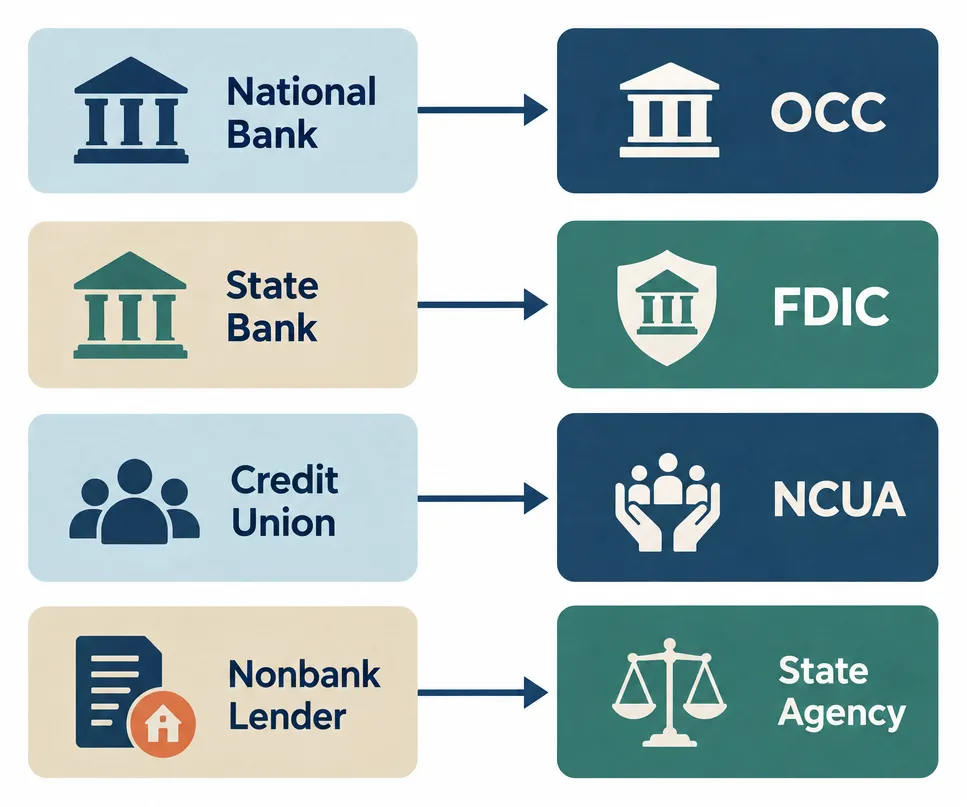
Your lender’s charter or license decides who can make it fix things. Read the name on your statement, then match it in the table below.
| Lender type | Primary regulator | Also file with | Phone / site | Notes |
|---|---|---|---|---|
| National bank or federal savings association (“N.A.”, “National”, “FSB”) | OCC Customer Assistance Group | CFPB | 1-800-613-6743, HelpWithMyBank.gov | You can appeal only the OCC’s own response |
| State bank, Federal Reserve member | Federal Reserve | State banking department, CFPB | Federal Reserve Consumer Help | The FFIEC Consumer Help Center identifies the regulator |
| State bank, not a Fed member | FDIC | State banking department, CFPB | FDIC Information and Support Center | Handled by the FDIC Consumer Response Unit |
| Federal credit union | NCUA Consumer Assistance Center | CFPB | 800-755-1030 | Written inquiry required |
| State-chartered credit union | State credit union regulator | NCUA, CFPB | State agency | Missouri, for example, has a separate Division of Credit Unions |
| Payday, title, installment, online or auto finance lender | State financial regulator | CFPB, state AG | Listed by the finder | Check the state license first |
| Mortgage servicer | Notice of error to the servicer, then the state mortgage regulator | CFPB | Servicer’s designated address | Regulation X deadlines apply |
| Lending discrimination | HUD (housing) or CFPB (other credit) | State civil rights agency | HUD | Fair Housing Act, Equal Credit Opportunity Act |
| Fake lender or scam | FTC | State AG, FBI IC3 | ReportFraud.ftc.gov | Real lenders don’t demand upfront “insurance” fees |
How to tell if your bank is national or state-chartered
The name usually tells you. “N.A.” stands for National Association, and any bank with that, or with “National” in its name, is supervised by the Office of the Comptroller of the Currency. For other banks, look the institution up in the FFIEC Consumer Help Center at apps.ffiec.gov/consumercenter, which names the federal regulator. Very large banks, those with more than $10 billion in assets, are also supervised by the CFPB for federal consumer law. That’s one more reason to file there too.
Nonbank and online lenders: check the state license
Payday, title, installment and most online lenders aren’t banks, so the state licenses them. Look the company up on the state regulator’s license search before you file. California’s DFPI and Missouri’s Division of Finance both publish licensee searches, and NMLS Consumer Access covers mortgage companies and many consumer lenders across states. If no license appears, say so in your complaint. Lending without a required license is often a violation in itself.
Some online lenders say they’re owned by a Native American tribe and that state law doesn’t reach them. Courts and regulators have pushed back on that claim many times. You can still file with the CFPB, your state regulator and your attorney general. They decide jurisdiction, not the lender.
Payday lenders that keep hitting your bank account
To complain about a payday lender’s repeated debits, use three channels at once: your state regulator, the CFPB (under “Payday loan, title loan, or personal loan”) and your bank. The bank is the one that can actually stop the next debit, which is covered below under protecting yourself.
Credit unions: federal vs. state charter
“Federal Credit Union” in the name means the National Credit Union Administration. Its Consumer Assistance Center (800-755-1030, Monday to Friday, 8 AM to 5 PM Eastern) asks for a written inquiry. Its 2026 form states it can’t review a matter that’s the subject of a pending lawsuit. A state-chartered credit union answers first to your state’s credit union regulator.
Complaining about a debt collector
Debt collection was the CFPB’s largest category after credit reporting in 2025, at about 387,400 complaints. Collection agencies are covered by the Fair Debt Collection Practices Act. File with the CFPB and with your state attorney general, and with your state regulator too if your state licenses collectors. Our guide to what a debt collector can and cannot do lists the specific conduct the law bans.
When it’s a scam, not a lender
A “lender” that guarantees approval, then asks for a fee by gift card, wire or crypto before releasing the money is running an advance-fee scam. Report it at ReportFraud.ftc.gov and to your state attorney general. If you paid by wire or crypto, report it to the FBI’s IC3 as well.
Before you file: the letters that legally start a clock
A CFPB complaint asks a company to respond. Some letters go further, because federal law gives the company a fixed deadline to answer them. Send these first, or at least at the same time.
Mortgage servicers: notice of error under Regulation X
A written notice of error sent to your servicer’s designated address is governed by Regulation X (12 CFR 1024.35), which carries out the Real Estate Settlement Procedures Act. That address is often printed on your statement. Under 1024.35, the servicer must:
- acknowledge it in writing within 5 business days;
- fix the error or explain in writing why there’s none within 30 business days, with one 15-day extension allowed if it notifies you in writing before the deadline;
- resolve a payoff balance error within 7 business days;
- respond to a foreclosure-related error before the sale date or within 30 business days, whichever comes first.
A request for information under 12 CFR 1024.36 works the same way: 5 days to acknowledge and 30 days to respond. The exception is a request for the name and contact details of the loan’s owner, which gets 10 days. Weekends and federal holidays don’t count in either rule.
Here’s how the business-day count works. A notice the servicer receives on Monday, January 4, 2027 must be acknowledged by January 11. A payoff error must be resolved by January 13. The 30-business-day deadline falls on February 17, 2027, once you skip weekends, Martin Luther King Jr. Day (January 18) and Presidents Day (February 15).
Did you know?
Under Regulation X (12 CFR 1024.35), a mortgage servicer has only 7 business days to correct a payoff balance error or explain why there isn’t one. That’s much faster than the usual 30.
Credit report errors: dispute with the bureau first
For a wrong late payment or a balance that isn’t yours, dispute it directly with Equifax, Experian or TransUnion. The Fair Credit Reporting Act (15 U.S.C. 1681i) gives the bureau 30 days to reinvestigate. That can stretch to 45 days if you send more information during the window. The bureau must send you the results within 5 business days after it finishes. The CFPB expects you to have tried this before you complain to it about a credit report.
Everyone else: a dated written complaint to the lender
For payday, auto, installment and credit card problems, write to the company’s complaint department by email, through its secure message center or by certified mail. Set out the problem, the dates and amounts, and the fix you want. Regulators will ask whether you did this.
Response deadlines at a glance
| Channel | Acknowledgment | Response deadline | Your follow-up window | Source |
|---|---|---|---|---|
| CFPB complaint | On submission | Generally 15 days; up to 60 days for a final response | 60 days to give feedback | CFPB complaint page |
| Mortgage notice of error | 5 business days | 30 business days (+15 once); 7 for payoff errors | Escalate after the deadline | Regulation X, 12 CFR 1024.35 |
| Mortgage request for information | 5 business days | 30 business days; 10 for owner identity | Escalate after the deadline | Regulation X, 12 CFR 1024.36 |
| Credit report dispute | Not fixed | 30 days (up to 45) | Results within 5 business days of finishing | Fair Credit Reporting Act, 15 U.S.C. 1681i |
| Missouri Division of Finance | Copy of its letter to the company | About 30 days (an estimate, not a legal deadline) | Reply to the agency | Missouri Division of Finance |
How to file a CFPB complaint step by step
The CFPB complaint portal takes a consumer financial complaint about bank accounts, credit cards, mortgages, vehicle loans, payday, title and personal loans, student loans, debt collection, credit reporting, money transfers and digital payment apps. You’ll need your name, email, phone number and mailing address, plus the company’s name.
What to include
Describe what happened in date order, name the company exactly as it appears on your statement, and say what fix you want. You can attach documents up to 50 pages in total, so pick the pages that prove your point: the contract page with the fee terms, the statement showing the charge and your earlier letter.
What happens after you submit
- The CFPB reviews the complaint and sends it to the company, or refers it to another regulator if that agency has jurisdiction.
- The company reviews it and generally responds within 15 days.
- If the company says the response is in progress, it has up to 60 days to give a final response.
- You can read the response in your account and give feedback within 60 days.
- The CFPB uses complaints to inform supervision and enforcement. Some complaint data is published without your personal details.
Did you know?
According to the CFPB’s complaint page, you can’t delete a complaint once you’ve filed it. The bureau keeps complaint records, including your personal information, for 25 years.
Filing on behalf of a parent or spouse
You can file for someone else, but the company will generally need that person’s written authorization before it discusses the account with you. Attach a signed letter that names you, the account and the issue. A power of attorney also works.
How to write a complaint that gets a real answer (with template)
Strong complaints are short, dated and specific about the fix. Someone reading a complaint at the company has to know within one minute what went wrong, when, how much it cost and what will settle it. The same structure works for the lender, the CFPB and your state regulator.
Copy-and-paste complaint template
[Your full name]
[Your mailing address]
[Date]Re: [Lender’s legal name], account number [Account number]
The problem: On [Date of the problem], [Lender’s legal name] [what happened, for example charged a $35 late fee although my payment posted on time]. This conflicts with [the contract term, statement or law you rely on].
Timeline:
– [Date]: [Event and amount]
– [Date]: [Event and amount]
– [Date]: I contacted the lender by [method] and was told [response]. Reference number [Reference number].What I am asking for: [The specific fix, for example a refund of $35 to my account and correction of the late payment reported for [Month and year]].
Attached: [List of documents].
[Your full name]
[Phone number]
What not to say to a lender or in a complaint
- No admissions you don’t mean. “I know I’m behind, but” can be used against you. Stick to the facts.
- No threats. Saying “I’ll post this everywhere” or “I’ll sue” without a lawyer makes your complaint easier to dismiss.
- No unrelated grievances. Old disputes and rude staff hide the one issue you can win.
- No exaggeration. One wrong number gives the company a reason to doubt the rest.
- One problem per complaint. You generally can’t file a second CFPB complaint about the same issue, so get the first one right.
Say exactly what you want
“Refund the $35 late fee charged on March 3” gets a clearer answer than “fix my account.” Companies answer the request they’re given, and a vague request gets a vague reply.
Documents that strengthen your case
| Document | Why it matters | Where to get it |
|---|---|---|
| Loan agreement and Truth in Lending disclosure | Shows the APR, fees and terms you agreed to | Loan offer email, lender’s online account |
| Monthly statements | Show the disputed charge and balance | Lender’s portal or mail |
| Bank statements | Prove when payments or debits actually happened | Your bank’s online banking |
| Written messages and letters | Prove you contacted the lender and what it said | Your email, secure messages, certified mail receipts |
| Call log | Dates, names and reference numbers of calls | Your own notes, phone records |
| License lookup screenshot | Shows whether the lender is licensed in your state | State regulator’s license search, NMLS Consumer Access |
Filing with your state financial regulator and attorney general
States can do things the CFPB can’t, such as suspending a lender’s license. California’s DFPI tells consumers to file even when they’re pursuing the dispute another way. Filing at both the state and federal level costs you nothing but time.
State banking and finance departments
A state financial regulator handles licensing and state law. It can examine a licensee, order restitution, impose penalties and suspend or revoke a license. The process is usually simple. The Missouri Division of Finance sends the company a letter asking for a response, copies you and says the process generally takes about 30 days. Some agencies want a signed, written complaint. The Texas Department of Savings and Mortgage Lending is one, so check the form’s signature line.
State attorney general consumer protection units
Attorneys general go after deceptive practices and lenders that operate without a license, and they often act on patterns that show up across many complaints. A March 2026 year-in-review from the law firm Goodwin reported that state AGs and banking regulators stayed active on payday and small-dollar enforcement in 2025. It expects more state action as the CFPB pulls back. This is where to report a predatory lender that isn’t licensed at all.
Recovery funds for harm by licensed originators
Some states keep funds that can repay consumers harmed by licensed professionals. Texas runs a recovery fund through its Department of Savings and Mortgage Lending for losses caused by licensed residential mortgage loan originators. Each fund has its own eligibility rules and usually requires a court judgment or a finding first.
Complaints against banks and credit unions: OCC, FDIC, Federal Reserve, NCUA
Each federally insured bank and credit union has one primary federal regulator, and that agency’s consumer unit takes complaints. Send yours to the agency that matches the charter, and copy the CFPB.
OCC (HelpWithMyBank.gov)
The OCC Customer Assistance Group handles national banks and federal savings associations. You can reach it at 1-800-613-6743 or at P.O. Box 53570, Houston, TX 77052, or file online at HelpWithMyBank.gov. You can appeal the OCC’s handling of a complaint, but only the OCC’s own response. You can’t appeal the answer the bank sent you directly.
FDIC Information and Support Center
The FDIC’s Consumer Response Unit investigates complaints about the state banks it supervises (state-chartered banks that aren’t Federal Reserve members). You file through the FDIC Information and Support Center. Complaints about state banks that are Fed members go to the Federal Reserve’s consumer help service instead.
NCUA Consumer Assistance Center
The NCUA reviews disputes with federal credit unions once you’ve put the inquiry in writing. It won’t take up a matter that’s already in a lawsuit, so file there before you sue.
Discrimination and scams: HUD, fair lending and the FTC
Lending discrimination
The Fair Housing Act bans discrimination in home lending based on race, color, national origin, religion, sex, familial status or disability. You file with HUD, and generally within one year of the discriminatory act. The Equal Credit Opportunity Act covers all credit, including car loans and credit cards. It adds marital status, age and receipt of public assistance to the protected grounds. File ECOA complaints with the CFPB or the lender’s regulator.
If you think a bank closed your account or refused service because of your politics or religion, complain to the bank’s federal regulator. Executive Order 14331 (Guaranteeing Fair Banking for All Americans), signed August 7, 2025, directed federal banking regulators to review their supervisory and complaint data for unlawful debanking.
Advance-fee loan and mortgage relief scams
Americans reported a record $15.9 billion in fraud losses to the FTC in 2025, up from $12.5 billion in 2024, across about 3 million fraud reports. Fake lenders follow a familiar pattern: guaranteed approval, pressure to act today, then an upfront “processing” or “insurance” fee. Companies offering mortgage relief generally can’t charge fees until you’ve accepted an offer from your lender, under the federal mortgage assistance relief services rule. Report scams at ReportFraud.ftc.gov and to your attorney general.
Before you pay anyone to help
Lenders and “complaint recovery” services that ask for money upfront, especially by gift card, wire or crypto, are the most common way people under money pressure lose more. Filing with the CFPB, the FTC, HUD and state regulators is always free.
Does filing a complaint actually do anything?
Yes, within limits. A complaint makes the company give a documented answer to a regulator, and that answer goes on record. It doesn’t make the agency your lawyer or a judge in your dispute.
What the 2025 numbers show
The CFPB’s 2025 Consumer Response Annual Report, released March 31, 2026, counted about 6,635,400 complaints. That’s more than double the roughly 3.2 million in 2024. About 90% (5,984,100) were sent to companies for a response, 3% went to other regulators and 7% weren’t actionable.
| Product | Complaints received, 2025 | Share of total |
|---|---|---|
| Credit or consumer reporting | 5,806,800 | 87.5% |
| Debt collection | 387,400 | 5.8% |
| Credit cards | 114,100 | 1.7% |
| Checking or savings | 104,200 | 1.6% |
| Mortgages | 30,400 | 0.5% |
| Student loans | 23,700 | 0.4% |
The report says credit repair and other actors misused the system, which explains much of the credit reporting surge. A clear complaint about a real loan stands out in that volume.
The CFPB in 2026: what’s changed
The One Big Beautiful Bill Act, signed July 4, 2025, cut the bureau’s statutory funding cap roughly in half. A federal judge ruled in December 2025 that the CFPB could keep drawing Federal Reserve funds, which averted furloughs. A revised reduction-in-force plan dated March 27, 2026 followed. In April 2026 the administration asked a court to approve cutting the workforce to about 556 employees. A secondary analysis of federal workforce data counts covered CFPB staff falling from 1,752 in January 2025 to 1,082 in June 2026. The complaint portal is still open as of November 2026 and still sends complaints to companies. Investigations and enforcement are thinner, which is why the state filing now matters more.
Who holds banks accountable
Bank regulators do: the OCC, the FDIC, the Federal Reserve, the NCUA and state banking departments. They examine institutions, and complaint patterns feed those exams. Courts and arbitrators decide individual disputes, which is why the escalation steps below exist.
If the response doesn’t fix it: escalation options
A CFPB complaint closes once the company responds, even if the answer is vague. That’s the point to use your feedback and move to the next channel.
- Give feedback within 60 days. Say specifically what the response left out.
- File with the regulator you skipped, whether that’s the state agency, the OCC, the FDIC or the NCUA.
- Appeal to the OCC if it handled a national bank complaint and you think it got the facts wrong.
- Go to the state attorney general, especially for unlicensed or deceptive lenders.
- Check your contract for an arbitration clause before you go to court.
- Talk to a consumer attorney or legal aid. The finder’s LSC line locates free help if you qualify.
Can I sue my lender or mortgage servicer?
Often, yes. The Real Estate Settlement Procedures Act gives borrowers a private right to sue servicers that violate certain duties, including the notice of error rules. The Fair Debt Collection Practices Act, the Fair Credit Reporting Act and the Truth in Lending Act also allow private lawsuits, and several of them let you recover attorney’s fees. That’s why many consumer lawyers take strong cases with no upfront fee. Talk to a lawyer before a foreclosure sale date, a lawsuit served on you or a filing deadline under the statute.
Small claims vs. arbitration
Many loan agreements require arbitration but carve out small claims court. Small claims is quick and cheap, and you don’t need a lawyer, which makes it a good fit for a refund like the $255 in the Texas example. Read the arbitration clause for the carve-out and for any deadline to opt out.
Finding free legal help
LSC-funded legal aid programs take consumer cases for people who qualify on income. Servicemembers can also use their base legal assistance office. The Military Lending Act caps most consumer loans to covered servicemembers and their dependents at a 36% military annual percentage rate.
Protect yourself while the complaint is open
A complaint doesn’t pause your loan. Keep these habits until the dispute is settled.
- Keep paying the amounts you don’t dispute. That way late fees and credit damage can’t build up on top of the dispute.
- Revoke ACH authorization in writing. Tell the lender, and tell your bank at least 3 business days before the next scheduled debit. That’s your right under the Electronic Fund Transfer Act and Regulation E. Report unauthorized debits to your bank within 60 days of the statement that shows them.
- Keep a call log with the date, time, name and reference number of every call.
- Watch your credit reports from Equifax, Experian and TransUnion for new negative marks.
- Ignore “complaint recovery” services that charge fees to do what the free portals do.
If you’re also working out how to clear the balance, our debt payoff calculator compares the snowball and avalanche orders.
The official rules that apply
These are the laws and regulations behind each channel, by their official names:
- Truth in Lending Act and Regulation Z (12 CFR 1026): APR and finance charge disclosures, plus credit card billing disputes.
- Real Estate Settlement Procedures Act and Regulation X (12 CFR 1024.35 and 1024.36): notices of error and requests for information to mortgage servicers.
- Fair Credit Reporting Act (15 U.S.C. 1681i): credit report disputes and the 30-day reinvestigation.
- Fair Debt Collection Practices Act: conduct rules for third-party debt collectors.
- Equal Credit Opportunity Act and the Fair Housing Act: lending discrimination.
- Electronic Fund Transfer Act and Regulation E (12 CFR 1005): stopping preauthorized debits and disputing unauthorized ones.
- Military Lending Act: the 36% cap and other protections for covered servicemembers.
- Executive Order 14331: the federal banking regulators’ review of debanking.
- Your state’s lending statutes, which the finder links from your state’s legislature and regulator sites.
FAQ
Does filing a complaint with the CFPB do anything?
Yes. In 2025, about 90% of CFPB complaints went to companies for a response, and companies must answer through the portal. A complaint doesn’t decide who’s right in your dispute. If the answer is vague, use the 60-day feedback window and file with your state regulator.
Will my complaint even get looked at now that the CFPB is being cut?
The portal remains open as of November 2026 and keeps sending complaints to companies. What has shrunk is the bureau’s staff for investigations, so file with your state financial regulator at the same time to make sure an agency with enforcement power sees it.
How do I file a complaint against a payday or online lender?
Start with a written complaint to the lender. Then file with your state regulator (the finder lists it) and with the CFPB under payday, title or personal loans. If the lender isn’t licensed in your state, add your attorney general. For unauthorized debits, tell your bank in writing as well.
My lender isn’t licensed in my state. Can I still report it?
Yes. Lending without a required license is exactly what state regulators and attorneys general act on. Include a screenshot of the empty license search in your complaint.
How do I file a complaint against a mortgage company?
Send a written notice of error to the servicer’s designated address. That gives it 5 business days to acknowledge the notice and 30 to respond. Then file with the CFPB and your state mortgage regulator. In Texas, that’s the Department of Savings and Mortgage Lending.
How do I file a complaint against a bank with the FDIC?
Confirm the bank is a state non-member bank through the FFIEC Consumer Help Center. Then submit your complaint through the FDIC Information and Support Center, with copies of your statements and your earlier letter to the bank.
How long does a lender have to respond to a CFPB complaint?
Generally 15 days. If the company says its response is in progress, it has up to 60 days to send a final one. You then have 60 days to give feedback.
Can I file with the CFPB and my state at the same time?
Yes, and you should. California’s DFPI says to file even if you’re pursuing the dispute elsewhere. Each agency has different powers.
Should I file with the BBB and the CFPB at the same time?
You can, but the Better Business Bureau is a private organization with no legal authority over lenders. Government regulators can require answers and take enforcement action, so put them first.
What should you not say to a lender?
Don’t admit fault you don’t accept, don’t make threats and don’t bring in unrelated grievances. Keep each complaint to one problem, with dates, amounts and the exact fix you want.
Will filing a complaint hurt my credit or my relationship with the lender?
A complaint doesn’t appear on your credit report. Lenders can’t legally retaliate against you for using your rights under the federal consumer protection laws. Keep paying the amounts you don’t dispute so the account stays in good standing.
What should I do first?
Choose your state in the finder, look up your lender’s license or charter, and send your dated written complaint to the lender today. Every deadline in this guide starts from the day that letter, or your first filing, is received.
Laws and regulations referenced
- Truth in Lending Act, 15 U.S.C. 1601
- Regulation Z, 12 CFR Part 1026
- Fair Debt Collection Practices Act, 15 U.S.C. 1692
- Fair Credit Reporting Act, 15 U.S.C. 1681
- Equal Credit Opportunity Act, 15 U.S.C. 1691
- Electronic Fund Transfer Act, 15 U.S.C. 1693
- Regulation E (electronic transfers), 12 CFR Part 1005
- Military Lending Act, 10 U.S.C. 987
Links go to the official text on government sites.
Check, verify or complain
Sources
- Submit a complaint | Consumer Financial Protection Bureau consumerfinance.gov · official source
- CFPB Consumer Response Annual Report 2025 files.consumerfinance.gov · official source
- 12 CFR 1024.35 Error resolution procedures - eCFR ecfr.gov · official source
- 12 CFR 1024.36 Requests for information - eCFR ecfr.gov · official source
- 15 U.S.C. 1681i Procedure in case of disputed accuracy uscode.house.gov · official source
- File an appeal - HelpWithMyBank.gov (OCC) helpwithmybank.gov · official source
- NCUA Consumer Inquiry Form 2026 mycreditunion.gov · official source
- FDIC consumer complaint process fdic.gov · official source
- Missouri Division of Finance consumer complaint finance.mo.gov · official source
- Executive Order 14331 Guaranteeing Fair Banking for All Americans - Federal Register govinfo.gov · official source
- FTC Protecting Older Consumers Report, December 2025 search.ftc.gov · official source
- How do I file a written complaint against a national bank or federal savings association? bankcustomer.gov · official source
- FFIEC Consumer Help Center apps.ffiec.gov · official source
- File a Payday Loans-Title Loan Complaint - Connecticut DOB portal.ct.gov · official source
- Submit a Complaint - California DFPI dfpi.ca.gov · official source
- Where to file a complaint about a mortgage company - USA.gov usa.gov · official source
- Consumer Complaints - Texas Department of Savings and Mortgage Lending sml.texas.gov · official source
- Consumer Complaints - Missouri Division of Finance finance.mo.gov · official source
- CFPB received 6.6M consumer complaints in 2025 - ABA Banking Journal bankingjournal.aba.com
- CFPB reports complaint volume doubled in 2025 - Orrick InfoBytes infobytes.orrick.com
- CFPB 2025 report on complaints received compliancecohort.com
- CFPB staves off furloughs after receiving funding - Government Executive govexec.com
- CFPB Revised Reduction-in-Force Plan infobytes.orrick.com
- CFPB workforce reorganization 2026 federalhiringdata.com
- Payday and small-dollar lending year in review - Goodwin goodwinlaw.com
- Consumer fraud losses, FTC 2025 data - PYMNTS pymnts.com
- Does CFPB Scare Lenders & Collectors Straight? - myFICO Forums ficoforums.myfico.com
- Consumer Financial Protection Bureau Reviews - Trustpilot ca.trustpilot.com
- One Complaint To CFPB Fixes Mortgage Snafu - Consumerist consumerist.com

Owen explains how crypto works for US readers: coins and tokens, buying and selling, wallets and self-custody, staking and DeFi. He sticks to how things work and what they cost, never price calls, and checks platform fees and licensing against the companies' own disclosures.
Ruth is US Financer's standards editor. Every article goes through her checks before and after it is published: each rate, fee, cap, deadline and rule is matched against its primary source, every law named is linked to its official text, and anything that cannot be…
What changed
- Nov 27, 2026 First published.
Comments are closed