

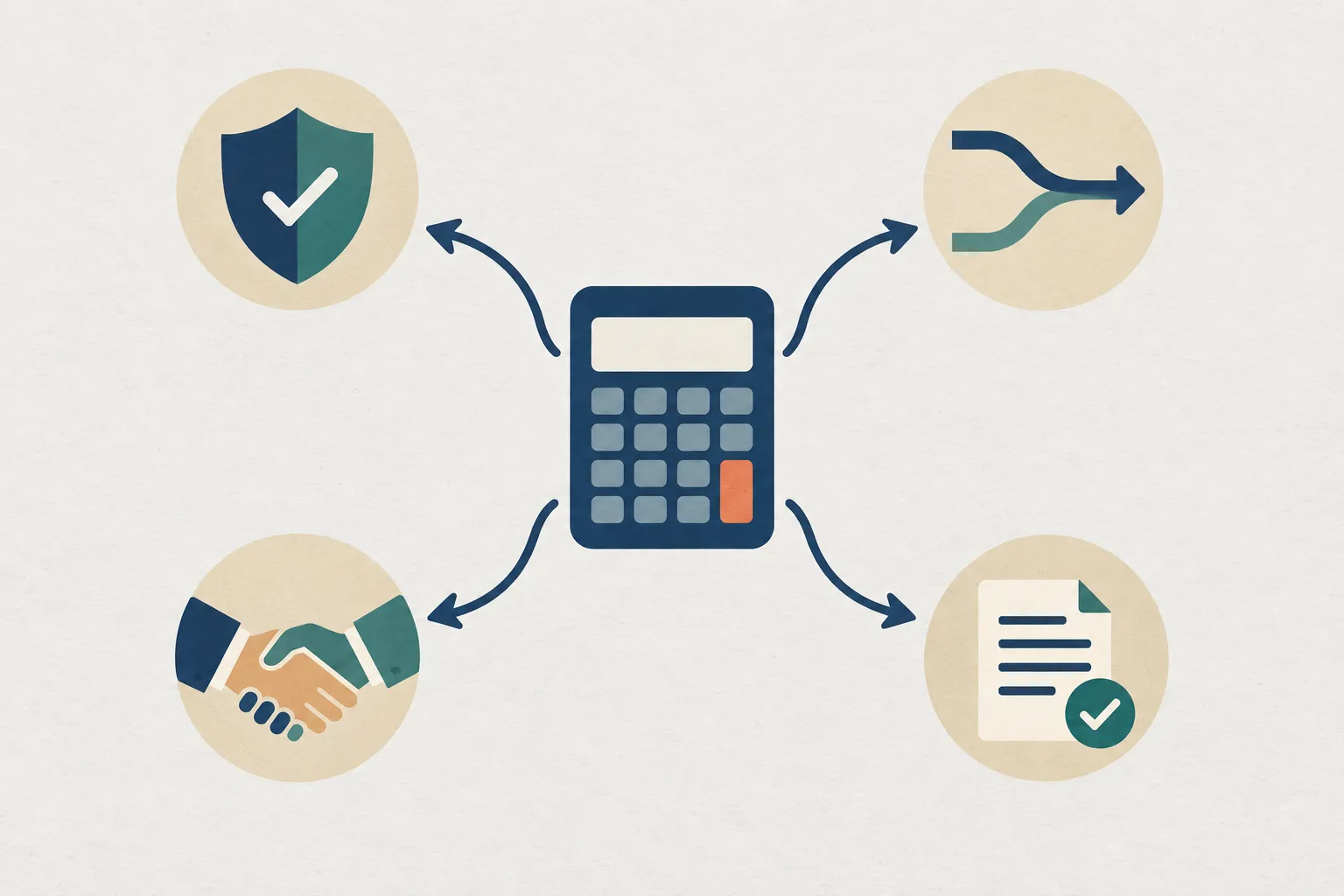
Results are estimates for comparison, not financial advice. Your lender's or card issuer's own disclosure shows the exact cost.
Runs in your browser. Nothing you type is sent or saved.
The debt relief calculator above puts your current payments, a nonprofit debt management plan, a consolidation loan and debt settlement side by side for the same debt. The average credit card rate was 21.19% in August 2026, according to the Federal Reserve. At rates like that, picking the wrong route can cost thousands of dollars. Before you start, have your latest card statements, any loan offer you have received and your most recent tax return in front of you.
Your money, in brief
- The headline result is the cheapest way to repay the debt in full. Settlement is shown on its own line because you don’t repay in full and your credit takes damage.
- With the default inputs, a debt management plan costs $18,184, compared with $24,966 if you keep paying as you are now.
- Settlement looks cheapest on paper ($11,400 here), but that figure includes a $3,000 fee and $900 of possible tax on the forgiven debt.
- Under the FTC’s Telemarketing Sales Rule, a debt relief company selling by phone can’t charge you until it has settled a debt and you have made a payment to that creditor.
- Every rate in the calculator is your own input. The defaults are examples, not quotes.
How to use it
- Add up the balances on your credit cards, medical bills, personal loans and other unsecured debts from your latest statements. Enter the total in Total unsecured debt ($).
- Find the purchase APR on each statement and enter a balance-weighted average in Average APR now (%). Then enter what you actually pay each month from your bank records in What you pay each month now ($).
- For a debt management plan, put the rate and monthly fee a nonprofit credit counseling agency quotes you into Debt management plan APR (%) and Plan monthly fee ($).
- From a written loan offer, copy the interest rate, the term and the origination fee into Consolidation loan APR (%), Loan term (months) and Loan origination fee (%).
- For settlement, enter a realistic share in Share of the debt creditors accept in settlement (%) and the fee from the company’s contract in Settlement company fee (% of debt).
- Find your marginal federal bracket on last year’s return, add your state income tax rate, and enter the total in Your tax rate on forgiven debt (%).
What each field means, and the input mistakes that skew results
The calculator has 11 inputs in four groups. Three describe your debt today, and the rest describe the terms of each relief route. Most bad results come from four habits: putting secured debt in the total, using a national average instead of your own APR, counting a loan’s origination fee twice, and guessing low on the tax rate.
Your current debt
Total unsecured debt ($), default 15000. Add up debts that have no collateral behind them: credit cards, store cards, medical bills, unsecured personal loans and old utility balances. Leave out your mortgage and car loan. Settlement and debt management plans don’t work on secured debt, and a car payment calculator handles those loans better. Leave out federal student loans too. They have their own income-driven repayment and forgiveness programs, and they rarely fit a card-focused plan.
Average APR now (%), default 24. If you have several cards, weight the average by balance. Take $6,000 at 27% and $9,000 at 22%: (6,000 × 27 + 9,000 × 22) ÷ 15,000 = 24%. A plain average of the two rates would give 24.5% and slightly overstate your cost.
What you pay each month now ($), default 450. Enter what you really pay, not the minimum printed on the statement, unless the minimum is all you pay. This number has to be larger than one month’s interest, or the “keep paying” line never reaches zero. At the default 24% on $15,000, interest alone is $300 a month.
Use your statement, not an average
Copy the APR printed on your latest statement, not a national figure. If part of a balance carries a cash-advance or penalty APR, weight it into the average at that higher rate. The calculator also assumes you stop adding new charges, so a card you keep using will take longer to clear than the result shows.
Debt management plan fields
These two inputs are the debt management plan calculator part of the tool. Debt management plan APR (%), default 8, is the reduced rate creditors agree to when a nonprofit credit counseling agency sets up a plan. Each creditor sets its own concession, so ask the agency for a rate on each card and weight them the way you did above.
Plan monthly fee ($), default 25, is the agency’s ongoing monthly charge. States regulate these fees, and many agencies waive them if you can’t afford them. A one-time setup fee isn’t a monthly fee. To include one, spread it over the months of the plan and add it to this field.
Consolidation loan fields
Consolidation loan APR (%), default 14, Loan term (months), default 36, and Loan origination fee (%), default 5, come from a written loan offer. The calculator adds the origination fee on its own, so it needs the loan’s interest rate here. An APR on a loan disclosure under the Truth in Lending Act already includes the fee. If you type that APR and also enter the fee, you count the fee twice. If your offer shows only an APR, enter it and set the origination fee to 0.
The fee is usually taken out of the money you receive. To pay off $15,000 with a 5% fee, you need to borrow $15,789.47, and the calculator does that for you. Lenders also look at your debt load when they decide on an offer. A debt-to-income ratio calculator shows how a lender is likely to see your application.
Debt settlement fields
Share of the debt creditors accept in settlement (%), default 50, is the share of the balance you pay creditors to close the debt. Nobody can promise you a number. Some creditors won’t settle at all, and balances often grow with late fees and interest while you save up a lump sum.
Settlement company fee (% of debt), default 20, is charged on the debt you enroll, not on what you save. CFPB enforcement records describe a settlement company charging 25% of enrolled debt, and some states cap fees lower. If a contract quotes a percentage of savings instead, convert it. For example, 40% of the savings on a 50% settlement equals 20% of the debt.
Your tax rate on forgiven debt (%), default 12, is your marginal rate, meaning the rate on your next dollar of income, plus any state income tax. Forgiven debt counts as income and can push part of your income into a higher bracket. If you were insolvent at the time of the settlement, the right figure may be 0% (more on that below).
How the debt relief calculator works: the formulas and two worked examples
The calculator runs four separate calculations on your inputs and labels the cheapest of the three full-repayment routes as the headline. Settlement isn’t eligible for the headline because you don’t repay in full and your credit is damaged. All figures below use the calculator’s rule as of November 2026.
The four formulas
- Keep paying as now. Each month, interest = balance × APR ÷ 12 ÷ 100. Your payment covers that interest first, and the rest reduces the balance. This repeats until the balance reaches zero.
- Debt management plan. Your current monthly payment minus the plan fee goes to creditors at the plan APR, paid down the same way. Total = debt + interest + (fee × months).
- Consolidation loan. Amount borrowed = debt ÷ (1 − origination fee %). The monthly rate is r = APR ÷ 12 ÷ 100 and the term is n months. Payment = amount × r ÷ (1 − (1 + r)^−n). Total = payment × n.
- Debt settlement. Total = (debt × share accepted) + (settlement fee % × debt) + (tax rate × forgiven part). The forgiven part is the debt minus what creditors accept.
Worked example 1: the default inputs
The defaults are $15,000 at 24%, a $450 payment, a plan at 8% with a $25 fee, a 14% loan over 36 months with a 5% fee, settlement at 50% with a 20% fee, and a 12% tax rate.
- Keep paying. The monthly rate is 24 ÷ 12 = 2%. In the first month, $300 of your $450 goes to interest and only $150 to principal. Payoff takes 56 months (4 years 8 months) and costs $24,966, which is $9,966 in interest.
- Debt management plan. $450 − $25 = $425 goes to creditors at 8% ÷ 12 = 0.667% a month. First-month interest is $100, so $325 goes to principal. Payoff takes 41 months (3 years 5 months). You pay creditors $17,159 and the agency 41 × $25 = $1,025, for a total of $18,184.
- Consolidation loan. Amount = 15,000 ÷ 0.95 = $15,789.47, so the fee is $789.47. At r = 1.1667% over 36 months, the payment is $539.65 a month, and 36 × $539.65 = $19,427. That payment is $89.65 more than you pay now.
- Debt settlement. Creditors receive 15,000 × 50% = $7,500. The fee is 15,000 × 20% = $3,000. Tax on the forgiven $7,500 at 12% is $900. Total: $11,400.
- Bankruptcy. The court filing fee is $338 for Chapter 7 or $313 for Chapter 13. Lawyer fees aren’t included.
Result: the cheapest way to repay in full with these numbers is the debt management plan. It costs $6,782 less than keeping your current payments and $1,243 less than the loan.
Worked example 2: $8,000 on a tighter budget
Change the inputs to $8,000 at 22% with a $300 payment. Then use a plan at 9% with a $35 fee, an 11% loan over 24 months with a 3% fee, settlement at 45% with a 25% fee, and a 22% tax rate (a mid-bracket federal rate).
- Keep paying. 8,000 × 22 ÷ 12 ÷ 100 = $146.67 of interest in month one, so $153.33 reduces the balance. After 36 payments of $300, about $278 is left. A 37th payment of about $283 clears it. Total: $11,083 over 3 years 1 month, with $3,083 of interest.
- Debt management plan. $300 − $35 = $265 goes to creditors at 0.75% a month. First-month interest is $60. Payoff takes 35 months. Creditors receive about $9,105, and fees are 35 × $35 = $1,225. Total: $10,330 over 2 years 11 months.
- Consolidation loan. Amount = 8,000 ÷ 0.97 = $8,247.42. At r = 11 ÷ 12 ÷ 100 = 0.9167% over 24 months, (1 + r)^−24 = 0.8033, so payment = 8,247.42 × 0.009167 ÷ 0.1967 = $384.40. Total: 24 × $384.40 = $9,226.
- Debt settlement. 8,000 × 45% = $3,600 to creditors, plus 8,000 × 25% = $2,000 in fees. The forgiven $4,400 × 22% = $968 in tax. Total: $6,568.
| Route (example 2) | Total paid | Time | Monthly cost |
|---|---|---|---|
| Keep paying as now | $11,083 | 37 months | $300 |
| Debt management plan | $10,330 | 35 months | $300 (incl. $35 fee) |
| Consolidation loan | $9,226 | 24 months | $384.40 |
| Debt settlement (not repaid in full) | $6,568 | Varies | Varies, credit damage |
This time the consolidation loan is the headline, and the reason is the fee structure. A $35 monthly fee on a small balance eats up most of what the lower plan rate saves, while a 3% origination fee on the $8,247.42 you borrow is only about $247. The catch is the payment: it is $84.40 a month above the current budget. A loan you can’t keep up with is worse than any route on this table.
Quick-reference tables
The tables below use the same rules as the calculator. The first answers the common “how fast can I pay off” questions at 22.15%, the Federal Reserve’s May 2026 rate for card accounts that were charged interest. The second shows loan and settlement totals at the calculator’s default rates for other balance sizes.
Monthly payment needed to clear a balance by a target date (22.15% APR)
| Balance | 6 months | 12 months | 24 months | 36 months | 60 months |
|---|---|---|---|---|---|
| $5,000 | $888 (interest $328) | $468 ($620) | $260 ($1,234) | $191 ($1,888) | $139 ($3,311) |
| $8,000 | $1,421 ($525) | $749 ($992) | $416 ($1,975) | $306 ($3,021) | $222 ($5,298) |
| $10,000 | $1,776 ($656) | $937 ($1,240) | $520 ($2,469) | $383 ($3,777) | $277 ($6,623) |
| $20,000 | $3,552 ($1,312) | $1,873 ($2,480) | $1,039 ($4,937) | $765 ($7,553) | $554 ($13,245) |
| $30,000 | $5,328 ($1,967) | $2,810 ($3,720) | $1,559 ($7,406) | $1,148 ($11,330) | $831 ($19,868) |
The table answers the most-searched versions of the question. Paying off $30,000 in one year at card rates takes about $2,810 a month and costs about $3,720 in interest. Paying off $8,000 in six months takes about $1,421 a month. Paying off $20,000 in three years takes about $765 a month. On a 60-month schedule, interest on $30,000 comes to about two-thirds of the original balance.
Loan and settlement totals at the default inputs
| Debt | Loan amount (5% fee) | Loan payment (14%, 36 mo) | Loan total | Settlement: to creditors (50%) | Fee (20%) | Possible tax (12%) | Settlement total |
|---|---|---|---|---|---|---|---|
| $5,000 | $5,263 | $179.88 | $6,476 | $2,500 | $1,000 | $300 | $3,800 |
| $10,000 | $10,526 | $359.77 | $12,952 | $5,000 | $2,000 | $600 | $7,600 |
| $15,000 | $15,789 | $539.65 | $19,427 | $7,500 | $3,000 | $900 | $11,400 |
| $20,000 | $21,053 | $719.53 | $25,903 | $10,000 | $4,000 | $1,200 | $15,200 |
| $30,000 | $31,579 | $1,079.30 | $38,855 | $15,000 | $6,000 | $1,800 | $22,800 |
At the default inputs, settlement always costs 76% of the debt: 50% to creditors, 20% in fees and 6% in tax. That figure is the best case, because it assumes every creditor settles and no penalty interest builds up first.
Credit card debt in the US: November 2026 benchmarks
Card debt reached a record in the third quarter of 2026, and card rates are still above 21%. Use these figures only for context. The calculator should always get your own APR.
| Measure | Value | Period | Source |
|---|---|---|---|
| Credit card balances | About $1.29 trillion (record) | Q3 2026 | Federal Reserve Bank of New York, Household Debt and Credit Report |
| Change in card balances | +$22 billion in the quarter, about 4.2% higher than a year earlier | Q3 2026 | New York Fed |
| Total household debt | $19.1 trillion | Q3 2026 | New York Fed |
| Share of all household debt delinquent | 5.0% | Q3 2026 | New York Fed |
| Card balances newly 90+ days delinquent | 6.87% (7.05% a year earlier) | Q3 2026 | New York Fed |
| Card rate, all accounts | 21.19% (20.94% in May) | August 2026 | Federal Reserve G.19 Consumer Credit release (FRED series TERMCBCCALLNS) |
| Card rate, accounts charged interest | 22.15% (21.52% in February) | May 2026 | Federal Reserve G.19 (FRED series TERMCBCCINTNS) |
| Consumer credit growth | 4.2% annual rate | Q3 2026 | Federal Reserve G.19, released November 6, 2026 |
The Fed’s next G.19 release is scheduled for December 7, 2026.
Why the “accounts assessed interest” rate matters if you carry a balance
The 21.19% figure averages the stated APR across every card account, including those of people who pay in full and never owe interest. The 22.15% measure covers only accounts that were actually charged interest, so it is closer to what people who carry a balance pay. Many payoff calculators use an undated “21%” example, which understates the cost for this group.
Did you know?
According to the New York Fed’s Q3 2026 report, card issuers raised total credit limits by about $115 billion in a single quarter, while card balances hit a record $1.29 trillion. More available credit makes it easy to run balances back up after a payoff or a consolidation.
Reading your result: what it means and what to try first
The headline names the cheapest way to repay everything you owe, based on the numbers you entered. Before you act on it, check two things: whether you can afford that route’s monthly payment, and whether an offer you can actually get matches the rate you typed in.
What to compare
- Total paid against monthly payment. A loan can win on total cost and still require a higher payment, as in example 2. A plan keeps your payment where it is now but usually closes the cards you enroll.
- Time. A shorter route ends the interest sooner and leaves you less exposed to job loss or emergencies during repayment.
- The gap between “keep paying” and the headline. If the gap is small, you may be better off speeding up your own payoff than signing up for anything.
- Settlement as a separate question. Compare it only with bankruptcy and hardship options, not with full repayment, because the credit damage and legal risk are a different kind of cost.
Paying it off yourself, faster
Extra payments shrink the “keep paying” line quickly. Using the default $15,000 at 24%:
| Monthly payment | Months to payoff | Total paid | Interest |
|---|---|---|---|
| $450 (current) | 56 | $24,966 | $9,966 |
| $500 | 47 | $23,135 | $8,135 |
| $550 | 40 | $21,899 | $6,899 |
| $700 | 29 | $19,782 | $4,782 |
| $450 plus a $2,000 lump sum up front | 44 | $21,594 | $6,594 |
If you pay half your payment every two weeks, you make 26 half-payments a year, which equals 13 monthly payments. On the default debt, that works out to roughly $487.50 a month and cuts payoff to about 49 months, saving roughly $1,400 in interest. Check with your card issuer that it applies payments made mid-cycle as soon as they arrive.
With more than one card, the order you pay them in matters too. The debt avalanche sends every extra dollar to the highest-APR balance first, which always costs the least interest. The debt snowball clears the smallest balance first. It costs more, but each closed account frees up a payment you can roll onto the next one. Many people start with the snowball to clear one or two tiny balances, then switch to the avalanche. That hybrid works fine as long as you keep your total monthly payment the same as balances close. Our debt payoff calculator runs both orders on your own list of cards.
Cheaper options first
Call each card issuer and ask about a hardship program with a lower rate. Many issuers offer one, and it costs nothing.
Ask a nonprofit credit counseling agency for a free budget review before you sign any contract.
If you have served in the military, look into debt relief for veterans, including Military Lending Act rate limits and Servicemembers Civil Relief Act protections.
Debt consolidation vs debt settlement vs credit counseling: the routes compared
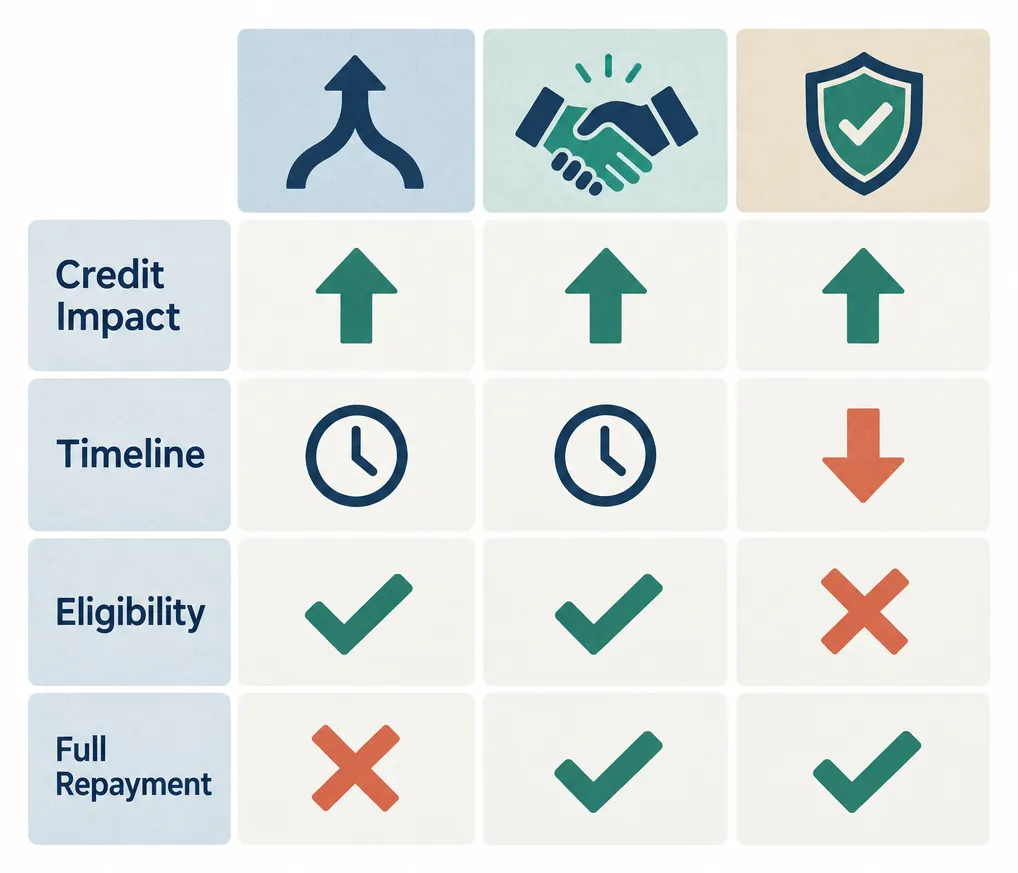
Consolidation and a debt management plan both repay your debt in full at a lower cost. Settlement repays less, but it charges you in fees, credit damage, tax and the risk of being sued. The table uses the default $15,000 example.
| Route | Who it fits | Total paid | Typical time | Fees | Credit impact | Tax consequence | Key rule or risk |
|---|---|---|---|---|---|---|---|
| Keep paying (self-payoff) | Payment well above interest | $24,966 | 56 months | None | Improves as balances fall | None | No new charges |
| Debt management plan | Steady income, high card APRs | $18,184 | 41 months | $25/month | Enrolled cards usually closed | None | Miss payments and the concessions can end |
| Consolidation loan | Good enough credit for a low rate | $19,427 | 36 months | 5% origination | Hard inquiry, new account | None | Higher payment; cards can fill up again |
| Debt settlement | Seriously behind, lump sum possible | $11,400 | Varies, often years | 20% of debt here | Delinquencies, settled accounts | Possible 1099-C income | No fee before a settlement (FTC rule) |
| Bankruptcy | Debt you can’t repay | Court fee $338 or $313, plus lawyer | Ch. 7 months, Ch. 13 3 to 5 years | Court and lawyer fees | Severe and long-lasting | Discharged debt generally excluded | Credit counseling required before filing |
Consolidation loan: when the rate plus the fee beats your cards
A personal consolidation loan wins when its total cost, fee included, comes in below your other routes, and when you can afford the payment. A lower APR stretched over a longer term can still cost more in total, so compare totals, not rates. Our personal loan calculator and debt consolidation calculator go deeper on loan offers.
Balance transfer card: the deadline math
A balance transfer card usually charges a transfer fee and offers a promotional rate for a fixed period. Treat the promo period as a deadline. Divide the transferred balance plus the fee by the number of promo months, and pay at least that each month. Whatever is left when the promo ends is charged the card’s regular APR.
Home equity loan or HELOC: secured by your house
A home equity loan or HELOC usually has a lower rate because your home is the collateral. That swap turns card debt, which can’t cost you your house, into debt that can. Use one only if your income is stable and you have stopped adding to your card balances.
Credit counseling vs debt settlement
Nonprofit credit counseling repays 100% of what you owe through a debt management plan, at concession rates negotiated with each creditor. You make one payment to the agency, and it pays your creditors. Debt settlement companies are usually for-profit. They often tell you to stop paying your creditors and save into a dedicated account until they can make lump-sum offers. These are different businesses, and the first usually leaves your credit in far better shape.
Bankruptcy in brief
Chapter 7 wipes out eligible unsecured debt for people who pass a means test, and some assets may be sold. Chapter 13 sets up a court-supervised repayment plan that lasts three to five years. Before you file either, you need credit counseling from an agency approved by the U.S. Trustee Program at the Department of Justice. That list is specific to bankruptcy. It isn’t a general rating of credit counselors.
The debt settlement calculator math most estimates leave out
A settlement estimate is only as good as its weakest assumption. The calculator’s settlement line already includes the fee and the tax, and those are the two items most settlement-company estimates leave out. A realistic estimate adds two more risks: balances growing while you save, and creditors who refuse to settle.
Here is a common pattern. You enroll $15,000 and creditors accept $8,000. A 25% fee on enrolled debt adds $3,750, so the total is $11,750 before tax. If you are taxed at 12% on the $7,000 that was forgiven, add $840, for a total of $12,590. That is 84% of the original debt, and that is the result when everything goes to plan.
Fees: 25% of enrolled debt is common, and some states cap it lower
The fee is calculated on enrolled debt, so it doesn’t shrink when a creditor gives you a better deal. Under the Telemarketing Sales Rule, if you enroll several debts, the company has to charge its fee debt by debt as each one settles. It can’t take the whole fee up front.
Credit damage from stopping payments
Most programs build up a settlement fund by having you stop paying creditors. The accounts go delinquent, late fees and penalty interest are added, and the accounts may be charged off or sent to a debt collector. Under the Fair Credit Reporting Act, those late payments and charge-offs can stay on your credit report for up to seven years.
Not every creditor settles
Creditors don’t have to accept any offer, and some can sue you while you are still saving. If a creditor refuses, that debt keeps growing while the rest of your program goes on. The FTC rule requires the company to tell you, before you enroll, how long it will take to make an offer to each creditor.
The tax bill: Form 1099-C, the $600 threshold, insolvency and Form 982
Under IRS Publication 4681 (2025 edition), canceled debt is generally taxable income in the year it is forgiven. A creditor that cancels $600 or more sends you a Form 1099-C. You owe tax on forgiven amounts below $600 too, even though no form arrives. You can exclude the income if you were insolvent, meaning your total debts were larger than the value of your total assets just before the cancellation. Use the insolvency worksheet in Publication 4681 and file Form 982 with your return. Debt discharged in a bankruptcy case is excluded under a separate rule.
Did you know?
The Taxpayer Advocate Service points out that you have to report canceled debt as income whether or not you receive a Form 1099-C. The $600 threshold only decides whether the creditor must send you the form. It doesn’t decide whether you owe tax.
Before you enroll in debt settlement
Settlement usually means missing payments on purpose, which can lead to late fees, collection calls, lawsuits and years of credit damage. Even then, there’s no guarantee a creditor will settle. Run the numbers for a debt management plan and for bankruptcy before you sign anything.
The official rules that apply
Four sets of federal rules shape what each route costs and what a company can do. On top of them, state law can cap fees or require licensing. Each rule below goes by its official name so you can look up the text.
Telemarketing Sales Rule (16 CFR Part 310)
The Federal Trade Commission’s Telemarketing Sales Rule has covered for-profit debt relief sold by phone since October 27, 2010, including calls you make in response to an ad. Under 16 CFR Part 310 it requires the following:
- No advance fees. The company can’t collect any fee until it has settled, reduced or changed the terms of at least one debt, you have agreed to that deal, and you have made at least one payment to the creditor under it.
- Labels don’t matter. FTC business guidance says that calling a fee a “retainer”, or running the program through attorneys, doesn’t get around the ban. The FTC looks at what a company does, not what it calls itself.
- Required disclosures. Before you enroll, the company has to tell you how long it will take to make offers, how much you must save first, and that stopping payments can hurt your credit, lead to collection or lawsuits and increase what you owe.
- Your money stays yours. A dedicated savings account must be held at an insured financial institution, and you own the funds. You can withdraw at any time without penalty, and if you leave, you get your money back within seven business days.
The Consumer Financial Protection Bureau has taken action against companies that broke these rules. In one case it described a company charging 25% of enrolled debt and won a ban against the company’s chief executive. In another, a company was ordered to pay $5.4 million in redress for fees it collected before any settlement or payment had been made.
Internal Revenue Code and IRS Publication 4681
Canceled debt is generally income, and Publication 4681 lists the exclusions, including insolvency and bankruptcy. Creditors report cancellations of $600 or more on Form 1099-C, and you claim an exclusion on Form 982.
Bankruptcy Code credit counseling requirement
To file Chapter 7 or Chapter 13 as an individual, you need a credit counseling session from a U.S. Trustee Program approved agency within 180 days before filing. You also need to complete a debtor education course before your debts are discharged. Court filing fees are $338 for Chapter 7 and $313 for Chapter 13.
Fair Debt Collection Practices Act and Fair Credit Reporting Act
If an account goes to a third-party collector during settlement, the Fair Debt Collection Practices Act limits the collector’s calls, bans threats and false statements, and gives you the right to ask for validation of the debt. The Fair Credit Reporting Act lets you dispute any settled account that is reported wrongly.
Red flags and where to complain
- The company asks for any fee before it has settled a debt.
- It guarantees a specific settlement percentage or promises to remove accurate negative items from your credit report.
- It won’t tell you which of your creditors it has worked with before.
- It describes a government program that doesn’t exist.
You can report problems through the FTC’s ReportFraud site, the CFPB complaint portal and your state attorney general. Your state attorney general or financial regulator can also tell you whether a settlement company is licensed or registered where you live. A debt relief trade association such as the Association for Consumer Debt Relief (ACDR) is an industry group, and membership isn’t a license.
Spot an illegal upfront fee
If a debt relief company asks for money before it has settled one of your debts and you have made a payment to that creditor, don’t pay. Under the Telemarketing Sales Rule, the request alone is grounds for a complaint to the FTC or the CFPB.
Build the same check in Excel or Google Sheets
Two built-in spreadsheet functions handle the “keep paying” math. NPER returns the number of months to payoff. =NPER(0.24/12, -450, 15000) returns 55.48 months, which rounds up to the calculator’s 56. PMT returns the fixed monthly payment for a loan with a constant rate and a set number of months. =PMT(0.2215/12, 12, -30000) returns about $2,810.03 for a 12-month payoff, which matches the reference table.
For a month-by-month schedule, set up five columns: month, opening balance, interest (opening balance × APR ÷ 12), payment, and closing balance (opening balance + interest − payment). Copy the rows down until the closing balance goes below zero. For several cards, sort them by APR from highest to lowest to follow the avalanche order. The same layout works as a general loan calculator for any fixed-rate debt.
FAQ
How do I pay off $30,000 of debt in one year?
At 22.15% APR, you’d need to pay about $2,810 a month, and interest would come to about $3,720. A promotional 0% balance transfer would cut that to $2,500 a month plus the transfer fee, but you’d need a credit limit large enough to take the whole balance.
How fast can I pay off $20,000 in debt?
That depends on your payment. At 22.15%, $1,873 a month clears it in 12 months, $1,039 in 24 months, $765 in 36 months and $554 in 60 months. Interest ranges from about $2,480 on the fastest schedule to $13,245 on the slowest.
How do I pay off $8,000 of debt in 6 months?
You’d need about $1,421 a month at 22.15%, with roughly $525 in interest. If that’s too much, a 24-month schedule at about $416 a month is a realistic alternative.
How long does it take to pay off $10,000 in credit card debt?
At $277 a month, it takes five years at 22.15%, and at $383 a month it takes three years. Credit Karma’s calculator shows that $200 a month at about 21% takes 120 months and costs $13,991.80 in interest, which is more than the original balance.
What is the mathematically fastest way to pay off debt?
Pay the highest-APR balance first while making minimums on the rest (the avalanche method), and roll each freed-up payment onto the next card. Starting with a snowball and then switching to the avalanche costs a little more, but it can help you keep going.
How much does debt relief cost?
With the default inputs, a debt management plan costs $18,184, a consolidation loan $19,427 and settlement $11,400. The settlement figure includes a $3,000 fee and $900 of possible tax. Your own figures depend entirely on the terms you’re offered, so enter real quotes.
How much will a debt settlement company settle for?
Nobody can promise an amount. Creditors decide whether to settle and for how much, and some refuse. Treat estimates on settlement-company websites as sales tools, not quotes, and test a less favorable share in the calculator to see your downside.
Is it better to use a big-name settlement company or pay it off yourself?
If you can afford a payment well above your monthly interest, paying it off yourself or through a nonprofit plan costs less in total and keeps your credit intact. Settlement mainly makes sense when you are already far behind and bankruptcy is the other realistic option.
Do I have to stop paying my cards to get into a settlement program?
Most programs tell you to, so that you can save for lump-sum offers. That leads to delinquencies, fees and possible lawsuits. The Telemarketing Sales Rule requires the company to warn you about these consequences before you enroll.
They charged me thousands right after I enrolled. Is that allowed?
No. A company covered by the Telemarketing Sales Rule can’t collect a fee until it has settled a debt and you have made a payment to that creditor. You can file a complaint with the FTC, the CFPB and your state attorney general, and ask for a refund in writing.
I got a 1099-C after settling. Do I really owe tax on money I never got?
Usually yes, because the IRS treats forgiven debt as income. If you were insolvent just before the cancellation, you may be able to exclude some or all of it using the Publication 4681 worksheet and Form 982.
Does debt relief hurt your credit score?
Settlement does the most harm, because it usually involves months of missed payments. A debt management plan usually closes your enrolled cards, but on-time plan payments are reported as paid. A consolidation loan adds a hard inquiry and a new account, but it can lower how much of your card limits you’re using.
Is debt consolidation or debt settlement better?
If you qualify for a reasonable rate and can afford the payment, consolidation is better, because you repay in full and your credit stays intact. Settlement can cost less in dollars, but it brings fees, tax, credit damage and the risk of lawsuits.
What should I do first?
Enter your real balances, APRs and payment, then call each card issuer to ask about a hardship rate. Next, book a free budget review with a nonprofit credit counselor, and run the calculator again with the rates and fees they actually quote you.
Guides that use this calculator
- Debt relief for veterans and disabled veterans
- CFPB Complaints Q3 2026: The Most Complained-About Banks, Lenders and Collectors
- Massachusetts Loan Laws: Payday, Title and Installment Rules
- Oregon Loan Laws: Payday, Title and Installment Rules
- Kentucky Loan Laws: Payday, Title and Installment Rules
- Arizona Loan Laws: Payday, Title and Installment Rules
Laws and regulations referenced
- Truth in Lending Act, 15 U.S.C. 1601
- Fair Debt Collection Practices Act, 15 U.S.C. 1692
- Fair Credit Reporting Act, 15 U.S.C. 1681
- Military Lending Act, 10 U.S.C. 987
- Servicemembers Civil Relief Act, 50 U.S.C. 3901
Links go to the official text on government sites.
Check, verify or complain
Sources
- Federal Reserve Board - Consumer Credit - G.19 federalreserve.gov · official source
- FTC Issues Final Rule to Protect Consumers in Credit Card Debt ftc.gov · official source
- Debt Relief Services & the Telemarketing Sales Rule: A Guide for Business ftc.gov · official source
- Federal Register: Telemarketing Sales Rule (August 10, 2010) govinfo.gov · official source
- CFPB obtains ban against debt relief CEO consumerfinance.gov · official source
- Publication 4681 (2025), Canceled Debts, Foreclosures, Repossessions, and Abandonments irs.gov · official source
- Taxpayer Advocate Service: Cancellation of Debt taxpayeradvocate.irs.gov · official source
- Instructions for Form 982 irs.gov · official source
- Bankruptcy Fee Schedule - U.S. Bankruptcy Court, District of Nevada nvb.uscourts.gov · official source
- Bankruptcy Court Miscellaneous Fee Schedule uscourts.gov · official source
- CFPB takes action against debt settlement company for charging consumers unlawful fees consumerfinance.gov · official source
- Household Debt Increased Moderately; Delinquency Transition Rates Remain Flat - Federal Reserve Bank of New York newyorkfed.org
- New York Fed: Total household debt reached $19.1T in Q3 bankingjournal.aba.com
- Credit card debt rises to a record $1.29T as household debt reaches $19.1T stockanalysis.com
- FRED: Commercial Bank Interest Rate on Credit Card Plans, All Accounts fred.stlouisfed.org
- FRED: Commercial Bank Interest Rate on Credit Card Plans, Accounts Assessed Interest fred.stlouisfed.org
- Form 1099-C: Cancellation of Debt hrblock.com
- Credit Karma Debt Repayment Calculator creditkarma.com
- National Debt Relief Review - NerdWallet nerdwallet.com
- National Debt Relief Review: Is It Legit and Worth It? - The Penny Hoarder thepennyhoarder.com
- How Accurate Is a Debt Settlement Calculator thecreditpeople.com
- Credit Card Payoff Calculator - Bankrate bankrate.com

Elena writes about getting through a money emergency, assistance programs, budgeting on a tight income, banking basics and borrower rights. Her guides list the cheaper options first and link the agency or program that can actually help.
Ruth is US Financer's standards editor. Every article goes through her checks before and after it is published: each rate, fee, cap, deadline and rule is matched against its primary source, every law named is linked to its official text, and anything that cannot be…
What changed
- Nov 27, 2026 First published.
Comments are closed